Overview
The study of interior angles of polygons is a foundational topic in plane geometry that appears consistently on the ACT Math test. This concept involves understanding the relationship between the number of sides a polygon has and the sum of its interior angles, as well as calculating individual angle measures in both regular and irregular polygons. Mastery of this topic enables students to solve a variety of geometric problems efficiently, from finding missing angles in complex figures to determining properties of specific polygons.
On the ACT, questions involving ACT interior angles of polygons typically appear 1-2 times per test and often integrate with other geometric concepts such as exterior angles, parallel lines, and properties of specific quadrilaterals and triangles. These questions may present straightforward calculations or embed polygon angle concepts within more complex diagrams requiring multi-step reasoning. The ability to quickly recall formulas and apply them accurately under time pressure is essential for success.
Understanding interior angles connects directly to broader mathematical concepts including symmetry, tessellations, and coordinate geometry. This topic serves as a bridge between basic triangle properties and more advanced geometric reasoning. Students who master interior angles of polygons develop stronger spatial reasoning skills and gain tools applicable to problems involving architectural design, computer graphics, and engineering applications where polygon properties are fundamental.
Learning Objectives
- [ ] Identify when Interior angles of polygons is being tested
- [ ] Explain the core rule or strategy behind Interior angles of polygons
- [ ] Apply Interior angles of polygons to ACT-style questions accurately
- [ ] Calculate the sum of interior angles for any polygon using the formula
- [ ] Determine individual angle measures in regular polygons
- [ ] Solve for unknown angles in irregular polygons using algebraic expressions
- [ ] Distinguish between interior and exterior angle problems and select appropriate formulas
Prerequisites
- Triangle angle sum theorem: Understanding that triangles have interior angles summing to 180° provides the foundation for polygon angle formulas, as polygons can be divided into triangles
- Basic algebra skills: Solving linear equations and working with variables is necessary for finding unknown angle measures in polygons
- Polygon classification: Knowing the names and properties of polygons (triangle, quadrilateral, pentagon, hexagon, etc.) helps identify which formulas to apply
- Properties of regular vs. irregular polygons: Recognizing that regular polygons have all equal sides and angles while irregular polygons do not affects calculation approaches
Why This Topic Matters
Interior angles of polygons have practical applications in numerous real-world contexts. Architects use polygon angle calculations when designing floor plans, roof structures, and decorative elements. Engineers apply these principles in structural design, ensuring that joints and connections meet at appropriate angles for stability. Computer graphics programmers rely on polygon properties to render shapes and create realistic 3D models. Even in everyday situations, understanding polygon angles helps with tasks like tiling floors, creating quilts, or designing gardens with geometric patterns.
On the ACT Math test, interior angles of polygons questions appear with moderate to high frequency, typically 1-2 questions per exam. These questions account for approximately 2-3% of the total Math section and are categorized under Plane Geometry, which comprises about 14% of the test. Questions may be presented as straightforward computational problems asking for angle sums or individual angle measures, or they may be embedded within complex diagrams requiring students to identify polygons, set up equations, and solve for unknowns. Some questions combine interior angle concepts with other geometric principles such as parallel lines cut by transversals or properties of specific quadrilaterals.
Common question formats include: finding the sum of interior angles given the number of sides; calculating individual angle measures in regular polygons; solving for unknown angles in irregular polygons where some angles are given; determining the number of sides when given angle information; and identifying which polygon satisfies certain angle conditions. The ACT frequently presents these problems with diagrams that may include extraneous information, testing students' ability to extract relevant data and apply appropriate formulas efficiently.
Core Concepts
The Interior Angle Sum Formula
The fundamental principle governing interior angles of polygons is that the sum of all interior angles in any polygon depends solely on the number of sides. The formula for calculating this sum is:
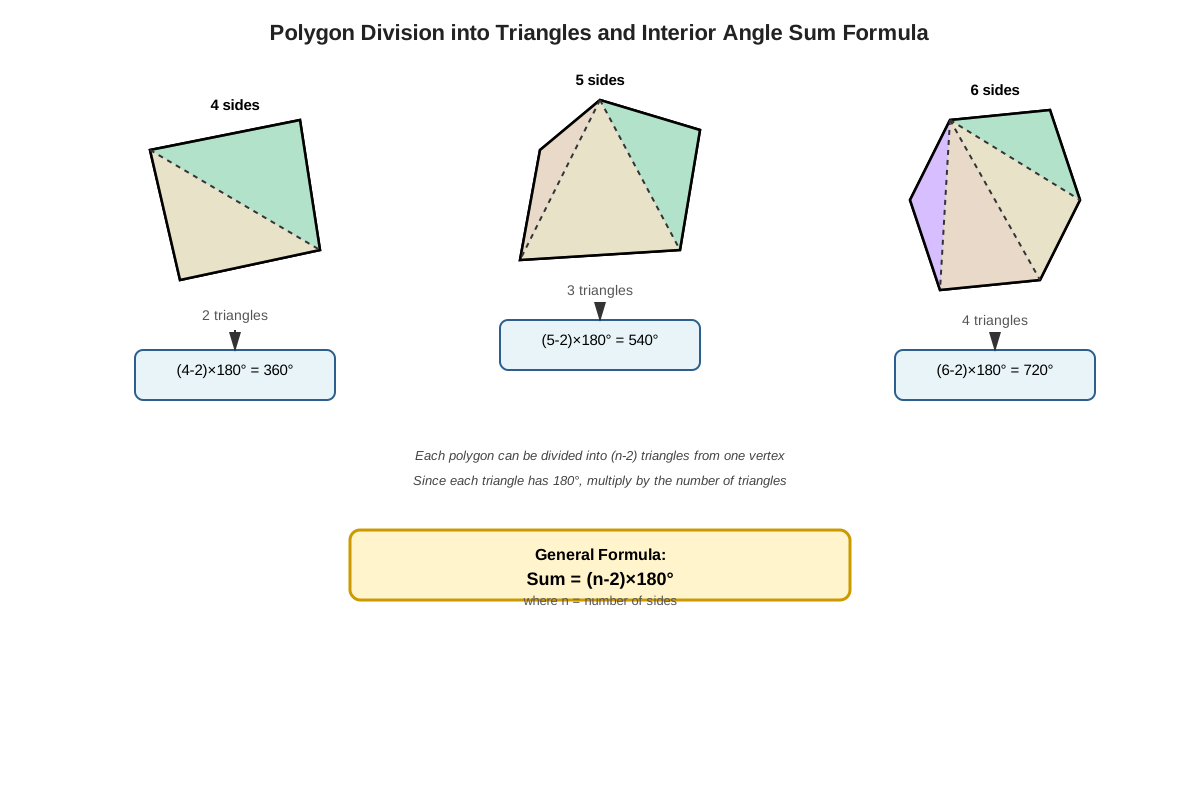
Sum of Interior Angles = (n - 2) × 180°where n represents the number of sides in the polygon. This formula derives from the fact that any polygon can be divided into triangles by drawing diagonals from one vertex to all non-adjacent vertices. Since each triangle contains 180°, and a polygon with n sides can be divided into (n - 2) triangles, the total angle sum equals (n - 2) × 180°.
For example, a quadrilateral (4 sides) has an interior angle sum of (4 - 2) × 180° = 2 × 180° = 360°. A pentagon (5 sides) has (5 - 2) × 180° = 3 × 180° = 540°. This formula works for all polygons regardless of whether they are regular or irregular, convex or concave.
Regular Polygon Individual Angles
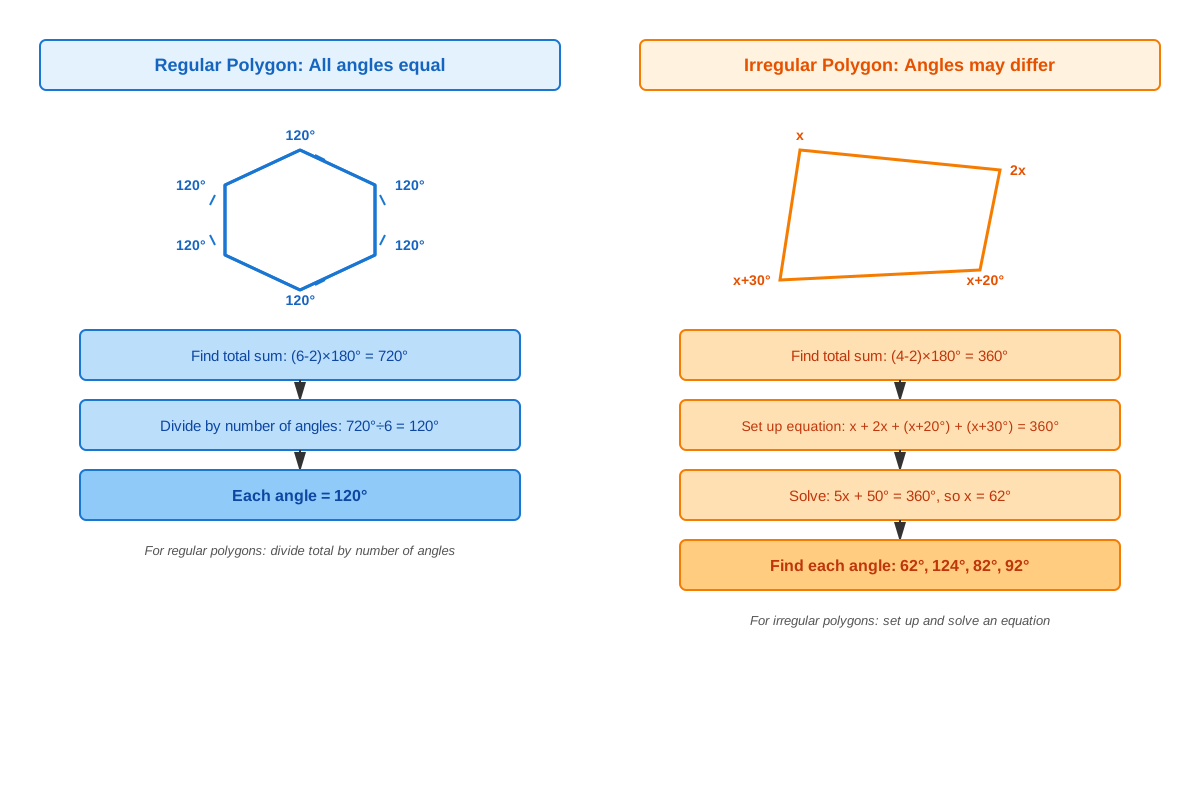
A regular polygon is one in which all sides are equal in length and all interior angles are equal in measure. To find the measure of each individual interior angle in a regular polygon, divide the total sum of interior angles by the number of angles (which equals the number of sides):
Each Interior Angle = [(n - 2) × 180°] / nThis formula can be simplified algebraically to:
Each Interior Angle = 180° - (360° / n)For instance, in a regular hexagon (6 sides), each interior angle measures [(6 - 2) × 180°] / 6 = (4 × 180°) / 6 = 720° / 6 = 120°. In a regular octagon (8 sides), each angle measures [(8 - 2) × 180°] / 8 = 1080° / 8 = 135°.
Common Polygon Angle Measures
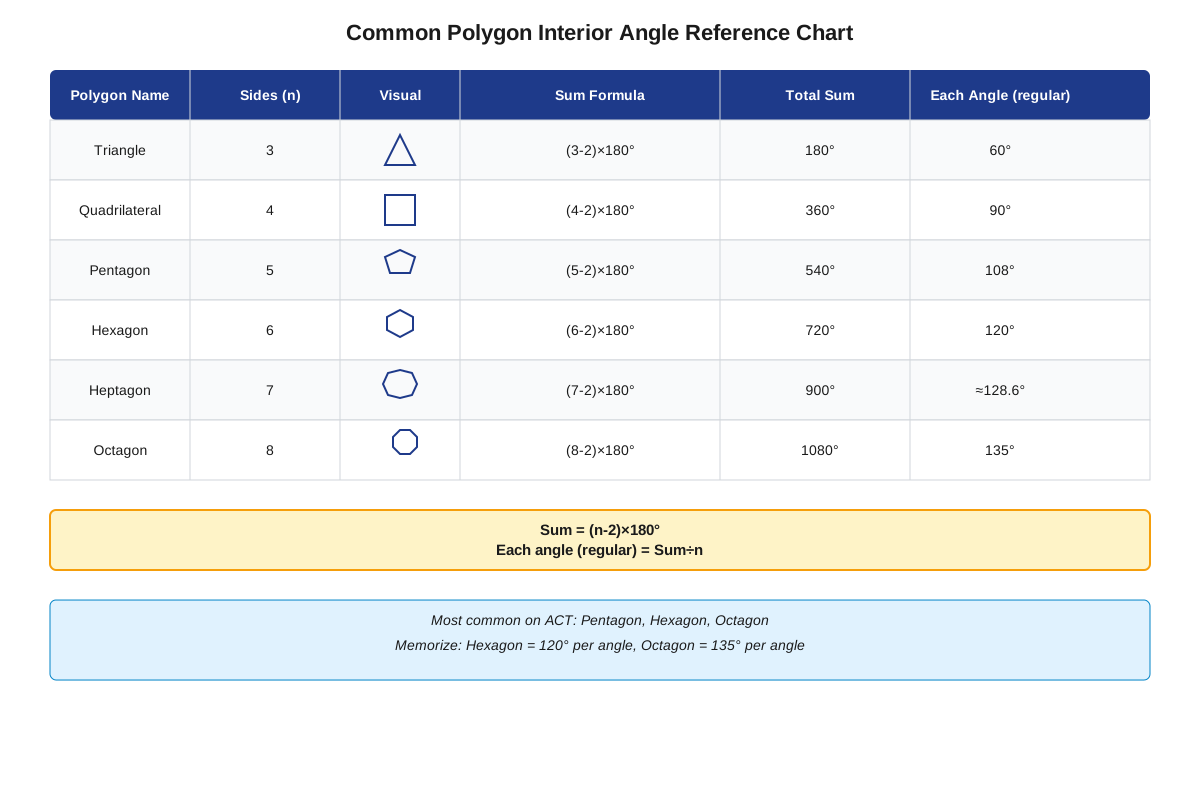
Memorizing the interior angle sums and individual angle measures for frequently tested polygons saves valuable time on the ACT:
| Polygon | Number of Sides (n) | Sum of Interior Angles | Each Angle (if regular) |
|---|---|---|---|
| Triangle | 3 | 180° | 60° |
| Quadrilateral | 4 | 360° | 90° |
| Pentagon | 5 | 540° | 108° |
| Hexagon | 6 | 720° | 120° |
| Heptagon | 7 | 900° | 128.57° |
| Octagon | 8 | 1080° | 135° |
| Nonagon | 9 | 1260° | 140° |
| Decagon | 10 | 1440° | 144° |
Solving for Unknown Angles in Irregular Polygons
When working with irregular polygons, the sum formula remains the same, but individual angles vary. ACT questions often provide some angle measures and ask students to find missing angles. The approach involves:
- Determine the number of sides (n)
- Calculate the total sum using (n - 2) × 180°
- Add all known angle measures
- Subtract the sum of known angles from the total to find unknown angles
- If multiple unknowns exist, set up an algebraic equation
For example, if a pentagon has four angles measuring 100°, 110°, 120°, and 95°, the fifth angle can be found by calculating: 540° - (100° + 110° + 120° + 95°) = 540° - 425° = 115°.
Algebraic Applications
ACT questions frequently express unknown angles using variables or expressions. For instance, a quadrilateral might have angles expressed as x, 2x, x + 20°, and x - 10°. To solve:
- Write an equation setting the sum of all angles equal to the total: x + 2x + (x + 20°) + (x - 10°) = 360°
- Combine like terms: 5x + 10° = 360°
- Solve for x: 5x = 350°, so x = 70°
- Substitute back to find each angle: 70°, 140°, 90°, and 60°
Relationship to Exterior Angles
While this guide focuses on interior angles, understanding their relationship to exterior angles enhances problem-solving ability. At any vertex of a polygon, the interior and exterior angles form a linear pair, meaning they sum to 180°. Additionally, the sum of all exterior angles of any polygon always equals 360°, regardless of the number of sides. This relationship can provide alternative solution paths for certain problems.
Concept Relationships
The interior angle sum formula (n - 2) × 180° directly derives from the triangle angle sum theorem, as polygons can be decomposed into triangles. This decomposition method → leads to → understanding why the formula contains the factor (n - 2), representing the number of triangles formed.
Regular polygon angle calculations → build upon → the general sum formula by introducing the concept of equal distribution of angles. This equal distribution → connects to → symmetry properties and → enables → quick mental calculations for common polygons.
Algebraic problem-solving with polygon angles → integrates → equation-solving skills with geometric reasoning. Setting up equations based on angle relationships → requires → understanding both the geometric constraints (angle sum) and algebraic manipulation techniques.
The distinction between regular and irregular polygons → affects → solution strategies, as regular polygons allow division by n to find individual angles, while irregular polygons → require → either subtraction methods or algebraic equation systems.
Interior angle concepts → extend to → exterior angles through the linear pair relationship, and both → contribute to → comprehensive understanding of polygon properties. These angle relationships → apply to → more complex problems involving parallel lines, transversals, and composite figures where polygons are embedded within larger geometric contexts.
Quick check — test yourself on Interior angles of polygons so far.
Try Flashcards →High-Yield Facts
⭐ The sum of interior angles of any polygon equals (n - 2) × 180°, where n is the number of sides
⭐ A quadrilateral always has interior angles summing to 360°
⭐ Each interior angle of a regular polygon equals [(n - 2) × 180°] / n
⭐ A regular hexagon has interior angles of 120° each
⭐ A regular octagon has interior angles of 135° each
- A triangle's interior angles always sum to 180°, making it the base case for the polygon formula
- A pentagon has interior angles summing to 540°
- The formula (n - 2) represents the number of triangles that can be formed by drawing diagonals from one vertex
- Regular polygons have all equal interior angles; irregular polygons have varying angle measures
- The interior angle sum formula works for both convex and concave polygons
- As the number of sides increases, each interior angle in a regular polygon approaches but never reaches 180°
- A regular polygon with interior angles of 90° each is a square (the only regular polygon with right angles)
Common Misconceptions
Misconception: The sum of interior angles equals n × 180° → Correction: The correct formula is (n - 2) × 180°. Students often forget to subtract 2 from the number of sides, leading to incorrect sums that are 360° too large.
Misconception: All polygons with the same number of sides have the same individual angle measures → Correction: Only regular polygons with the same number of sides have identical angle measures. Irregular polygons with the same number of sides have the same angle sum but different individual angle distributions.
Misconception: The formula for each interior angle of a regular polygon is (n - 2) × 180° → Correction: This formula gives the total sum, not each individual angle. To find each angle in a regular polygon, divide the sum by n: [(n - 2) × 180°] / n.
Misconception: A polygon with larger angles must have more sides → Correction: The relationship between angle size and number of sides is not linear. A triangle can have a 150° angle, while a regular hexagon has 120° angles despite having more sides. The sum increases with more sides, but individual angles depend on whether the polygon is regular and how angles are distributed.
Misconception: Interior and exterior angles of a polygon are equal → Correction: Interior and exterior angles at the same vertex are supplementary (sum to 180°), not equal. Only in a square do interior and exterior angles have a special relationship where the exterior angle (90°) equals the interior angle (90°), but this is the exception, not the rule.
Misconception: The formula only works for convex polygons → Correction: The interior angle sum formula (n - 2) × 180° applies to all simple polygons, including concave polygons, as long as the polygon doesn't intersect itself. However, in concave polygons, some interior angles may be reflex angles (greater than 180°).
Worked Examples
Example 1: Finding the Sum and Individual Angles
Problem: A regular nonagon (9-sided polygon) is inscribed in a circle. What is the measure of each interior angle?
Solution:
Step 1: Identify the number of sides: n = 9
Step 2: Calculate the sum of all interior angles using the formula:
Sum = (n - 2) × 180°
Sum = (9 - 2) × 180°
Sum = 7 × 180°
Sum = 1260°
Step 3: Since this is a regular polygon, all angles are equal. Divide the sum by the number of angles:
Each angle = 1260° / 9
Each angle = 140°
Answer: Each interior angle of a regular nonagon measures 140°.
Connection to Learning Objectives: This problem demonstrates the application of both the sum formula and the method for finding individual angles in regular polygons, directly addressing the objectives of explaining core rules and applying them to ACT-style questions.
Example 2: Solving for Unknown Angles with Algebra
Problem: A hexagon has interior angles that can be expressed as x°, x°, (x + 10)°, (x + 20)°, (2x - 10)°, and (2x)°. Find the value of x and the measure of the largest angle.
Solution:
Step 1: Determine the sum of interior angles for a hexagon:
Sum = (6 - 2) × 180° = 4 × 180° = 720°
Step 2: Set up an equation with all angles summing to 720°:
x + x + (x + 10) + (x + 20) + (2x - 10) + 2x = 720
Step 3: Combine like terms:
8x + 20 = 720
Step 4: Solve for x:
8x = 700
x = 87.5
Step 5: Calculate each angle:
- First angle: 87.5°
- Second angle: 87.5°
- Third angle: 87.5° + 10° = 97.5°
- Fourth angle: 87.5° + 20° = 107.5°
- Fifth angle: 2(87.5°) - 10° = 175° - 10° = 165°
- Sixth angle: 2(87.5°) = 175°
Step 6: Identify the largest angle: 175°
Step 7: Verify by adding all angles: 87.5 + 87.5 + 97.5 + 107.5 + 165 + 175 = 720° ✓
Answer: x = 87.5° and the largest angle measures 175°.
Connection to Learning Objectives: This example demonstrates the algebraic application of interior angle concepts, showing how to set up and solve equations when angles are expressed as variables—a common ACT question format.
Exam Strategy
When approaching ACT interior angles of polygons questions, begin by identifying the polygon type and counting sides carefully. Many diagrams include extraneous lines or decorative elements that aren't part of the polygon itself. Circle or highlight the actual vertices of the polygon in question to avoid counting errors.
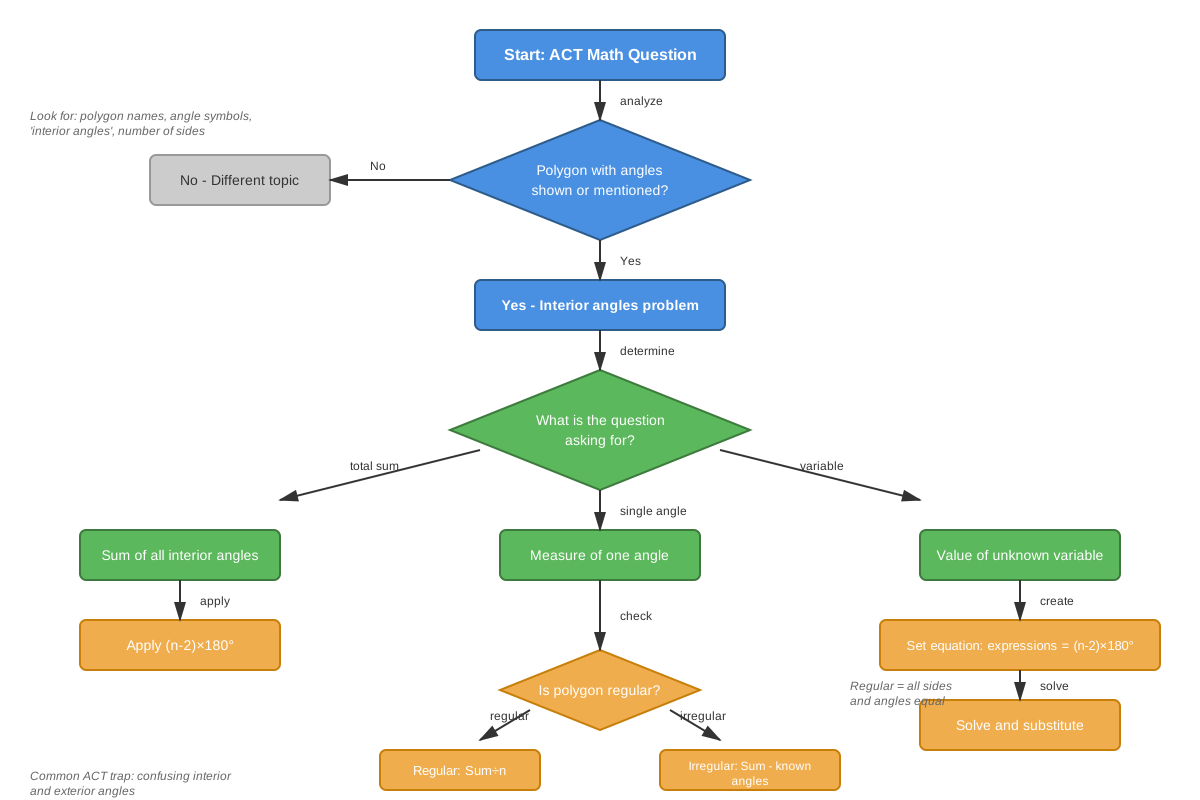
Trigger words and phrases that signal interior angle problems include: "sum of the interior angles," "each angle of a regular polygon," "find the missing angle," "what is the measure of angle X," and "how many sides does the polygon have if the sum is..." When you see these phrases, immediately recall the formula (n - 2) × 180°.
For process-of-elimination strategies, use these approaches:
- If asked for the sum of interior angles, eliminate any answer choice that isn't a multiple of 180°
- For regular polygon individual angles, eliminate answers greater than 180° (unless dealing with reflex angles in concave polygons, which is rare on the ACT)
- If solving for the number of sides, eliminate answers that would produce negative or non-integer results when working backward through the formula
- Check whether the question asks for one angle or the sum of all angles—many students calculate the correct value but select the wrong answer because they found the sum when asked for one angle, or vice versa
Time allocation: Interior angle problems typically require 30-60 seconds. Straightforward calculation problems should take closer to 30 seconds, while algebraic problems with multiple unknowns may require up to 60 seconds. If a problem requires more than 90 seconds, mark it for review and move on—you may be overcomplicating the solution or missing a key insight.
Quick calculation tips: Memorize the angle sums for triangles (180°), quadrilaterals (360°), pentagons (540°), hexagons (720°), and octagons (1080°). Also memorize that regular hexagons have 120° angles and regular octagons have 135° angles, as these appear frequently. For other polygons, the formula is quick to apply, but having these memorized saves 10-15 seconds per question.
Memory Techniques
Mnemonic for the formula: "Need Two Less Triangles" helps remember (n - 2) × 180°. The number of sides needs two less to get the number of triangles, then multiply by 180°.
Visualization strategy: Picture drawing diagonals from one vertex of a polygon to all non-adjacent vertices. Visualize that a quadrilateral splits into 2 triangles, a pentagon into 3 triangles, a hexagon into 4 triangles. This visual reinforces why we subtract 2 from the number of sides.
Acronym for common polygons: "Tiny Quick Pets Have Odd Names" represents Triangle (3), Quadrilateral (4), Pentagon (5), Hexagon (6), Octagon (8), Nonagon (9). Note that heptagon (7) and decagon (10) are missing, but these are less commonly tested.
Finger counting technique: For polygons with 3-10 sides, hold up fingers equal to the number of sides, then fold down 2 fingers. The remaining fingers represent the number of triangles. Multiply by 180° for the sum. This kinesthetic approach helps visual and tactile learners.
Rhyme for regular hexagons: "Hexagons are neat, their angles are one-twenty" helps remember that regular hexagons have 120° interior angles, one of the most frequently tested values.
Summary
Interior angles of polygons represent a high-yield ACT Math topic centered on the fundamental formula: the sum of interior angles equals (n - 2) × 180°, where n is the number of sides. This formula derives from dividing polygons into triangles and applies universally to all polygons regardless of regularity. For regular polygons where all angles are equal, each individual angle measures [(n - 2) × 180°] / n. ACT questions test this concept through direct calculation problems, algebraic applications where angles are expressed as variables, and integrated problems combining polygon properties with other geometric principles. Success requires memorizing key angle sums (especially for quadrilaterals at 360° and hexagons at 720°), recognizing when to apply the sum formula versus the individual angle formula, and efficiently setting up algebraic equations when unknowns are present. The ability to quickly identify polygon types, count sides accurately, and distinguish between regular and irregular polygons enables students to select appropriate solution strategies and avoid common pitfalls such as confusing total sums with individual angle measures.
Key Takeaways
- The sum of interior angles of any n-sided polygon is (n - 2) × 180°, derived from dividing the polygon into triangles
- Each interior angle of a regular n-sided polygon measures [(n - 2) × 180°] / n
- Quadrilaterals always have interior angles summing to 360°; hexagons sum to 720°
- Regular polygons have all equal angles; irregular polygons have the same sum but varying individual angles
- ACT questions frequently use algebraic expressions for angles, requiring equation setup and solving
- Memorize common polygon angle measures (regular hexagon = 120° each, regular octagon = 135° each) for time efficiency
- Always verify whether a question asks for the sum of all angles or one individual angle before selecting an answer
Related Topics
Exterior Angles of Polygons: Understanding that exterior angles sum to 360° for any polygon and that each exterior angle of a regular polygon equals 360° / n complements interior angle knowledge and provides alternative solution paths.
Properties of Specific Quadrilaterals: Mastering interior angles enables deeper study of parallelograms, rectangles, rhombuses, and trapezoids, where angle relationships follow specific patterns based on parallel sides and symmetry.
Triangle Angle Relationships: Since the polygon formula derives from triangles, strengthening triangle angle knowledge (including exterior angles, remote interior angles, and angle bisectors) enhances overall geometric reasoning.
Coordinate Geometry and Polygons: Applying interior angle concepts to polygons graphed on coordinate planes requires integrating angle formulas with slope calculations and distance formulas.
Trigonometry in Regular Polygons: Advanced applications involve using interior angles to calculate side lengths, apothems, and areas of regular polygons through trigonometric ratios.
Practice CTA
Now that you've mastered the core concepts of interior angles of polygons, it's time to solidify your understanding through active practice. Attempt the practice questions designed specifically for this topic, focusing on both straightforward calculations and algebraic applications. Use the flashcards to drill the essential formulas and common polygon angle measures until they become automatic. Remember, the ACT rewards both accuracy and speed—consistent practice transforms these formulas from concepts you need to derive into tools you can apply instantly. Every practice problem you solve builds the confidence and competence needed to tackle any polygon angle question on test day. You've got this!
Sign up free to keep reading
Create a free AnvayaPrep account to finish this ACT guide on Interior angles of polygons — plus flashcards and practice questions.