Overview
Isosceles triangles represent one of the most frequently tested geometric concepts on the ACT Math section. These special triangles, characterized by having exactly two sides of equal length, appear in approximately 10-15% of all plane geometry questions on the exam. Understanding isosceles triangles is essential not only for direct questions about their properties but also for solving complex problems involving coordinate geometry, trigonometry, and even algebraic applications.
The power of ACT isosceles triangles lies in their predictable properties and the elegant relationships between their sides and angles. When students recognize an isosceles triangle in a problem—whether explicitly stated or implied through equal side lengths—they immediately gain access to valuable information about angle measures and can often unlock the entire solution pathway. This recognition skill becomes particularly crucial under timed test conditions, where identifying the presence of an isosceles triangle can reduce a multi-step problem to a simple application of fundamental properties.
Mastery of isosceles triangles serves as a foundation for understanding more complex geometric concepts tested on the ACT, including equilateral triangles (which are special cases of isosceles triangles), triangle congruence theorems, and circle geometry involving inscribed triangles. The topic also connects deeply with the Pythagorean theorem, triangle inequality principles, and coordinate geometry applications. Students who thoroughly understand isosceles triangles gain a significant strategic advantage on test day, as these triangles often appear in problems that initially seem unrelated to triangle geometry.
Learning Objectives
- [ ] Identify when isosceles triangles are being tested in ACT problems, including implicit scenarios
- [ ] Explain the core rule or strategy behind isosceles triangles, particularly the base angles theorem
- [ ] Apply isosceles triangles properties to ACT-style questions accurately and efficiently
- [ ] Calculate missing angle measures in isosceles triangles using angle relationships
- [ ] Determine side lengths using properties of isosceles triangles combined with other geometric principles
- [ ] Recognize and utilize the altitude-to-base property that creates two congruent right triangles
- [ ] Solve coordinate geometry problems involving isosceles triangles by applying distance formulas and symmetry
Prerequisites
- Basic triangle properties: Understanding that the sum of interior angles equals 180° is fundamental to calculating missing angles in isosceles triangles
- Angle measurement: Familiarity with degrees, acute, obtuse, and right angles enables proper classification and calculation of isosceles triangle angles
- Congruence concepts: Knowing what it means for segments or angles to be congruent helps understand the equal sides and equal angles properties
- Pythagorean theorem: Essential for solving problems involving the altitude of an isosceles triangle, which creates right triangles
- Distance formula: Required for coordinate geometry problems where students must verify or calculate equal side lengths
- Basic algebraic equation solving: Necessary for setting up and solving equations when angle or side measures are expressed algebraically
Why This Topic Matters
Isosceles triangles appear throughout mathematics and the physical world, making them both practically significant and academically essential. Architects and engineers regularly use isosceles triangles in structural design because their symmetry provides stability and aesthetic appeal. The triangular trusses supporting bridges and roofs often incorporate isosceles triangles for load distribution. In nature, isosceles triangles appear in crystal structures, leaf arrangements, and even in the flight patterns of certain birds. Understanding these triangles helps students appreciate the mathematical patterns underlying both human-made and natural structures.
On the ACT Math section, isosceles triangles appear with remarkable frequency and in diverse question formats. Statistical analysis of recent ACT exams reveals that approximately 3-5 questions per test directly or indirectly involve isosceles triangle properties. These questions typically fall into several categories: direct angle calculation problems (30% of isosceles questions), coordinate geometry applications (25%), problems combining isosceles triangles with circles or other polygons (20%), algebraic problems where variables represent angles or sides (15%), and complex multi-step problems where recognizing an isosceles triangle is the key insight (10%).
The ACT commonly embeds isosceles triangles within larger geometric figures, requiring students to identify them as part of problem-solving rather than explicitly labeling them. For example, a circle problem might involve a radius and chord that create an isosceles triangle, or a coordinate geometry question might present three points that form an isosceles triangle without stating this fact. This implicit testing approach rewards students who have developed strong pattern recognition skills and can quickly identify isosceles triangles from given information about equal sides or equal angles.
Core Concepts
Definition and Basic Properties
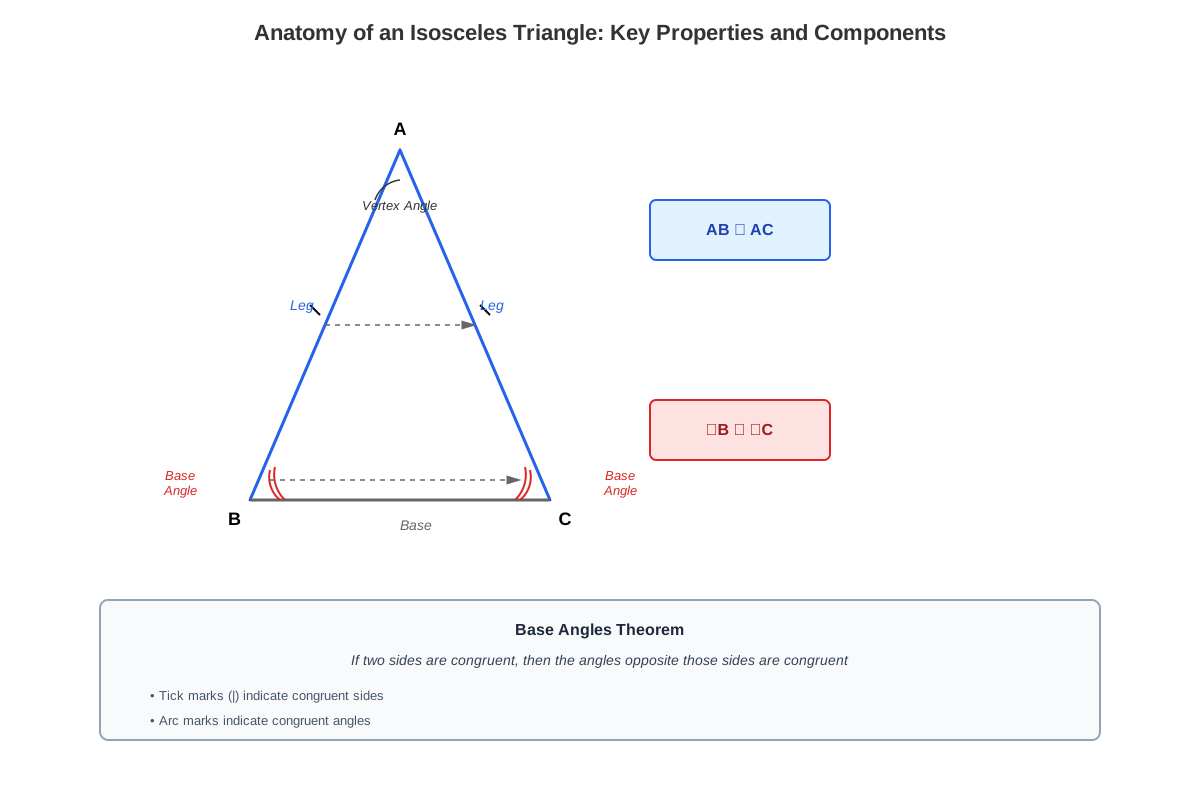
An isosceles triangle is defined as a triangle with exactly two congruent (equal-length) sides. These equal sides are called the legs of the isosceles triangle, while the third side is called the base. The angle formed by the two legs is called the vertex angle, and the two angles adjacent to the base are called the base angles. This terminology is crucial for communicating about isosceles triangles and understanding problem statements on the ACT.
The fundamental property that makes isosceles triangles so powerful is the Base Angles Theorem: In an isosceles triangle, the angles opposite the congruent sides are congruent. This means the base angles are always equal in measure. Conversely, if a triangle has two congruent angles, then the sides opposite those angles are congruent, making the triangle isosceles. This converse property is equally important for problem-solving, as it allows students to identify isosceles triangles when given angle information rather than side information.
Angle Relationships and Calculations
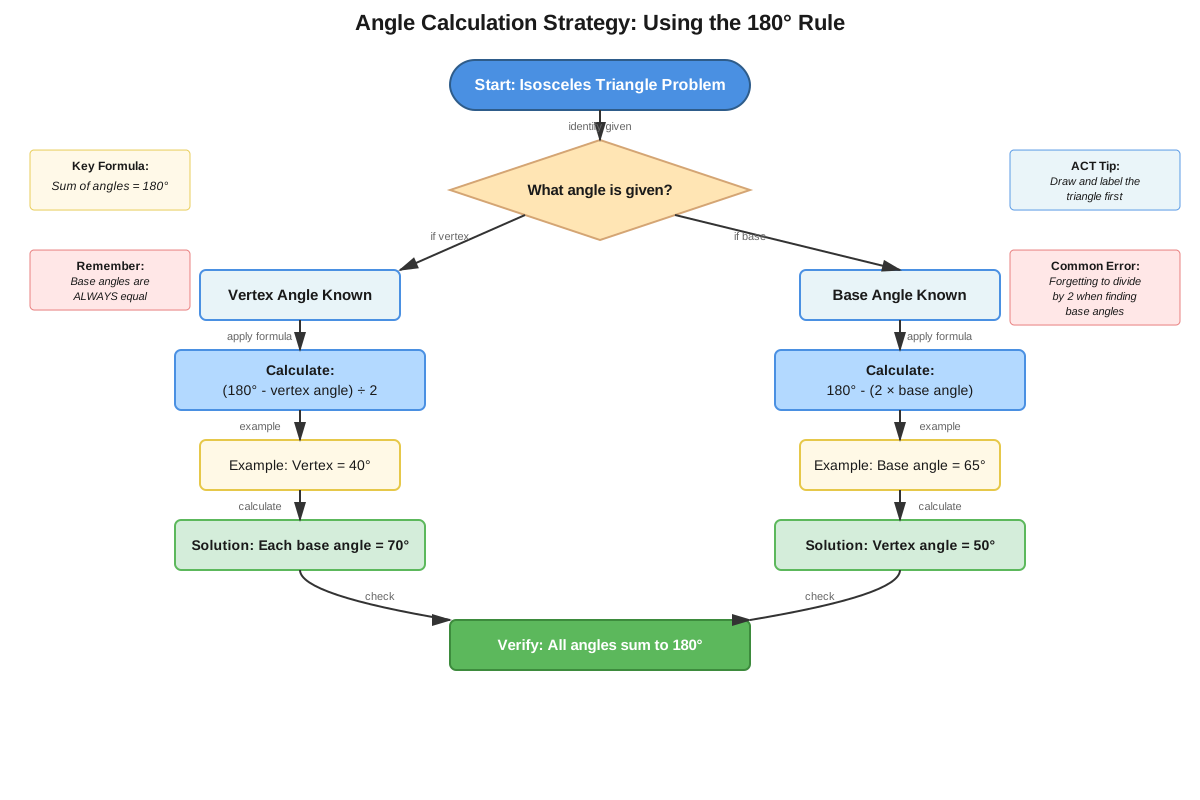
Since the base angles of an isosceles triangle are congruent and all three angles must sum to 180°, a simple formula emerges for angle calculations. If the vertex angle measures v degrees, then each base angle measures (180° - v)/2 degrees. Alternatively, if each base angle measures b degrees, then the vertex angle measures 180° - 2b degrees. These relationships allow for rapid calculation of missing angles when any single angle measure is known.
Consider the special cases that frequently appear on the ACT:
- When the vertex angle is 60°, each base angle is also 60°, creating an equilateral triangle (a special type of isosceles triangle)
- When the vertex angle is 90°, each base angle is 45°, creating a 45-45-90 right triangle
- When each base angle is 30°, the vertex angle is 120°
- When the vertex angle is very small (approaching 0°), the base angles approach 90° each
The Altitude and Symmetry Properties
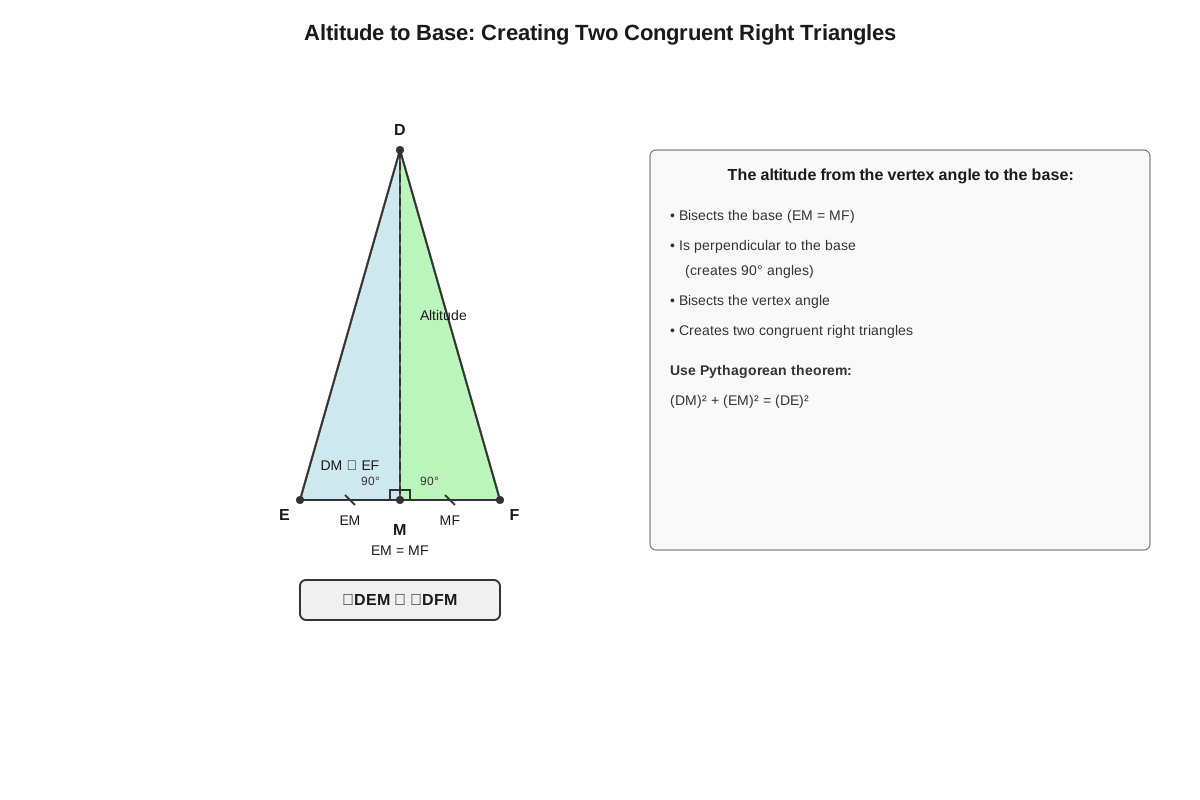
When an altitude is drawn from the vertex angle to the base of an isosceles triangle, it creates several important properties. This altitude is simultaneously a median (dividing the base into two equal segments), an angle bisector (dividing the vertex angle into two equal angles), and a perpendicular bisector of the base. This four-in-one property is unique to isosceles triangles and creates powerful problem-solving opportunities.
The altitude divides the isosceles triangle into two congruent right triangles. Each right triangle has:
- The altitude as one leg
- Half the base as the other leg
- One of the original legs as the hypotenuse
- The vertex angle divided by 2 as one acute angle
- One of the base angles as the other acute angle
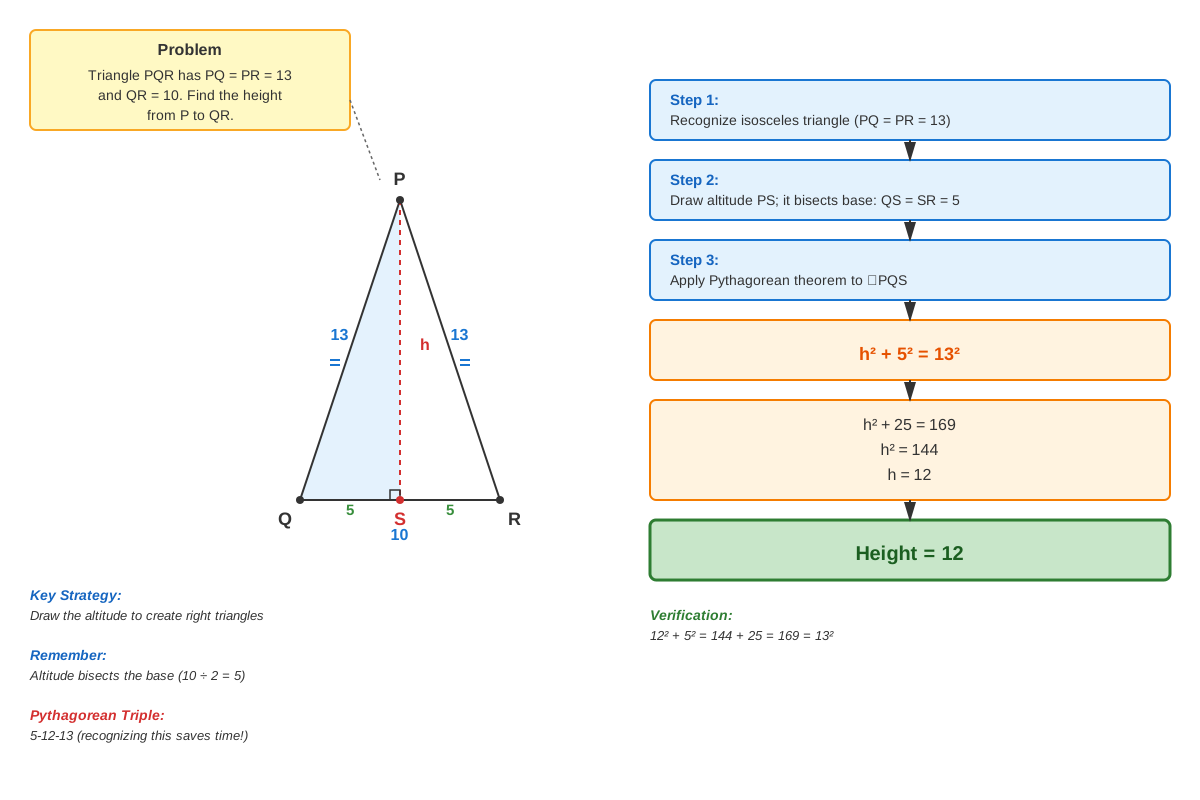
This decomposition allows students to apply the Pythagorean theorem to find missing side lengths. If the legs of the isosceles triangle have length l, the base has length b, and the altitude has length h, then: h² + (b/2)² = l²
Coordinate Geometry Applications
On the ACT, isosceles triangles frequently appear in coordinate geometry contexts. To determine whether three points form an isosceles triangle, students must calculate the distances between all three pairs of points using the distance formula: d = √[(x₂-x₁)² + (y₂-y₁)²]. If exactly two of these distances are equal, the triangle is isosceles.
The symmetry of isosceles triangles also manifests in coordinate geometry. When an isosceles triangle is positioned with its base parallel to the x-axis or y-axis, the vertex point lies on the perpendicular bisector of the base. This means if the base endpoints are (x₁, y) and (x₂, y), the vertex must have an x-coordinate of (x₁ + x₂)/2. This symmetry property can dramatically simplify coordinate geometry problems.
Classification by Angles
Isosceles triangles can be further classified by their angle measures:
| Classification | Vertex Angle | Base Angles | Example Measures |
|---|---|---|---|
| Acute isosceles | Less than 90° | Less than 90° each | 40°-70°-70° |
| Right isosceles | Exactly 90° | Exactly 45° each | 90°-45°-45° |
| Obtuse isosceles | Greater than 90° | Less than 45° each | 120°-30°-30° |
Understanding these classifications helps students quickly eliminate incorrect answer choices and verify their solutions. For instance, if a problem states that an isosceles triangle has a 100° angle, students immediately know this must be the vertex angle, and the base angles must each be 40°.
Perimeter and Area Calculations
The perimeter of an isosceles triangle with legs of length l and base of length b is simply: P = 2l + b. This straightforward formula appears in many ACT problems, often combined with algebraic constraints.
The area can be calculated using the standard triangle area formula (A = ½ × base × height), where the height is the altitude from the vertex angle to the base. When the altitude length isn't directly given, students can calculate it using the Pythagorean theorem as described earlier. Alternatively, if all three side lengths are known, Heron's formula can be applied, though this is rarely the most efficient approach for isosceles triangles on the ACT.
Concept Relationships
The properties of isosceles triangles form an interconnected web of relationships. The definition (two equal sides) → leads to → the Base Angles Theorem (two equal angles) → which enables → angle calculations using the 180° sum property. Simultaneously, the equal sides → combine with → the altitude property → creating → two congruent right triangles → allowing application of → the Pythagorean theorem for side length calculations.
These internal relationships extend outward to connect with prerequisite and related topics. The Base Angles Theorem relies fundamentally on triangle angle sum knowledge, while the altitude property depends on understanding perpendicular lines and angle bisectors. When isosceles triangles appear in coordinate geometry problems, students must integrate the distance formula with isosceles properties to verify equal side lengths.
Isosceles triangles also serve as building blocks for more complex geometric concepts. Equilateral triangles are special isosceles triangles where all three sides (and all three angles) are equal. Regular polygons can be divided into isosceles triangles by drawing radii from the center to vertices. Circle geometry problems frequently involve isosceles triangles formed by two radii and a chord. Understanding these connections allows students to transfer their isosceles triangle knowledge to seemingly unrelated problem types.
The relationship map flows as follows: Basic Triangle Properties → Isosceles Triangle Definition → Base Angles Theorem ↔ Angle Calculations ↔ Altitude Properties → Right Triangle Applications → Pythagorean Theorem → Coordinate Geometry Integration → Complex Multi-Figure Problems.
Quick check — test yourself on Isosceles triangles so far.
Try Flashcards →High-Yield Facts
⭐ In an isosceles triangle, the two base angles (opposite the equal sides) are always congruent.
⭐ The altitude from the vertex angle to the base is simultaneously a median, angle bisector, and perpendicular bisector.
⭐ If a triangle has two equal angles, it must be isosceles with the sides opposite those angles being equal.
⭐ In a right isosceles triangle, the two base angles are each 45°, and the legs are equal in length.
⭐ The sum of the two base angles equals 180° minus the vertex angle: 2b = 180° - v
- The altitude of an isosceles triangle divides it into two congruent right triangles.
- An equilateral triangle is a special case of an isosceles triangle where all three sides are equal.
- In coordinate geometry, if two sides of a triangle have equal length (calculated via distance formula), the triangle is isosceles.
- The perimeter of an isosceles triangle is 2l + b, where l is the leg length and b is the base length.
- If the vertex angle is obtuse (greater than 90°), each base angle must be acute and less than 45°.
- The line of symmetry in an isosceles triangle passes through the vertex angle and the midpoint of the base.
- When an isosceles triangle is inscribed in a circle with the base as a chord, the vertex lies on the perpendicular bisector of that chord.
- The altitude to the base can be found using the Pythagorean theorem: h = √[l² - (b/2)²]
Common Misconceptions
Misconception: All isosceles triangles have a 60° angle. → Correction: Only equilateral triangles (a special type of isosceles triangle) have all angles equal to 60°. Isosceles triangles can have any vertex angle between 0° and 180° (exclusive), with corresponding base angles that maintain the 180° sum.
Misconception: The base of an isosceles triangle is always the longest side. → Correction: The base can be shorter than, equal to, or longer than the legs, depending on the vertex angle. When the vertex angle is less than 60°, the base is shorter than the legs. When it equals 60°, all sides are equal. When it exceeds 60°, the base is longer than the legs.
Misconception: An isosceles triangle must have a vertical line of symmetry when drawn. → Correction: The orientation of an isosceles triangle on the page doesn't affect its properties. An isosceles triangle has a line of symmetry, but this line can be oriented in any direction depending on how the triangle is positioned. The ACT often presents isosceles triangles in non-standard orientations to test true understanding.
Misconception: If two sides of a triangle are equal, the third side must be different. → Correction: While the definition states "at least two equal sides," if all three sides are equal, the triangle is both isosceles and equilateral. An equilateral triangle satisfies all properties of isosceles triangles.
Misconception: The altitude, median, and angle bisector are always the same line in any triangle. → Correction: These three segments coincide only for the altitude from the vertex angle to the base in an isosceles triangle (or for any altitude in an equilateral triangle). In scalene triangles, these are three different segments.
Misconception: In coordinate geometry, if two points have the same x-coordinate or y-coordinate, any triangle formed must be isosceles. → Correction: Having two points aligned vertically or horizontally only means one side is vertical or horizontal. The triangle is isosceles only if two of the three side lengths (calculated using the distance formula) are equal.
Misconception: The vertex angle is always at the "top" of the triangle. → Correction: The vertex angle is defined as the angle between the two equal sides (legs), regardless of the triangle's orientation. The ACT may position this angle at any location to test whether students understand the definition rather than relying on visual assumptions.
Worked Examples
Example 1: Angle Calculation with Algebraic Expression
Problem: In isosceles triangle ABC, the vertex angle A measures (3x + 15)°, and each base angle measures (2x - 5)°. Find the measure of each angle in the triangle.
Solution:
Step 1: Apply the triangle angle sum property. The sum of all three angles must equal 180°.
- Vertex angle + Base angle 1 + Base angle 2 = 180°
- (3x + 15) + (2x - 5) + (2x - 5) = 180
Step 2: Simplify and solve for x.
- 3x + 15 + 2x - 5 + 2x - 5 = 180
- 7x + 5 = 180
- 7x = 175
- x = 25
Step 3: Calculate each angle measure.
- Vertex angle A = 3(25) + 15 = 75 + 15 = 90°
- Each base angle = 2(25) - 5 = 50 - 5 = 45°
Step 4: Verify the solution.
- 90° + 45° + 45° = 180° ✓
- The two base angles are equal ✓
- This is a right isosceles triangle (45-45-90 triangle)
Connection to Learning Objectives: This problem demonstrates the application of isosceles triangle properties (equal base angles) combined with algebraic equation solving, a common ACT question type. Recognizing that the base angles must be equal allows us to set up the correct equation.
Example 2: Coordinate Geometry and Side Length Calculation
Problem: Triangle PQR has vertices at P(2, 5), Q(8, 5), and R(5, k), where k > 5. If triangle PQR is isosceles with PQ as the base, find the value of k when the legs each have length 5 units.
Solution:
Step 1: Identify what we know.
- P and Q both have y-coordinate 5, so PQ is horizontal
- PQ length = |8 - 2| = 6 units
- Since PQ is the base, PR and QR must be the equal legs
- Each leg has length 5 units
Step 2: Use the symmetry property of isosceles triangles.
- Since PQ is the base, R must lie on the perpendicular bisector of PQ
- The midpoint of PQ is ((2+8)/2, 5) = (5, 5)
- The perpendicular bisector is the vertical line x = 5
- This confirms R has x-coordinate 5 ✓
Step 3: Apply the distance formula to find k.
- PR = 5 (given)
- PR = √[(5-2)² + (k-5)²]
- 5 = √[3² + (k-5)²]
- 5 = √[9 + (k-5)²]
Step 4: Solve for k.
- 25 = 9 + (k-5)²
- 16 = (k-5)²
- ±4 = k - 5
- k = 9 or k = 1
Step 5: Apply the constraint k > 5.
- Since k > 5, we have k = 9
Step 6: Verify using QR.
- QR = √[(5-8)² + (9-5)²] = √[9 + 16] = √25 = 5 ✓
Connection to Learning Objectives: This problem requires identifying an isosceles triangle in a coordinate geometry context, applying the symmetry property, and using the distance formula. It demonstrates how multiple concepts integrate in ACT problems and shows the importance of checking constraints.
Exam Strategy
When approaching ACT questions involving isosceles triangles, begin by scanning the problem for trigger words and phrases: "two equal sides," "two congruent sides," "legs," "base angles," or any statement that two sides have the same length. Also watch for implicit indicators like "AB = AC" or coordinate geometry problems where calculating distances reveals equal lengths. The ACT frequently tests whether students can identify isosceles triangles without explicit labeling.
Develop a systematic approach for isosceles triangle problems:
- Identify the triangle type: Determine which two sides are equal (the legs) and which is the base
- Mark equal parts: On your test booklet, mark the equal sides and equal angles with matching symbols
- Apply the Base Angles Theorem: Immediately note that the base angles are equal
- Set up equations: Use the angle sum property (angles sum to 180°) or the Pythagorean theorem (for altitude problems)
- Solve and verify: Check that your answer makes geometric sense
For process of elimination, use these isosceles-specific strategies:
- If answer choices give angle measures, eliminate any that would make the base angles unequal or cause the angle sum to differ from 180°
- If the problem involves a right isosceles triangle, eliminate answers that don't reflect the 45-45-90 relationship
- For coordinate geometry, eliminate points that would create a triangle with three different side lengths
- If the vertex angle is given as obtuse, eliminate answer choices showing base angles of 45° or greater
Time allocation is crucial on the ACT. Simple isosceles angle problems should take 30-45 seconds once you've identified the triangle type. More complex problems involving coordinate geometry or multiple steps might require 60-90 seconds. If a problem requires extensive calculation, consider whether you've missed a shortcut—isosceles triangle problems often have elegant solutions based on symmetry. Don't spend more than 2 minutes on any single problem; mark it and return if time permits.
Exam Tip: When you see a triangle inscribed in a circle with two radii drawn to vertices, you've found an isosceles triangle. The two radii are equal (both are the radius), making this a high-frequency ACT setup.
Memory Techniques
BASE Mnemonic for the four-in-one altitude property:
- Bisector (of the vertex angle)
- Altitude (perpendicular to the base)
- Symmetry line (of the triangle)
- Equal divider (median splitting the base into equal parts)
"Two Equal Sides, Two Equal Angles" - This simple rhyme reinforces the fundamental relationship. Whenever you identify two equal sides, immediately think "two equal angles opposite them."
Visual Memory Technique: Picture an isosceles triangle as a mountain with two equal hiking trails (the legs) leading to the peak (vertex angle). The base is the flat ground between the trail starts. The two hikers starting from each end will reach the peak at the same angle—the base angles are equal.
45-45-90 Quick Recognition: Remember "right isosceles = 45-45-90" by visualizing a square cut diagonally. Each resulting triangle is right isosceles with 45° base angles.
Coordinate Symmetry Acronym - PERP:
- Perpendicular bisector of base
- Equal distances from vertex to base endpoints
- Reflection symmetry across altitude
- Point (vertex) lies on the perpendicular bisector
Summary
Isosceles triangles, defined by having exactly two equal sides, represent a cornerstone concept in ACT plane geometry. The Base Angles Theorem—stating that angles opposite the equal sides are congruent—provides the foundation for solving most isosceles triangle problems. When combined with the triangle angle sum property (180°), this theorem enables rapid calculation of missing angles. The altitude from the vertex angle to the base possesses unique properties: it simultaneously serves as a median, angle bisector, and perpendicular bisector, creating two congruent right triangles that allow application of the Pythagorean theorem. On the ACT, isosceles triangles appear in diverse contexts including direct angle calculations, coordinate geometry applications, and complex multi-figure problems. Success requires both recognizing when isosceles triangles are present (whether explicitly stated or implied through equal sides or angles) and efficiently applying their properties. The symmetry inherent in isosceles triangles often provides elegant solution pathways that save valuable time under test conditions.
Key Takeaways
- An isosceles triangle has exactly two equal sides (legs), and the angles opposite these sides (base angles) are always equal
- The altitude from the vertex angle to the base is simultaneously a median, angle bisector, and perpendicular bisector
- If the vertex angle measures v°, each base angle measures (180° - v)/2°; if each base angle measures b°, the vertex angle measures 180° - 2b°
- The altitude divides an isosceles triangle into two congruent right triangles, enabling Pythagorean theorem applications
- In coordinate geometry, calculate all three side lengths using the distance formula to identify isosceles triangles
- Right isosceles triangles always have 45° base angles and equal legs (45-45-90 triangles)
- Watch for implicit isosceles triangles in circle problems (two radii forming a triangle) and other multi-figure scenarios
Related Topics
Equilateral Triangles: Building on isosceles triangle properties, equilateral triangles have all three sides equal and all three angles equal to 60°. Mastering isosceles triangles provides the foundation for understanding these perfectly symmetric triangles.
Triangle Congruence Theorems: The properties of isosceles triangles connect directly to congruence theorems, particularly SAS (Side-Angle-Side) and ASA (Angle-Side-Angle), which are used to prove triangles congruent.
Special Right Triangles: The 45-45-90 triangle is a right isosceles triangle, and understanding isosceles properties helps master this special right triangle along with the 30-60-90 triangle.
Circle Geometry: Isosceles triangles frequently appear in circle problems involving radii, chords, and inscribed angles. The connection between these topics is tested regularly on the ACT.
Coordinate Geometry: Advanced coordinate geometry problems often require identifying isosceles triangles through distance calculations and using symmetry properties to find unknown coordinates.
Practice CTA
Now that you've mastered the core concepts of isosceles triangles, it's time to solidify your understanding through active practice. Work through the practice questions to apply these properties in various ACT-style scenarios, from straightforward angle calculations to complex coordinate geometry applications. Use the flashcards to reinforce the key properties and theorems until they become automatic. Remember, recognizing isosceles triangles quickly and applying their properties efficiently can save you valuable time on test day and unlock solutions to problems that initially seem complex. Your investment in mastering this high-yield topic will pay dividends across multiple geometry questions on the ACT!
Sign up free to keep reading
Create a free AnvayaPrep account to finish this ACT guide on Isosceles triangles — plus flashcards and practice questions.