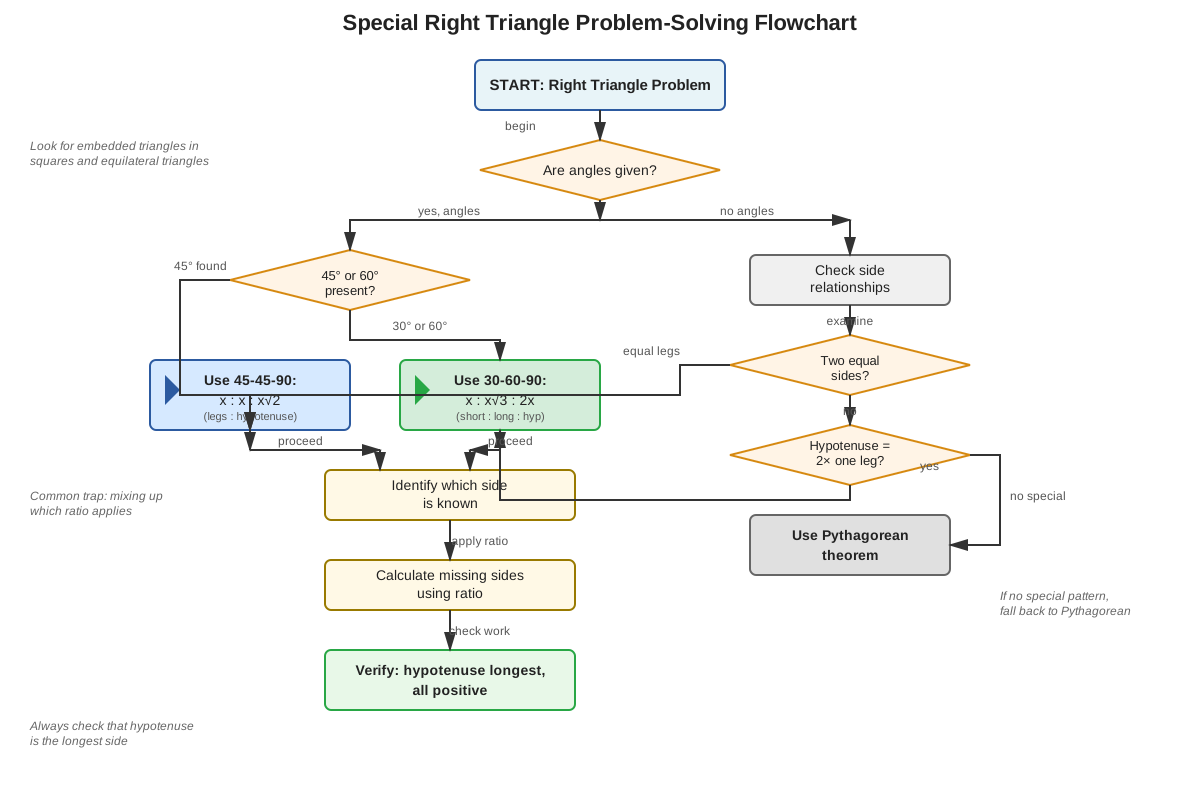
Overview
Special right triangles are among the most frequently tested geometric concepts on the ACT Math section, appearing in approximately 2-4 questions per exam. These triangles—specifically the 45-45-90 and 30-60-90 triangles—possess unique side-length relationships that allow students to solve problems quickly without relying on the Pythagorean theorem or trigonometric functions. Mastering these patterns transforms what could be time-consuming calculations into rapid, pattern-recognition exercises that save precious minutes during the exam.
The power of ACT special right triangles lies in their predictability. Once students internalize the fixed ratios between sides, they can instantly determine missing measurements, calculate areas and perimeters, and solve complex coordinate geometry problems. These triangles frequently appear embedded within larger geometric figures—rectangles, squares, equilateral triangles, and regular polygons—making them essential building blocks for solving multi-step problems. The ACT test writers deliberately design questions that reward students who recognize these patterns, often making problems that appear complex surprisingly straightforward for prepared test-takers.
Understanding special right triangles connects directly to broader mathematical concepts including the Pythagorean theorem, trigonometric ratios, coordinate geometry, and polygon properties. These triangles serve as the foundation for understanding how angles and side lengths relate in right triangles, which extends to applications in distance problems, area calculations, and even three-dimensional geometry questions. Students who master this topic gain a significant strategic advantage, as they can bypass lengthy calculations and reduce the likelihood of computational errors.
Learning Objectives
- [ ] Identify when Special right triangles is being tested
- [ ] Explain the core rule or strategy behind Special right triangles
- [ ] Apply Special right triangles to ACT-style questions accurately
- [ ] Recognize special right triangles embedded within other geometric figures (squares, equilateral triangles, rectangles)
- [ ] Convert between different forms of special right triangle side lengths (simplified radicals, decimals, and multiples of base ratios)
- [ ] Determine which special right triangle pattern applies based on given angle measures or side-length relationships
- [ ] Solve multi-step problems that combine special right triangles with area, perimeter, and coordinate geometry
Prerequisites
- Right triangle basics: Understanding that right triangles contain one 90-degree angle and that the side opposite this angle is the hypotenuse—essential for identifying which side corresponds to which position in special right triangle ratios
- Pythagorean theorem (a² + b² = c²): Provides the underlying proof for why special right triangle ratios work and serves as a verification method when patterns aren't immediately obvious
- Basic radical simplification: Necessary for working with the √2 and √3 that appear in special right triangle ratios and for expressing answers in simplified form
- Angle relationships in triangles: Knowledge that triangle angles sum to 180° helps identify special right triangles when only some angle measures are given
- Properties of squares and equilateral triangles: These shapes naturally contain special right triangles when diagonals or altitudes are drawn
Why This Topic Matters
Special right triangles represent one of the highest-yield topics for ACT Math preparation because they appear consistently across multiple question types and difficulty levels. Beyond their direct application in pure geometry questions, these triangles emerge in coordinate geometry (finding distances and slopes), trigonometry (as the basis for common angle values), and word problems involving real-world scenarios like ramps, ladders, and architectural designs. The ability to instantly recall these ratios can save 30-60 seconds per question—time that accumulates significantly across an entire exam section.
On the ACT, special right triangles appear in approximately 3-5% of all Math questions, with higher frequency in the medium-to-difficult range (questions 30-60 in the 60-question section). They commonly appear as:
- Direct identification problems asking for a missing side length
- Area and perimeter calculations of composite figures
- Coordinate geometry distance problems
- Questions involving diagonals of squares or rectangles
- Problems with equilateral triangles and their altitudes
- Multi-step problems where recognizing the special triangle is the key insight
The ACT specifically favors these triangles because they test pattern recognition, spatial reasoning, and the ability to apply memorized relationships—all skills that correlate with mathematical readiness for college-level coursework. Questions are designed to reward students who have internalized these ratios while penalizing those who attempt to derive everything from first principles during the timed exam.
Core Concepts
The 45-45-90 Triangle
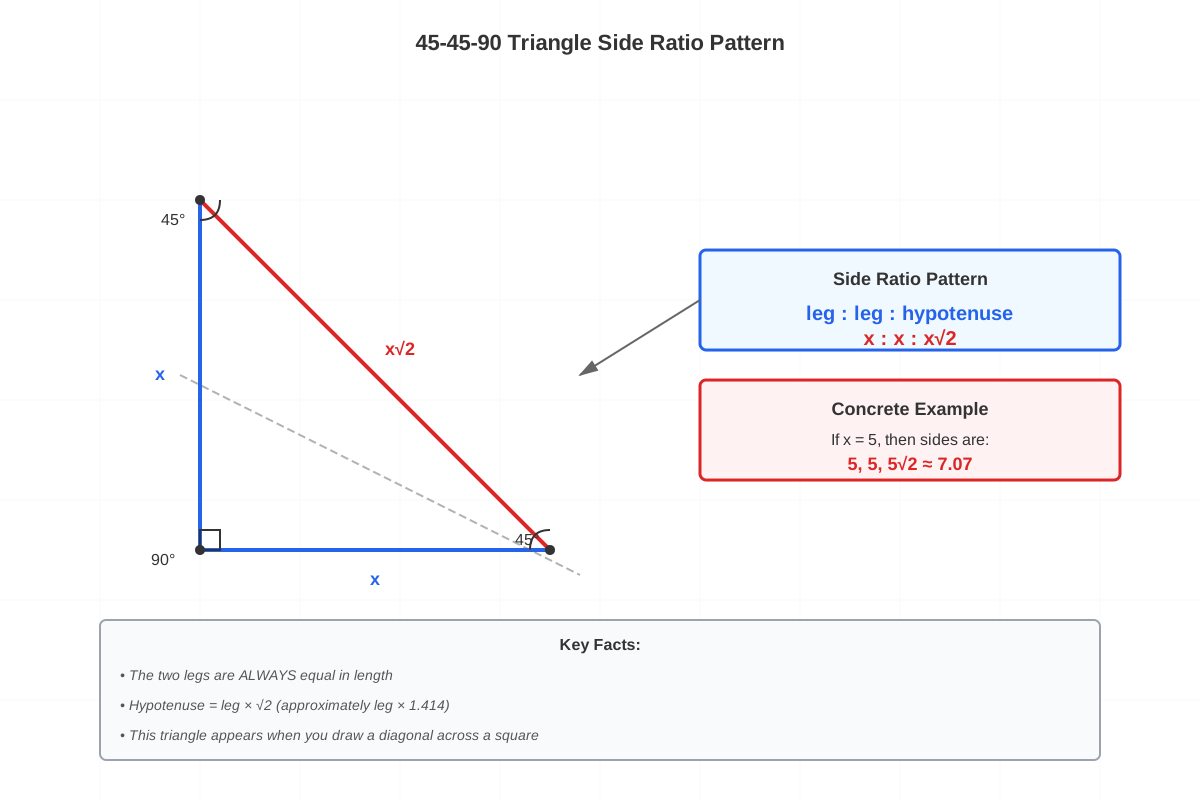
The 45-45-90 triangle is an isosceles right triangle, meaning it contains a right angle and two 45-degree angles. This triangle appears whenever a square is divided by its diagonal or when an isosceles right triangle is constructed. The defining characteristic is that the two legs are congruent (equal in length).
The side-length ratio for a 45-45-90 triangle follows the pattern:
- Leg : Leg : Hypotenuse = 1 : 1 : √2
More specifically, if each leg has length x, then:
- Both legs = x
- Hypotenuse = x√2
This ratio derives from the Pythagorean theorem: if both legs equal x, then x² + x² = c², which simplifies to 2x² = c², and therefore c = x√2.
Key applications:
- Finding the diagonal of a square with side length s: diagonal = s√2
- Determining the side of a square when given its diagonal d: side = d/√2 = d√2/2
- Calculating distances in coordinate geometry when moving equal amounts horizontally and vertically
The 30-60-90 Triangle
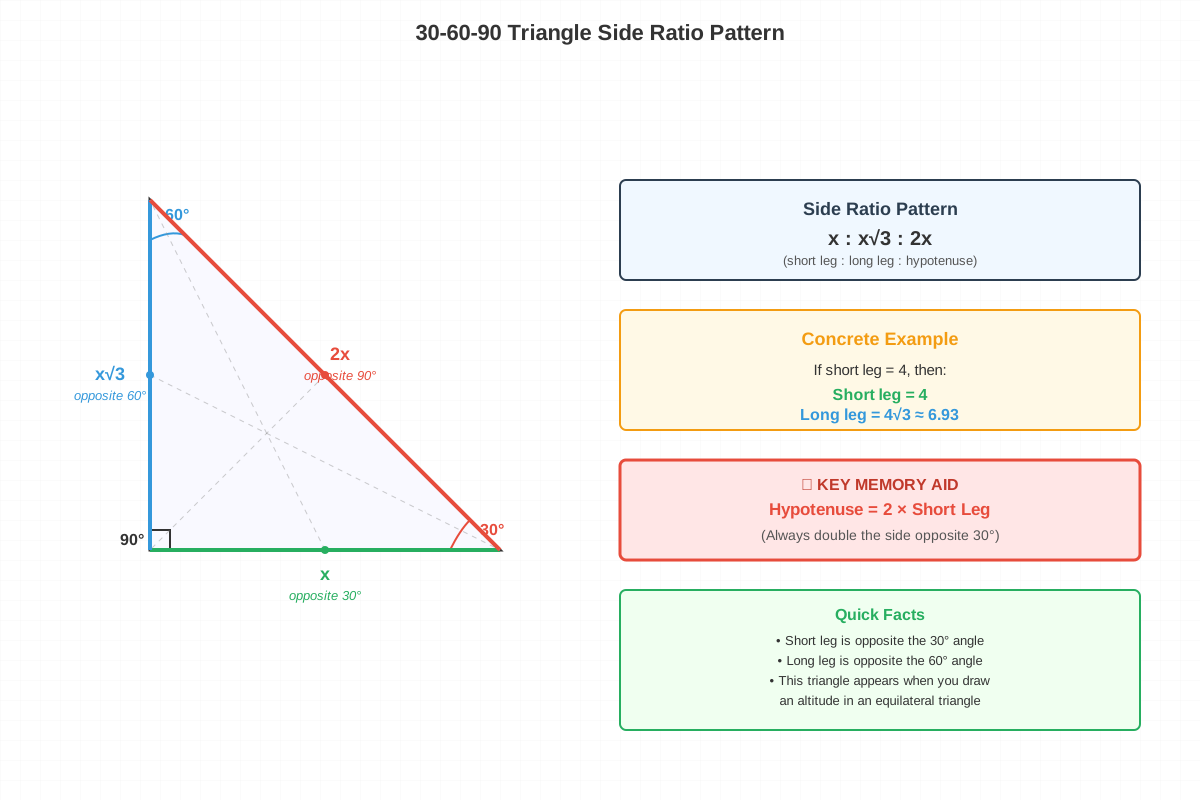
The 30-60-90 triangle contains angles measuring 30°, 60°, and 90°. This triangle appears when an equilateral triangle is bisected by an altitude, creating two congruent 30-60-90 triangles. The sides have three different lengths, each corresponding to a specific angle.
The side-length ratio for a 30-60-90 triangle follows the pattern:
- Short leg : Long leg : Hypotenuse = 1 : √3 : 2
More specifically, if the shortest leg (opposite the 30° angle) has length x, then:
- Short leg (opposite 30°) = x
- Long leg (opposite 60°) = x√3
- Hypotenuse (opposite 90°) = 2x
This ratio also derives from the Pythagorean theorem combined with properties of equilateral triangles. When an equilateral triangle with side length 2x is bisected, the altitude creates two 30-60-90 triangles where the short leg is x (half the base), the hypotenuse is 2x (the original side), and the long leg can be found: x² + b² = (2x)², giving b = x√3.
Key applications:
- Finding the altitude of an equilateral triangle with side length s: altitude = (s√3)/2
- Determining the side length of an equilateral triangle when given its altitude h: side = 2h/√3 = 2h√3/3
- Solving problems involving 30° or 60° angles in various geometric contexts
Identifying Special Right Triangles
Recognition is the critical first step. Special right triangles can be identified through several indicators:
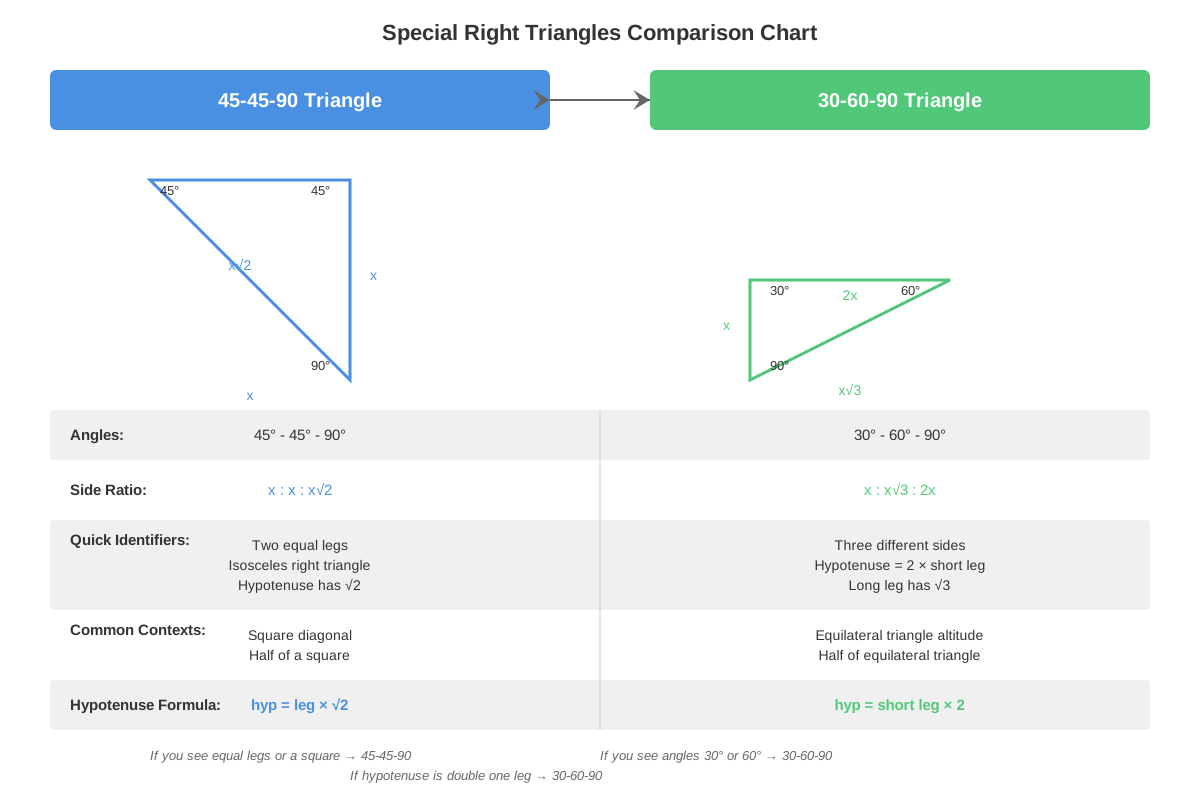
- Angle measures: If a right triangle has angles of 45-45-90 or 30-60-90, it's a special right triangle
- Side-length ratios: If given sides are in ratios of 1:1:√2 or 1:√3:2 (or any multiple thereof), it's a special right triangle
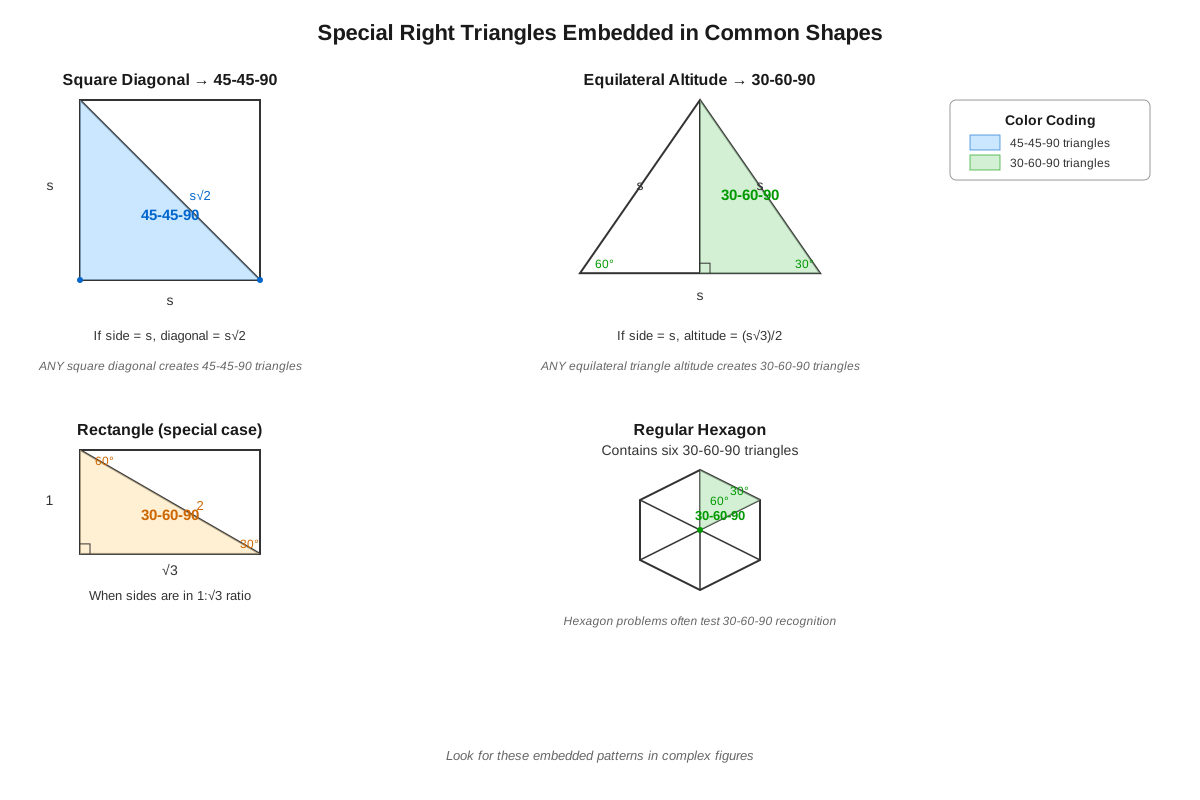
- Geometric context: Diagonals of squares create 45-45-90 triangles; altitudes of equilateral triangles create 30-60-90 triangles
- Isosceles right triangles: Any right triangle with two equal legs is automatically a 45-45-90 triangle
Scaling Special Right Triangles
The ratios remain constant regardless of the triangle's size. If a 45-45-90 triangle has legs of length 5, the hypotenuse is 5√2 (not just √2). The key is identifying the scaling factor—the number that multiplies the base ratio.
| Triangle Type | Base Ratio | Example with scale factor 3 | Example with scale factor 7 |
|---|---|---|---|
| 45-45-90 | 1 : 1 : √2 | 3 : 3 : 3√2 | 7 : 7 : 7√2 |
| 30-60-90 | 1 : √3 : 2 | 3 : 3√3 : 6 | 7 : 7√3 : 14 |
To find the scaling factor:
- Identify which side you're given
- Determine what that side represents in the base ratio
- Divide the given value by the base ratio value
- Apply that scaling factor to find the other sides
Working Backward from the Hypotenuse
Many ACT questions provide the hypotenuse and ask for leg lengths. This requires working backward:
For 45-45-90 triangles:
- If hypotenuse = h, then each leg = h/√2 = h√2/2
For 30-60-90 triangles:
- If hypotenuse = h, then short leg = h/2 and long leg = (h√3)/2
Students must be comfortable rationalizing denominators, as ACT answer choices typically present radicals in simplified form with no radicals in denominators.
Concept Relationships
The two types of special right triangles connect to each other through their shared foundation in the Pythagorean theorem, though they arise from different geometric constructions. The 45-45-90 triangle emerges from bisecting a square, while the 30-60-90 triangle emerges from bisecting an equilateral triangle. Both represent special cases where angle measures create predictable side-length ratios.
Relationship map:
- Right triangle properties → Special angle measures → Fixed side-length ratios → Rapid problem solving
- Square properties → Diagonal creates 45-45-90 triangles → Applications in coordinate geometry and area problems
- Equilateral triangle properties → Altitude creates 30-60-90 triangles → Applications in polygon problems and trigonometry
- Pythagorean theorem → Verification tool for special right triangle ratios → Backup method when patterns aren't recognized
Special right triangles also connect forward to trigonometry, as the sine, cosine, and tangent values for 30°, 45°, and 60° angles derive directly from these triangle ratios. Understanding these triangles provides intuitive meaning to why sin(45°) = √2/2 or why tan(60°) = √3.
The coordinate geometry connection is particularly strong: when finding distances between points that differ by equal amounts in x and y coordinates, a 45-45-90 triangle is formed. When points create angles of 30° or 60° with the axes, 30-60-90 triangles emerge. This makes special right triangles essential for coordinate plane problems on the ACT.
High-Yield Facts
⭐ The 45-45-90 triangle has side ratio 1 : 1 : √2, where the legs are equal and the hypotenuse is √2 times the leg length
⭐ The 30-60-90 triangle has side ratio 1 : √3 : 2, where 1 is opposite 30°, √3 is opposite 60°, and 2 is the hypotenuse
⭐ The diagonal of a square with side s equals s√2 (creates two 45-45-90 triangles)
⭐ The altitude of an equilateral triangle with side s equals (s√3)/2 (creates two 30-60-90 triangles)
⭐ In a 30-60-90 triangle, the hypotenuse is always twice the length of the short leg
- In a 45-45-90 triangle, if the hypotenuse is h, each leg equals h√2/2 or h/√2
- The short leg of a 30-60-90 triangle is always half the hypotenuse
- The long leg of a 30-60-90 triangle is √3 times the short leg
- Any isosceles right triangle is automatically a 45-45-90 triangle
- Special right triangle ratios work with any scaling factor—multiply all sides by the same number to maintain the ratio
- When a rectangle's diagonal is drawn, it creates two right triangles that may or may not be special right triangles (only if the rectangle is a square for 45-45-90)
- The area of a 45-45-90 triangle with leg x is x²/2
- The area of a 30-60-90 triangle with short leg x is (x²√3)/2
Quick check — test yourself on Special right triangles so far.
Try Flashcards →Common Misconceptions
Misconception: All right triangles are special right triangles.
Correction: Only right triangles with angles of 45-45-90 or 30-60-90 are special right triangles. A right triangle with angles like 20-70-90 does not have the memorizable side-length ratios and requires the Pythagorean theorem or trigonometry.
Misconception: In a 45-45-90 triangle, if the leg is 5, the hypotenuse is 5 + √2 or 5√2.
Correction: The hypotenuse is 5√2 (not 5 + √2). The √2 is a multiplier, not an addend. The ratio is multiplicative: hypotenuse = leg × √2.
Misconception: In a 30-60-90 triangle, the sides can be in any order as long as they follow the ratio 1 : √3 : 2.
Correction: The sides must correspond to specific angles. The shortest side (1) is always opposite the 30° angle, the middle side (√3) is always opposite the 60° angle, and the longest side (2) is always the hypotenuse opposite the 90° angle.
Misconception: When given the hypotenuse of a 45-45-90 triangle, dividing by √2 gives the final answer for the leg.
Correction: While dividing by √2 is mathematically correct, ACT answers require rationalized denominators. The leg equals hypotenuse/√2, which must be rationalized to (hypotenuse × √2)/2. For example, if the hypotenuse is 10, the leg is 10/√2 = 10√2/2 = 5√2.
Misconception: The altitude of any triangle creates 30-60-90 triangles.
Correction: Only the altitude of an equilateral triangle creates 30-60-90 triangles. Altitudes of other triangles create right triangles, but not necessarily special right triangles.
Misconception: In a 30-60-90 triangle with hypotenuse 10, the long leg is 10√3.
Correction: The long leg is 5√3, not 10√3. Since the hypotenuse is twice the short leg, the short leg is 5. The long leg is √3 times the short leg, so 5√3. Students often forget to first find the short leg before calculating the long leg.
Misconception: Special right triangles only appear in pure geometry questions.
Correction: Special right triangles frequently appear in coordinate geometry (distance problems), word problems (ramps, ladders), and even in trigonometry contexts. Recognizing them across different question types is essential.
Worked Examples
Example 1: Finding Missing Sides in a 45-45-90 Triangle
Problem: A square has a diagonal of length 12. What is the length of one side of the square?
Solution:
Step 1: Recognize the special right triangle
When a diagonal is drawn in a square, it creates two congruent 45-45-90 triangles. The diagonal serves as the hypotenuse, and the sides of the square are the legs.
Step 2: Recall the 45-45-90 ratio
The ratio is leg : leg : hypotenuse = 1 : 1 : √2, or more specifically, if the leg is x, the hypotenuse is x√2.
Step 3: Set up the equation
We know the hypotenuse (diagonal) = 12, so:
x√2 = 12
Step 4: Solve for x
x = 12/√2
Step 5: Rationalize the denominator
x = 12/√2 × √2/√2 = 12√2/2 = 6√2
Answer: The side of the square is 6√2.
Connection to learning objectives: This problem demonstrates identifying when special right triangles are being tested (diagonal of a square), explaining the core strategy (using the 1:1:√2 ratio), and applying it accurately to find the answer.
Example 2: Multi-Step Problem with 30-60-90 Triangle
Problem: An equilateral triangle has a side length of 8. What is the area of the triangle?
Solution:
Step 1: Recognize that area requires the height
The area formula for a triangle is A = (1/2) × base × height. We have the base (8), but need the height.
Step 2: Identify the special right triangle
When an altitude is drawn in an equilateral triangle, it creates two 30-60-90 triangles. The altitude is the long leg of this triangle.
Step 3: Determine the components of the 30-60-90 triangle
- The hypotenuse is the side of the equilateral triangle: 8
- The short leg is half the base: 4
- The long leg (altitude) is what we need to find
Step 4: Apply the 30-60-90 ratio
In the ratio 1 : √3 : 2, if the short leg is 4, then the scaling factor is 4.
- Short leg = 4 (given)
- Long leg = 4√3 (short leg × √3)
- Hypotenuse = 8 (short leg × 2) ✓ This confirms our setup
Step 5: Calculate the area
A = (1/2) × base × height
A = (1/2) × 8 × 4√3
A = 4 × 4√3
A = 16√3
Answer: The area is 16√3 square units.
Connection to learning objectives: This problem shows how to recognize special right triangles embedded within other shapes (equilateral triangle), apply the correct ratio (1:√3:2), and solve a multi-step problem combining special right triangles with area calculations.
Exam Strategy
Recognition Triggers
Watch for these trigger words and phrases that signal special right triangles:
- "Square" with "diagonal" → 45-45-90 triangle
- "Equilateral triangle" with "altitude" or "height" → 30-60-90 triangle
- "Isosceles right triangle" → 45-45-90 triangle
- Angle measures of "45°, 45°, 90°" or "30°, 60°, 90°"
- "Two equal legs" in a right triangle → 45-45-90 triangle
- Coordinate geometry with equal horizontal and vertical distances → 45-45-90 triangle
Systematic Approach
- Identify the triangle type: Look at angles or side relationships first
- Determine what you know: Which side(s) are given? Which position in the ratio?
- Find the scaling factor: Divide the given side by its position in the base ratio
- Apply to find unknowns: Multiply the scaling factor by the ratio values for unknown sides
- Simplify radicals: Ensure answers are in simplified form with rationalized denominators
Process of Elimination Tips
- Eliminate answers without radicals when the problem involves special right triangles (unless the radical simplifies to a whole number)
- Eliminate answers with √2 for 30-60-90 problems and answers with √3 for 45-45-90 problems (these radicals don't appear in those respective triangles)
- Check magnitude: In 45-45-90, the hypotenuse should be about 1.4 times the leg; in 30-60-90, the hypotenuse should be exactly twice the short leg
- Verify angle-side correspondence: The longest side must be opposite the largest angle (90°)
Time Allocation
Special right triangle questions should take 30-45 seconds once you recognize the pattern. If you find yourself spending more than one minute:
- You may not have recognized the special triangle pattern
- Consider whether the Pythagorean theorem might be faster for this specific problem
- Mark the question and return if time permits
Exam Tip: If you forget the exact ratios during the test, you can quickly derive them. For 45-45-90, use the Pythagorean theorem with legs of 1: 1² + 1² = c², so c = √2. For 30-60-90, remember that it comes from bisecting an equilateral triangle with side 2, giving you sides of 1, √3, and 2.
Memory Techniques
The "1-1-Root2" Chant
For 45-45-90 triangles, memorize the rhythm: "One, one, root-two" (1 : 1 : √2). Associate this with a square being cut diagonally—two equal sides (1, 1) and a diagonal (√2).
The "1-Root3-2" Sequence
For 30-60-90 triangles, memorize: "One, root-three, two" (1 : √3 : 2). Visualize an equilateral triangle being split down the middle—the smallest piece (1), the height with a radical (√3), and the original side (2).
Angle-Side Association
Create a visual memory:
- 45-45-90: Two equal angles (45, 45) → two equal sides (legs) → the different angle (90) → the different side (hypotenuse with √2)
- 30-60-90: Three different angles → three different sides, ordered from smallest to largest
The "Twice" Rule for 30-60-90
Remember: "The hypotenuse is TWICE the short leg" in 30-60-90 triangles. This is the easiest relationship to recall and can help you reconstruct the entire ratio.
Square-Diagonal Visualization
Picture a square with side 1. Its diagonal must be longer than 1 but shorter than 2 (since going around two sides would be 2). The diagonal is √2 ≈ 1.414, which fits perfectly. This helps you remember that diagonals of squares involve √2.
Equilateral-Altitude Visualization
Picture an equilateral triangle with side 2. When you drop an altitude, it splits the base into two 1s. The altitude must be less than 2 but more than 1. It's √3 ≈ 1.732, which makes geometric sense.
Summary
Special right triangles—the 45-45-90 and 30-60-90 triangles—are essential patterns that appear frequently on the ACT Math section, offering students a rapid alternative to the Pythagorean theorem for specific geometric situations. The 45-45-90 triangle, with its 1:1:√2 ratio, emerges whenever squares are divided by diagonals or isosceles right triangles are formed. The 30-60-90 triangle, with its 1:√3:2 ratio, appears when equilateral triangles are bisected by altitudes. Success with these triangles requires three key skills: recognizing when they appear (through angle measures, side relationships, or geometric context), recalling the correct ratio, and applying the scaling factor to find unknown sides. These triangles connect to broader mathematical concepts including coordinate geometry, area calculations, and trigonometry, making them foundational knowledge for multiple question types. Students who master these patterns gain significant time advantages and accuracy improvements on test day.
Key Takeaways
- The 45-45-90 triangle has a side ratio of 1 : 1 : √2, where both legs are equal and the hypotenuse is the leg length multiplied by √2
- The 30-60-90 triangle has a side ratio of 1 : √3 : 2, where the sides correspond to the angles opposite them (shortest opposite 30°, longest opposite 90°)
- Diagonals of squares always create 45-45-90 triangles; altitudes of equilateral triangles always create 30-60-90 triangles
- Finding the scaling factor is crucial: divide the given side by its position in the base ratio, then multiply all ratio values by this factor
- Always rationalize denominators in final answers—ACT answer choices never have radicals in denominators
- Recognition is faster than calculation: train yourself to spot these triangles immediately in various contexts
- These patterns save time and reduce errors compared to using the Pythagorean theorem for every right triangle problem
Related Topics
Pythagorean Theorem: While special right triangles provide shortcuts, understanding the Pythagorean theorem (a² + b² = c²) remains essential for non-special right triangles and serves as the underlying proof for why special triangle ratios work. Mastering special right triangles makes Pythagorean theorem applications faster when you can quickly check whether a triangle fits a special pattern.
Trigonometric Ratios: The sine, cosine, and tangent values for 30°, 45°, and 60° angles derive directly from special right triangle ratios. Understanding these triangles provides intuitive meaning to trigonometric functions and helps with memorizing common angle values.
Coordinate Geometry: Distance problems on the coordinate plane frequently create special right triangles, especially when points differ by equal amounts in x and y coordinates (45-45-90) or when angles of 30° or 60° are involved. Mastering special right triangles accelerates coordinate geometry problem-solving.
Polygon Properties: Regular polygons, particularly squares, rectangles, and equilateral triangles, contain special right triangles when diagonals or altitudes are drawn. Understanding these relationships enables quick calculations of diagonals, heights, and areas.
Practice CTA
Now that you've mastered the core concepts of special right triangles, it's time to solidify your understanding through active practice. Work through the practice questions to test your ability to recognize these triangles in various contexts and apply the ratios accurately under timed conditions. Use the flashcards to drill the fundamental ratios until they become automatic—this instant recall will save you valuable time on test day. Remember, the difference between knowing these patterns and truly mastering them lies in repeated application. Every practice problem you solve builds the pattern recognition skills that will make these questions feel effortless on the actual ACT. You've got this!
Sign up free to keep reading
Create a free AnvayaPrep account to finish this ACT guide on Special right triangles — plus flashcards and practice questions.