Overview
Equilateral triangles represent one of the most frequently tested geometric figures on the ACT Math section. These special triangles possess unique properties that make them both elegant mathematical objects and powerful problem-solving tools. An equilateral triangle is defined as a triangle in which all three sides have equal length and all three interior angles measure exactly 60 degrees. This perfect symmetry creates predictable relationships between side lengths, heights, areas, and angles that appear repeatedly across ACT geometry questions.
Understanding ACT equilateral triangles is essential because they serve as building blocks for more complex geometric concepts tested on the exam. Questions involving equilateral triangles often appear in coordinate geometry problems, area calculations, perimeter questions, and composite figure analysis. The ACT frequently embeds equilateral triangles within hexagons, presents them in coordinate plane scenarios, or uses them as components of three-dimensional figures. Mastery of equilateral triangle properties enables students to solve problems quickly and confidently, often eliminating the need for lengthy calculations.
The relationship between equilateral triangles and broader mathematical concepts extends throughout plane geometry and trigonometry. These triangles connect directly to the 30-60-90 special right triangle (formed when an altitude bisects an equilateral triangle), circle geometry (equilateral triangles inscribed in or circumscribed about circles), and regular polygons (particularly hexagons, which can be divided into six equilateral triangles). This interconnectedness means that understanding equilateral triangles strengthens overall geometric reasoning and provides multiple pathways to solve challenging ACT problems efficiently.
Learning Objectives
- [ ] Identify when Equilateral triangles is being tested
- [ ] Explain the core rule or strategy behind Equilateral triangles
- [ ] Apply Equilateral triangles to ACT-style questions accurately
- [ ] Calculate the area of an equilateral triangle using the side length formula
- [ ] Determine the height (altitude) of an equilateral triangle given its side length
- [ ] Recognize equilateral triangles embedded within other geometric figures
- [ ] Apply equilateral triangle properties to solve coordinate geometry problems
Prerequisites
- Basic triangle properties: Understanding that the sum of interior angles equals 180° and familiarity with perimeter calculations are fundamental to working with any triangle type
- Pythagorean theorem: Essential for deriving the height formula and understanding the 30-60-90 relationship within equilateral triangles
- Area formulas for triangles: The general formula A = ½bh serves as the foundation for the specialized equilateral triangle area formula
- Square roots and radical simplification: Many equilateral triangle calculations involve √3, requiring comfort with radical expressions
- Congruence and symmetry: Recognizing when sides and angles are equal helps identify equilateral triangles in complex diagrams
Why This Topic Matters
Equilateral triangles appear in approximately 3-5 questions per ACT Math test, making them a high-yield topic for focused study. These questions typically test multiple concepts simultaneously—a single problem might require calculating area, recognizing special angle relationships, and applying coordinate geometry principles. The predictable nature of equilateral triangle properties makes them ideal for rapid problem-solving, which is crucial given the ACT's time constraints of 60 minutes for 60 questions.
In real-world applications, equilateral triangles appear in engineering structures (truss designs maximize strength through triangular bracing), architectural elements (geodesic domes utilize triangular panels), crystallography (molecular structures often exhibit triangular symmetry), and design (the equilateral triangle's visual balance makes it popular in logos and graphics). Understanding these triangles develops spatial reasoning skills applicable to fields ranging from computer graphics to materials science.
On the ACT, equilateral triangles commonly appear in several question formats: direct calculation problems asking for area or perimeter given a side length; composite figure questions where equilateral triangles form part of a larger shape; coordinate geometry problems placing vertices at specific points; and word problems describing real-world scenarios involving triangular structures. The exam also tests recognition skills by presenting triangles without explicitly stating they are equilateral, requiring students to identify equal sides or 60° angles from given information.
Core Concepts
Definition and Fundamental Properties
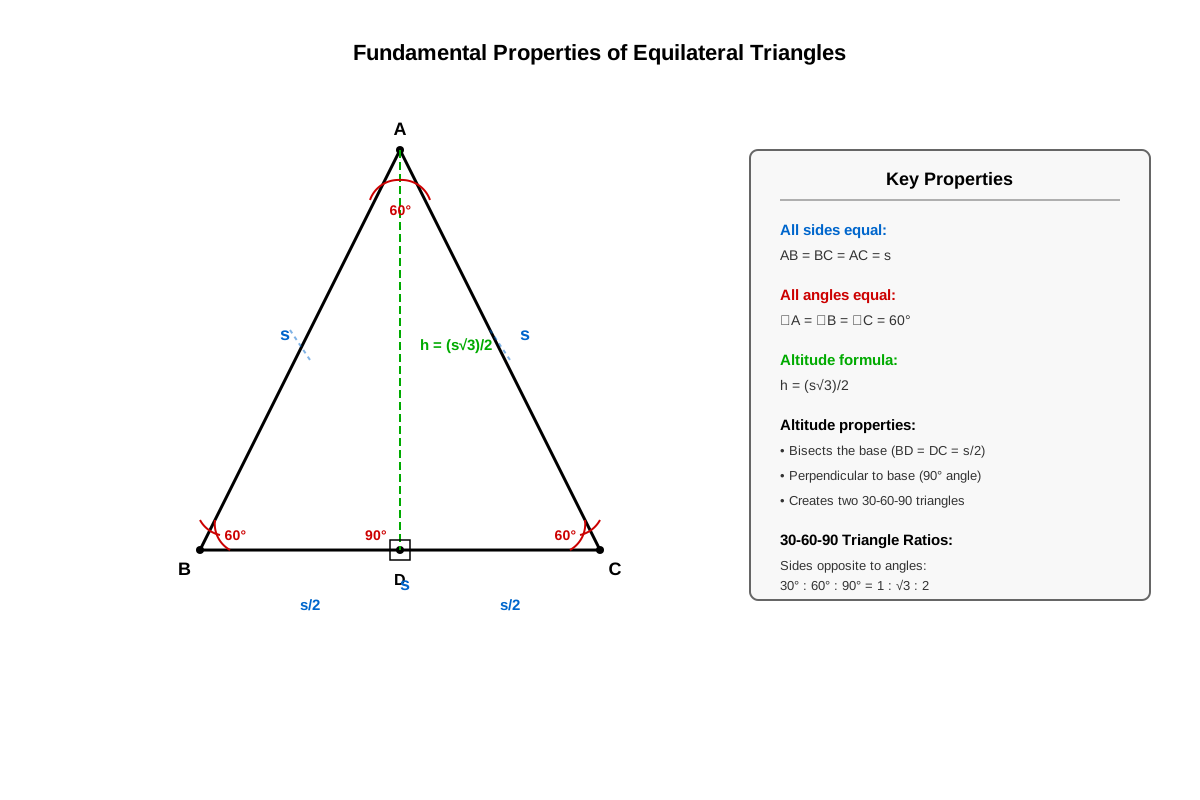
An equilateral triangle is a polygon with three sides of equal length and three angles of equal measure. Since the sum of interior angles in any triangle equals 180°, each angle in an equilateral triangle measures exactly 60° (180° ÷ 3 = 60°). This dual property—equal sides (equilateral) and equal angles (equiangular)—creates a perfectly symmetric figure with three lines of symmetry and rotational symmetry of order 3.
The defining characteristics of equilateral triangles include:
- All three sides have identical length (if one side = s, then all sides = s)
- All three interior angles measure 60°
- All three altitudes have equal length
- All three medians have equal length and coincide with the altitudes
- The centroid, circumcenter, incenter, and orthocenter all coincide at the same point
The Height (Altitude) Formula
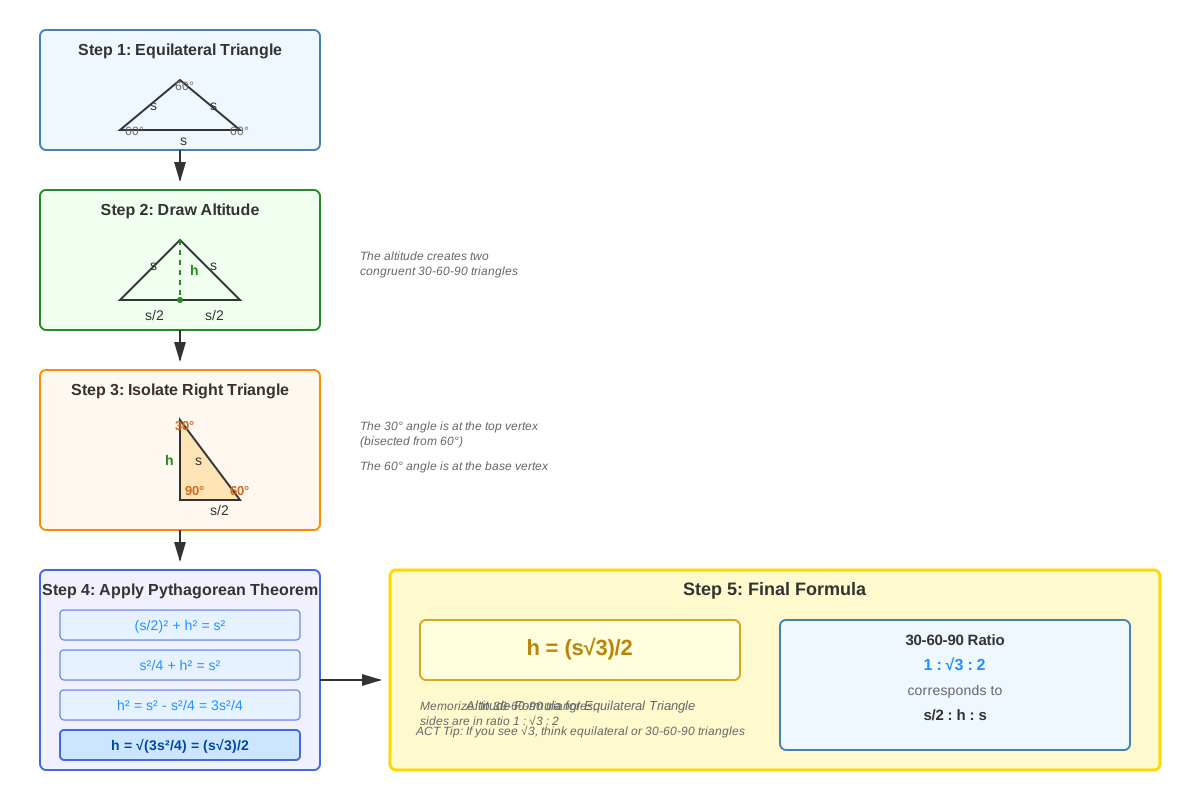
The altitude or height of an equilateral triangle can be derived using the Pythagorean theorem. When an altitude is drawn from any vertex to the opposite side, it bisects both the base and the vertex angle, creating two congruent 30-60-90 right triangles.
For an equilateral triangle with side length s:
- The altitude bisects the base, creating two segments of length s/2
- The altitude forms the longer leg of a 30-60-90 triangle
- Using the Pythagorean theorem: h² + (s/2)² = s²
h² = s² - s²/4
h² = 3s²/4
h = (s√3)/2
This formula is crucial for ACT problems because height appears in area calculations and coordinate geometry questions. Memorizing h = (s√3)/2 eliminates the need to re-derive it during the exam.
Area Formula
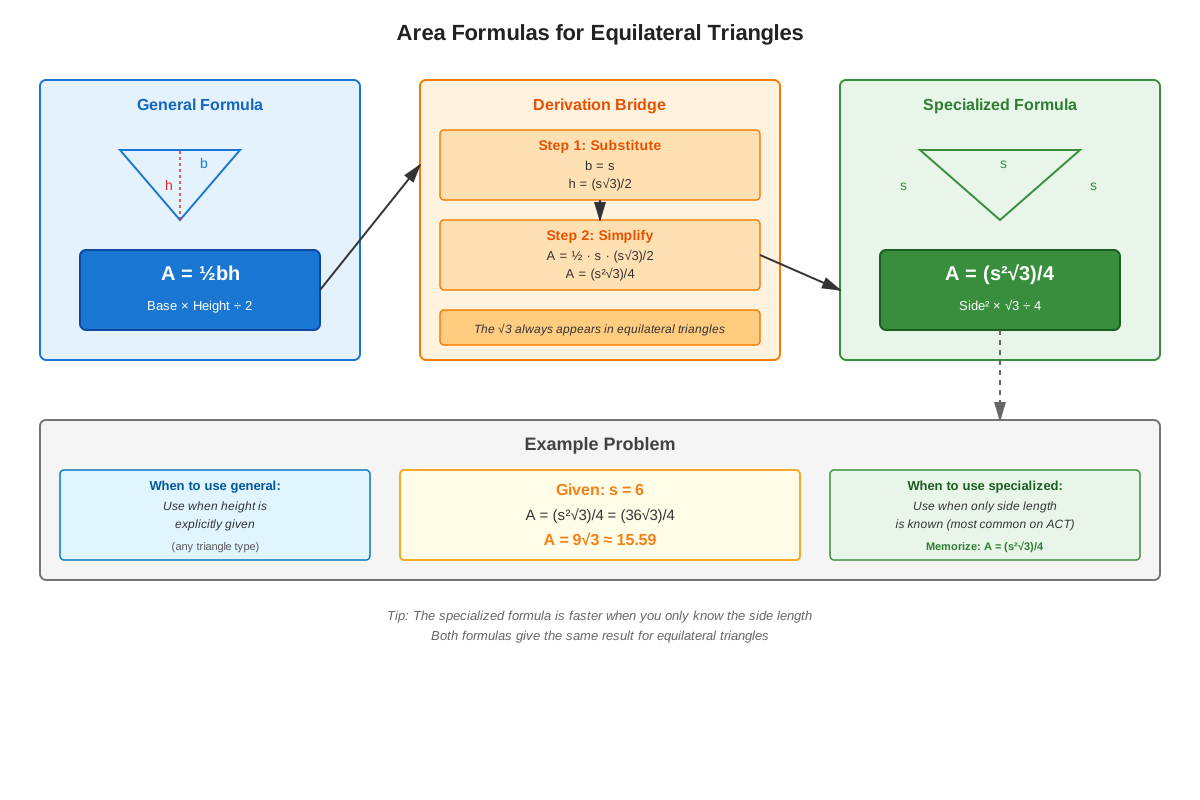
The area of an equilateral triangle can be calculated using the general triangle formula A = ½bh, but substituting the specialized height formula creates a more efficient approach:
A = ½ × base × height
A = ½ × s × (s√3)/2
A = (s²√3)/4
This area formula A = (s²√3)/4 is the single most important equation for ACT equilateral triangle questions. It allows direct calculation from side length alone, without requiring separate height computation.
Perimeter
The perimeter of an equilateral triangle follows directly from the definition:
P = s + s + s = 3sWhile straightforward, perimeter questions often appear in reverse: given the perimeter, find the side length (s = P/3), then use that to calculate area or other properties.
The 30-60-90 Connection
Every equilateral triangle contains six 30-60-90 right triangles when all three altitudes are drawn. Understanding this relationship is essential because:
- The 30-60-90 ratio is 1 : √3 : 2 (short leg : long leg : hypotenuse)
- In an equilateral triangle with side s, the altitude creates a 30-60-90 triangle where:
- Short leg = s/2 (half the base)
- Long leg = (s√3)/2 (the altitude)
- Hypotenuse = s (the original side)
This connection allows students to solve problems involving partial information about equilateral triangles by recognizing the 30-60-90 pattern.
Equilateral Triangles in Coordinate Geometry
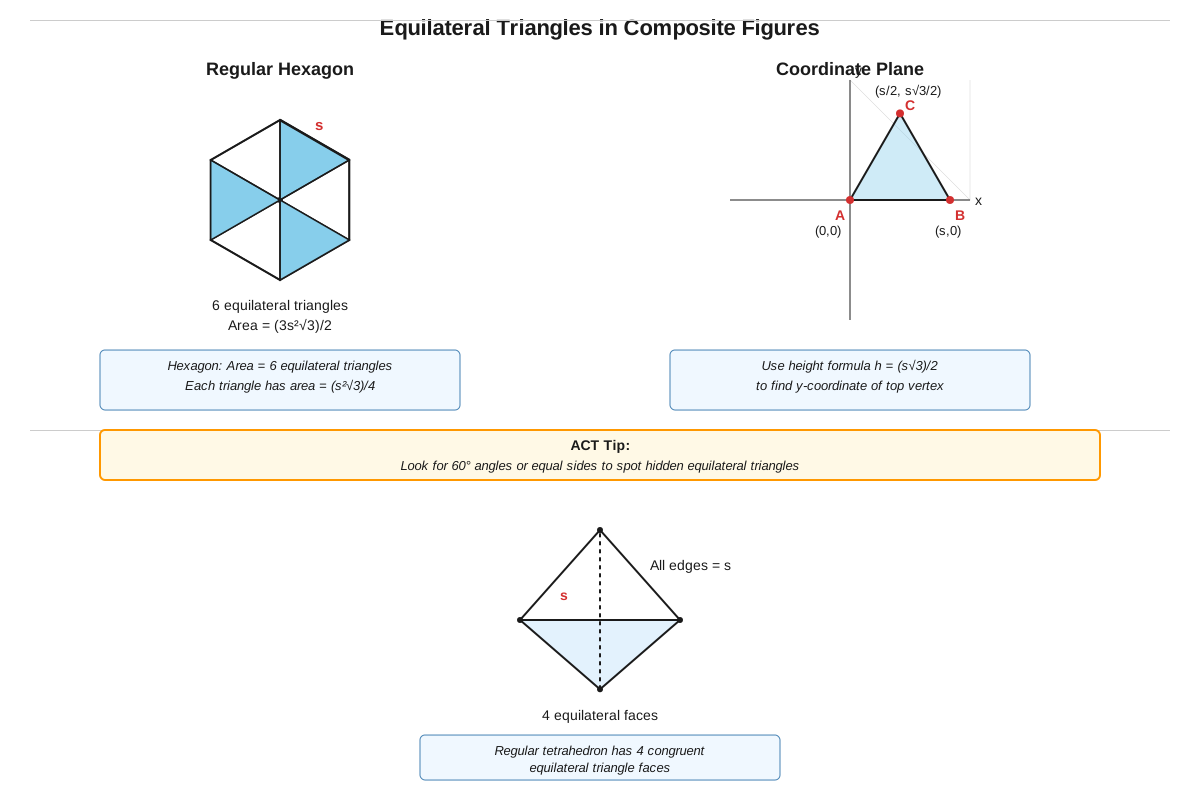
On the coordinate plane, equilateral triangles frequently appear with one side horizontal or one vertex at the origin. Key strategies include:
- Horizontal base approach: If the base lies along the x-axis from (0,0) to (s,0), the third vertex is located at (s/2, (s√3)/2)
- Distance formula verification: The distance between any two vertices must equal s
- Symmetry exploitation: The triangle's center lies at the centroid, located at the average of the three vertices' coordinates
Composite Figures and Inscribed/Circumscribed Circles
Equilateral triangles often appear within or around other shapes:
| Configuration | Relationship | Key Formula |
|---|---|---|
| Inscribed in circle | Radius R relates to side s | s = R√3 |
| Circumscribed around circle | Inradius r relates to side s | r = (s√3)/6 |
| Within regular hexagon | Hexagon contains 6 equilateral triangles | Hexagon area = 6 × triangle area |
| Forming larger triangle | Similar triangles maintain proportions | Areas scale by square of side ratio |
Concept Relationships
The properties of equilateral triangles form an interconnected web of relationships. The equal side lengths → directly determine the perimeter (multiply by 3) and → enable calculation of the altitude using the derived formula → which then allows area calculation through either the general or specialized formula. This linear progression represents the most common problem-solving pathway on the ACT.
The 60° angle property → connects to trigonometric ratios (sin 60° = √3/2, cos 60° = 1/2) → which relate to the 30-60-90 special right triangle → that appears when any altitude is drawn. This angular pathway provides an alternative approach to problems and reinforces the relationship between equilateral triangles and special right triangles.
Equilateral triangles also connect upward to more complex geometric concepts: they serve as the fundamental unit of regular hexagons (six equilateral triangles sharing a common center), appear in tessellation patterns (equilateral triangles can tile a plane), and relate to circle geometry through inscribed and circumscribed configurations. Understanding these connections allows students to decompose complex figures into manageable equilateral triangle components.
The coordinate geometry connection flows from algebraic representations of vertices → to distance formula applications verifying equal sides → to midpoint and slope calculations confirming perpendicular altitudes. This algebraic-geometric bridge is particularly important for ACT questions that blend multiple mathematical domains.
Quick check — test yourself on Equilateral triangles so far.
Try Flashcards →High-Yield Facts
⭐ All sides of an equilateral triangle have equal length, and all angles measure exactly 60°
⭐ The area formula for an equilateral triangle with side length s is A = (s²√3)/4
⭐ The height (altitude) of an equilateral triangle with side length s is h = (s√3)/2
⭐ Drawing an altitude in an equilateral triangle creates two congruent 30-60-90 right triangles
⭐ The perimeter of an equilateral triangle is P = 3s, where s is the side length
- The altitude, median, angle bisector, and perpendicular bisector from any vertex are all the same line segment
- A regular hexagon can be divided into exactly six congruent equilateral triangles
- The ratio of the area of an equilateral triangle to the area of a square with the same side length is √3:4
- If an equilateral triangle is inscribed in a circle with radius R, the side length is s = R√3
- The centroid of an equilateral triangle divides each altitude in a 2:1 ratio from vertex to base
- Equilateral triangles have three lines of reflective symmetry and 120° rotational symmetry
- The inradius (radius of inscribed circle) of an equilateral triangle is r = (s√3)/6 or r = h/3
Common Misconceptions
Misconception: All triangles with equal angles are equilateral triangles → Correction: While all equilateral triangles have equal angles (60° each), the statement is actually true—any triangle with three equal angles must have three equal sides. However, students sometimes confuse this with isosceles triangles, which have only two equal sides and two equal angles.
Misconception: The height of an equilateral triangle equals the side length → Correction: The height is always shorter than the side length. Specifically, h = (s√3)/2 ≈ 0.866s. This misconception leads to significant area calculation errors.
Misconception: The area formula A = ½bh cannot be used for equilateral triangles → Correction: The general formula works perfectly for equilateral triangles. The specialized formula A = (s²√3)/4 is simply a more efficient version derived by substituting h = (s√3)/2 into the general formula.
Misconception: An equilateral triangle can have a right angle → Correction: This is impossible. Since all angles in an equilateral triangle must be equal and must sum to 180°, each angle must be exactly 60°. A right angle (90°) would violate both the equal-angle property and the angle sum property.
Misconception: Doubling the side length of an equilateral triangle doubles its area → Correction: Area scales with the square of the side length. Doubling the side length quadruples the area because A = (s²√3)/4, and (2s)² = 4s². This is a critical concept for similarity and scaling problems.
Misconception: The altitude of an equilateral triangle bisects the opposite side but not the vertex angle → Correction: The altitude does both—it bisects the base into two equal segments of length s/2 AND bisects the 60° vertex angle into two 30° angles, creating the 30-60-90 right triangles.
Worked Examples
Example 1: Finding Area from Side Length
Problem: An equilateral triangle has a side length of 8 inches. What is the area of the triangle?
Solution:
Step 1: Identify the given information and what we need to find.
- Given: side length s = 8 inches
- Find: area A
Step 2: Recall the area formula for an equilateral triangle.
- A = (s²√3)/4
Step 3: Substitute the side length into the formula.
- A = (8²√3)/4
- A = (64√3)/4
- A = 16√3 square inches
Step 4: If a numerical approximation is needed (√3 ≈ 1.732):
- A ≈ 16 × 1.732 = 27.712 square inches
Answer: The area is 16√3 square inches (or approximately 27.71 square inches).
Connection to Learning Objectives: This problem directly applies the core equilateral triangle formula and demonstrates the standard approach to ACT-style calculation questions. Recognizing that the answer may be left in radical form (16√3) rather than approximated is important for matching answer choices.
Example 2: Coordinate Geometry Application
Problem: In the coordinate plane, an equilateral triangle has vertices at A(0, 0) and B(6, 0). If the third vertex C is in the first quadrant, what are the coordinates of point C?
Solution:
Step 1: Visualize the problem.
- Two vertices lie on the x-axis, 6 units apart
- The side length s = 6
- The third vertex must be equidistant from both A and B
Step 2: Use symmetry to find the x-coordinate of C.
- C must lie on the perpendicular bisector of AB
- The midpoint of AB is (3, 0)
- Therefore, the x-coordinate of C is 3
Step 3: Calculate the y-coordinate using the altitude formula.
- The altitude of an equilateral triangle with side 6 is h = (6√3)/2 = 3√3
- Since C is in the first quadrant, y = 3√3
Step 4: Verify using the distance formula (optional but recommended).
- Distance from A(0,0) to C(3, 3√3): √[(3-0)² + (3√3-0)²] = √[9 + 27] = √36 = 6 ✓
- Distance from B(6,0) to C(3, 3√3): √[(3-6)² + (3√3-0)²] = √[9 + 27] = √36 = 6 ✓
Answer: The coordinates of point C are (3, 3√3).
Connection to Learning Objectives: This problem requires recognizing an equilateral triangle in coordinate geometry, applying the altitude formula, and using symmetry properties—all essential skills for ACT questions that blend algebraic and geometric reasoning.
Exam Strategy
When approaching ACT questions involving equilateral triangles, begin by identifying the trigger words and phrases: "equilateral," "all sides equal," "all angles equal," "regular triangle," or "60° angles." Sometimes the problem won't explicitly state the triangle is equilateral but will provide information like "triangle ABC has AB = BC = CA" or "triangle with three 60° angles."
Immediate action steps upon recognizing an equilateral triangle:
- Mark all three sides as equal on your diagram
- Label all angles as 60°
- Write down the side length if given, or assign a variable if unknown
- Determine what the question asks for (area, perimeter, height, coordinates)
For time management, memorize the three essential formulas to avoid re-deriving them:
- Area: A = (s²√3)/4
- Height: h = (s√3)/2
- Perimeter: P = 3s
These formulas enable 30-second solutions to problems that might otherwise require several minutes of calculation.
Process of elimination strategies specific to equilateral triangles:
- If answer choices include both radical and decimal forms, the radical form is usually correct
- Area answers should contain √3 in the numerator (never in the denominator after simplification)
- Height must be less than the side length (eliminate any h ≥ s)
- For coordinate problems, the third vertex typically has coordinates involving √3
Common question variations and how to handle them:
- Given perimeter, find area: Calculate s = P/3, then use area formula
- Given area, find side: Solve (s²√3)/4 = A for s, which gives s = √(4A/√3) = 2√(A√3/3)
- Composite figures: Identify how many equilateral triangles compose the figure, find one triangle's area, multiply
- Inscribed/circumscribed circles: Use the relationships R = (s√3)/3 for circumradius and r = (s√3)/6 for inradius
Exam Tip: If a problem seems to require complex trigonometry, check whether recognizing a 30-60-90 triangle within the equilateral triangle simplifies the solution. The ACT rarely requires advanced trigonometry when geometric properties suffice.
Memory Techniques
Mnemonic for the area formula: "Square the Side, Slash by four, Stick root-three before" helps remember A = (s²√3)/4. The four S's correspond to the four key elements of the formula.
Visual memory for height: Picture an equilateral triangle as a "tent" where the height is the center pole. The pole is shorter than the slanted sides, and specifically it's about 87% of the side length (since √3/2 ≈ 0.866). This prevents the common error of assuming height equals side length.
The "60-60-60" chant: When you see equal sides, immediately think "60-60-60" for the angles. This automatic association helps trigger recognition of equilateral triangles in complex diagrams.
Acronym for properties - SHAPES:
- Sides all equal
- Height formula uses √3/2
- Area formula uses √3/4
- Perimeter is 3s
- Each angle is 60°
- Symmetry in three directions
Finger trick for 30-60-90 ratios: Hold up your index finger (1), middle and ring fingers together (√3), and all four fingers (2) to remember the ratio 1:√3:2. When you see an equilateral triangle's altitude, you're seeing the √3 part of this ratio.
Summary
Equilateral triangles are fundamental geometric figures characterized by three equal sides and three 60° angles, making them among the most symmetric and predictable shapes in plane geometry. Mastery of equilateral triangles for the ACT requires memorizing three essential formulas: area A = (s²√3)/4, height h = (s√3)/2, and perimeter P = 3s. These formulas derive from the triangle's perfect symmetry and its relationship to 30-60-90 right triangles, which appear whenever an altitude is drawn. ACT questions test equilateral triangles through direct calculation problems, composite figure analysis, coordinate geometry applications, and problems involving inscribed or circumscribed circles. Success requires both formula memorization and the ability to recognize equilateral triangles embedded within complex diagrams or described indirectly through properties. The connection between equilateral triangles and special right triangles provides alternative solution pathways and reinforces broader geometric understanding essential for high ACT Math scores.
Key Takeaways
- An equilateral triangle has three equal sides and three 60° angles, creating perfect symmetry with multiple coinciding centers and lines of symmetry
- The area formula A = (s²√3)/4 and height formula h = (s√3)/2 are essential memorization items that enable rapid problem-solving on the ACT
- Drawing an altitude in an equilateral triangle creates two congruent 30-60-90 right triangles, connecting equilateral triangles to special right triangle properties
- Equilateral triangles appear frequently in composite figures (especially hexagons), coordinate geometry problems, and circle geometry questions on the ACT
- Recognition skills are crucial—identify equilateral triangles from descriptions like "all sides equal" or "three 60° angles" even when not explicitly labeled
- Time-saving strategies include using symmetry to find coordinates, recognizing that answers often contain √3, and avoiding re-derivation of standard formulas
- The relationship between side length and area is quadratic—doubling the side length quadruples the area, a critical concept for scaling and similarity problems
Related Topics
30-60-90 Special Right Triangles: Understanding these triangles deepens comprehension of equilateral triangle properties since every altitude creates two 30-60-90 triangles. Mastering the 1:√3:2 ratio enables alternative solution methods for equilateral triangle problems.
Isosceles Triangles: While equilateral triangles are a special case of isosceles triangles (with all three sides equal rather than just two), studying isosceles triangles more broadly develops skills in recognizing symmetry and using angle relationships.
Regular Polygons: Equilateral triangles serve as the building blocks for regular hexagons and appear in other regular polygon constructions. Understanding how equilateral triangles tile and combine extends geometric reasoning to more complex figures.
Circle Geometry: Problems involving equilateral triangles inscribed in or circumscribed about circles test multiple concepts simultaneously. Mastering equilateral triangles prepares students for these higher-level integration problems.
Coordinate Geometry: Placing equilateral triangles on the coordinate plane requires combining algebraic and geometric reasoning, a skill that extends to parabolas, circles, and other figures in coordinate systems.
Practice CTA
Now that you've mastered the core concepts, formulas, and strategies for equilateral triangles, it's time to solidify your understanding through active practice. Work through the practice questions to apply these concepts to ACT-style problems, and use the flashcards to reinforce the essential formulas and properties until they become automatic. Remember, the difference between knowing these concepts and scoring points on test day is practice—each problem you solve builds the pattern recognition and speed you need for ACT success. You've got this!
Sign up free to keep reading
Create a free AnvayaPrep account to finish this ACT guide on Equilateral triangles — plus flashcards and practice questions.