Overview
Right triangles are among the most frequently tested geometric concepts on the ACT Math section, appearing in approximately 4-6 questions per exam. These special triangles contain one 90-degree angle and possess unique properties that allow for powerful problem-solving techniques. Mastery of right triangle concepts is not merely about memorizing the Pythagorean theorem—it requires understanding special angle relationships, recognizing common side ratios, and applying trigonometric principles efficiently under time pressure.
The ACT consistently tests right triangles in multiple contexts: as standalone geometry problems, embedded within coordinate geometry questions, integrated with trigonometry, and disguised within word problems involving real-world scenarios like ladder problems, navigation, and architectural measurements. Students who develop fluency with right triangle properties can solve these questions in 30-45 seconds rather than the 60+ seconds less-prepared students require, creating a significant competitive advantage on test day.
Right triangles serve as a foundational bridge connecting pure geometry to algebra, trigonometry, and coordinate geometry. The relationships within right triangles underpin the distance formula, slope calculations, trigonometric ratios, and even some circle problems. Understanding how right triangles function provides the conceptual framework necessary for tackling approximately 15-20% of all ACT Math questions, making this topic one of the highest-yield areas for focused study.
Learning Objectives
- [ ] Identify when Right triangles is being tested
- [ ] Explain the core rule or strategy behind Right triangles
- [ ] Apply Right triangles to ACT-style questions accurately
- [ ] Recognize and apply the Pythagorean theorem and its variations in multiple contexts
- [ ] Identify and utilize special right triangle ratios (30-60-90 and 45-45-90) without calculation
- [ ] Determine when to use the Pythagorean theorem versus special triangle ratios for optimal efficiency
- [ ] Solve multi-step problems involving right triangles in coordinate plane settings
Prerequisites
- Basic triangle properties: Understanding that triangle angles sum to 180° is essential for finding missing angles in right triangles
- Algebraic manipulation: Solving equations and working with square roots is necessary for applying the Pythagorean theorem
- Radical simplification: Simplifying expressions like √50 to 5√2 appears frequently in right triangle problems
- Basic trigonometry: Familiarity with sine, cosine, and tangent ratios enhances problem-solving options (though not always required)
- Coordinate plane fundamentals: Many ACT right triangle problems are embedded in coordinate geometry contexts
Why This Topic Matters
Right triangles appear throughout mathematics, science, engineering, and everyday problem-solving. Architects use right triangle principles to calculate roof pitches and structural supports. Navigation systems rely on right triangle calculations to determine distances and bearings. Construction workers apply these concepts when ensuring structures are level and square. Computer graphics and game design use right triangle mathematics extensively for rendering three-dimensional objects and calculating trajectories.
On the ACT Math section, right triangle questions appear with remarkable consistency. Approximately 10-12% of the 60 math questions directly test right triangle concepts, while another 5-8% incorporate right triangles as part of more complex problems. These questions typically appear in the medium-to-difficult range (questions 30-50 out of 60), making them critical for students aiming for scores above 25. The ACT favors questions that test multiple concepts simultaneously—a right triangle problem might also require coordinate geometry, algebraic manipulation, or trigonometric reasoning.
Common ACT question formats include: finding a missing side length given two sides; identifying whether three given lengths can form a right triangle; calculating the area or perimeter when given limited information; determining distances in the coordinate plane; solving word problems involving heights, shadows, or diagonal measurements; and recognizing special right triangles embedded within other geometric figures. The test writers particularly favor questions where recognizing a special right triangle ratio saves significant calculation time compared to using the Pythagorean theorem.
Core Concepts
The Pythagorean Theorem
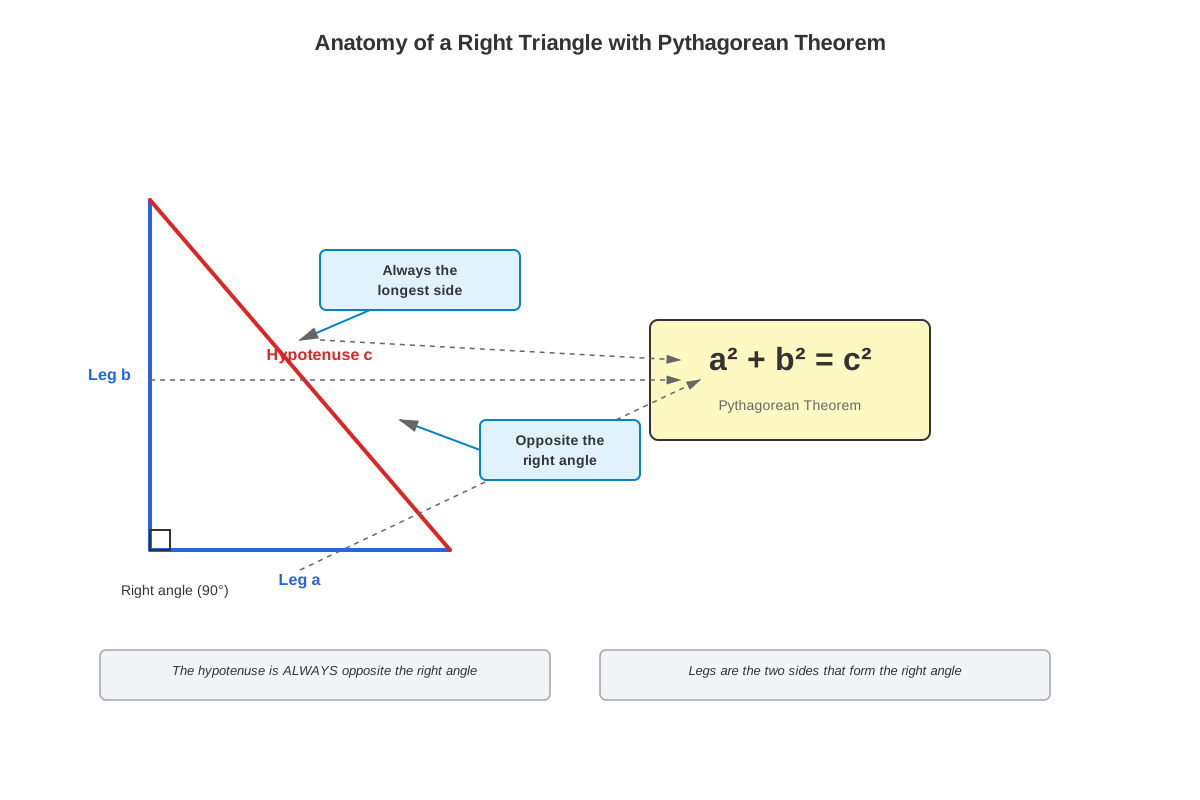
The Pythagorean theorem is the fundamental relationship in all right triangles: in a right triangle with legs of length a and b and hypotenuse of length c, the equation a² + b² = c² always holds true. The hypotenuse is always the longest side and is always opposite the right angle. The legs are the two sides that form the right angle.
a² + b² = c²This theorem allows calculation of any side length when the other two are known. For example, if a right triangle has legs of length 5 and 12, the hypotenuse can be found: 5² + 12² = c², so 25 + 144 = c², giving c² = 169, and therefore c = 13.
The converse of the Pythagorean theorem is equally important for the ACT: if three side lengths satisfy a² + b² = c² (where c is the longest side), then the triangle must be a right triangle. This allows students to verify whether a triangle is a right triangle without seeing a diagram.
Pythagorean Triples
Pythagorean triples are sets of three positive integers that satisfy the Pythagorean theorem. Recognizing these common triples dramatically increases solving speed on the ACT:
| Triple | Multiples | Example |
|---|---|---|
| 3-4-5 | 6-8-10, 9-12-15, 15-20-25 | Most common on ACT |
| 5-12-13 | 10-24-26, 15-36-39 | Second most common |
| 8-15-17 | 16-30-34 | Appears occasionally |
| 7-24-25 | 14-48-50 | Less common but useful |
When an ACT problem gives two sides of a right triangle, checking whether they're part of a Pythagorean triple before calculating can save 20-30 seconds. For instance, if legs are 9 and 12, recognizing this as 3(3-4-5) immediately gives the hypotenuse as 15 without calculation.
Special Right Triangles: 45-45-90
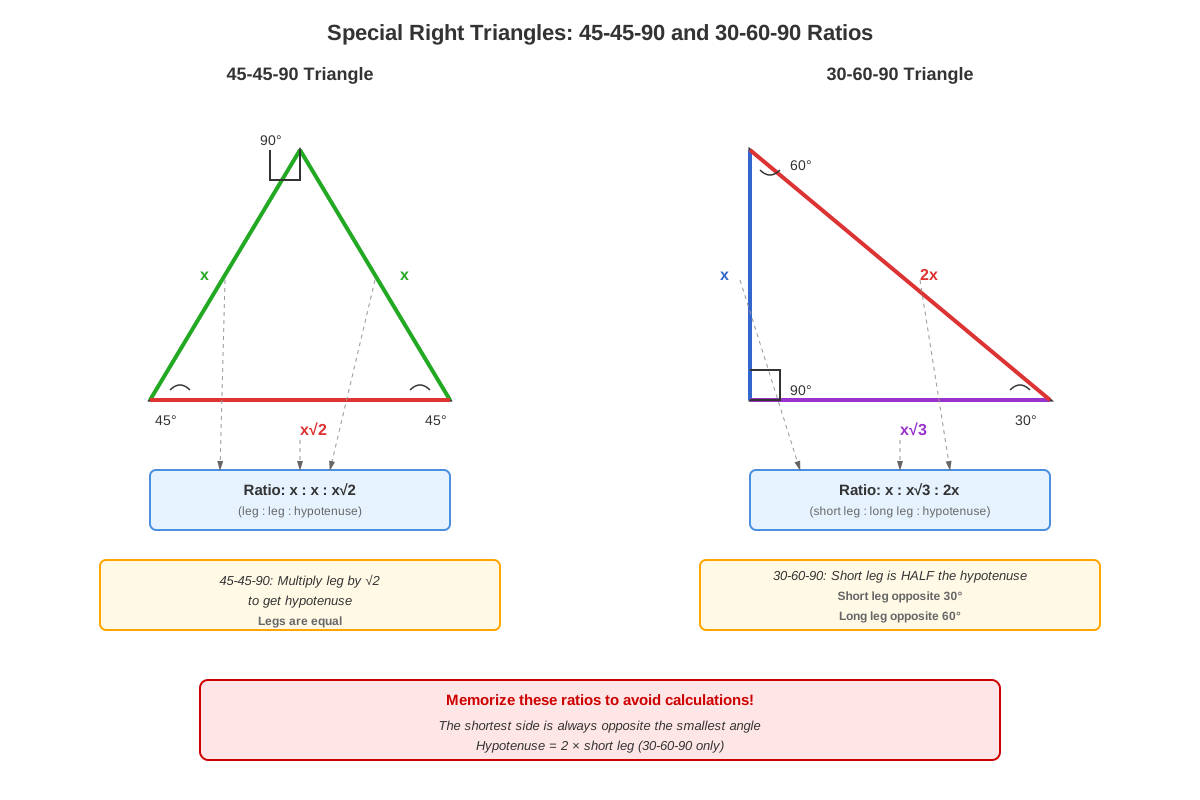
A 45-45-90 triangle is an isosceles right triangle with two 45° angles and one 90° angle. Because two angles are equal, the two legs must be equal in length. The side ratio for any 45-45-90 triangle is:
leg : leg : hypotenuse = x : x : x√2If each leg has length x, the hypotenuse has length x√2. Conversely, if the hypotenuse has length h, each leg has length h/√2 or (h√2)/2 after rationalizing.
Key applications: 45-45-90 triangles appear when a square is cut diagonally, when analyzing coordinate plane problems with slopes of 1 or -1, and in problems involving isosceles right triangles. The ACT frequently tests whether students can work backward from the hypotenuse to find the legs.
Special Right Triangles: 30-60-90
A 30-60-90 triangle results from cutting an equilateral triangle in half. The side ratio for any 30-60-90 triangle is:
short leg : long leg : hypotenuse = x : x√3 : 2xThe short leg is opposite the 30° angle, the long leg is opposite the 60° angle, and the hypotenuse is opposite the 90° angle. If the short leg has length x, the long leg has length x√3, and the hypotenuse has length 2x.
Critical relationships:
- Hypotenuse = 2 × (short leg)
- Long leg = √3 × (short leg)
- Short leg = (long leg)/√3 = (long leg × √3)/3
- Short leg = (hypotenuse)/2
The ACT loves testing whether students can identify which leg is which and work with any given side to find the others. Problems often provide the long leg or hypotenuse, requiring students to work backward.
Right Triangles in the Coordinate Plane
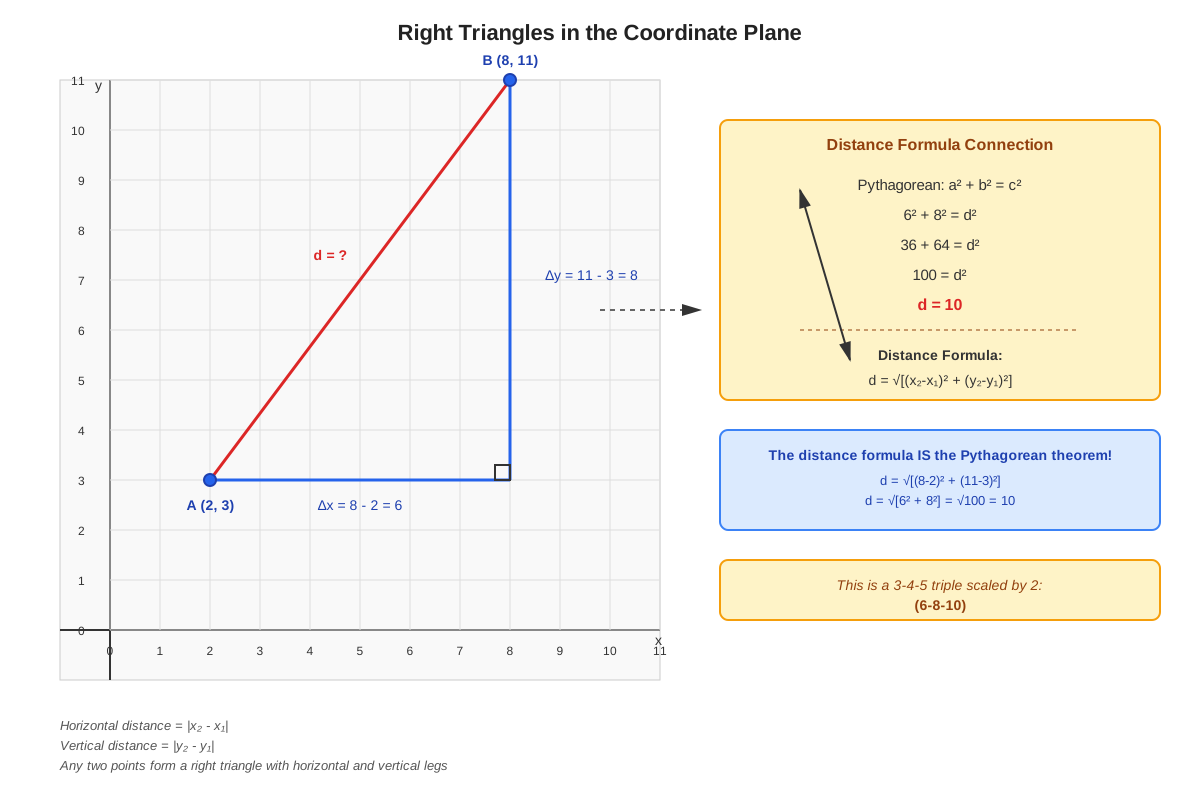
Right triangles frequently appear in coordinate geometry problems. The distance formula is actually the Pythagorean theorem applied to the coordinate plane:
d = √[(x₂ - x₁)² + (y₂ - y₁)²]When finding the distance between two points, visualize a right triangle where the horizontal distance (x₂ - x₁) and vertical distance (y₂ - y₁) are the legs, and the distance between the points is the hypotenuse.
Slope connections: When a line has slope 1 or -1, any right triangle formed with that line as the hypotenuse is a 45-45-90 triangle. When a line has slope √3 or 1/√3, 30-60-90 triangles may be involved.
Altitude to the Hypotenuse
When an altitude (perpendicular line) is drawn from the right angle to the hypotenuse, it creates two smaller right triangles that are similar to each other and to the original triangle. This geometric mean relationship appears occasionally on the ACT:
- The altitude is the geometric mean of the two segments it creates on the hypotenuse
- Each leg is the geometric mean of the hypotenuse and the adjacent hypotenuse segment
While less common than other right triangle concepts, recognizing this relationship can unlock certain difficult problems.
Concept Relationships
The Pythagorean theorem serves as the foundation from which all other right triangle concepts derive. Pythagorean triples are specific integer solutions to the Pythagorean theorem that allow for rapid mental calculation. Special right triangles (45-45-90 and 30-60-90) are specific cases where angle measures create predictable side ratios, offering an alternative to Pythagorean calculations.
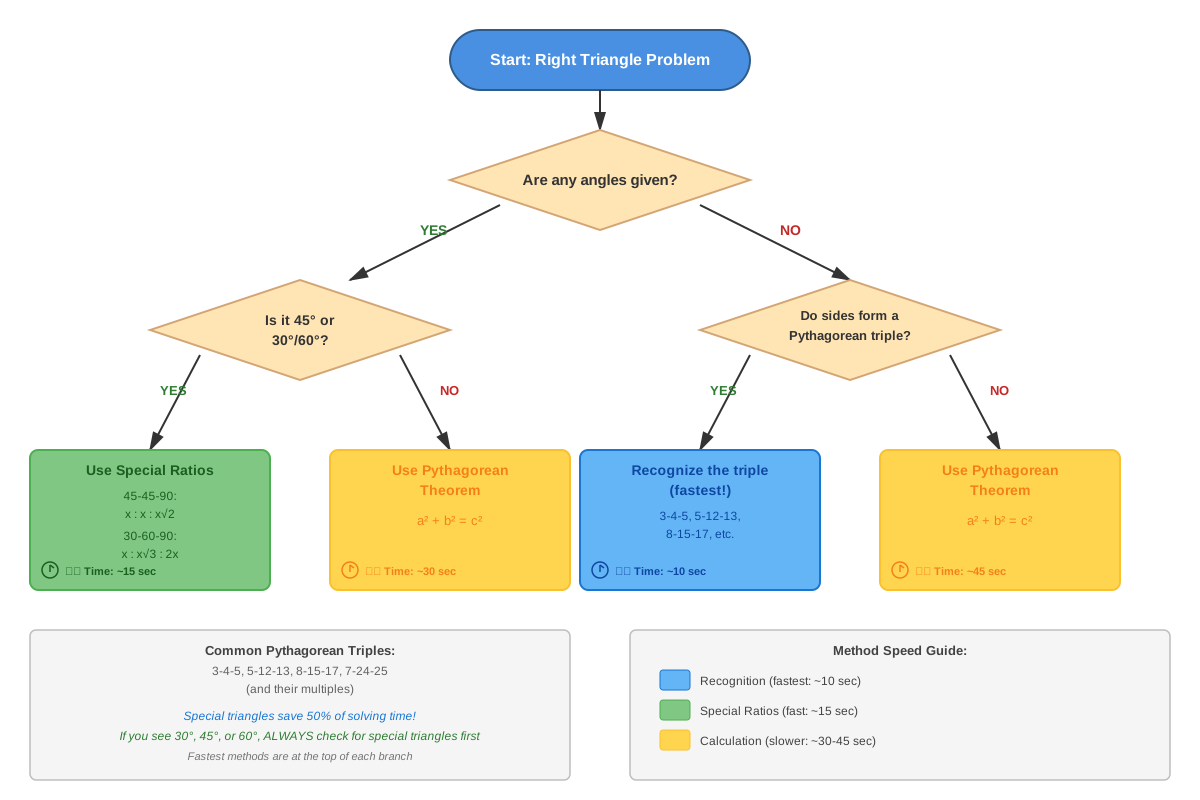
The relationship flow: Basic right triangle properties → Pythagorean theorem → branches into two paths: (1) Pythagorean triples for integer solutions, and (2) Special right triangles for angle-based solutions. Both paths converge when applied to coordinate plane problems, where right triangles become the tool for calculating distances and analyzing geometric figures.
Trigonometric ratios (sine, cosine, tangent) extend right triangle concepts by relating angles to side ratios, creating another problem-solving pathway. The choice between using the Pythagorean theorem, special triangle ratios, or trigonometry depends on what information is given and what the question asks.
Area calculations connect to right triangles through the formula Area = (1/2) × base × height, where the two legs of a right triangle serve as base and height. This relationship links right triangles to broader geometry concepts tested on the ACT.
Quick check — test yourself on Right triangles so far.
Try Flashcards →High-Yield Facts
⭐ The Pythagorean theorem (a² + b² = c²) applies to every right triangle, where c is always the hypotenuse
⭐ The 3-4-5 triangle and its multiples (6-8-10, 9-12-15, etc.) are the most common Pythagorean triples on the ACT
⭐ In a 45-45-90 triangle, if each leg is x, the hypotenuse is x√2
⭐ In a 30-60-90 triangle, the sides are in ratio x : x√3 : 2x (short leg : long leg : hypotenuse)
⭐ The hypotenuse is always the longest side of a right triangle and is always opposite the 90° angle
- The 5-12-13 triangle is the second most common Pythagorean triple tested on the ACT
- If three side lengths satisfy a² + b² = c², the triangle must be a right triangle (converse of Pythagorean theorem)
- The area of a right triangle equals (1/2) × leg₁ × leg₂, using the two legs as base and height
- In a 30-60-90 triangle, the hypotenuse is always exactly twice the length of the short leg
- When a square's diagonal is drawn, it creates two 45-45-90 triangles
- The distance formula in coordinate geometry is the Pythagorean theorem in disguise
- If a right triangle has one leg equal to the hypotenuse divided by 2, it must be a 30-60-90 triangle
Common Misconceptions
Misconception: The hypotenuse can be any side of a right triangle → Correction: The hypotenuse is always the longest side and must be opposite the 90° angle. In the Pythagorean theorem, c must represent the hypotenuse, not just any side.
Misconception: In a 30-60-90 triangle, the side opposite 30° is the longest → Correction: The side opposite 30° is the shortest leg. The side opposite 60° is the longer leg, and the side opposite 90° (the hypotenuse) is the longest.
Misconception: The Pythagorean theorem works for all triangles → Correction: The Pythagorean theorem only applies to right triangles. For other triangles, the Law of Cosines must be used instead.
Misconception: In a 45-45-90 triangle, all three sides are equal → Correction: The two legs are equal, but the hypotenuse is √2 times longer than each leg. If legs are 5, the hypotenuse is 5√2, not 5.
Misconception: When using a² + b² = c², any two sides can be a and b → Correction: The variables a and b must represent the two legs (shorter sides), while c must always represent the hypotenuse (longest side). Mixing these up produces incorrect answers.
Misconception: Special right triangle ratios only work when sides are whole numbers → Correction: The ratios work for any measurements. If a 30-60-90 triangle has a short leg of 2.5, the long leg is 2.5√3 and the hypotenuse is 5.
Misconception: √(a² + b²) equals a + b → Correction: The square root of a sum is not the sum of the square roots. √(9 + 16) = √25 = 5, not 3 + 4 = 7. This algebraic error frequently appears in right triangle problems.
Worked Examples
Example 1: Multi-Step Problem with Special Triangles
Problem: In the coordinate plane, point A is at (0, 0) and point B is at (6, 6). Point C is directly below point B on the x-axis. What is the perimeter of triangle ABC?
Solution:
Step 1: Visualize and identify the triangle type
Point A is at the origin, point C is at (6, 0) since it's directly below B on the x-axis, and point B is at (6, 6). Drawing this creates a right triangle with the right angle at C.
Step 2: Find the leg lengths
- AC (horizontal leg) = 6 - 0 = 6
- BC (vertical leg) = 6 - 0 = 6
Step 3: Recognize the special triangle
Since both legs equal 6, this is a 45-45-90 triangle. Using the ratio x : x : x√2, where x = 6:
- AB (hypotenuse) = 6√2
Step 4: Calculate perimeter
Perimeter = AC + BC + AB = 6 + 6 + 6√2 = 12 + 6√2
Alternative approach using Pythagorean theorem:
AB² = 6² + 6² = 36 + 36 = 72
AB = √72 = √(36 × 2) = 6√2
Both methods yield the same answer, but recognizing the 45-45-90 triangle is faster.
Connection to learning objectives: This problem tests the ability to identify right triangles in coordinate geometry contexts and apply special triangle ratios efficiently.
Example 2: Pythagorean Triple Recognition
Problem: A ladder leans against a wall, reaching 24 feet high. The base of the ladder is 7 feet from the wall. What is the length of the ladder?
Solution:
Step 1: Identify the right triangle
The wall, ground, and ladder form a right triangle where:
- One leg (height on wall) = 24 feet
- Other leg (distance from wall) = 7 feet
- Hypotenuse (ladder length) = unknown
Step 2: Check for Pythagorean triple
The numbers 7 and 24 should trigger recognition of the 7-24-25 triple. Since we have legs of 7 and 24, the hypotenuse must be 25.
Step 3: Verify if needed
7² + 24² = 49 + 576 = 625 = 25² ✓
Answer: The ladder is 25 feet long.
Time comparison: Recognizing the triple takes 5-10 seconds. Calculating from scratch takes 30-40 seconds.
Connection to learning objectives: This demonstrates identifying when right triangles are being tested in word problems and applying efficient strategies (triple recognition) for ACT-style questions.
Exam Strategy
Trigger words and phrases that signal right triangle problems:
- "perpendicular," "right angle," "90 degrees"
- "distance between two points" (coordinate plane)
- "diagonal" (of rectangles or squares)
- "ladder against a wall," "height and shadow"
- "isosceles right triangle" (signals 45-45-90)
- "equilateral triangle cut in half" (signals 30-60-90)
Approach sequence for maximum efficiency:
- Identify the right triangle (5 seconds): Look for the 90° angle marker or perpendicular indicators. In coordinate problems, visualize the horizontal and vertical legs.
- Determine what's given and what's needed (5 seconds): Label known sides and angles. Identify whether you're finding a leg or the hypotenuse.
- Check for special triangles first (10 seconds): Look for equal legs (45-45-90), angles of 30° or 60° (30-60-90), or ratios that match special triangles.
- Check for Pythagorean triples second (5 seconds): If two sides are given, see if they match a common triple before calculating.
- Use Pythagorean theorem as backup (20-30 seconds): If no shortcuts apply, calculate using a² + b² = c².
Process of elimination tips:
- Eliminate answers where the hypotenuse is shorter than a given leg
- Eliminate answers that don't match special triangle ratios when angles are given
- For "could this be a right triangle?" questions, test whether a² + b² = c² using the largest value as c
- When answers include radicals, eliminate those that don't simplify correctly
Time allocation: Budget 45-60 seconds for straightforward right triangle problems, 60-90 seconds for multi-step problems involving coordinate geometry or multiple triangles. If a problem takes longer than 90 seconds, mark it and return later.
ACT Tip: When a diagram isn't drawn to scale (or no diagram is provided), sketch your own. Drawing a quick right triangle with labeled sides prevents errors and clarifies the problem structure.
Memory Techniques
Pythagorean Theorem Mnemonic: "A squared plus B squared equals C squared, where C is the Climb (hypotenuse—the side you'd climb up)"
Special Triangle Ratios:
- 45-45-90: "X, X, X-tra root 2" (the hypotenuse has the "extra" √2)
- 30-60-90: "1, root 3, 2" (memorize the simplest ratio, then multiply by x)
Remembering which leg is which in 30-60-90 triangles: "Small angle (30°) sees small side; big angle (60°) sees big side (the one with √3)"
Common Pythagorean Triples: "3-4-5 is alive, 5-12-13 is in heaven, 8-15-17 is in between"
Visualization for coordinate plane: Picture a right triangle with horizontal and vertical legs whenever you see two points. The horizontal leg is the difference in x-coordinates, the vertical leg is the difference in y-coordinates.
Hypotenuse identification: "Hypotenuse has the most letters, so it's the longest side"
Summary
Right triangles represent one of the highest-yield topics on the ACT Math section, appearing in 10-15% of questions either directly or embedded within other concepts. Mastery requires fluency with three core approaches: the Pythagorean theorem (a² + b² = c²), recognition of Pythagorean triples (especially 3-4-5 and 5-12-13), and instant application of special right triangle ratios (45-45-90 with sides x : x : x√2, and 30-60-90 with sides x : x√3 : 2x). The key to ACT success is recognizing which approach offers the fastest solution path—checking for special triangles and Pythagorean triples before resorting to calculation saves crucial time. Right triangles connect to coordinate geometry through the distance formula, to trigonometry through angle-side relationships, and to broader geometry through area and perimeter calculations. Students who can quickly identify right triangle problems, select the optimal solution strategy, and execute accurately will gain a significant competitive advantage on test day.
Key Takeaways
- The Pythagorean theorem (a² + b² = c²) is the foundation for all right triangle problems, but special triangles and triples often provide faster solutions
- The 3-4-5 and 5-12-13 Pythagorean triples and their multiples appear frequently; recognizing them saves 20-30 seconds per problem
- 45-45-90 triangles have sides in ratio x : x : x√2, while 30-60-90 triangles have sides in ratio x : x√3 : 2x
- The hypotenuse is always the longest side and always opposite the 90° angle—never assign it to variable c incorrectly
- Right triangle concepts underpin coordinate geometry distance problems, making them essential for multiple question types
- Always check for special triangles and Pythagorean triples before calculating with the Pythagorean theorem
- Drawing a quick sketch clarifies the problem structure and prevents errors, especially when diagrams aren't provided
Related Topics
Trigonometric Ratios (SOH-CAH-TOA): Building on right triangle foundations, trigonometry uses sine, cosine, and tangent to relate angles to side ratios, providing another powerful tool for solving right triangle problems when angles are involved.
Coordinate Geometry: The distance formula and midpoint formula both rely on right triangle concepts, making mastery of right triangles essential for coordinate plane problems.
Similar Triangles: Right triangles with the same angles are similar, and understanding similarity ratios extends right triangle problem-solving to more complex scenarios.
Circle Geometry: Radii perpendicular to chords, tangent lines, and inscribed angles often create right triangles within circle problems, making right triangle skills essential for advanced geometry.
Three-Dimensional Geometry: Finding space diagonals in rectangular prisms and calculating surface distances requires applying the Pythagorean theorem in three dimensions.
Practice CTA
Now that you've mastered the core concepts of right triangles, it's time to solidify your understanding through practice. Work through the practice questions to test your ability to recognize right triangle problems, select efficient solution strategies, and execute accurately under time pressure. Use the flashcards to drill the special triangle ratios and Pythagorean triples until they become automatic. Remember: recognizing a 30-60-90 triangle or 5-12-13 triple in 5 seconds rather than calculating for 30 seconds can be the difference between finishing the ACT Math section comfortably and running out of time. You've got this—practice makes permanent!
Sign up free to keep reading
Create a free AnvayaPrep account to finish this ACT guide on Right triangles — plus flashcards and practice questions.