Overview
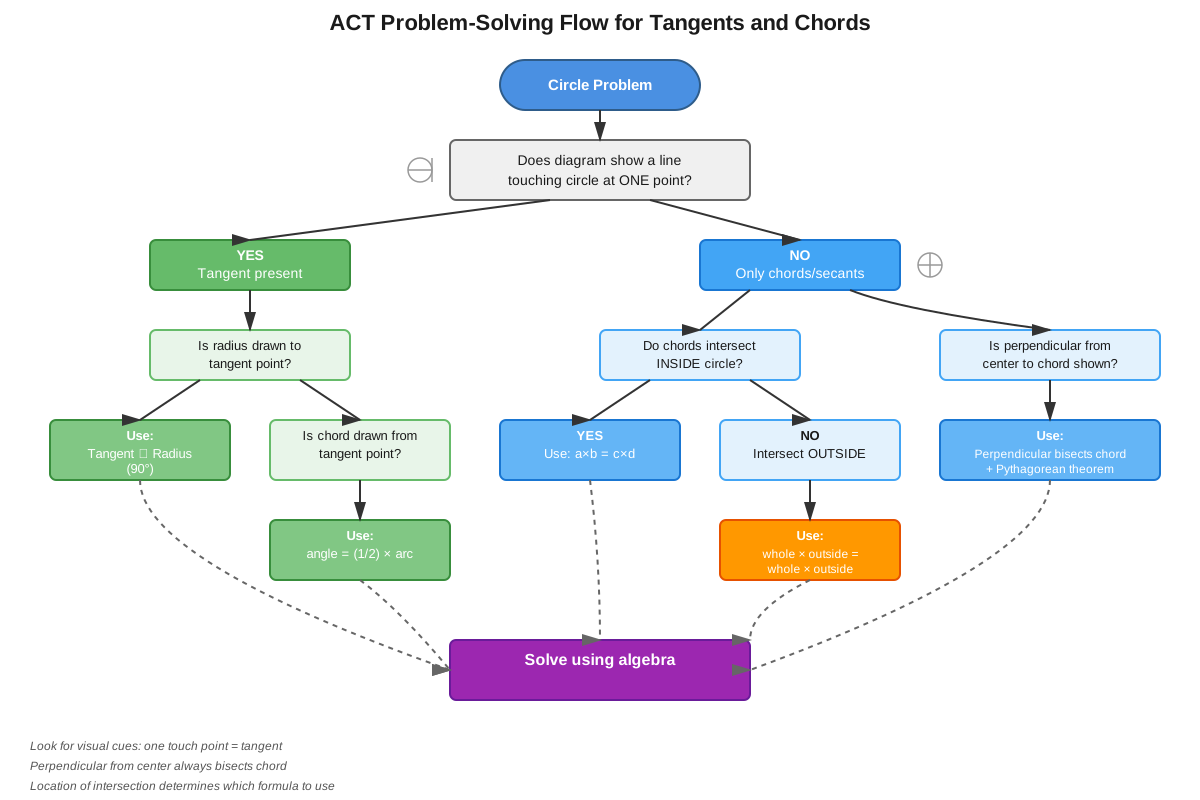
Tangents and chords represent fundamental geometric relationships that appear consistently on the ACT Math test. These concepts involve the interaction between lines and circles, specifically how lines can touch circles at exactly one point (tangents) or intersect circles at two points (chords). Understanding these relationships requires mastery of angle measurements, arc lengths, and the special properties that emerge when these elements interact. The ACT frequently tests these concepts through multi-step problems that combine circle properties with algebraic reasoning and coordinate geometry.
Mastering ACT tangents and chords is essential because these questions often appear in the higher-difficulty range of the Math section, typically in questions 40-60. Students who can quickly identify tangent-chord relationships and apply the appropriate theorems gain a significant advantage in both accuracy and time management. These problems frequently integrate multiple geometric concepts, making them ideal for testing mathematical reasoning and problem-solving skills that the ACT values.
The study of tangents and chords connects directly to broader circle geometry, including central angles, inscribed angles, and arc measures. These concepts also bridge to coordinate geometry when circles are placed on the coordinate plane, and to right triangle trigonometry when tangent lines create perpendicular relationships with radii. A solid understanding of tangents and chords provides the foundation for solving complex geometric proofs and real-world applications involving circular motion, engineering designs, and architectural structures.
Learning Objectives
- [ ] Identify when tangents and chords is being tested in ACT Math questions
- [ ] Explain the core rule or strategy behind tangents and chords relationships
- [ ] Apply tangents and chords concepts to ACT-style questions accurately
- [ ] Calculate chord lengths using perpendicular bisector properties and the Pythagorean theorem
- [ ] Determine angle measures formed by tangent lines and chords at points of tangency
- [ ] Solve problems involving multiple chords intersecting inside or outside a circle
- [ ] Apply the power of a point theorem to find segment lengths in complex configurations
Prerequisites
- Circle basics: Understanding radius, diameter, circumference, and area is essential because tangents and chords are defined by their relationship to these fundamental circle elements
- Right triangle properties: The Pythagorean theorem and special right triangles are frequently used when tangent lines create perpendicular relationships with radii
- Angle relationships: Knowledge of complementary, supplementary, and vertical angles helps when analyzing angles formed by tangents and chords
- Arc measures: Understanding how arcs relate to central and inscribed angles is necessary for solving problems involving chord-angle relationships
- Basic algebra: Solving equations and systems of equations is required when setting up relationships between unknown lengths and angles
Why This Topic Matters
In real-world applications, tangent and chord relationships appear in engineering designs, architectural structures, and mechanical systems. Gears and pulleys use tangent lines to transfer motion between circular components. Bridge designs incorporate chord lengths to calculate structural support requirements. Satellite dishes and radio telescopes use tangent-chord geometry to optimize signal reception. Understanding these relationships enables professionals to design efficient circular pathways, calculate optimal viewing angles, and determine precise measurements in circular structures.
On the ACT Math test, tangent and chord problems appear in approximately 2-4 questions per exam, representing roughly 3-7% of the total Math section. These questions typically fall in the medium to difficult range and often combine multiple geometric concepts in a single problem. The ACT tests these concepts through direct calculation problems, multi-step reasoning questions, and coordinate geometry applications. Questions may ask students to find lengths, angles, or areas, or to identify relationships between multiple geometric elements.
Common question formats include: finding the length of a tangent segment from an external point, calculating chord lengths when given the radius and distance from center, determining angles formed by intersecting chords, and solving for unknown values in figures with multiple tangent lines. The ACT also tests these concepts through word problems involving circular objects, coordinate plane applications where students must identify tangent lines to circles, and complex figures requiring multiple theorem applications.
Core Concepts
Tangent Line Properties
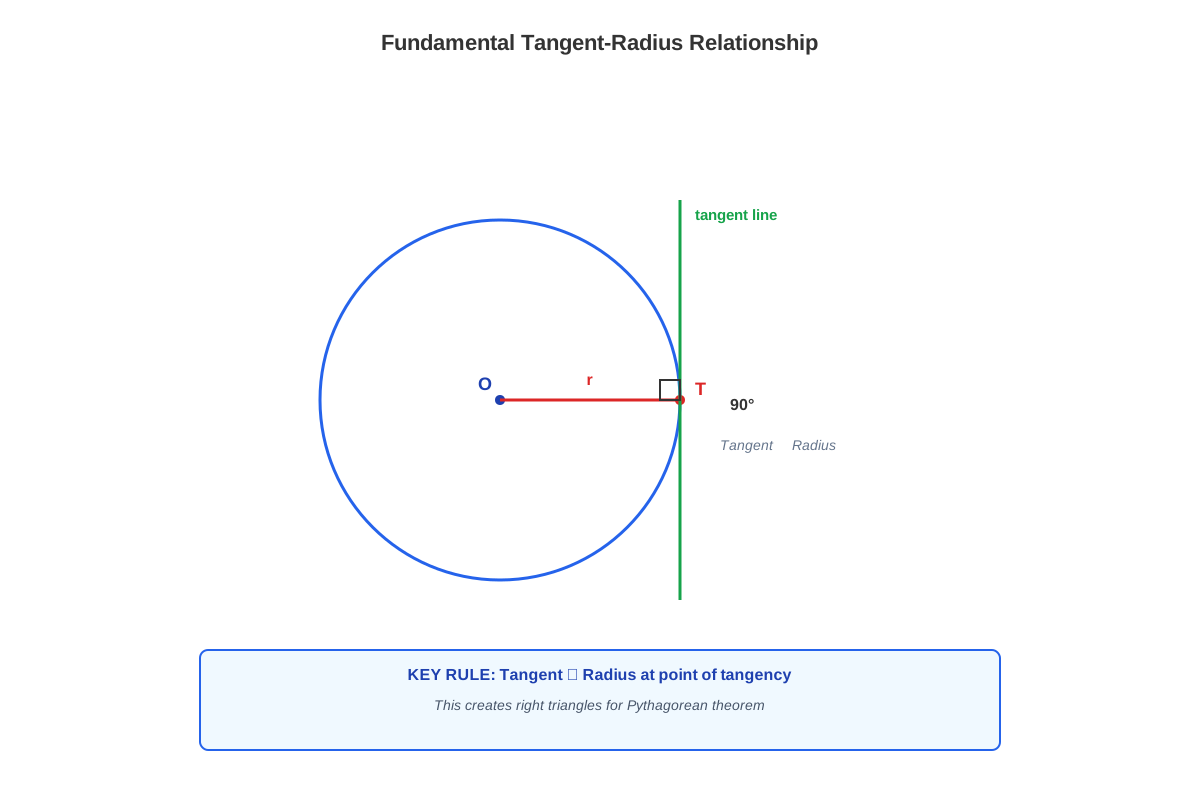
A tangent line is a line that intersects a circle at exactly one point, called the point of tangency. The most fundamental property of tangent lines is that a tangent line is always perpendicular to the radius drawn to the point of tangency. This perpendicular relationship creates a right angle (90°) and is the basis for most tangent-related problem solving on the ACT.
When two tangent segments are drawn from the same external point to a circle, these segments are congruent (equal in length). This property allows students to set up equations when solving for unknown lengths. For example, if point P is outside a circle and tangent segments PA and PB touch the circle at points A and B respectively, then PA = PB.
The relationship between a tangent line and a radius creates opportunities to apply the Pythagorean theorem. When given the radius of a circle and the distance from the center to an external point, students can calculate the length of the tangent segment by recognizing the right triangle formed by the radius, the tangent segment, and the line connecting the center to the external point.
Chord Properties
A chord is a line segment whose endpoints both lie on a circle. The diameter is the longest possible chord and passes through the center of the circle. Understanding chord properties requires recognizing several key relationships that the ACT tests regularly.
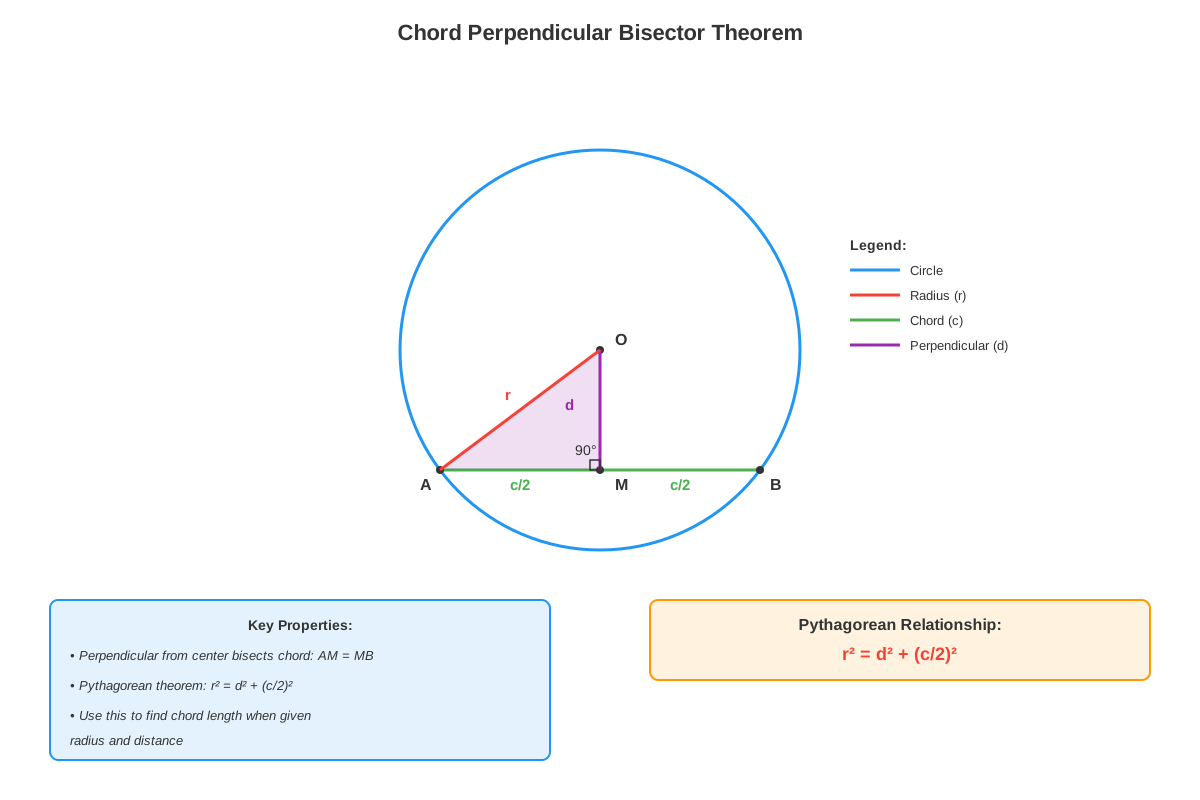
When a radius (or any line through the center) is perpendicular to a chord, it bisects that chord into two equal segments. This perpendicular bisector property is one of the most frequently tested chord concepts. Conversely, the perpendicular bisector of any chord passes through the center of the circle. This creates right triangles that can be solved using the Pythagorean theorem, where the radius is the hypotenuse, half the chord length is one leg, and the distance from the center to the chord is the other leg.
Congruent chords (chords of equal length) are equidistant from the center of the circle. This means that if two chords have the same length, the perpendicular distances from the center to each chord are equal. The converse is also true: chords that are equidistant from the center have equal lengths.
Angles Formed by Chords
When two chords intersect inside a circle, they create angles whose measures relate to the arcs they intercept. The measure of an angle formed by two intersecting chords equals half the sum of the intercepted arcs. If chords AB and CD intersect at point E inside the circle, then the measure of angle AEC equals (arc AC + arc BD)/2.
This relationship extends to secants (lines that intersect a circle at two points) and tangents intersecting outside the circle. When two secants, two tangents, or a secant and tangent intersect at a point outside the circle, the angle formed equals half the difference of the intercepted arcs. Understanding whether to add or subtract arc measures depends on recognizing whether the intersection point is inside or outside the circle.
Power of a Point Theorem
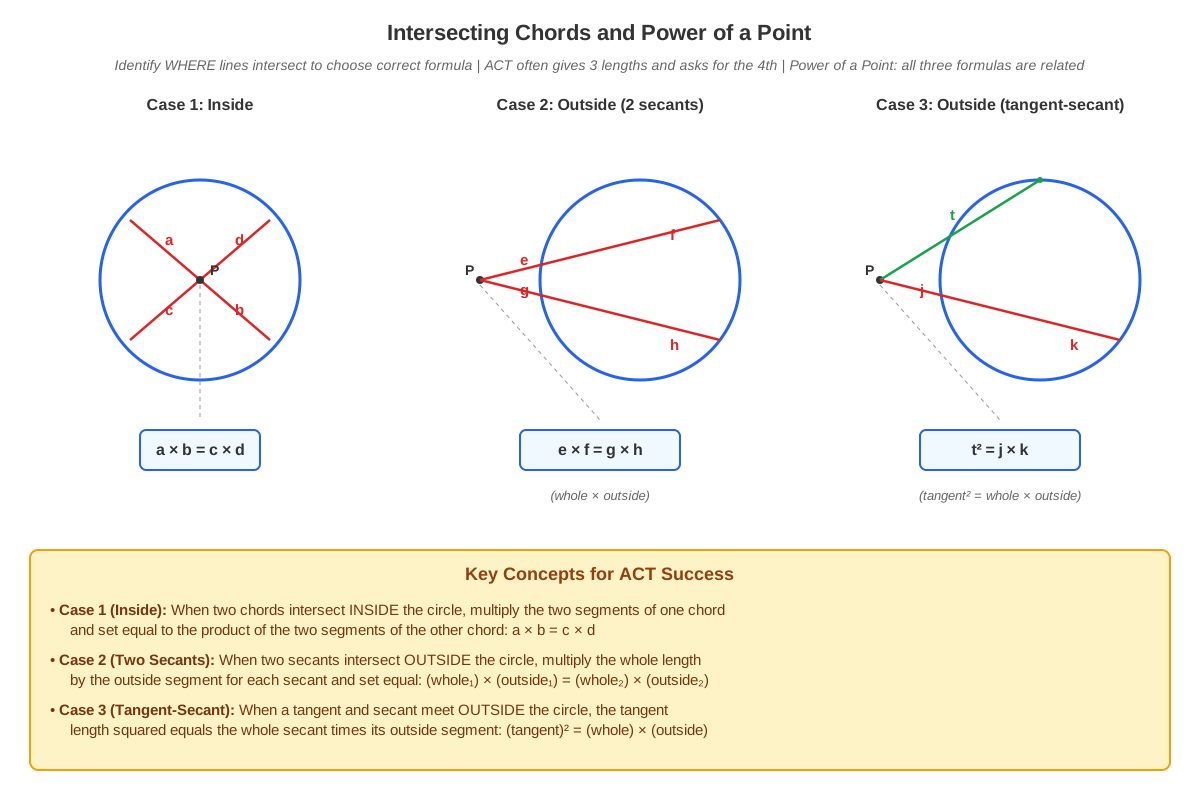
The power of a point theorem describes relationships between segment lengths when chords, secants, or tangents intersect. When two chords intersect inside a circle at point P, creating segments PA, PB, PC, and PD, the products of the segments are equal: PA × PB = PC × PD. This relationship allows students to solve for unknown lengths when three of the four segments are known.
For secants drawn from an external point, if one secant intersects the circle at points A and B (with A closer to the external point P), and another secant intersects at points C and D (with C closer to P), then PA × PB = PC × PD. The entire length from the external point to the far intersection is multiplied by the length from the external point to the near intersection.
When a tangent and secant are drawn from the same external point, the square of the tangent length equals the product of the secant segments: (tangent)² = (near distance) × (far distance).
Tangent-Chord Angles
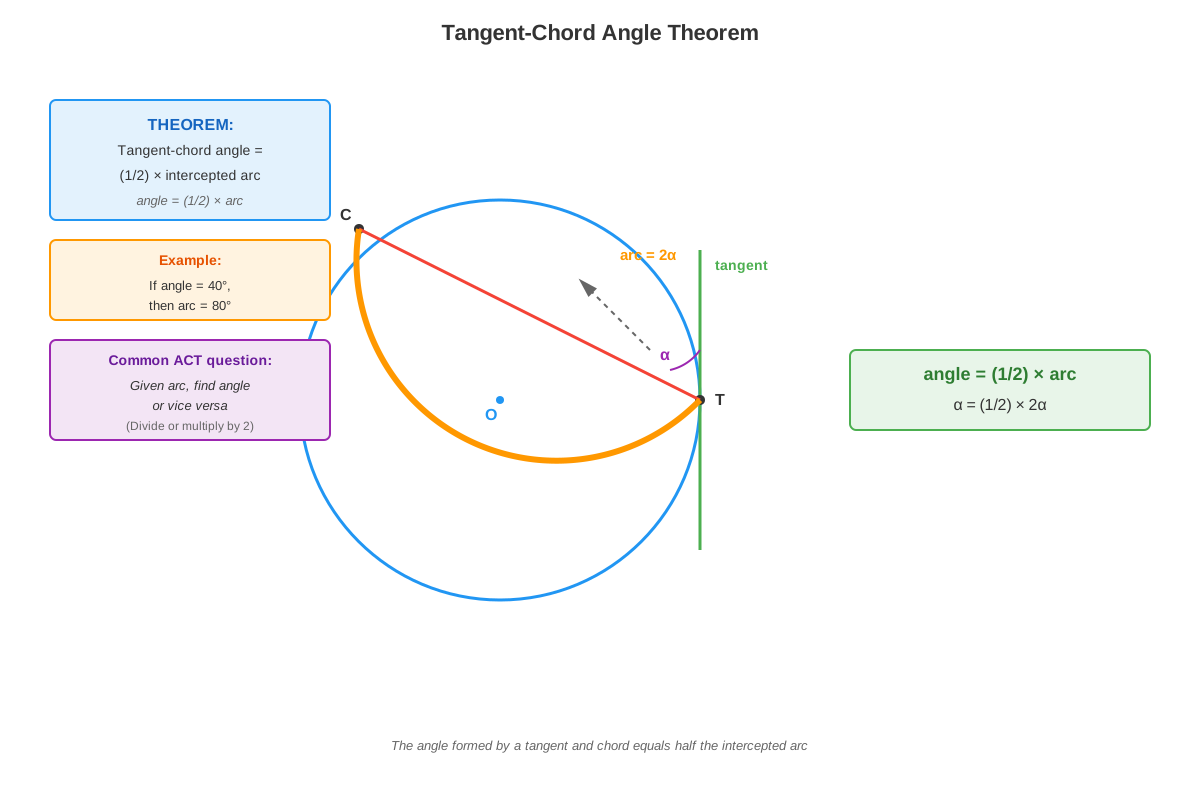
When a tangent line and a chord meet at a point on the circle, they form an angle whose measure equals half the measure of the intercepted arc. This is similar to an inscribed angle but involves a tangent line instead of two chords. If tangent line PT touches the circle at point T, and chord TA extends from the point of tangency, then angle PTA equals (arc TA)/2.
This relationship is particularly useful when combined with other angle relationships in complex figures. The ACT often creates problems where students must identify multiple angle relationships to find unknown measures, requiring recognition of tangent-chord angles alongside inscribed angles and central angles.
Concept Relationships
The core concepts of tangents and chords build upon each other in a logical progression. The perpendicular relationship between tangents and radii serves as the foundation → this creates right triangles → which enables application of the Pythagorean theorem → leading to calculations of tangent segment lengths. Similarly, the perpendicular bisector property of chords → creates right triangles with the radius as hypotenuse → allowing chord length calculations through the Pythagorean theorem.
Angle relationships connect through arc measures: central angles → define arc measures → which determine inscribed angles → and tangent-chord angles → all relating back to the same intercepted arcs. The power of a point theorem unifies chord intersections, secant intersections, and tangent-secant combinations under a single multiplicative relationship.
These concepts connect to prerequisite knowledge through right triangle geometry (Pythagorean theorem applications), angle relationships (using supplementary and complementary angles), and algebraic equation solving (setting up and solving for unknowns). They extend forward to coordinate geometry (finding tangent lines to circles on the coordinate plane), trigonometry (using sine, cosine, and tangent with circular relationships), and calculus (where tangent lines represent instantaneous rates of change).
High-Yield Facts
- ⭐ A tangent line is always perpendicular to the radius at the point of tangency, forming a 90° angle
- ⭐ Two tangent segments drawn from the same external point to a circle are congruent (equal in length)
- ⭐ A radius perpendicular to a chord bisects that chord into two equal segments
- ⭐ When two chords intersect inside a circle, the angle formed equals half the sum of the intercepted arcs
- ⭐ The power of a point: for intersecting chords, PA × PB = PC × PD
- Congruent chords are equidistant from the center of the circle
- The perpendicular bisector of any chord passes through the center of the circle
- When a tangent and chord meet at a point on the circle, the angle equals half the intercepted arc
- For two secants from an external point: (whole length 1) × (external part 1) = (whole length 2) × (external part 2)
- For a tangent and secant from the same external point: (tangent length)² = (external part) × (whole secant length)
- When two tangents, two secants, or a tangent and secant intersect outside a circle, the angle equals half the difference of the intercepted arcs
- The longest chord in any circle is the diameter
- If a line is tangent to a circle, it touches the circle at exactly one point
- In a circle, equal arcs correspond to equal chords (when the arcs are in the same circle or congruent circles)
Quick check — test yourself on Tangents and chords so far.
Try Flashcards →Common Misconceptions
Misconception: A tangent line can intersect a circle at two points if the circle is large enough → Correction: By definition, a tangent line intersects a circle at exactly one point. A line intersecting at two points is called a secant, not a tangent.
Misconception: Any line perpendicular to a chord passes through the center of the circle → Correction: Only the perpendicular bisector of a chord passes through the center. A line can be perpendicular to a chord without bisecting it, and such a line will not pass through the center.
Misconception: When chords intersect, you always add the arc measures to find the angle → Correction: You add arc measures only when the intersection is inside the circle. When lines intersect outside the circle, you subtract the arc measures and divide by two.
Misconception: The tangent segment length equals the radius of the circle → Correction: The tangent segment length depends on the distance from the external point to the center and the radius, related through the Pythagorean theorem: (tangent)² + (radius)² = (distance from center to external point)².
Misconception: All chords are equidistant from the center → Correction: Only congruent chords (chords of equal length) are equidistant from the center. Different chord lengths have different distances from the center, with longer chords being closer to the center.
Misconception: The power of a point theorem only applies to chords → Correction: The power of a point theorem applies to chords intersecting inside a circle, secants intersecting outside a circle, and combinations of tangents and secants from external points, each with appropriate formulations.
Worked Examples
Example 1: Finding Tangent Length
Problem: Circle O has a radius of 5 cm. Point P is located 13 cm from the center O. A tangent line from P touches the circle at point T. What is the length of segment PT?
Solution:
Step 1: Recognize that the tangent line PT is perpendicular to radius OT at the point of tangency. This creates a right triangle OPT.
Step 2: Identify the components of the right triangle:
- OT (radius) = 5 cm
- OP (distance from center to external point) = 13 cm
- PT (tangent segment) = unknown
Step 3: Apply the Pythagorean theorem where OP is the hypotenuse:
OP² = OT² + PT²
13² = 5² + PT²
169 = 25 + PT²
PT² = 144
PT = 12 cmAnswer: The tangent segment PT has length 12 cm.
Connection to Learning Objectives: This problem demonstrates identifying tangent relationships (perpendicular to radius), explaining the core strategy (using right triangle properties), and applying the concept accurately to find an unknown length.
Example 2: Intersecting Chords and Arc Measures
Problem: In circle C, chord AB and chord DE intersect at point F inside the circle. Arc AD measures 80°, and arc BE measures 60°. What is the measure of angle AFD?
Solution:
Step 1: Recognize that when two chords intersect inside a circle, the angle formed equals half the sum of the intercepted arcs.
Step 2: Identify which arcs are intercepted by angle AFD. The angle AFD intercepts arc AD and arc BE (the arcs that are "across from each other" relative to the intersection point).
Step 3: Apply the formula for angles formed by intersecting chords:
Angle AFD = (arc AD + arc BE) / 2
Angle AFD = (80° + 60°) / 2
Angle AFD = 140° / 2
Angle AFD = 70°Answer: Angle AFD measures 70°.
Connection to Learning Objectives: This problem requires identifying when chord-angle relationships are being tested, explaining the rule (half the sum of intercepted arcs for interior intersections), and accurately applying the formula to find the angle measure.
Example 3: Chord Length Using Perpendicular Bisector
Problem: In circle O with radius 10 inches, a chord AB is located 6 inches from the center. What is the length of chord AB?
Solution:
Step 1: Draw a perpendicular line from center O to chord AB, meeting the chord at point M. This perpendicular bisects the chord, so AM = MB.
Step 2: Recognize that triangle OMA is a right triangle where:
- OM (distance from center to chord) = 6 inches
- OA (radius) = 10 inches
- AM (half the chord length) = unknown
Step 3: Apply the Pythagorean theorem:
OA² = OM² + AM²
10² = 6² + AM²
100 = 36 + AM²
AM² = 64
AM = 8 inches
Step 4: Since M bisects chord AB, the full chord length is:
AB = 2 × AM = 2 × 8 = 16 inchesAnswer: Chord AB has length 16 inches.
Connection to Learning Objectives: This demonstrates the perpendicular bisector property of chords and shows how to calculate chord lengths using the Pythagorean theorem in the right triangle formed.
Exam Strategy
When approaching ACT questions on tangents and chords, begin by carefully examining the diagram and identifying all given information. Mark right angles where tangent lines meet radii, label congruent segments when two tangents extend from the same external point, and identify the location of intersection points (inside or outside the circle) for chord and secant problems.
Trigger words and phrases to watch for include: "tangent to the circle," "perpendicular to the chord," "intersect inside/outside the circle," "from an external point," "point of tangency," and "distance from the center." When you see "tangent," immediately look for or draw the radius to the point of tangency and mark the right angle. When you see "chord" with "perpendicular," expect to use the bisector property and set up a right triangle.
For process of elimination, recognize that tangent lengths from the same external point must be equal, so eliminate any answer choice that violates this property. When calculating angles formed by intersecting chords or secants, remember that angles inside the circle use addition of arcs while angles outside use subtraction—eliminate answers that use the wrong operation. If a problem involves the Pythagorean theorem with a radius, eliminate answers that are larger than the diameter or that don't satisfy the theorem.
Time allocation for these problems should be approximately 60-90 seconds for straightforward applications of a single property (like finding a tangent length with given radius and distance) and 90-120 seconds for multi-step problems involving multiple concepts (like finding an angle that requires calculating arc measures from multiple chord relationships). If a problem requires more than two minutes, mark it for review and move on—these problems often have a key insight that becomes clearer on a second look.
Set up equations systematically: write down the relevant theorem or property, substitute known values, and solve algebraically. For complex figures with multiple tangents or chords, label all segments with variables and look for relationships that create equations. The ACT rewards organized problem-solving, so showing clear logical steps (even in scratch work) reduces errors.
Memory Techniques
TRAP for tangent properties:
- Tangent touches at one point
- Right angle with radius
- Always perpendicular
- Pair from external point are equal
BISECT for chord properties:
- Bisected by perpendicular from center
- Inside creates right triangles
- Same length means same distance from center
- Equal chords, equal distances
- Center lies on perpendicular bisector
- Two halves are congruent
For angle relationships, visualize "IN-ADD, OUT-SUBTRACT": when the intersection is INside the circle, ADD the arcs and divide by 2; when the intersection is OUTside the circle, SUBTRACT the arcs and divide by 2.
For the power of a point theorem, remember "MULTIPLY ACROSS": when chords or secants intersect, multiply the two segments on one line and set equal to the product of the two segments on the other line. Visualize an "X" shape and multiply along each arm.
Create a mental image of a circle with a tangent line forming a "T" shape with the radius—the perpendicular relationship is literally built into the letter T. For chords, visualize a ladder (chord) with a rope (perpendicular from center) hanging down to the middle rung—the rope always hits the center of the ladder.
Summary
Tangents and chords represent essential circle geometry relationships tested consistently on the ACT Math section. The fundamental principle that tangent lines are perpendicular to radii at points of tangency creates right triangles that enable length calculations through the Pythagorean theorem. Two tangent segments from the same external point are always congruent, providing a powerful tool for setting up equations. Chords exhibit the perpendicular bisector property: when a line from the center is perpendicular to a chord, it bisects that chord, again creating right triangles for calculation. Angle measures formed by intersecting chords, secants, and tangents relate directly to intercepted arc measures, with interior intersections using the sum of arcs and exterior intersections using the difference. The power of a point theorem unifies these relationships through multiplicative properties of segment lengths. Mastering these concepts requires recognizing which property applies to each configuration, setting up appropriate equations, and executing calculations accurately. Success on ACT tangent and chord problems depends on identifying the geometric relationships present, applying the correct theorem or property, and using algebraic and geometric reasoning to find unknown values.
Key Takeaways
- A tangent line is always perpendicular to the radius at the point of tangency, creating a 90° angle that enables Pythagorean theorem applications
- Two tangent segments drawn from the same external point to a circle are congruent, allowing equation setup for unknown lengths
- A perpendicular from the center to a chord bisects that chord, creating right triangles with the radius as hypotenuse
- Angles formed by intersecting chords inside a circle equal half the sum of intercepted arcs; angles formed outside equal half the difference
- The power of a point theorem states that for intersecting chords, the products of their segments are equal: PA × PB = PC × PD
- Congruent chords are equidistant from the center, and conversely, chords equidistant from the center are congruent
- Tangent-chord angles at a point on the circle equal half the measure of the intercepted arc, similar to inscribed angles
Related Topics
Inscribed Angles and Central Angles: Understanding how angles relate to arcs in circles extends naturally from tangent-chord angle relationships, with inscribed angles measuring half their intercepted arcs and central angles measuring the full arc.
Circle Equations in Coordinate Geometry: Applying tangent and chord concepts to circles on the coordinate plane requires finding equations of tangent lines using perpendicular slopes and point-slope form.
Arc Length and Sector Area: The arc measures used in tangent-chord angle calculations connect directly to finding actual arc lengths and areas of sectors using radius and angle measures.
Trigonometry with Circles: The right triangles formed by tangents and chords provide applications for sine, cosine, and tangent ratios, extending these geometric concepts into trigonometric problem-solving.
Geometric Proofs: Mastering tangent and chord properties enables students to construct formal proofs involving circle theorems, developing logical reasoning skills essential for advanced mathematics.
Practice CTA
Now that you've mastered the core concepts of tangents and chords, it's time to solidify your understanding through active practice. Work through the practice questions to apply these theorems in various ACT-style scenarios, and use the flashcards to reinforce the key properties and relationships. Remember that geometry problems reward systematic thinking—identify the relationship, apply the appropriate theorem, and execute the calculation carefully. Each practice problem you complete builds the pattern recognition and problem-solving speed essential for ACT success. You've got this!
Sign up free to keep reading
Create a free AnvayaPrep account to finish this ACT guide on Tangents and chords — plus flashcards and practice questions.