Overview
Vertical angles are one of the most fundamental and frequently tested concepts in ACT plane geometry. When two lines intersect, they create four angles at the point of intersection. The pairs of angles that are opposite each other—that is, not adjacent—are called vertical angles, and they possess a special property that makes them invaluable for solving geometry problems: they are always congruent (equal in measure). This elegant relationship appears in countless ACT Math questions, both as the primary focus of a problem and as a stepping stone toward solving more complex geometric scenarios.
Understanding vertical angles is essential for ACT success because this concept appears in approximately 10-15% of all geometry questions on the exam. The ACT frequently embeds vertical angle relationships within problems involving parallel lines, triangles, polygons, and coordinate geometry. Students who can quickly identify and apply the vertical angles theorem gain a significant time advantage, as these problems often require only one or two steps to solve when the relationship is recognized immediately. Moreover, vertical angles serve as a gateway concept to understanding more sophisticated geometric relationships, including corresponding angles, alternate interior angles, and the angle relationships within complex figures.
The beauty of vertical angles lies in their universality and reliability. Unlike some geometric relationships that depend on specific conditions (such as parallel lines or special triangles), vertical angles are always congruent whenever two lines intersect—no exceptions. This makes them a powerful tool for finding unknown angle measures, proving geometric statements, and eliminating incorrect answer choices on multiple-choice questions. Mastering ACT vertical angles questions requires not just memorizing the definition, but developing the ability to spot intersecting lines in complex diagrams and recognize when this relationship provides the key to unlocking a solution.
Learning Objectives
- [ ] Identify when Vertical angles is being tested in ACT Math questions
- [ ] Explain the core rule or strategy behind Vertical angles
- [ ] Apply Vertical angles to ACT-style questions accurately
- [ ] Recognize vertical angles within complex geometric figures containing multiple intersecting lines
- [ ] Combine vertical angle relationships with other geometric principles to solve multi-step problems
- [ ] Determine when vertical angles provide the most efficient solution path among multiple approaches
Prerequisites
- Basic angle measurement and terminology: Understanding degrees, angle notation, and how to identify angles is fundamental to recognizing vertical angle pairs
- Properties of straight lines: Knowing that angles on a straight line sum to 180° (supplementary angles) helps distinguish vertical angles from adjacent angles
- Algebraic equation solving: Many vertical angle problems require setting up and solving simple equations to find unknown angle measures
- Congruence concept: Understanding what it means for two geometric figures or measures to be congruent (identical in measure) is essential for applying the vertical angles theorem
Why This Topic Matters
Vertical angles represent one of the highest-yield topics in ACT plane geometry due to their frequent appearance and the speed with which they can be solved once recognized. In real-world applications, vertical angles appear in architecture, engineering, and design whenever structural elements intersect. Surveyors use vertical angle relationships when measuring land boundaries, and engineers apply these principles when designing intersecting support beams, road intersections, and mechanical linkages. The concept also underlies more advanced mathematical fields, including trigonometry and analytic geometry.
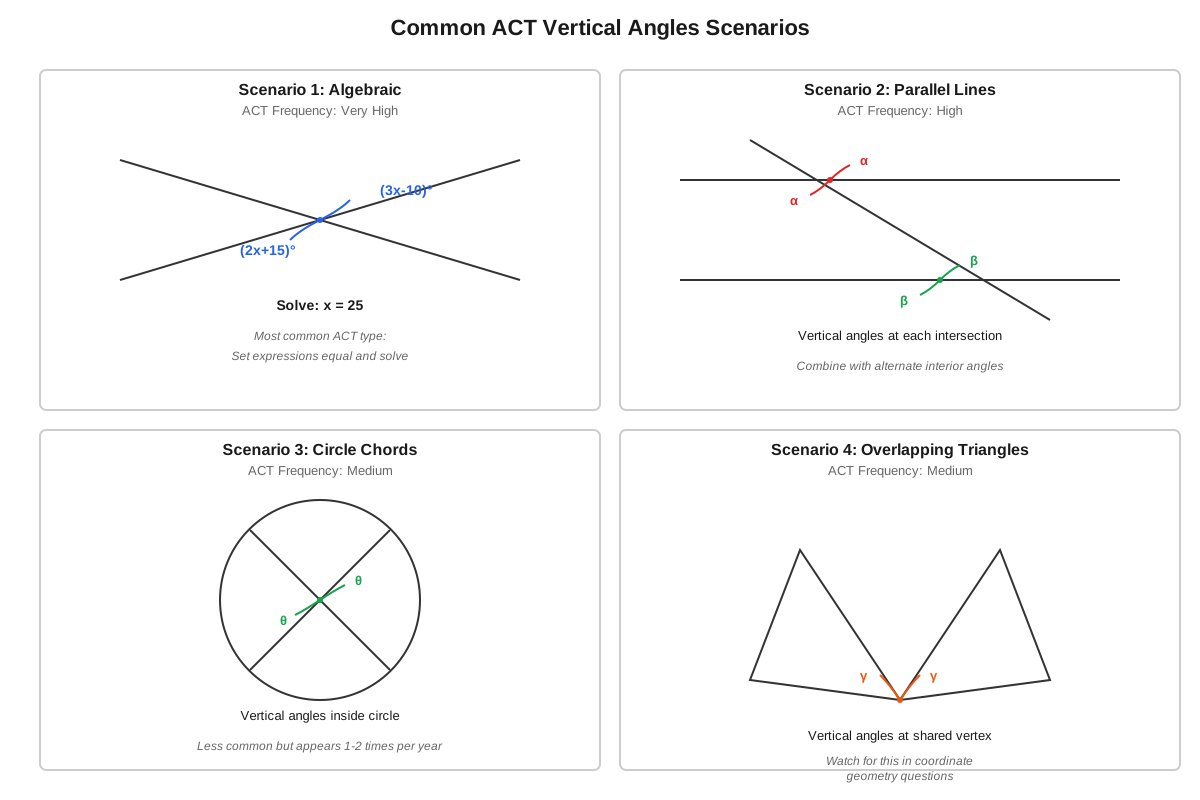
On the ACT Math section, vertical angles appear in approximately 2-4 questions per exam, either as standalone problems or integrated into more complex scenarios. The exam tests this concept in several distinct ways: direct identification problems where students must find the measure of a vertical angle given its opposite angle; algebraic problems where expressions represent angle measures and students must solve for variables; and complex diagram problems where vertical angles must be identified among multiple intersecting lines or within geometric figures like triangles and quadrilaterals.
The ACT particularly favors questions that combine vertical angles with other geometric relationships. Common question types include: intersecting lines with algebraic expressions for angle measures; parallel lines cut by a transversal where vertical angles appear at multiple intersection points; triangles or other polygons with extended sides creating vertical angles; and coordinate geometry problems where lines intersect and angle relationships must be determined. Students who can rapidly identify vertical angle pairs in these varied contexts gain both accuracy and time—two critical factors for ACT success.
Core Concepts
Definition and Fundamental Property
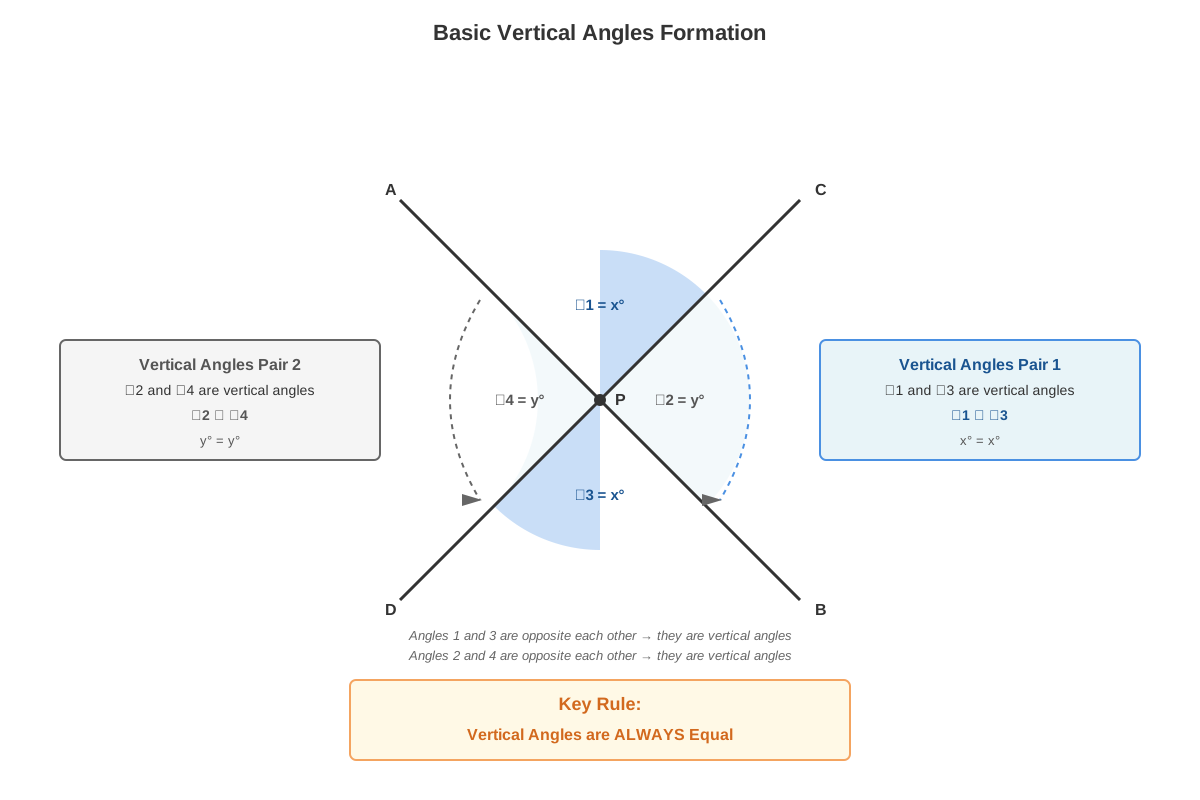
Vertical angles are the pairs of opposite angles formed when two straight lines intersect at a point. At any intersection of two lines, four angles are created, and the two pairs of angles that face each other across the intersection point are vertical angles. The defining property of vertical angles is that they are always congruent—they have exactly the same measure. This relationship holds true regardless of the angle of intersection or the measures of the individual angles.
When two lines intersect, they create four angles around the point of intersection. If we label these angles as ∠1, ∠2, ∠3, and ∠4 going clockwise around the intersection, then ∠1 and ∠3 form one pair of vertical angles, while ∠2 and ∠4 form the other pair. The vertical angles theorem states: ∠1 ≅ ∠3 and ∠2 ≅ ∠4 (where ≅ means "is congruent to").
Visual Identification
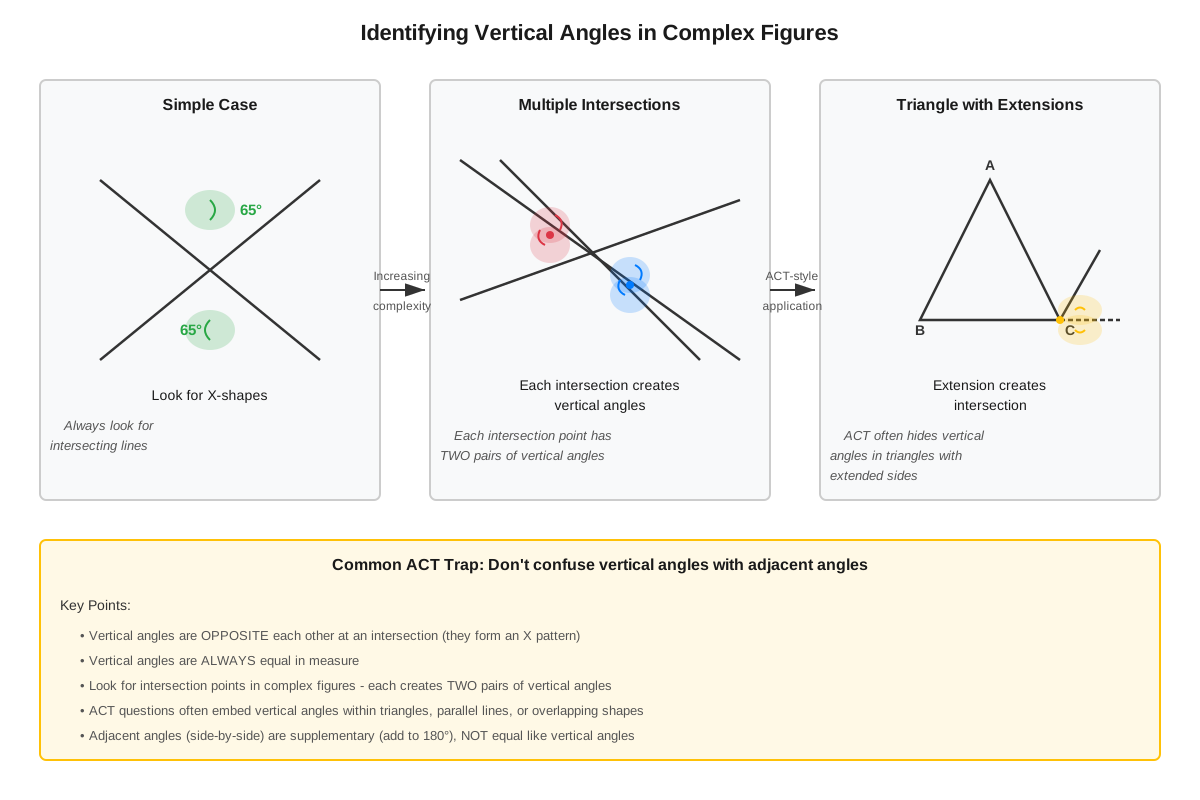
Recognizing vertical angles in diagrams is a critical skill for ACT success. Vertical angles are always non-adjacent—they do not share a common side. They are positioned directly across from each other, separated by the intersection point. A helpful visualization technique is to imagine the intersection point as the center of an "X" shape; the angles at opposite ends of the X are vertical angles.
In contrast, adjacent angles at an intersection are supplementary (they sum to 180°) because they form a straight line together. This distinction is crucial: vertical angles are equal, while adjacent angles at an intersection are supplementary. Many ACT questions test whether students can distinguish between these two relationships.
Mathematical Proof and Justification
The vertical angles theorem can be proven using the properties of supplementary angles. Consider two intersecting lines creating angles ∠1, ∠2, ∠3, and ∠4. Since ∠1 and ∠2 are adjacent angles on a straight line, they are supplementary: ∠1 + ∠2 = 180°. Similarly, ∠2 and ∠3 are supplementary: ∠2 + ∠3 = 180°. Using the transitive property, if ∠1 + ∠2 = 180° and ∠2 + ∠3 = 180°, then ∠1 + ∠2 = ∠2 + ∠3. Subtracting ∠2 from both sides yields ∠1 = ∠3, proving that vertical angles are congruent.
Algebraic Applications
The ACT frequently presents vertical angle problems using algebraic expressions. For example, if one angle measures (3x + 10)° and its vertical angle measures (5x - 20)°, students must set these expressions equal and solve for x: 3x + 10 = 5x - 20, which gives 30 = 2x, so x = 15. After finding x, students often must calculate the actual angle measure by substituting back into either expression.
Multiple Intersections
More complex ACT problems involve multiple pairs of intersecting lines, creating several sets of vertical angles simultaneously. In these scenarios, students must identify which angles are vertical to each other and which are related through other geometric principles (such as corresponding angles when parallel lines are involved). The key strategy is to examine each intersection point separately, identifying the vertical angle pairs at that specific location before moving to other intersections.
Integration with Other Geometric Concepts
Vertical angles rarely appear in isolation on the ACT. They commonly combine with:
| Geometric Concept | How It Combines with Vertical Angles |
|---|---|
| Supplementary Angles | Adjacent angles at an intersection are supplementary; vertical angles are congruent |
| Parallel Lines | When a transversal crosses parallel lines, vertical angles appear at each intersection point |
| Triangle Angle Sum | Extended sides of triangles create vertical angles with interior angles |
| Linear Pairs | Vertical angles and linear pairs both involve intersecting lines but represent different relationships |
| Angle Bisectors | When an angle bisector intersects another line, vertical angles may be created |
Concept Relationships
The vertical angles concept sits at the intersection of several fundamental geometric principles. At its foundation, vertical angles depend on the properties of straight lines and angle measurement. When two lines intersect, they create a configuration where the straight angle property (180°) governs adjacent angles, which in turn guarantees that opposite angles must be equal.
Vertical angles connect directly to supplementary angles through a complementary relationship: at any intersection, each angle is supplementary to its two adjacent angles but congruent to its opposite (vertical) angle. This creates a logical chain: if ∠1 + ∠2 = 180° and ∠2 + ∠3 = 180°, then ∠1 = ∠3 (vertical angles).
The concept extends upward to more complex geometric scenarios. When studying parallel lines cut by a transversal, vertical angles appear at each intersection point, and recognizing them helps identify corresponding angles, alternate interior angles, and alternate exterior angles. In triangle geometry, extending the sides of a triangle creates vertical angles with the interior angles, which is essential for understanding exterior angle theorems and solving for unknown measures.
The relationship map flows as follows: Basic angle measurement → Intersecting lines → Vertical angles (congruent) and Adjacent angles (supplementary) → Multiple intersections → Parallel lines and transversals → Complex polygon problems → Coordinate geometry applications.
Understanding vertical angles also enables progression to angle proofs and geometric reasoning, where students must justify why certain angles are equal or supplementary. The vertical angles theorem serves as a fundamental justification statement in many geometric proofs.
Quick check — test yourself on Vertical angles so far.
Try Flashcards →High-Yield Facts
- ⭐ Vertical angles are always congruent (equal in measure) when two lines intersect
- ⭐ Vertical angles are the pairs of opposite angles formed at an intersection, not adjacent angles
- ⭐ At any intersection of two lines, there are exactly two pairs of vertical angles
- ⭐ Adjacent angles at an intersection are supplementary (sum to 180°), not congruent
- ⭐ The vertical angles theorem requires no special conditions—it works for any two intersecting lines
- If one angle at an intersection measures x°, its vertical angle also measures x°, and the two adjacent angles each measure (180 - x)°
- Vertical angles can be acute, obtuse, or right angles, depending on how the lines intersect
- When two perpendicular lines intersect, all four angles are 90°, making all angles both vertical and congruent
- In problems with algebraic expressions, set the expressions for vertical angles equal to each other and solve
- Vertical angles maintain their congruence relationship even when the intersecting lines are part of larger geometric figures like triangles or polygons
Common Misconceptions
Misconception: Vertical angles are angles that point vertically upward or downward in a diagram.
Correction: The term "vertical" in vertical angles refers to the vertex (intersection point) being shared, not the orientation of the angles. Vertical angles are opposite angles at an intersection, regardless of how the diagram is oriented on the page.
Misconception: Adjacent angles at an intersection are vertical angles.
Correction: Vertical angles are non-adjacent—they are opposite each other across the intersection point. Adjacent angles at an intersection are supplementary (sum to 180°), not congruent. Only the angles that face each other across the vertex are vertical angles.
Misconception: Vertical angles only exist when lines intersect at right angles.
Correction: Vertical angles exist whenever any two lines intersect, regardless of the angle of intersection. The lines do not need to be perpendicular. The vertical angles theorem applies to all intersections, whether the angles are acute, obtuse, or right.
Misconception: All four angles at an intersection are vertical angles to each other.
Correction: At an intersection, there are only two pairs of vertical angles. Each angle is vertical to exactly one other angle (the one directly opposite it), not to all three other angles. The other two angles are adjacent and supplementary to the given angle.
Misconception: When solving for x in vertical angle problems, the value of x is the angle measure.
Correction: The variable x represents the value that makes the algebraic expressions equal, but the actual angle measure requires substituting x back into the original expression. For example, if (2x + 10)° = (3x - 5)°, solving gives x = 15, but the angle measure is 2(15) + 10 = 40°, not 15°.
Misconception: Vertical angles can have different measures if the lines intersect at unusual angles.
Correction: The vertical angles theorem is absolute—vertical angles are always congruent, with no exceptions. This is a proven mathematical theorem that holds for all intersecting lines in Euclidean geometry, regardless of how the lines are positioned.
Worked Examples
Example 1: Basic Algebraic Vertical Angles
Problem: Two lines intersect, forming four angles. One angle measures (4x - 15)° and its vertical angle measures (2x + 25)°. Find the value of x and the measure of these vertical angles.
Solution:
Step 1: Recognize that vertical angles are congruent, so we can set the expressions equal:
4x - 15 = 2x + 25Step 2: Solve for x by collecting like terms:
4x - 2x = 25 + 15
2x = 40
x = 20
Step 3: Substitute x = 20 back into either expression to find the angle measure:
4(20) - 15 = 80 - 15 = 65°Step 4: Verify by checking the other expression:
2(20) + 25 = 40 + 25 = 65° ✓Answer: x = 20, and both vertical angles measure 65°.
Connection to Learning Objectives: This example demonstrates the core strategy of setting vertical angle expressions equal and solving algebraically, directly addressing the objective to apply vertical angles to ACT-style questions accurately.
Example 2: Complex Multi-Step Problem
Problem: Lines AB and CD intersect at point E. The angle AEC measures (3y + 20)°. Line FG also passes through point E, creating angle FEA that measures 40°. If angles AEC and BED are vertical angles, and angle FEA is adjacent to angle AEC, find the value of y and the measure of angle BED.
Solution:
Step 1: Draw or visualize the diagram. Lines AB and CD intersect at E, and line FG also passes through E.
Step 2: Identify that angles AEC and BED are vertical angles, so they are congruent:
∠AEC = ∠BED = (3y + 20)°Step 3: Recognize that angles FEA and AEC are adjacent angles on line FG, so they are supplementary:
∠FEA + ∠AEC = 180°
40° + (3y + 20)° = 180°
Step 4: Solve for y:
60 + 3y = 180
3y = 120
y = 40
Step 5: Calculate the measure of angle AEC (and therefore angle BED):
∠AEC = 3(40) + 20 = 120 + 20 = 140°Step 6: Since ∠BED is vertical to ∠AEC:
∠BED = 140°Answer: y = 40, and angle BED measures 140°.
Connection to Learning Objectives: This example shows how to identify vertical angles within complex figures containing multiple intersecting lines and demonstrates combining vertical angle relationships with supplementary angle properties—key skills for ACT success.
Exam Strategy
When approaching ACT vertical angles questions, begin by scanning the diagram for intersecting lines. Look for the characteristic "X" pattern that indicates an intersection point where vertical angles exist. Circle or mark the intersection points in complex diagrams to ensure you identify all relevant angle relationships.
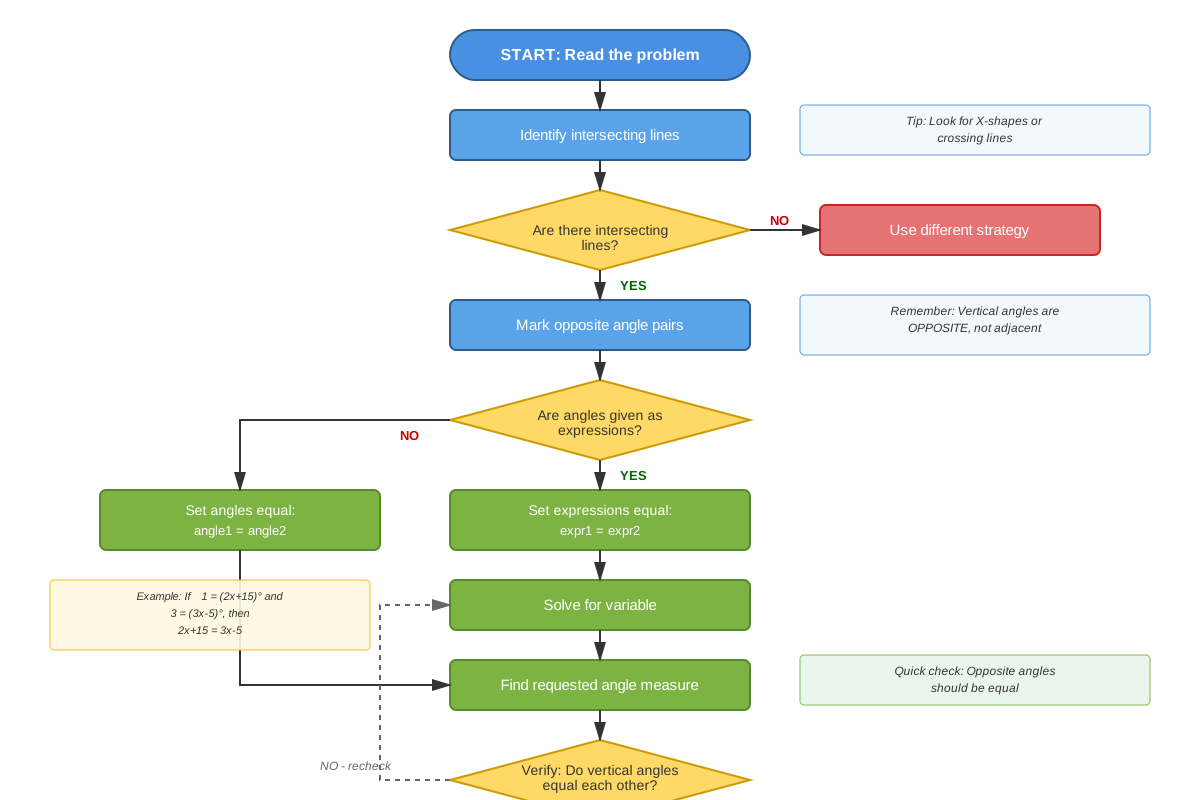
Trigger words and phrases that signal vertical angle problems include: "opposite angles," "angles formed by intersecting lines," "two lines cross," "angles across from each other," and direct statements like "vertical angles." When you see algebraic expressions for two angles at an intersection, immediately consider whether they might be vertical angles (set them equal) or supplementary angles (set their sum to 180°).
For process of elimination, remember these key principles:
- If two angles at an intersection are given as answer choices, and they're adjacent (share a side), they cannot both be correct as vertical angles
- If an answer choice suggests vertical angles have different measures, eliminate it immediately
- If a problem asks for an angle measure and you've identified vertical angles, any answer choice that doesn't match the given vertical angle can be eliminated
- When solving for variables, substitute your answer back into the expressions; if the two expressions don't yield the same angle measure, you've made an error
Time allocation for vertical angle questions should be approximately 30-45 seconds for straightforward identification problems and 60-90 seconds for algebraic problems requiring equation solving. If a problem involves multiple intersections or combines vertical angles with other concepts (like parallel lines), allocate up to 2 minutes. If you cannot identify the vertical angles within 15 seconds of reading the problem, mark it and return later—these problems should be among the quickest to solve once you recognize the pattern.
A powerful strategy is to label all four angles at an intersection immediately, even if the problem only asks about two of them. This helps you visualize the relationships and avoid confusing vertical angles with adjacent angles. Use the fact that all four angles must sum to 360° as a check on your work.
Memory Techniques
Mnemonic for Vertical Angles: "Vertical angles are Very Equal" – The two V's remind you that vertical angles are congruent (equal in measure).
Visual Memory Aid: Picture a large letter "X" and remember "X marks the spot where angles are equal across." The opposite corners of the X are vertical angles. This visualization helps you quickly identify vertical angle pairs in any diagram.
The "No-Touch Rule": Vertical angles never touch each other—they're separated by the intersection point. If two angles share a side (touch), they cannot be vertical angles. This simple rule prevents the most common error of confusing adjacent angles with vertical angles.
Acronym for Problem-Solving Steps: SOLVE
- Spot the intersection point
- Opposite angles are vertical
- Label all four angles if needed
- Vertical angles are equal (set expressions equal)
- Evaluate by solving and checking
Rhyme for Remembering the Relationship: "Angles that face, have the same space" – This reminds you that angles facing each other across an intersection have the same measure.
Summary
Vertical angles are pairs of opposite angles formed when two lines intersect, and they possess the fundamental property of always being congruent. This concept appears frequently on the ACT Math section, both as standalone problems and integrated into more complex geometric scenarios involving parallel lines, triangles, and polygons. To master vertical angles, students must be able to quickly identify intersecting lines in diagrams, distinguish vertical angles from adjacent supplementary angles, and apply the congruence relationship to solve for unknown angle measures. The most common ACT applications involve setting algebraic expressions equal when they represent vertical angles, then solving for variables and calculating actual angle measures. Success with vertical angles requires recognizing that this relationship holds universally for any two intersecting lines, regardless of the angle of intersection or the complexity of the surrounding figure. Students who can rapidly spot vertical angle pairs and apply the congruence theorem gain significant advantages in both speed and accuracy on the ACT Math section.
Key Takeaways
- Vertical angles are always congruent—this is an absolute rule with no exceptions for any intersecting lines
- Vertical angles are opposite angles at an intersection, not adjacent angles (which are supplementary)
- At every intersection of two lines, there are exactly two pairs of vertical angles
- In algebraic problems, set expressions for vertical angles equal to each other and solve for the variable
- Vertical angles appear in approximately 10-15% of ACT geometry questions, making them a high-yield topic
- The fastest way to identify vertical angles is to look for the "X" pattern of intersecting lines and identify opposite angles
- Always verify your answer by checking that vertical angles have equal measures and adjacent angles sum to 180°
Related Topics
Supplementary and Complementary Angles: Understanding how angles relate when they sum to 180° or 90° builds on the adjacent angle relationships at intersections and helps distinguish these from vertical angles.
Parallel Lines and Transversals: This topic extends vertical angles to scenarios with multiple intersections, where corresponding angles, alternate interior angles, and alternate exterior angles all interact with vertical angle pairs.
Triangle Angle Relationships: Exterior angles of triangles create vertical angles with extended sides, making vertical angles essential for solving triangle problems involving exterior angles.
Linear Pairs: These are adjacent angles that form a straight line and sum to 180°, providing the complementary concept to vertical angles at intersections.
Angle Proofs and Geometric Reasoning: Mastering vertical angles enables students to write formal geometric proofs and justify angle relationships in complex figures.
Practice CTA
Now that you've mastered the fundamentals of vertical angles, it's time to solidify your understanding through practice! Work through the practice questions to test your ability to identify vertical angles in various contexts, solve algebraic problems, and apply this concept to complex ACT-style scenarios. Use the flashcards to reinforce the key definitions and relationships until recognizing vertical angles becomes automatic. Remember, vertical angles are one of the highest-yield topics on the ACT Math section—every minute you invest in mastering this concept will pay dividends on test day. You've got this!
Sign up free to keep reading
Create a free AnvayaPrep account to finish this ACT guide on Vertical angles — plus flashcards and practice questions.