Overview
Complementary angles represent one of the most frequently tested angle relationships on the ACT Math section. These angles appear in approximately 3-5 questions per exam, making them a high-yield topic that students cannot afford to overlook. Understanding complementary angles forms the foundation for solving complex geometry problems involving right triangles, coordinate geometry, and trigonometric relationships.
The concept itself is elegantly simple: two angles are complementary when their measures sum to exactly 90 degrees. Despite this straightforward definition, the ACT tests this concept in sophisticated ways—embedding it within multi-step problems, combining it with algebraic expressions, and integrating it with other geometric principles. Students who master ACT complementary angles gain a powerful tool for quickly identifying relationships and setting up equations that lead to correct answers.
Complementary angles connect to broader mathematical concepts including supplementary angles (which sum to 180°), angle relationships in polygons, and the fundamental properties of right triangles. This topic serves as a bridge between basic angle measurement and advanced geometric reasoning, making it essential for success not only in the Plane Geometry section but also in Trigonometry and Coordinate Geometry questions where angle relationships determine the path to solution.
Learning Objectives
- [ ] Identify when Complementary angles is being tested
- [ ] Explain the core rule or strategy behind Complementary angles
- [ ] Apply Complementary angles to ACT-style questions accurately
- [ ] Solve algebraic equations involving complementary angle expressions
- [ ] Recognize complementary angle relationships in complex geometric figures
- [ ] Distinguish between complementary and supplementary angle scenarios
- [ ] Apply complementary angle properties to trigonometric problems
Prerequisites
- Basic angle measurement: Understanding that angles are measured in degrees and recognizing angle notation is essential for identifying and working with complementary relationships
- Algebraic equation solving: The ability to set up and solve linear equations is necessary because ACT questions frequently express complementary angles as algebraic expressions
- Right angle recognition: Knowing that a right angle measures exactly 90° provides the foundation for understanding why complementary angles sum to this value
- Variable manipulation: Comfort with combining like terms and isolating variables enables students to solve for unknown angle measures efficiently
Why This Topic Matters
Complementary angles appear throughout real-world applications in architecture, engineering, navigation, and design. Architects use complementary angle relationships when designing roof pitches and structural supports. Engineers apply these principles when calculating force vectors and load distributions. Even in everyday situations, understanding complementary angles helps with tasks like adjusting mirrors, positioning solar panels, or understanding how light reflects off surfaces.
On the ACT Math section, complementary angles appear in approximately 8-12% of Plane Geometry questions, which translates to 3-5 questions per exam. These questions typically fall into several categories: direct identification problems where students must recognize complementary relationships, algebraic problems requiring equation setup and solving, multi-step geometry problems where complementary angles are one component of a larger solution, and trigonometry problems where complementary angle relationships connect sine and cosine functions.
The ACT frequently disguises complementary angle questions within more complex scenarios. Students might encounter a diagram showing intersecting lines where they must identify right angles, word problems describing angle relationships without explicitly stating "complementary," or coordinate geometry questions where perpendicular lines create complementary angles. The exam also commonly presents complementary angles using algebraic expressions like (2x + 10)° and (3x - 5)°, requiring students to set up equations and solve for variables before finding the actual angle measures.
Core Concepts
Definition of Complementary Angles
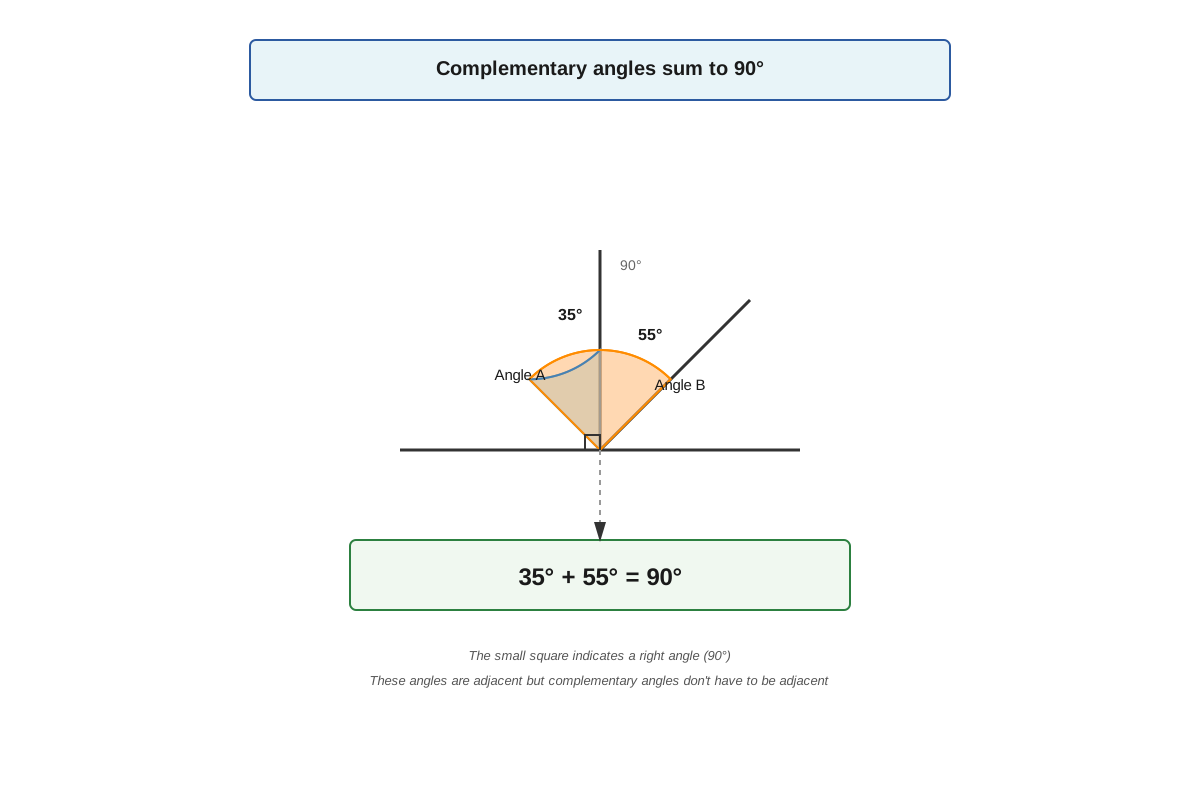
Two angles are complementary angles if and only if the sum of their measures equals exactly 90 degrees. This relationship can be expressed mathematically as: if angle A and angle B are complementary, then m∠A + m∠B = 90°. The term "complementary" comes from the Latin word "complementum," meaning "something that completes," which perfectly describes how these angles complete a right angle.
It is crucial to understand that complementary angles do not need to be adjacent (next to each other) or even appear in the same diagram. Two angles can be complementary based solely on their measures, regardless of their physical position. For example, a 30° angle in one triangle and a 60° angle in a completely different figure are complementary because 30° + 60° = 90°.
Algebraic Representation
The ACT frequently tests complementary angles through algebraic expressions. When one angle is represented by a variable or expression, the complementary angle can be expressed as (90 - x)° where x represents the measure of the first angle. This relationship becomes particularly important when solving for unknown values.
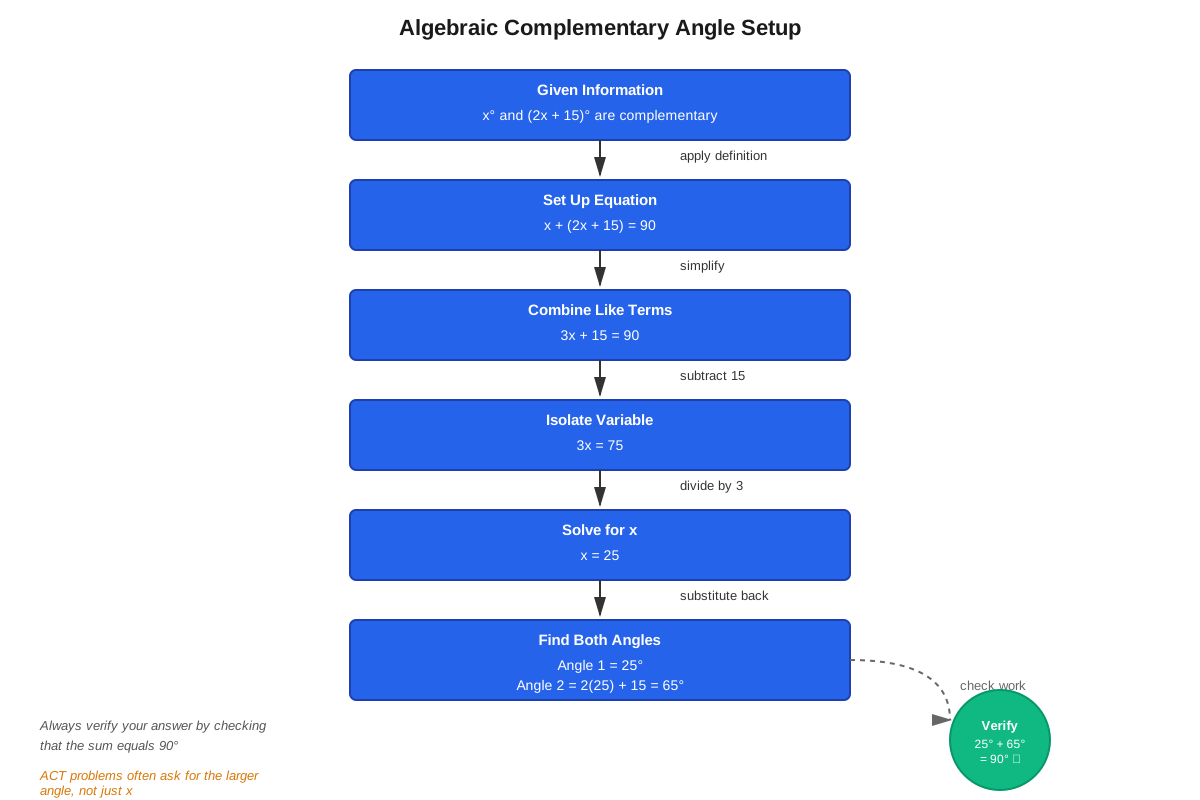
For example, if one angle measures (3x + 15)°, its complement measures (90 - (3x + 15))° = (75 - 3x)°. Students must be comfortable manipulating these expressions and setting up equations when both angles are given as algebraic expressions. The standard approach involves writing the equation: first expression + second expression = 90, then solving for the variable.
Visual Recognition in Diagrams
On the ACT, complementary angles often appear within right angles or right triangles. When a right angle is divided by a ray or line segment, the two resulting angles are always complementary. This visual pattern is a critical trigger for recognizing when complementary angle relationships apply.
Common visual scenarios include:
- A right angle marked with a small square symbol, divided by an internal ray
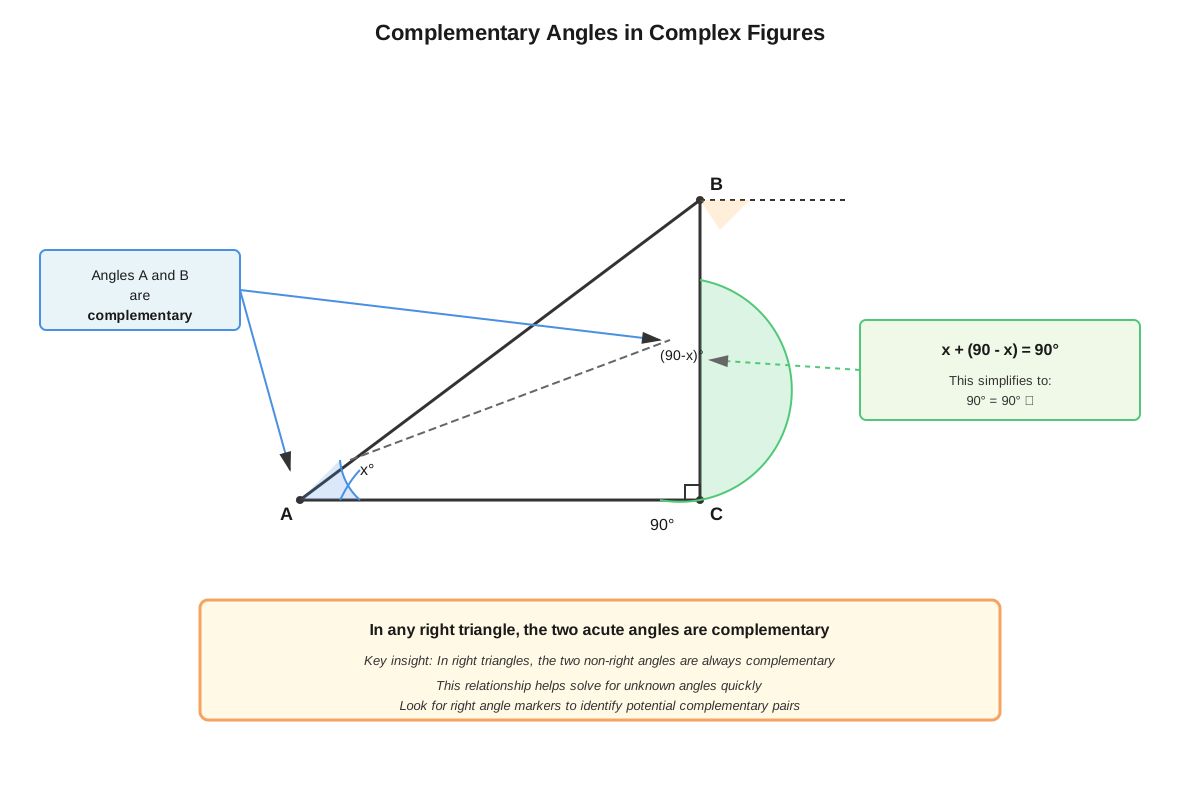
- Two acute angles in a right triangle (the two non-right angles are always complementary)
- Perpendicular lines creating four right angles, where any right angle can be subdivided
- Coordinate plane problems where perpendicular lines meet at right angles
Complementary vs. Supplementary Angles
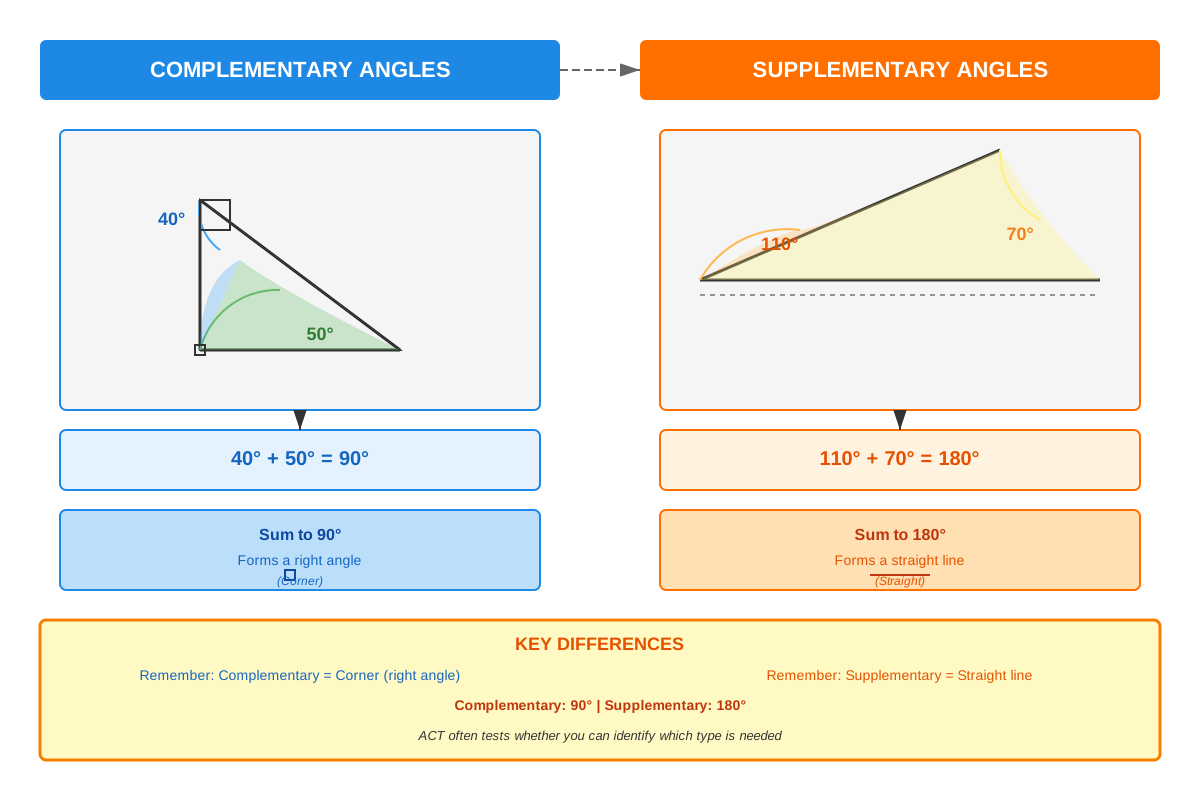
A frequent source of confusion involves distinguishing between complementary and supplementary angles. The following table clarifies the key differences:
| Property | Complementary Angles | Supplementary Angles |
|---|---|---|
| Sum of measures | 90° | 180° |
| Memory device | "C" for Corner (right angle) | "S" for Straight (line) |
| Common location | Right angles, right triangles | Linear pairs, straight lines |
| Example | 35° and 55° | 120° and 60° |
Application in Right Triangles
In any right triangle, the two acute angles (the angles that are not the right angle) are always complementary. This property stems from the triangle angle sum theorem, which states that all three angles in a triangle sum to 180°. Since one angle is 90° (the right angle), the remaining two angles must sum to 90° (because 180° - 90° = 90°).
This relationship has profound implications for trigonometry on the ACT. The complementary angle relationship explains why sin(x) = cos(90° - x) and why tan(x) = cot(90° - x). These co-function identities frequently appear in ACT Trigonometry questions.
Multi-Step Problem Integration
The ACT rarely tests complementary angles in isolation. Instead, the concept typically appears as one step within a larger problem. Students might need to:
- Recognize that two angles are complementary
- Set up an equation using this relationship
- Solve for a variable
- Use that variable to find other measurements
- Apply those measurements to answer the actual question
This multi-layered approach requires both conceptual understanding and procedural fluency. Students must recognize the complementary relationship quickly, then execute the necessary calculations accurately under time pressure.
Concept Relationships
Complementary angles serve as a foundational concept that connects to numerous other geometric principles. The relationship flows as follows: Basic angle measurement → enables recognition of → Complementary angles → which appear within → Right angles and right triangles → which connect to → Trigonometric ratios and Pythagorean theorem applications.
The concept also relates horizontally to supplementary angles (both involve angle sums but with different totals) and vertical angles (which may be complementary if they measure 45° each). When combined with parallel lines cut by transversals, complementary angles help solve complex multi-angle problems where several angle relationships must be applied sequentially.
Understanding complementary angles enhances performance on coordinate geometry questions, particularly those involving perpendicular lines (which meet at right angles) and slope relationships (where perpendicular lines have slopes that are negative reciprocals). The concept also appears in circle geometry when dealing with inscribed angles and tangent lines that create right angles with radii.
High-Yield Facts
⭐ Two angles are complementary if and only if their measures sum to exactly 90 degrees
⭐ The two acute angles in any right triangle are always complementary
⭐ If one angle measures x degrees, its complement measures (90 - x) degrees
⭐ Complementary angles do not need to be adjacent or share a common vertex
⭐ When a right angle is divided by a ray, the two resulting angles are complementary
- Complementary angles can both be acute (less than 90°), but neither can be obtuse or right
- Two 45° angles are complementary to each other and are the only case where complementary angles are congruent
- In trigonometry, sine and cosine are co-functions related through complementary angles: sin(x) = cos(90° - x)
- The complement of an angle is unique—each angle has exactly one complement
- If two angles are both complementary to the same angle, they are congruent to each other
- Complementary angles appear in approximately 3-5 questions per ACT Math section
- The ACT often presents complementary angles using algebraic expressions requiring equation solving
Quick check — test yourself on Complementary angles so far.
Try Flashcards →Common Misconceptions
Misconception: Complementary angles must be adjacent or next to each other in a diagram → Correction: Complementary angles are defined solely by their sum equaling 90°, regardless of their position. Two angles in completely separate diagrams can be complementary if their measures sum to 90°.
Misconception: Complementary and supplementary mean the same thing → Correction: Complementary angles sum to 90° (think "C" for corner/right angle), while supplementary angles sum to 180° (think "S" for straight line). These are distinct relationships that cannot be used interchangeably.
Misconception: Both angles in a complementary pair must be less than 45° → Correction: Complementary angles must both be acute (less than 90°), but one can be larger than 45° as long as the other is correspondingly smaller. For example, 70° and 20° are complementary.
Misconception: If two angles form a right angle when placed together, they must share a vertex → Correction: While adjacent complementary angles do share a vertex and form a right angle visually, the complementary relationship is based on measurement alone. The angles need not be physically connected.
Misconception: The complement of 90° is 0° → Correction: While mathematically 90° + 0° = 90°, a 0° angle is not typically considered a valid angle in geometry. More importantly, 90° itself is a right angle, and right angles do not have complements in standard geometric contexts—only acute angles have meaningful complements.
Misconception: In a right triangle, all three angles are complementary → Correction: Only the two acute angles in a right triangle are complementary to each other. The right angle (90°) is not complementary to either of the other angles.
Misconception: When solving algebraic complementary angle problems, the expressions can be set equal to each other → Correction: The two expressions must be set to sum to 90°, not equal to each other. The equation should be: expression₁ + expression₂ = 90.
Worked Examples
Example 1: Algebraic Complementary Angles
Problem: Two complementary angles are represented by the expressions (4x - 12)° and (2x + 18)°. Find the measure of the larger angle.
Solution:
Step 1: Recognize that complementary angles sum to 90°. Set up the equation:
(4x - 12) + (2x + 18) = 90Step 2: Combine like terms on the left side:
6x + 6 = 90Step 3: Solve for x by subtracting 6 from both sides:
6x = 84
x = 14
Step 4: Substitute x = 14 back into both expressions to find the actual angle measures:
- First angle: 4(14) - 12 = 56 - 12 = 44°
- Second angle: 2(14) + 18 = 28 + 18 = 46°
Step 5: Verify the solution by checking that the angles sum to 90°:
44° + 46° = 90° ✓Step 6: Answer the question—find the larger angle. The larger angle measures 46°.
Connection to Learning Objectives: This problem demonstrates the ability to identify complementary angle relationships, apply the core rule (sum equals 90°), and accurately solve ACT-style algebraic questions involving complementary angles.
Example 2: Right Triangle Application
Problem: In right triangle ABC, angle C is the right angle. If angle A measures (3x + 5)° and angle B measures (5x - 15)°, what is the measure of angle A?
Solution:
Step 1: Recognize that in a right triangle, the two acute angles are complementary. This means angles A and B must sum to 90°.
Step 2: Set up the equation:
(3x + 5) + (5x - 15) = 90Step 3: Simplify by combining like terms:
8x - 10 = 90Step 4: Solve for x:
8x = 100
x = 12.5
Step 5: Find the measure of angle A by substituting x = 12.5:
Angle A = 3(12.5) + 5 = 37.5 + 5 = 42.5°Step 6: Verify by finding angle B and checking the sum:
Angle B = 5(12.5) - 15 = 62.5 - 15 = 47.5°
42.5° + 47.5° = 90° ✓Answer: Angle A measures 42.5°.
Connection to Learning Objectives: This example shows how to recognize complementary angles within right triangles, a common ACT scenario that combines geometric properties with algebraic problem-solving. It demonstrates the application of complementary angle concepts to multi-step problems.
Exam Strategy
When approaching ACT questions involving complementary angles, follow this systematic process:
Step 1: Scan for trigger words and visual cues. Look for phrases like "complementary angles," "right angle," "right triangle," or "perpendicular." Visual triggers include the right angle symbol (small square in the corner), diagrams showing angles that appear to form a right angle, or explicit labels indicating 90°.
Step 2: Verify the relationship. Before assuming angles are complementary, confirm that they should sum to 90°. Check whether the problem states they are complementary, whether they are the two acute angles in a right triangle, or whether they visibly form a right angle when combined.
Step 3: Set up your equation immediately. If algebraic expressions are involved, write the equation (expression₁ + expression₂ = 90) before attempting mental math. This prevents errors and provides a clear path forward.
Step 4: Solve systematically. Use standard algebraic techniques to solve for variables, showing work in the test booklet. This allows for easy error-checking and prevents calculation mistakes under time pressure.
Step 5: Answer the actual question. Many students solve for x but forget that the question asks for an angle measure or a different variable. Always reread the question after solving to ensure the correct value is selected.
Time-Saving Tip: If answer choices are given, consider working backward. Plug answer choices into the complementary relationship to see which pair sums to 90°. This can be faster than solving algebraically, especially if the algebra appears complex.
Process of Elimination Strategies:
- Eliminate any answer choice greater than or equal to 90° when looking for a complementary angle
- If two angles are described as complementary and one is given, the complement must be (90 - given angle)
- In right triangles, eliminate any answer that would make the two acute angles sum to anything other than 90°
- Watch for trap answers that use 180° (supplementary) instead of 90° (complementary)
Time Allocation: Straightforward complementary angle problems should take 30-45 seconds. Multi-step problems involving algebra may require 60-90 seconds. If a problem is taking longer than 2 minutes, mark it and return later—these questions are designed to be solved quickly once the relationship is recognized.
Memory Techniques
The "C" Mnemonic: Remember that Complementary angles form a Corner (right angle). The letter C appears in both words, creating a strong mental association. Visualize the letter C as an incomplete right angle that needs to be "completed" to 90°.
The 9-0 Rule: Complementary angles sum to 9-0 degrees. The number 90 itself reminds you of the sum. Some students remember "9-0 is the way to go for complementary angles."
Right Triangle Reminder: Use the phrase "Right triangles have Remaining angles that are complementary" to remember that the two acute angles in any right triangle are complementary. The double-R creates a memorable connection.
Complement vs. Supplement Distinction:
- Complementary = Corner = 90° (C comes before S in the alphabet, 90 comes before 180)
- Supplementary = Straight line = 180°
The Subtraction Shortcut: To find a complement quickly, remember "90 minus the angle." If you know one angle is 35°, immediately think "90 - 35 = 55°" for its complement. This mental math should become automatic.
Visual Memory Aid: Picture a square (which has four 90° angles). When you see complementary angle problems, visualize one corner of that square being divided by a diagonal line, creating two complementary angles. This visual anchor helps recall the 90° sum.
Summary
Complementary angles represent a fundamental geometric relationship where two angles sum to exactly 90 degrees, forming the cornerstone of numerous ACT Math problems. This concept appears both independently and as a component of more complex questions involving right triangles, perpendicular lines, and trigonometric relationships. Success on ACT complementary angle questions requires three key competencies: rapid recognition of when the complementary relationship applies (through visual cues like right angle symbols or contextual clues like right triangles), fluent algebraic manipulation when angles are expressed as variables or expressions, and systematic problem-solving that moves from identifying the relationship through setting up equations to solving for the requested value. The distinction between complementary (90°) and supplementary (180°) angles must be crystal clear, as the ACT frequently includes trap answers based on this confusion. Students who master complementary angles gain not only direct points on geometry questions but also enhanced ability to solve trigonometry problems involving co-function relationships and coordinate geometry questions involving perpendicular lines.
Key Takeaways
- Complementary angles always sum to exactly 90°, regardless of whether they are adjacent or share a vertex
- The two acute angles in any right triangle are complementary—this is one of the most frequently tested applications
- When one angle measures x°, its complement measures (90 - x)°, providing a quick calculation method
- Algebraic complementary angle problems require setting up the equation: expression₁ + expression₂ = 90
- Visual triggers include right angle symbols (small squares), right triangles, and perpendicular lines
- Never confuse complementary (90°) with supplementary (180°)—use memory devices like "C for Corner" to maintain the distinction
- Complementary angle questions appear in 3-5 problems per ACT Math section, making this a high-yield topic worth mastering
Related Topics
Supplementary Angles: Understanding angles that sum to 180° builds on complementary angle knowledge and appears with similar frequency on the ACT. Mastering complementary angles makes supplementary angles easier to learn since the concepts are parallel.
Right Triangle Properties: Complementary angles form the foundation for understanding right triangle geometry, including the Pythagorean theorem and special right triangles (30-60-90 and 45-45-90).
Trigonometric Co-functions: The relationship between sine and cosine, tangent and cotangent, and secant and cosecant all stem from complementary angle properties, making this topic essential for ACT Trigonometry questions.
Angle Relationships with Parallel Lines: When transversals cut parallel lines, various angle relationships emerge, and recognizing complementary angles helps solve complex multi-angle problems.
Coordinate Geometry and Perpendicular Lines: Perpendicular lines create right angles, and understanding complementary angles enhances the ability to work with slope relationships and angle measures in the coordinate plane.
Practice CTA
Now that you have thoroughly studied complementary angles, it's time to solidify your understanding through active practice. Attempt the practice questions designed specifically for this topic, focusing on both straightforward identification problems and complex multi-step scenarios. Use the flashcards to drill the key definitions and relationships until they become automatic. Remember, the ACT rewards both accuracy and speed—practice will build both. Each problem you solve correctly strengthens your geometric reasoning and brings you closer to your target score. Approach the practice with confidence, knowing that complementary angles are a high-yield topic where mastery translates directly into points on test day!
Sign up free to keep reading
Create a free AnvayaPrep account to finish this ACT guide on Complementary angles — plus flashcards and practice questions.