Overview
Parallel lines and transversals represent one of the most frequently tested concepts in the Plane Geometry section of the ACT Math test. This topic explores the angle relationships that emerge when a line (called a transversal) intersects two or more parallel lines. Understanding these relationships allows students to solve for unknown angles quickly and confidently, often without complex calculations. The beauty of this topic lies in its predictability: once the fundamental angle relationships are mastered, students can identify patterns and solve problems in seconds rather than minutes.
The ACT consistently includes 2-4 questions per test that directly assess knowledge of parallel lines and transversals, making this a high-yield topic for score improvement. These questions typically appear in the first 40 questions of the 60-question Math section, positioning them as medium-difficulty problems that separate average scorers from high achievers. Beyond direct questions, the principles of parallel lines and transversals underpin more complex geometry problems involving polygons, coordinate geometry, and even trigonometry.
This topic serves as a foundational bridge between basic angle concepts and advanced geometric reasoning. Mastery of ACT parallel lines and transversals questions requires not just memorizing angle relationships, but developing the ability to recognize when these relationships apply, identify which angles are congruent or supplementary, and chain multiple relationships together to solve multi-step problems. The concepts learned here directly support understanding of polygon interior angles, properties of parallelograms and trapezoids, and coordinate geometry slope relationships.
Learning Objectives
- [ ] Identify when Parallel lines and transversals is being tested
- [ ] Explain the core rule or strategy behind Parallel lines and transversals
- [ ] Apply Parallel lines and transversals to ACT-style questions accurately
- [ ] Distinguish between corresponding angles, alternate interior angles, alternate exterior angles, and consecutive interior angles
- [ ] Determine whether two lines are parallel based on angle relationships created by a transversal
- [ ] Solve multi-step problems that require combining multiple angle relationships
- [ ] Recognize parallel line scenarios in coordinate geometry and polygon problems
Prerequisites
- Basic angle vocabulary: Understanding terms like acute, obtuse, right, and straight angles is essential for describing the angles formed by transversals
- Vertical angles: Recognizing that vertical angles are congruent provides a foundation for understanding more complex angle relationships
- Linear pairs and supplementary angles: Many parallel line problems require identifying angles that sum to 180°
- Properties of parallel lines: Basic understanding that parallel lines never intersect and maintain constant distance
- Algebraic equation solving: Most ACT questions require setting up and solving equations to find unknown angle measures
Why This Topic Matters
In real-world applications, parallel lines and transversals appear throughout architecture, engineering, and design. Railroad tracks, street grids, building frameworks, and bridge supports all rely on parallel line principles. Architects use these relationships to ensure structural integrity, while urban planners apply them to create efficient transportation networks. Understanding angle relationships helps in fields ranging from carpentry to computer graphics, where precise angle calculations determine whether structures are sound or designs render correctly.
On the ACT Math test, parallel lines and transversals questions appear with remarkable consistency. Statistical analysis of released ACT tests shows that approximately 3-5% of all Math questions directly test this concept, with an additional 5-7% incorporating these principles into more complex geometry problems. These questions typically appear in positions 15-40 of the 60-question test, placing them in the medium difficulty range where strategic knowledge can significantly boost scores. The ACT favors certain question formats: identifying angle measures when given one angle and parallel lines (most common), determining whether lines are parallel based on angle relationships (moderately common), and multi-step problems requiring multiple angle relationships (less common but higher difficulty).
Common question presentations include diagrams showing two parallel lines cut by one or more transversals with algebraic expressions for angle measures, word problems describing geometric scenarios without diagrams, and coordinate geometry problems where parallel line concepts combine with slope relationships. The test writers frequently use variables and expressions like (2x + 15)° rather than simple numeric values, requiring students to set up and solve equations. Recognizing these patterns allows students to approach questions systematically rather than attempting to reason through each problem from scratch.
Core Concepts
Parallel Lines Definition and Notation
Parallel lines are two or more lines in the same plane that never intersect, no matter how far they are extended in either direction. In geometric notation, parallel lines are indicated by the symbol ∥. For example, if line m is parallel to line n, this relationship is written as m ∥ n. Parallel lines maintain a constant perpendicular distance from each other at all points. On the ACT, parallel lines are typically indicated either by the parallel symbol, by matching arrow marks on the lines in a diagram, or by explicit statement in the problem text.
Transversal Definition
A transversal is any line that intersects two or more other lines at distinct points. When a transversal crosses parallel lines, it creates eight angles at the two intersection points (four angles at each intersection). These eight angles form specific relationships that are the foundation of all parallel lines and transversals problems. The transversal does not need to be perpendicular to the parallel lines; it can intersect at any angle, though the angle relationships remain constant regardless of the transversal's orientation.
The Eight Angles and Their Positions
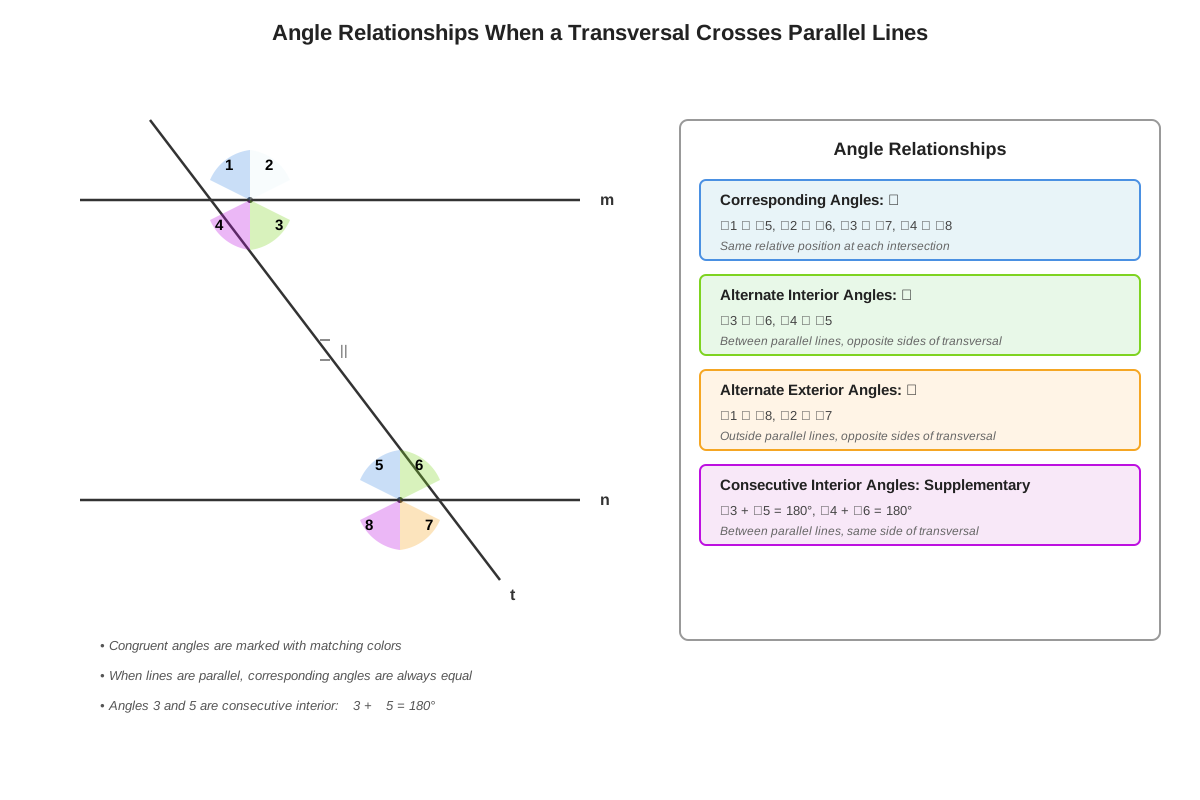
When a transversal intersects two parallel lines, eight angles are formed. These angles are typically numbered 1-8 for reference, with angles 1-4 at the upper intersection point and angles 5-8 at the lower intersection point. Understanding the position and naming of these angles is crucial:
- Interior angles: The four angles between the parallel lines (angles 3, 4, 5, and 6 in standard notation)
- Exterior angles: The four angles outside the parallel lines (angles 1, 2, 7, and 8)
- Same-side angles: Angles on the same side of the transversal
- Opposite-side angles: Angles on opposite sides of the transversal
Corresponding Angles
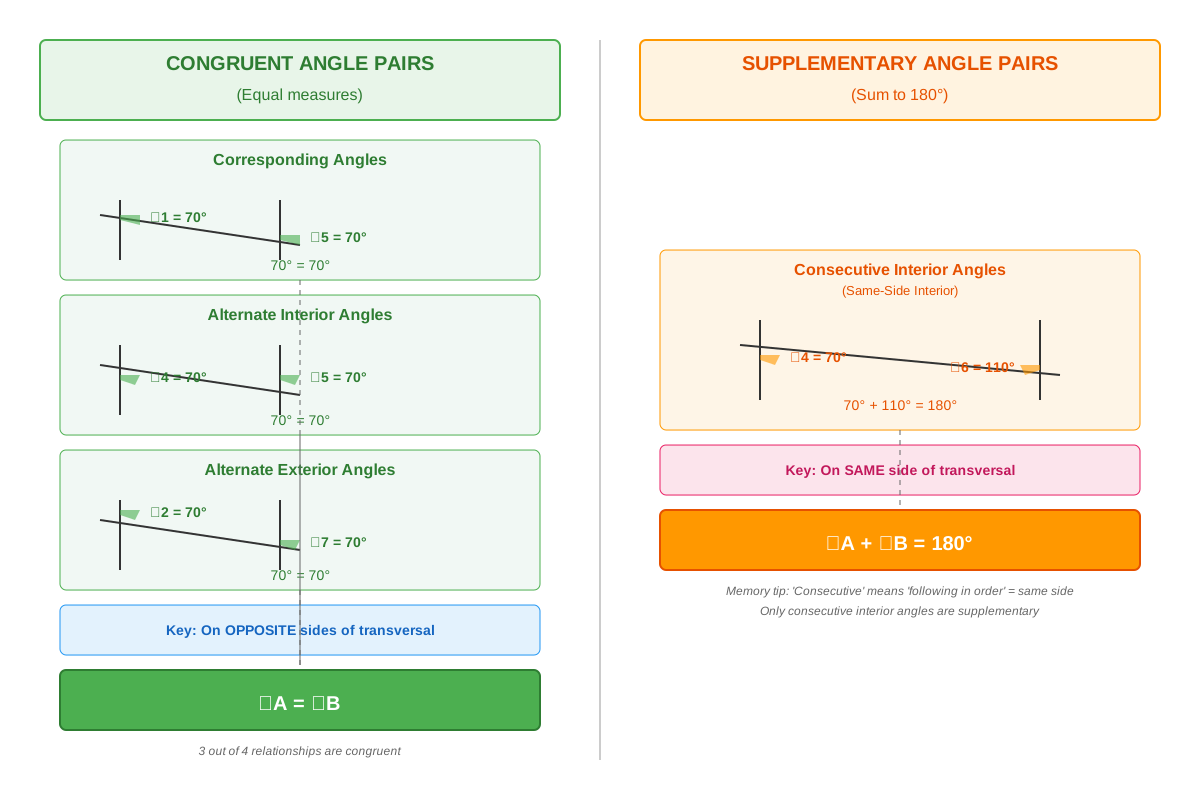
Corresponding angles occupy the same relative position at each intersection point. When two parallel lines are cut by a transversal, corresponding angles are always congruent (equal in measure). The four pairs of corresponding angles are:
- Upper-left at first intersection and upper-left at second intersection
- Upper-right at first intersection and upper-right at second intersection
- Lower-left at first intersection and lower-left at second intersection
- Lower-right at first intersection and lower-right at second intersection
This relationship is so fundamental that it serves as the basis for proving lines are parallel: if corresponding angles are congruent, the lines must be parallel. On the ACT, corresponding angles are the most frequently tested angle relationship, appearing in approximately 40% of parallel lines questions.
Alternate Interior Angles
Alternate interior angles are pairs of angles on opposite sides of the transversal and between (interior to) the parallel lines. When lines are parallel, alternate interior angles are congruent. These angles form a "Z" pattern (or reverse "Z") in the diagram. There are two pairs of alternate interior angles in any parallel lines and transversal configuration. This relationship is particularly useful for solving problems where angles are not adjacent, as it allows students to "jump" from one intersection point to another.
Alternate Exterior Angles
Alternate exterior angles are pairs of angles on opposite sides of the transversal and outside (exterior to) the parallel lines. Like alternate interior angles, alternate exterior angles are congruent when the lines are parallel. These also form a "Z" pattern but in the exterior regions. While less commonly tested than corresponding or alternate interior angles, alternate exterior angles appear in approximately 15% of ACT parallel lines questions, often in more challenging problems.
Consecutive Interior Angles (Same-Side Interior Angles)
Consecutive interior angles, also called same-side interior angles or co-interior angles, are pairs of angles on the same side of the transversal and between the parallel lines. Unlike the previous relationships, consecutive interior angles are supplementary (sum to 180°) rather than congruent. This relationship is crucial for solving problems where students must find an angle that is not congruent to the given angle. The two pairs of consecutive interior angles form a "C" or "U" shape in the diagram.
Summary Table of Angle Relationships
| Angle Pair Type | Position | Relationship When Lines Are Parallel | Visual Pattern |
|---|---|---|---|
| Corresponding Angles | Same relative position at each intersection | Congruent (equal) | "F" shape |
| Alternate Interior Angles | Opposite sides of transversal, between lines | Congruent (equal) | "Z" shape |
| Alternate Exterior Angles | Opposite sides of transversal, outside lines | Congruent (equal) | "Z" shape |
| Consecutive Interior Angles | Same side of transversal, between lines | Supplementary (sum to 180°) | "C" or "U" shape |
Vertical Angles in Parallel Line Diagrams
While not unique to parallel lines, vertical angles (opposite angles formed when two lines intersect) are always congruent and frequently appear in parallel lines problems. At each intersection point where the transversal crosses a parallel line, two pairs of vertical angles are formed. Recognizing vertical angles allows students to identify additional angle relationships beyond the four main parallel line relationships. Many ACT problems require combining vertical angle relationships with parallel line relationships to solve for unknown angles.
Using Angle Relationships to Prove Lines Are Parallel
The converse of each angle relationship also holds true: if the angle relationship exists, the lines must be parallel. This principle allows students to determine whether lines are parallel:
- If corresponding angles are congruent → lines are parallel
- If alternate interior angles are congruent → lines are parallel
- If alternate exterior angles are congruent → lines are parallel
- If consecutive interior angles are supplementary → lines are parallel
ACT questions occasionally ask students to identify which angle relationship would prove lines are parallel, testing conceptual understanding rather than computational skill.
Multi-Step Problem Solving
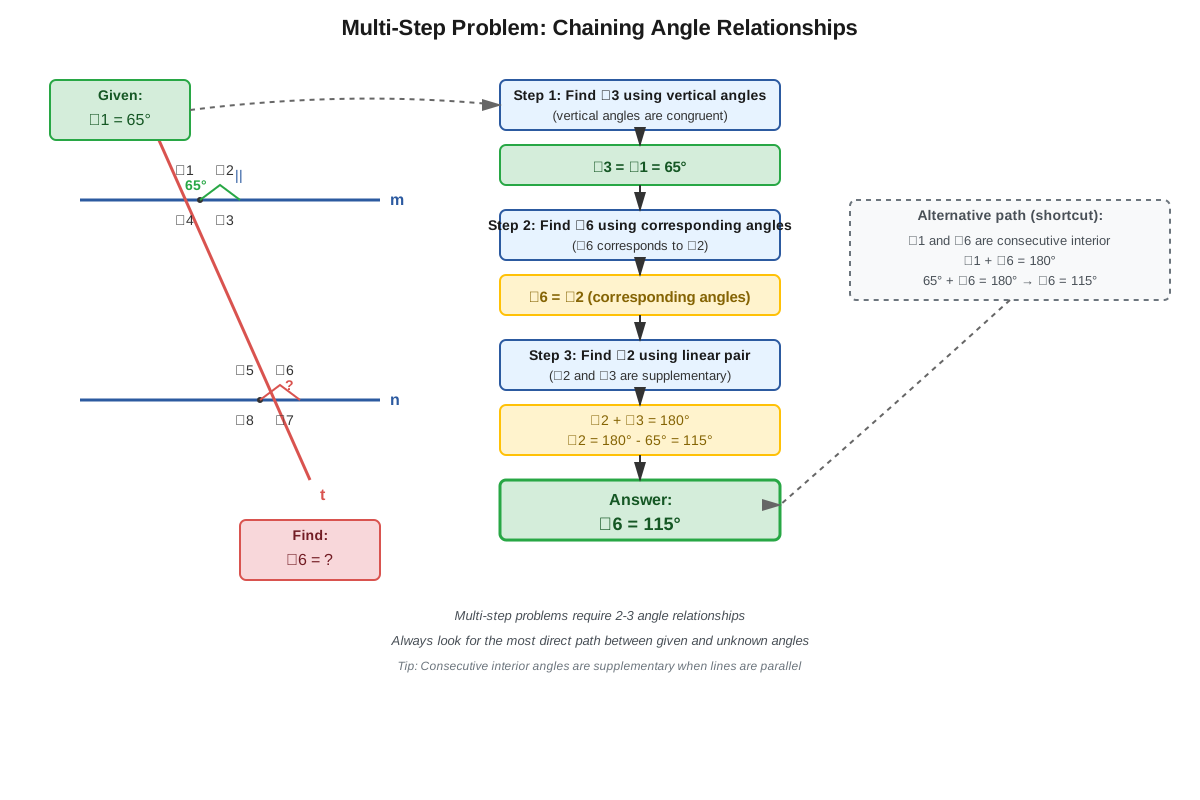
Many ACT problems require chaining multiple angle relationships together. A typical multi-step problem might provide one angle measure and ask for an angle that requires using both a parallel line relationship and a vertical angle relationship, or combining two different parallel line relationships. The key strategy is to work systematically from the known angle to the unknown angle, identifying each relationship along the path.
Concept Relationships
The concepts within parallel lines and transversals form a hierarchical structure. At the foundation lies the definition of parallel lines and transversals, which establishes the geometric configuration. This configuration → creates eight angles at two intersection points → which form four types of angle pair relationships (corresponding, alternate interior, alternate exterior, and consecutive interior). Each of these relationships → provides a method for finding unknown angles → which enables solving both direct angle-finding problems and proof-based problems about whether lines are parallel.
The angle relationships themselves are interconnected. Corresponding angles → serve as the fundamental relationship from which the others can be derived. For example, if two corresponding angles are congruent, and vertical angles at one intersection are congruent, then → alternate interior angles must also be congruent. Similarly, if corresponding angles are congruent → and linear pairs are supplementary → then consecutive interior angles must be supplementary.
Parallel lines and transversals connect to prerequisite topics in essential ways. Vertical angles → provide a tool for relating angles at the same intersection point, while linear pairs and supplementary angles → enable finding angles adjacent to known angles. These basic angle relationships → combine with parallel line relationships → to solve complex multi-step problems.
Looking forward, parallel lines and transversals → support understanding of polygon angle sums (parallel sides create transversal relationships), properties of parallelograms and trapezoids (opposite sides are parallel), coordinate geometry (parallel lines have equal slopes), and even trigonometry (angle relationships in parallel line diagrams can involve trigonometric ratios).
Quick check — test yourself on Parallel lines and transversals so far.
Try Flashcards →High-Yield Facts
⭐ When a transversal intersects two parallel lines, corresponding angles are always congruent
⭐ Alternate interior angles formed by a transversal crossing parallel lines are always congruent
⭐ Consecutive interior angles (same-side interior angles) are always supplementary, summing to 180°
⭐ If any of the angle relationships (corresponding, alternate interior, alternate exterior congruent, or consecutive interior supplementary) hold true, the lines must be parallel
⭐ All acute angles formed by a transversal crossing parallel lines are congruent to each other, and all obtuse angles are congruent to each other
- Alternate exterior angles are congruent when lines are parallel
- At each intersection point, vertical angles are congruent regardless of whether lines are parallel
- Linear pairs of angles at each intersection are supplementary (sum to 180°)
- If a transversal is perpendicular to one of two parallel lines, it is perpendicular to both
- The sum of all eight angles formed by a transversal crossing two parallel lines is 1440° (8 × 180° = 1440°)
- In any parallel lines and transversal configuration, there are exactly four different angle measures (or two if the transversal is perpendicular)
- Corresponding angles form an "F" pattern, alternate interior angles form a "Z" pattern, and consecutive interior angles form a "C" pattern
- If two lines are cut by a transversal and corresponding angles are NOT congruent, the lines are NOT parallel
Common Misconceptions
Misconception: All angles formed by a transversal crossing parallel lines are congruent to each other.
Correction: Only specific angle pairs are congruent. There are typically two different angle measures: one for all acute angles and one for all obtuse angles. These two measures are supplementary (sum to 180°).
Misconception: Alternate interior angles are on the same side of the transversal.
Correction: Alternate interior angles are on opposite (alternate) sides of the transversal. Angles on the same side are called consecutive interior angles or same-side interior angles, and they are supplementary, not congruent.
Misconception: Consecutive interior angles are congruent when lines are parallel.
Correction: Consecutive interior angles are supplementary (sum to 180°) when lines are parallel, not congruent. This is the only major angle relationship that involves supplementary rather than congruent angles.
Misconception: The angle relationships only work when the transversal is perpendicular to the parallel lines.
Correction: The angle relationships hold true regardless of the angle at which the transversal intersects the parallel lines. The transversal can intersect at any angle, and the relationships remain valid.
Misconception: If two lines look parallel in a diagram, they are parallel.
Correction: On the ACT, never assume lines are parallel based on appearance alone. Lines are only parallel if explicitly stated, marked with parallel symbols or arrows, or if angle relationships prove they are parallel. The test writers intentionally draw diagrams that are not to scale.
Misconception: Vertical angles are only congruent when lines are parallel.
Correction: Vertical angles are always congruent whenever two lines intersect, regardless of whether those lines are parallel to any other lines. Vertical angles are a separate concept that applies at each individual intersection point.
Misconception: Corresponding angles are always adjacent to each other.
Correction: Corresponding angles are at different intersection points, not adjacent. They occupy the same relative position at each intersection (both upper-left, both lower-right, etc.).
Worked Examples
Example 1: Finding an Unknown Angle Using Multiple Relationships
Problem: In the diagram below, lines m and n are parallel, and they are intersected by transversal t. If angle 1 measures 65°, what is the measure of angle 6?
        t
        |
    1 2 |
  m ----+----
    3 4 |
        |
    5 6 |
  n ----+----
7 8 |Solution:
Step 1: Identify what we know. Angle 1 = 65°, lines m and n are parallel, and we need to find angle 6.
Step 2: Determine the relationship between angles 1 and 6. Angle 1 is at the upper intersection, exterior, on the left side of the transversal. Angle 6 is at the lower intersection, interior, on the right side of the transversal. These are not one of our standard angle pairs.
Step 3: Find an intermediate angle. Let's use angle 4, which is a corresponding angle to angle 8, and angle 8 is a vertical angle to angle 6.
Alternative approach (more direct): Angle 1 and angle 5 are corresponding angles (both upper-left at their respective intersections). Since lines m and n are parallel, corresponding angles are congruent. Therefore, angle 5 = 65°.
Step 4: Angles 5 and 6 form a linear pair (they are adjacent and supplementary). Therefore:
angle 5 + angle 6 = 180°
65° + angle 6 = 180°
angle 6 = 115°
Answer: Angle 6 measures 115°.
Connection to Learning Objectives: This problem demonstrates identifying when parallel lines and transversals is being tested (parallel lines marked, transversal shown, angle measure requested), applying the core strategy (using corresponding angles and linear pairs), and accurately solving an ACT-style question.
Example 2: Determining if Lines Are Parallel
Problem: Lines p and q are cut by transversal r. Angle A measures (3x + 20)° and angle B measures (5x - 40)°. Angles A and B are alternate interior angles. For what value of x are lines p and q parallel?
Solution:
Step 1: Recall the rule for alternate interior angles. When lines are parallel, alternate interior angles are congruent (equal in measure).
Step 2: Set up an equation. For lines p and q to be parallel, angles A and B must be equal:
3x + 20 = 5x - 40
Step 3: Solve for x:
3x + 20 = 5x - 40
20 + 40 = 5x - 3x
60 = 2x
x = 30
Step 4: Verify (optional but recommended). When x = 30:
- Angle A = 3(30) + 20 = 90 + 20 = 110°
- Angle B = 5(30) - 40 = 150 - 40 = 110°
Since the angles are equal, the lines are parallel when x = 30.
Answer: x = 30
Connection to Learning Objectives: This problem tests the ability to explain the core rule (alternate interior angles are congruent when lines are parallel), apply algebraic reasoning to parallel lines problems, and determine when lines are parallel based on angle relationships.
Exam Strategy
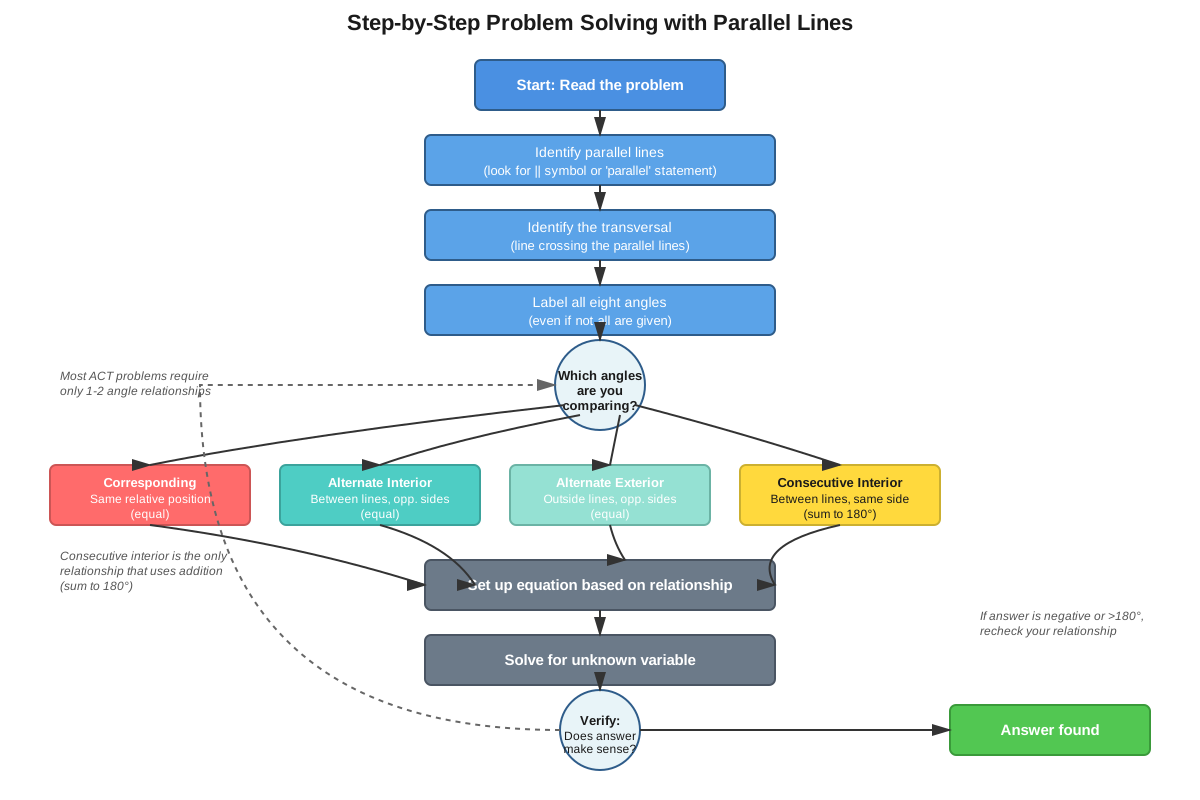
When approaching ACT questions on parallel lines and transversals, follow this systematic process:
Step 1: Identify the configuration. Look for explicit statements that lines are parallel, parallel symbols (∥), or matching arrow marks on lines. Never assume lines are parallel based on appearance alone, as ACT diagrams are often not to scale.
Step 2: Mark the diagram. If angles are not already labeled, quickly label them 1-8 or use letters. Mark any given angle measures directly on the diagram. This visual organization prevents errors and saves time.
Step 3: Identify the angle relationship. Determine which type of angle pair connects the known angle to the unknown angle: corresponding (same position), alternate interior (opposite sides, between lines), alternate exterior (opposite sides, outside lines), or consecutive interior (same side, between lines).
Step 4: Apply the appropriate rule. Use congruence for corresponding, alternate interior, and alternate exterior angles. Use supplementary (sum to 180°) for consecutive interior angles.
Trigger words and phrases that indicate parallel lines and transversals questions:
- "parallel lines cut by a transversal"
- "corresponding angles"
- "alternate interior angles"
- "same-side interior angles"
- "lines m and n are parallel"
- Diagrams showing two lines with matching arrow marks
- "what is the measure of angle..."
- "for what value of x are the lines parallel"
Process-of-elimination tips:
- If the answer choices include both an angle measure and its supplement (e.g., 65° and 115°), you likely need to determine whether the angles are congruent or supplementary
- Eliminate any answer that would make an acute angle obtuse or vice versa (unless the transversal is perpendicular)
- If solving for a variable, eliminate answers that produce negative angle measures or angles greater than 180°
- For "which statement proves lines are parallel" questions, eliminate any answer involving vertical angles (vertical angles don't prove parallel lines)
Time allocation: Most parallel lines and transversals questions should take 30-60 seconds once the concept is mastered. If a problem is taking longer than 90 seconds, mark it and return later. These questions are designed to be solved quickly with pattern recognition rather than complex calculations.
Common trap: The ACT often provides the measure of one angle and asks for an angle that requires two steps (e.g., using corresponding angles then linear pairs) rather than one direct relationship. Always check whether the angle you found is the angle being asked for.
Memory Techniques
"CAZ" Mnemonic for Congruent Angle Pairs:
- Corresponding angles are congruent
- Alternate interior angles are congruent
- Z-pattern (alternate exterior) angles are congruent
"Same-Side = Supplementary" Alliteration: The repeated "S" sound helps remember that same-side interior angles (consecutive interior angles) are supplementary, not congruent.
Visual Pattern Recognition:
- F-pattern: Corresponding angles form an "F" shape (or backwards F)
- Z-pattern: Alternate interior angles form a "Z" shape (or backwards Z)
- C-pattern: Consecutive interior angles form a "C" or "U" shape
"All Acute Are Alike" Rhyme: When a transversal crosses parallel lines, all acute angles are congruent to each other, and all obtuse angles are congruent to each other. Any acute angle plus any obtuse angle equals 180°.
The "Four-Four Rule": There are four types of angle relationships (corresponding, alternate interior, alternate exterior, consecutive interior), and there are four angles at each intersection point. This helps organize the mental framework.
"Parallel = Same Distance = Same Angles": Visualize parallel lines as railroad tracks that maintain the same distance. When a transversal crosses them at the same angle, it creates matching (corresponding) angles at each crossing.
Summary
Parallel lines and transversals is a foundational geometry topic that appears consistently on the ACT Math test, typically in 2-4 questions per exam. When a transversal intersects two parallel lines, eight angles are formed that create four key relationships: corresponding angles are congruent, alternate interior angles are congruent, alternate exterior angles are congruent, and consecutive interior angles are supplementary. Mastering these relationships allows students to solve for unknown angles quickly and accurately. The key to success is recognizing which angle relationship applies, understanding that congruent angles are equal while supplementary angles sum to 180°, and systematically working from known to unknown angles. Most problems require either direct application of one relationship or combining two relationships (such as using corresponding angles and then linear pairs). Students must remember never to assume lines are parallel based on diagram appearance alone, but only when explicitly stated or proven through angle relationships. The converse relationships also hold: if the angle relationships exist, the lines must be parallel. This topic connects to broader geometry concepts including polygon properties, coordinate geometry slopes, and serves as essential preparation for more advanced mathematical reasoning.
Key Takeaways
- When a transversal crosses parallel lines, corresponding angles, alternate interior angles, and alternate exterior angles are all congruent (equal)
- Consecutive interior angles (same-side interior angles) are supplementary, summing to 180°, not congruent
- All acute angles in a parallel lines and transversal configuration are congruent to each other; all obtuse angles are congruent to each other
- The angle relationships work in reverse: if the relationships hold, the lines must be parallel
- Never assume lines are parallel from diagram appearance; look for explicit statements, parallel symbols, or matching arrow marks
- Most ACT problems require 1-2 steps: identify the angle relationship, then apply congruence or supplementary rules
- Visual patterns help: F-shape for corresponding, Z-shape for alternate interior/exterior, C-shape for consecutive interior
Related Topics
Polygon Interior and Exterior Angles: Understanding parallel lines helps explain why polygon interior angles sum to (n-2)×180°, as polygons can be divided into triangles using parallel line principles.
Properties of Parallelograms: Parallelograms have two pairs of parallel sides, making parallel lines and transversals essential for understanding their angle properties and proving congruence.
Coordinate Geometry and Slope: Parallel lines in the coordinate plane have equal slopes, connecting algebraic and geometric representations of parallelism.
Triangle Angle Relationships: When a line is drawn parallel to one side of a triangle, it creates angle relationships through transversal principles that help solve for unknown angles.
Transformations and Translations: Parallel lines remain parallel under translation transformations, and understanding angle preservation requires knowledge of transversal relationships.
Practice CTA
Now that you've mastered the core concepts of parallel lines and transversals, it's time to solidify your understanding through practice. Attempt the practice questions to test your ability to identify angle relationships quickly and accurately. Use the flashcards to drill the key angle relationships until they become automatic. Remember, the difference between a good score and a great score often comes down to speed and accuracy on high-yield topics like this one. Every practice problem you complete builds the pattern recognition that will save you valuable time on test day. You've got this!
Sign up free to keep reading
Create a free AnvayaPrep account to finish this ACT guide on Parallel lines and transversals — plus flashcards and practice questions.