Overview
Linear functions represent one of the most fundamental and frequently tested concepts on the ACT Math section. These functions describe relationships where one variable changes at a constant rate with respect to another, forming a straight line when graphed on a coordinate plane. Understanding linear functions is not merely about memorizing formulas—it requires recognizing patterns, interpreting graphs, manipulating equations, and translating between multiple representations of the same relationship.
The ACT consistently dedicates approximately 15-20% of its Math section to questions involving linear relationships, making this a high-yield topic that directly impacts test scores. Questions may ask students to find slopes, write equations, interpret graphs, solve systems of linear equations, or apply linear models to real-world scenarios. Mastery of this topic provides the foundation for understanding more complex algebraic concepts and is essential for achieving scores in the upper percentile ranges.
Linear functions connect to virtually every other algebraic concept tested on the ACT. They serve as building blocks for understanding quadratic functions, exponential functions, and systems of equations. Additionally, linear functions appear in coordinate geometry problems, data interpretation questions, and word problems involving rates, distances, and proportional relationships. A solid grasp of linear functions enables students to approach a significant portion of the ACT Math section with confidence and efficiency.
Learning Objectives
- [ ] Identify when Linear functions is being tested
- [ ] Explain the core rule or strategy behind Linear functions
- [ ] Apply Linear functions to ACT-style questions accurately
- [ ] Convert between different forms of linear equations (slope-intercept, point-slope, standard form)
- [ ] Determine the equation of a line given various pieces of information (two points, point and slope, graph)
- [ ] Interpret the meaning of slope and y-intercept in real-world contexts
- [ ] Recognize parallel and perpendicular lines through their slopes
Prerequisites
- Basic algebraic manipulation: Solving for variables, distributing, and combining like terms are essential for rearranging linear equations into different forms
- Coordinate plane understanding: Plotting points and understanding x and y axes enables visualization of linear relationships
- Fraction operations: Calculating slopes often requires working with fractions, including simplification and negative values
- Substitution skills: Evaluating functions and checking solutions requires substituting values into equations
Why This Topic Matters
Linear functions model countless real-world phenomena, from calculating costs based on usage (phone bills, taxi fares) to predicting trends (population growth, temperature changes). In business, linear functions help analyze profit margins and break-even points. In science, they describe constant-rate processes like speed and chemical reactions. Understanding these relationships empowers students to make informed decisions and predictions in everyday life.
On the ACT Math section, linear functions appear in approximately 8-12 questions per test, representing one of the highest-frequency topics. These questions span multiple difficulty levels and formats, including:
- Direct equation questions: Finding slopes, intercepts, or writing equations
- Graph interpretation: Reading information from coordinate planes
- Word problems: Translating verbal descriptions into mathematical models
- Systems of equations: Finding intersection points of two lines
- Coordinate geometry: Calculating distances and midpoints involving linear relationships
The ACT frequently embeds linear function concepts within more complex problems, making them appear in questions nominally testing other topics. For example, a geometry problem might require finding the equation of a line to determine where it intersects a circle. This integration means that mastering linear functions provides benefits far beyond the questions explicitly labeled as "linear function problems."
Core Concepts
Definition and Basic Form
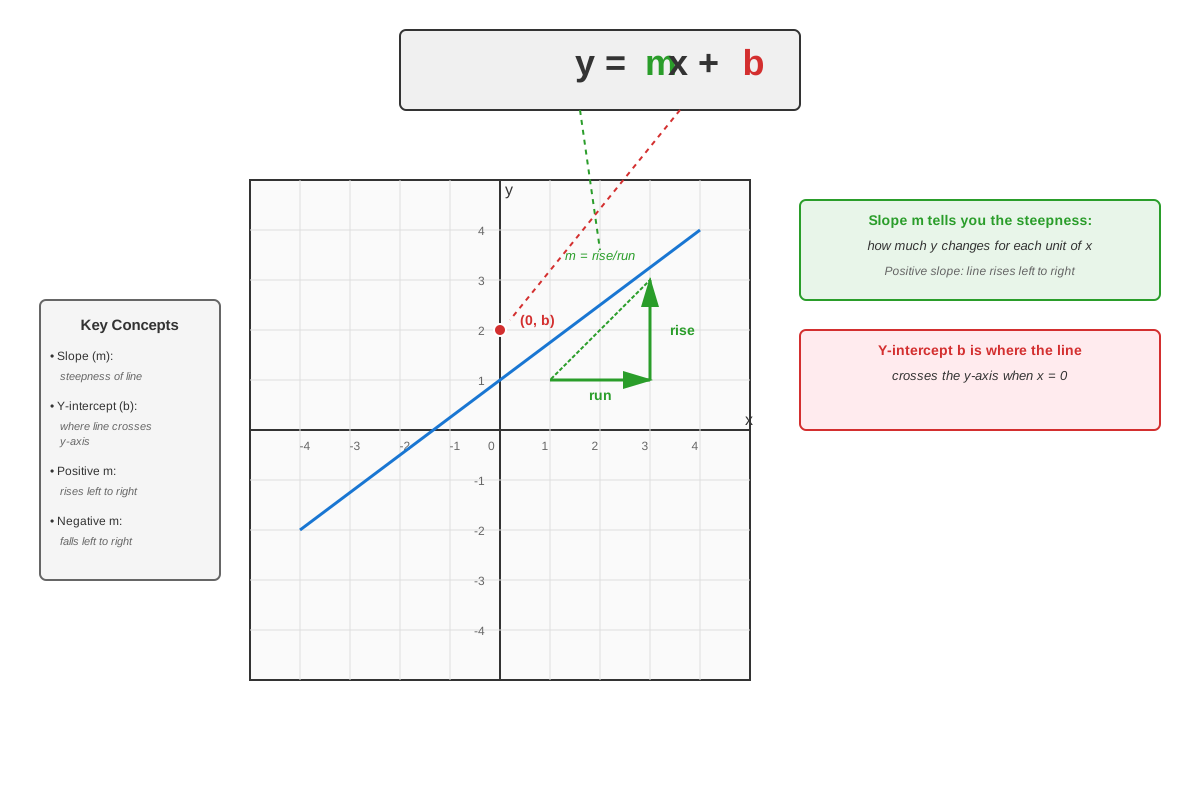
A linear function is a function that can be written in the form f(x) = mx + b, where m and b are constants. This is called slope-intercept form, where m represents the slope (rate of change) and b represents the y-intercept (the y-value where the line crosses the y-axis). The graph of any linear function is always a straight line, which is why these functions are called "linear."
The slope measures how steep the line is and in which direction it goes. Mathematically, slope represents the ratio of vertical change (rise) to horizontal change (run) between any two points on the line. A positive slope indicates the line rises from left to right, while a negative slope indicates it falls. A slope of zero creates a horizontal line, and an undefined slope (division by zero) creates a vertical line.
Forms of Linear Equations
Linear equations can be expressed in multiple forms, each useful for different purposes:
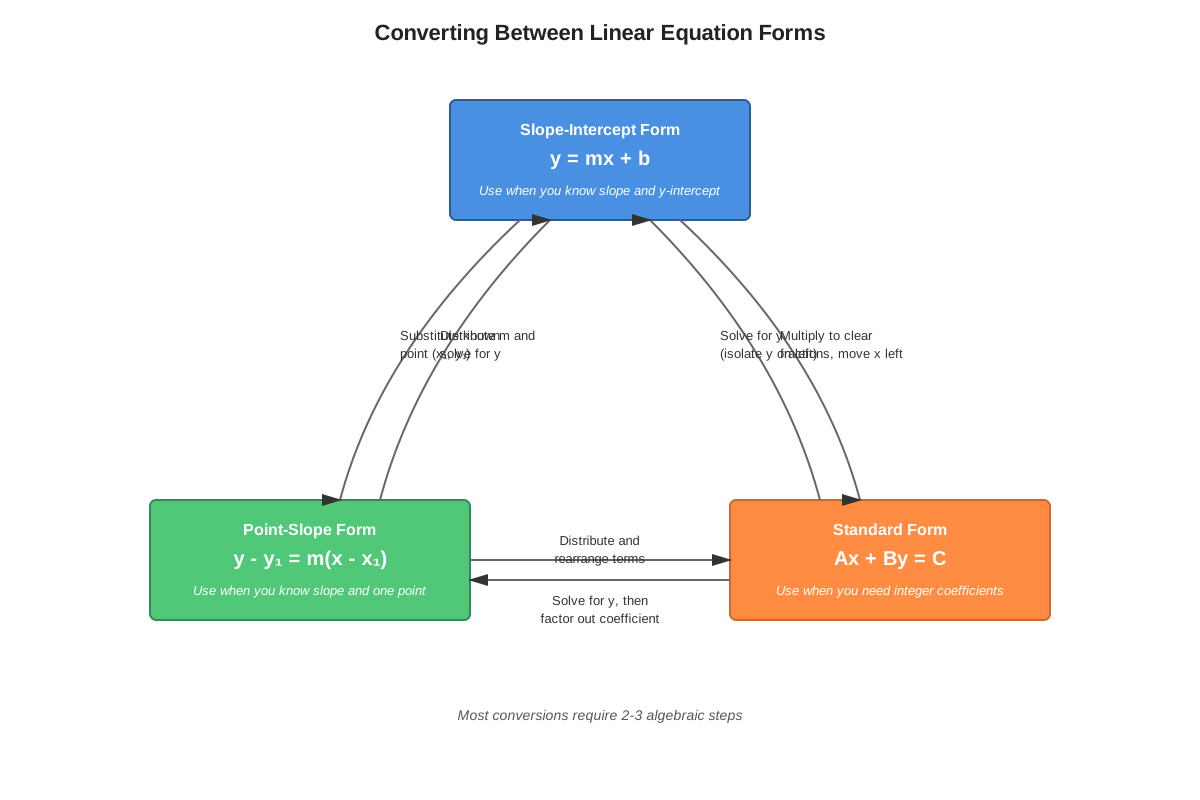
| Form | Equation | Best Used When |
|---|---|---|
| Slope-Intercept | y = mx + b | You know the slope and y-intercept, or need to quickly identify them |
| Point-Slope | y - y₁ = m(x - x₁) | You know the slope and one point on the line |
| Standard Form | Ax + By = C | Working with systems of equations or when integer coefficients are preferred |
Converting between these forms is a critical skill for the ACT. To convert from point-slope to slope-intercept form, distribute and solve for y. To convert from slope-intercept to standard form, move all variables to one side and eliminate fractions by multiplying through by the least common denominator.
Calculating Slope
The slope formula calculates the rate of change between two points (x₁, y₁) and (x₂, y₂):
m = (y₂ - y₁)/(x₂ - x₁)This formula is fundamental to virtually every linear function problem on the ACT. When applying it, consistency matters—whichever point you designate as "point 1" must be used consistently in both numerator and denominator. The order of subtraction doesn't matter as long as it's consistent (both top-to-bottom or both bottom-to-top).
Special cases to remember:
- Horizontal lines have slope m = 0 (no vertical change)
- Vertical lines have undefined slope (division by zero)
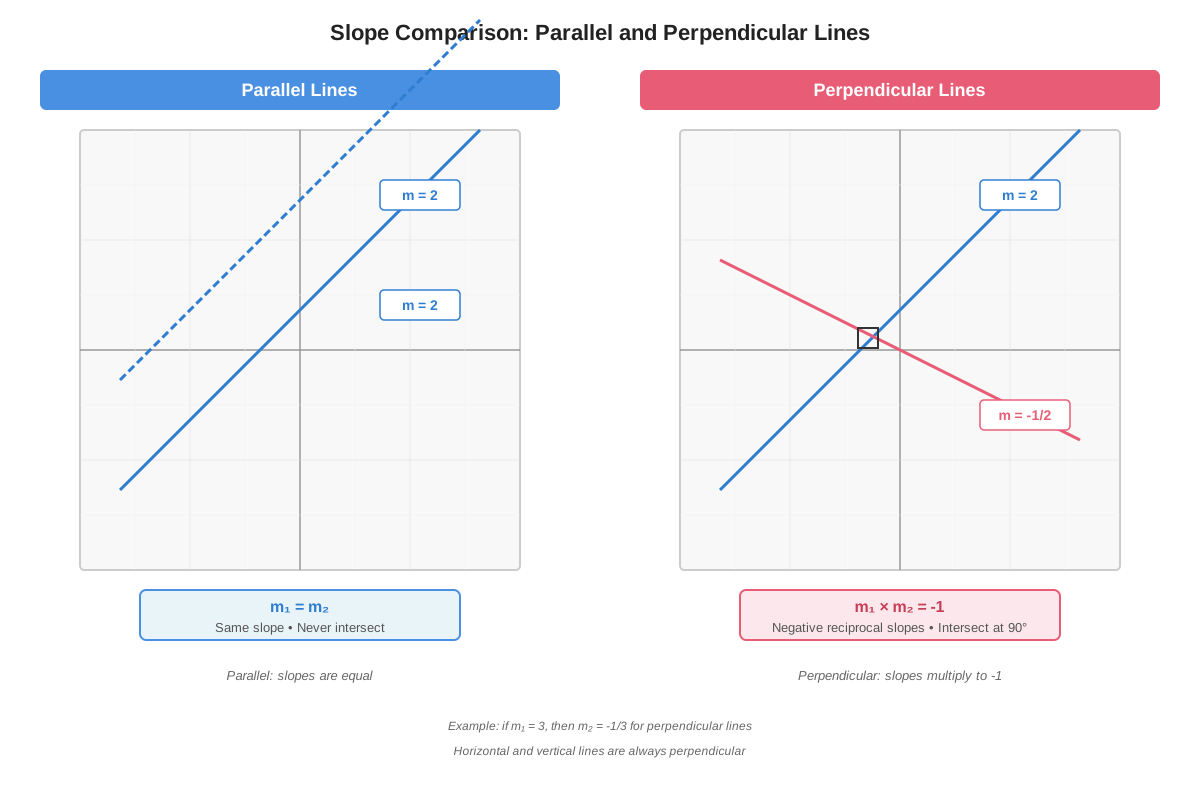
- Parallel lines have equal slopes
- Perpendicular lines have slopes that are negative reciprocals (m₁ × m₂ = -1)
Finding Linear Equations
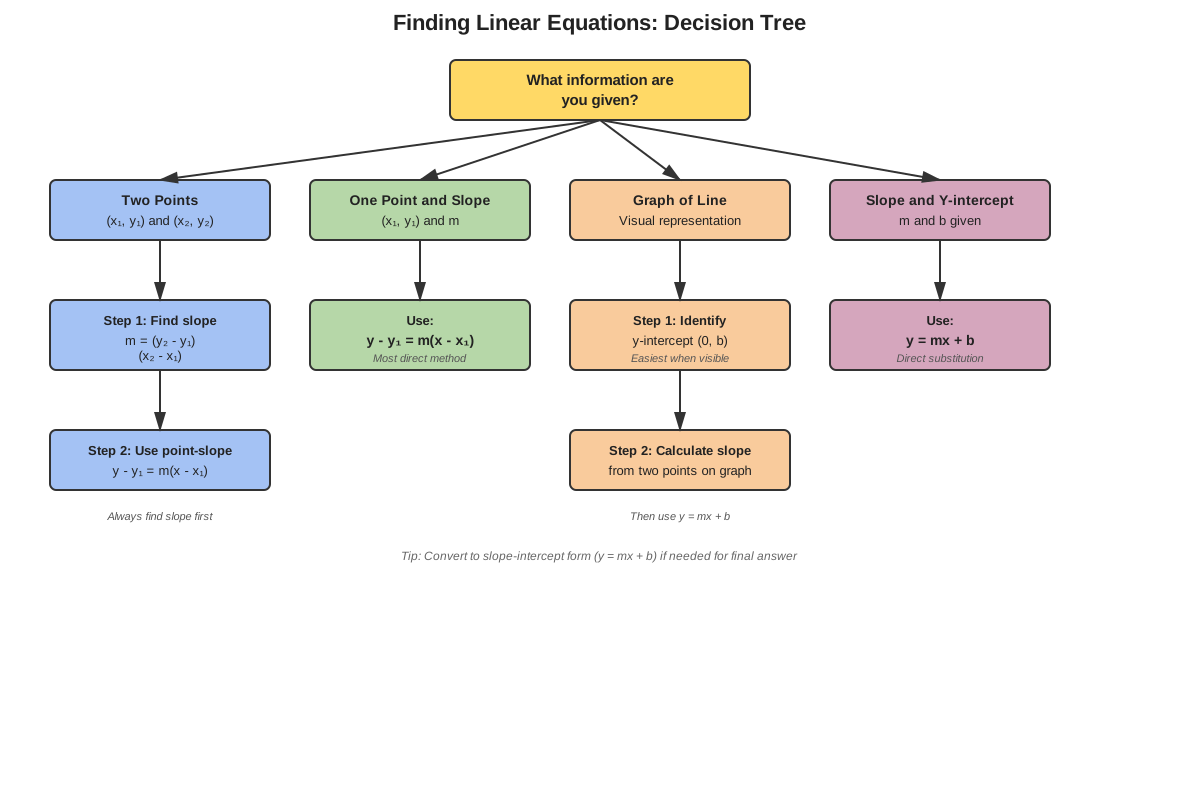
The ACT tests multiple scenarios for determining a line's equation:
Given slope and y-intercept: Directly substitute into y = mx + b
Given slope and one point: Use point-slope form y - y₁ = m(x - x₁), then convert to slope-intercept if needed
Given two points:
- Calculate slope using the slope formula
- Substitute the slope and either point into point-slope form
- Simplify to desired form
Given a graph:
- Identify the y-intercept (where the line crosses the y-axis)
- Count rise over run between two clear points to find slope
- Write equation in slope-intercept form
Interpreting Linear Functions in Context
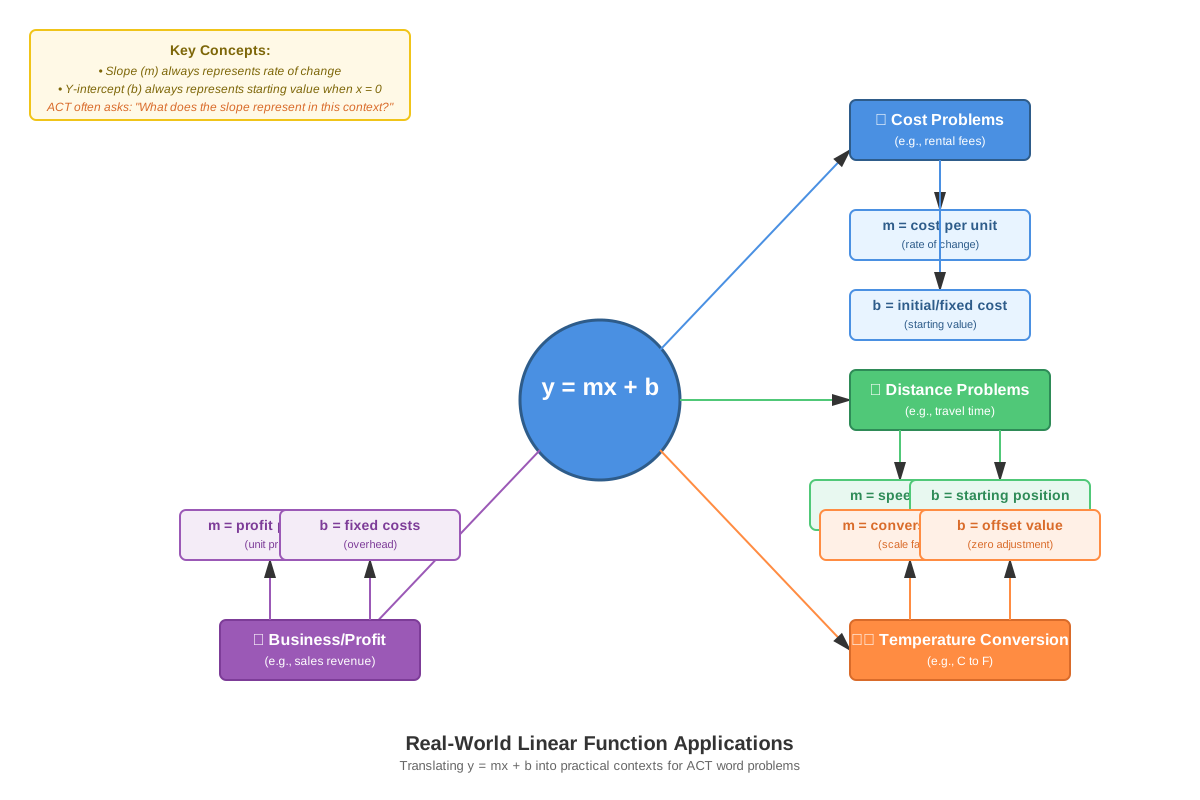
ACT linear functions problems frequently present real-world scenarios where students must interpret the meaning of slope and y-intercept. The slope represents the rate of change—how much the dependent variable changes per unit increase in the independent variable. The y-intercept represents the initial value or starting point when the independent variable equals zero.
For example, in the equation C = 50 + 0.15m (where C is cost in dollars and m is miles driven), the slope 0.15 means the cost increases by $0.15 per mile, and the y-intercept 50 represents a $50 base fee regardless of miles driven.
Parallel and Perpendicular Lines
Understanding the relationship between slopes of parallel and perpendicular lines is essential for ACT success:
Parallel lines never intersect and have identical slopes. If line 1 has equation y = 3x + 2, any line parallel to it must have slope 3, such as y = 3x - 5.
Perpendicular lines intersect at right angles and have slopes that are negative reciprocals. If line 1 has slope m₁ = 2/3, any perpendicular line has slope m₂ = -3/2. To find the negative reciprocal: flip the fraction and change the sign.
Systems of Linear Equations
When two linear equations are considered together, they form a system. The solution to a system is the point (x, y) that satisfies both equations simultaneously—graphically, this is where the lines intersect.
Three methods solve systems:
- Graphing: Plot both lines and identify intersection point (useful when graphs are provided)
- Substitution: Solve one equation for a variable, substitute into the other
- Elimination: Add or subtract equations to eliminate one variable
The ACT most commonly tests substitution and elimination methods, particularly in word problems involving two unknowns.
Concept Relationships
Linear functions form a hierarchical knowledge structure where each concept builds upon previous ones. The slope concept serves as the foundation, connecting to the slope formula which enables calculation from coordinates. This calculation skill then feeds into writing equations using various forms, which in turn enables solving systems and interpreting real-world models.
The relationship flows: Coordinate Plane Understanding → Slope Calculation → Equation Forms → Graphing → Systems of Equations → Applied Problems
Linear functions also connect horizontally to other ACT topics. They intersect with coordinate geometry when finding distances and midpoints, with inequalities when graphing solution regions, and with functions when evaluating and composing. Understanding that linear functions are a specific type of function (with constant rate of change) helps students distinguish them from quadratic and exponential functions.
The prerequisite skills of algebraic manipulation enable all work with linear equations, while the concept of rate of change connects linear functions to calculus concepts (though calculus isn't tested on the ACT). Recognizing these connections helps students see linear functions not as isolated formulas but as part of an integrated mathematical framework.
Quick check — test yourself on Linear functions so far.
Try Flashcards →High-Yield Facts
⭐ The slope-intercept form y = mx + b immediately reveals both the slope (m) and y-intercept (b)
⭐ Slope equals rise over run: m = (y₂ - y₁)/(x₂ - x₁) for any two points on the line
⭐ Parallel lines have equal slopes; perpendicular lines have slopes that are negative reciprocals
⭐ The y-intercept is the y-value when x = 0; the x-intercept is the x-value when y = 0
⭐ A positive slope rises from left to right; a negative slope falls from left to right
- Horizontal lines have the form y = k (slope of 0); vertical lines have the form x = k (undefined slope)
- Point-slope form y - y₁ = m(x - x₁) is most efficient when you know one point and the slope
- Standard form Ax + By = C is useful for systems of equations and when integer coefficients are required
- To find where a line crosses the x-axis, set y = 0 and solve for x
- The slope represents the rate of change in applied problems (dollars per hour, miles per gallon, etc.)
- When two lines intersect, their intersection point satisfies both equations simultaneously
- A steeper line has a larger absolute value of slope
- Linear functions have constant rates of change—the slope is the same between any two points
- To convert from standard form to slope-intercept form, solve for y
- The domain and range of most linear functions are all real numbers (unless context restricts them)
Common Misconceptions
Misconception: Slope is always positive → Correction: Slope can be positive, negative, zero, or undefined depending on the line's direction. Downward-sloping lines have negative slopes, horizontal lines have zero slope, and vertical lines have undefined slope.
Misconception: The y-intercept is always positive → Correction: The y-intercept can be any real number—positive, negative, or zero. It simply represents where the line crosses the y-axis, which can occur above, below, or at the origin.
Misconception: When calculating slope, the order of points doesn't matter → Correction: While you can choose which point is "first," you must be consistent. If you use (x₂ - x₁) in the denominator, you must use (y₂ - y₁) in the numerator. Mixing the order gives the wrong sign.
Misconception: Parallel lines have slopes that are reciprocals → Correction: Parallel lines have identical slopes. It's perpendicular lines that have slopes that are negative reciprocals of each other.
Misconception: The equation y = 5 represents a vertical line → Correction: The equation y = 5 represents a horizontal line (all points have y-coordinate 5). Vertical lines have equations of the form x = k.
Misconception: A steeper line always has a larger slope → Correction: A steeper line has a larger absolute value of slope. A line with slope -10 is steeper than a line with slope 2, even though -10 < 2.
Misconception: The slope formula only works for positive coordinates → Correction: The slope formula works for all real number coordinates, including negative values. Just be careful with signs when subtracting negative numbers.
Misconception: In word problems, the first number mentioned is always the y-intercept → Correction: Carefully analyze what the numbers represent. The y-intercept is the value when the independent variable equals zero, which may not be the first number mentioned.
Worked Examples
Example 1: Writing an Equation from Two Points
Problem: Write the equation of the line passing through points (2, 5) and (6, 13) in slope-intercept form.
Solution:
Step 1: Calculate the slope using the slope formula.
m = (y₂ - y₁)/(x₂ - x₁) = (13 - 5)/(6 - 2) = 8/4 = 2Step 2: Use point-slope form with either point. Using (2, 5):
y - 5 = 2(x - 2)Step 3: Convert to slope-intercept form by distributing and solving for y:
y - 5 = 2x - 4
y = 2x - 4 + 5
y = 2x + 1Answer: y = 2x + 1
Connection to Learning Objectives: This problem demonstrates applying the slope formula and converting between equation forms, both essential skills for ACT linear function questions.
Example 2: Real-World Application with Interpretation
Problem: A phone plan charges a monthly base fee plus a per-minute charge for calls. In January, Sarah used 200 minutes and paid $35. In February, she used 350 minutes and paid $47.50. Write a linear equation for the total cost C in terms of minutes m, and interpret the slope and y-intercept.
Solution:
Step 1: Identify the two points in (minutes, cost) format: (200, 35) and (350, 47.50)
Step 2: Calculate the slope:
m = (47.50 - 35)/(350 - 200) = 12.50/150 = 0.0833... ≈ 1/12Converting to a simpler fraction: 12.50/150 = 25/300 = 1/12
Step 3: Use point-slope form with (200, 35):
C - 35 = (1/12)(m - 200)
C - 35 = (1/12)m - 200/12
C - 35 = (1/12)m - 16.67
C = (1/12)m + 18.33
Or more precisely: C = (1/12)m + 55/3
Step 4: Interpret the components:
- Slope (1/12 ≈ $0.083): The cost increases by approximately 8.3 cents per minute of calls
- Y-intercept ($18.33 or $55/3): The monthly base fee charged regardless of minutes used
Answer: C = (1/12)m + 55/3, where the slope represents the per-minute charge and the y-intercept represents the base monthly fee.
Connection to Learning Objectives: This problem requires identifying when linear functions are being tested (constant rate scenario), applying the core strategy (slope formula and equation writing), and interpreting results in context—all key ACT skills.
Exam Strategy
When approaching ACT linear functions questions, begin by identifying what information is given and what form would be most useful for the answer. If the question provides a graph, extract the y-intercept first (it's usually easier to identify than slope), then count rise over run carefully between two points with integer coordinates.
Trigger words and phrases that signal linear function questions:
- "constant rate," "per unit," "each additional"
- "write an equation," "find the slope"
- "parallel to," "perpendicular to"
- "passes through," "contains the point"
- "y-intercept," "x-intercept," "crosses the axis"
- "initial value," "starting amount"
Process of elimination strategies:
- If asked for an equation and you know the y-intercept, eliminate any answer choices with different y-intercepts
- Check answer choices by substituting given points—the correct equation must satisfy all given points
- For slope questions, eliminate answers with wrong signs (positive vs. negative) based on line direction
- When finding perpendicular slopes, eliminate any answer that isn't a negative reciprocal
Time allocation: Most linear function questions should take 45-60 seconds. If you're spending more than 90 seconds, you may be overcomplicating the problem. Look for a more direct approach or move on and return later. Questions involving systems of equations or complex word problems may legitimately require 90-120 seconds.
Common shortcuts:
- When two answer choices differ only in sign, you likely made a sign error—double-check your slope calculation
- If the question asks for slope-intercept form and you have standard form, solve for y immediately
- For parallel/perpendicular questions, focus only on slope—you don't need to find the full equation unless asked
Exam Tip: Always verify your answer makes sense. If the problem describes an increasing relationship, your slope must be positive. If it describes a cost that starts at $50, your y-intercept should be 50.
Memory Techniques
Slope Formula Mnemonic: "You Rise Over X's Run" helps remember that y-values go in the numerator (rise) and x-values go in the denominator (run).
Parallel vs. Perpendicular: "Parallel = Precisely the same slope" and "Perpendicular = Product of slopes is -1" (or think "flip and negate" for perpendicular slopes).
Slope-Intercept Form Visualization: Picture "mountain" for slope (m) showing how steep the climb is, and "base camp" for y-intercept (b) showing where you start at the base.
Forms Acronym - SPS: Slope-intercept (y = mx + b), Point-slope (y - y₁ = m(x - x₁)), Standard (Ax + By = C) reminds you of the three main forms in order of most commonly used on the ACT.
Positive/Negative Slope Memory: Draw a simple face: / = happy/positive slope (rises), \\ = sad/negative slope (falls).
Intercept Finding: "To find y-intercept, make x = 0" and "To find x-intercept, make y = 0" (the letter you're finding is the one you DON'T set to zero).
Summary
Linear functions represent relationships with constant rates of change and graph as straight lines. Mastery requires fluency with three equation forms (slope-intercept, point-slope, and standard), the ability to calculate slope from two points or a graph, and skill in converting between forms. The slope m represents the rate of change (rise over run), while the y-intercept b represents the initial value. Parallel lines share identical slopes, while perpendicular lines have slopes that are negative reciprocals. On the ACT, linear function questions appear frequently in both pure algebraic form and real-world contexts, requiring students to write equations, interpret graphs, solve systems, and translate between verbal descriptions and mathematical models. Success depends on recognizing the constant-rate pattern that signals linear relationships, selecting the most efficient equation form for the given information, and carefully executing algebraic manipulations while maintaining attention to signs.
Key Takeaways
- Linear functions have constant rates of change and graph as straight lines; the equation y = mx + b reveals slope (m) and y-intercept (b) immediately
- Calculate slope using m = (y₂ - y₁)/(x₂ - x₁) with consistent point ordering, and remember that positive slopes rise while negative slopes fall
- Master converting between slope-intercept, point-slope, and standard forms by solving for y or rearranging terms
- Parallel lines have equal slopes; perpendicular lines have slopes that are negative reciprocals (product equals -1)
- In real-world problems, slope represents the rate of change (cost per item, speed, etc.) and y-intercept represents the initial or fixed value
- Verify answers by substituting given points into your equation and checking that the slope's sign matches the line's direction
- Use the most efficient form for the given information: slope-intercept when you know m and b, point-slope when you know m and one point
Related Topics
Systems of Linear Equations: Building on single linear equations, systems involve finding where two lines intersect, requiring substitution or elimination methods—essential for word problems with multiple unknowns.
Linear Inequalities: Extends linear equations to include inequality symbols, involving shading regions on coordinate planes and understanding boundary lines—frequently appears in optimization problems.
Quadratic Functions: The next level of polynomial functions, where understanding linear functions provides contrast (constant vs. changing rate of change) and helps with finding intercepts and axis of symmetry.
Absolute Value Functions: Combines linear functions with absolute value, creating V-shaped graphs that require understanding of piecewise linear behavior.
Coordinate Geometry: Uses linear equations to find distances, midpoints, and equations of geometric figures, directly applying slope and equation-writing skills to geometric contexts.
Practice CTA
Now that you've mastered the core concepts of linear functions, it's time to solidify your understanding through practice. Work through the practice questions to apply these strategies to ACT-style problems, and use the flashcards to reinforce key formulas and concepts. Remember, linear functions appear in approximately 15-20% of ACT Math questions—your investment in mastering this topic will pay significant dividends on test day. Approach each practice problem systematically, checking your work and learning from any mistakes. You've got this!
Sign up free to keep reading
Create a free AnvayaPrep account to finish this ACT guide on Linear functions — plus flashcards and practice questions.