Overview
The counting principle, also known as the fundamental counting principle, is one of the most powerful and frequently tested concepts in ACT Math. This principle provides a systematic method for determining the total number of possible outcomes when multiple independent events or choices occur in sequence. Rather than listing every possible combination manually—which becomes impractical or impossible with large numbers—the counting principle allows students to multiply the number of options at each stage to find the total number of arrangements, selections, or outcomes.
On the ACT, the ACT counting principle appears regularly in the Statistics and Probability section, typically in 1-3 questions per test. These questions often involve real-world scenarios such as creating passwords, arranging objects, selecting outfits, or determining possible routes. The beauty of this principle lies in its simplicity: when you have a sequence of independent choices, multiply the number of options at each step. Despite this straightforward rule, many students struggle with counting principle questions because they fail to recognize when the principle applies or make errors in identifying whether choices are independent or dependent.
The counting principle serves as the foundation for more advanced probability and combinatorics concepts. It connects directly to permutations and combinations, probability calculations, and even tree diagrams. Mastering this topic not only secures points on direct counting questions but also strengthens the ability to solve complex probability problems that require determining total possible outcomes. Understanding when and how to apply the counting principle is essential for achieving a competitive score on the ACT Math section.
Learning Objectives
- [ ] Identify when Counting principle is being tested
- [ ] Explain the core rule or strategy behind Counting principle
- [ ] Apply Counting principle to ACT-style questions accurately
- [ ] Distinguish between independent and dependent choices in counting scenarios
- [ ] Recognize when restrictions or constraints modify the standard counting approach
- [ ] Solve multi-stage counting problems involving different types of selections
Prerequisites
- Basic multiplication: The counting principle fundamentally relies on multiplying numbers representing choices at each stage
- Understanding of independence: Recognizing when one choice does not affect the availability of options in subsequent choices is crucial for correct application
- Set theory basics: Familiarity with the concept of distinct objects and categories helps in organizing counting problems
- Exponents: Some counting problems involve repeated selections from the same set, requiring understanding of powers
Why This Topic Matters
The counting principle has extensive real-world applications beyond standardized testing. Computer scientists use it to calculate possible passwords and security combinations, ensuring digital safety. Event planners apply it when determining seating arrangements and scheduling options. Geneticists employ counting principles to predict possible genetic combinations in offspring. Business analysts use it to evaluate product configuration options and inventory management. The principle appears in everyday decisions, from choosing outfits (3 shirts × 4 pants = 12 outfits) to planning travel routes.
On the ACT, counting principle questions appear with high frequency—typically 1-3 questions per 60-question Math test, representing approximately 2-5% of the exam. These questions are considered medium difficulty and are strategically placed throughout the test. The ACT favors practical, scenario-based questions rather than abstract mathematical problems. Common question formats include: creating license plates or passwords with specific character requirements, determining outfit combinations from wardrobe items, calculating possible arrangements of people or objects with restrictions, finding the number of paths between locations, and determining menu combinations at restaurants.
The counting principle questions are considered "high-yield" because they are predictable in format, solvable in under one minute with proper technique, and rarely require complex calculations. Students who master this topic can quickly identify these questions and secure reliable points, making it an excellent return on study time investment.
Core Concepts
The Fundamental Counting Principle
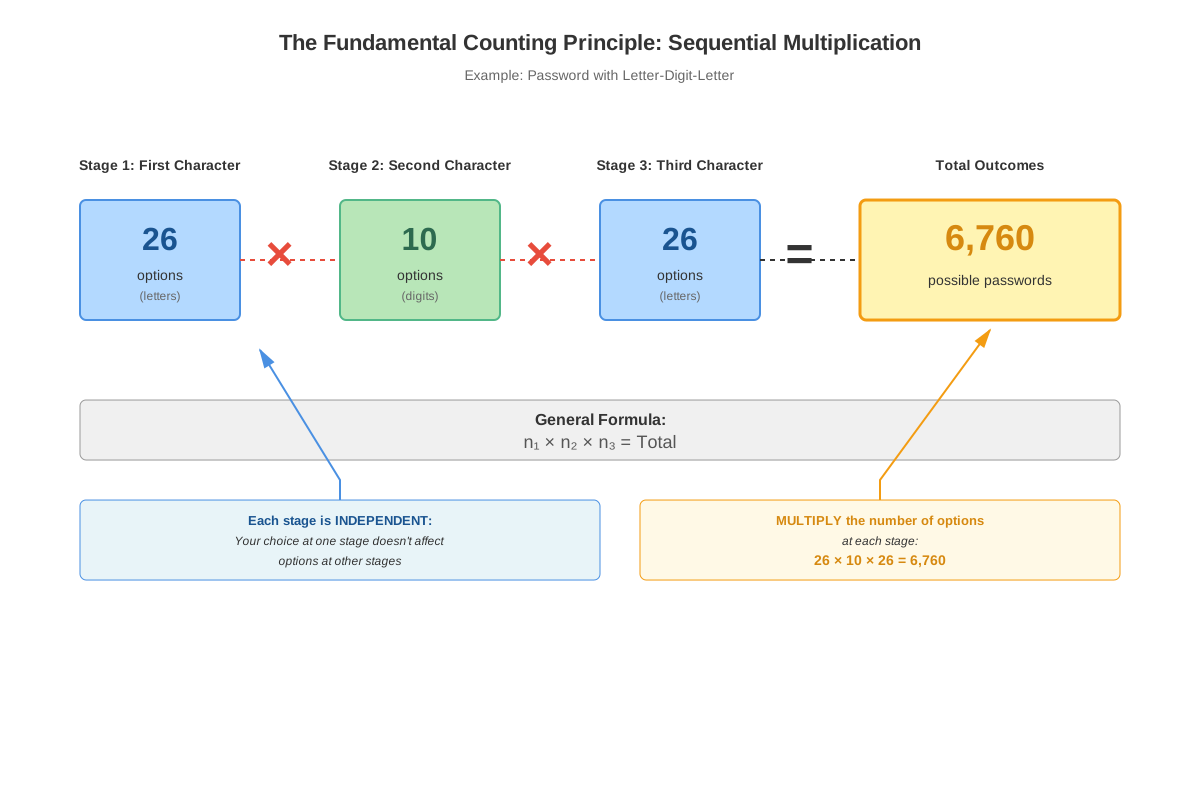
The counting principle states: If one event can occur in m ways and a second independent event can occur in n ways, then the two events together can occur in m × n ways. This extends to any number of events: multiply the number of ways each independent event can occur to find the total number of outcomes.
The key word here is independent—each choice must not affect the available options for subsequent choices. For example, if you're choosing a shirt and then pants, the shirt choice doesn't limit which pants you can select (assuming all combinations are acceptable).
Mathematical notation:
Total Outcomes = n₁ × n₂ × n₃ × ... × nₖwhere n₁, n₂, n₃, ..., nₖ represent the number of options at each of k stages.
Simple Applications
Consider a restaurant menu offering 4 appetizers, 6 entrees, and 3 desserts. To find the total number of three-course meals possible, apply the counting principle:
Total meals = 4 × 6 × 3 = 72 different three-course combinations
Each selection stage is independent—choosing chicken as an entree doesn't eliminate any appetizer or dessert options. This independence is what allows direct multiplication.
Counting with Restrictions
Many ACT questions introduce restrictions or constraints that modify the straightforward application. Common restrictions include:
- Position-specific requirements: "The first digit must be odd"
- Exclusions: "No letter can be repeated"
- Mandatory inclusions: "Must contain at least one vowel"
- Ordering constraints: "The tallest person must stand in the middle"
When restrictions exist, carefully analyze which stage of selection is affected and adjust the count for that stage accordingly.
Example with restriction: Creating a 3-digit code where the first digit must be even (from 0-9) and digits can repeat:
- First position: 5 choices (0, 2, 4, 6, 8)
- Second position: 10 choices (0-9)
- Third position: 10 choices (0-9)
- Total: 5 × 10 × 10 = 500 codes
Dependent vs. Independent Choices
Understanding the distinction between dependent and independent choices is critical:
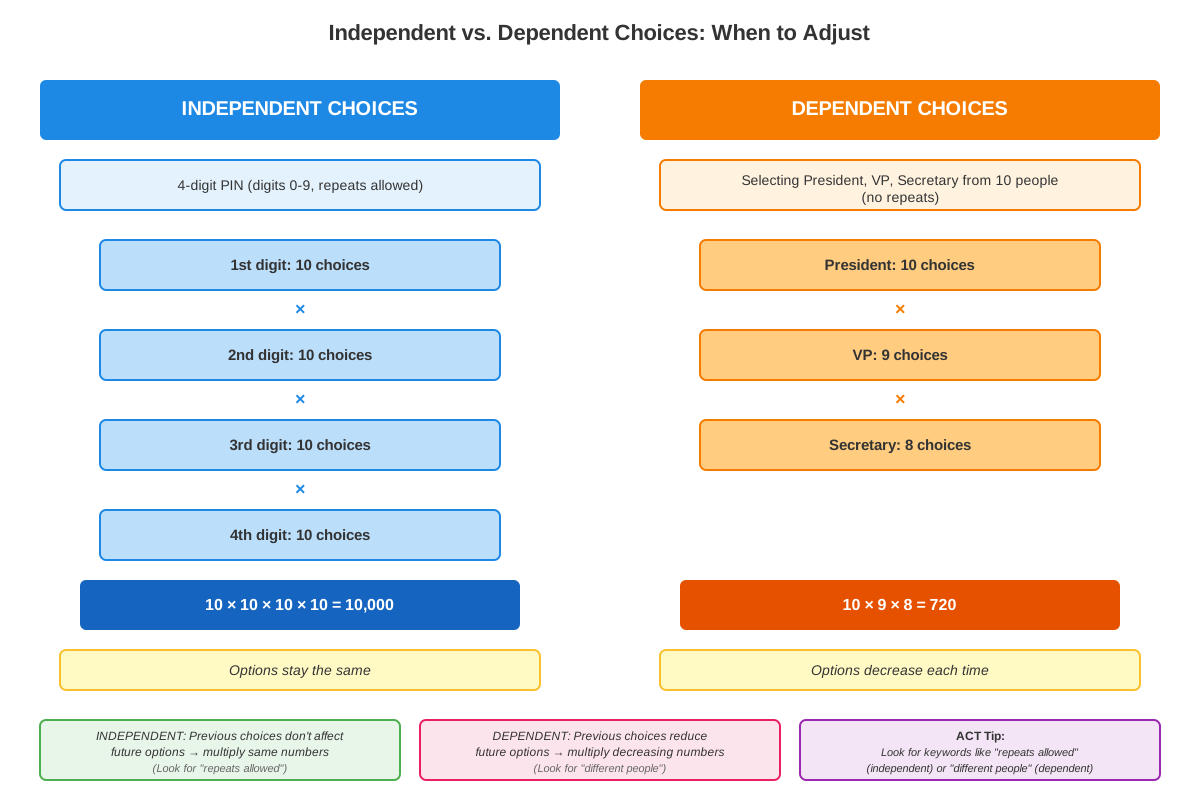
| Independent Choices | Dependent Choices |
|---|---|
| Selection doesn't affect future options | Selection reduces future options |
| Repetition is allowed | No repetition allowed |
| Multiply same number repeatedly | Multiply decreasing numbers |
| Example: Rolling dice multiple times | Example: Selecting committee members from a group |
Independent example: Flipping a coin 4 times
- Each flip: 2 outcomes
- Total: 2 × 2 × 2 × 2 = 2⁴ = 16 outcomes
Dependent example: Selecting 3 people from 8 for distinct positions (president, vice president, secretary)
- First selection: 8 choices
- Second selection: 7 choices (one person already selected)
- Third selection: 6 choices
- Total: 8 × 7 × 6 = 336 arrangements
Multi-Category Counting
Some problems involve selecting from multiple distinct categories. The approach remains the same: identify each decision point and multiply.
Example: Creating an outfit from 5 shirts, 3 pairs of pants, 4 pairs of shoes, and 2 hats:
Total outfits = 5 × 3 × 4 × 2 = 120 complete outfits
Each category represents an independent choice, and all must be made to complete the outfit.
Sequential Arrangements
When arranging objects in a line where order matters and no repetition is allowed, the counting principle applies with decreasing numbers:
Arranging n distinct objects in a line: n × (n-1) × (n-2) × ... × 2 × 1 = n!
Example: Arranging 5 books on a shelf:
5 × 4 × 3 × 2 × 1 = 120 arrangements
For partial arrangements (arranging r objects from n total), multiply only the first r terms:
n × (n-1) × (n-2) × ... × (n-r+1)
Counting with Identical Items
When some items are identical, the standard counting principle overcounts because swapping identical items doesn't create a new arrangement. However, for ACT purposes, most counting principle questions involve distinct items. If identical items appear, the question typically asks only about the initial selection stages where the counting principle still applies directly.
Concept Relationships
The counting principle serves as the foundational concept that connects to multiple related topics in probability and statistics. Understanding these relationships strengthens problem-solving ability:
Counting Principle → Probability Calculations: The counting principle determines the denominator (total possible outcomes) in probability fractions. To find P(event) = favorable outcomes / total outcomes, the counting principle often calculates the total.
Counting Principle → Permutations: Permutations are special applications of the counting principle where order matters and repetition is not allowed. The permutation formula P(n,r) = n!/(n-r)! is derived from applying the counting principle with decreasing choices.
Counting Principle → Combinations: While combinations involve division to account for order not mattering, the counting principle still provides the initial count before adjustment.
Basic Multiplication → Counting Principle → Complex Probability: This progression shows how fundamental arithmetic operations scale to solve sophisticated real-world problems.
Independence Concept → Counting Principle Application: Understanding when events are independent (from basic probability) directly determines when the counting principle can be applied through multiplication.
Within the topic itself: Simple counting → Counting with restrictions → Dependent counting → Multi-stage problems represents the progression of complexity students encounter.
High-Yield Facts
⭐ The fundamental counting principle: Multiply the number of options at each independent stage to find total outcomes
⭐ Independence is key: The counting principle applies when choices don't affect each other; if selection reduces future options, adjust the count accordingly
⭐ Order of multiplication doesn't matter: 3 × 4 × 5 = 5 × 4 × 3; organize calculations in whatever order is clearest
⭐ Restrictions affect specific stages: When a constraint applies to one position, adjust only that position's count, not the entire problem
⭐ "And" means multiply, "or" means add: Sequential choices connected by "and" use multiplication; separate scenarios connected by "or" use addition
- When digits/letters can repeat, use the same number for each position (10 × 10 × 10 for a 3-digit code with repetition allowed)
- When repetition is not allowed, decrease the count at each stage (10 × 9 × 8 for a 3-digit code without repetition)
- Zero can be tricky: Check whether zero is allowed in the first position (license plates often exclude it; mathematical codes may include it)
- "At least one" problems often use complementary counting: Total - None = At least one
- The counting principle works for any number of stages: 2 stages, 5 stages, or 10 stages—just keep multiplying
Quick check — test yourself on Counting principle so far.
Try Flashcards →Common Misconceptions
Misconception: The counting principle only works for exactly two events or choices.
Correction: The counting principle extends to any number of sequential, independent events. Whether there are 2, 5, or 20 stages, multiply the number of options at each stage.
Misconception: When a problem says "no repetition allowed," divide the final answer by 2.
Correction: "No repetition" means decrease the count at each subsequent stage. If selecting 3 items from 10 without repetition: 10 × 9 × 8, not (10 × 10 × 10) ÷ 2.
Misconception: The counting principle and probability are the same thing.
Correction: The counting principle calculates total possible outcomes; probability uses that count as the denominator and requires identifying favorable outcomes as the numerator. The counting principle is a tool used within probability calculations.
Misconception: Restrictions always make the answer smaller.
Correction: While many restrictions reduce possibilities, some restrictions actually simplify counting without reducing the answer. For example, "the first letter must be A" doesn't necessarily make the total smaller than "the first letter must be a vowel"—it just changes which specific outcomes are counted.
Misconception: If a problem involves arranging people or objects, always use factorial (n!).
Correction: Only use factorial when arranging ALL items from a set with no repetition. If selecting some items from a larger set, or if repetition is allowed, or if there are multiple categories, use the counting principle with appropriate numbers at each stage.
Misconception: The order of multiplication matters and must follow the problem's narrative sequence.
Correction: Multiplication is commutative; 4 × 5 × 3 = 3 × 5 × 4. Organize calculations in whatever order makes the arithmetic easiest, regardless of the problem's presentation order.
Worked Examples
Example 1: License Plate Creation
Problem: A state issues license plates with 2 letters followed by 4 digits. Letters can be any of the 26 letters in the alphabet, and digits can be any number from 0-9. Both letters and digits can repeat. How many different license plates are possible?
Solution:
Step 1: Identify the stages of selection.
- First letter position
- Second letter position
- First digit position
- Second digit position
- Third digit position
- Fourth digit position
Step 2: Determine the number of options at each stage.
- First letter: 26 options (A-Z)
- Second letter: 26 options (repetition allowed)
- First digit: 10 options (0-9)
- Second digit: 10 options (repetition allowed)
- Third digit: 10 options (repetition allowed)
- Fourth digit: 10 options (repetition allowed)
Step 3: Apply the counting principle.
Total license plates = 26 × 26 × 10 × 10 × 10 × 10
Step 4: Calculate.
= 676 × 10,000
= 6,760,000 different license plates
Connection to learning objectives: This problem demonstrates identifying when the counting principle applies (multiple independent sequential choices), explaining the core strategy (multiply options at each stage), and applying it accurately to an ACT-style scenario.
Example 2: Committee Selection with Restrictions
Problem: A club has 12 members: 7 seniors and 5 juniors. The club needs to select a president, vice president, and treasurer. The president must be a senior, but the other two positions can be filled by any remaining member. No person can hold more than one position. How many different ways can these three positions be filled?
Solution:
Step 1: Identify the stages and any restrictions.
- President position: Must be a senior
- Vice president position: Any remaining member
- Treasurer position: Any remaining member (after president and VP selected)
Step 2: Determine options at each stage.
- President: 7 options (must be one of the 7 seniors)
- Vice president: 11 options (12 total members - 1 already selected as president)
- Treasurer: 10 options (12 total members - 2 already selected)
Step 3: Apply the counting principle with the restriction.
Total arrangements = 7 × 11 × 10
Step 4: Calculate.
= 770 different ways to fill the positions
Key insight: The restriction only affected the first stage (president must be senior). After that, the problem became a standard dependent counting problem where each selection reduces future options. Notice we didn't need to track whether the VP and treasurer were seniors or juniors—we only needed to know how many members remained available.
Connection to learning objectives: This demonstrates recognizing restrictions, distinguishing between independent and dependent choices (each selection reduces the pool), and applying the counting principle accurately despite constraints.
Exam Strategy
When approaching ACT counting principle questions, follow this systematic process:
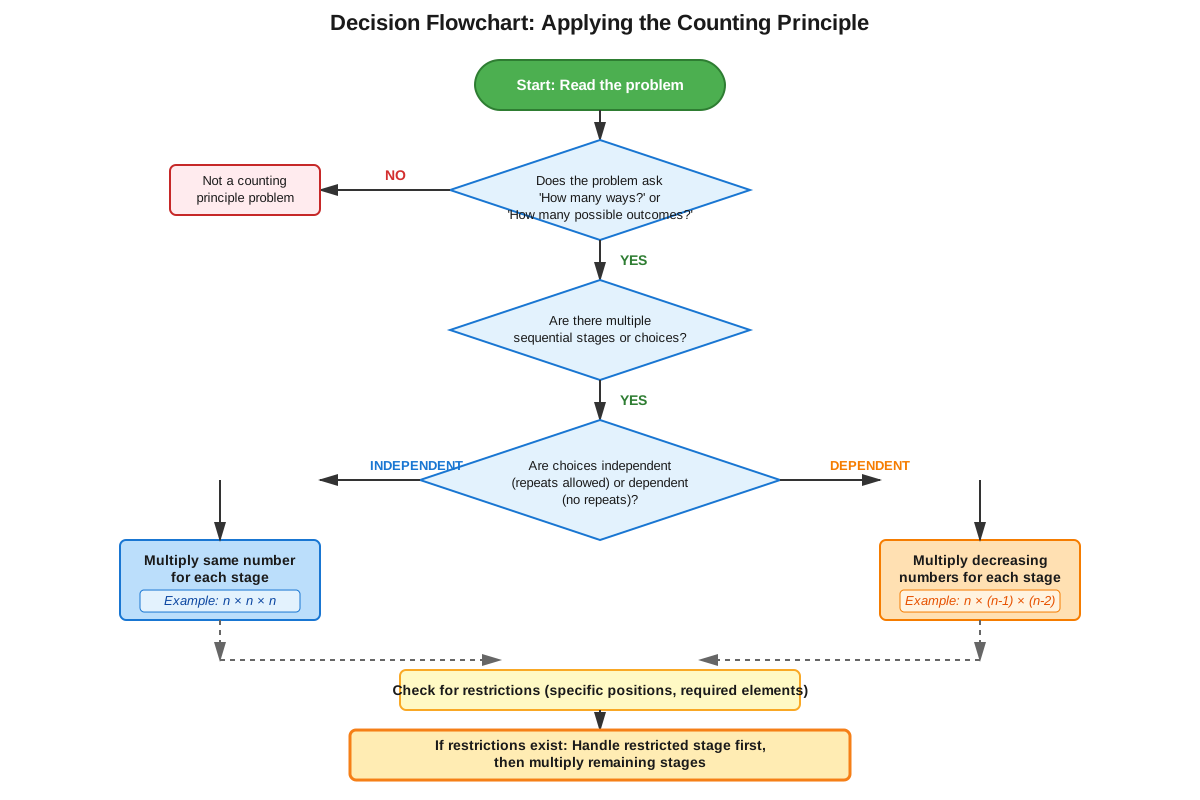
Step 1: Identify the trigger words and phrases
- "How many different ways..."
- "How many possible..."
- "How many arrangements..."
- "How many combinations..." (Note: ACT often uses "combinations" colloquially, not in the technical mathematical sense)
- "Total number of outcomes..."
Step 2: Determine the stages
Draw boxes or slots representing each decision point. For a 3-letter code, draw three boxes: ___ ___ ___. This visual helps organize thinking and prevents missing stages.
Step 3: Check for restrictions
Before filling in numbers, scan the problem for:
- "Must be..." or "must contain..."
- "Cannot repeat..."
- "First/last position must..."
- "At least one..."
Handle restricted stages first, then fill in unrestricted stages.
Step 4: Determine independence
Ask: "Does making this choice affect the options available for the next choice?"
- If NO → use the same number (or full set) for the next stage
- If YES → decrease the count for subsequent stages
Step 5: Multiply and calculate
Multiply all the numbers together. On the ACT, these calculations are designed to be manageable without a calculator, though calculators are permitted.
Time allocation: Counting principle questions should take 30-60 seconds once the concept is mastered. If spending more than 90 seconds, mark the question and return to it later.
Process of elimination tips:
- Eliminate answers that seem too small (often result from adding instead of multiplying)
- Eliminate answers that seem too large (often result from not accounting for restrictions)
- If two answer choices differ by a factor of 2, 3, or 10, the difference likely relates to a specific restriction or stage in the problem
Common trap answers: ACT test writers often include answers that result from:
- Adding instead of multiplying (always wrong for counting principle)
- Forgetting one stage of selection
- Not accounting for a restriction
- Treating dependent choices as independent (or vice versa)
Memory Techniques
Mnemonic for when to multiply: "STAGES MULTIPLY" - Each stage of selection multiplies with others.
Acronym for problem-solving steps: "STAR"
- Stages: Identify all decision points
- Test for independence: Are choices dependent or independent?
- Adjust for restrictions: Handle constraints first
- Resolve by multiplying: Calculate the final answer
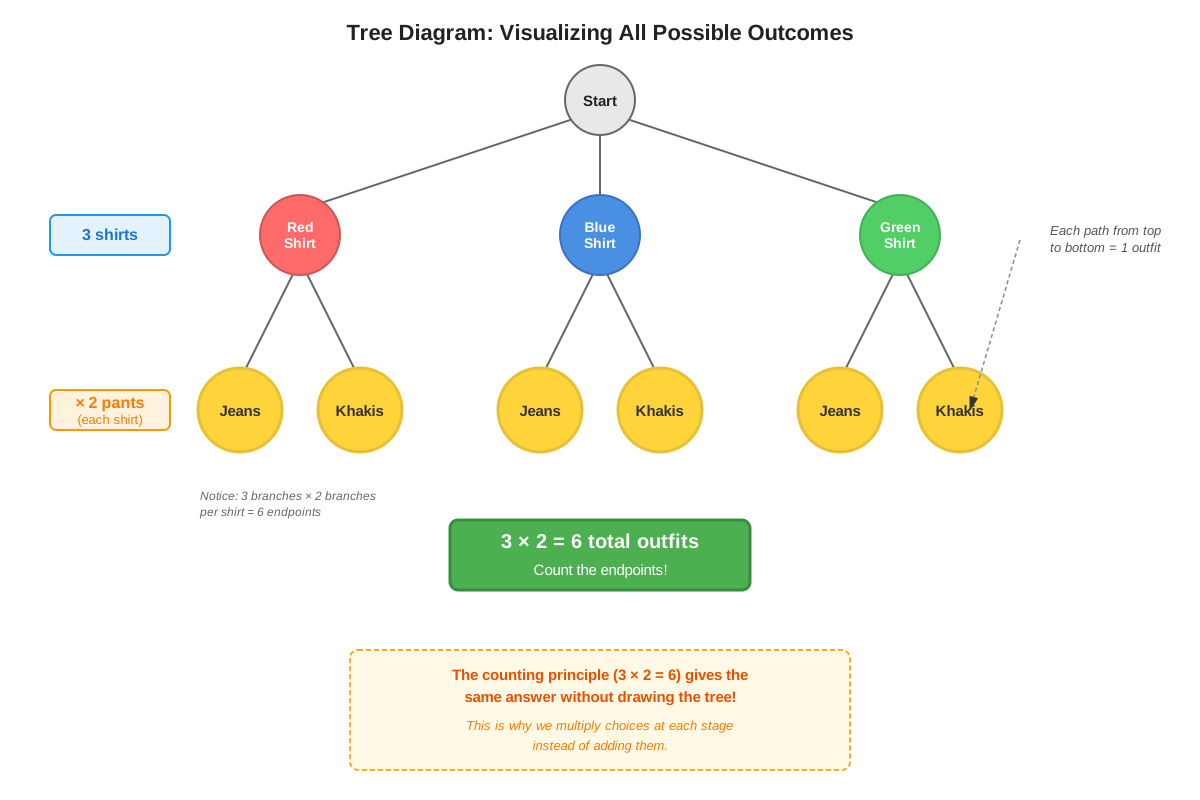
Visualization technique: Picture a tree diagram where each branch represents a choice. The total number of complete paths from start to finish equals the product of branches at each level. This mental image reinforces why multiplication works.
Rhyme for independence: "If the choice stays the same, multiply the same. If the choice goes down, decrease the count."
Hand technique: Hold up fingers representing the number of stages. As you identify the count for each stage, fold down one finger. When all fingers are down, you've identified all stages and are ready to multiply.
Restriction reminder: "Restrictions Reduce Right away" - Handle restrictions immediately when setting up the problem, not as an afterthought.
Summary
The counting principle is a fundamental mathematical tool that enables efficient calculation of total possible outcomes when multiple sequential choices occur. By multiplying the number of options at each independent stage, students can solve complex counting problems without exhaustive enumeration. The principle's power lies in its simplicity and broad applicability across diverse scenarios, from password creation to arrangement problems. Success with ACT counting principle questions requires three core competencies: recognizing when the principle applies (multiple sequential choices), distinguishing between independent and dependent selections (does one choice affect future options?), and correctly handling restrictions (position-specific requirements or exclusions). The most common errors stem from adding instead of multiplying, failing to account for restrictions, or misidentifying whether choices are independent. Mastery involves systematic problem analysis—identifying stages, checking for restrictions, determining independence, and multiplying appropriately. With practice, these questions become quick, reliable point opportunities on the ACT Math section.
Key Takeaways
- The counting principle states: multiply the number of options at each independent stage to find total possible outcomes
- Independence is crucial—if choices don't affect each other, multiply the same numbers; if selection reduces options, decrease counts at subsequent stages
- Restrictions modify specific stages, not the entire problem—handle constrained positions first, then proceed with remaining stages
- Visual organization (drawing boxes for each stage) prevents errors and clarifies the problem structure
- "And" signals multiplication (sequential choices), while "or" signals addition (separate scenarios)
- ACT counting principle questions are high-yield: predictable format, quick to solve, and appear 1-3 times per test
- Common errors include adding instead of multiplying, forgetting stages, and mishandling restrictions—systematic approaches prevent these mistakes
Related Topics
Permutations: Building on the counting principle, permutations formalize the calculation of arrangements when order matters and repetition is not allowed. The formula P(n,r) = n!/(n-r)! is essentially the counting principle applied to arrangement problems.
Combinations: While combinations also count selections, they account for order not mattering by dividing permutation results. Understanding the counting principle is essential before learning why and how this division works.
Probability: The counting principle provides the foundation for calculating probabilities by determining total possible outcomes (denominator) and sometimes favorable outcomes (numerator). Most probability problems require counting principle application.
Tree Diagrams: These visual representations of outcomes demonstrate why the counting principle works—each complete path through the tree represents one outcome, and the total paths equal the product of branches at each level.
Factorial Notation: Understanding n! as the product n × (n-1) × (n-2) × ... × 1 connects directly to counting principle applications in arrangement problems.
Practice CTA
Now that you've mastered the fundamental concepts of the counting principle, it's time to solidify your understanding through practice. The counting principle is one of those topics where recognition and application improve dramatically with repetition. Work through the practice questions systematically, applying the STAR method (Stages, Test for independence, Adjust for restrictions, Resolve by multiplying) to each problem. Pay special attention to questions with restrictions—these are where the ACT tests true mastery versus surface-level understanding. Use the flashcards to reinforce the distinction between independent and dependent choices, as this is the most common point of confusion. Remember: every practice problem you solve correctly builds confidence and speed for test day. You've got this!
Sign up free to keep reading
Create a free AnvayaPrep account to finish this ACT guide on Counting principle — plus flashcards and practice questions.