Overview
Dependent events represent a fundamental concept in probability that appears regularly on the ACT Math test. Unlike independent events where one outcome has no effect on another, dependent events are situations where the occurrence of one event directly affects the probability of a subsequent event. Understanding this distinction is critical for solving probability problems correctly on the ACT.
The ACT frequently tests dependent events through scenarios involving drawing objects without replacement, selecting items from groups where the composition changes, or analyzing conditional probabilities. These questions typically appear in the Statistics and Probability content area, which comprises approximately 5-7 questions on each ACT Math test. Mastering ACT dependent events is essential because these problems often appear as medium to high-difficulty questions that can differentiate between good and excellent scores.
This topic connects directly to fundamental probability concepts, fraction operations, and logical reasoning. Students who understand dependent events gain a powerful framework for analyzing sequential outcomes and conditional relationships—skills that extend beyond probability into data analysis, combinatorics, and real-world decision-making scenarios. The mathematical reasoning developed through studying dependent events strengthens overall problem-solving abilities across multiple ACT Math domains.
Learning Objectives
- [ ] Identify when Dependent events is being tested
- [ ] Explain the core rule or strategy behind Dependent events
- [ ] Apply Dependent events to ACT-style questions accurately
- [ ] Distinguish between dependent and independent events in various contexts
- [ ] Calculate multi-stage probabilities involving dependent events using the multiplication rule
- [ ] Recognize how sample space changes after each dependent event occurs
- [ ] Solve conditional probability problems involving dependent events
Prerequisites
- Basic probability concepts: Understanding that probability represents the ratio of favorable outcomes to total possible outcomes is essential for calculating dependent event probabilities
- Fraction operations: Multiplying and simplifying fractions is necessary since dependent event calculations involve multiplying sequential probabilities
- Set theory fundamentals: Knowing how to count elements in sets helps determine changing sample spaces as events occur
- Ratio and proportion: Understanding proportional relationships aids in recognizing how probabilities shift when the composition of a sample changes
Why This Topic Matters
Dependent events appear in countless real-world scenarios: medical testing accuracy, quality control sampling, card games, jury selection, and genetic inheritance patterns. Understanding dependent probability enables better decision-making when outcomes are interconnected and sequential choices affect future possibilities.
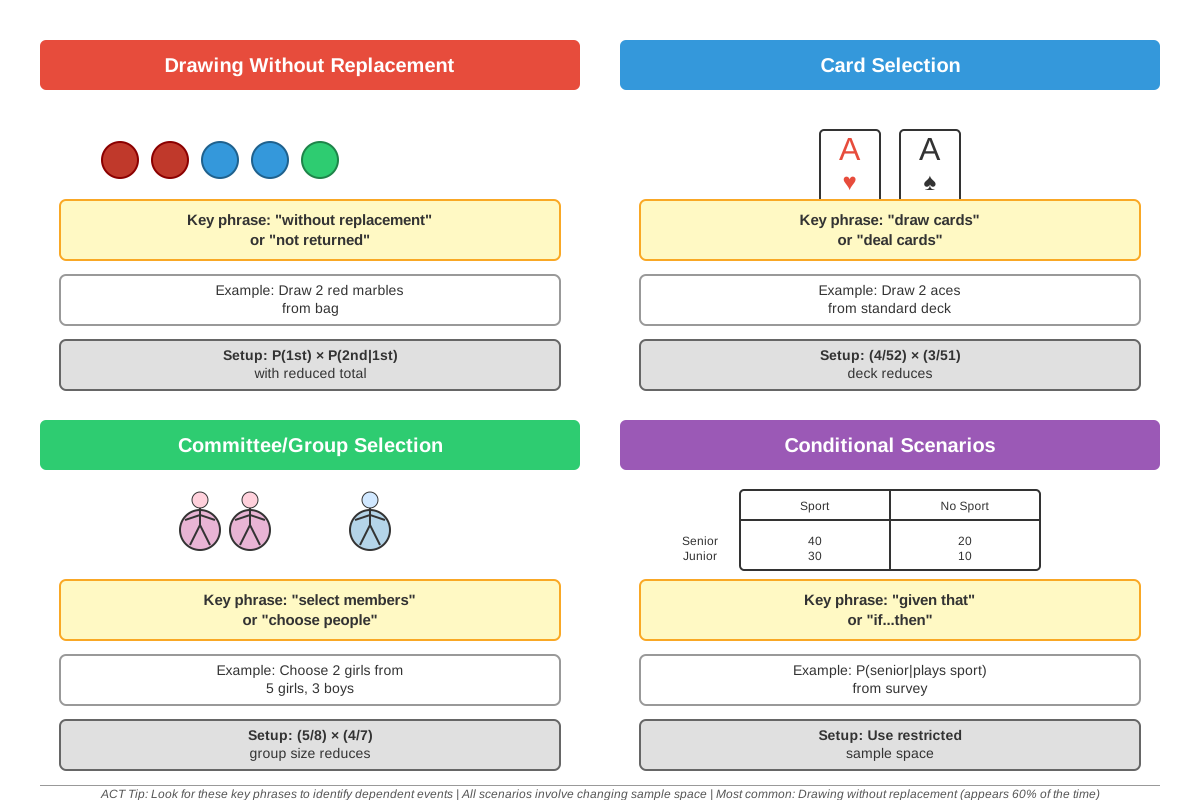
On the ACT Math test, dependent events questions typically appear 1-2 times per exam, often as medium to high-difficulty problems worth the same single point as easier questions. These problems frequently appear in the latter half of the test (questions 40-60) and can significantly impact scores for students aiming for 28+ composite scores. The ACT tests dependent events through various formats: selecting objects without replacement, drawing cards from a deck, choosing committee members from groups, or analyzing survey data where conditions change.
Common ACT question formats include: calculating the probability of drawing specific colored marbles from a bag without replacement, determining the likelihood of selecting particular cards in sequence, finding probabilities involving committee selection where gender or other characteristics matter, and analyzing conditional scenarios where the first outcome affects subsequent possibilities. Recognizing these patterns allows students to quickly identify dependent event problems and apply the appropriate solution strategy.
Core Concepts
Definition of Dependent Events
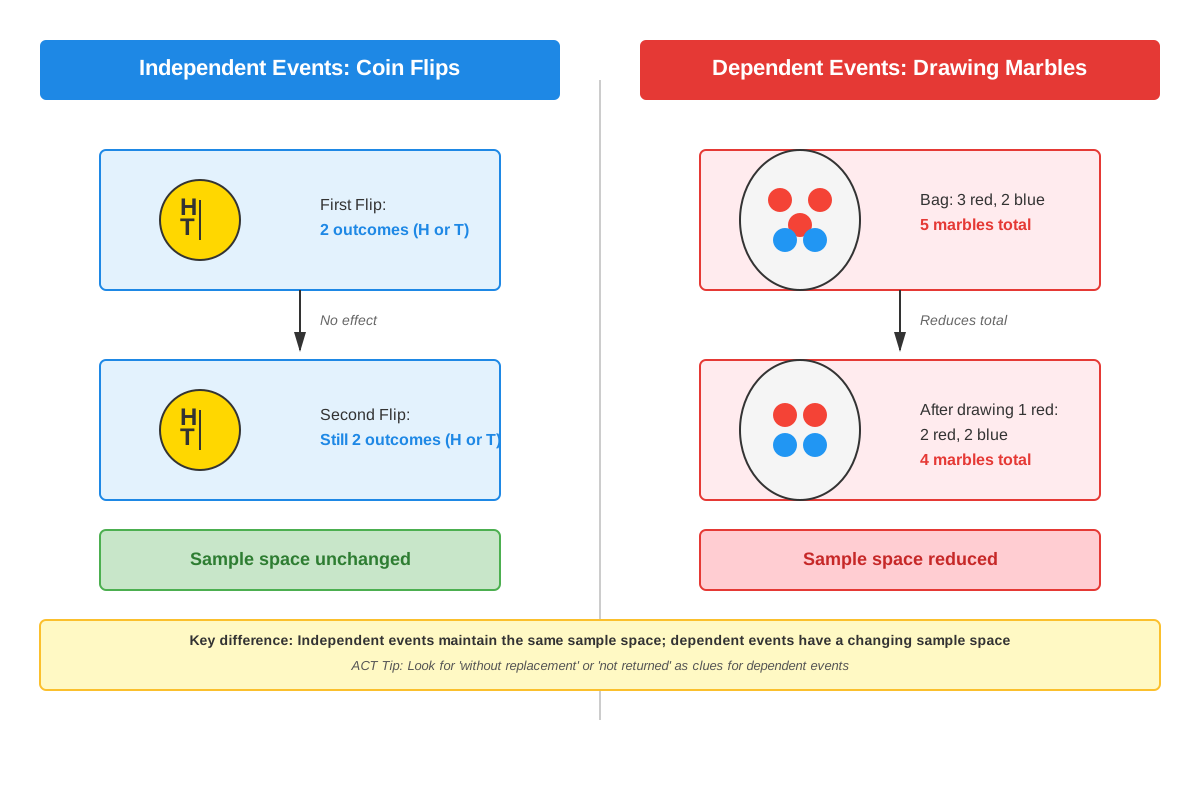
Dependent events are two or more events where the occurrence of one event affects the probability of the other event(s) occurring. The key characteristic distinguishing dependent from independent events is that the sample space or the number of favorable outcomes changes after the first event occurs. When events are dependent, the probability of the second event is conditional upon what happened in the first event.
Mathematically, events A and B are dependent if:
P(B|A) ≠ P(B)This notation reads "the probability of B given A has occurred is not equal to the probability of B alone." The vertical bar "|" represents "given that" or "conditional upon."
The Multiplication Rule for Dependent Events
The fundamental formula for calculating the probability of multiple dependent events occurring in sequence is:
P(A and B) = P(A) × P(B|A)For three dependent events:
P(A and B and C) = P(A) × P(B|A) × P(C|A and B)This rule states that to find the probability of dependent events occurring together, multiply the probability of the first event by the probability of the second event given that the first has occurred, and continue this pattern for additional events.
Without Replacement Scenarios
The most common ACT context for dependent events involves sampling without replacement. When an item is selected and not returned to the population, the total number of items decreases, and the composition of the remaining items changes. This creates dependency between selections.
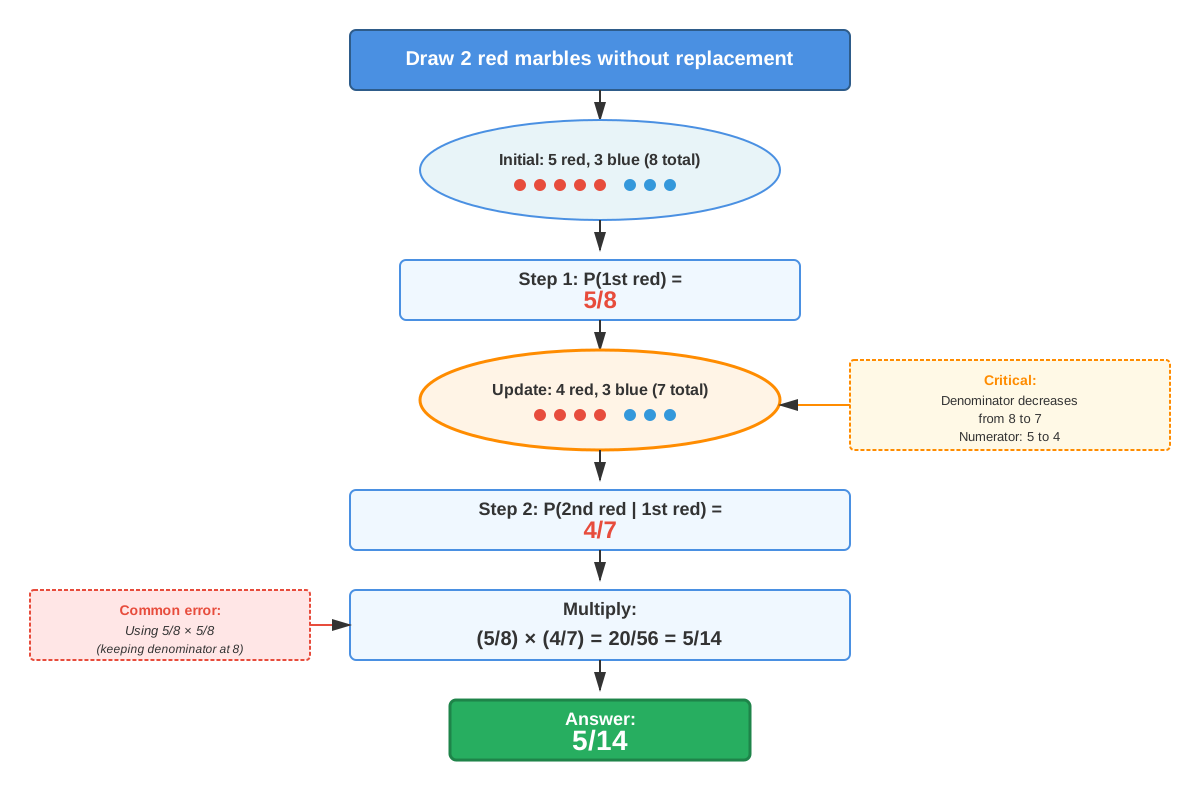
Example scenario: A bag contains 5 red marbles and 3 blue marbles. If you draw two marbles without replacement:
- First draw: P(red) = 5/8
- Second draw (if first was red): P(red|first red) = 4/7 (only 4 red remain out of 7 total)
- P(both red) = 5/8 × 4/7 = 20/56 = 5/14
Notice how the denominator decreased from 8 to 7, and the numerator decreased from 5 to 4 because the sample space changed.
Tracking Sample Space Changes
A critical skill for solving dependent event problems is systematically tracking how the sample space evolves. After each event:
- Reduce the total count by the number of items removed
- Adjust the favorable outcome count based on what was selected
- Recalculate the probability using the new numbers
| Stage | Total Items | Favorable Items | Probability |
|---|---|---|---|
| Initial | Original count | Original favorable | Favorable/Total |
| After 1st event | Total - 1 | Adjusted favorable | New favorable/New total |
| After 2nd event | Total - 2 | Adjusted favorable | New favorable/New total |
Conditional Probability Notation
Understanding conditional probability notation is essential for dependent events. The expression P(B|A) represents "the probability of event B occurring given that event A has already occurred." This conditional probability is calculated using:
P(B|A) = P(A and B) / P(A)However, for ACT problems, students typically calculate P(A and B) directly using the multiplication rule rather than rearranging this formula.
Distinguishing Dependent from Independent Events
| Characteristic | Dependent Events | Independent Events | |
|---|---|---|---|
| Effect of first event | Changes probability of second | No effect on second | |
| Sample space | Changes after each event | Remains constant | |
| Common scenarios | Without replacement, conditional selection | With replacement, separate populations | |
| Multiplication rule | P(A) × P(B\ | A) | P(A) × P(B) |
| ACT trigger words | "without replacement," "not returned," "then" | "with replacement," "independent," "separate" |
Multi-Stage Probability Trees
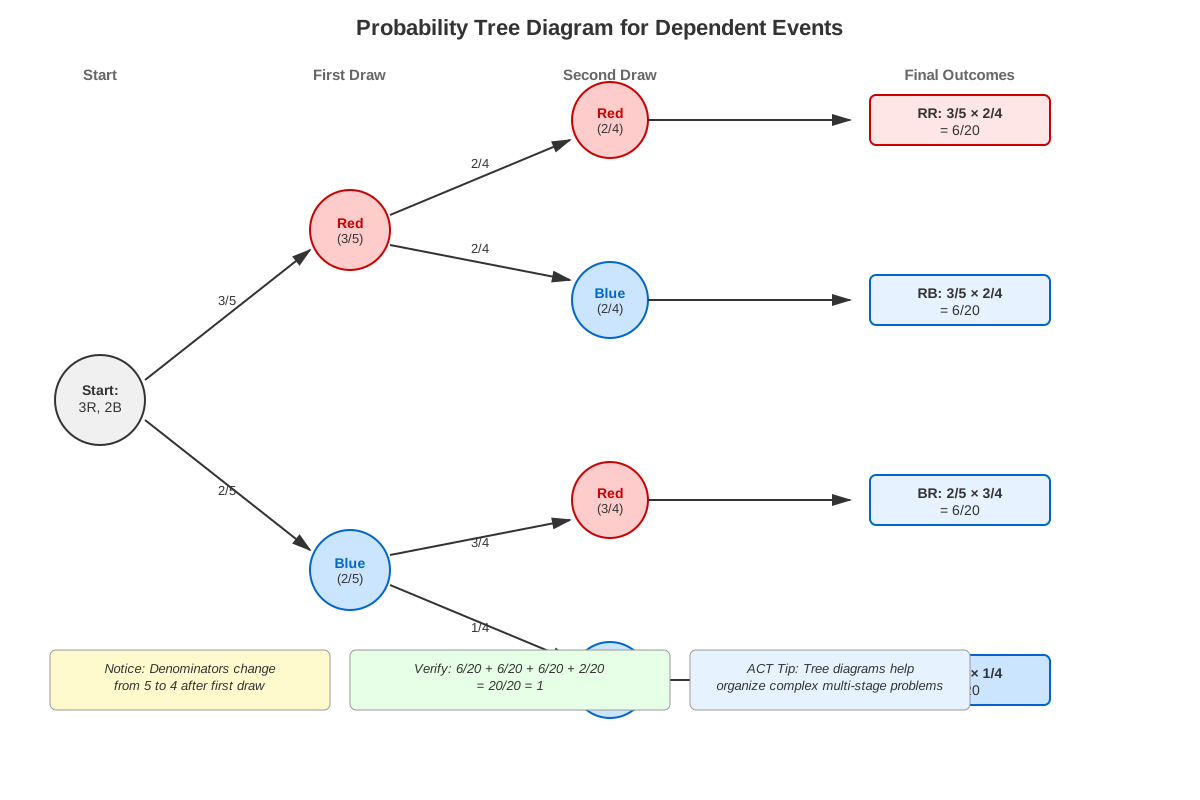
For complex dependent event problems, creating a probability tree diagram helps visualize all possible outcomes and their probabilities. Each branch represents a possible outcome, with probabilities multiplied along each path. The sum of all final probabilities equals 1.
When constructing probability trees for dependent events:
- First level branches show initial event probabilities
- Second level branches show conditional probabilities given first event
- Multiply along branches to find probability of each complete path
- Add probabilities of paths that satisfy the desired outcome
Concept Relationships
Dependent events build directly upon fundamental probability concepts, specifically the basic probability formula (favorable outcomes / total outcomes). The relationship flows as: Basic Probability → Compound Events → Dependent vs. Independent Events → Conditional Probability.
Within dependent events, the core concepts connect sequentially: Definition of Dependency → Multiplication Rule → Sample Space Tracking → Without Replacement Scenarios → Conditional Probability. Each concept relies on the previous one, with the multiplication rule serving as the central calculation method that applies the understanding of how sample spaces change.
Dependent events connect to prerequisite topics through fraction operations (multiplying sequential probabilities requires fraction multiplication) and set theory (tracking changing sample spaces involves counting set elements). The topic also relates to combinatorics, as some ACT problems combine dependent probability with counting principles to determine total possible outcomes.
Looking forward, mastering dependent events enables progression to more advanced probability topics including Bayes' theorem, expected value calculations with conditional probabilities, and statistical inference. The logical reasoning developed through dependent events also strengthens skills in data analysis and interpreting conditional relationships in statistics.
High-Yield Facts
⭐ Dependent events occur when the outcome of one event affects the probability of subsequent events
⭐ The multiplication rule for dependent events is P(A and B) = P(A) × P(B|A)
⭐ "Without replacement" is the most common ACT trigger phrase indicating dependent events
⭐ After each dependent event, both the numerator and denominator of the probability fraction typically decrease
⭐ The total probability of all possible outcomes in a dependent event scenario always equals 1
- When drawing from a standard deck without replacement, the denominator decreases by 1 with each draw (52, then 51, then 50, etc.)
- Dependent events can involve more than two stages; multiply all conditional probabilities in sequence
- The probability of "at least one" in dependent events often requires calculating the complement (1 - probability of none)
- If items are replaced after each selection, events become independent, not dependent
- Conditional probability P(B|A) reads as "probability of B given A" and represents dependency
Quick check — test yourself on Dependent events so far.
Try Flashcards →Common Misconceptions
Misconception: All sequential events are dependent events → Correction: Events are only dependent if one outcome affects the probability of another. Sequential events with replacement or involving separate populations are independent. For example, flipping a coin twice involves sequential events, but they're independent because the first flip doesn't affect the second.
Misconception: The denominator stays the same in dependent event calculations → Correction: In without replacement scenarios, the denominator (total number of items) decreases with each selection. If you start with 10 items and draw 2 without replacement, the denominators are 10 for the first draw and 9 for the second.
Misconception: You can add probabilities to find P(A and B) for dependent events → Correction: You must multiply probabilities for "and" scenarios. Addition is used for "or" scenarios (mutually exclusive events). For dependent events occurring together, always use P(A) × P(B|A).
Misconception: P(B|A) equals P(A|B) → Correction: Conditional probabilities are not symmetric. P(B|A) represents the probability of B given A occurred, while P(A|B) represents the probability of A given B occurred. These are generally different values unless the events have special symmetry.
Misconception: If the first event doesn't happen, you can ignore it in calculations → Correction: When calculating overall probabilities, you must consider all possible paths through the probability tree, including scenarios where the first event doesn't occur. The complete probability space includes all branches.
Misconception: Dependent events always involve physical objects being removed → Correction: Dependency can occur in many contexts beyond physical removal, including conditional selection based on characteristics, time-dependent processes, or any scenario where one outcome changes the conditions for subsequent outcomes.
Worked Examples
Example 1: Classic Marble Problem
Problem: A bag contains 6 green marbles and 4 yellow marbles. If two marbles are drawn without replacement, what is the probability that both marbles are green?
Solution:
Step 1: Identify this as a dependent events problem. The key phrase "without replacement" indicates that the first draw affects the second draw.
Step 2: Calculate P(first marble is green).
- Total marbles initially: 6 + 4 = 10
- Green marbles: 6
- P(first green) = 6/10 = 3/5
Step 3: Calculate P(second marble is green | first was green).
- After removing one green marble: 5 green remain
- Total marbles remaining: 9
- P(second green | first green) = 5/9
Step 4: Apply the multiplication rule.
- P(both green) = P(first green) × P(second green | first green)
- P(both green) = 3/5 × 5/9 = 15/45 = 1/3
Answer: The probability that both marbles are green is 1/3 or approximately 0.333.
Connection to learning objectives: This problem demonstrates identifying dependent events (trigger phrase "without replacement"), applying the core multiplication rule, and tracking how the sample space changes from 10 to 9 marbles.
Example 2: Card Selection Problem
Problem: From a standard 52-card deck, two cards are drawn without replacement. What is the probability that the first card is a King and the second card is a Queen?
Solution:
Step 1: Recognize dependent events due to "without replacement."
Step 2: Calculate P(first card is King).
- Kings in deck: 4
- Total cards: 52
- P(King first) = 4/52 = 1/13
Step 3: Calculate P(second card is Queen | first was King).
- After removing one King, the deck composition changes
- Queens remaining: 4 (unchanged because we removed a King)
- Total cards remaining: 51
- P(Queen second | King first) = 4/51
Step 4: Apply multiplication rule.
- P(King then Queen) = 1/13 × 4/51 = 4/663
Answer: The probability is 4/663, which cannot be simplified further.
Key insight: Notice that the numerator for the second probability (4) didn't change because we drew a King first, not a Queen. The denominator decreased from 52 to 51 because one card was removed. This demonstrates the importance of carefully tracking what changes and what stays the same based on the specific outcome of the first event.
Connection to learning objectives: This example shows how to distinguish what changes in the sample space based on the specific first outcome, a subtle but important skill for ACT dependent events problems.
Exam Strategy
Identification triggers: Watch for these phrases that signal dependent events: "without replacement," "not returned," "then," "given that," "after selecting," "one after another," and "from the remaining." If you see any of these, immediately think dependent events and prepare to adjust your sample space.
Step-by-step approach:
- Confirm dependency (2-3 seconds): Verify that the problem involves without replacement or conditional selection
- Set up the first probability (5-10 seconds): Write the initial favorable/total fraction
- Adjust for the second event (10-15 seconds): Carefully decrease both numerator and denominator based on what was selected
- Multiply (5-10 seconds): Calculate the product and simplify if needed
- Check reasonableness (3-5 seconds): Ensure your answer is between 0 and 1 and makes intuitive sense
Process of elimination tips:
- Eliminate any answer greater than the probability of the first event alone (the combined probability of dependent events cannot exceed the probability of the first event)
- Eliminate answers that don't account for the changing denominator (if an answer uses the same denominator twice, it's likely wrong for dependent events)
- If answer choices include both products with adjusted denominators and products with constant denominators, the adjusted version is correct for dependent events
Time allocation: Dependent events problems typically require 45-75 seconds. Don't rush the sample space adjustment step—errors here cascade through the entire calculation. If a problem involves three or more stages, consider whether the time investment is worthwhile or if you should mark it for review and return if time permits.
Common trap answers: ACT test makers often include incorrect answers that result from treating dependent events as independent (using the same denominator for both events). They also include answers from calculation errors like forgetting to simplify or multiplying incorrectly.
Memory Techniques
DRAW mnemonic for dependent events:
- Determine if events are dependent (look for "without replacement")
- Record the first probability
- Adjust the sample space (decrease numerator and denominator)
- Write and multiply all probabilities
Visualization strategy: Picture a physical bag or deck in your mind. Literally visualize removing an item and seeing fewer items remain. This concrete mental image helps prevent the error of keeping denominators constant.
"Shrinking sample" reminder: Remember that dependent events involve a "shrinking sample"—both the total and the favorable outcomes typically decrease. If your denominators aren't decreasing, double-check whether the events are truly dependent.
Conditional probability phrase: Remember "given that" always signals conditional probability, which indicates dependent events. When you see "|" in probability notation, think "given" and "dependent."
Multiplication mantra: "And means multiply, but adjust before you do." This reminds you that "and" requires multiplication, but you must adjust probabilities for dependency first.
Summary
Dependent events represent probability scenarios where one outcome affects the probability of subsequent outcomes, most commonly appearing in ACT problems involving selection without replacement. The fundamental approach requires applying the multiplication rule P(A and B) = P(A) × P(B|A), where P(B|A) represents the conditional probability of B given that A has occurred. Success with dependent events requires three core skills: recognizing dependency triggers (especially "without replacement"), systematically tracking how sample spaces change after each event, and accurately calculating sequential probabilities by adjusting both numerators and denominators. The ACT tests this concept through marble problems, card selections, committee formations, and other scenarios where the composition of a group changes with each selection. Students must distinguish dependent events from independent events and understand that the probability of compound dependent events is always calculated through multiplication, not addition, with careful attention to how each outcome modifies the conditions for subsequent events.
Key Takeaways
- Dependent events occur when one outcome affects the probability of another; the key indicator is "without replacement" or conditional selection
- Always use the multiplication rule: P(A and B) = P(A) × P(B|A), multiplying the first probability by the conditional probability of the second
- The sample space shrinks with each dependent event—both numerators and denominators typically decrease
- Carefully track what changes based on the specific outcome of each event (if you draw a red marble, red marbles decrease; if you draw a blue marble, blue marbles decrease)
- Distinguish dependent from independent events: replacement makes events independent, while without replacement creates dependency
- The probability of any compound event must be between 0 and 1; use this to check your answer's reasonableness
- Practice visualizing the physical scenario to avoid calculation errors and maintain accuracy under test pressure
Related Topics
Independent Events: Understanding the contrast between dependent and independent events deepens comprehension of both concepts. Independent events involve scenarios with replacement or separate populations where P(A and B) = P(A) × P(B) without conditional adjustment.
Conditional Probability: This advanced topic explores P(B|A) in greater depth, including Bayes' theorem and more complex conditional relationships. Mastering dependent events provides the foundation for these sophisticated probability concepts.
Combinatorics and Counting Principles: Many ACT problems combine dependent probability with counting techniques to determine total possible outcomes. Understanding dependent events enables solving complex problems involving permutations and combinations with restrictions.
Probability Distributions: Dependent events form the basis for understanding more complex probability distributions, including binomial distributions with changing probabilities and Markov chains where future states depend on current states.
Practice CTA
Now that you've mastered the core concepts of dependent events, it's time to solidify your understanding through practice! Work through the practice questions to apply the multiplication rule, track changing sample spaces, and build the speed and accuracy needed for ACT success. Each problem you solve strengthens your pattern recognition and calculation skills. Review the flashcards to reinforce key definitions and formulas until they become automatic. Remember, dependent events questions often appear in the higher-difficulty range of the ACT Math test—mastering this topic can significantly boost your score. You've got this!
Sign up free to keep reading
Create a free AnvayaPrep account to finish this ACT guide on Dependent events — plus flashcards and practice questions.