Overview
Frequency tables are one of the most practical and commonly tested data organization tools on the ACT Math test. These tables systematically display how often different values or categories appear in a dataset, making them essential for interpreting statistical information quickly and accurately. On the ACT, frequency tables appear in approximately 2-4 questions per test, often integrated with other statistical concepts like mean, median, mode, and probability calculations.
Understanding frequency tables is crucial because they serve as the foundation for data analysis questions on the ACT. These tables condense large amounts of information into an organized format that allows test-takers to extract specific values, calculate measures of central tendency, and determine probabilities. The ACT frequently presents frequency tables in various formats—sometimes as simple two-column tables showing values and their frequencies, other times as more complex grouped frequency tables with intervals or categories. Mastering this topic enables students to approach data interpretation questions with confidence and efficiency.
The relationship between frequency tables and broader mathematical concepts is significant. They connect directly to statistics (calculating mean, median, and mode), probability (determining likelihood of events), and data visualization (understanding histograms and bar graphs). Additionally, ACT frequency tables often appear alongside other representations of data, requiring students to translate between different formats or verify consistency across multiple representations. This interconnectedness makes frequency tables a high-yield topic that supports success across multiple question types on the exam.
Learning Objectives
- [ ] Identify when Frequency tables is being tested
- [ ] Explain the core rule or strategy behind Frequency tables
- [ ] Apply Frequency tables to ACT-style questions accurately
- [ ] Calculate measures of central tendency (mean, median, mode) from frequency table data
- [ ] Determine total sample size and individual category frequencies from table information
- [ ] Convert between frequency tables and other data representations (histograms, lists)
- [ ] Use frequency tables to calculate probabilities and proportions
Prerequisites
- Basic arithmetic operations: Essential for calculating totals, means, and performing operations with frequency values
- Understanding of mean, median, and mode: Required to compute these measures from frequency table data rather than raw lists
- Fraction and percentage conversions: Necessary for probability calculations and proportion questions involving frequency data
- Reading and interpreting tables: Fundamental skill for extracting information from rows and columns accurately
Why This Topic Matters
Frequency tables represent a critical intersection between pure mathematics and real-world data analysis. In everyday life, frequency tables appear in survey results, scientific studies, business analytics, quality control reports, and demographic data. Understanding how to read and interpret these tables enables informed decision-making based on empirical evidence. From analyzing customer preferences to understanding test score distributions, frequency tables provide the organizational structure that makes large datasets comprehensible.
On the ACT Math test, frequency tables appear with high regularity, typically in 2-4 questions per exam. These questions often carry medium difficulty ratings but can range from straightforward interpretation to complex multi-step calculations. The ACT tests frequency tables in several distinct ways: direct reading questions that ask for specific frequency values, calculation questions requiring mean or median determination, probability questions based on frequency data, and synthesis questions that combine frequency table interpretation with other mathematical concepts. Questions may present frequency tables in standard format, as grouped data with intervals, or require students to construct frequency information from verbal descriptions.
The strategic importance of mastering frequency tables extends beyond individual questions. Because these tables often appear in multi-part question sets, understanding them efficiently can yield multiple correct answers from a single data interpretation. Additionally, frequency table questions typically appear in the middle-to-later portions of the ACT Math section, where time management becomes crucial. Students who can quickly extract and manipulate frequency data gain valuable time advantages over those who struggle with table interpretation.
Core Concepts
Understanding Frequency Table Structure
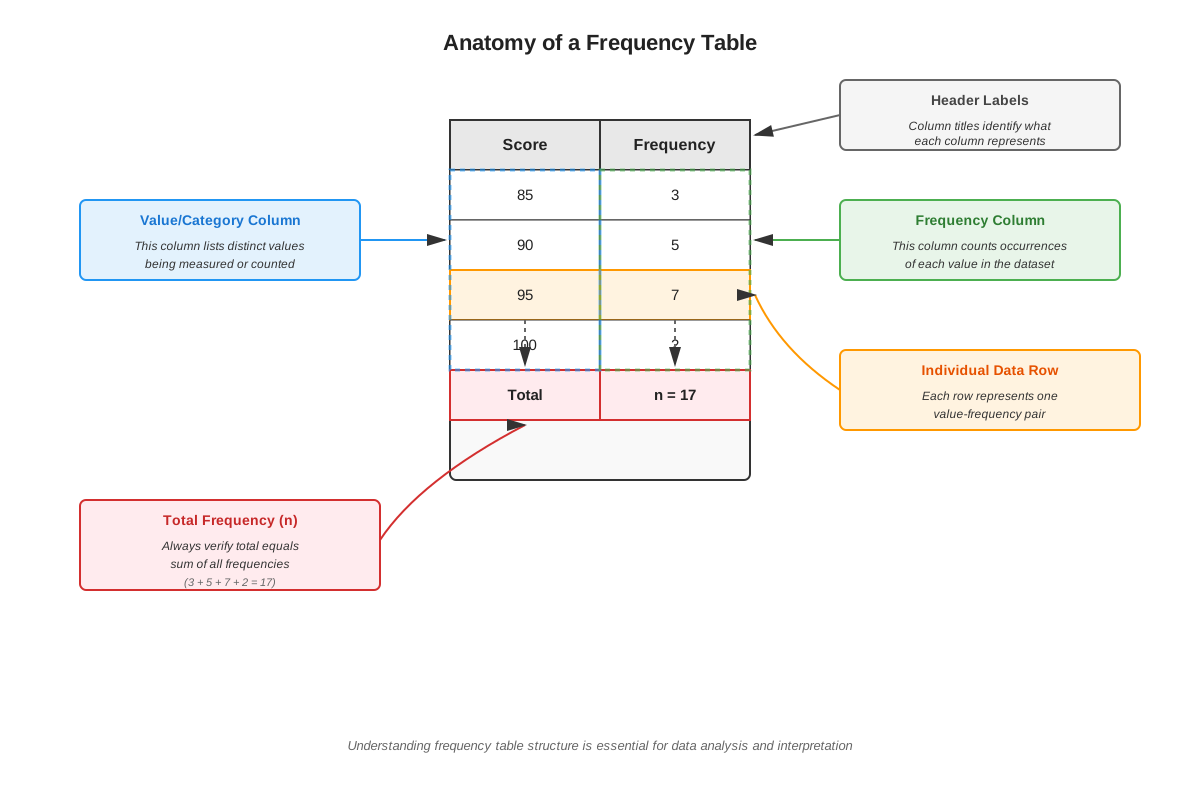
A frequency table is a systematic arrangement of data that shows how many times each value or category appears in a dataset. The basic structure consists of two columns: one listing the distinct values or categories (often labeled as "Value," "Category," or "Score"), and another showing the frequency or count of how many times each appears (labeled "Frequency," "Count," or "Number"). Some frequency tables include additional columns for cumulative frequency, relative frequency (proportions), or percentages.
The fundamental components of any frequency table include:
- Values/Categories: The distinct items being counted
- Frequencies: The number of occurrences for each value
- Total: The sum of all frequencies (sample size)
For example, a simple frequency table showing test scores might look like:
| Score | Frequency |
|---|---|
| 85 | 3 |
| 90 | 5 |
| 95 | 2 |
| 100 | 4 |
In this table, the total sample size is 3 + 5 + 2 + 4 = 14 students.
Reading and Interpreting Frequency Tables
Extracting information from frequency tables requires careful attention to what each row and column represents. The most basic operation is identifying the frequency of a specific value by locating the value in the first column and reading across to find its corresponding frequency. However, ACT questions often require deeper interpretation.
Key interpretation skills include:
- Finding the total sample size: Add all frequency values
- Identifying the mode: The value with the highest frequency
- Determining range: The difference between maximum and minimum values
- Calculating cumulative frequencies: Adding frequencies progressively to find "at least" or "at most" values
Calculating Mean from Frequency Tables
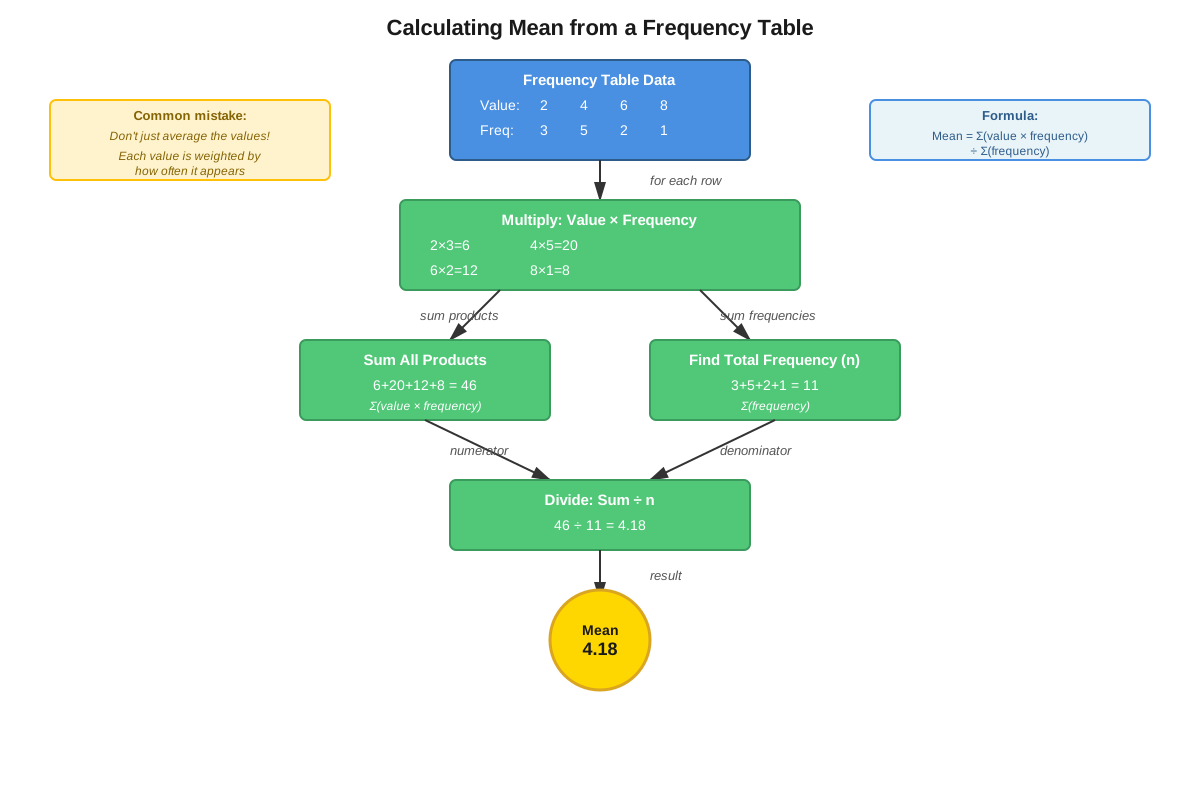
Computing the mean (average) from a frequency table differs from calculating the mean of a simple list. Instead of adding all individual values, multiply each value by its frequency, sum these products, then divide by the total frequency.
The formula is:
Mean = (Σ(value × frequency)) / (Σfrequency)Step-by-step process:
- Multiply each value by its corresponding frequency
- Add all these products together
- Divide by the total of all frequencies
This method is more efficient than writing out all individual values, especially when frequencies are large.
Finding Median from Frequency Tables
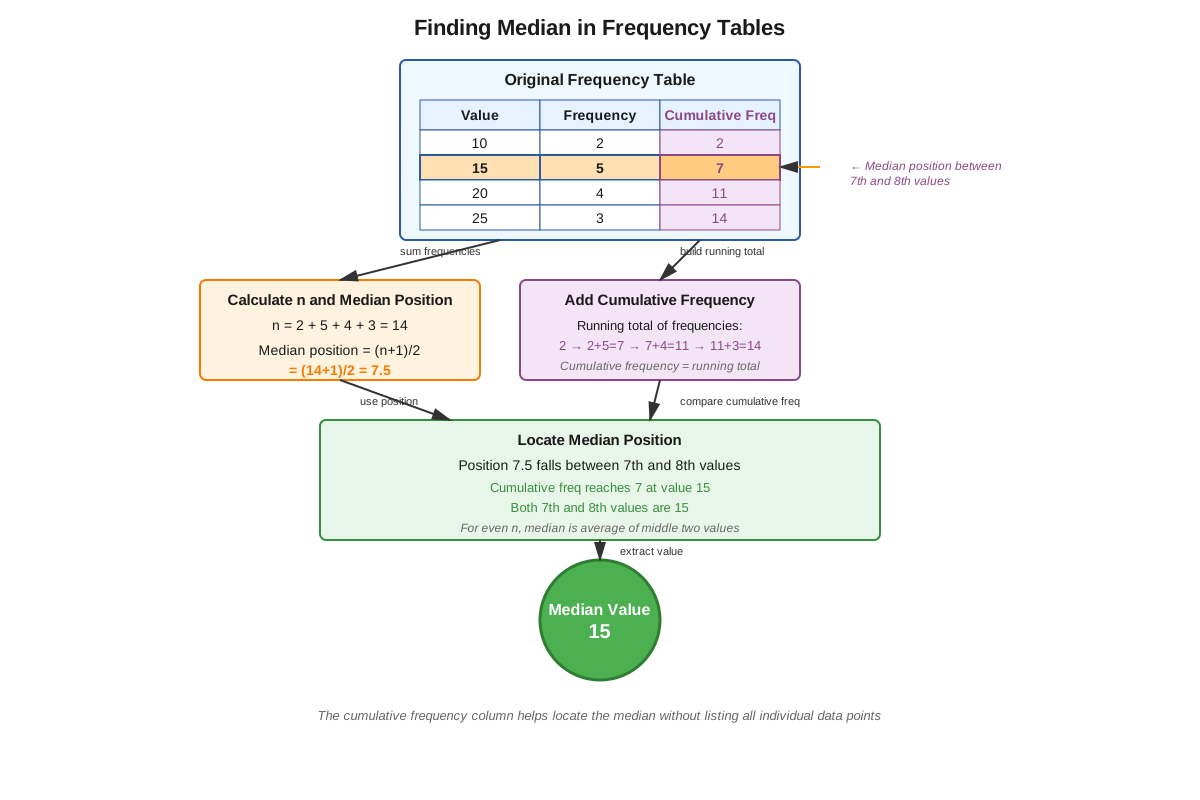
The median is the middle value when data is arranged in order. With frequency tables, determine the position of the median using (n+1)/2, where n is the total frequency. Then, count through the frequencies until reaching that position.
Process for finding median:
- Calculate total frequency (n)
- Find the median position: (n+1)/2
- Count cumulatively through frequencies until reaching or passing this position
- The value corresponding to that frequency is the median
For even-numbered datasets, the median is the average of the two middle values. When these fall within the same frequency row, that value is the median. When they span two different values, average those two values.
Grouped Frequency Tables
Grouped frequency tables organize data into intervals or ranges rather than individual values. These appear when dealing with continuous data or large datasets. Each row represents a class interval (like 0-9, 10-19, etc.), and the frequency shows how many data points fall within that range.
Important considerations for grouped frequency tables:
- Class width: The size of each interval
- Class midpoint: The center value of each interval, used for calculations
- Class boundaries: The actual limits of each interval
When calculating mean from grouped data, use the midpoint of each interval as the representative value for all data points in that class.
Relative Frequency and Probability
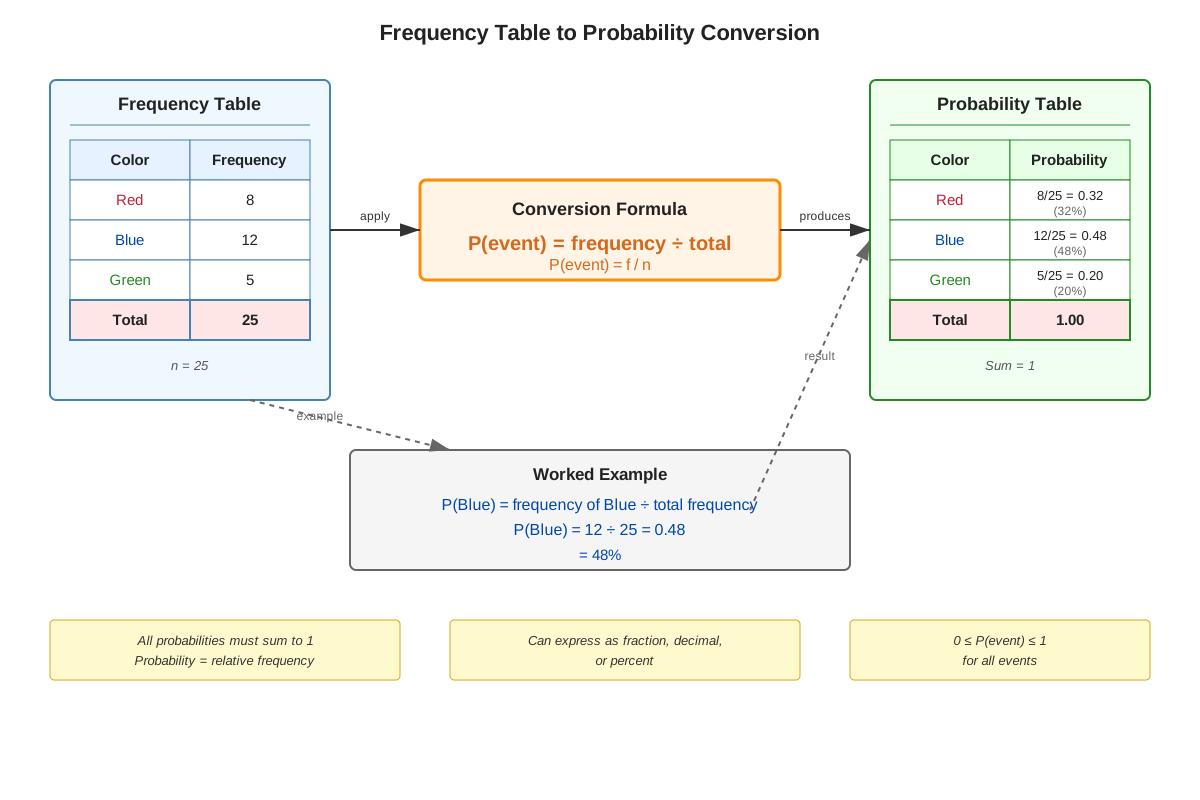
Relative frequency expresses each frequency as a proportion or percentage of the total. Calculate it by dividing each individual frequency by the total frequency. This concept directly connects to probability, as relative frequency represents the experimental probability of selecting that value randomly from the dataset.
Relative Frequency = (Individual Frequency) / (Total Frequency)On the ACT, questions might ask: "If one student is selected at random, what is the probability they scored 90?" This requires dividing the frequency of 90 by the total number of students.
Cumulative Frequency
Cumulative frequency shows the running total of frequencies up to and including each value. This is particularly useful for "at least" or "at most" questions. To create a cumulative frequency column, add each frequency to the sum of all previous frequencies.
Cumulative frequency helps answer questions like:
- "How many students scored 90 or below?"
- "What percentage scored above 85?"
Concept Relationships
The concepts within frequency tables build upon each other in a logical progression. Understanding basic table structure → enables accurate reading and interpretation → which supports calculating measures of central tendency → leading to probability and proportion calculations. Each skill layer depends on mastery of the previous level.
Frequency tables connect directly to prerequisite knowledge of mean, median, and mode, but transform these concepts by requiring calculation from organized data rather than raw lists. The relationship to fractions and percentages becomes operational when computing relative frequencies and probabilities. Basic arithmetic operations underpin every calculation, from finding totals to computing weighted means.
The relationship map flows as follows:
Basic Table Structure → Direct Reading Skills → Total/Sum Calculations → Mean Calculation (weighted average) → Median Determination (positional analysis) → Mode Identification → Relative Frequency → Probability Applications → Cumulative Frequency → Complex Multi-Step Problems
Frequency tables also connect forward to more advanced topics. They provide the foundation for understanding histograms (visual representations of frequency data), probability distributions, and statistical inference. The skills developed in reading frequency tables transfer directly to interpreting two-way tables, scatter plots with frequency information, and other complex data representations that appear on the ACT.
High-Yield Facts
⭐ The total frequency equals the sample size: Always sum all frequencies to find how many data points exist in the dataset
⭐ Mean from frequency table formula: Multiply each value by its frequency, sum these products, then divide by total frequency
⭐ The mode is the value with the highest frequency: Look for the largest number in the frequency column
⭐ Relative frequency equals individual frequency divided by total frequency: This value represents probability when selecting randomly
⭐ Median position is (n+1)/2: Use cumulative frequency to locate which value occupies this position
- Grouped frequency tables use class midpoints for calculations when exact values aren't available
- Cumulative frequency answers "at most" or "at least" questions by showing running totals
- The sum of all relative frequencies always equals 1 (or 100% if expressed as percentages)
- When two values have the same highest frequency, the dataset is bimodal
- Frequency tables can represent both categorical data (colors, names) and numerical data (scores, ages)
- Missing frequency values can be found by subtracting known frequencies from the stated total
- The range of data can be determined from the highest and lowest values in the table, regardless of their frequencies
- Weighted averages from frequency tables give more influence to values that appear more often
- Converting between frequency tables and other representations (lists, histograms) requires careful attention to how many times each value appears
- Zero frequencies are sometimes omitted from tables but represent values that don't appear in the dataset
Quick check — test yourself on Frequency tables so far.
Try Flashcards →Common Misconceptions
Misconception: The mean is always one of the values listed in the frequency table → Correction: The mean is calculated as a weighted average and can be any value, including decimals not appearing in the original data. For example, if scores of 80 (frequency 3) and 90 (frequency 2) are averaged, the mean is 84, which doesn't appear in the table.
Misconception: The mode is the highest frequency number → Correction: The mode is the value (from the first column) that has the highest frequency, not the frequency number itself. If "Score 85" has frequency 7, the mode is 85, not 7.
Misconception: To find the median, simply locate the middle row of the table → Correction: The median is the middle value when all data points are arranged in order. Must account for frequency by finding the position (n+1)/2 and counting through cumulative frequencies, not just table rows.
Misconception: Relative frequency and frequency are the same thing → Correction: Frequency is the count of occurrences (whole numbers), while relative frequency is the proportion or percentage (frequency divided by total). A value might have frequency 5 but relative frequency 0.25 if the total is 20.
Misconception: When calculating mean from a frequency table, add all the values in the first column and divide by the number of rows → Correction: Must multiply each value by its frequency before summing, then divide by the total frequency (not the number of rows). Each value must be weighted by how often it appears.
Misconception: Grouped frequency tables provide exact data values → Correction: Grouped tables show intervals, not exact values. When calculating from grouped data, use class midpoints as estimates, understanding that the actual values could be anywhere within each interval.
Misconception: If a value doesn't appear in the table, it has a frequency of 1 → Correction: Values not listed in a frequency table have a frequency of zero—they don't appear in the dataset at all. Only values explicitly shown have non-zero frequencies.
Worked Examples
Example 1: Calculating Mean and Probability from a Frequency Table
Problem: The frequency table below shows the number of hours students studied for an exam. What is the mean number of study hours? If one student is selected at random, what is the probability they studied exactly 3 hours?
| Hours | Frequency |
|---|---|
| 1 | 4 |
| 2 | 6 |
| 3 | 8 |
| 4 | 5 |
| 5 | 2 |
Solution:
Step 1: Calculate the mean using the frequency table formula.
Multiply each value by its frequency:
- 1 × 4 = 4
- 2 × 6 = 12
- 3 × 8 = 24
- 4 × 5 = 20
- 5 × 2 = 10
Step 2: Sum these products:
4 + 12 + 24 + 20 + 10 = 70
Step 3: Find the total frequency:
4 + 6 + 8 + 5 + 2 = 25 students
Step 4: Calculate mean:
Mean = 70 ÷ 25 = 2.8 hours
Step 5: Calculate probability of studying exactly 3 hours:
Probability = (Frequency of 3 hours) / (Total frequency)
Probability = 8/25 = 0.32 or 32%
Answer: The mean is 2.8 hours, and the probability is 8/25 or 0.32.
This example demonstrates the core learning objectives of applying frequency table formulas accurately and connecting frequency data to probability concepts.
Example 2: Finding Median and Missing Frequency
Problem: The frequency table shows quiz scores for a class. One frequency value is missing, but the total number of students is 30. What is the missing frequency? What is the median score?
| Score | Frequency |
|---|---|
| 6 | 3 |
| 7 | 5 |
| 8 | ? |
| 9 | 8 |
| 10 | 6 |
Solution:
Step 1: Find the missing frequency.
Known frequencies: 3 + 5 + 8 + 6 = 22
Total students: 30
Missing frequency: 30 - 22 = 8
The completed table:
| Score | Frequency | Cumulative Frequency |
|---|---|---|
| 6 | 3 | 3 |
| 7 | 5 | 8 |
| 8 | 8 | 16 |
| 9 | 8 | 24 |
| 10 | 6 | 30 |
Step 2: Find the median position.
With n = 30 students, the median is the average of the 15th and 16th values.
Step 3: Use cumulative frequency to locate these positions.
- Positions 1-3: Score 6
- Positions 4-8: Score 7
- Positions 9-16: Score 8
- Positions 17-24: Score 9
- Positions 25-30: Score 10
Both the 15th and 16th students scored 8.
Step 4: Calculate median.
Median = (8 + 8) / 2 = 8
Answer: The missing frequency is 8, and the median score is 8.
This example illustrates how frequency tables often require multi-step reasoning and demonstrates the practical use of cumulative frequency for finding medians.
Exam Strategy
When approaching ACT frequency tables questions, begin by quickly scanning the table structure to understand what data is being presented. Identify the column headers, note whether the table shows individual values or grouped intervals, and check if additional columns (like cumulative frequency or percentages) are provided. This initial orientation prevents misreading the table under time pressure.
Trigger words and phrases that signal frequency table questions include:
- "According to the table..."
- "How many students/people/items..."
- "What is the mean/median/mode..."
- "If one is selected at random..."
- "What is the probability..."
- "What percent of..."
- "How many more/fewer..."
These phrases indicate you'll need to extract and manipulate frequency data rather than perform abstract calculations.
Process-of-elimination strategies for frequency table questions:
- Eliminate answers that exceed the total frequency (impossible values)
- Rule out answers that don't match the data type (e.g., decimal frequencies when all given frequencies are whole numbers)
- For mean calculations, eliminate extreme values that fall outside the range of the data
- For probability questions, eliminate any answer greater than 1 or less than 0
- Check if answer choices are in simplified form when dealing with fractions
Time allocation advice: Frequency table questions typically require 45-75 seconds each. Simple reading questions (finding a specific frequency) should take 30-45 seconds. Calculation questions (mean, median) warrant 60-90 seconds. Multi-step questions combining frequency tables with other concepts may require up to 2 minutes. If a question requires constructing a frequency table from a verbal description, budget extra time but consider whether skipping and returning is more efficient.
Systematic approach:
- Read the question first to know what you're looking for
- Locate the relevant row(s) or column(s) in the table
- Perform necessary calculations step-by-step
- Double-check that your answer makes sense in context
- Verify units and format match the question requirements
Exam Tip: Always calculate the total frequency first, even if the question doesn't explicitly ask for it. This total is needed for most calculations and helps verify your understanding of the table.
Memory Techniques
Mnemonic for Mean Calculation: "MVP" - Multiply (value × frequency), Value sum (add products), Proportion (divide by total)
Mnemonic for Median Position: "HALF Plus" - Find HALF the total, Plus one, then divide by 2: (n+1)/2
Visualization Strategy: Picture frequency tables as stacks of blocks. Each value is a different colored block, and the frequency tells you how many blocks of that color are stacked. The tallest stack is the mode. To find the mean, imagine redistributing all blocks evenly. For median, imagine lining up all blocks and finding the middle one.
Acronym for Table Reading: "RVFT" - Read the question, Verify the table structure, Find relevant data, Transform/calculate as needed
Memory aid for Relative Frequency: Think "Part over Whole" - the individual frequency is the part, the total frequency is the whole. This same principle applies to probability calculations.
Conceptual anchor: Remember that frequency tables are just organized lists. If you're unsure about a calculation, imagine writing out the full list (though don't actually do this on the test due to time constraints). For example, a frequency table showing "5 appears 3 times" is the same as the list: 5, 5, 5.
Summary
Frequency tables are essential data organization tools that systematically display how often values appear in a dataset. Mastering frequency tables for the ACT requires understanding their structure (values and corresponding frequencies), accurately reading and interpreting table information, and performing calculations including mean (sum of value×frequency divided by total frequency), median (finding the middle position using cumulative frequency), and mode (value with highest frequency). These tables connect directly to probability through relative frequency calculations (individual frequency divided by total frequency). ACT questions test frequency tables through direct reading, statistical calculations, probability applications, and multi-step problems that combine multiple concepts. Success requires careful attention to what each column represents, systematic calculation methods, and awareness of common pitfalls like confusing frequency values with the actual data values or miscalculating weighted averages. The ability to quickly extract information from frequency tables and perform accurate calculations is a high-yield skill that appears consistently across ACT Math sections.
Key Takeaways
- Frequency tables organize data by showing how many times each value appears, with total frequency representing the complete sample size
- Calculate mean from frequency tables by multiplying each value by its frequency, summing these products, and dividing by total frequency
- Find median by determining position (n+1)/2 and using cumulative frequency to locate which value occupies that position
- The mode is always the value (not the frequency) that appears most often in the dataset
- Relative frequency (individual frequency ÷ total frequency) directly represents probability for random selection questions
- Always verify table structure before calculating—distinguish between individual values and grouped intervals
- Common errors include confusing the mode with the highest frequency number and calculating simple averages instead of weighted averages
Related Topics
Two-Way Frequency Tables: Building on single-variable frequency tables, two-way tables display relationships between two categorical variables, enabling analysis of conditional probabilities and associations between variables.
Histograms and Bar Graphs: Visual representations of frequency data where bar heights correspond to frequencies, requiring translation between tabular and graphical formats.
Measures of Spread: Standard deviation, variance, and interquartile range calculations that extend frequency table analysis beyond central tendency to describe data variability.
Probability Distributions: Theoretical frameworks that build on relative frequency concepts to model expected outcomes in various scenarios.
Data Analysis and Statistics: Broader statistical reasoning skills including hypothesis testing, sampling methods, and drawing conclusions from data—all of which rely on organizing and interpreting frequency information.
Mastering frequency tables provides the foundation for all these advanced topics, making it a gateway skill for higher-level statistical reasoning on the ACT and beyond.
Practice CTA
Now that you've thoroughly reviewed frequency tables, it's time to solidify your understanding through active practice. Attempt the practice questions designed specifically for this topic, focusing on applying the calculation methods and interpretation strategies you've learned. Use the flashcards to reinforce key formulas and concepts until they become automatic. Remember, frequency table questions are high-yield on the ACT—investing time in mastering this topic will directly translate to points on test day. Challenge yourself to work through problems systematically, and review any mistakes to understand where your reasoning went astray. You've got this!
Sign up free to keep reading
Create a free AnvayaPrep account to finish this ACT guide on Frequency tables — plus flashcards and practice questions.