Overview
The median is one of the three primary measures of central tendency in statistics, alongside mean and mode. On the ACT Math test, understanding how to calculate and interpret the median is crucial for success in the Statistics and Probability content area. The median represents the middle value in a dataset when all values are arranged in numerical order, providing a measure of center that is resistant to extreme values or outliers—a property that distinguishes it from the arithmetic mean.
The ACT median questions appear regularly on the exam, typically 1-2 times per test, making this a high-yield topic that deserves focused attention. These questions range from straightforward calculations with small datasets to more complex scenarios involving missing values, combined datasets, or interpretation of graphical data. The ACT frequently tests whether students can identify when the median is the appropriate measure to use, calculate it correctly in various contexts, and understand how changes to a dataset affect the median value.
Mastery of median concepts connects directly to broader mathematical reasoning skills tested on the ACT, including data analysis, number sense, and logical problem-solving. The median serves as a foundation for understanding more advanced statistical concepts like quartiles, interquartile range, and box plots—all of which may appear on the exam. Additionally, median problems often integrate with other ACT Math topics such as inequalities, sequences, and algebraic reasoning, making it essential to develop both computational fluency and conceptual understanding of this measure of central tendency.
Learning Objectives
- [ ] Identify when Median is being tested in ACT questions
- [ ] Explain the core rule or strategy behind Median calculations
- [ ] Apply Median to ACT-style questions accurately
- [ ] Calculate the median for both odd and even numbers of data points
- [ ] Determine how adding, removing, or changing values affects the median
- [ ] Distinguish between situations where median is more appropriate than mean
- [ ] Solve problems involving the median of combined or grouped datasets
Prerequisites
- Ordering numbers: The ability to arrange numbers from least to greatest is fundamental, as median calculation requires ordered data
- Basic arithmetic operations: Addition and division are necessary when calculating the median of an even number of values
- Understanding of fractions and decimals: Median values may be non-integers, requiring comfort with fractional and decimal representations
- Mean calculation: Familiarity with the mean helps distinguish between different measures of central tendency and understand their relative properties
Why This Topic Matters
In real-world applications, the median provides critical insights in fields ranging from economics to healthcare. Median household income, for example, offers a more accurate representation of typical earnings than mean income because it isn't skewed by extremely wealthy individuals. Real estate professionals use median home prices to describe housing markets, and medical researchers report median survival times in clinical studies. Understanding when to use median versus other measures of central tendency demonstrates statistical literacy—a skill increasingly valued in college coursework and professional settings.
On the ACT Math test, median questions appear with consistent frequency, typically comprising 2-4% of the 60 mathematics questions. These problems most commonly appear in the Statistics and Probability content area but may also integrate with other domains. The ACT tests median through various question formats: direct calculation problems, word problems requiring interpretation, questions about the effect of data changes, and problems involving graphical representations like dot plots or stem-and-leaf plots. According to ACT data, approximately 60% of test-takers answer median questions correctly, indicating that mastery of this topic provides a competitive advantage.
Common ACT question types include: finding the median of a listed dataset, determining what value must be added to achieve a specific median, identifying how the median changes when data points are modified, comparing median to mean in skewed distributions, and calculating the median from frequency tables or graphs. The exam particularly favors questions that test conceptual understanding rather than pure computation, such as asking which measure of center would be most affected by an outlier or determining the median of a dataset where some values are represented algebraically.
Core Concepts
Definition and Basic Calculation
The median is defined as the middle value in a dataset when all values are arranged in ascending (or descending) order. Unlike the mean, which considers all values equally in its calculation, the median depends only on the position of values, making it a positional measure of central tendency. This positional nature gives the median its resistance to outliers—extreme values don't affect the median unless they change which value occupies the middle position.
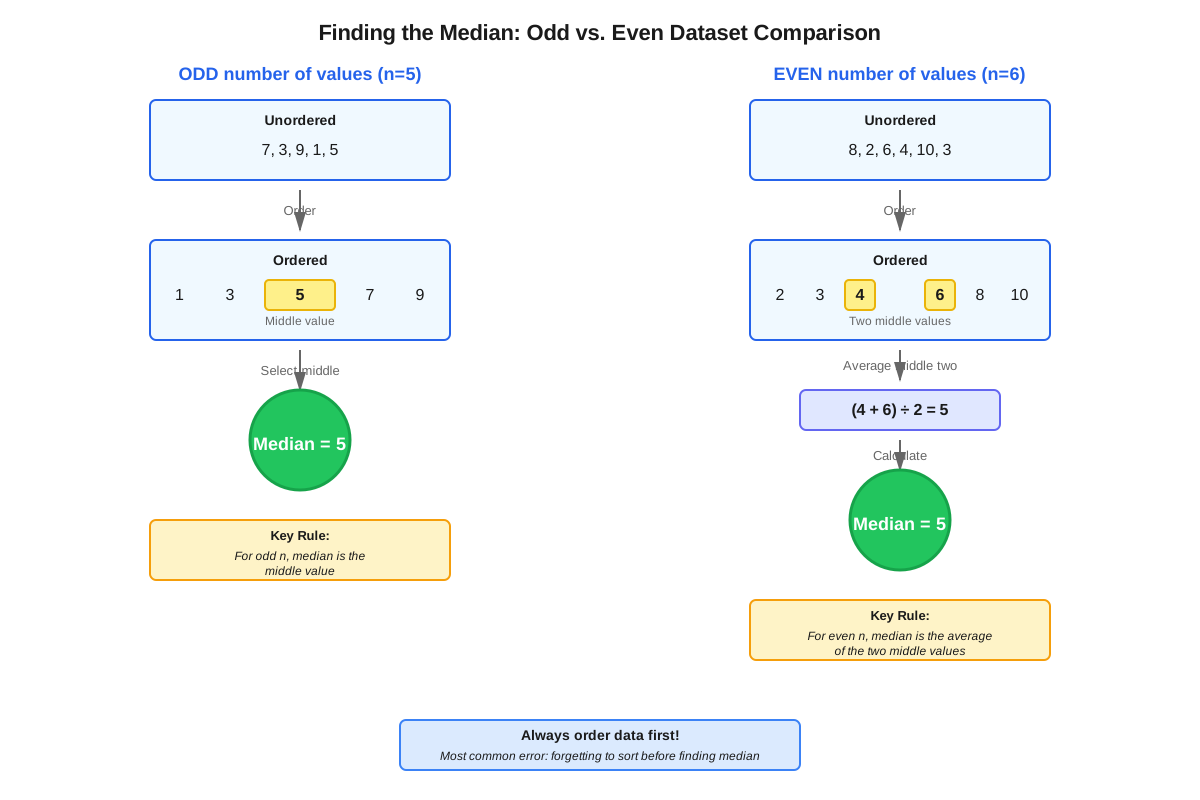
For datasets with an odd number of values, the median is simply the middle value after ordering. For example, in the dataset {3, 7, 2, 9, 5}, we first order the values: {2, 3, 5, 7, 9}. With 5 values, the median is the 3rd value (the middle position), which is 5.
For datasets with an even number of values, the median is the arithmetic mean (average) of the two middle values. Consider the dataset {4, 1, 8, 3, 6, 2}. After ordering: {1, 2, 3, 4, 6, 8}. With 6 values, the two middle positions are the 3rd and 4th values (3 and 4). The median is (3 + 4) ÷ 2 = 3.5.
Finding the Position of the Median
A systematic approach to locating the median position uses the formula:
Position = (n + 1) ÷ 2where n represents the total number of values in the dataset.
For odd n, this formula gives a whole number indicating the exact position. For even n, this formula gives a decimal (ending in .5), indicating that the median falls between two positions. For example:
- If n = 7, position = (7 + 1) ÷ 2 = 4 (the 4th value is the median)
- If n = 8, position = (8 + 1) ÷ 2 = 4.5 (average the 4th and 5th values)
Median with Repeated Values
When a dataset contains repeated values, the median calculation follows the same process—order all values (including duplicates) and find the middle. Consider {5, 3, 7, 5, 2, 5, 8}. Ordered: {2, 3, 5, 5, 5, 7, 8}. With 7 values, the median is the 4th value, which is 5. The fact that 5 appears multiple times doesn't change the calculation method; each instance occupies its own position in the ordered list.
Effect of Data Changes on Median
Understanding how the median responds to changes in the dataset is crucial for ACT success:
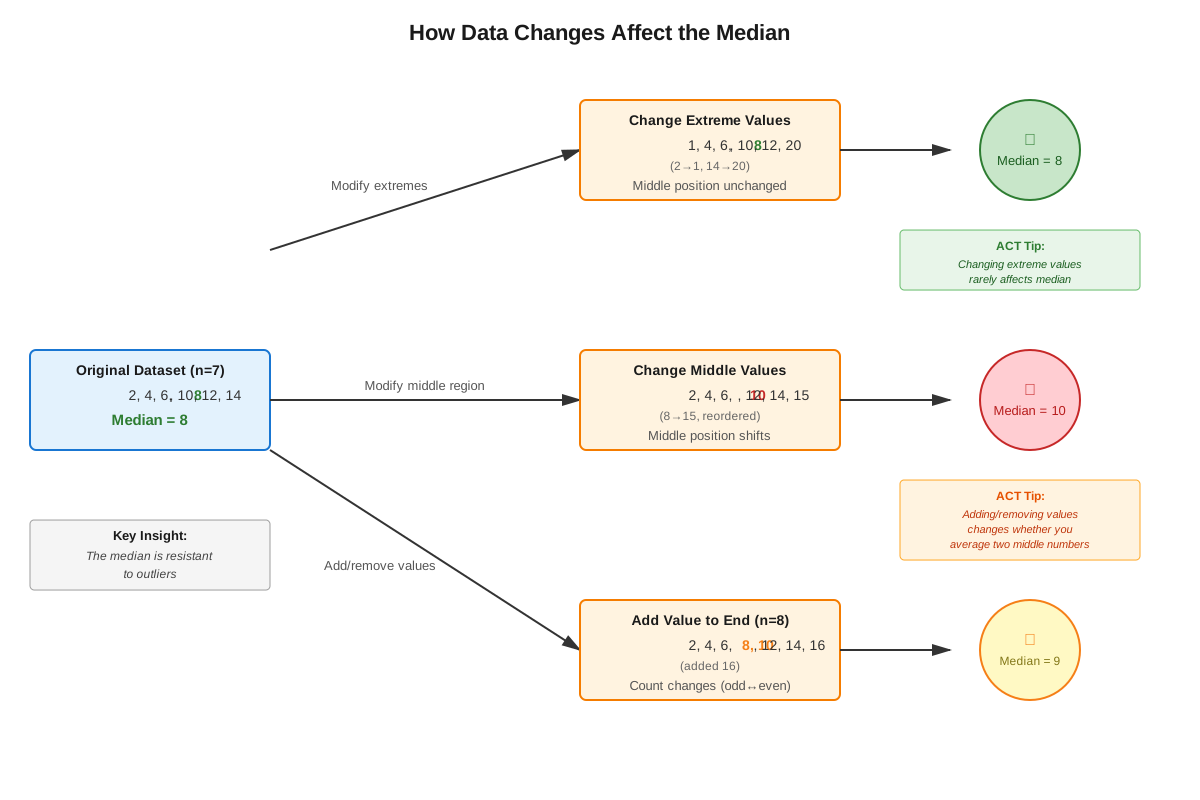
Adding values: Adding a value above the current median tends to increase the median (or keep it the same), while adding a value below tends to decrease it. However, the effect depends on whether the addition changes which value(s) occupy the middle position.
Removing values: Removing the median value itself forces a recalculation with the remaining values. Removing values above or below the median may shift which values occupy the middle positions.
Changing values: Modifying a value that isn't currently the median (or one of the two middle values) often doesn't affect the median at all, as long as the change doesn't cause that value to "cross over" the median position.
Median versus Mean
| Characteristic | Median | Mean |
|---|---|---|
| Calculation | Middle value(s) when ordered | Sum divided by count |
| Affected by outliers | No (resistant) | Yes (sensitive) |
| Uses all data values | No (only position matters) | Yes (every value contributes) |
| Always a data value | Sometimes (odd n) | Rarely |
| Best for skewed data | Yes | No |
| Best for symmetric data | Either works well | Either works well |
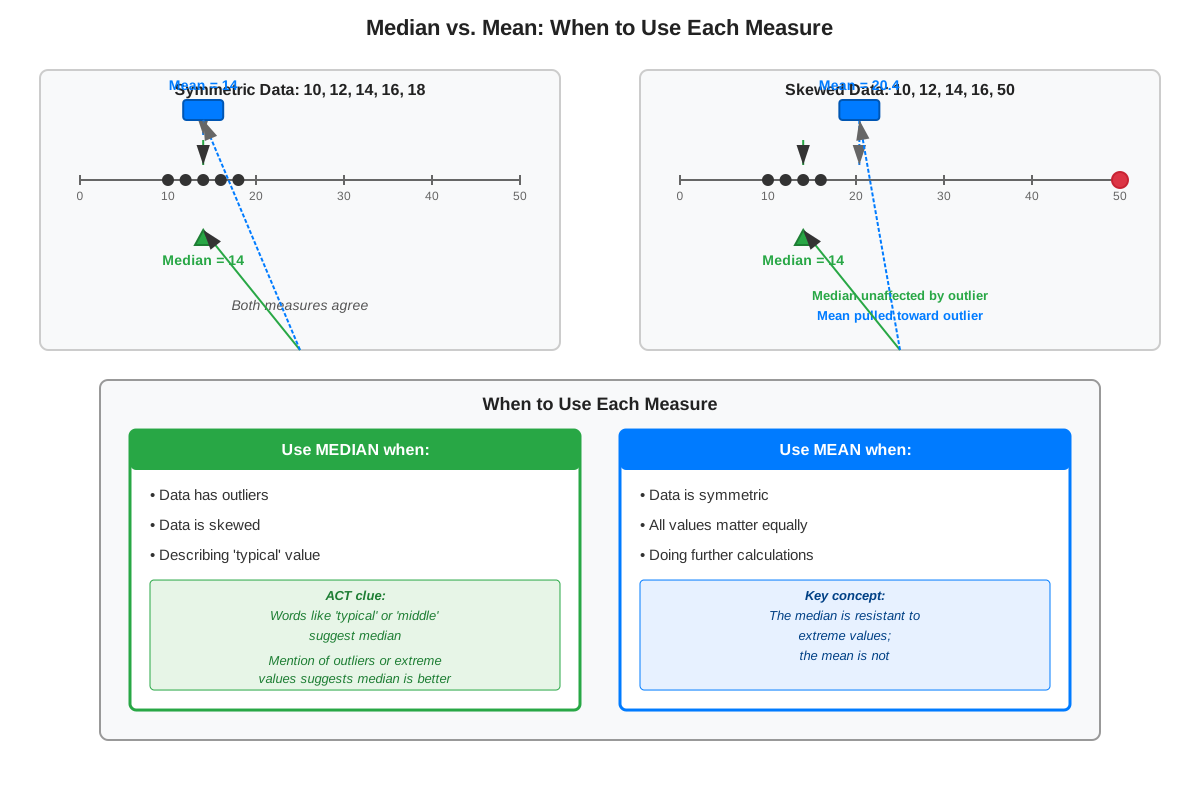
The median is particularly valuable when dealing with skewed distributions—datasets where extreme values pull the mean away from the typical center. In such cases, the median better represents the "typical" value. For example, in a dataset of home prices where a few mansions exist among many modest homes, the median price better represents what most people pay than the mean price would.
Median in Graphical Representations
On the ACT, median questions may present data through various visual formats:
Dot plots: Count the total dots, then locate the middle position(s) by counting from either end.
Stem-and-leaf plots: Read all values from the plot, order them if necessary, then find the middle value(s).
Frequency tables: Expand the data by considering how many times each value appears, then find the middle position in this expanded dataset.
Box plots: The median is represented by the line inside the box, making it immediately visible without calculation.
Concept Relationships
The median concept builds directly on the prerequisite skill of ordering numbers, as every median calculation begins with arranging data in sequence. This ordering process connects to number line understanding and inequality concepts tested elsewhere on the ACT. The median then serves as a gateway to more advanced statistical measures: the first quartile (Q1) is the median of the lower half of data, while the third quartile (Q3) is the median of the upper half. These quartiles, in turn, enable calculation of the interquartile range (IQR = Q3 - Q1), a measure of spread that appears on the ACT.
The relationship between median and mean represents a crucial conceptual connection. When a distribution is symmetric, median and mean are approximately equal. When a distribution is skewed right (tail extending toward higher values), the mean exceeds the median. When skewed left, the median exceeds the mean. This relationship helps students identify distribution shapes and choose appropriate measures of center.
Within the broader Statistics and Probability unit, median connects to data analysis and interpretation skills. Questions may ask students to calculate the median, then use that value to make inferences about the dataset or compare it to other measures. The median also relates to probability concepts when considering what value a randomly selected data point is likely to be near.
Conceptual flow: Ordering data → Identifying middle position(s) → Calculating median → Comparing to mean → Understanding distribution shape → Making statistical inferences
High-Yield Facts
⭐ The median is the middle value when data is arranged in order; for even counts, average the two middle values
⭐ The median is resistant to outliers, unlike the mean, making it better for skewed distributions
⭐ To find the median position in a dataset of n values, use position = (n + 1) ÷ 2
⭐ Adding or removing values may change the median, but changing non-middle values often doesn't affect it
⭐ In a symmetric distribution, median ≈ mean; in right-skewed data, median < mean; in left-skewed data, median > mean
- When n is odd, the median is always one of the actual data values
- When n is even, the median may not be a value that appears in the dataset
- Repeated values are counted separately when determining the median position
- The median divides a dataset into two equal halves by count, not by value
- Multiplying or adding the same number to every data value affects the median in the same way
- The median of a dataset with all identical values is that value
- In a box plot, the median is the vertical line inside the box
- For frequency tables, expand the data mentally by considering how many times each value appears
- The median can be found without calculating the mean, but both together provide fuller understanding
- ACT questions often test whether students know when median is more appropriate than mean
Quick check — test yourself on Median so far.
Try Flashcards →Common Misconceptions
Misconception: The median is always one of the numbers in the dataset.
Correction: When the dataset has an even number of values, the median is the average of the two middle values, which may not appear in the original data. For example, in {1, 2, 3, 4}, the median is 2.5, which isn't in the dataset.
Misconception: You can find the median without ordering the data first.
Correction: The median specifically requires ordered data. Finding the "middle" value in an unordered list will likely give an incorrect answer. Always arrange values from least to greatest (or greatest to least) before identifying the median.
Misconception: Changing any value in the dataset will change the median.
Correction: The median depends only on the middle position(s). Changing values that are far from the middle often has no effect on the median. For example, in {1, 2, 3, 4, 100}, the median is 3. Changing 100 to 1000 doesn't affect the median because neither value occupies a middle position.
Misconception: The median and mean are the same thing.
Correction: The median is the middle value when ordered; the mean is the arithmetic average. They are equal only in perfectly symmetric distributions. In skewed data, they differ significantly, with the mean being pulled toward the tail.
Misconception: To find the median of an even-numbered dataset, you just pick one of the two middle values.
Correction: For even-numbered datasets, you must calculate the arithmetic mean (average) of the two middle values. Simply choosing one or the other is incorrect.
Misconception: The median position formula (n + 1) ÷ 2 gives you the median value.
Correction: This formula gives you the position where the median is located, not the median value itself. You must then look at that position in your ordered dataset to find the actual median value.
Misconception: If a dataset has repeated values, you only count each unique value once when finding the median.
Correction: Every data point counts separately, even if values repeat. In {2, 2, 2, 5, 8}, there are 5 values total, and the median is the 3rd value, which is 2. You don't reduce this to {2, 5, 8} before calculating.
Worked Examples
Example 1: Basic Median Calculation with Interpretation
Problem: The test scores for seven students in a class are: 78, 92, 85, 78, 88, 95, 82. What is the median test score, and what does it tell us about the class performance?
Solution:
Step 1: Order the data from least to greatest.
{78, 78, 82, 85, 88, 92, 95}
Step 2: Determine the number of values.
n = 7 (odd number)
Step 3: Find the median position.
Position = (7 + 1) ÷ 2 = 8 ÷ 2 = 4
The median is the 4th value in the ordered list.
Step 4: Identify the median value.
Counting to the 4th position: 78 (1st), 78 (2nd), 82 (3rd), 85 (4th)
Answer: The median test score is 85.
Interpretation: The median of 85 indicates that half the students scored 85 or below, and half scored 85 or above. This provides a measure of typical performance that isn't affected by the highest score (95) or the repeated lower score (78). Notice that even though 78 appears twice, it doesn't disproportionately affect the median the way it would affect the mean.
Connection to Learning Objectives: This example demonstrates the core calculation strategy (ordering, finding position, identifying value) and shows how to apply median to a realistic ACT-style scenario involving test scores.
Example 2: Finding a Missing Value Given the Median
Problem: A dataset consists of five numbers: 12, 18, x, 25, 30, where x is an unknown value. If the median of this dataset is 20, what is the value of x?
Solution:
Step 1: Understand what we know.
- We have 5 values (odd number)
- The median is 20
- Four values are known: 12, 18, 25, 30
Step 2: Determine where the median falls.
With n = 5, the median position is (5 + 1) ÷ 2 = 3
The median is the 3rd value when the data is ordered.
Step 3: Consider possible positions for x.
Since the median must be 20, and 20 must be the 3rd value when ordered, we need to determine where x fits.
Step 4: Test scenarios.
- If x < 12: ordered list would be {x, 12, 18, 25, 30}, making 18 the median ✗
- If 12 ≤ x < 18: ordered list would be {12, x, 18, 25, 30}, making 18 the median ✗
- If 18 ≤ x < 25: ordered list would be {12, 18, x, 25, 30}, making x the median ✓
- If x ≥ 25: ordered list would be {12, 18, 25, x, 30} or {12, 18, 25, 30, x}, making 25 the median ✗
Step 5: Solve for x.
Since x must be the 3rd value (the median) and the median equals 20:
x = 20
Step 6: Verify.
Ordered list: {12, 18, 20, 25, 30}
The 3rd value is indeed 20 ✓
Answer: x = 20
Connection to Learning Objectives: This problem requires understanding the core rule of median (middle position when ordered) and applying algebraic reasoning to determine an unknown value. This type of question frequently appears on the ACT, testing both computational and conceptual understanding.
Exam Strategy
When approaching ACT median questions, begin by identifying trigger words and phrases that signal median is being tested: "middle value," "median," "central value," "divides the data in half," or questions asking about measures of center that are "resistant to outliers." The ACT often contrasts median with mean, so watch for questions asking which measure is more appropriate for a given situation.
Step-by-step approach for median questions:
- Read carefully to determine what's being asked—calculation, interpretation, or comparison
- Extract the data from text, tables, or graphs
- Order the values from least to greatest (write them out if not already ordered)
- Count the values to determine n
- Find the position using (n + 1) ÷ 2
- Identify the median value at that position (or average two middle values if n is even)
- Check your answer against the context and answer choices
Process of elimination tips:
- If answer choices include values not in the dataset and n is odd, eliminate those choices (the median must be a data value)
- If the question involves a skewed distribution, eliminate answer choices where median equals mean
- For "which measure is most appropriate" questions, eliminate mean if outliers are present
- If you're asked how adding a value affects the median, eliminate choices that show extreme changes unless the dataset is very small
Time allocation: Most median questions should take 45-60 seconds. If a question involves finding a missing value or requires multiple steps, allocate up to 90 seconds. Don't spend excessive time ordering large datasets—if the data is presented in a graph or frequency table, use the visual structure to your advantage rather than writing out every value.
Common ACT tricks to watch for:
- Presenting data in unordered form to test whether you remember to order it
- Including outliers to test whether you understand median's resistance to extreme values
- Asking about the effect of changes without requiring full recalculation
- Mixing median questions with mean questions in the same problem
- Using frequency tables where you must account for repeated values
Exam Tip: If you're running short on time and face a median question with a large dataset, remember that you only need to find the middle value(s)—you don't need to fully order the entire dataset. Count from both ends toward the middle to save time.
Memory Techniques
MEDIAN Mnemonic:
- Middle value
- Even count? Average two
- Data must be ordered
- Ignores outliers
- Always divides data in half
- Number position: (n + 1) ÷ 2
Visualization Strategy: Picture a line of people arranged by height. The median is the person in the middle—if someone very tall joins the line at the end, the middle person doesn't change (illustrating resistance to outliers). If an even number of people stand in line, the median height is halfway between the two middle people.
"SORT First" Reminder: Before calculating any median, always SORT the data:
- See all the values
- Order them least to greatest
- Recognize the count (n)
- Target the middle position
Odd vs. Even Memory Aid:
- ODD = One Data point (the median is a single value)
- EVEN = Exact Value Elusive, Need average (must average two values)
Median vs. Mean Distinction:
- MEDIAN has "DIA" in the middle (like diameter goes through the middle)
- MEAN sounds like "MEAN" (cruel)—it's affected by extreme (mean) values
Summary
The median represents the middle value in an ordered dataset and serves as a crucial measure of central tendency on the ACT Math test. Unlike the mean, the median is resistant to outliers and extreme values, making it the preferred measure for skewed distributions. Calculating the median requires three essential steps: ordering the data from least to greatest, determining the middle position using (n + 1) ÷ 2, and identifying the value at that position (or averaging the two middle values for even-numbered datasets). The ACT tests median through direct calculation problems, questions about the effects of data changes, comparisons with mean, and interpretation scenarios. Understanding when the median is more appropriate than other measures of center demonstrates statistical reasoning that extends beyond mere computation. Success with median questions requires both procedural fluency in calculation and conceptual understanding of how the median behaves under various conditions—knowledge that appears in approximately 2-4% of ACT Math questions and provides a competitive advantage for test-takers who master this high-yield topic.
Key Takeaways
- The median is the middle value when data is ordered; for even counts, average the two middle values
- Always order data before calculating the median—this is the most common source of errors
- The median is resistant to outliers, making it superior to mean for skewed distributions
- Use position = (n + 1) ÷ 2 to locate where the median falls in an ordered dataset
- Changing values far from the middle often doesn't affect the median at all
- In symmetric distributions median ≈ mean; in skewed distributions they differ significantly
- ACT questions frequently test conceptual understanding (when to use median) rather than just calculation
Related Topics
Quartiles and Interquartile Range: Building on median concepts, quartiles divide data into four equal parts, with Q1 being the median of the lower half and Q3 the median of the upper half. The IQR (Q3 - Q1) measures spread and appears frequently on the ACT alongside median questions.
Mean and Mode: Understanding all three measures of central tendency enables comparison and selection of the most appropriate measure for different distributions. The ACT often asks students to calculate multiple measures or explain why one is preferable.
Box Plots: These visual representations display the median prominently as the line inside the box, along with quartiles and outliers. Interpreting box plots requires solid understanding of median concepts.
Standard Deviation and Variance: While median measures center, these measures quantify spread. Together, they provide comprehensive description of distributions, a skill tested in advanced ACT statistics questions.
Data Analysis and Interpretation: Median serves as a foundation for broader data literacy, including identifying distribution shapes, making predictions, and drawing conclusions from statistical information.
Practice CTA
Now that you've mastered the core concepts of median calculation and interpretation, it's time to solidify your understanding through practice. Attempt the practice questions designed specifically for this topic—they mirror actual ACT question formats and difficulty levels. Work through each problem systematically, applying the strategies and techniques covered in this guide. Don't forget to review the flashcards to reinforce high-yield facts and ensure quick recall during the exam. Remember, median questions represent high-value points on the ACT Math test; investing 20 minutes in focused practice now will pay dividends on test day. You've built the foundation—now strengthen it through application!
Sign up free to keep reading
Create a free AnvayaPrep account to finish this ACT guide on Median — plus flashcards and practice questions.