Overview
The mean, commonly known as the average, is one of the most fundamental statistical concepts tested on the ACT Math section. Understanding how to calculate, manipulate, and apply the mean is essential for success on the exam, as it appears in approximately 3-5 questions per test across various question formats. The mean represents the central tendency of a data set—the value that best represents the "typical" element when all values are balanced equally.
On the ACT, mean problems range from straightforward calculation questions to complex multi-step problems involving missing values, weighted averages, or the relationship between mean and other statistical measures. The ACT mean questions often embed the concept within real-world scenarios such as test scores, temperatures, prices, or measurements, requiring students to extract relevant information and apply the appropriate formula. Mastery of this topic is non-negotiable for students targeting scores above 25, as mean problems frequently serve as gateway questions to more complex statistics and probability concepts.
The mean connects directly to other mathematical concepts including median, mode, range, and standard deviation within the Statistics and Probability unit. It also relates to algebraic problem-solving, as many mean problems require setting up and solving equations. Understanding the mean provides the foundation for weighted averages, probability distributions, and data analysis—skills that extend beyond the ACT into college-level mathematics and real-world quantitative reasoning.
Learning Objectives
- [ ] Identify when Mean is being tested in ACT questions
- [ ] Explain the core rule or strategy behind Mean calculations
- [ ] Apply Mean to ACT-style questions accurately
- [ ] Calculate the mean of a data set given all values
- [ ] Determine a missing value when the mean and other values are known
- [ ] Solve problems involving changes to data sets and their effect on the mean
- [ ] Distinguish between situations requiring mean versus other measures of central tendency
Prerequisites
- Basic arithmetic operations: Addition, subtraction, multiplication, and division are essential for calculating means and solving related equations
- Algebraic equation solving: Many mean problems require setting up equations with variables and solving for unknown values
- Understanding of fractions and decimals: Mean calculations often result in non-integer values that must be interpreted correctly
- Basic data interpretation: Reading and extracting numerical information from word problems, tables, and charts is necessary for identifying relevant values
Why This Topic Matters
The mean is one of the most widely used statistical measures in everyday life, from calculating grade point averages to understanding economic indicators like average income or average temperature. In professional fields ranging from business analytics to scientific research, the mean serves as a fundamental tool for summarizing large data sets and making informed decisions. Understanding how the mean responds to changes in data helps develop critical thinking about how individual values influence overall trends.
On the ACT Math section, mean-related questions appear with high frequency, typically 3-5 times per 60-question test. These questions account for approximately 5-8% of the total Math score, making them a high-yield topic for focused study. Mean problems appear in various formats: straightforward calculation questions worth quick points, multi-step word problems that test algebraic reasoning, and data interpretation questions that combine statistics with graph reading skills.
The ACT commonly presents mean problems in several distinct ways: finding the mean of a given set of numbers, determining a missing value when the mean is provided, calculating how adding or removing values affects the mean, and comparing means across different data sets. Questions may appear as standalone computational problems or embedded within real-world scenarios involving test scores, sports statistics, business data, or scientific measurements. The ability to quickly recognize mean problems and apply the appropriate strategy is crucial for efficient time management during the exam.
Core Concepts
Definition and Basic Formula
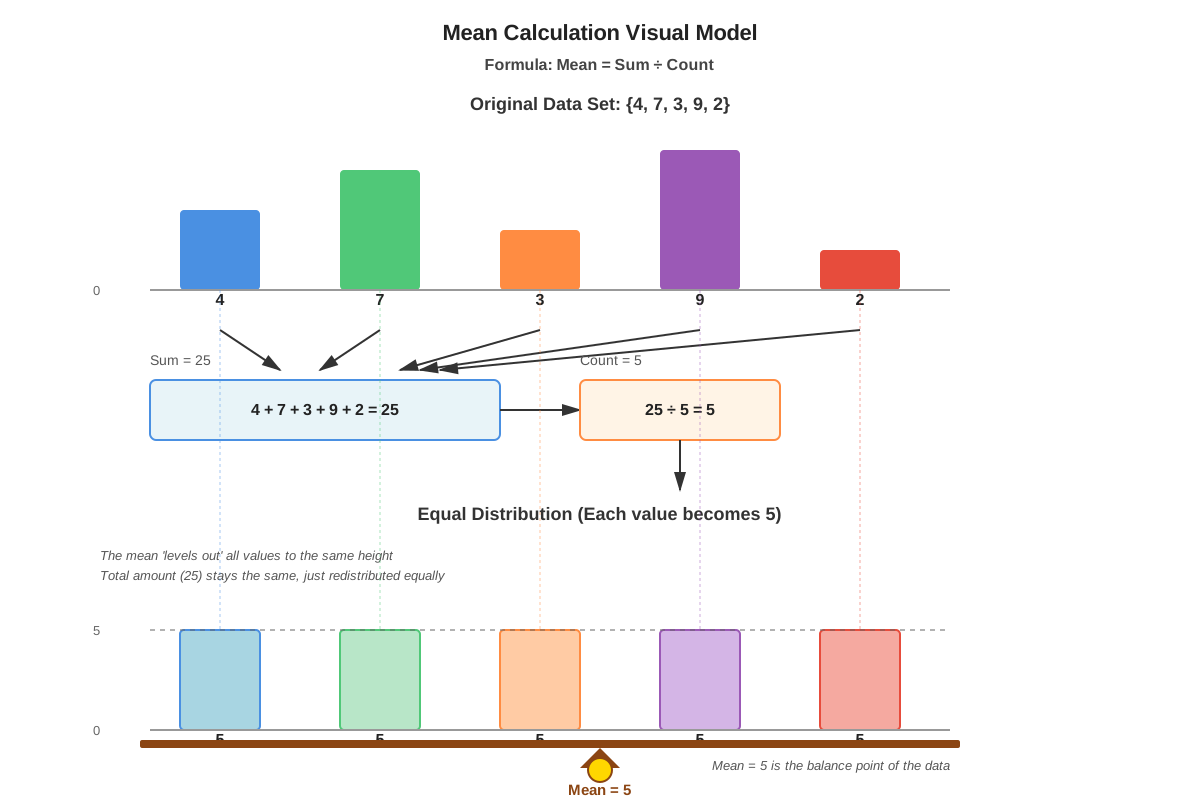
The mean of a data set is the sum of all values divided by the number of values. This measure of central tendency distributes the total equally across all data points. The formula for calculating the mean is:
Mean = (Sum of all values) / (Number of values)Or expressed algebraically:
Mean = (x₁ + x₂ + x₃ + ... + xₙ) / nwhere x₁, x₂, x₃, etc., represent individual data values and n represents the total count of values.
For example, to find the mean of the test scores 85, 92, 78, 88, and 97:
- Sum: 85 + 92 + 78 + 88 + 97 = 440
- Count: 5 scores
- Mean: 440 ÷ 5 = 88
The Reverse Formula: Finding Missing Values
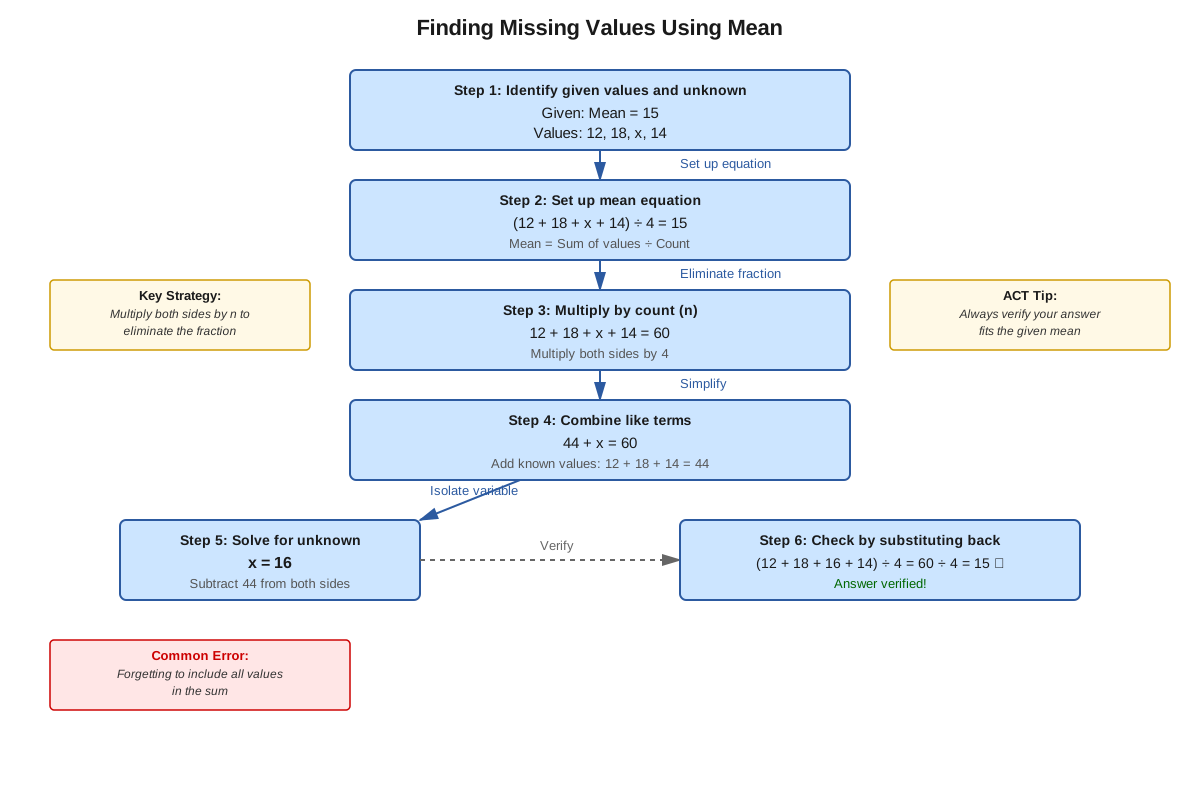
One of the most common ACT applications involves working backward from a known mean to find a missing value. This requires rearranging the mean formula:
Sum of all values = Mean × Number of valuesWhen one value is unknown, set up an equation where the sum of known values plus the unknown value equals the mean times the total count.
For instance, if four test scores are 82, 88, 91, and 85, and the mean of all five tests is 87, find the fifth score:
- Total sum needed: 87 × 5 = 435
- Sum of known scores: 82 + 88 + 91 + 85 = 346
- Missing score: 435 - 346 = 89
Effect of Adding or Removing Values
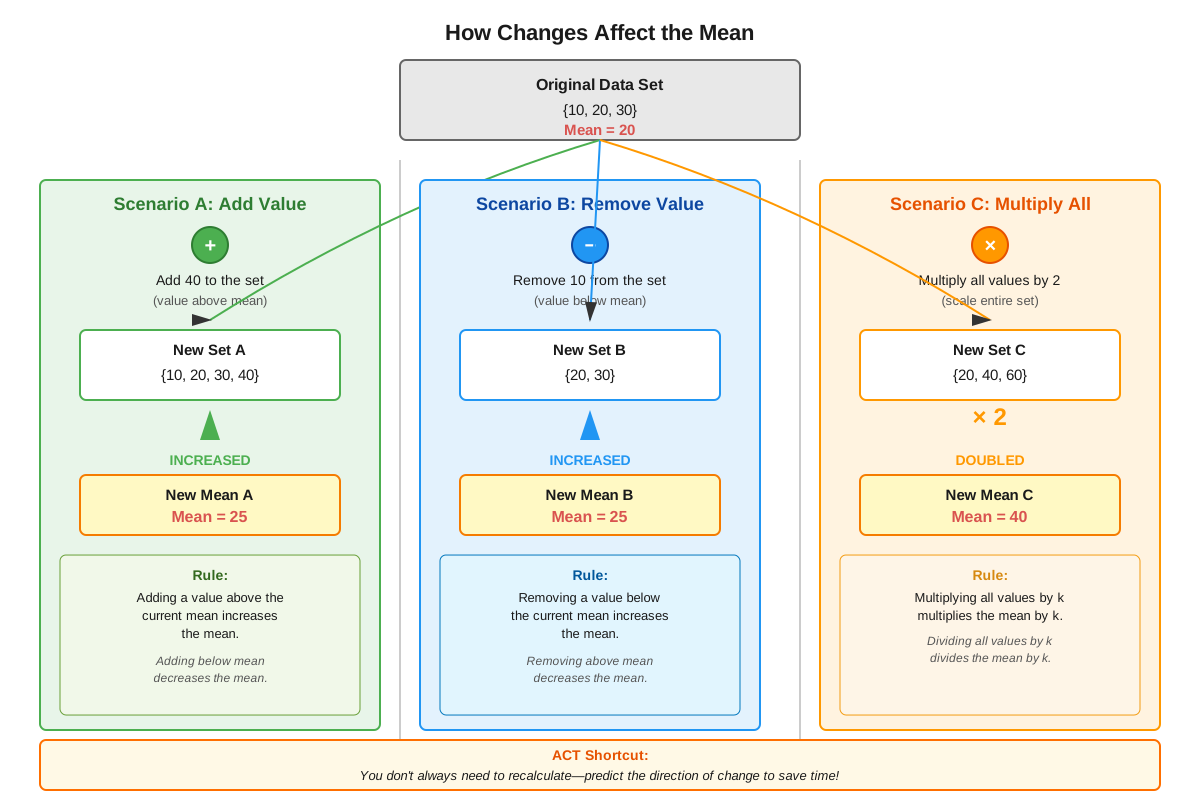
Understanding how the mean changes when values are added to or removed from a data set is crucial for ACT success. When a value equal to the current mean is added, the mean remains unchanged. When a value greater than the mean is added, the mean increases. When a value less than the mean is added, the mean decreases.
The magnitude of change depends on both the difference between the new value and the current mean, and the size of the data set. Larger data sets are less affected by individual values than smaller data sets.
Weighted Averages
While technically a separate concept, weighted averages appear on the ACT as an extension of mean problems. A weighted average accounts for values that have different levels of importance or frequency. The formula is:
Weighted Mean = (w₁x₁ + w₂x₂ + ... + wₙxₙ) / (w₁ + w₂ + ... + wₙ)where w represents the weight (importance or frequency) of each value x.
For example, if homework counts for 20% of a grade (average 85), tests count for 50% (average 78), and the final exam counts for 30% (score 92):
- Weighted mean = (0.20 × 85 + 0.50 × 78 + 0.30 × 92) / (0.20 + 0.50 + 0.30)
- Weighted mean = (17 + 39 + 27.6) / 1 = 83.6
Mean vs. Other Measures of Central Tendency
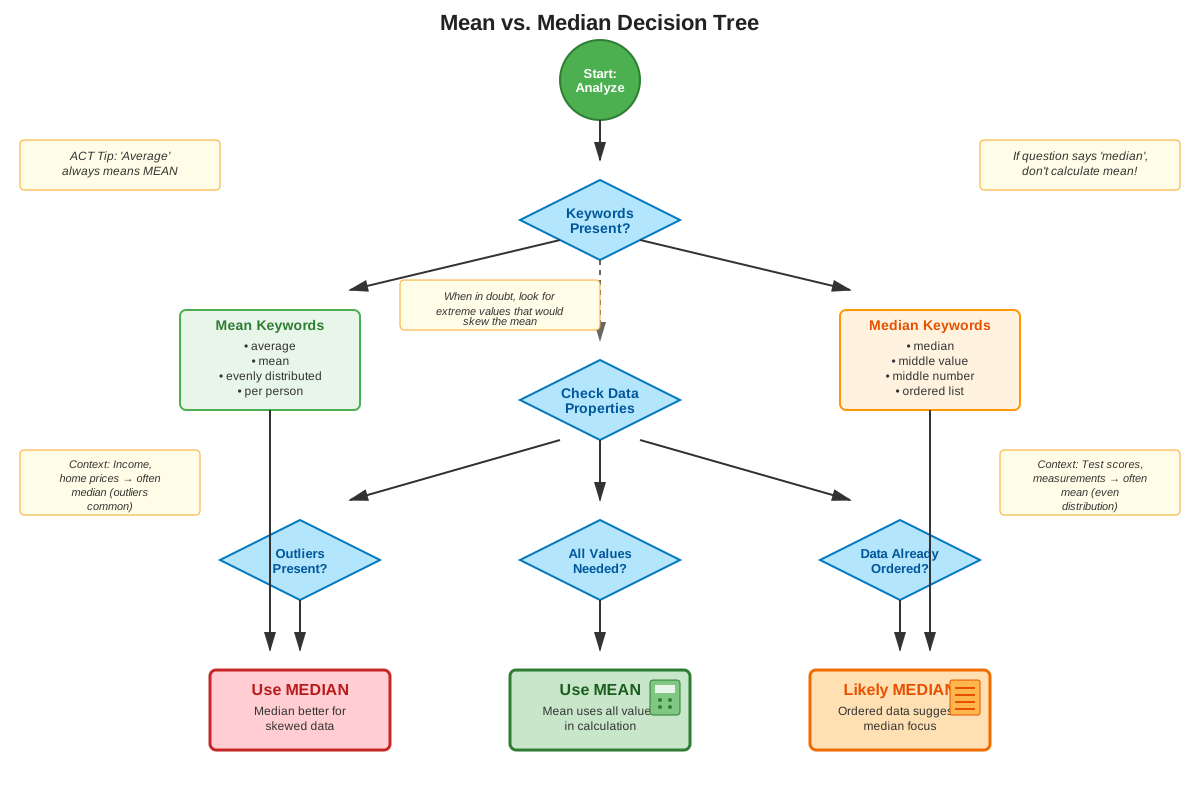
The mean differs from the median (middle value) and mode (most frequent value) in important ways. The mean uses all values in its calculation, making it sensitive to extreme values (outliers). The median is resistant to outliers, while the mode only considers frequency. On the ACT, recognizing which measure is most appropriate for a given situation demonstrates deeper understanding.
| Measure | Definition | Sensitivity to Outliers | Best Used When |
|---|---|---|---|
| Mean | Sum divided by count | High | Data is relatively symmetric |
| Median | Middle value when ordered | Low | Data contains outliers |
| Mode | Most frequent value | None | Identifying most common category |
Properties of the Mean
Several mathematical properties of the mean appear in ACT problems:
- Linearity: If every value in a data set is multiplied by a constant k, the mean is also multiplied by k
- Translation: If a constant c is added to every value, the mean increases by c
- Balance point: The sum of deviations from the mean always equals zero
- Algebraic manipulation: The mean can be treated as a variable in equations
Concept Relationships
The mean serves as the foundation for understanding statistical concepts tested on the ACT. The calculation of mean requires basic arithmetic operations (addition and division), connecting this statistical concept to fundamental mathematics. When solving for missing values given a mean, students must apply algebraic equation-solving skills, demonstrating how statistics and algebra intersect.
Within the Statistics and Probability unit, the mean relates directly to other measures of central tendency. Understanding the mean enables comparison with the median and mode, helping students recognize when each measure is most appropriate. The mean also serves as the reference point for calculating range (difference between maximum and minimum values) and understanding standard deviation (average distance from the mean).
The relationship flow can be visualized as: Basic Arithmetic → Mean Calculation → Algebraic Applications → Comparison with Median/Mode → Advanced Statistics (Standard Deviation). Additionally, mean concepts extend to weighted averages, which appear in real-world ACT problems involving grades, mixtures, or combined rates.
Understanding how individual values affect the mean connects to data analysis and critical thinking skills. This relationship extends to probability when calculating expected values, which are essentially weighted means of possible outcomes. The mean also appears in coordinate geometry when finding the midpoint of a line segment (the mean of x-coordinates and y-coordinates separately).
High-Yield Facts
⭐ The mean equals the sum of all values divided by the number of values: This is the fundamental formula that underlies all mean problems on the ACT.
⭐ To find a missing value when the mean is known: Multiply the mean by the total number of values to get the required sum, then subtract the known values.
⭐ Adding a value equal to the current mean does not change the mean: This property helps quickly eliminate answer choices in multiple-choice questions.
⭐ The mean is sensitive to outliers: Extreme values significantly affect the mean, unlike the median which is resistant to outliers.
⭐ Sum of all values = Mean × Number of values: This reverse formula is essential for solving ACT mean problems efficiently.
- When every value in a data set increases by a constant, the mean increases by that same constant
- When every value in a data set is multiplied by a constant, the mean is multiplied by that same constant
- The mean of a data set can be a non-integer even when all values are integers
- Removing the highest or lowest value from a data set will move the mean toward the center of the remaining values
- In a symmetric distribution, the mean, median, and mode are all equal
- The mean of two numbers is equivalent to their midpoint on a number line
- Zero values must be included when calculating the mean; they cannot be ignored
- The mean can be calculated for any set of numerical data, regardless of whether the numbers represent counts, measurements, or rates
Quick check — test yourself on Mean so far.
Try Flashcards →Common Misconceptions
Misconception: The mean is always one of the values in the data set → Correction: The mean is calculated from all values but does not need to match any actual data point. For example, the mean of 3, 4, and 5 is 4 (which happens to be in the set), but the mean of 3, 4, and 6 is 4.33 (which is not in the set).
Misconception: Adding more values to a data set always changes the mean → Correction: If the added value equals the current mean, the mean remains unchanged. Only values different from the current mean will shift it up or down.
Misconception: The mean is the same as the median → Correction: The mean and median are different measures of central tendency. The mean uses all values in its calculation (sum divided by count), while the median is simply the middle value when data is ordered. They are only equal in perfectly symmetric distributions.
Misconception: When calculating the mean, zero values should be excluded → Correction: Zero is a valid data value and must be included in both the sum and the count. For example, test scores of 85, 90, 0, and 95 have a mean of (85+90+0+95)/4 = 67.5, not (85+90+95)/3 = 90.
Misconception: The mean must be between the smallest and largest values → Correction: While this is true for the mean of a single data set, when comparing means of different groups or calculating weighted averages, the overall mean can fall outside the range of individual group means if weights are considered.
Misconception: Doubling all values in a data set doubles the sum but keeps the mean the same → Correction: Doubling all values doubles both the sum and the mean. If the original mean is 10, doubling all values results in a new mean of 20, because both the numerator (sum) and the result are doubled while the denominator (count) stays the same.
Misconception: The mean is always the "best" measure of central tendency → Correction: The mean is appropriate for symmetric data without extreme outliers, but the median is often more representative when outliers are present. For example, in income data where a few extremely high earners skew the distribution, median income better represents the typical person.
Worked Examples
Example 1: Finding a Missing Test Score
Problem: Sarah has taken four math tests this semester and earned scores of 88, 92, 85, and 91. She needs a mean score of 90 for all five tests to earn an A in the class. What score must she earn on her fifth test?
Solution:
Step 1: Identify what we know and what we need to find.
- Known scores: 88, 92, 85, 91
- Number of tests: 5 total
- Target mean: 90
- Unknown: fifth test score
Step 2: Use the reverse formula to find the required total sum.
- Sum needed = Mean × Number of values
- Sum needed = 90 × 5 = 450
Step 3: Calculate the sum of the known scores.
- Sum of known scores = 88 + 92 + 85 + 91 = 356
Step 4: Find the missing score.
- Fifth score = Total sum needed - Sum of known scores
- Fifth score = 450 - 356 = 94
Answer: Sarah must score 94 on her fifth test to achieve a mean of 90.
Connection to Learning Objectives: This problem demonstrates applying the mean formula in reverse (Objective 2) and accurately solving an ACT-style question (Objective 3) by determining a missing value when the mean is known (Objective 5).
Example 2: Effect of Removing a Value
Problem: The mean of six numbers is 42. When one of the numbers, 54, is removed from the set, what is the mean of the remaining five numbers?
Solution:
Step 1: Find the sum of all six original numbers.
- Sum of six numbers = Mean × Count
- Sum of six numbers = 42 × 6 = 252
Step 2: Calculate the sum after removing 54.
- New sum = Original sum - Removed value
- New sum = 252 - 54 = 198
Step 3: Calculate the new mean with five numbers.
- New mean = New sum ÷ New count
- New mean = 198 ÷ 5 = 39.6
Answer: The mean of the remaining five numbers is 39.6.
Connection to Learning Objectives: This problem illustrates solving problems involving changes to data sets and their effect on the mean (Objective 6) and demonstrates the core strategy of using the relationship between sum, mean, and count (Objective 2).
Example 3: Weighted Average Application
Problem: A student's grade is calculated using weighted averages: quizzes (30%) with an average of 85, homework (20%) with an average of 92, and exams (50%) with an average of 78. What is the student's overall grade?
Solution:
Step 1: Identify the weights and corresponding averages.
- Quizzes: 30% weight, 85 average
- Homework: 20% weight, 92 average
- Exams: 50% weight, 78 average
Step 2: Convert percentages to decimals.
- Quizzes: 0.30
- Homework: 0.20
- Exams: 0.50
Step 3: Calculate the weighted mean.
- Weighted mean = (0.30 × 85) + (0.20 × 92) + (0.50 × 78)
- Weighted mean = 25.5 + 18.4 + 39
- Weighted mean = 82.9
Answer: The student's overall grade is 82.9.
Connection to Learning Objectives: This problem extends the basic mean concept to weighted averages, demonstrating advanced application to ACT-style questions (Objective 3) and explaining the strategy behind more complex mean calculations (Objective 2).
Exam Strategy
When approaching mean problems on the ACT, begin by identifying the question type. Look for trigger words such as "average," "mean," "typical," or phrases like "what score is needed" or "what is the effect on the mean." These signals indicate a mean problem and help activate the appropriate problem-solving strategy.
Exam Tip: The ACT often uses the word "average" instead of "mean" in questions. Treat these terms as identical for test purposes.
For straightforward calculation problems, quickly add all values and divide by the count. Use your calculator efficiently, but double-check that you've included all values and counted correctly. A common error is miscounting the number of values, especially when some are listed in a table or embedded in text.
For missing value problems, immediately write down the reverse formula: Sum = Mean × Count. This transforms the problem into simple algebra. Calculate the required total sum first, then subtract the known values to find the unknown. This systematic approach prevents errors and saves time.
Process of elimination strategies specific to mean problems:
- If a question asks what value must be added to achieve a certain mean, eliminate any answer choice less than the current mean if the target mean is higher (and vice versa)
- When a value is removed from a data set, the new mean must fall between the old mean and the opposite extreme from the removed value
- For weighted average problems, the answer must fall between the lowest and highest individual averages
- If all values in a set are integers, but answer choices include decimals, don't automatically eliminate decimals—the mean can be a non-integer
Time allocation advice: Simple mean calculation problems should take 30-45 seconds. Missing value problems typically require 60-90 seconds. Complex weighted average or multi-step problems may take up to 2 minutes. If a mean problem is taking longer than expected, mark it and return after completing faster questions. The ACT rewards efficient time management, and mean problems often appear early in the test when students are fresh.
Watch for combination problems where mean is tested alongside other concepts. For example, a question might ask for the mean of values extracted from a graph, or require calculating a mean before using it in a probability calculation. These multi-step problems require careful organization—write down intermediate results to avoid recalculation.
Memory Techniques
Mnemonic for the Mean Formula: "Sum Divided by Number" → SDN → "Sarah Doesn't Nap" (imagine Sarah staying awake to calculate averages)
Mnemonic for Reverse Formula: "Mean Times Number equals Sum" → MTNS → "MounTaiNS" (visualize climbing a mountain where you multiply to reach the sum at the peak)
Visualization Strategy: Picture the mean as a balance point on a seesaw. All values above the mean are on one side, all values below are on the other. The mean is where the seesaw balances perfectly. When you add a high value, the balance point shifts up; when you add a low value, it shifts down.
Acronym for Problem-Solving Steps: FIND the mean
- Find what you know (given values, mean, or count)
- Identify what you need (mean, missing value, or new mean)
- Navigate to the right formula (basic or reverse)
- Do the calculation carefully
Memory Aid for Outlier Effect: "Mean is MEAN to outliers—it gets pulled toward them!" This helps remember that unlike the median, the mean is sensitive to extreme values.
Rhyme for Weighted Averages: "Multiply each weight by its mate, add them up, then calculate!" (Multiply weights by values, sum the products, divide by sum of weights)
Summary
The mean is a fundamental measure of central tendency that represents the arithmetic average of a data set, calculated by dividing the sum of all values by the number of values. On the ACT Math section, mean problems appear frequently in various formats, from straightforward calculations to complex multi-step problems involving missing values, weighted averages, and the effects of adding or removing data points. Success requires mastery of both the basic formula (Mean = Sum ÷ Count) and the reverse formula (Sum = Mean × Count), which enables solving for unknown values. The mean is sensitive to outliers and changes predictably when values are added, removed, or modified—understanding these properties allows for quick elimination of incorrect answer choices. Students must distinguish between mean, median, and mode, recognizing when each measure is most appropriate. ACT mean problems often appear embedded in real-world contexts requiring careful extraction of relevant information and systematic application of formulas. Efficient problem-solving involves identifying trigger words, selecting the appropriate strategy, and managing time effectively across different question difficulties.
Key Takeaways
- The mean equals the sum of all values divided by the count of values—this fundamental formula underlies all ACT mean problems
- Use the reverse formula (Sum = Mean × Count) to solve for missing values when the mean is known
- The mean is sensitive to outliers and extreme values, unlike the median which is resistant to such influences
- When a value equal to the current mean is added to a data set, the mean remains unchanged; values above or below the mean shift it accordingly
- Weighted averages extend the mean concept by accounting for different levels of importance or frequency among values
- Recognize trigger words like "average," "mean," and "typical" to quickly identify mean problems on the ACT
- Systematic problem-solving—writing down known values, identifying what to find, and applying the appropriate formula—prevents errors and saves time
Related Topics
Median and Mode: These alternative measures of central tendency complement the mean and frequently appear in comparison questions on the ACT. Understanding when to use each measure demonstrates statistical reasoning.
Range and Standard Deviation: These measures of spread describe how data varies around the mean. Standard deviation specifically measures the average distance of values from the mean, building directly on mean concepts.
Data Interpretation and Analysis: Mean calculations often appear within larger data analysis problems involving tables, charts, and graphs. Mastering mean enables efficient extraction and synthesis of information from complex data presentations.
Probability and Expected Value: Expected value in probability is calculated as a weighted mean of possible outcomes, connecting statistical and probabilistic reasoning.
Algebraic Problem Solving: Many mean problems require setting up and solving equations, reinforcing the connection between statistics and algebra that appears throughout the ACT Math section.
Practice CTA
Now that you've mastered the concepts, formulas, and strategies for ACT mean problems, it's time to put your knowledge into action! Complete the practice questions to reinforce your understanding and build the speed and accuracy needed for test day. Work through the flashcards to memorize key formulas and properties until they become automatic. Remember, consistent practice with immediate feedback is the most effective way to transform understanding into high scores. Every problem you solve strengthens your pattern recognition and problem-solving efficiency—skills that will serve you across the entire ACT Math section. You've got this!
Sign up free to keep reading
Create a free AnvayaPrep account to finish this ACT guide on Mean — plus flashcards and practice questions.