Overview
Outliers represent one of the most frequently tested concepts in the Statistics and Probability section of the ACT Math test. An outlier is a data value that differs significantly from other observations in a dataset—it stands apart from the general pattern of the data. Understanding outliers is crucial because they can dramatically affect statistical measures like mean, range, and standard deviation, while having minimal impact on others like the median. The ACT regularly tests whether students can identify outliers, understand their effects on various statistical measures, and make informed decisions about data interpretation when outliers are present.
The concept of outliers bridges multiple mathematical domains on the ACT. Students must combine their understanding of descriptive statistics (mean, median, mode, range), data visualization (box plots, scatter plots, histograms), and numerical reasoning to successfully tackle ACT outliers questions. These questions often appear in the context of real-world scenarios where students must analyze datasets, interpret graphs, or make predictions based on data that contains unusual values.
Mastering outliers is essential not only for direct questions about identifying unusual data points but also for understanding how these extreme values influence statistical conclusions. The ACT frequently presents problems where students must calculate measures of central tendency both with and without outliers, or determine which statistical measure best represents a dataset containing extreme values. This topic typically appears 1-3 times per ACT Math section and is considered high-yield material that can significantly impact overall performance.
Learning Objectives
- [ ] Identify when Outliers is being tested in ACT Math questions
- [ ] Explain the core rule or strategy behind Outliers and their effects on statistical measures
- [ ] Apply Outliers concepts to ACT-style questions accurately
- [ ] Calculate and compare statistical measures with and without outliers present
- [ ] Determine which measure of central tendency is most appropriate when outliers exist
- [ ] Interpret visual representations of data to identify potential outliers
- [ ] Analyze the impact of adding or removing outliers on dataset characteristics
Prerequisites
- Mean (arithmetic average): Understanding how to calculate the sum of values divided by the count is essential because outliers most dramatically affect the mean
- Median: Knowledge of finding the middle value in an ordered dataset is necessary since the median is resistant to outliers
- Range: Familiarity with calculating the difference between maximum and minimum values helps understand how outliers extend data spread
- Basic data interpretation: Ability to read and understand simple graphs and tables is required for identifying outliers visually
- Number sense: Strong intuition about relative magnitude helps quickly spot values that don't fit patterns
Why This Topic Matters
In real-world applications, outliers appear constantly and significantly impact decision-making. In economics, a single billionaire in a neighborhood dramatically skews average income statistics. In scientific research, outlier data points might indicate measurement errors or breakthrough discoveries. In sports analytics, exceptional performances (both positive and negative) must be carefully considered when evaluating player statistics. Understanding how to identify and appropriately handle outliers is a fundamental skill in data literacy that extends far beyond standardized testing.
On the ACT Math test, outliers appear with remarkable frequency—typically 1-3 questions per exam directly test this concept, with additional questions incorporating outliers indirectly. These questions commonly appear in several formats: identifying which value in a dataset is an outlier, calculating how removing an outlier affects the mean or median, determining which statistical measure best represents a dataset with extreme values, or interpreting box plots and scatter plots where outliers are visually represented. The ACT particularly favors questions that test whether students understand the differential impact of outliers on mean versus median.
The topic appears most frequently in word problems involving real-world contexts such as test scores, home prices, athletic performance, or scientific measurements. Questions often present a small dataset (5-10 values) and ask students to analyze what happens when an extreme value is added or removed. Additionally, the ACT regularly includes questions where students must interpret box plots that show outliers as individual points beyond the whiskers, or scatter plots where outliers appear far from the general trend line.
Core Concepts
Definition of Outliers
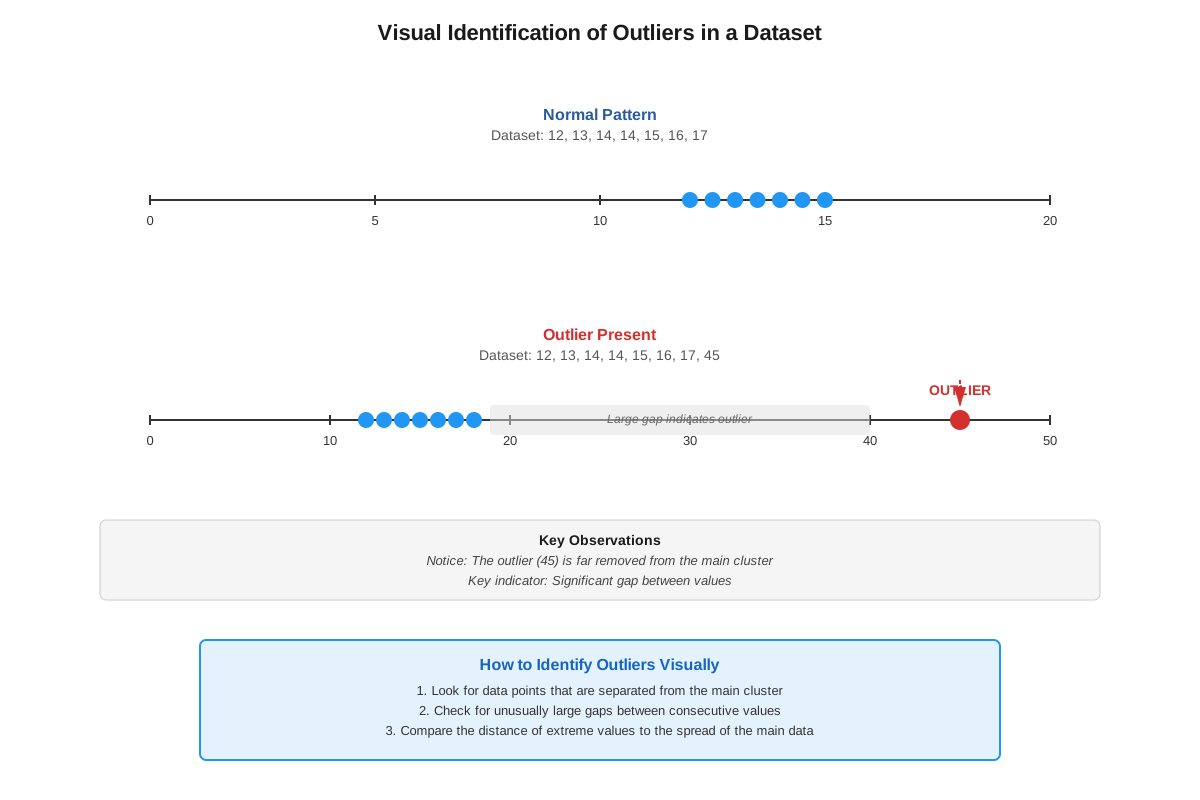
An outlier is a data value that is significantly different from other observations in a dataset. While there's no single universal definition, the ACT typically treats outliers as values that are noticeably separated from the main cluster of data points. For practical ACT purposes, a value is generally considered an outlier if it is much larger or much smaller than the other values in the dataset—often by a substantial margin that makes it stand out immediately upon inspection.
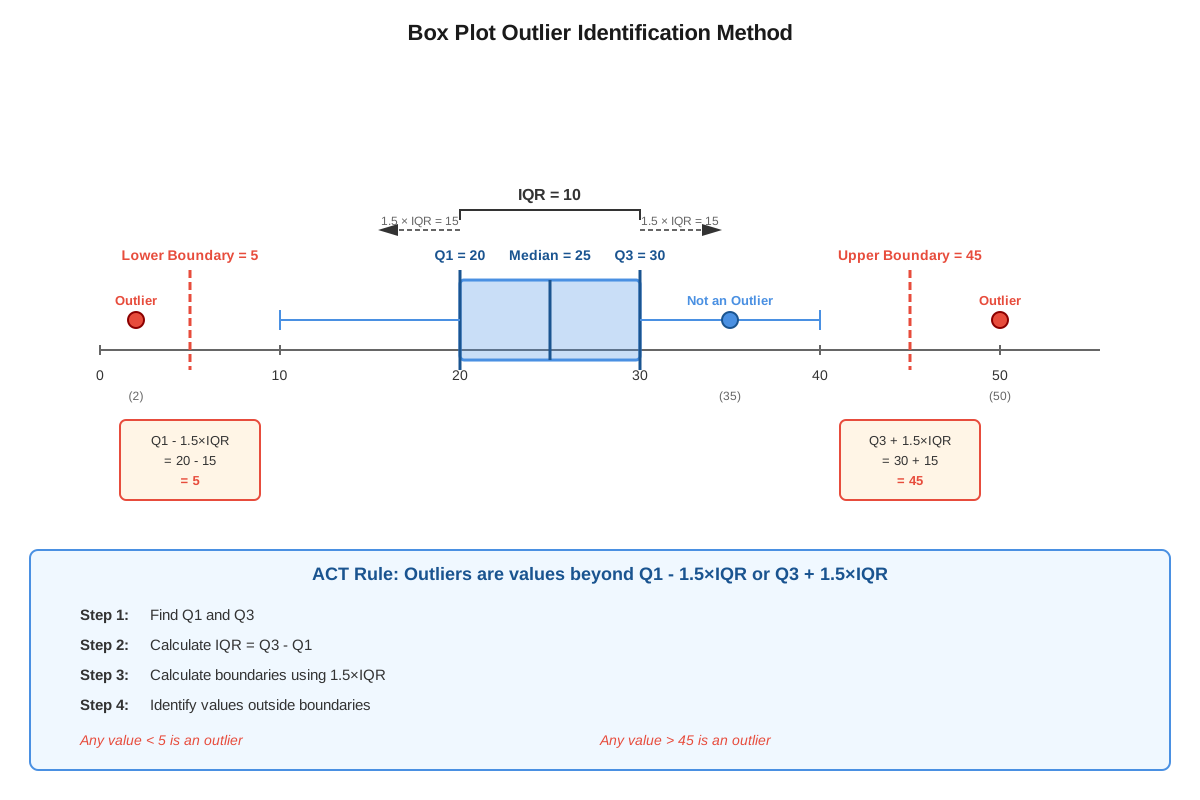
The formal statistical definition uses the Interquartile Range (IQR) method: a value is an outlier if it falls below Q1 - 1.5(IQR) or above Q3 + 1.5(IQR), where Q1 is the first quartile, Q3 is the third quartile, and IQR = Q3 - Q1. However, the ACT rarely requires this formal calculation. Instead, questions typically present obvious outliers that students can identify through visual inspection or basic numerical comparison.
Impact on Mean
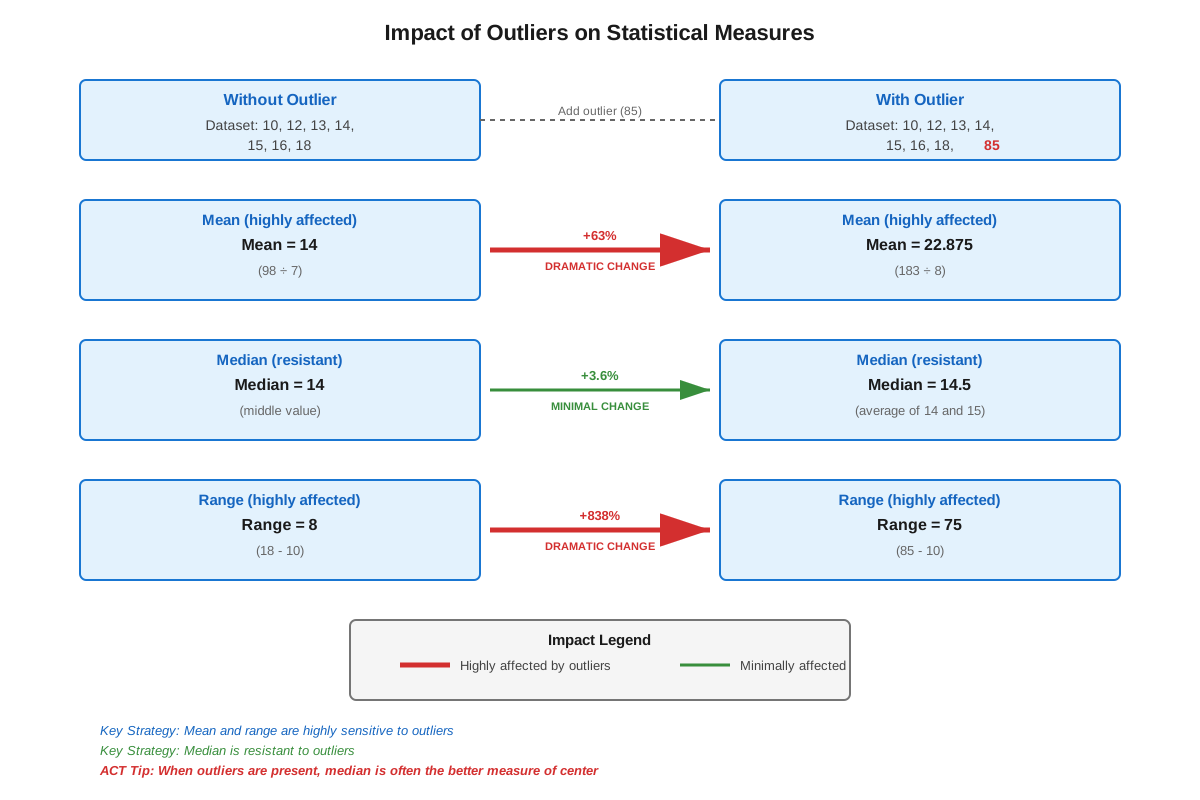
The mean (arithmetic average) is highly sensitive to outliers because every value in the dataset contributes equally to the calculation. When an outlier is present, it pulls the mean toward itself, away from the center of the main data cluster. A single extremely large value increases the mean significantly, while a single extremely small value decreases it substantially.
For example, consider the dataset: 10, 12, 13, 14, 15. The mean is 12.8. If we add an outlier of 50, the new dataset becomes: 10, 12, 13, 14, 15, 50, and the mean jumps to 19—a dramatic increase caused by one extreme value. This sensitivity makes the mean a poor representative measure when outliers are present, as it no longer reflects the typical value in the dataset.
Impact on Median
The median is the middle value when data is arranged in order, and it is resistant (or robust) to outliers. This means outliers have minimal or no effect on the median because the median only depends on the position of values, not their magnitude. Whether the largest value is 20 or 2000, if it occupies the same position in the ordered list, the median remains unchanged.
Using the previous example: 10, 12, 13, 14, 15 has a median of 13. Adding the outlier 50 creates: 10, 12, 13, 14, 15, 50, which has a median of 13.5 (the average of 13 and 14). The median changed only slightly due to the shift in position, not because of the extreme magnitude of 50. This resistance to outliers makes the median the preferred measure of central tendency when extreme values are present.
Impact on Mode
The mode (most frequently occurring value) is completely unaffected by outliers unless the outlier itself appears multiple times and becomes the most frequent value. Since outliers are typically unique extreme values, they rarely impact the mode. In datasets without repeated values, there may be no mode at all, making this measure less relevant for outlier analysis on the ACT.
Impact on Range
The range (maximum value minus minimum value) is extremely sensitive to outliers because it depends entirely on the two most extreme values in the dataset. A single outlier that is either much larger or much smaller than other values will dramatically increase the range, making it a poor measure of spread when outliers are present.
For the dataset 10, 12, 13, 14, 15, the range is 15 - 10 = 5. Adding the outlier 50 changes the range to 50 - 10 = 40, an eightfold increase caused by one value. This demonstrates why range is not a robust measure of variability.
Visual Identification of Outliers
On the ACT, outliers frequently appear in visual representations:
Box plots: Outliers are shown as individual dots or points beyond the whiskers (the lines extending from the box). The whiskers typically extend to the minimum and maximum values within 1.5 IQR of the quartiles, and any points beyond these whiskers are outliers.
Scatter plots: Outliers appear as points that are far removed from the general pattern or trend of the data. They don't follow the linear or curved relationship that most other points exhibit.
Histograms: Outliers appear as isolated bars separated by gaps from the main distribution of data.
Statistical Measure Comparison Table
| Statistical Measure | Sensitivity to Outliers | Effect of Outliers | Best Use Case |
|---|---|---|---|
| Mean | High | Pulled toward outlier | Symmetric data without outliers |
| Median | Low (resistant) | Minimal change | Data with outliers or skewed distributions |
| Mode | None (usually) | No effect unless outlier repeats | Categorical data or finding most common value |
| Range | Very High | Dramatically increased | Quick spread estimate in clean data |
| Standard Deviation | High | Increased substantially | Measuring variability in symmetric data |
Concept Relationships
The concept of outliers serves as a central hub connecting multiple statistical ideas. Outliers → directly affect → measures of central tendency (mean, median, mode), with the mean being most sensitive and the median being most resistant. This relationship is fundamental to understanding which measure best represents a dataset.
Outliers → influence → measures of spread (range, standard deviation, IQR), where range and standard deviation are highly sensitive while IQR remains relatively stable. This connection helps students understand data variability and dispersion.
Visual data representation → reveals → outliers, as box plots, scatter plots, and histograms make extreme values immediately apparent. This visual-to-conceptual connection is frequently tested on the ACT.
Data distribution shape → determines → outlier impact, where symmetric distributions are more affected by outliers than already-skewed distributions. Understanding this relationship helps students predict how outliers will influence statistical measures.
The prerequisite concepts of mean, median, and range form the foundation upon which outlier understanding is built. Without solid knowledge of these basic measures, students cannot fully grasp how outliers distort statistical analysis. This topic also connects forward to more advanced concepts like standard deviation, correlation, and regression analysis, where outliers can significantly affect results and interpretations.
High-Yield Facts
⭐ The mean is highly sensitive to outliers and gets pulled toward extreme values, while the median is resistant to outliers and remains relatively stable.
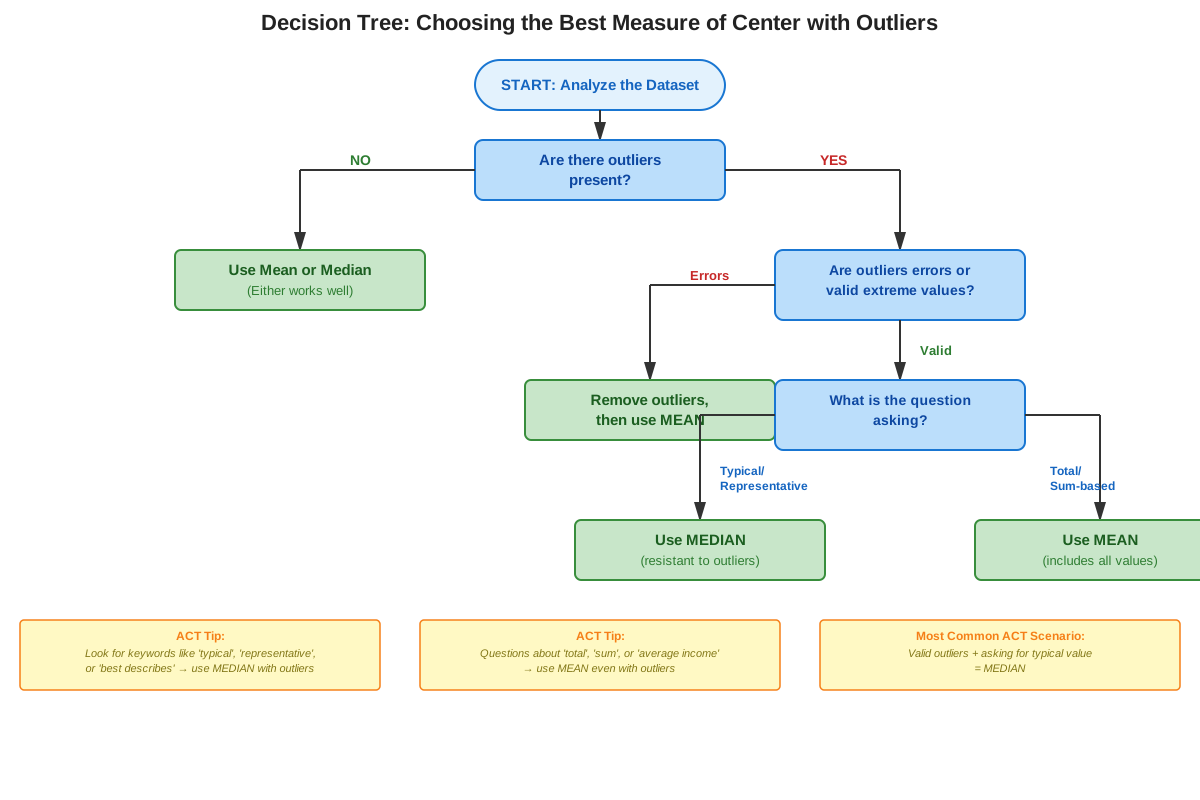
⭐ When a dataset contains outliers, the median is typically a better measure of central tendency than the mean.
⭐ An outlier is a data value that is significantly separated from the main cluster of data points.
⭐ Adding a large outlier to a dataset increases the mean but has minimal effect on the median.
⭐ The range is extremely sensitive to outliers because it depends only on the maximum and minimum values.
- Removing an outlier from a dataset will move the mean closer to the median if they were previously different.
- In a box plot, outliers appear as individual points beyond the whiskers.
- Multiple outliers can exist in a single dataset (both high and low extremes).
- The mode is generally unaffected by outliers unless the outlier value appears multiple times.
- Standard deviation increases substantially when outliers are present because it measures how far values deviate from the mean.
- When comparing two datasets, the one with outliers will typically have a larger range and standard deviation.
- Outliers can be legitimate data points (not errors) that represent unusual but real occurrences.
- In scatter plots, outliers don't follow the general trend or pattern of the other data points.
- The IQR (interquartile range) is resistant to outliers because it only considers the middle 50% of data.
- ACT questions often ask students to calculate a statistic both with and without an outlier to test understanding of impact.
Quick check — test yourself on Outliers so far.
Try Flashcards →Common Misconceptions
Misconception: All extreme values are outliers that should be removed from analysis.
Correction: Outliers are not necessarily errors or invalid data points. They can represent legitimate unusual occurrences that provide important information. The ACT tests understanding of outlier effects, not whether to remove them.
Misconception: Outliers affect all statistical measures equally.
Correction: Different measures have vastly different sensitivities to outliers. The mean and range are highly affected, while the median and IQR are resistant. Understanding these differential effects is crucial for ACT success.
Misconception: The median never changes when an outlier is added.
Correction: While the median is resistant to outliers, it can change slightly when an outlier is added, especially in small datasets where the middle position shifts. However, the change is minimal compared to the mean's change.
Misconception: A value must be calculated using the 1.5 IQR rule to be considered an outlier on the ACT.
Correction: The ACT typically presents obvious outliers that can be identified through visual inspection or basic comparison. Formal calculations are rarely required; instead, students need to recognize values that clearly don't fit the pattern.
Misconception: Outliers only occur at the high end of a dataset.
Correction: Outliers can be either unusually high or unusually low values. A dataset can have outliers on both ends simultaneously, and low outliers affect statistics just as significantly as high outliers.
Misconception: If the mean and median are equal, there are no outliers.
Correction: While outliers often cause the mean and median to differ, equal mean and median values don't guarantee the absence of outliers. Symmetric outliers on both ends could balance each other's effects on the mean.
Misconception: The mode is the best measure when outliers are present.
Correction: The median, not the mode, is typically the best measure of central tendency when outliers exist. The mode may not even exist in many datasets and doesn't provide information about the center of the data distribution.
Worked Examples
Example 1: Calculating Impact on Mean and Median
Problem: A teacher records test scores for six students: 78, 82, 85, 87, 89, and 45. The score of 45 is an outlier because one student was absent for most of the unit. Calculate the mean and median both with and without the outlier, and explain which measure better represents the typical student performance.
Solution:
With the outlier (all six scores):
- Ordered data: 45, 78, 82, 85, 87, 89
- Mean = (45 + 78 + 82 + 85 + 87 + 89) ÷ 6 = 466 ÷ 6 = 77.67
- Median = (82 + 85) ÷ 2 = 83.5 (average of the two middle values)
Without the outlier (removing 45):
- Ordered data: 78, 82, 85, 87, 89
- Mean = (78 + 82 + 85 + 87 + 89) ÷ 5 = 421 ÷ 5 = 84.2
- Median = 85 (the middle value)
Analysis:
The outlier of 45 pulled the mean down from 84.2 to 77.67—a decrease of 6.53 points. However, the median only decreased from 85 to 83.5—a change of just 1.5 points. The median of 83.5 (with outlier) or 85 (without outlier) better represents typical student performance because most students scored in the low-to-mid 80s. The mean of 77.67 is misleading because it suggests average performance was much lower than what most students actually achieved.
Connection to Learning Objectives: This example demonstrates how to identify an outlier (45 is clearly separated from the cluster of 78-89), calculate the differential impact on mean versus median, and determine which measure is more appropriate for representing the data.
Example 2: Interpreting a Box Plot with Outliers
Problem: A box plot shows the distribution of home prices in a neighborhood. The box extends from $180,000 (Q1) to $240,000 (Q3), with a median line at $210,000. The left whisker extends to $150,000, and the right whisker extends to $280,000. There are two individual points plotted: one at $95,000 and one at $450,000. A real estate agent claims the average home price is $235,000. Explain why this average might be misleading and what measure would better represent typical home prices.
Solution:
Identifying the outliers: The two individual points at $95,000 and $450,000 are outliers because they appear beyond the whiskers of the box plot. These represent homes that are significantly cheaper or more expensive than the main cluster of homes.
Understanding the mean vs. median: The agent's reported average of $235,000 is the mean, which has been pulled upward by the high outlier at $450,000. The median shown in the box plot is $210,000, which is $25,000 less than the reported average.
Analysis: The mean of $235,000 is misleading because it's influenced by the extremely expensive home at $450,000. Most homes in the neighborhood (50% of them) fall between $180,000 and $240,000, with the middle value at $210,000. A buyer using the mean would expect to pay $235,000 for a typical home, but the median of $210,000 more accurately represents what most homes actually cost. The median is resistant to the outliers and therefore provides a better representation of typical home prices in this neighborhood.
Connection to Learning Objectives: This example shows how to identify outliers in a box plot (points beyond whiskers), understand why the mean can be misleading when outliers are present, and recognize that the median better represents central tendency in skewed data with extreme values.
Exam Strategy
When approaching ACT outliers questions, begin by quickly scanning the dataset or graph to identify any values that appear dramatically different from the others. Look for numbers that are much larger or smaller than the cluster of data points—these will typically be obvious rather than requiring complex calculations.
Trigger words and phrases that signal outlier questions include:
- "Which value is an outlier?"
- "How does removing [specific value] affect the mean?"
- "Which measure best represents the typical..."
- "The mean is much higher/lower than the median because..."
- "Which point in the scatter plot doesn't fit the pattern?"
- "The box plot shows individual points beyond the whiskers..."
When you encounter these triggers, immediately think about the differential effects on mean versus median. The ACT loves to test whether students understand that outliers pull the mean but barely affect the median.
Process-of-elimination strategy: If a question asks which statistical measure is most affected by an outlier, immediately eliminate median and mode as they are resistant. Focus on mean, range, and standard deviation as the sensitive measures. If asked which measure best represents data with outliers, eliminate mean and range, focusing on median as the correct answer.
For calculation questions, work systematically: calculate the requested statistic with all values, then recalculate without the outlier, and compare the results. Show your work clearly to avoid arithmetic errors. Remember that the mean will change substantially while the median changes minimally.
Time allocation: Most outlier questions can be solved in 45-60 seconds. Don't spend time on formal IQR calculations unless explicitly required. Visual identification and basic arithmetic are usually sufficient. If a question seems to require complex calculations, reconsider whether there's a simpler conceptual approach.
When interpreting graphs, pay special attention to box plots with individual points beyond whiskers and scatter plots with points far from the trend line. These visual representations make outliers immediately apparent and often lead to quick answers.
Memory Techniques
MNEMONIC for measure sensitivity: "MR. MEAN is SENSITIVE, but MS. MEDIAN is RESISTANT"
- This helps remember that the mean is highly affected by outliers while the median resists their influence.
Visualization strategy: Picture a tug-of-war where the mean is a person being pulled toward the outlier, while the median is a person standing firm in the middle, barely budging. This mental image reinforces the differential sensitivity.
Acronym for resistant measures: "MIQ" (Median, IQR, Quartiles)
- These three measures are resistant to outliers and remain relatively stable when extreme values are present.
The "One Bad Apple" analogy: Think of an outlier as one bad apple in a basket. It ruins the average quality (mean) of all the apples, but the middle apple (median) is still perfectly fine. This real-world analogy makes the concept memorable and intuitive.
Box Plot Memory Aid: "Dots Beyond = Outliers"
- In box plots, any individual dots or points beyond the whiskers are outliers. This simple phrase helps with quick visual identification.
Directional Effect: "Outlier Pulls Mean Toward Itself"
- A high outlier increases the mean; a low outlier decreases it. The outlier always pulls the mean in its direction, like a magnet.
Summary
Outliers are data values that differ significantly from other observations in a dataset, standing apart from the main cluster of data points. Understanding outliers is crucial for ACT Math success because they dramatically affect some statistical measures while barely influencing others. The mean is highly sensitive to outliers and gets pulled toward extreme values, making it a poor representative measure when outliers are present. In contrast, the median is resistant to outliers and remains relatively stable, making it the preferred measure of central tendency for datasets containing extreme values. The range is also highly sensitive to outliers, while the mode is generally unaffected. On the ACT, outliers appear frequently in both numerical datasets and visual representations like box plots and scatter plots, where they are shown as points separated from the main data distribution. Success on outlier questions requires the ability to identify extreme values quickly, calculate their differential effects on various statistical measures, and determine which measure best represents typical values in the dataset. The key insight is recognizing that not all statistical measures respond equally to outliers—understanding these differential sensitivities is essential for accurate data interpretation and ACT success.
Key Takeaways
- Outliers are data values significantly separated from the main cluster of observations in a dataset
- The mean is highly sensitive to outliers and gets pulled toward extreme values, while the median is resistant and remains relatively stable
- When outliers are present, the median typically provides a better representation of central tendency than the mean
- In box plots, outliers appear as individual points beyond the whiskers; in scatter plots, they appear far from the general trend
- The range is extremely sensitive to outliers because it depends only on the maximum and minimum values
- ACT outlier questions frequently test understanding of differential effects on mean versus median
- Outliers can be legitimate data points representing unusual but real occurrences, not necessarily errors to be removed
Related Topics
Standard Deviation: Understanding how outliers affect standard deviation builds on outlier concepts, as extreme values increase variability measures substantially. Mastering outliers provides the foundation for understanding why standard deviation is sensitive to extreme values.
Interquartile Range (IQR): The IQR is a resistant measure of spread that, like the median, is not affected by outliers. Understanding outliers helps explain why IQR is preferred over range when extreme values are present.
Data Distribution and Skewness: Outliers often create skewed distributions where the mean and median differ. Mastering outliers enables deeper understanding of distribution shapes and their characteristics.
Correlation and Regression: In scatter plots, outliers can significantly affect correlation coefficients and regression lines. Understanding outlier identification prepares students for more advanced statistical analysis.
Box Plot Interpretation: Advanced box plot questions require understanding how outliers are identified using the 1.5 IQR rule and how they're visually represented, building directly on basic outlier concepts.
Practice CTA
Now that you've mastered the core concepts of outliers and their effects on statistical measures, it's time to put your knowledge into action! Work through the practice questions to reinforce your understanding of identifying outliers, calculating their impact on mean and median, and determining which measures best represent datasets with extreme values. Use the flashcards to drill the key facts about measure sensitivity and resistance. Remember, outliers appear frequently on the ACT Math test—mastering this high-yield topic will directly boost your score. You've built a strong foundation; now solidify it through focused practice!
Sign up free to keep reading
Create a free AnvayaPrep account to finish this ACT guide on Outliers — plus flashcards and practice questions.