Overview
Probability basics form a critical component of the ACT Math test, appearing in approximately 10-15% of all questions in the Statistics and Probability content area. Understanding probability is essential not only for direct probability questions but also for interpreting data, analyzing outcomes, and making logical predictions based on given information. The ACT tests probability through straightforward computational problems, word problems involving real-world scenarios, and questions requiring students to analyze multiple events or conditions.
Mastering ACT probability basics provides students with a systematic approach to quantifying uncertainty and likelihood. These concepts build upon fundamental arithmetic and fraction skills while connecting to broader mathematical reasoning abilities. On the ACT, probability questions typically involve calculating the likelihood of single events, understanding complementary events, working with compound probability, and interpreting probability in context. Students who develop strong probability intuition can quickly identify the total number of possible outcomes, count favorable outcomes accurately, and express their answers in the required format (fraction, decimal, or percent).
The relationship between probability and other ACT Math concepts is substantial. Probability questions often incorporate ratios, fractions, percentages, and basic counting principles. Additionally, probability connects to data interpretation, as students must frequently extract information from tables, charts, or written descriptions before performing calculations. Strong foundational skills in these prerequisite areas enable students to focus on the probability-specific reasoning required to solve problems efficiently within the time constraints of the ACT.
Learning Objectives
- [ ] Identify when Probability basics is being tested
- [ ] Explain the core rule or strategy behind Probability basics
- [ ] Apply Probability basics to ACT-style questions accurately
- [ ] Calculate probabilities for single events using the fundamental probability formula
- [ ] Determine complementary probabilities and use them to solve problems efficiently
- [ ] Distinguish between independent and dependent events in probability scenarios
- [ ] Convert between different probability representations (fractions, decimals, percentages)
Prerequisites
- Fractions and simplification: Probability is most commonly expressed as a fraction, requiring students to reduce fractions to lowest terms and perform fraction operations
- Basic arithmetic operations: Calculating probabilities involves multiplication, division, addition, and subtraction with whole numbers, fractions, and decimals
- Ratios and proportions: Understanding the relationship between parts and wholes is fundamental to interpreting probability as a ratio of favorable to total outcomes
- Percentages: Many ACT questions require converting probability values to percentages or interpreting percentage-based probability statements
- Basic counting principles: Determining total possible outcomes and favorable outcomes requires systematic counting strategies
Why This Topic Matters
Probability has extensive real-world applications that extend far beyond the classroom. Weather forecasting, medical diagnosis, financial risk assessment, sports analytics, insurance calculations, and quality control in manufacturing all rely on probability principles. Understanding probability enables informed decision-making in everyday situations, from evaluating the likelihood of traffic delays to assessing the reliability of test results. This practical relevance makes probability a valuable life skill that transcends academic testing.
On the ACT Math test, probability questions appear with high frequency, typically comprising 2-4 questions per exam. These questions are distributed throughout the test rather than clustered together, appearing at various difficulty levels. The ACT favors straightforward probability calculations over complex theoretical scenarios, focusing on practical applications that students can solve using fundamental principles. Common question formats include selecting items from groups (drawing cards, choosing marbles, picking students), analyzing game outcomes (dice rolls, coin flips, spinners), and interpreting probability in real-world contexts (weather predictions, survey results, quality control scenarios).
The ACT tests probability through multiple question types: direct calculation problems that ask for the probability of a specific outcome, complementary probability questions that require finding the probability that an event does NOT occur, compound probability scenarios involving multiple events, and conditional probability situations where one event affects another. Questions may present information through text descriptions, tables, diagrams, or combinations of these formats. Students must extract relevant information, identify the appropriate probability strategy, perform accurate calculations, and express answers in the requested format—all within approximately one minute per question.
Core Concepts
The Fundamental Probability Formula
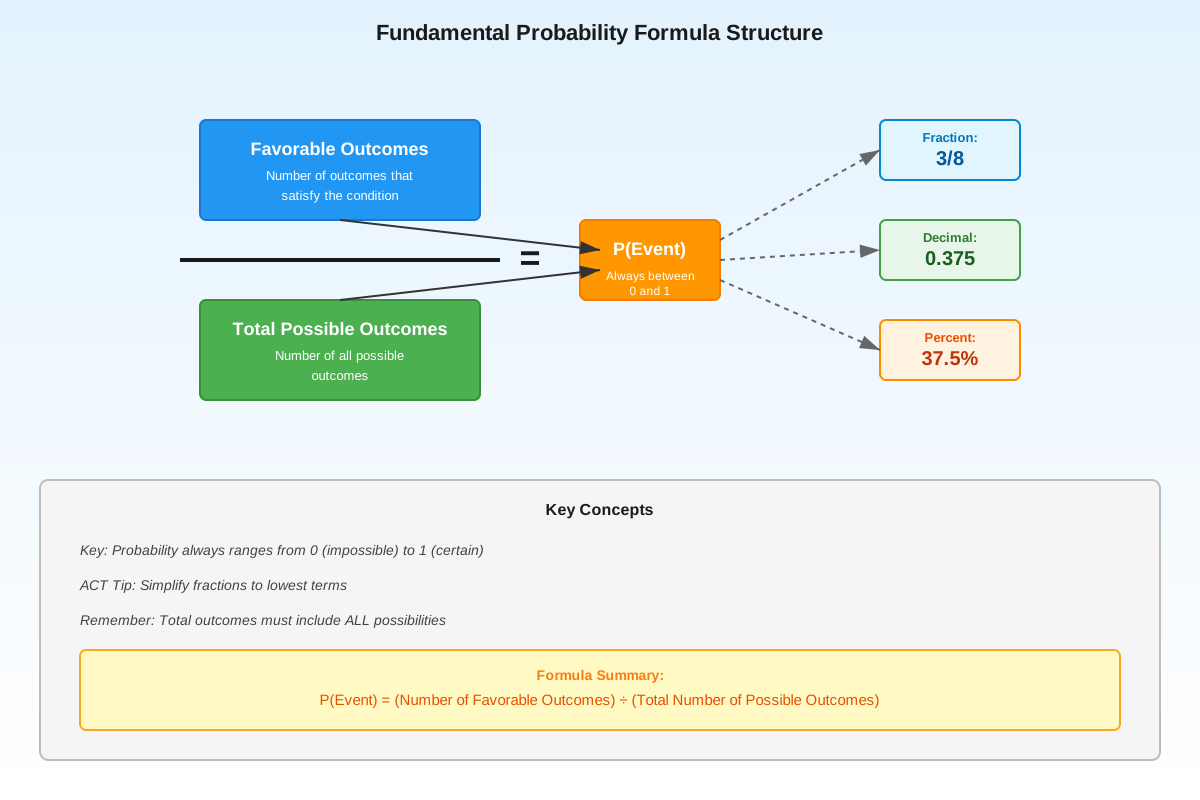
The foundation of all probability basics rests on a single, powerful formula:
P(event) = Number of favorable outcomes / Total number of possible outcomesThis formula expresses probability as a ratio between 0 and 1 (or 0% and 100%), where 0 represents impossibility and 1 represents certainty. A probability of 0.5 (or 1/2, or 50%) indicates that an event is equally likely to occur or not occur.
To apply this formula successfully, students must accurately identify two critical values:
- Total number of possible outcomes: All outcomes that could potentially occur in the given scenario, regardless of whether they satisfy the condition in question
- Number of favorable outcomes: The specific outcomes that satisfy the condition or event being measured
For example, when rolling a standard six-sided die, the total number of possible outcomes is 6 (the numbers 1, 2, 3, 4, 5, and 6). If asked to find the probability of rolling an even number, the favorable outcomes are 2, 4, and 6—three outcomes. Therefore, P(even) = 3/6 = 1/2.
Sample Spaces and Outcomes
A sample space represents the complete set of all possible outcomes for a probability experiment. Clearly defining the sample space is essential for accurate probability calculations. Sample spaces can be listed explicitly, represented in tables, or described systematically.
For simple experiments:
- Flipping one coin: {Heads, Tails} — 2 outcomes
- Rolling one die: {1, 2, 3, 4, 5, 6} — 6 outcomes
- Drawing one card from a standard deck: 52 distinct outcomes
For compound experiments involving multiple actions:
- Flipping two coins: {HH, HT, TH, TT} — 4 outcomes
- Rolling two dice: 36 total outcomes (6 × 6)
- Drawing two cards without replacement: 52 × 51 = 2,652 ordered outcomes
The ACT frequently tests whether students can correctly determine the size of a sample space, particularly when multiple events occur in sequence.
Complementary Events
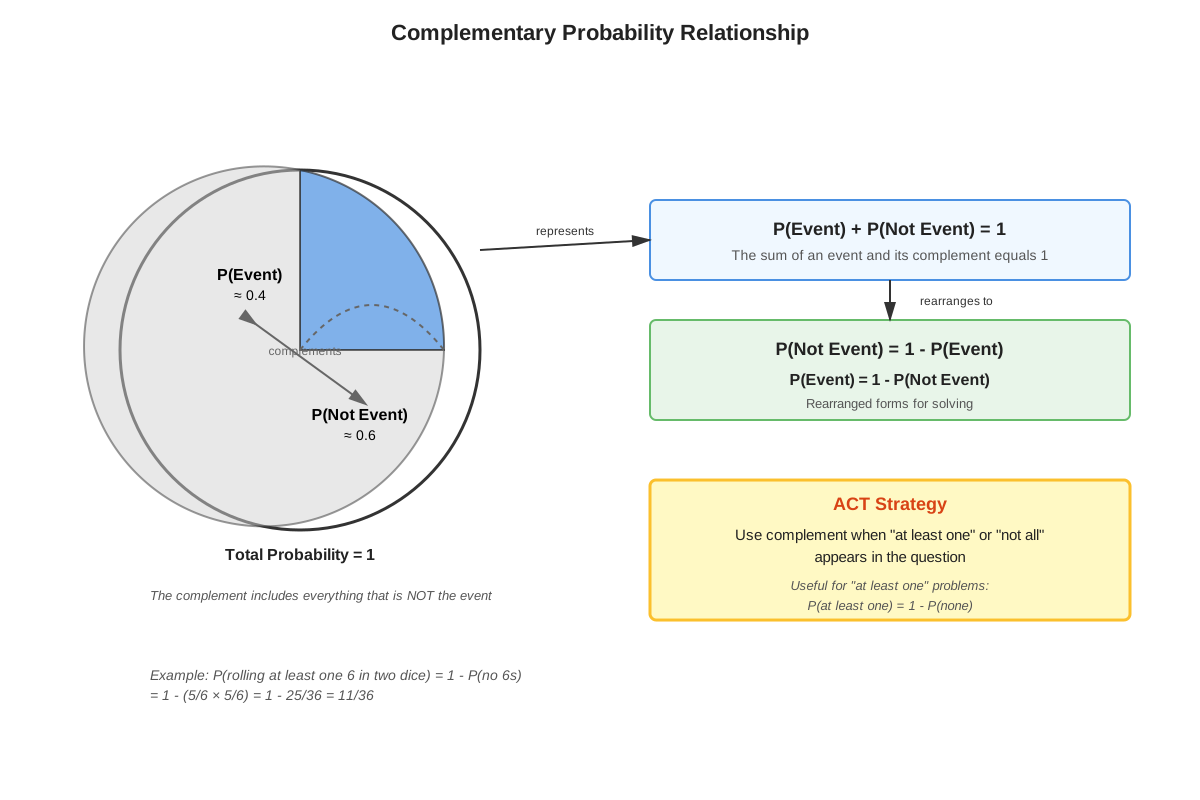
Complementary events are pairs of outcomes where one event represents "success" and the other represents "failure"—together, they encompass all possible outcomes. The probability of an event and its complement always sum to 1:
P(event) + P(not event) = 1This relationship provides a powerful problem-solving strategy:
P(event) = 1 - P(not event)Complementary probability is especially useful when calculating the probability that an event does NOT occur is simpler than calculating the probability that it DOES occur. For example, finding the probability of getting at least one heads in three coin flips is easier by calculating the complement: P(at least one heads) = 1 - P(no heads) = 1 - P(all tails) = 1 - (1/8) = 7/8.
Independent Events and Compound Probability
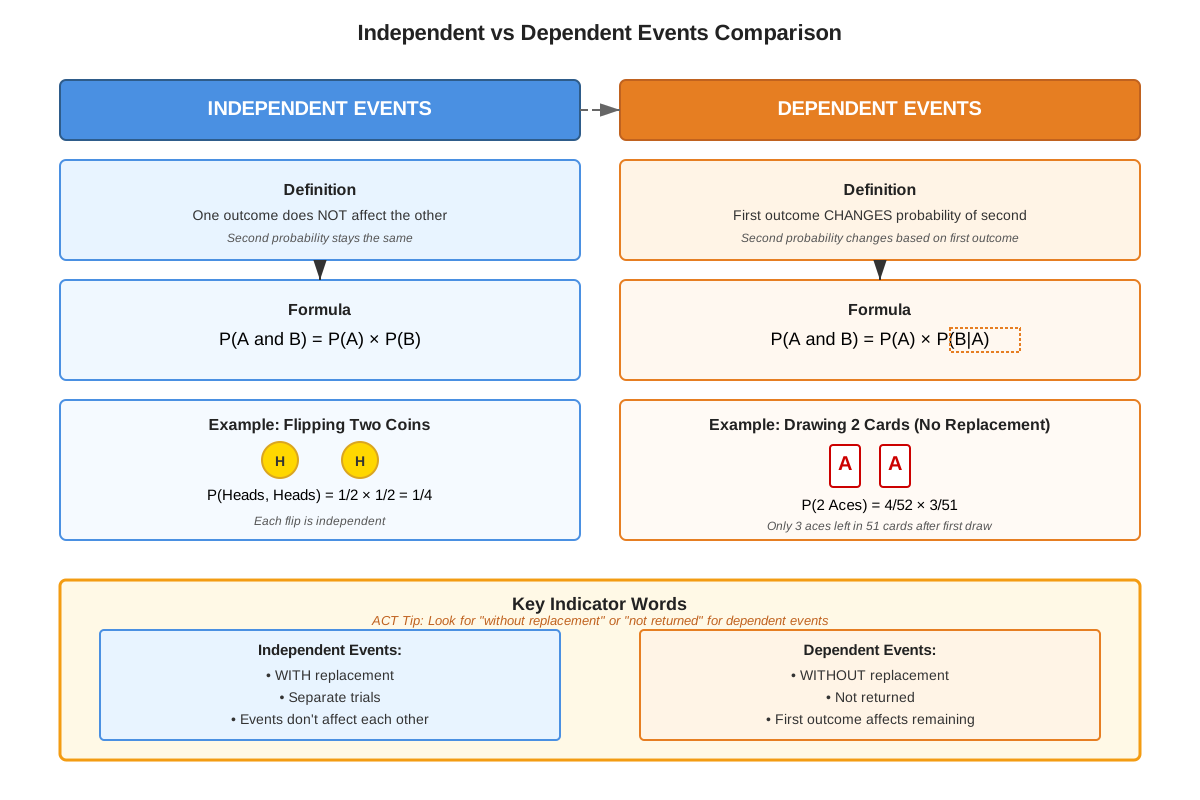
Independent events are events where the outcome of one does not affect the probability of the other. When two events A and B are independent, the probability that both occur is found by multiplication:
P(A and B) = P(A) × P(B)This multiplication rule extends to any number of independent events. For example, the probability of flipping heads three times in a row is:
P(HHH) = P(H) × P(H) × P(H) = (1/2) × (1/2) × (1/2) = 1/8
Common independent events on the ACT include:
- Multiple coin flips
- Multiple die rolls
- Spinning a spinner multiple times
- Drawing cards with replacement (returning the card before drawing again)
Dependent Events
Dependent events occur when the outcome of one event affects the probability of subsequent events. The most common ACT scenario involves selection without replacement—choosing items from a group where selected items are not returned.
For dependent events, probabilities must be recalculated after each selection:
When drawing two cards from a standard deck without replacement:
- P(first card is an Ace) = 4/52
- P(second card is an Ace | first was an Ace) = 3/51
The probability of both events occurring:
P(both Aces) = (4/52) × (3/51) = 12/2,652 = 1/221
Notice that after drawing one Ace, only 3 Aces remain among the 51 remaining cards, changing the probability for the second draw.
Probability Representations
The ACT requires students to work flexibly with different probability formats:
| Format | Example | When Used |
|---|---|---|
| Fraction | 3/4 | Most common form; often required in final answers |
| Decimal | 0.75 | Useful for calculations; sometimes required |
| Percentage | 75% | Common in word problems and real-world contexts |
| Ratio | 3:1 | Occasionally used to describe odds |
Converting between formats is essential:
- Fraction to decimal: divide numerator by denominator (3/4 = 0.75)
- Decimal to percentage: multiply by 100 (0.75 = 75%)
- Percentage to fraction: write over 100 and simplify (75% = 75/100 = 3/4)
Mutually Exclusive Events
Mutually exclusive events cannot occur simultaneously—if one happens, the other cannot. For mutually exclusive events A and B, the probability that either A or B occurs is:
P(A or B) = P(A) + P(B)For example, when rolling a die, the events "rolling a 2" and "rolling a 5" are mutually exclusive. The probability of rolling either a 2 or a 5 is:
P(2 or 5) = P(2) + P(5) = 1/6 + 1/6 = 2/6 = 1/3
This addition rule applies only when events cannot occur together. Rolling an even number and rolling a number greater than 3 are NOT mutually exclusive (both occur when rolling 4 or 6), so the simple addition rule does not apply.
Concept Relationships
The concepts within probability basics form a hierarchical structure built upon the fundamental probability formula. This formula serves as the foundation → from which all other probability concepts derive. Understanding how to identify favorable and total outcomes → enables calculation of single-event probabilities → which then extends to complementary probability through the relationship P(event) + P(complement) = 1.
The distinction between independent and dependent events → determines which multiplication approach to use for compound probability. Independent events → use straightforward multiplication of individual probabilities, while dependent events → require adjusting probabilities after each outcome. Both types → rely on the fundamental formula but apply it in sequence.
Mutually exclusive events → connect to the addition principle, allowing probabilities to be summed when calculating "or" scenarios. This concept → contrasts with compound probability (which uses multiplication for "and" scenarios) → creating a clear decision framework: use addition for "or" with mutually exclusive events, use multiplication for "and" with independent or dependent events.
Probability representations → serve as the communication layer across all concepts, requiring students to translate between fractions, decimals, and percentages while maintaining mathematical accuracy. This skill → integrates with prerequisite knowledge of fractions and percentages → and applies throughout all probability calculations.
The sample space concept → underlies every probability calculation by defining the denominator (total outcomes) in the fundamental formula. Clearly identifying the sample space → prevents counting errors → and ensures accurate probability values. This concept → connects directly to counting principles and systematic enumeration strategies.
Quick check — test yourself on Probability basics so far.
Try Flashcards →High-Yield Facts
⭐ The fundamental probability formula is P(event) = favorable outcomes / total outcomes, and all probabilities fall between 0 and 1 inclusive
⭐ Complementary probability: P(event) + P(not event) = 1, which can be rearranged to P(event) = 1 - P(not event)
⭐ For independent events, multiply probabilities: P(A and B) = P(A) × P(B)
⭐ For dependent events without replacement, adjust the denominator and numerator after each selection
⭐ For mutually exclusive events, add probabilities: P(A or B) = P(A) + P(B)
- A standard deck of cards contains 52 cards: 13 ranks × 4 suits, with 26 red cards and 26 black cards
- When rolling two standard dice, there are 36 total possible outcomes (6 × 6)
- Probability can be expressed as a fraction, decimal, or percentage—the ACT may require any format
- "At least one" problems are often solved most efficiently using complementary probability
- With replacement means the item is returned before the next selection, maintaining constant probabilities (independent events)
- Without replacement means the item is not returned, changing probabilities for subsequent selections (dependent events)
- The probability of an impossible event is 0; the probability of a certain event is 1
- When outcomes are equally likely, each individual outcome has probability 1/(total number of outcomes)
- The sum of all probabilities in a complete sample space equals 1
- Probability questions often require simplifying fractions to lowest terms for the final answer
Common Misconceptions
Misconception: Probability can be greater than 1 or less than 0 → Correction: Probability is always a value between 0 and 1 inclusive (or 0% to 100%). A probability greater than 1 indicates an error in calculation, typically from incorrectly identifying favorable outcomes as exceeding total outcomes.
Misconception: Independent events and mutually exclusive events are the same thing → Correction: These are fundamentally different concepts. Independent events can occur together (their occurrence doesn't affect each other's probability), while mutually exclusive events cannot occur simultaneously. For example, flipping heads on two different coins represents independent events (both can happen), but rolling a 2 and rolling a 5 on the same die are mutually exclusive (only one can occur).
Misconception: When drawing without replacement, the total number of outcomes stays the same → Correction: Without replacement, both the numerator (favorable outcomes) and denominator (total outcomes) typically decrease after each selection. If drawing two aces from a deck without replacement, the first draw has probability 4/52, but the second draw has probability 3/51 because one ace and one card total have been removed.
Misconception: "At least one" means exactly one → Correction: "At least one" means one or more—it includes scenarios with exactly one, exactly two, exactly three, etc. This phrase is best handled using complementary probability: P(at least one) = 1 - P(none).
Misconception: Adding probabilities works for all "or" scenarios → Correction: Simple addition P(A or B) = P(A) + P(B) only works when events are mutually exclusive. When events can occur together, the formula must account for overlap: P(A or B) = P(A) + P(B) - P(A and B). However, the ACT typically tests mutually exclusive scenarios or provides sufficient information to avoid this complexity.
Misconception: Probability predicts exactly what will happen → Correction: Probability describes likelihood over many trials, not certainty for individual events. A 1/6 probability of rolling a 4 doesn't mean a 4 will appear exactly once in six rolls—it describes the long-term average frequency.
Misconception: Past outcomes affect future probabilities for independent events → Correction: This is known as the "gambler's fallacy." For independent events like coin flips, previous outcomes do not influence future probabilities. After flipping five heads in a row, the probability of heads on the next flip remains 1/2.
Worked Examples
Example 1: Single Event Probability with Complementary Thinking
Problem: A bag contains 5 red marbles, 3 blue marbles, and 7 green marbles. If one marble is drawn at random, what is the probability that it is NOT green?
Solution:
Step 1: Identify the total number of outcomes.
Total marbles = 5 + 3 + 7 = 15 marbles
Step 2: Recognize this as a complementary probability problem.
The question asks for P(not green), which is the complement of P(green).
Step 3: Calculate P(green) first.
Number of green marbles = 7
P(green) = 7/15
Step 4: Use the complementary probability formula.
P(not green) = 1 - P(green)
P(not green) = 1 - 7/15
P(not green) = 15/15 - 7/15
P(not green) = 8/15
Alternative approach: Count favorable outcomes directly.
Not green means red or blue.
Number of red or blue marbles = 5 + 3 = 8
P(not green) = 8/15
Both methods yield the same answer: 8/15
Connection to learning objectives: This problem demonstrates identifying when probability is tested (random selection from a group), applying the fundamental formula, and using complementary probability as an efficient strategy.
Example 2: Compound Probability with Dependent Events
Problem: A committee of 12 people includes 7 women and 5 men. If two people are selected at random without replacement to serve as chair and vice-chair, what is the probability that both selected people are women?
Solution:
Step 1: Identify this as a dependent events problem.
"Without replacement" signals that the first selection affects the second selection.
Step 2: Calculate the probability for the first selection.
P(first person is a woman) = 7/12
(7 women out of 12 total people)
Step 3: Calculate the probability for the second selection, given the first was a woman.
After selecting one woman, 6 women remain among 11 total people.
P(second person is a woman | first was a woman) = 6/11
Step 4: Multiply the probabilities for dependent events.
P(both women) = P(first woman) × P(second woman | first woman)
P(both women) = (7/12) × (6/11)
P(both women) = 42/132
Step 5: Simplify the fraction.
42/132 = 21/66 = 7/22
Answer: 7/22
Key insight: Notice how the denominator decreased from 12 to 11 (one person removed) and the numerator decreased from 7 to 6 (one woman removed). This adjustment is essential for dependent events.
Connection to learning objectives: This problem requires distinguishing between independent and dependent events, applying the multiplication rule correctly with adjusted probabilities, and simplifying the final answer—all core ACT probability skills.
Exam Strategy
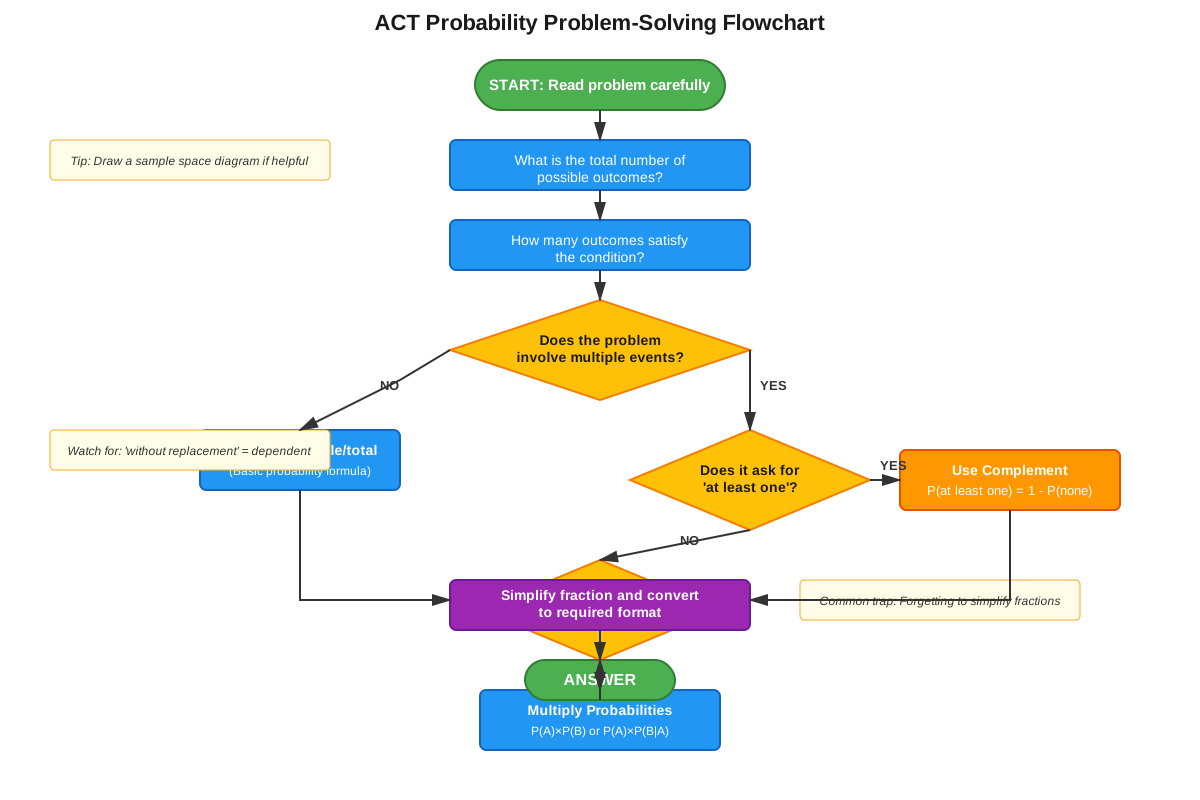
When approaching ACT probability questions, begin by carefully reading the problem to identify the scenario type. Look for trigger words that signal specific probability concepts:
- "At random" or "randomly selected" → indicates equal probability for all outcomes
- "Without replacement" → signals dependent events requiring adjusted probabilities
- "With replacement" → indicates independent events with constant probabilities
- "At least one" → suggests using complementary probability (1 - P(none))
- "Both," "all," or "and" → typically requires multiplication
- "Either," "or" → may require addition (if mutually exclusive)
Step-by-step approach for ACT probability questions:
- Identify the sample space: Determine the total number of possible outcomes
- Count favorable outcomes: Identify which outcomes satisfy the condition
- Choose the appropriate formula: Single event, complement, multiplication (and), or addition (or)
- Calculate carefully: Show work to avoid arithmetic errors
- Simplify and format: Reduce fractions and express in the requested format
Process of elimination strategies:
- Eliminate any answer choice greater than 1 or less than 0 (impossible probabilities)
- If the question asks for a probability close to certainty, eliminate small values near 0
- If the question asks for an unlikely event, eliminate values close to 1
- Check whether answer choices are in simplified form—the correct answer typically is
- For complementary probability, if you calculate P(event) = 3/7, look for P(not event) = 4/7 among choices
Time allocation: ACT probability questions typically require 45-75 seconds. Simple single-event probability problems should take 30-45 seconds, while compound probability or word problems may require 60-90 seconds. If a problem requires more than 90 seconds, consider marking it for review and moving forward to maintain pacing.
Common traps to avoid:
- Forgetting to adjust denominators and numerators for dependent events
- Confusing "and" (multiply) with "or" (add)
- Failing to simplify fractions in final answers
- Misreading "at least one" as "exactly one"
- Using addition for non-mutually exclusive events
Exam Tip: When you see a complex "at least one" scenario, immediately think complementary probability. Calculate the probability of the opposite (usually "none") and subtract from 1. This approach is almost always faster and less error-prone than calculating multiple scenarios separately.
Memory Techniques
AND means MULTIPLY, OR means ADD
- When events must occur together (AND), multiply their probabilities
- When either event can occur (OR, mutually exclusive), add their probabilities
- Mnemonic: "AND demands both, so multiply; OR offers choices, so add"
COMPLEMENT = 1 - EVENT
- Visualize a complete circle (probability = 1) divided into two pieces: the event and its complement
- The two pieces always sum to the whole circle (1)
- Acronym: C.O.N.E. = Complement Opposite Not Event
Dependent Events: REDUCE BOTH
- Without replacement → Reduce Both numerator and denominator
- Mnemonic: "When you take one out, both numbers go down"
Probability Range: ZERO to ONE
- Impossible = 0, Certain = 1, Everything else between
- Visual: Number line from 0 to 1, with 0.5 at the midpoint (equally likely)
Standard Deck Memory: 52-4-13
- 52 total cards
- 4 suits (hearts, diamonds, clubs, spades)
- 13 ranks per suit (A, 2-10, J, Q, K)
- Half red (26), half black (26)
Favorable over Total: F/T
- Favorable outcomes on top
- Total outcomes on bottom
- Think "Fraction Tells probability"
Summary
Probability basics represent a high-yield ACT Math topic that tests students' ability to quantify likelihood using systematic reasoning. The fundamental probability formula—favorable outcomes divided by total outcomes—serves as the foundation for all probability calculations, producing values between 0 and 1. Mastery requires distinguishing between independent events (where outcomes don't affect each other, requiring multiplication of probabilities) and dependent events (where outcomes affect subsequent probabilities, requiring adjusted calculations). Complementary probability provides an efficient problem-solving strategy by recognizing that P(event) + P(not event) = 1, particularly useful for "at least one" scenarios. Students must accurately identify sample spaces, count outcomes systematically, and work flexibly with fractions, decimals, and percentages. The ACT emphasizes practical applications through word problems involving random selection, games of chance, and real-world scenarios, testing whether students can extract relevant information and apply appropriate probability principles within strict time constraints.
Key Takeaways
- The fundamental probability formula P(event) = favorable/total applies to all single-event probability calculations and produces values between 0 and 1
- Complementary probability (P(event) = 1 - P(not event)) is essential for efficiently solving "at least one" problems
- Independent events require multiplying probabilities (P(A and B) = P(A) × P(B)), while dependent events require adjusting both numerator and denominator after each selection
- Trigger words like "without replacement," "at random," and "at least one" signal specific probability strategies that must be recognized quickly
- Mutually exclusive events (cannot occur simultaneously) use addition for "or" scenarios: P(A or B) = P(A) + P(B)
- Accurate counting of sample spaces and favorable outcomes is fundamental—systematic enumeration prevents errors
- ACT probability questions require flexibility in converting between fractions, decimals, and percentages, with final answers typically expressed as simplified fractions
Related Topics
Counting Principles and Permutations: Building on probability basics, counting principles provide systematic methods for determining the size of sample spaces when outcomes involve arrangements or selections. The fundamental counting principle, permutations, and combinations extend probability calculations to more complex scenarios.
Conditional Probability: This advanced topic explores how the probability of an event changes given that another event has occurred, formalizing the dependent events concept through P(A|B) notation and Bayes' theorem applications.
Expected Value: Expected value combines probability with outcomes to calculate long-term average results, connecting probability to decision-making and risk assessment in real-world contexts.
Data Analysis and Statistics: Probability concepts integrate with statistical reasoning when interpreting data distributions, understanding sampling, and making inferences from data sets—all tested on the ACT Math section.
Geometric Probability: This extension applies probability principles to continuous scenarios involving areas, lengths, and regions rather than discrete countable outcomes.
Practice CTA
Now that you've mastered the core concepts of probability basics, it's time to solidify your understanding through active practice. Attempt the practice questions designed specifically for this topic, focusing on applying the strategies and formulas you've learned. Use the flashcards to reinforce high-yield facts and formulas until they become automatic. Remember, probability questions appear frequently on the ACT, and consistent practice transforms these concepts from abstract ideas into reliable problem-solving tools. Each practice problem you complete builds the pattern recognition and calculation speed essential for test-day success. You've built a strong foundation—now strengthen it through deliberate practice!
Sign up free to keep reading
Create a free AnvayaPrep account to finish this ACT guide on Probability basics — plus flashcards and practice questions.