Overview
Standard deviation basics is a fundamental statistical concept that measures how spread out data points are from the mean (average) of a dataset. On the ACT Math test, understanding standard deviation is crucial because it appears regularly in questions involving data analysis, statistics, and probability. The concept tests a student's ability to interpret variability in datasets and make comparisons between different distributions.
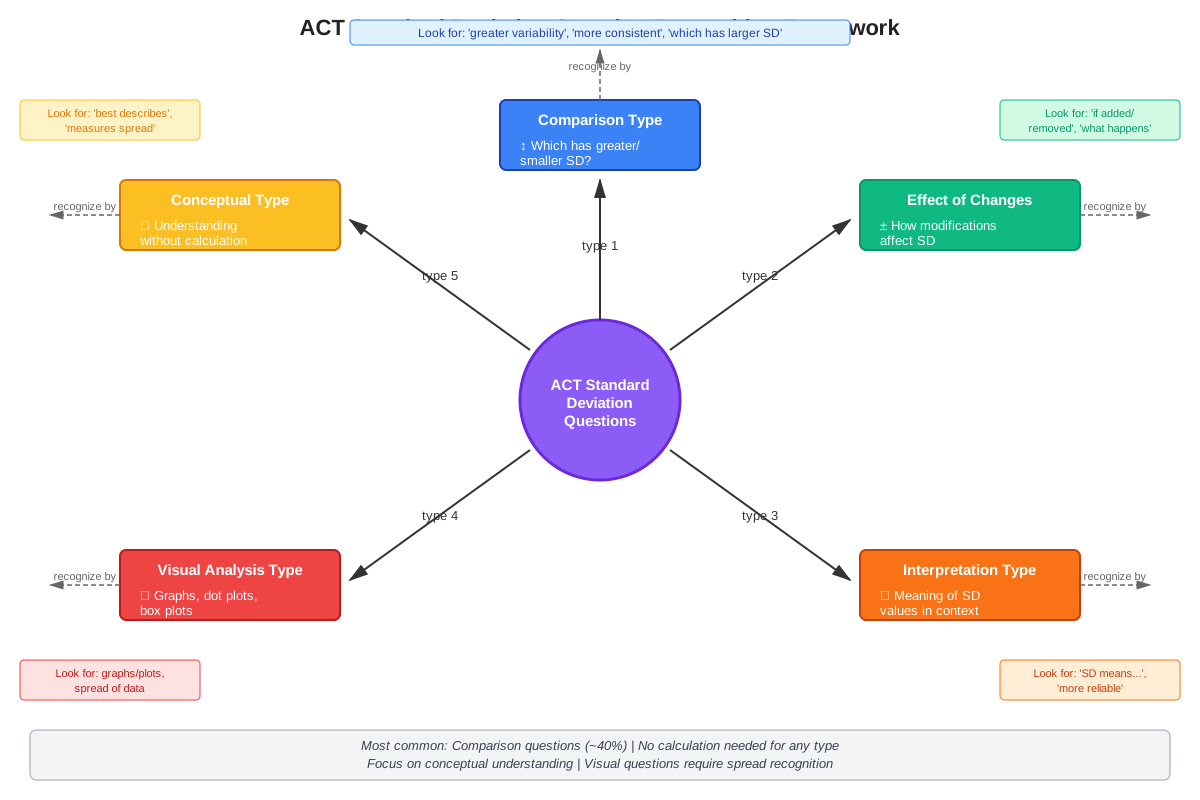
The ACT typically presents ACT standard deviation basics through questions that ask students to compare the spread of two or more datasets, identify which dataset has greater variability, or understand how changes to data affect standard deviation. Rather than requiring complex calculations, the ACT focuses on conceptual understanding—recognizing that standard deviation quantifies how tightly clustered or widely dispersed data points are around their mean. Questions may present data in tables, graphs, or word problems, requiring students to apply logical reasoning about spread and variability.
This topic connects directly to broader statistical concepts including mean, median, range, and data distribution. Standard deviation serves as a bridge between basic descriptive statistics and more advanced probability concepts. Mastering standard deviation basics enables students to tackle complex data interpretation questions and strengthens their overall quantitative reasoning skills—abilities that extend beyond the ACT into college-level mathematics and real-world data analysis.
Learning Objectives
- [ ] Identify when Standard deviation basics is being tested
- [ ] Explain the core rule or strategy behind Standard deviation basics
- [ ] Apply Standard deviation basics to ACT-style questions accurately
- [ ] Compare two or more datasets and determine which has greater standard deviation without calculation
- [ ] Predict how adding, removing, or changing data points affects standard deviation
- [ ] Interpret standard deviation values in context to make informed conclusions about data variability
Prerequisites
- Mean (average) calculation: Standard deviation measures spread around the mean, so understanding how to find and interpret averages is essential
- Basic data interpretation: Reading tables, charts, and graphs is necessary since ACT questions present data in various formats
- Number sense and comparison: Recognizing relative sizes and distances between numbers helps visualize data spread
- Basic algebra: Understanding variables and simple equations aids in grasping the conceptual formula for standard deviation
Why This Topic Matters
Standard deviation appears in everyday life whenever variability matters: quality control in manufacturing (consistent product dimensions), weather forecasting (temperature variability), finance (investment risk assessment), and medical research (treatment consistency). Understanding standard deviation enables informed decision-making when comparing options with different levels of consistency or predictability.
On the ACT Math test, standard deviation questions appear approximately 1-2 times per exam, typically in the Statistics and Probability content area. These questions carry significant weight because they test higher-order thinking rather than simple computation. The ACT specifically focuses on conceptual understanding, making this a high-yield topic where strategic knowledge can quickly earn points without lengthy calculations.
Common ACT question formats include: comparing standard deviations of two datasets presented visually or numerically; determining how specific changes to data affect standard deviation; identifying which dataset shows more variability based on descriptions; and interpreting what a given standard deviation value reveals about data consistency. Questions often integrate standard deviation with other statistical concepts, requiring students to synthesize multiple ideas simultaneously.
Core Concepts
Definition and Meaning
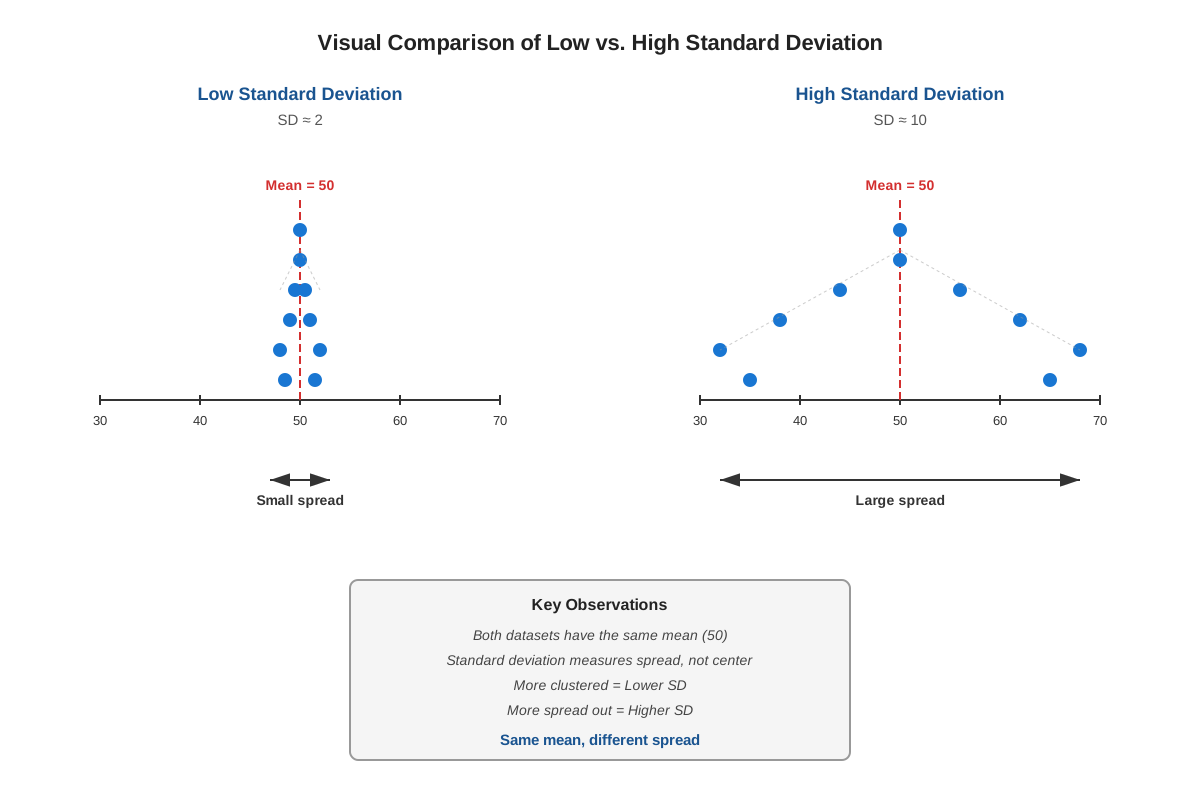
Standard deviation is a numerical measure that quantifies the amount of variation or dispersion in a dataset. It tells us, on average, how far individual data points deviate from the mean of the dataset. A small standard deviation indicates that data points cluster tightly around the mean, showing consistency and low variability. A large standard deviation indicates that data points are spread widely from the mean, showing high variability and inconsistency.
The fundamental principle is this: standard deviation measures spread, not center. Two datasets can have identical means but vastly different standard deviations if their data points are distributed differently around that mean.
Conceptual Understanding (ACT Focus)
For the ACT, students rarely need to calculate standard deviation using the formal formula. Instead, the exam tests conceptual understanding through visual and logical reasoning. The key insight is recognizing that standard deviation increases when data points are farther from the mean and decreases when data points are closer to the mean.
Consider three datasets, all with a mean of 50:
- Dataset A: {50, 50, 50, 50, 50} — all values equal the mean
- Dataset B: {48, 49, 50, 51, 52} — values close to the mean
- Dataset C: {20, 40, 50, 60, 80} — values far from the mean
Dataset A has a standard deviation of 0 (no variability). Dataset B has a small standard deviation (low variability). Dataset C has a large standard deviation (high variability). This visual comparison approach is exactly what the ACT tests.
Visual Recognition of Standard Deviation
When data is presented graphically, standard deviation can be assessed visually:
| Graph Type | High Standard Deviation | Low Standard Deviation |
|---|---|---|
| Dot plot | Points widely scattered | Points tightly clustered |
| Histogram | Flat, spread-out distribution | Tall, narrow peak |
| Box plot | Long whiskers, wide IQR | Short whiskers, narrow IQR |
| Line graph | Large fluctuations | Relatively flat, stable |
How Changes Affect Standard Deviation
Understanding how modifications to a dataset impact standard deviation is crucial for ACT success:
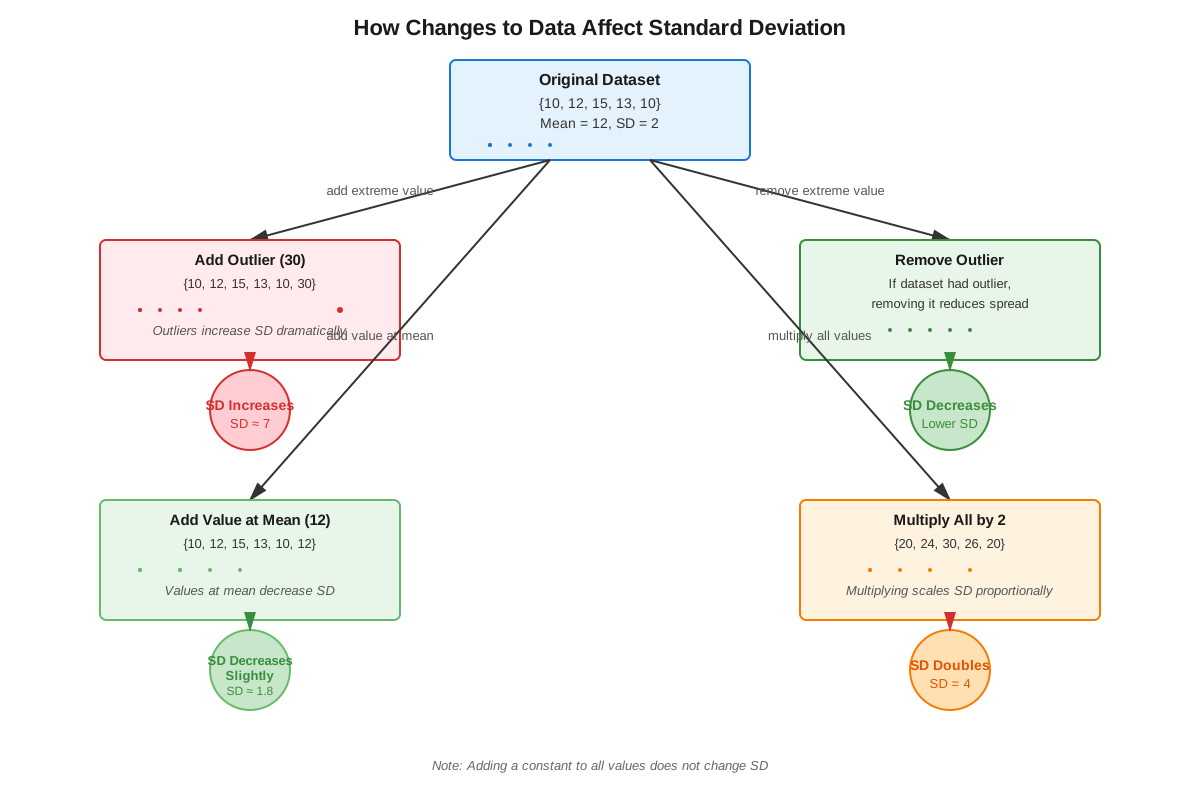
- Adding a value equal to the mean: Standard deviation decreases (or stays the same if the dataset is uniform) because you're adding a point with zero deviation
- Adding a value far from the mean: Standard deviation increases because you're introducing more variability
- Removing an outlier: Standard deviation typically decreases because extreme values contribute heavily to spread
- Adding the same constant to all values: Standard deviation remains unchanged because the relative distances between points don't change
- Multiplying all values by a constant: Standard deviation is multiplied by the absolute value of that constant
The Relationship Between Range and Standard Deviation
While range (maximum minus minimum) and standard deviation both measure spread, they differ significantly. Range only considers the two extreme values, while standard deviation considers every data point's distance from the mean. A dataset can have a large range but small standard deviation if most values cluster near the mean with only one or two outliers. Conversely, evenly distributed data across a range will have a relatively larger standard deviation.
Standard Deviation in Context
The ACT often presents standard deviation with units and context. For example, "The standard deviation of test scores is 8 points" means that, on average, individual scores deviate from the mean by about 8 points. A standard deviation of 2 points would indicate much more consistent performance, while a standard deviation of 20 points would indicate highly variable performance.
Comparing Multiple Datasets
ACT questions frequently ask students to compare standard deviations across datasets. The systematic approach involves:
- Identify the mean of each dataset (or recognize if they're equal)
- Assess how tightly data clusters around each mean
- Look for outliers or extreme values that increase spread
- Compare the overall "tightness" or "looseness" of each distribution
The dataset with data points more spread out from its mean has the larger standard deviation, regardless of what the actual means are.
Concept Relationships
Standard deviation builds directly on the concept of mean because it measures distances from the mean. Without understanding averages, standard deviation lacks context. The relationship flows: calculate mean → measure each point's distance from mean → quantify the typical distance (standard deviation).
Standard deviation connects to range as both measure spread, but standard deviation provides more nuanced information by considering all data points rather than just extremes. The relationship is complementary: Range → gives maximum spread; Standard deviation → gives typical spread.
Within data analysis, standard deviation relates to outliers—extreme values that significantly increase standard deviation. The connection: Outliers present → distances from mean increase → standard deviation increases. Removing outliers → distances decrease → standard deviation decreases.
Standard deviation also connects forward to normal distribution and probability concepts. In normally distributed data, approximately 68% of values fall within one standard deviation of the mean, 95% within two standard deviations, and 99.7% within three standard deviations. This relationship enables predictions about data likelihood.
The conceptual map: Data Collection → Calculate Mean → Measure Spread (Range vs. Standard Deviation) → Interpret Variability → Make Comparisons → Draw Conclusions
High-Yield Facts
⭐ Standard deviation measures how spread out data points are from the mean, not the mean itself
⭐ A standard deviation of zero means all data points are identical
⭐ Larger standard deviation = more variability; smaller standard deviation = more consistency
⭐ Adding or subtracting the same value to all data points does NOT change standard deviation
⭐ Multiplying all data points by a constant multiplies the standard deviation by that constant's absolute value
- Standard deviation is always non-negative (zero or positive, never negative)
- Two datasets can have the same mean but different standard deviations
- Outliers significantly increase standard deviation because they're far from the mean
- In a dataset where all values equal the mean, standard deviation equals zero
- Standard deviation has the same units as the original data (if data is in inches, standard deviation is in inches)
- Removing a value equal to the mean typically decreases standard deviation slightly
- A dataset with evenly spaced values has larger standard deviation than one with clustered values (same range)
- Standard deviation considers every data point, making it more informative than range
- Visual clustering on graphs indicates low standard deviation; wide scatter indicates high standard deviation
- The ACT rarely requires calculating standard deviation using the formula—focus on conceptual understanding
Quick check — test yourself on Standard deviation basics so far.
Try Flashcards →Common Misconceptions
Misconception: Standard deviation and mean are the same thing → Correction: Mean measures the center (average) of data, while standard deviation measures the spread around that center. They are completely different statistical measures serving different purposes.
Misconception: A larger dataset always has a larger standard deviation → Correction: Standard deviation depends on spread, not sample size. A dataset with 1,000 nearly identical values has a smaller standard deviation than a dataset with 10 widely varying values.
Misconception: Range and standard deviation always increase or decrease together → Correction: While often correlated, they can behave differently. Adding a value equal to the mean doesn't change range but affects standard deviation. Range ignores the distribution of middle values that standard deviation considers.
Misconception: Adding 10 to every data point increases standard deviation by 10 → Correction: Adding a constant to all values shifts the mean but doesn't change the spread. Standard deviation remains exactly the same because relative distances between points are unchanged.
Misconception: Standard deviation can be negative if data points are below the mean → Correction: Standard deviation is always zero or positive because it's based on squared distances (or their square root). Negative values are mathematically impossible.
Misconception: The dataset with the larger range always has the larger standard deviation → Correction: Range only considers extremes. If one dataset has outliers but clustered middle values, while another has evenly distributed values across a smaller range, the second could have a larger standard deviation.
Misconception: Standard deviation tells you the maximum distance any point is from the mean → Correction: Standard deviation represents the typical or average distance, not the maximum. Some points may be much farther from the mean than one standard deviation.
Worked Examples
Example 1: Comparing Standard Deviations Visually
Question: Two classes took the same test. Class A's scores: {72, 75, 76, 78, 79}. Class B's scores: {50, 70, 75, 80, 100}. Which class has the greater standard deviation?
Solution:
Step 1: Find the mean of each class.
- Class A mean: (72 + 75 + 76 + 78 + 79) ÷ 5 = 380 ÷ 5 = 76
- Class B mean: (50 + 70 + 75 + 80 + 100) ÷ 5 = 375 ÷ 5 = 75
Step 2: Assess how far data points are from their respective means.
- Class A: Points range from 72 to 79, all within 4 points of the mean (76)
- Distances: 4, 1, 0, 2, 3 (all small)
- Class B: Points range from 50 to 100, with extremes far from the mean (75)
- Distances: 25, 5, 0, 5, 25 (much larger)
Step 3: Compare the spread.
Class B has data points much farther from its mean than Class A. The values 50 and 100 are 25 points away from the mean, while Class A's farthest point is only 4 points away.
Answer: Class B has the greater standard deviation because its data points are more spread out from the mean, showing higher variability in test scores.
Connection to Learning Objectives: This example demonstrates how to identify standard deviation testing (comparing datasets), apply the core strategy (assess spread from mean), and accurately solve ACT-style questions without formal calculation.
Example 2: Effect of Data Changes
Question: A dataset has five values: {10, 12, 15, 18, 20}. The mean is 15 and the standard deviation is approximately 3.7. If the value 15 is removed from the dataset, what happens to the standard deviation?
Solution:
Step 1: Understand what's being removed.
The value 15 equals the current mean, so it has zero deviation from the mean.
Step 2: Analyze the new dataset.
New dataset: {10, 12, 18, 20}
New mean: (10 + 12 + 18 + 20) ÷ 4 = 60 ÷ 4 = 15
Step 3: Assess the new spread.
Original dataset had five points, including one exactly at the mean. The remaining four points are all at distances from the mean:
- 10 is 5 away from 15
- 12 is 3 away from 15
- 18 is 3 away from 15
- 20 is 5 away from 15
Step 4: Compare to the original.
The original dataset included a point with zero deviation (the value 15), which pulled the average deviation down. Removing it leaves only points with non-zero deviations, increasing the typical distance from the mean.
Answer: The standard deviation increases. Removing a value equal to the mean eliminates a point with zero deviation, leaving only points that deviate from the mean, which increases the average deviation.
Connection to Learning Objectives: This example shows how to predict the effect of data changes on standard deviation, a key ACT skill that tests deep conceptual understanding rather than calculation ability.
Exam Strategy
When approaching ACT questions on standard deviation, follow this systematic process:
Step 1: Identify the Question Type
Look for trigger words: "variability," "consistency," "spread," "deviation," "more/less variable," "clustered," or "dispersed." Questions asking which dataset is "more consistent" are asking which has lower standard deviation.
Step 2: Visual Assessment First
If data is presented graphically, use visual clustering as your primary tool. Tightly grouped points = low standard deviation; widely scattered points = high standard deviation. This approach is faster and less error-prone than calculation.
Step 3: Compare Spreads, Not Centers
Don't be distracted by different means. Two datasets can have different means but the question asks about spread. Focus on how far points deviate from their respective means, not the means themselves.
Step 4: Use Process of Elimination
For multiple-choice questions, eliminate obviously wrong answers:
- Eliminate any answer suggesting standard deviation can be negative
- Eliminate answers that confuse mean with standard deviation
- Eliminate answers that ignore outliers when they're present
Step 5: Check for Data Transformation Questions
If the question involves adding, subtracting, multiplying, or removing values, recall the rules:
- Adding/subtracting constants: standard deviation unchanged
- Multiplying by constants: standard deviation multiplied by absolute value
- Removing outliers: standard deviation typically decreases
Time-Saving Tip: On the ACT, you can almost always determine which dataset has greater standard deviation by visual inspection or logical reasoning in under 30 seconds. Never waste time attempting to calculate standard deviation using the formula unless explicitly required.
Trigger Phrases to Watch For:
- "More consistent" = smaller standard deviation
- "More variable" = larger standard deviation
- "Greater spread" = larger standard deviation
- "Tightly clustered" = smaller standard deviation
- "How does this change affect..." = test transformation rules
Memory Techniques
SPREAD Acronym for Standard Deviation Concepts:
- Spread from the mean (what it measures)
- Positive or zero (never negative)
- Remove outliers to decrease it
- Equal values give zero
- Adding constants doesn't change it
- Distance matters, not direction
Visual Memory Aid: Picture a dartboard. Darts clustered near the bullseye = low standard deviation (consistent). Darts scattered all over = high standard deviation (inconsistent). The bullseye represents the mean.
The "Rubber Band" Visualization: Imagine data points connected to the mean by rubber bands. Standard deviation measures how stretched the rubber bands are. Tight bands = low standard deviation; stretched bands = high standard deviation. Adding a point far from the mean stretches the bands more.
Transformation Rhyme:
"Add or subtract, spread stays intact.
Multiply through, standard deviation changes too."
Comparison Mnemonic: "CLOSE vs. LOOSE"
- Clustered data = Low standard deviation
- Outliers present = Obviously higher
- Scattered points = Standard deviation up
- Equal to mean = Eliminates deviation
Summary
Standard deviation basics represents a critical ACT Math concept that measures data variability and spread around the mean. Unlike computational statistics, the ACT emphasizes conceptual understanding: recognizing that larger standard deviation indicates greater variability while smaller standard deviation indicates consistency. Success requires visual assessment skills—identifying clustered versus scattered data in graphs and tables—and understanding how data transformations affect spread. Key principles include: standard deviation is always non-negative; adding constants to all values doesn't change it; multiplying values scales standard deviation proportionally; outliers significantly increase it; and removing values equal to the mean typically decreases it. The ACT tests these concepts through comparison questions, transformation scenarios, and visual interpretation tasks. Mastery comes from recognizing that standard deviation quantifies the typical distance of data points from their mean, enabling quick, logical reasoning without complex calculations. Students who understand these core principles can confidently tackle any ACT standard deviation question within seconds.
Key Takeaways
- Standard deviation measures spread from the mean, not the center itself—it quantifies variability and consistency in data
- Visual clustering is the fastest way to compare standard deviations: tight grouping = low SD, wide scatter = high SD
- Adding or subtracting the same value to all data points leaves standard deviation completely unchanged
- Outliers dramatically increase standard deviation because they're far from the mean; removing them decreases SD
- Standard deviation is always zero or positive, never negative, with zero indicating all values are identical
- The ACT tests conceptual understanding through comparisons and transformations, rarely requiring formula-based calculations
- Focus on relative distances from the mean rather than absolute values when comparing datasets
Related Topics
Variance: The square of standard deviation, representing another measure of spread. Understanding standard deviation provides the foundation for grasping variance, which appears in advanced statistics.
Normal Distribution and the Empirical Rule: Standard deviation becomes especially powerful when data follows a normal distribution, where specific percentages of data fall within one, two, or three standard deviations from the mean.
Z-scores: These standardized scores express how many standard deviations a value is from the mean, building directly on standard deviation concepts to enable cross-dataset comparisons.
Interquartile Range (IQR): Another measure of spread that's less sensitive to outliers than standard deviation, providing complementary information about data distribution.
Correlation and Regression: Advanced statistical concepts where standard deviation plays a role in measuring relationship strength and prediction accuracy between variables.
Practice CTA
Now that you've mastered the conceptual foundations of standard deviation basics, it's time to cement your understanding through active practice. Attempt the practice questions to apply these strategies to authentic ACT-style problems, and use the flashcards to reinforce the high-yield facts and transformation rules. Remember: standard deviation questions are high-value opportunities on the ACT because they reward conceptual thinking over lengthy calculations. With the strategies you've learned, you can confidently approach these questions and earn quick points. Your investment in understanding spread and variability will pay dividends not just on test day, but in any future work involving data analysis and statistical reasoning. You've got this!
Sign up free to keep reading
Create a free AnvayaPrep account to finish this ACT guide on Standard deviation basics — plus flashcards and practice questions.