Overview
The cotangent function is one of the six fundamental trigonometric functions tested on the ACT Math section. While sine, cosine, and tangent receive more attention in typical trigonometry instruction, understanding cotangent is essential for achieving top scores on the ACT, as questions involving this function appear regularly and often catch unprepared students off guard. Cotangent represents the reciprocal of the tangent function and can be expressed as the ratio of the adjacent side to the opposite side in a right triangle, or as cosine divided by sine.
Mastery of ACT cotangent questions requires more than memorizing a definition—students must recognize when cotangent is being tested (often disguised within more complex problems), understand its relationship to other trigonometric functions, and apply it efficiently under time pressure. The ACT frequently tests cotangent through coordinate plane problems, unit circle questions, trigonometric identities, and graph interpretation. Questions may ask students to evaluate cotangent at specific angles, simplify expressions containing cotangent, or recognize equivalent forms of trigonometric expressions.
The cotangent function serves as a bridge between multiple mathematical concepts tested on the ACT. It connects directly to the tangent function through reciprocal relationships, relates to sine and cosine through quotient identities, and appears in problems involving right triangle trigonometry, the unit circle, and trigonometric graphs. Understanding cotangent deepens comprehension of trigonometric identities and enables students to approach complex problems from multiple angles, often revealing simpler solution paths that save valuable time during the exam.
Learning Objectives
- [ ] Identify when Cotangent is being tested in ACT Math questions
- [ ] Explain the core rule or strategy behind Cotangent and its relationship to other trigonometric functions
- [ ] Apply Cotangent to ACT-style questions accurately and efficiently
- [ ] Convert between different representations of cotangent (ratio form, reciprocal form, quotient form)
- [ ] Evaluate cotangent values for common angles without a calculator
- [ ] Recognize and apply cotangent in trigonometric identities and simplification problems
- [ ] Interpret cotangent in the context of the unit circle and coordinate plane
Prerequisites
- Right triangle trigonometry: Understanding sine, cosine, and tangent ratios is fundamental, as cotangent is defined in relation to these functions
- Reciprocal relationships: Knowledge of reciprocals is necessary to understand cotangent as the reciprocal of tangent
- Unit circle basics: Familiarity with the unit circle enables evaluation of cotangent at standard angles
- Angle measurement: Comfort with both degree and radian measures is required for interpreting cotangent problems
- Basic algebraic manipulation: Simplifying fractions and expressions is essential for working with cotangent in various forms
Why This Topic Matters
Cotangent appears in approximately 2-4 questions per ACT Math section, making it a high-yield topic that can significantly impact scores. While this may seem modest, these questions often serve as differentiators between good and excellent scores, as they tend to appear in the medium-to-difficult range (questions 30-50) where point values become crucial for reaching the 30+ score threshold. Students who skip or guess on cotangent questions forfeit easy points that could be earned with proper preparation.
In real-world applications, cotangent appears in engineering, physics, and architecture. It's used to calculate slopes, angles of elevation and depression, and in wave analysis. Navigation systems, surveying equipment, and computer graphics all utilize cotangent functions. Understanding cotangent provides insight into periodic phenomena and angular relationships that govern everything from sound waves to structural design.
On the ACT, cotangent most commonly appears in these contexts: evaluating trigonometric expressions at specific angles, simplifying complex trigonometric expressions using identities, solving trigonometric equations, interpreting graphs of trigonometric functions, and applying trigonometry to coordinate plane problems. The ACT may test cotangent directly by name or indirectly through expressions like cos(θ)/sin(θ) or 1/tan(θ), requiring students to recognize these equivalent forms.
Core Concepts
Definition and Basic Understanding
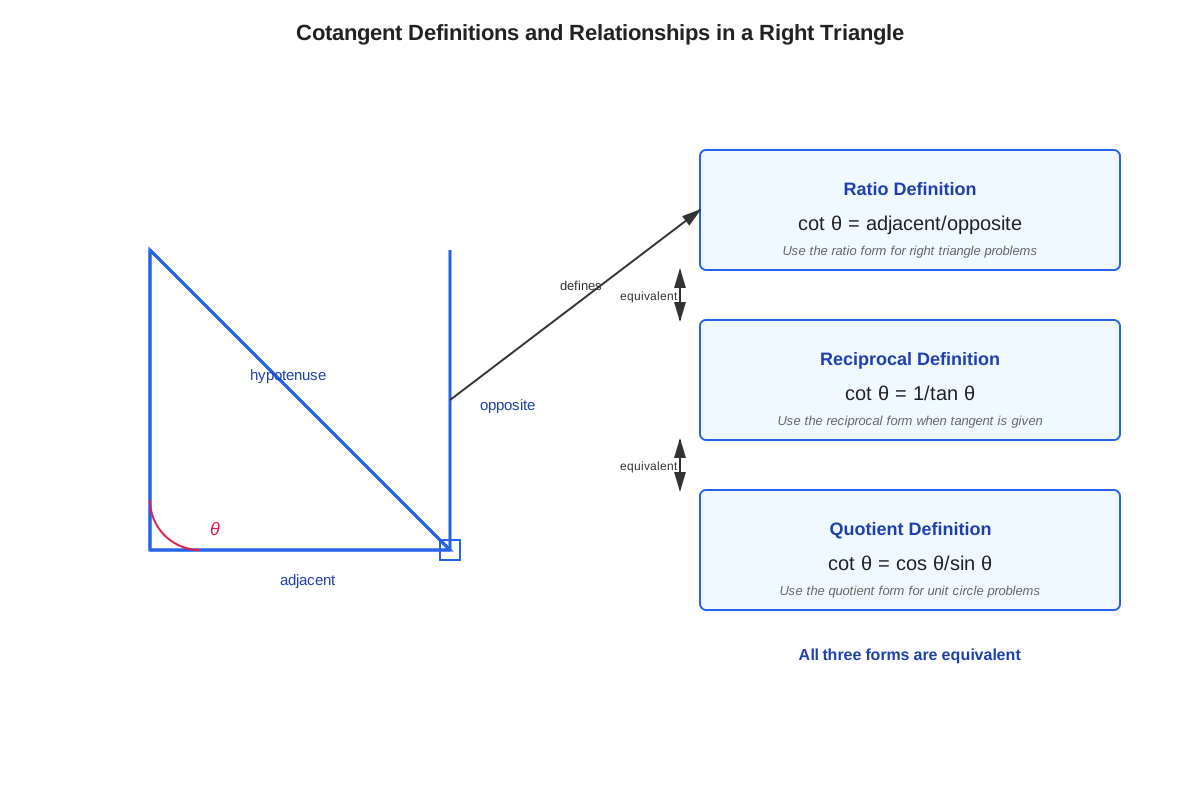
Cotangent (abbreviated as cot or ctn) is defined in three equivalent ways, each useful in different problem contexts. In a right triangle, cotangent of an angle equals the ratio of the adjacent side to the opposite side. This makes it the "flipped" version of tangent, which equals opposite over adjacent. Mathematically:
cot(θ) = adjacent/oppositeThe second definition expresses cotangent as the reciprocal of tangent:
cot(θ) = 1/tan(θ)The third definition, most useful for unit circle problems and advanced applications, expresses cotangent as the quotient of cosine and sine:
cot(θ) = cos(θ)/sin(θ)All three definitions are mathematically equivalent and interchangeable. ACT questions may use any of these forms, so recognizing them instantly is crucial for exam success.
Cotangent Values for Common Angles
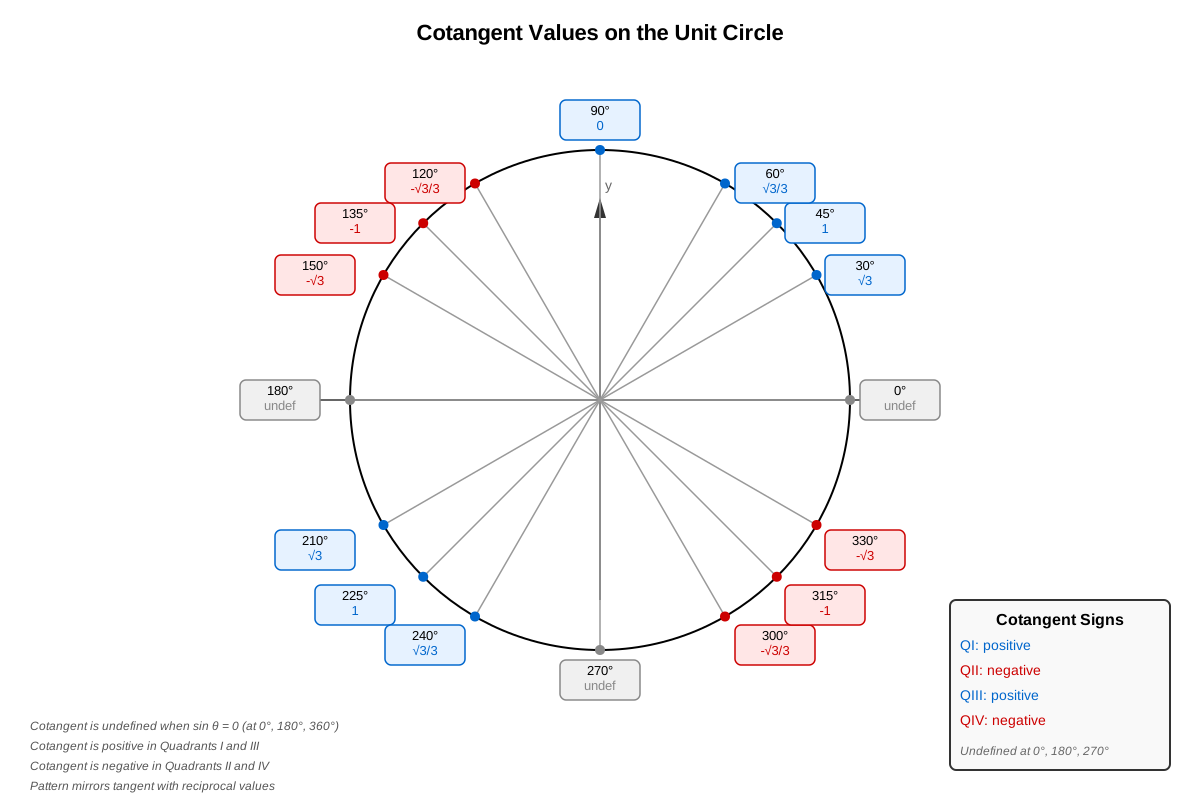
Memorizing cotangent values for standard angles eliminates the need for time-consuming calculations during the exam. These values appear repeatedly on the ACT:
| Angle (degrees) | Angle (radians) | cot(θ) | Simplified Form |
|---|---|---|---|
| 0° | 0 | undefined | — |
| 30° | π/6 | √3 | √3 |
| 45° | π/4 | 1 | 1 |
| 60° | π/3 | 1/√3 | √3/3 |
| 90° | π/2 | 0 | 0 |
| 120° | 2π/3 | -1/√3 | -√3/3 |
| 135° | 3π/4 | -1 | -1 |
| 150° | 5π/6 | -√3 | -√3 |
| 180° | π | undefined | — |
Notice that cotangent is undefined when sine equals zero (at 0°, 180°, 360°, etc.) because division by zero is undefined. This occurs at integer multiples of π radians or 180°.
Sign of Cotangent in Different Quadrants
Understanding where cotangent is positive or negative helps eliminate wrong answers and verify solutions. Since cot(θ) = cos(θ)/sin(θ), cotangent is positive when cosine and sine have the same sign, and negative when they have opposite signs:
- Quadrant I (0° to 90°): Both sine and cosine are positive → cotangent is positive
- Quadrant II (90° to 180°): Sine is positive, cosine is negative → cotangent is negative
- Quadrant III (180° to 270°): Both sine and cosine are negative → cotangent is positive
- Quadrant IV (270° to 360°): Sine is negative, cosine is positive → cotangent is negative
The mnemonic "All Students Take Calculus" helps remember which functions are positive in each quadrant (All, Sine, Tangent, Cosine), and since cotangent has the same sign as tangent, it's positive in Quadrants I and III.
Cotangent in Trigonometric Identities
Several important identities involve cotangent and appear frequently on the ACT:
Pythagorean Identity for Cotangent:
1 + cot²(θ) = csc²(θ)This identity derives from the fundamental Pythagorean identity sin²(θ) + cos²(θ) = 1 by dividing all terms by sin²(θ).
Reciprocal Identities:
cot(θ) = 1/tan(θ)
tan(θ) = 1/cot(θ)
Quotient Identity:
cot(θ) = cos(θ)/sin(θ)Cofunction Identity:
cot(θ) = tan(90° - θ) = tan(π/2 - θ)These identities enable transformation of complex expressions into simpler forms, often revealing solution paths that aren't immediately obvious.
Graph of the Cotangent Function
The graph of y = cot(x) has distinctive characteristics that differentiate it from other trigonometric functions. The function has a period of π (180°), meaning it repeats every π units. Unlike sine and cosine, cotangent has vertical asymptotes at x = 0, π, 2π, and all integer multiples of π, where the function is undefined. Between asymptotes, the function decreases from positive infinity to negative infinity. The graph crosses the x-axis at π/2, 3π/2, 5π/2, and generally at odd multiples of π/2.
Concept Relationships
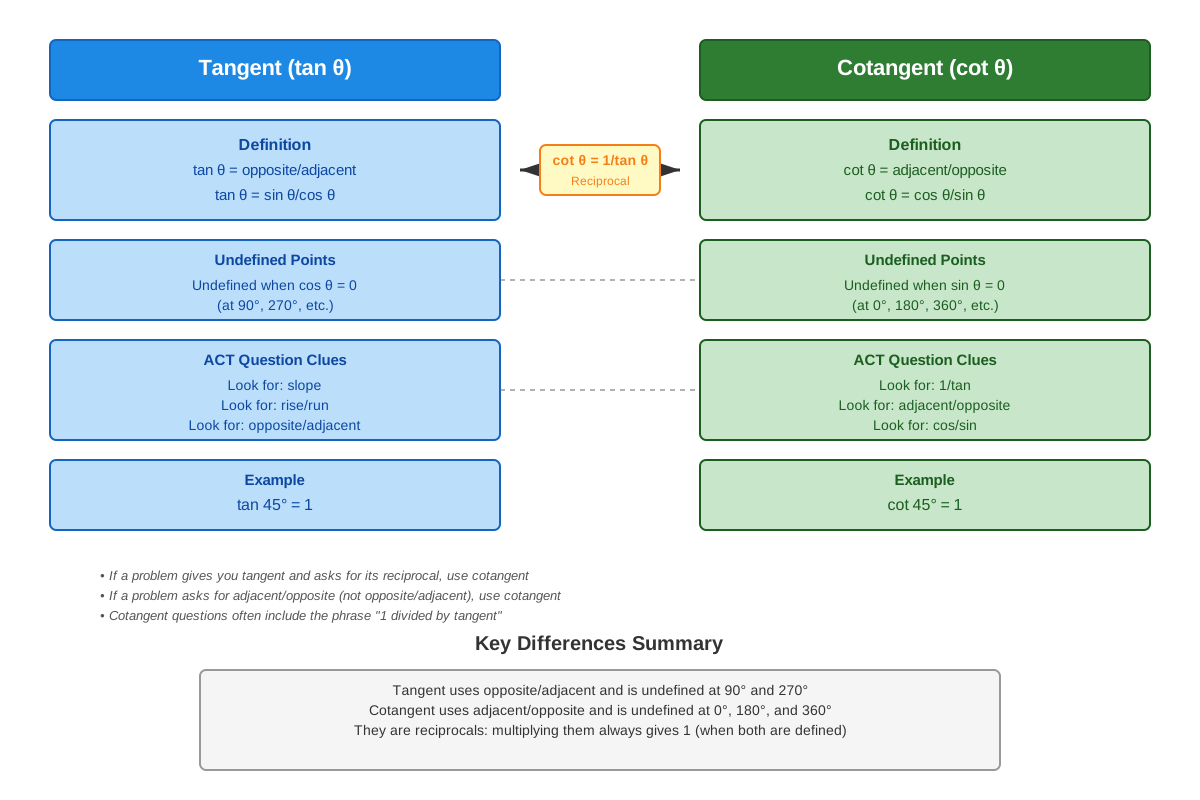
The cotangent function sits at the intersection of multiple trigonometric concepts, making it a central topic for understanding trigonometry holistically. Cotangent connects to tangent through the reciprocal relationship (cot = 1/tan), meaning any problem involving tangent can potentially be reframed using cotangent, and vice versa. This reciprocal relationship mirrors the connection between sine and cosecant, and between cosine and secant.
Cotangent connects to sine and cosine through the quotient identity (cot = cos/sin), establishing it as a derived function built from the two fundamental trigonometric functions. This relationship enables conversion between forms, particularly useful when simplifying complex expressions or solving equations.
Right triangle trigonometry leads to cotangent as the ratio of adjacent to opposite sides, making it applicable to any problem involving right triangles, angles of elevation or depression, and geometric relationships. Cotangent extends to the unit circle, where it can be evaluated for any angle by taking the x-coordinate divided by the y-coordinate of the corresponding point on the circle.
Cotangent appears in trigonometric identities, particularly the Pythagorean identity 1 + cot²(θ) = csc²(θ), which connects cotangent to cosecant. This identity chain links all six trigonometric functions into an interconnected system where knowledge of one function facilitates understanding of others.
The relationship map flows: Right Triangle Ratios → Cotangent Definition → Reciprocal of Tangent → Quotient of Cosine and Sine → Unit Circle Evaluation → Trigonometric Identities → Complex Problem Solving.
Quick check — test yourself on Cotangent so far.
Try Flashcards →High-Yield Facts
⭐ Cotangent equals the reciprocal of tangent: cot(θ) = 1/tan(θ)
⭐ Cotangent equals cosine divided by sine: cot(θ) = cos(θ)/sin(θ)
⭐ Cotangent is undefined when sine equals zero (at 0°, 180°, 360°, etc.)
⭐ cot(45°) = 1 and cot(π/4) = 1 (most frequently tested special angle)
⭐ Cotangent is positive in Quadrants I and III, negative in Quadrants II and IV
- In a right triangle, cot(θ) = adjacent/opposite
- The Pythagorean identity for cotangent is 1 + cot²(θ) = csc²(θ)
- cot(30°) = √3 and cot(60°) = √3/3 (or 1/√3)
- The period of the cotangent function is π (180°), not 2π like sine and cosine
- cot(90°) = 0 because cos(90°) = 0 and sin(90°) = 1
- The cofunction identity states cot(θ) = tan(90° - θ)
- Cotangent has vertical asymptotes at all integer multiples of π
- The graph of cotangent decreases throughout each period (from +∞ to -∞)
Common Misconceptions
Misconception: Cotangent equals opposite over adjacent in a right triangle.
Correction: Cotangent equals adjacent over opposite (the reciprocal of tangent). This is the reverse of tangent's ratio. A helpful memory aid: "cotangent is tangent flipped."
Misconception: Cotangent has the same period as sine and cosine (2π).
Correction: Cotangent has a period of π, meaning it completes one full cycle in 180° rather than 360°. This matches the period of tangent, its reciprocal function.
Misconception: cot(θ) = 1/cos(θ) or cot(θ) = 1/sin(θ).
Correction: These are secant and cosecant, respectively. Cotangent equals 1/tan(θ), which equals cos(θ)/sin(θ). The reciprocal relationships must be memorized precisely to avoid confusion.
Misconception: Cotangent is always positive.
Correction: Cotangent is negative in Quadrants II and IV, where sine and cosine have opposite signs. The sign of cotangent depends on the angle's location on the unit circle.
Misconception: When cotangent is undefined, it equals zero.
Correction: When cotangent is undefined (at 0°, 180°, etc.), it has no value—not even zero. This occurs when the denominator (sine) equals zero, making the expression undefined. Conversely, cotangent equals zero when the numerator (cosine) equals zero, which happens at 90°, 270°, etc.
Misconception: cot²(θ) means cot(θ²).
Correction: cot²(θ) means [cot(θ)]², the cotangent of θ squared. The exponent applies to the entire function value, not to the angle itself. This notation appears frequently in trigonometric identities.
Worked Examples
Example 1: Evaluating Cotangent Using Multiple Methods
Problem: Find the exact value of cot(150°).
Solution:
Method 1 - Using the quotient identity:
First, find cos(150°) and sin(150°).
150° is in Quadrant II, where cosine is negative and sine is positive.
The reference angle is 180° - 150° = 30°.
cos(150°) = -cos(30°) = -√3/2
sin(150°) = sin(30°) = 1/2
Therefore:
cot(150°) = cos(150°)/sin(150°) = (-√3/2)/(1/2) = -√3/2 × 2/1 = -√3Method 2 - Using the reciprocal identity:
First find tan(150°).
tan(150°) = sin(150°)/cos(150°) = (1/2)/(-√3/2) = 1/2 × (-2/√3) = -1/√3
Therefore:
cot(150°) = 1/tan(150°) = 1/(-1/√3) = -√3Method 3 - Using the cofunction identity:
cot(150°) = tan(90° - 150°) = tan(-60°) = -tan(60°) = -√3
All three methods yield cot(150°) = -√3, demonstrating the interconnected nature of trigonometric functions. On the ACT, choosing the most efficient method saves time—in this case, recognizing 150° as a standard angle and recalling the memorized value would be fastest.
Example 2: Simplifying an Expression with Cotangent
Problem: Simplify the expression: (sin(x) × cot(x)) + cos(x)
Solution:
Step 1: Replace cot(x) with its quotient form.
sin(x) × cot(x) + cos(x) = sin(x) × [cos(x)/sin(x)] + cos(x)Step 2: Simplify the first term by canceling sin(x).
= [sin(x) × cos(x)]/sin(x) + cos(x) = cos(x) + cos(x)Step 3: Combine like terms.
= 2cos(x)Answer: The expression simplifies to 2cos(x).
This problem demonstrates a common ACT strategy: converting cotangent to its quotient form often reveals cancellation opportunities that simplify complex expressions. Recognizing when to apply this technique is crucial for efficiency on the exam.
Exam Strategy
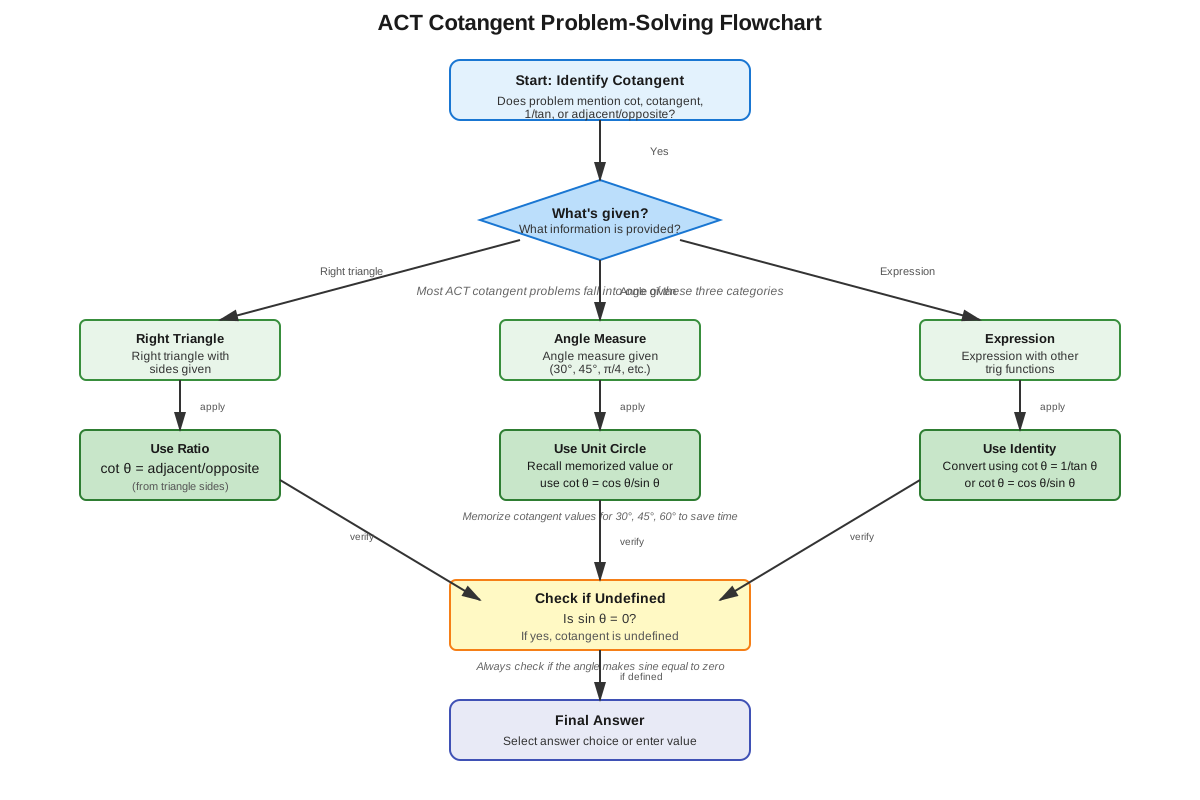
When approaching ACT cotangent questions, begin by identifying which form of cotangent will be most useful. If the problem involves a right triangle, use the adjacent/opposite ratio. If it contains other trigonometric functions, consider the reciprocal (1/tan) or quotient (cos/sin) forms. This initial decision often determines whether a problem takes 30 seconds or 3 minutes.
Trigger words and phrases that signal cotangent problems include: "reciprocal of tangent," expressions written as "cos(θ)/sin(θ)," problems asking for "cot" or "cotangent" explicitly, and questions involving all six trigonometric functions where cotangent completes the set. Watch for problems that give tangent values and ask for related information—these often require finding cotangent as an intermediate step.
Process of elimination strategies: If answer choices contain cotangent values, immediately eliminate any that have the wrong sign based on the quadrant. For angles in Quadrant I or III, cotangent must be positive; in Quadrants II or IV, it must be negative. If evaluating cotangent at a special angle (30°, 45°, 60°, etc.), eliminate answers that don't match memorized values. If the problem involves simplification, eliminate answers that are more complex than the original expression—simplification should reduce complexity.
Time allocation: Standard cotangent evaluation problems should take 30-45 seconds once values are memorized. Simplification problems involving cotangent typically require 60-90 seconds. If a problem takes longer than 2 minutes, mark it and return later—the ACT rewards efficient time management more than perfect completion.
Calculator considerations: The ACT allows calculators, but most cotangent problems are designed to be solved without one. Calculators may not have a cotangent button (requiring you to calculate 1/tan instead), and exact answers involving radicals cannot be matched to decimal approximations. Use calculators for verification, not primary calculation, on cotangent problems.
Memory Techniques
Mnemonic for cotangent definition: "Cotangent is Cosine over sine" (both start with C). This helps recall cot(θ) = cos(θ)/sin(θ).
Mnemonic for right triangle ratio: "Adjacent Over Opposite" spells "AOO," which sounds like "ow!" (the sound you make when you forget it). Cotangent = Adjacent/Opposite.
Visualization for reciprocal relationship: Picture tangent and cotangent as mirror images across the line y = 1. When tangent is large, cotangent is small; when tangent is small, cotangent is large. They're inversely related, like flipping a fraction.
Acronym for special angle values: "Some Old Hippie Caught Another Hippie Trippin' On Acid" represents the pattern of trigonometric values: √0/2, √1/2, √2/2, √3/2, √4/2 for sine values at 0°, 30°, 45°, 60°, 90°. Cotangent values derive from these by taking cosine/sine.
Memory palace technique: Assign each special angle to a location in a familiar place (your home, school route, etc.). At each location, visualize the cotangent value in an exaggerated, memorable way. For example, at your front door (45°), picture a perfectly square door (cot(45°) = 1, representing equality).
Quadrant sign memory: Use "All Students Take Calculus" for which functions are positive in each quadrant (I: All, II: Sine, III: Tangent, IV: Cosine). Since cotangent has the same sign as tangent, it's positive in Quadrants I and III.
Summary
Cotangent is a fundamental trigonometric function defined as the reciprocal of tangent, the ratio of adjacent to opposite in a right triangle, or the quotient of cosine and sine. Mastery of cotangent requires memorizing values for special angles (30°, 45°, 60°, etc.), understanding its sign in different quadrants (positive in I and III, negative in II and IV), and recognizing its three equivalent forms. The function has a period of π and is undefined at integer multiples of π where sine equals zero. Cotangent appears in trigonometric identities, particularly 1 + cot²(θ) = csc²(θ), and connects deeply to other trigonometric functions through reciprocal and quotient relationships. On the ACT, cotangent questions test evaluation at specific angles, simplification of expressions, and application of identities. Success requires instant recognition of cotangent in various forms, strategic selection of the most efficient solution method, and fluency with special angle values. Students who master cotangent gain a significant advantage on medium-to-difficult ACT Math questions, as these problems often differentiate between good and excellent scores.
Key Takeaways
- Cotangent has three equivalent definitions: adjacent/opposite, 1/tan(θ), and cos(θ)/sin(θ)—recognize and use all three forms
- Memorize cotangent values for special angles: cot(30°) = √3, cot(45°) = 1, cot(60°) = √3/3
- Cotangent is positive in Quadrants I and III, negative in Quadrants II and IV
- Cotangent is undefined when sine equals zero (0°, 180°, 360°, etc.) and equals zero when cosine equals zero (90°, 270°, etc.)
- The Pythagorean identity 1 + cot²(θ) = csc²(θ) frequently appears in simplification problems
- Converting cotangent to cos(θ)/sin(θ) often reveals simplification opportunities through cancellation
- The period of cotangent is π (180°), not 2π like sine and cosine
Related Topics
Tangent Function: As the reciprocal of cotangent, mastering tangent deepens understanding of cotangent and vice versa. The two functions share the same period and sign patterns.
Cosecant and Secant: These reciprocal functions (1/sin and 1/cos) parallel cotangent's relationship to tangent, forming a complete set of six trigonometric functions with interconnected identities.
Trigonometric Identities: Advanced identities involving cotangent, including sum and difference formulas, double-angle formulas, and half-angle formulas, build on the foundational concepts covered here.
Inverse Trigonometric Functions: Understanding arccotangent (cot⁻¹) extends cotangent knowledge to solving equations and finding angles from ratios.
Polar Coordinates and Complex Numbers: Cotangent appears in advanced applications involving polar form and complex plane representations, topics that may appear on higher-level standardized tests.
Practice CTA
Now that you've mastered the core concepts of cotangent, it's time to solidify your understanding through active practice. Attempt the practice questions designed specifically for this topic—they mirror actual ACT question formats and difficulty levels. Use the flashcards to drill special angle values until recall becomes automatic. Remember, the difference between knowing cotangent and mastering it lies in repeated application under test-like conditions. Every practice problem you solve builds the pattern recognition and speed essential for ACT success. You've invested the time to learn this material thoroughly—now convert that knowledge into points by practicing until cotangent questions become routine opportunities to demonstrate your expertise.
Sign up free to keep reading
Create a free AnvayaPrep account to finish this ACT guide on Cotangent — plus flashcards and practice questions.