Overview
The tangent function is one of the three fundamental trigonometric ratios tested extensively on the ACT Math section. While sine and cosine often receive more attention in introductory trigonometry courses, tangent plays an equally critical role in solving real-world problems involving angles, slopes, and relationships between sides of right triangles. Understanding tangent is essential not only for direct trigonometry questions but also for coordinate geometry, function analysis, and applied problem-solving scenarios that appear throughout the ACT Math test.
On the ACT, tangent questions typically appear 2-4 times per exam, making this a high-yield topic that directly impacts your score. These questions range from straightforward right triangle applications to more complex scenarios involving the unit circle, tangent graphs, and inverse tangent functions. The ACT frequently embeds tangent within word problems about ramps, shadows, angles of elevation and depression, and architectural measurements—contexts that require you to recognize when tangent is the appropriate tool to use.
Mastering tangent strengthens your overall mathematical reasoning because it connects multiple domains: geometry (right triangles and circles), algebra (ratios and functions), and coordinate geometry (slopes and perpendicular lines). The tangent function serves as a bridge between these areas, and proficiency with tangent enables you to tackle multi-step problems that integrate several mathematical concepts simultaneously. This interconnectedness makes tangent a cornerstone topic for achieving a high score on the ACT Math section.
Learning Objectives
- [ ] Identify when Tangent is being tested in ACT questions
- [ ] Explain the core rule or strategy behind Tangent
- [ ] Apply Tangent to ACT-style questions accurately
- [ ] Calculate tangent values using right triangle ratios (opposite/adjacent)
- [ ] Recognize and apply the relationship between tangent and slope in coordinate geometry
- [ ] Solve inverse tangent problems to find angle measures
- [ ] Interpret tangent in real-world contexts such as angles of elevation and depression
Prerequisites
- Right triangle properties: Understanding the relationships between sides and angles in right triangles is fundamental, as tangent is defined using these ratios
- Basic trigonometric vocabulary: Familiarity with terms like hypotenuse, opposite side, and adjacent side enables quick identification of which sides to use in tangent calculations
- Angle measurement in degrees: The ACT primarily uses degree measure, so comfort with angles measured in degrees (rather than radians) is essential for efficient problem-solving
- Pythagorean theorem: Often needed to find missing side lengths before calculating tangent ratios
- Basic fraction and decimal operations: Tangent values are ratios that require simplification and decimal conversion
Why This Topic Matters
In real-world applications, tangent is indispensable for any situation involving angles and distances. Engineers use tangent to calculate slopes of roads and ramps, ensuring accessibility standards are met. Architects employ tangent when determining roof pitches and staircase angles. Surveyors rely on tangent to measure heights of buildings and mountains using angle measurements from known distances. Navigation systems use tangent calculations to determine bearings and distances. Even smartphone technology uses tangent in augmented reality applications to overlay digital information accurately on physical spaces.
On the ACT Math section, tangent appears in approximately 3-7% of all questions, translating to 2-4 questions per 60-question test. These questions typically fall into several categories: direct right triangle problems (40% of tangent questions), word problems involving angles of elevation or depression (30%), coordinate geometry problems connecting tangent to slope (20%), and unit circle or function-based questions (10%). The ACT particularly favors practical application problems where students must first recognize that tangent is the appropriate tool, then set up and solve the equation correctly.
Common question formats include: finding the height of an object given a distance and angle; determining the angle of a ramp given rise and run; calculating the slope of a line using tangent; solving for missing sides in right triangles; and interpreting tangent values in context. The ACT also tests whether students understand special angle values (30°, 45°, 60°) and can work with inverse tangent to find angle measures. Recognition is often the most challenging aspect—identifying that a problem requires tangent rather than sine or cosine.
Core Concepts
Definition of Tangent in Right Triangles
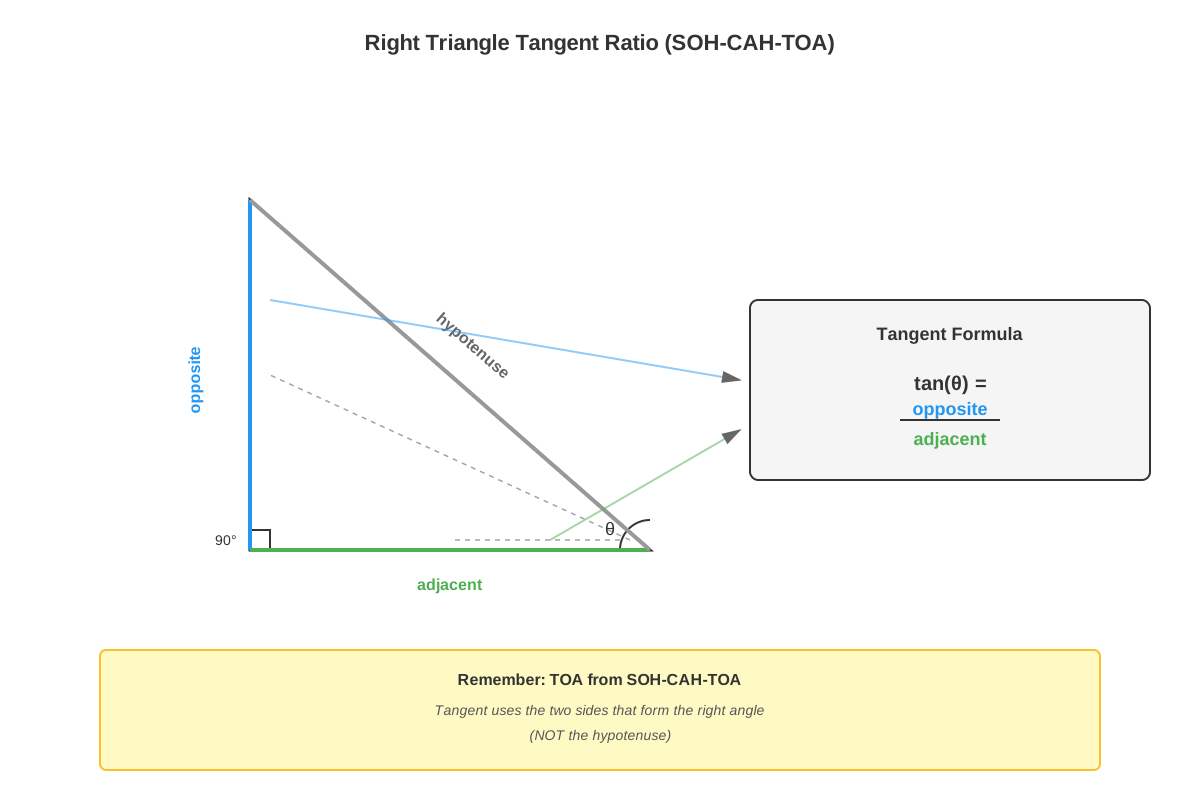
The tangent of an angle in a right triangle is defined as the ratio of the length of the side opposite the angle to the length of the side adjacent to the angle. This can be expressed as:
tan(θ) = opposite/adjacentThis definition is the foundation for all tangent applications on the ACT. When given a right triangle with an angle θ (other than the right angle), identify which side is opposite to θ and which side is adjacent to θ. The hypotenuse is never used in the tangent ratio—this distinguishes tangent from sine and cosine.
For example, in a right triangle where the angle of interest is 35°, the opposite side measures 7 units, and the adjacent side measures 10 units, the tangent would be: tan(35°) = 7/10 = 0.7. This ratio remains constant for all right triangles with a 35° angle, regardless of their size—a property called similarity.
The SOH-CAH-TOA Mnemonic
The classic mnemonic SOH-CAH-TOA helps students remember all three primary trigonometric ratios:
- Sine = Opposite/Hypotenuse
- Cosine = Adjacent/Hypotenuse
- Tangent = Opposite/Adjacent
The "TOA" portion specifically reminds us that tangent uses the opposite side divided by the adjacent side. This mnemonic is particularly valuable on the ACT when you need to quickly determine which trigonometric function to use in a problem.
Special Angle Values
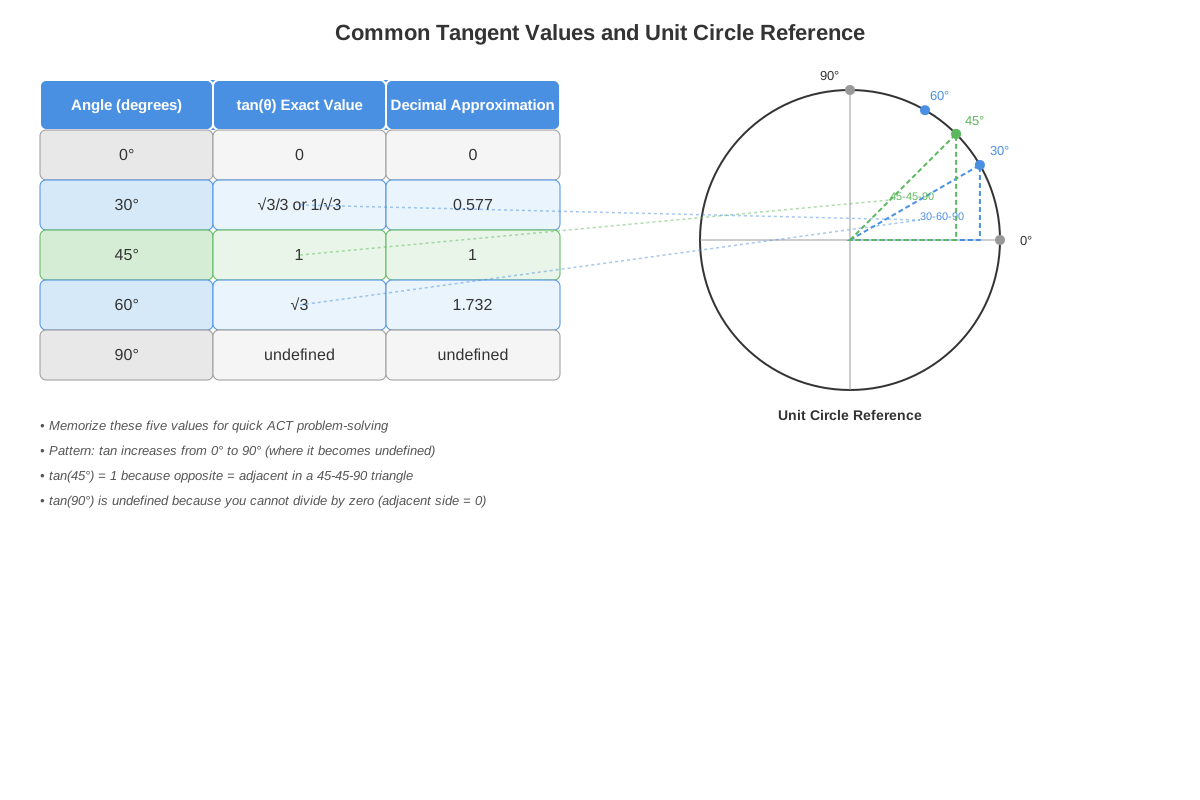
The ACT frequently tests tangent values for special angles. Memorizing these values saves time and reduces calculator dependency:
| Angle | Tangent Value | Exact Form |
|---|---|---|
| 0° | 0 | 0 |
| 30° | 0.577... | √3/3 or 1/√3 |
| 45° | 1 | 1 |
| 60° | 1.732... | √3 |
| 90° | undefined | undefined |
The 45° angle is particularly important because tan(45°) = 1, which occurs when the opposite and adjacent sides are equal (an isosceles right triangle). The tangent of 90° is undefined because the adjacent side would have length zero, creating division by zero.
Tangent and Slope Connection
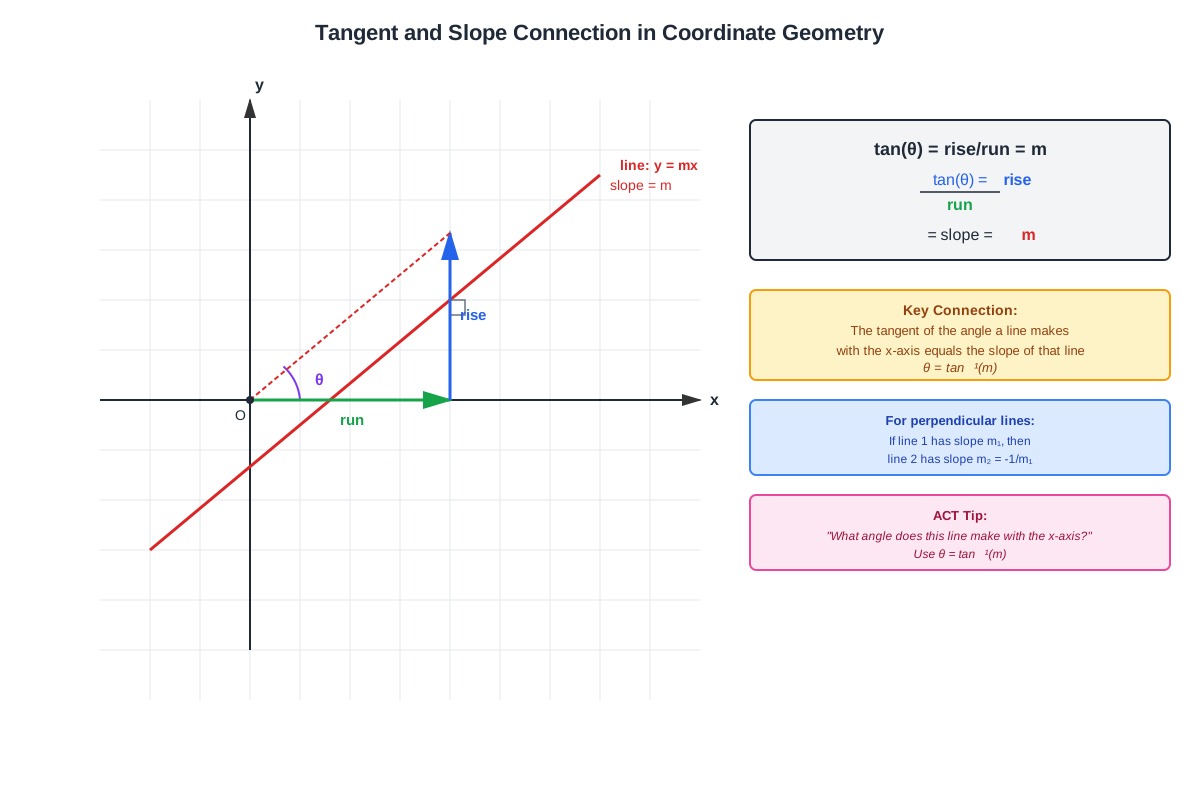
One of the most powerful applications of tangent on the ACT involves its relationship to slope in coordinate geometry. The slope of a line is defined as rise over run (change in y over change in x), which is mathematically identical to the tangent ratio (opposite over adjacent).
When a line makes an angle θ with the positive x-axis, the slope m of that line equals tan(θ). This connection allows you to:
- Find the angle a line makes with the x-axis if you know its slope
- Determine the slope of a line if you know its angle
- Solve problems involving perpendicular lines (whose angles differ by 90°)
For instance, if a line has a slope of 2, the angle it makes with the x-axis is arctan(2) ≈ 63.4°. Conversely, if a line makes a 30° angle with the x-axis, its slope is tan(30°) = √3/3 ≈ 0.577.
Angles of Elevation and Depression
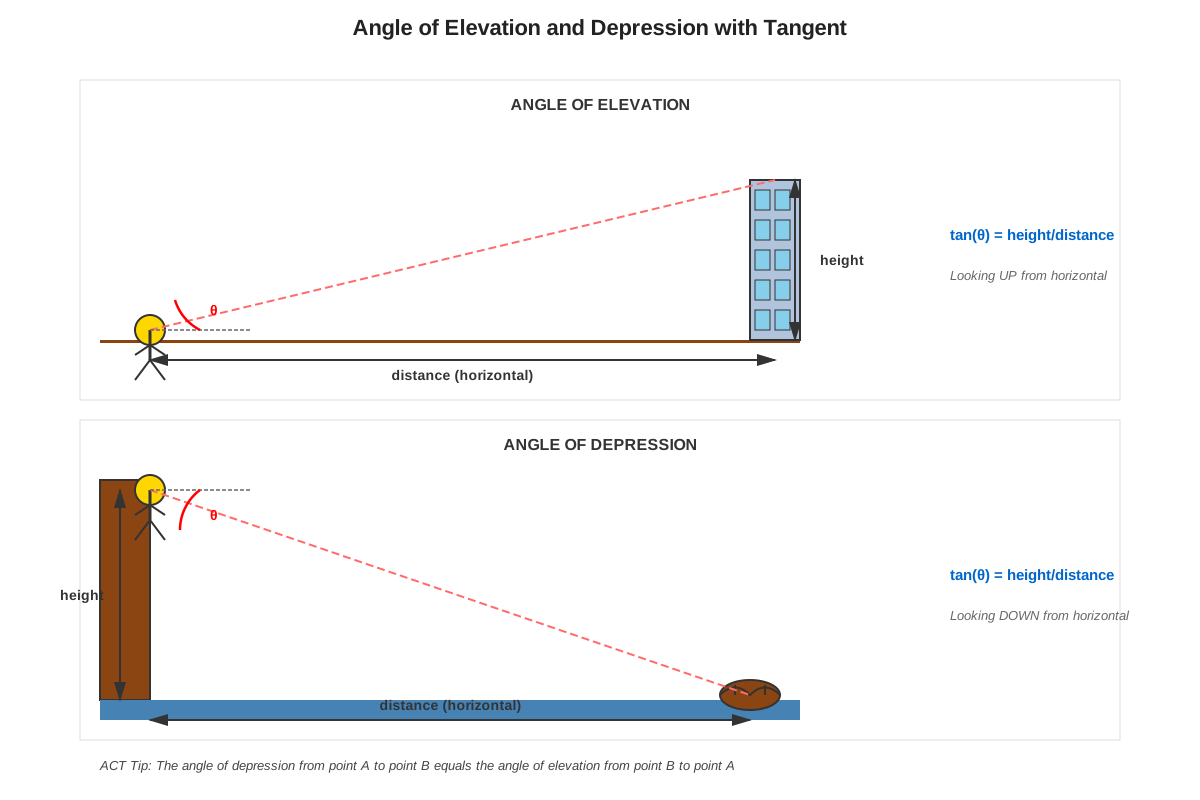
Angles of elevation and angles of depression are among the most common real-world applications of tangent on the ACT. An angle of elevation is measured upward from a horizontal line to an object above the observer. An angle of depression is measured downward from a horizontal line to an object below the observer.
The key insight is that these angles create right triangles where:
- The horizontal distance becomes the adjacent side
- The vertical distance (height difference) becomes the opposite side
- Tangent relates these two measurements
For example, if you stand 50 feet from a building and look up at a 40° angle to see the top, the building's height h satisfies: tan(40°) = h/50, so h = 50 × tan(40°) ≈ 50 × 0.839 ≈ 42 feet.
Inverse Tangent (Arctangent)
The inverse tangent function, written as tan⁻¹(x) or arctan(x), reverses the tangent operation. While tangent takes an angle and produces a ratio, inverse tangent takes a ratio and produces an angle. On the ACT, inverse tangent problems typically ask you to find an angle measure when you know the ratio of two sides.
For example, if opposite/adjacent = 3/4, then the angle θ = tan⁻¹(3/4) ≈ 36.87°. Most scientific calculators have a tan⁻¹ button for these calculations. The ACT expects you to recognize when to use inverse tangent: when the question asks for an angle and you have or can calculate the ratio of opposite to adjacent sides.
Tangent in the Unit Circle
In the unit circle framework, tangent can be understood as the y-coordinate divided by the x-coordinate of a point on the circle corresponding to angle θ. This definition extends tangent beyond acute angles in right triangles to all angle measures, including obtuse angles and negative angles.
Key properties from the unit circle perspective:
- Tangent is positive in Quadrants I and III (where sine and cosine have the same sign)
- Tangent is negative in Quadrants II and IV (where sine and cosine have opposite signs)
- Tangent has a period of 180° (or π radians), meaning tan(θ) = tan(θ + 180°)
- Tangent is undefined at 90° and 270° (where cosine equals zero)
While the ACT focuses primarily on acute angles, understanding these properties helps with more advanced questions involving the tangent function.
Concept Relationships
The tangent function sits at the intersection of multiple mathematical domains, creating a web of interconnected concepts. At its foundation, tangent emerges from right triangle geometry, specifically from the relationship between the opposite and adjacent sides relative to an angle. This geometric definition connects directly to the Pythagorean theorem, which is often needed to find missing side lengths before calculating tangent ratios.
Moving from geometry to algebra, tangent connects to ratios and proportions—every tangent value is fundamentally a ratio that can be simplified or scaled. This ratio interpretation leads naturally to similar triangles, where corresponding angles have identical tangent values regardless of triangle size.
In coordinate geometry, tangent bridges to slope, creating the powerful relationship: slope = tan(angle with x-axis). This connection enables problems that integrate linear equations, graphing, and angle measurement. The slope-tangent relationship also connects to perpendicular lines, since perpendicular slopes are negative reciprocals, corresponding to angles that differ by 90°.
The inverse tangent function creates a bidirectional relationship: tangent converts angles to ratios, while arctangent converts ratios back to angles. This reciprocal relationship is analogous to exponential and logarithmic functions or squaring and square root operations.
Finally, tangent connects to the other trigonometric functions through identities. The fundamental relationship tan(θ) = sin(θ)/cos(θ) shows how tangent derives from sine and cosine. The Pythagorean identity 1 + tan²(θ) = sec²(θ) connects tangent to secant.
Concept flow: Right Triangle Properties → Tangent Ratio Definition → Special Angle Values → Real-World Applications (Elevation/Depression) → Coordinate Geometry (Slope) → Inverse Tangent (Finding Angles) → Unit Circle Extension
High-Yield Facts
⭐ Tangent is defined as opposite/adjacent in a right triangle, never involving the hypotenuse
⭐ tan(45°) = 1 because opposite and adjacent sides are equal in a 45-45-90 triangle
⭐ The slope of a line equals the tangent of the angle it makes with the positive x-axis
⭐ Inverse tangent (tan⁻¹ or arctan) is used to find an angle when you know the opposite/adjacent ratio
⭐ In angle of elevation/depression problems, horizontal distance is adjacent and vertical distance is opposite
- tan(30°) = √3/3 ≈ 0.577 and tan(60°) = √3 ≈ 1.732
- tan(0°) = 0 and tan(90°) is undefined
- Tangent values can be greater than 1 (unlike sine and cosine, which are bounded by -1 and 1)
- The tangent function has a period of 180°, so tan(θ) = tan(θ + 180°)
- In the unit circle, tan(θ) = y/x for the point (x, y) corresponding to angle θ
- Tangent is positive in Quadrants I and III, negative in Quadrants II and IV
- The relationship tan(θ) = sin(θ)/cos(θ) connects all three primary trig functions
- When two lines are perpendicular, their slopes (and thus their tangent values) are negative reciprocals
- Calculator mode matters: ensure your calculator is in degree mode for ACT problems unless otherwise specified
- Complementary angles satisfy the relationship: tan(θ) = 1/tan(90° - θ), which equals cot(90° - θ)
Quick check — test yourself on Tangent so far.
Try Flashcards →Common Misconceptions
Misconception: Tangent always involves the hypotenuse of a right triangle.
Correction: Tangent is the only primary trigonometric ratio that does NOT use the hypotenuse. It is exclusively the ratio of opposite to adjacent sides. Sine and cosine use the hypotenuse, but tangent does not.
Misconception: tan(45°) equals √2/2 or some other special value involving √2.
Correction: tan(45°) = 1 exactly. This occurs because in a 45-45-90 triangle, the two legs are equal in length, making opposite/adjacent = 1. The √2 appears in sine and cosine for 45°, not tangent.
Misconception: Tangent values must be between -1 and 1, like sine and cosine.
Correction: Tangent values can be any real number from negative infinity to positive infinity. As angles approach 90°, tangent values grow without bound. For example, tan(89°) ≈ 57.3, and tan(60°) ≈ 1.732.
Misconception: In angle of elevation problems, the angle is always measured from the ground.
Correction: Angles of elevation are measured from a horizontal line at the observer's eye level, not necessarily from the ground. If you're standing on a cliff looking up at a mountain peak, the horizontal reference is at your position on the cliff, not at ground level.
Misconception: The inverse tangent of a number always gives an angle between 0° and 180°.
Correction: The inverse tangent function (arctan) on calculators typically returns angles between -90° and 90° (or -π/2 and π/2 in radians). This is the principal value range. If you need an angle in a different quadrant, you must adjust based on context.
Misconception: Slope and tangent are completely different concepts that just happen to use similar formulas.
Correction: Slope and tangent are fundamentally the same mathematical concept viewed from different perspectives. The slope of a line IS the tangent of the angle that line makes with the positive x-axis. They are identical, not merely similar.
Misconception: When given two sides of a right triangle, you can always find tangent without knowing which angle you're working with.
Correction: You must identify which angle you're finding the tangent for, because opposite and adjacent are defined relative to a specific angle. The same two sides could be opposite and adjacent for one angle, but adjacent and hypotenuse for another angle in the same triangle.
Worked Examples
Example 1: Classic Right Triangle Problem
Problem: In right triangle ABC, angle C is the right angle. If AC = 12 and BC = 5, what is tan(A)?
Solution:
Step 1: Draw and label the triangle. Angle C is the right angle, so the right angle is at vertex C. This means AB is the hypotenuse.
Step 2: Identify which sides are opposite and adjacent to angle A. From angle A's perspective:
- The opposite side is BC (across from angle A) = 5
- The adjacent side is AC (next to angle A) = 12
- The hypotenuse is AB (we don't need this for tangent)
Step 3: Apply the tangent ratio:
tan(A) = opposite/adjacent = BC/AC = 5/12Answer: tan(A) = 5/12 or approximately 0.417
Connection to learning objectives: This problem tests the core definition of tangent and requires correctly identifying opposite and adjacent sides relative to a specified angle. This is the foundational skill for all tangent applications.
Example 2: Angle of Elevation Application
Problem: A person standing 80 feet from the base of a building measures the angle of elevation to the top of the building as 65°. What is the height of the building to the nearest foot?
Solution:
Step 1: Visualize the scenario. The person, the base of the building, and the top of the building form a right triangle where:
- The horizontal distance (80 feet) is the adjacent side
- The building height (unknown) is the opposite side
- The angle of elevation (65°) is the angle at the person's position
Step 2: Set up the tangent equation. Since we know the angle and the adjacent side, and we need to find the opposite side:
tan(65°) = opposite/adjacent = height/80Step 3: Solve for height:
height = 80 × tan(65°)Step 4: Calculate using a calculator (in degree mode):
height = 80 × 2.1445 ≈ 171.56 feetStep 5: Round to the nearest foot as requested:
height ≈ 172 feetAnswer: The building is approximately 172 feet tall.
Connection to learning objectives: This problem demonstrates identifying when tangent is appropriate (angle of elevation context), applying the tangent ratio to a real-world scenario, and using inverse operations to solve for an unknown side. This type of word problem is extremely common on the ACT.
Example 3: Finding an Angle Using Inverse Tangent
Problem: A wheelchair ramp rises 3 feet over a horizontal distance of 36 feet. What angle does the ramp make with the ground, to the nearest degree?
Solution:
Step 1: Identify the given information:
- Rise (vertical distance) = 3 feet = opposite side
- Run (horizontal distance) = 36 feet = adjacent side
- Angle with ground = unknown
Step 2: Recognize that we need inverse tangent because we're finding an angle from a ratio:
tan(θ) = opposite/adjacent = 3/36 = 1/12Step 3: Apply inverse tangent:
θ = tan⁻¹(1/12)Step 4: Calculate using a calculator:
θ = tan⁻¹(0.0833...) ≈ 4.76°Step 5: Round to the nearest degree:
θ ≈ 5°Answer: The ramp makes an angle of approximately 5° with the ground.
Connection to learning objectives: This problem requires recognizing when to use inverse tangent (when finding an angle rather than a side), understanding the rise/run context as opposite/adjacent, and correctly applying the arctangent function. It also connects tangent to slope (rise/run), demonstrating the coordinate geometry relationship.
Exam Strategy
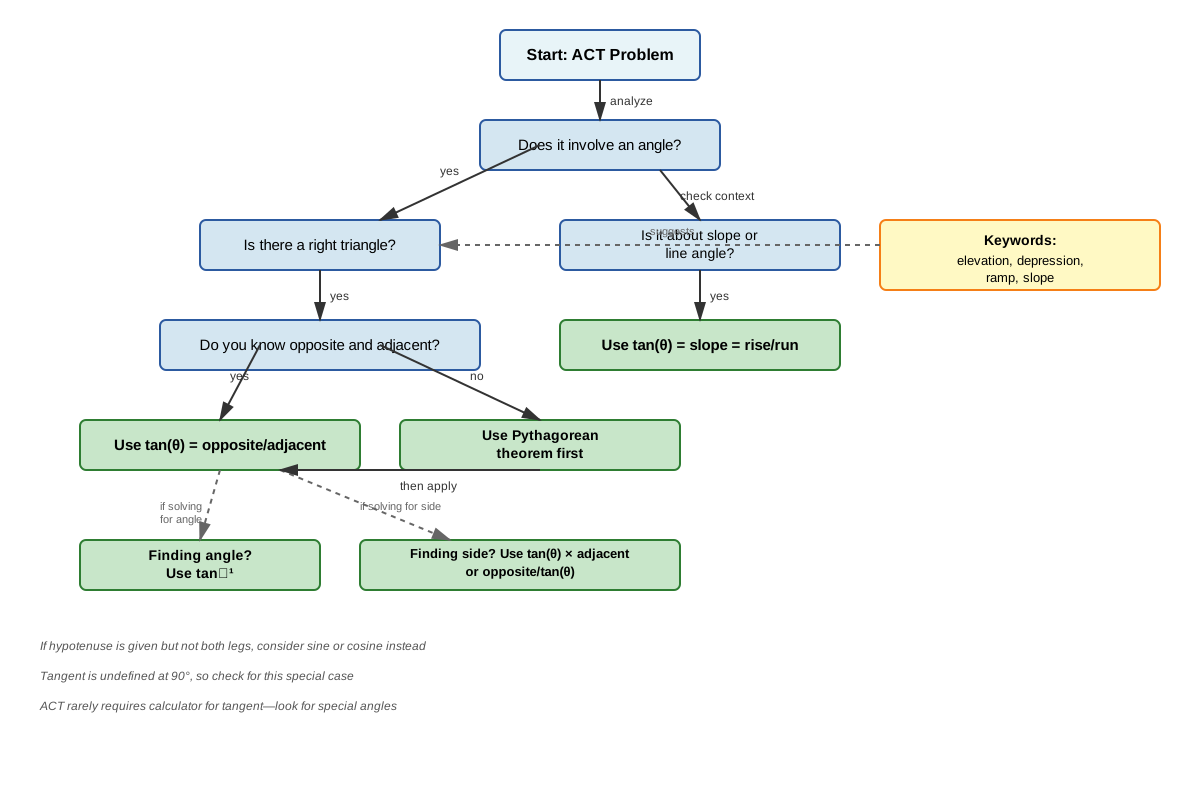
When approaching ACT tangent questions, begin by identifying trigger words and contexts that signal tangent is the appropriate tool. Look for phrases like "angle of elevation," "angle of depression," "slope," "ramp," "grade," "pitch," or any scenario involving a right triangle where you're given or asked about an angle and two sides (neither of which is the hypotenuse).
Recognition strategy: Ask yourself three questions:
- Is there a right triangle (explicit or implied)?
- Do I know or need to find an angle?
- Are the two sides involved NOT the hypotenuse?
If all three answers are yes, tangent is likely your tool.
Calculation approach: Always identify the angle of interest first, then label opposite and adjacent sides relative to that specific angle. Draw a diagram if one isn't provided—this prevents the most common error of confusing which side is which. Write out "tan(angle) = opp/adj" before substituting numbers to ensure you're setting up the ratio correctly.
Time-saving tips:
- Memorize special angle values (30°, 45°, 60°) to avoid calculator use when possible
- Recognize that tan(45°) = 1 immediately signals equal legs
- When you see slope problems, immediately think tangent
- If the problem asks for an angle and gives you two sides, jump straight to inverse tangent
Process of elimination: On multiple-choice questions, you can often eliminate answers by:
- Checking if the answer is reasonable (a 100-foot building viewed from 20 feet away won't have a 10° angle)
- Recognizing that tangent values for acute angles between 0° and 45° are less than 1
- Knowing that tangent values for acute angles between 45° and 90° are greater than 1
- Verifying that angles of elevation/depression must be between 0° and 90°
Calculator management: Ensure your calculator is in degree mode (not radians) before starting the math section. The ACT uses degrees unless explicitly stated otherwise. Double-check this if you get an unexpected answer. Also, know where your tan⁻¹ button is located—it's often a second function above the tan button.
Common trap avoidance: The ACT loves to test whether you'll confuse sine, cosine, and tangent. If you see answer choices that would result from using the wrong trig function, that's a red flag to double-check your setup. Also watch for problems that give you the hypotenuse—this means you CANNOT use tangent alone without first finding another side.
Memory Techniques
SOH-CAH-TOA remains the gold standard mnemonic for remembering all three primary trig ratios. For tangent specifically, focus on "TOA": Tangent = Opposite/Adjacent. Some students create silly sentences like "The Old Alligator" or "Toes Over Ankles" to remember this sequence.
The "Tan = Slope" connection can be remembered with the phrase "Tangent And Slope are the same" (TAS). Whenever you see slope, think tangent; whenever you see tangent of an angle with the x-axis, think slope.
Special angle visualization: Picture an equilateral triangle split in half to create 30-60-90 triangles, and picture a square split diagonally to create 45-45-90 triangles. These visual anchors help you remember:
- 45° → equal legs → tan = 1
- 30° → short leg over long leg → tan < 1 (specifically √3/3)
- 60° → long leg over short leg → tan > 1 (specifically √3)
The "No Hypotenuse" rule: Remember that tangent is the "rebel" trig function—it's the only one that doesn't use the hypotenuse. Think "Tangent Totally ignores Hypotenuse" (TTH).
Inverse tangent reminder: When you need to find an angle, think "I need the Angle, so I use Arctan" (inverse tangent). The word "arctan" literally means "the arc (angle) whose tangent is..."
Elevation/Depression memory aid: "Elevation = Eyes up" and "Depression = Down." The angle of elevation is when you look up; the angle of depression is when you look down. Both create right triangles where horizontal is adjacent and vertical is opposite.
Summary
Tangent is a fundamental trigonometric ratio defined as opposite over adjacent in right triangles, and it serves as a critical tool for solving ACT Math problems involving angles, slopes, and spatial relationships. Unlike sine and cosine, tangent does not involve the hypotenuse, making it the appropriate choice when working with the two legs of a right triangle. The ACT tests tangent through direct right triangle problems, real-world applications like angles of elevation and depression, and coordinate geometry questions involving slope. Mastery requires recognizing when tangent applies, correctly identifying opposite and adjacent sides relative to the angle of interest, and fluently using both tangent (to find ratios from angles) and inverse tangent (to find angles from ratios). Special angle values—particularly tan(45°) = 1, tan(30°) = √3/3, and tan(60°) = √3—should be memorized for efficiency. The powerful connection between tangent and slope enables solving problems that bridge trigonometry and coordinate geometry, making tangent one of the most versatile tools in your ACT Math arsenal.
Key Takeaways
- Tangent equals opposite over adjacent (never involves the hypotenuse), distinguishing it from sine and cosine
- SOH-CAH-TOA is the essential mnemonic, with TOA specifically representing Tangent = Opposite/Adjacent
- tan(45°) = 1 is the most frequently tested special angle value, occurring when opposite and adjacent sides are equal
- Slope equals tangent of the angle a line makes with the positive x-axis, connecting coordinate geometry to trigonometry
- Inverse tangent (arctan) finds angles when you know the opposite/adjacent ratio—use it when the question asks for an angle measure
- Angles of elevation and depression create right triangles where horizontal distance is adjacent and vertical distance is opposite
- Recognition is crucial: identify tangent problems by looking for right triangles with angle information and two non-hypotenuse sides
Related Topics
Sine and Cosine: The other two primary trigonometric ratios that complete the SOH-CAH-TOA framework. Mastering tangent alongside sine and cosine enables you to solve any right triangle problem and choose the most efficient approach for each question type.
Pythagorean Theorem: Essential for finding missing side lengths before calculating tangent ratios. Often combined with tangent in multi-step ACT problems where you must first determine a side length, then use it in a trig ratio.
Unit Circle and Radian Measure: Extends trigonometric functions beyond right triangles to all angle measures. While the ACT focuses on degrees, understanding the unit circle deepens comprehension of tangent's properties and periodic behavior.
Trigonometric Identities: Relationships like tan(θ) = sin(θ)/cos(θ) and 1 + tan²(θ) = sec²(θ) connect tangent to other trig functions. These identities appear in advanced ACT questions and are essential for calculus preparation.
Law of Sines and Law of Cosines: Tools for solving non-right triangles that build on right triangle trigonometry. After mastering tangent in right triangles, these laws extend your problem-solving capabilities to all triangle types.
Practice CTA
Now that you've mastered the core concepts of tangent, it's time to solidify your understanding through practice! Work through the practice questions to test your ability to recognize tangent problems, apply the correct ratios, and solve real-world applications efficiently. Use the flashcards to drill special angle values and key formulas until they become automatic. Remember, the difference between knowing tangent and mastering it lies in repeated application—each practice problem strengthens your pattern recognition and builds the confidence you need to tackle any tangent question the ACT throws at you. You've got this!
Sign up free to keep reading
Create a free AnvayaPrep account to finish this ACT guide on Tangent — plus flashcards and practice questions.