Overview
The graph of cosine is a fundamental trigonometric concept that appears regularly on the ACT Math test, particularly in questions involving periodic functions, transformations, and coordinate geometry. Understanding the cosine graph means recognizing its distinctive wave-like shape, knowing its key properties such as amplitude, period, phase shift, and vertical shift, and being able to identify how algebraic modifications to the cosine function affect its graphical representation. This topic bridges algebra, geometry, and trigonometry, making it a high-yield area for test preparation.
On the ACT, students encounter cosine graphs in multiple contexts: identifying graphs from equations, determining equations from graphs, analyzing transformations, and solving real-world problems involving periodic phenomena. The ACT graph of cosine questions typically test whether students can quickly recognize the standard cosine curve and predict how changes to the function's parameters alter its appearance. These questions often appear in the later portion of the 60-question Math section, where more advanced topics are tested, and they frequently combine multiple concepts in a single problem.
Mastering the cosine graph connects directly to broader mathematical understanding. The cosine function relates to the unit circle, right triangle trigonometry, and the sine function. Understanding cosine graphs enables students to tackle problems involving wave motion, circular motion, and oscillating systems. Additionally, the transformations applied to cosine functions (stretches, compressions, shifts) mirror transformation concepts applied to other function families, reinforcing algebraic reasoning skills essential throughout the ACT Math section.
Learning Objectives
- [ ] Identify when Graph of cosine is being tested in ACT questions
- [ ] Explain the core rule or strategy behind Graph of cosine analysis
- [ ] Apply Graph of cosine concepts to ACT-style questions accurately
- [ ] Sketch the basic cosine curve from memory with correct key points
- [ ] Determine the amplitude, period, phase shift, and vertical shift from a cosine equation
- [ ] Match cosine equations to their corresponding graphs and vice versa
- [ ] Predict how parameter changes affect the cosine graph's appearance
Prerequisites
- Basic trigonometric ratios (sine, cosine, tangent): Understanding what cosine represents in right triangles provides the foundation for extending this concept to the coordinate plane
- Unit circle fundamentals: The cosine function's values correspond to x-coordinates on the unit circle, which explains the function's range and periodic nature
- Function notation and evaluation: Ability to substitute values into functions like f(x) = cos(x) is necessary for plotting points and verifying graph properties
- Coordinate plane graphing: Familiarity with plotting points and interpreting graphs enables visualization of the cosine function
- Function transformations: Knowledge of how adding, multiplying, and shifting affects general functions applies directly to cosine transformations
Why This Topic Matters
The cosine function models countless real-world phenomena involving periodic behavior: sound waves, light waves, tidal patterns, seasonal temperature variations, and mechanical oscillations. Engineers use cosine functions to design suspension systems, architects employ them in structural analysis, and physicists rely on them to describe wave mechanics. Understanding cosine graphs provides insight into any situation where values repeat in regular cycles.
On the ACT Math test, cosine graph questions appear with moderate frequency—typically 1-2 questions per exam. These questions usually fall in the difficulty range of questions 40-60, where more advanced mathematical reasoning is required. The ACT tests cosine graphs through several question types: identifying the correct graph from multiple choices given an equation, determining the equation that matches a displayed graph, finding specific values from a graph, and analyzing how parameter changes affect the graph. Questions may also combine cosine graphs with other topics such as domain and range, function composition, or solving equations.
Common ACT question formats include showing four different wave graphs and asking which represents y = cos(x) versus y = sin(x), presenting an equation like y = 2cos(3x - π) + 1 and asking for its amplitude or period, or displaying a transformed cosine graph and asking which equation produces it. The test frequently includes distractor answers that represent common misconceptions, making thorough understanding essential for avoiding traps.
Core Concepts
The Basic Cosine Function
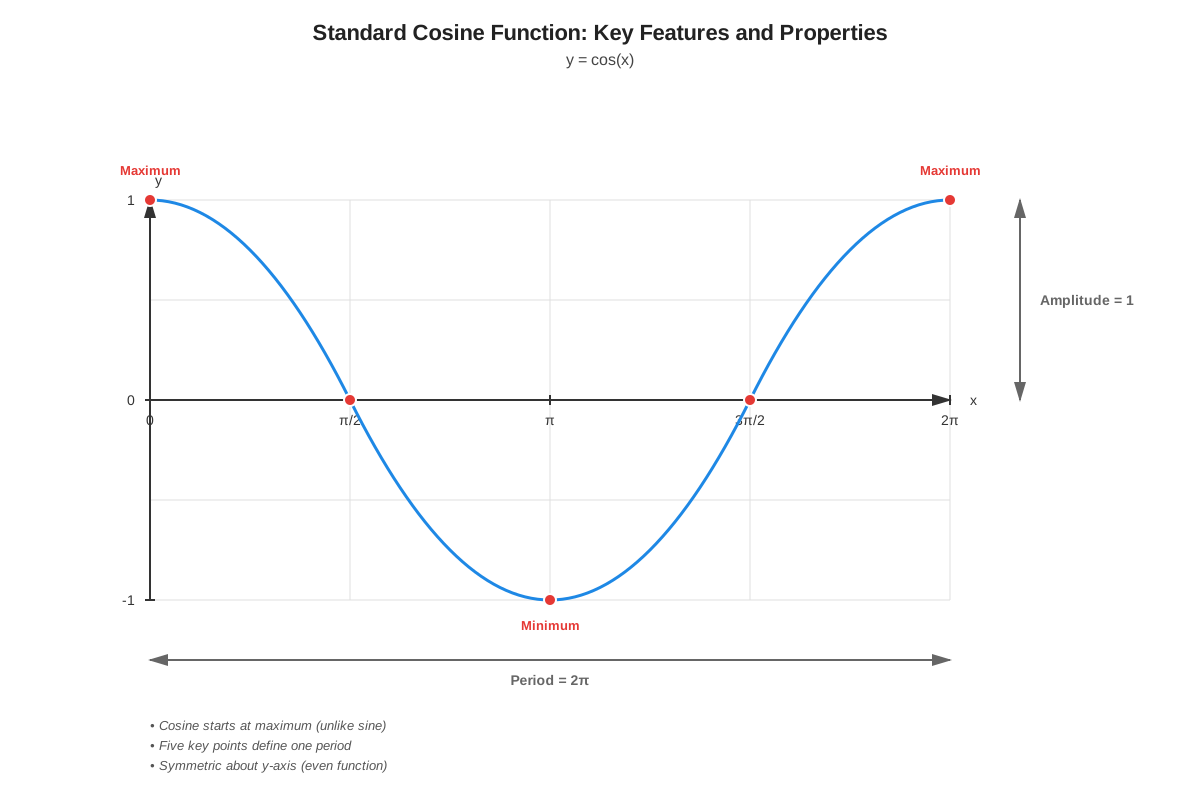
The graph of cosine in its most fundamental form is represented by the function f(x) = cos(x), where x is measured in radians. This basic cosine curve has several defining characteristics that distinguish it from other functions. The graph is a smooth, continuous wave that oscillates between -1 and 1, creating a periodic pattern that repeats every 2π units.
The standard cosine graph begins at its maximum value when x = 0, where cos(0) = 1. This starting point at a maximum is the primary visual difference between cosine and sine graphs. As x increases from 0, the cosine value decreases, crossing through cos(π/2) = 0, reaching its minimum at cos(π) = -1, returning through cos(3π/2) = 0, and completing one full cycle at cos(2π) = 1.
Key points on the basic cosine curve occur at regular intervals:
- (0, 1) — maximum point
- (π/2, 0) — x-intercept
- (π, -1) — minimum point
- (3π/2, 0) — x-intercept
- (2π, 1) — maximum point (cycle repeats)
Amplitude
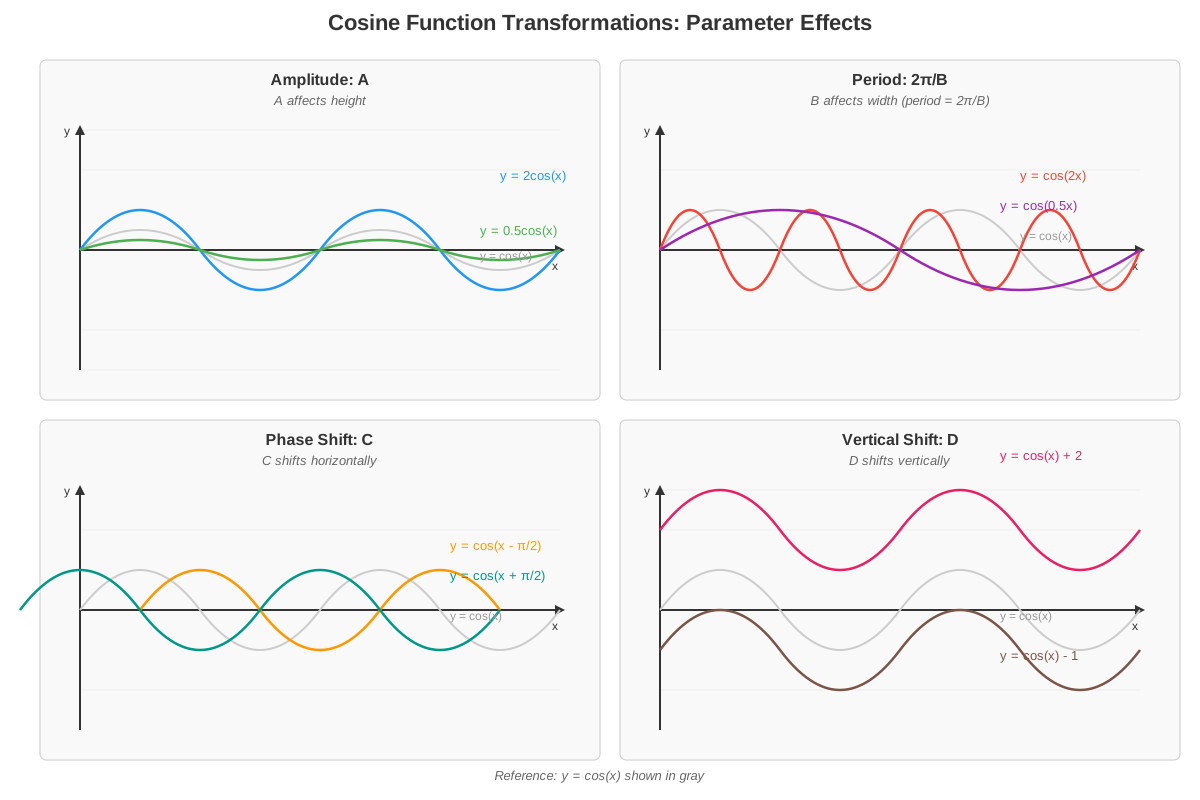
Amplitude represents the vertical distance from the function's midline to its maximum (or minimum) value. For the general form y = A·cos(x), the amplitude equals |A|. The amplitude determines how "tall" the waves appear—larger amplitudes create taller waves, while smaller amplitudes create shorter waves.
When A is positive, the cosine graph maintains its standard orientation (starting at a maximum). When A is negative, the graph reflects across the x-axis, starting at a minimum instead. For example, y = 3cos(x) has amplitude 3, oscillating between -3 and 3, while y = -2cos(x) has amplitude 2 but is inverted, starting at -2 when x = 0.
Period
The period of a cosine function is the horizontal length required for the function to complete one full cycle before repeating. For the general form y = cos(Bx), the period equals 2π/|B|. The coefficient B affects horizontal compression or stretching—larger values of B compress the graph horizontally (creating more cycles in the same space), while smaller values stretch it horizontally (creating fewer cycles).
For example, y = cos(2x) has period 2π/2 = π, meaning the function completes a full cycle twice as quickly as the standard cosine. Conversely, y = cos(x/2) has period 2π/(1/2) = 4π, stretching the cycle to twice the normal length.
Phase Shift
Phase shift refers to horizontal translation of the cosine graph left or right. For the general form y = cos(B(x - C)), the phase shift equals C. When C is positive, the graph shifts right; when C is negative, the graph shifts left. The phase shift moves the entire wave pattern horizontally without changing its shape.
For instance, y = cos(x - π/2) shifts the standard cosine graph π/2 units to the right, which notably makes it coincide with the sine function. The equation y = cos(x + π) shifts the graph π units left, creating an inverted cosine curve.
Vertical Shift
Vertical shift moves the entire cosine graph up or down, changing the midline around which the function oscillates. For the general form y = cos(x) + D, the vertical shift equals D. This transformation doesn't affect the amplitude or period but changes the range of the function.
For example, y = cos(x) + 2 shifts the entire graph up 2 units, so the function oscillates between 1 and 3 instead of -1 and 1. The midline becomes y = 2 rather than y = 0.
General Form and Complete Transformations
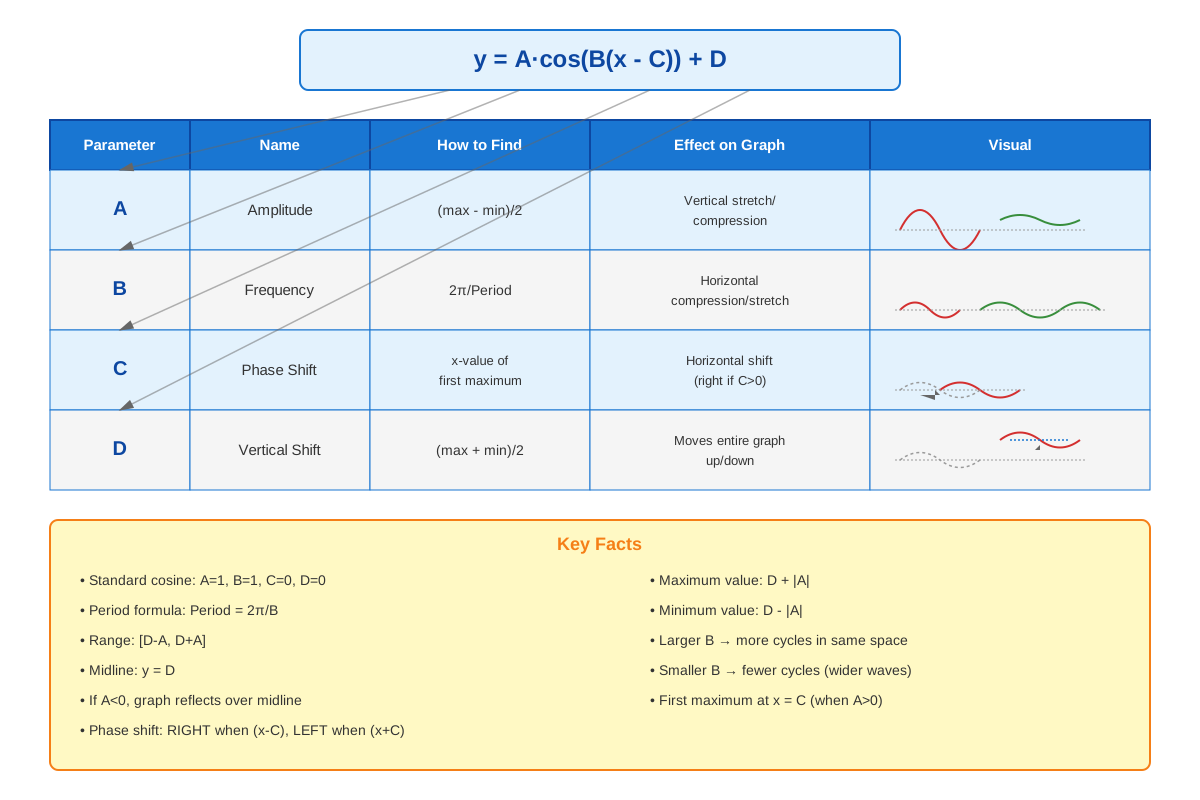
The complete general form of a transformed cosine function is:
y = A·cos(B(x - C)) + DWhere:
- |A| = amplitude
- 2π/|B| = period
- C = phase shift (horizontal shift)
- D = vertical shift
The maximum value of this function is D + |A|, and the minimum value is D - |A|. Understanding how each parameter affects the graph independently allows students to analyze complex transformations systematically.
Comparison with Sine
| Property | Cosine Graph | Sine Graph |
|---|---|---|
| Starting point (x=0) | Maximum (1) | Midline (0) |
| First quarter cycle | Decreasing | Increasing |
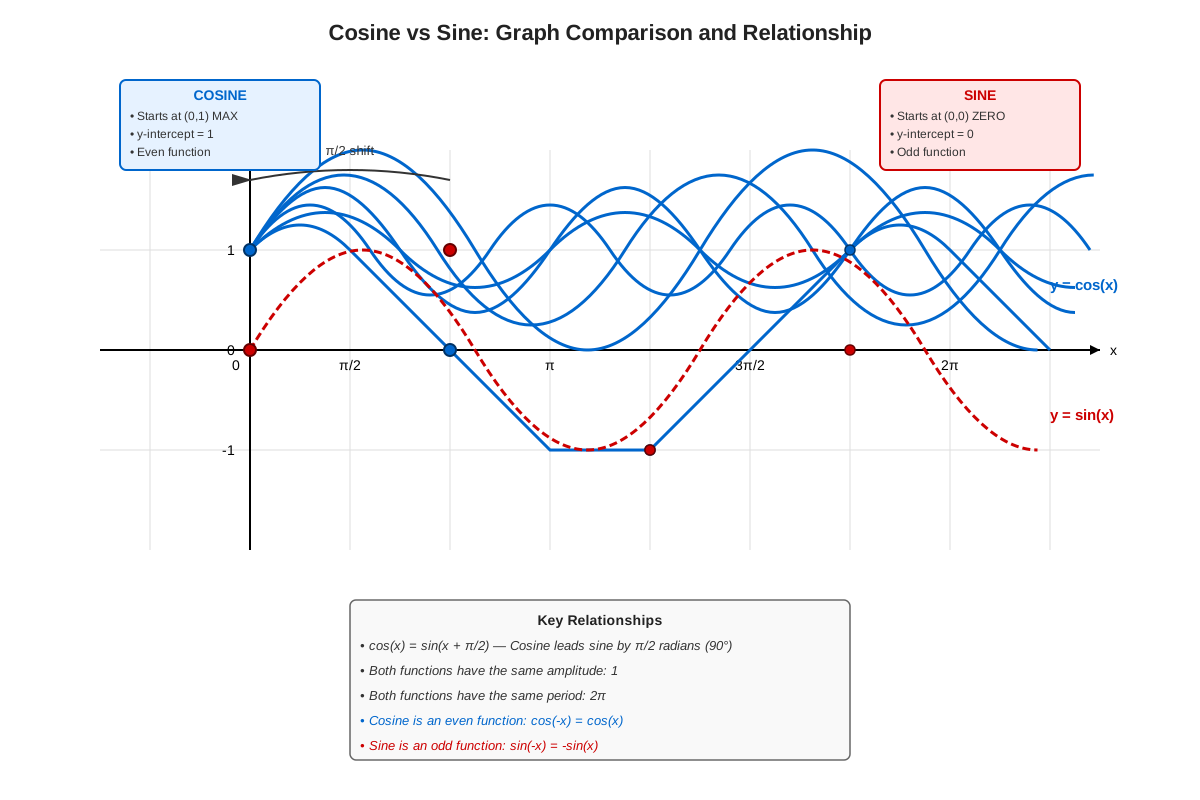
| Relationship | cos(x) = sin(x + π/2) | sin(x) = cos(x - π/2) |
| Symmetry | Even function (symmetric about y-axis) | Odd function (symmetric about origin) |
| Key points at x=0 | (0, 1) | (0, 0) |
Concept Relationships
The cosine graph concepts form an interconnected system where each element builds upon others. The basic cosine function serves as the foundation → amplitude transformations modify vertical stretching → period transformations modify horizontal compression → phase shifts translate horizontally → vertical shifts translate vertically → complete general form combines all transformations.
The relationship to prerequisite knowledge flows as follows: Unit circle → defines cosine values at key angles → basic cosine function → plots these values continuously → graph of cosine emerges as a wave pattern. Similarly, function transformations (general algebraic concept) → apply specifically to trigonometric functions → transformed cosine graphs result.
Cosine graphs connect to other trigonometric concepts: sine graphs are phase-shifted versions of cosine graphs, tangent graphs involve ratios of sine and cosine, and inverse trigonometric functions reverse the graphing process. Understanding cosine graphs also enables work with trigonometric equations (finding x-values where the graph intersects specific y-values) and trigonometric identities (which can be visualized through graph relationships).
High-Yield Facts
⭐ The basic cosine graph y = cos(x) starts at its maximum point (0, 1) when x = 0
⭐ The standard cosine function has amplitude 1, period 2π, and oscillates between -1 and 1
⭐ For y = A·cos(Bx), the amplitude is |A| and the period is 2π/|B|
⭐ A negative coefficient A reflects the cosine graph across the x-axis (inverts it)
⭐ The cosine function is an even function, meaning cos(-x) = cos(x), creating y-axis symmetry
- The cosine graph crosses the x-axis at odd multiples of π/2: ..., -3π/2, -π/2, π/2, 3π/2, ...
- Maximum points on y = cos(x) occur at x = 0, ±2π, ±4π, ... (even multiples of π)
- Minimum points on y = cos(x) occur at x = ±π, ±3π, ±5π, ... (odd multiples of π)
- The range of y = A·cos(B(x - C)) + D is [D - |A|, D + |A|]
- The domain of all cosine functions is all real numbers (-∞, ∞)
- Increasing B compresses the graph horizontally, creating more cycles in the same interval
- The phase shift C must be factored out from the B coefficient: y = cos(2x - π) = cos(2(x - π/2))
- Cosine and sine graphs are identical except for a horizontal shift of π/2
- The midline of a transformed cosine graph is the horizontal line y = D
- One complete cycle of any cosine graph includes exactly one maximum, one minimum, and two x-intercepts
Quick check — test yourself on Graph of cosine so far.
Try Flashcards →Common Misconceptions
Misconception: The period of y = cos(x - 2) is 2 because of the "-2" in the equation.
Correction: The period remains 2π because the "-2" represents a phase shift (horizontal translation), not a period change. Only the coefficient of x (the B value) affects the period. The function y = cos(x - 2) has period 2π and is shifted 2 units to the right.
Misconception: Amplitude can be negative.
Correction: Amplitude is always expressed as a positive value representing distance, so amplitude = |A|. While the coefficient A can be negative (which reflects the graph), the amplitude itself is the absolute value. For y = -3cos(x), the amplitude is 3, not -3.
Misconception: The cosine graph starts at the origin like the sine graph.
Correction: The basic cosine graph starts at its maximum point (0, 1), not at the origin. This is the key visual difference between cosine and sine. The sine graph passes through the origin (0, 0), while cosine starts at its peak.
Misconception: To find the phase shift in y = cos(2x - 4), simply use C = -4.
Correction: The phase shift must be calculated by factoring out the coefficient of x first: y = cos(2x - 4) = cos(2(x - 2)), so the phase shift is C = 2 (right 2 units), not -4. The general form requires B(x - C), so you must divide the constant by B.
Misconception: A larger period means more waves fit in the same interval.
Correction: A larger period means fewer waves fit in the same interval because each cycle takes more horizontal space to complete. For example, y = cos(x/2) with period 4π completes only half a cycle from 0 to 2π, while y = cos(2x) with period π completes two full cycles in that same interval.
Misconception: The maximum value of y = 3cos(x) + 2 is 3.
Correction: The maximum value is 5, calculated as D + |A| = 2 + 3 = 5. The "+2" shifts the entire graph up, so the wave oscillates between -1 and 5, not between -3 and 3.
Misconception: Cosine graphs always cross the y-axis at y = 1.
Correction: Only the basic cosine graph y = cos(x) crosses the y-axis at (0, 1). Transformed cosine functions cross the y-axis at different points depending on their amplitude and vertical shift. For example, y = 2cos(x) + 3 crosses at (0, 5).
Worked Examples
Example 1: Identifying Graph Properties from an Equation
Problem: For the function y = -2cos(3x + π) - 1, determine the amplitude, period, phase shift, vertical shift, maximum value, and minimum value.
Solution:
First, rewrite the equation in standard form y = A·cos(B(x - C)) + D by factoring:
y = -2cos(3x + π) - 1 = -2cos(3(x + π/3)) - 1
Now identify each parameter:
- A = -2, so amplitude = |A| = |-2| = 2
- B = 3, so period = 2π/|B| = 2π/3
- C = -π/3, so phase shift = -π/3 (left π/3 units)
- D = -1, so vertical shift = -1 (down 1 unit)
The negative A value means the graph is reflected (inverted), starting at a minimum instead of a maximum.
For the maximum and minimum values:
- Maximum value = D + |A| = -1 + 2 = 1
- Minimum value = D - |A| = -1 - 2 = -3
The graph oscillates between -3 and 1, with midline at y = -1, completing cycles every 2π/3 units, shifted left by π/3 units, and inverted from the standard cosine orientation.
Connection to Learning Objectives: This example demonstrates applying the core rules for analyzing cosine graphs and shows the systematic approach needed for ACT questions that present an equation and ask for specific properties.
Example 2: Matching a Graph to its Equation
Problem: A cosine graph is shown with the following properties: it passes through the point (0, 3), has a minimum value of -1, has a maximum value of 3, and completes one full cycle from x = 0 to x = π. Which equation represents this graph?
A) y = 2cos(2x) + 1
B) y = 4cos(2x) - 1
C) y = 2cos(x) + 1
D) y = 3cos(2x)
Solution:
Step 1: Determine the amplitude.
The distance from minimum to maximum is 3 - (-1) = 4.
Amplitude = 4/2 = 2, so |A| = 2.
Step 2: Determine the vertical shift.
The midline is halfway between maximum and minimum: (-1 + 3)/2 = 1.
So D = 1.
Step 3: Determine if the graph is inverted.
The graph passes through (0, 3), which is the maximum value. Standard cosine starts at a maximum, so A is positive: A = 2.
Step 4: Determine the period.
One complete cycle occurs from x = 0 to x = π, so period = π.
Using period = 2π/|B|: π = 2π/|B|, so |B| = 2, meaning B = 2.
Step 5: Construct the equation.
y = 2cos(2x) + 1
Answer: A
Verification: At x = 0: y = 2cos(0) + 1 = 2(1) + 1 = 3 ✓
Maximum: D + |A| = 1 + 2 = 3 ✓
Minimum: D - |A| = 1 - 2 = -1 ✓
Period: 2π/2 = π ✓
Connection to Learning Objectives: This example shows how to work backward from graph properties to equation, a common ACT question type that tests whether students truly understand the relationship between algebraic parameters and graphical features.
Exam Strategy
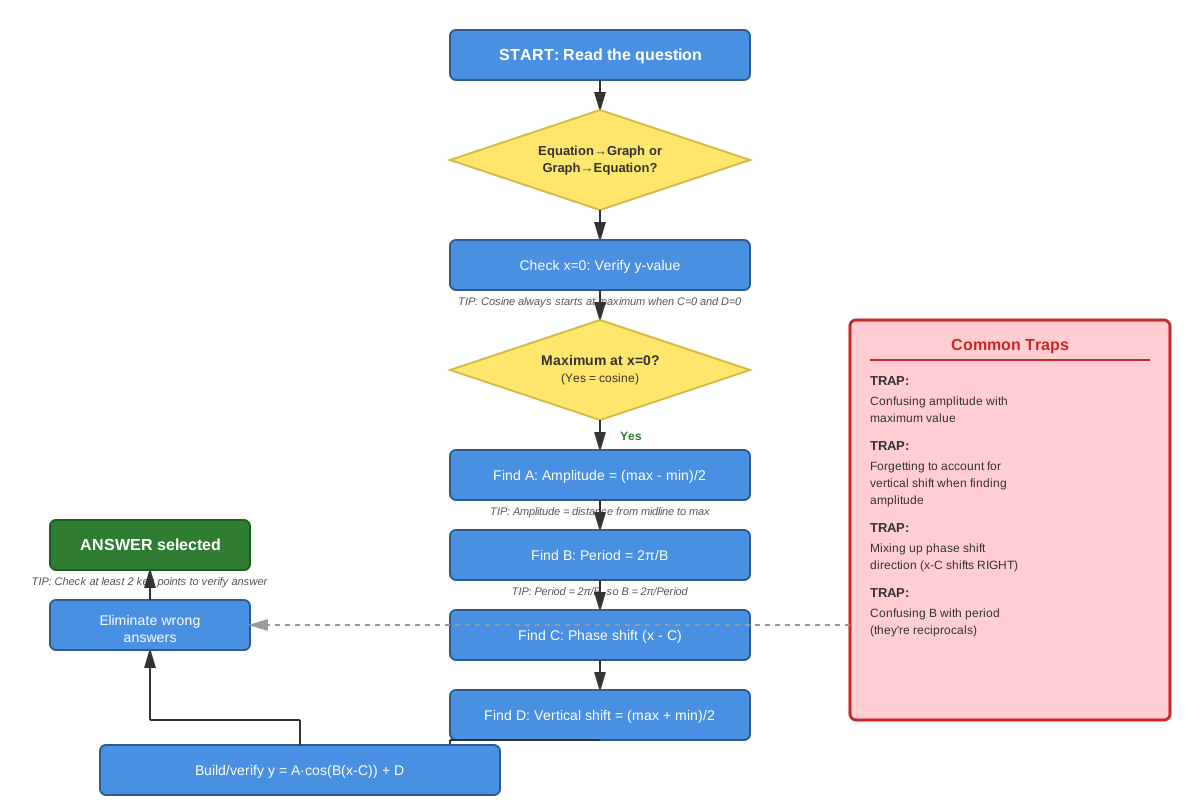
When approaching ACT graph of cosine questions, begin by identifying what the question asks: are you finding properties from an equation, matching graphs to equations, or determining equations from graphs? This determines your strategy.
Trigger words and phrases that indicate cosine graph questions include: "periodic function," "oscillates," "amplitude," "period," "maximum value," "minimum value," "completes a cycle," "wave," and direct mentions of "cosine" or "cos." Questions may also show a graph without naming the function type, requiring you to recognize the cosine pattern visually.
For equation-to-graph questions, use this systematic approach:
- Identify the starting point at x = 0 (cosine starts at maximum if A > 0, minimum if A < 0)
- Calculate the period to determine horizontal spacing
- Determine amplitude to find vertical extent
- Check for vertical shifts to locate the midline
- Eliminate answer choices that don't match these properties
For graph-to-equation questions, work backward:
- Find the midline (vertical shift D)
- Measure from midline to maximum (amplitude |A|)
- Count the horizontal distance for one complete cycle (period)
- Check the starting point to determine if A is positive or negative
- Calculate B from the period using B = 2π/period
Exam Tip: The ACT often includes sine graphs as distractor answers in cosine questions. Remember: cosine starts at a maximum or minimum (depending on sign), while sine starts at the midline.
Process-of-elimination strategies:
- Immediately eliminate any answer with the wrong period (count cycles in the given interval)
- Eliminate answers with incorrect amplitude (measure vertical distance from midline)
- Eliminate answers where the y-intercept doesn't match the graph
- For inverted graphs (starting at minimum), eliminate positive A values
Time allocation: Cosine graph questions typically require 45-60 seconds. If a question involves complex transformations or requires calculating multiple properties, it may warrant up to 90 seconds. Don't spend excessive time trying to visualize complicated phase shifts—calculate them algebraically instead.
When stuck, plug in x = 0 to each answer choice and see which gives the correct y-intercept shown on the graph. This quick check often eliminates 2-3 wrong answers immediately.
Memory Techniques
APVP Mnemonic for the four main transformations:
- Amplitude (vertical stretch)
- Period (horizontal compression)
- Vertical shift (up/down)
- Phase shift (left/right)
"Cosine Starts at the Top": Remember that the basic cosine graph begins at its maximum point (0, 1), unlike sine which starts at the origin. Visualize a mountain peak at the y-axis.
"2π Divided By B": For period calculation, always remember the formula as a fraction: 2π/B. Create a mental image of "2π sitting on top of B" to avoid confusion.
"Inside Affects X, Outside Affects Y": Transformations inside the function (with x) affect horizontal properties (period and phase shift), while transformations outside affect vertical properties (amplitude and vertical shift). This helps categorize what each parameter controls.
The "DABC" Order: When writing the general form, remember the order as D-A-B-C:
- D comes at the end (vertical shift)
- A multiplies the entire function (amplitude)
- B multiplies x (period)
- C subtracts from x (phase shift)
Visualization Strategy: Picture the basic cosine wave as a roller coaster starting at the highest point. Amplitude makes it taller or shorter, period makes the hills closer or farther apart, phase shift moves the whole track left or right, and vertical shift raises or lowers the entire track.
Summary
The graph of cosine is a periodic wave function that oscillates smoothly between maximum and minimum values, starting at its maximum when x = 0 for the basic form y = cos(x). Understanding cosine graphs requires mastery of four key transformations: amplitude (vertical stretch/compression), period (horizontal stretch/compression), phase shift (horizontal translation), and vertical shift (vertical translation). The general form y = A·cos(B(x - C)) + D encodes all these transformations, where |A| determines amplitude, 2π/|B| determines period, C determines phase shift, and D determines vertical shift. On the ACT, students must quickly identify these parameters from equations, match equations to graphs, and recognize how parameter changes affect the graph's appearance. The cosine graph differs from the sine graph primarily in its starting position—cosine begins at a maximum while sine begins at the midline. Successful ACT performance requires recognizing the standard cosine wave pattern, systematically analyzing transformations, and efficiently eliminating incorrect answer choices based on visual and algebraic properties.
Key Takeaways
- The basic cosine graph y = cos(x) starts at (0, 1), has amplitude 1, period 2π, and oscillates between -1 and 1
- Amplitude |A| determines vertical stretch; period 2π/|B| determines horizontal compression; both are always positive values
- Phase shift C moves the graph horizontally (must factor out B to find it); vertical shift D moves the graph up or down
- Negative A values invert the cosine graph, making it start at a minimum instead of a maximum
- The maximum value of any transformed cosine is D + |A|; the minimum is D - |A|
- Cosine graphs are even functions with y-axis symmetry, while sine graphs are odd functions with origin symmetry
- On the ACT, systematically identify each transformation parameter and eliminate answer choices that don't match the graph's properties
Related Topics
Sine Graphs: The sine function produces a wave identical in shape to cosine but shifted horizontally by π/2. Mastering cosine graphs makes sine graphs immediately accessible, as they follow the same transformation rules with only a different starting point.
Tangent Graphs: Unlike cosine and sine, tangent graphs have vertical asymptotes and a period of π. Understanding periodic behavior in cosine provides foundation for analyzing tangent's different periodic pattern.
Trigonometric Equations: Solving equations like cos(x) = 0.5 requires understanding where the cosine graph intersects horizontal lines, directly applying graph visualization skills.
Inverse Trigonometric Functions: The graphs of arccos(x) and related inverse functions are reflections of restricted cosine graphs across the line y = x, building on cosine graph knowledge.
Harmonic Motion and Wave Functions: Real-world applications of cosine graphs appear in physics problems involving oscillations, waves, and circular motion, extending the mathematical concepts to applied contexts.
Practice CTA
Now that you've mastered the core concepts of cosine graphs, it's time to solidify your understanding through active practice. Attempt the practice questions to test your ability to identify transformations, match equations to graphs, and solve ACT-style problems under timed conditions. Use the flashcards to reinforce the key formulas and properties until they become automatic. Remember: understanding the concepts is just the first step—consistent practice builds the speed and accuracy needed for test day success. You've got this!
Sign up free to keep reading
Create a free AnvayaPrep account to finish this ACT guide on Graph of cosine — plus flashcards and practice questions.