Overview
The graph of sine is one of the most frequently tested trigonometric concepts on the ACT Math section. Understanding how the sine function behaves graphically allows students to solve problems involving periodic phenomena, transformations, and function analysis. The sine curve represents a smooth, wave-like pattern that repeats at regular intervals, making it essential for modeling cyclical behavior in mathematics and real-world applications.
On the ACT, questions about the ACT graph of sine typically appear in 2-3 questions per test and may involve identifying key features such as amplitude, period, phase shift, and vertical shift. Students must recognize the standard sine curve and understand how various transformations affect its shape and position. These questions often integrate multiple mathematical concepts, including coordinate geometry, function transformations, and algebraic manipulation, making mastery of sine graphs crucial for achieving a competitive score.
The sine function connects deeply to the unit circle, right triangle trigonometry, and the broader family of periodic functions. Understanding sine graphs provides the foundation for analyzing cosine and tangent graphs, solving trigonometric equations graphically, and interpreting real-world periodic models. This topic bridges pure trigonometry with function analysis, demonstrating how abstract mathematical concepts translate into visual representations that can be analyzed and manipulated systematically.
Learning Objectives
- [ ] Identify when Graph of sine is being tested
- [ ] Explain the core rule or strategy behind Graph of sine
- [ ] Apply Graph of sine to ACT-style questions accurately
- [ ] Determine the amplitude, period, phase shift, and vertical shift of transformed sine functions
- [ ] Sketch accurate sine graphs given an equation or identify equations from given graphs
- [ ] Solve problems involving maximum and minimum values of sine functions
- [ ] Recognize and apply the relationship between sine graphs and real-world periodic phenomena
Prerequisites
- Unit circle definitions: Understanding sine as the y-coordinate of points on the unit circle provides the foundation for why the sine function oscillates between -1 and 1
- Basic function transformations: Knowledge of how adding constants, multiplying by coefficients, and horizontal shifts affect general functions applies directly to sine transformations
- Coordinate plane proficiency: Ability to plot points and interpret graphs is essential for visualizing and analyzing sine curves
- Radian and degree measure: Familiarity with both angle measurement systems enables interpretation of the x-axis values in sine graphs
- Domain and range concepts: Understanding these function properties helps identify the behavior and limitations of sine functions
Why This Topic Matters
The sine function models countless real-world phenomena including sound waves, light waves, tidal patterns, seasonal temperature variations, and alternating electrical current. Engineers use sine functions to design suspension bridges, analyze vibrations in mechanical systems, and predict oscillatory motion. Musicians and audio engineers rely on sine waves as the fundamental building blocks of all sound. Understanding sine graphs provides the mathematical language for describing any repeating pattern in nature or technology.
On the ACT Math section, sine graph questions appear with high frequency, typically 2-3 times per 60-question test. These questions account for approximately 3-5% of the total math score and often appear in the medium-to-difficult range (questions 30-50). The ACT tests sine graphs through multiple question formats: identifying transformations from equations, matching graphs to equations, finding specific values from graphs, determining key features like amplitude and period, and solving application problems involving periodic models.
Common ACT question types include: "Which of the following graphs represents y = 2sin(x) + 1?", "What is the amplitude of y = -3sin(4x)?", "At what value of x does the function first reach its maximum?", and "Which equation models the given periodic graph?" These questions frequently combine multiple concepts, requiring students to synthesize their understanding of transformations, function properties, and graphical analysis within strict time constraints.
Core Concepts
The Standard Sine Function
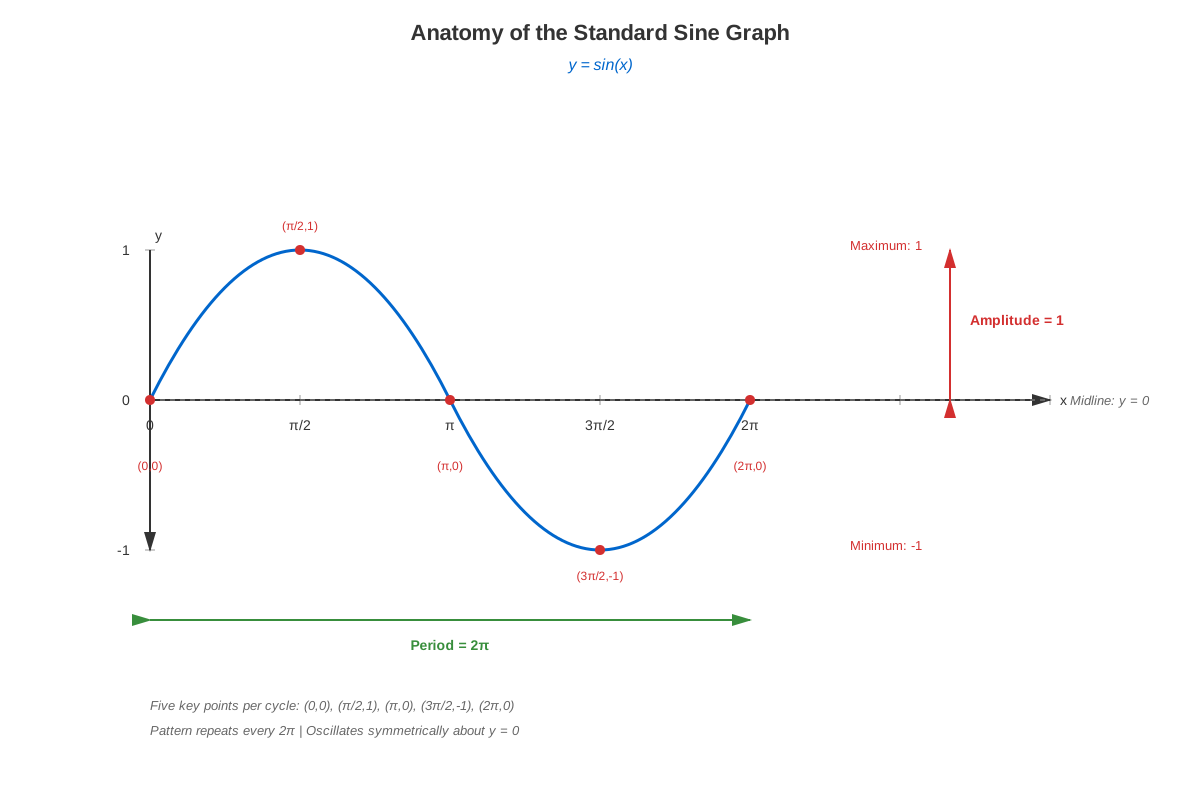
The standard sine function is written as y = sin(x) and produces a smooth, continuous wave that oscillates between -1 and 1. When graphed on the coordinate plane with x representing angle measures (in radians or degrees) and y representing the sine value, the function creates a characteristic S-shaped curve that repeats indefinitely in both directions.
Key features of y = sin(x):
- Domain: All real numbers (-∞, ∞)
- Range: [-1, 1]
- Period: 2π radians (or 360°)
- Amplitude: 1
- Midline: y = 0 (the x-axis)
- x-intercepts: x = nπ where n is any integer (0, ±π, ±2π, ±3π, ...)
- Maximum points: (π/2 + 2πn, 1) where n is any integer
- Minimum points: (3π/2 + 2πn, -1) where n is any integer
The sine curve begins at the origin (0, 0), rises to its maximum at π/2, returns to zero at π, descends to its minimum at 3π/2, and completes one full cycle at 2π. This pattern then repeats identically for every subsequent interval of length 2π.
General Form and Transformations
The general form of a sine function is:
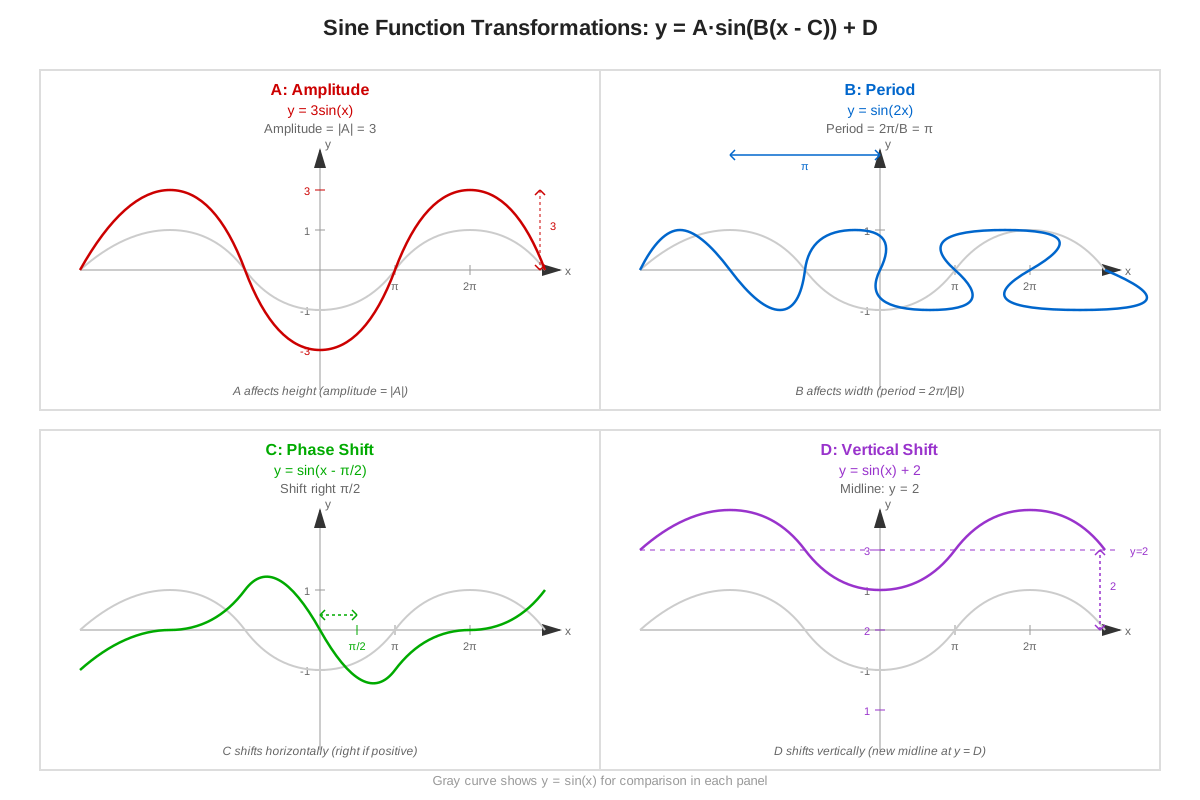
y = A sin(B(x - C)) + DEach parameter creates a specific transformation:
| Parameter | Effect | How to Calculate | ||
|---|---|---|---|---|
| A | Amplitude - vertical stretch/compression and reflection | \ | A\ | = amplitude; negative A reflects over midline |
| B | Period change - horizontal stretch/compression | Period = 2π/\ | B\ | |
| C | Phase shift - horizontal translation | Shift right C units (left if negative) | ||
| D | Vertical shift - moves midline up or down | Midline becomes y = D |
Amplitude
Amplitude represents half the distance between the maximum and minimum values of the sine function. It measures the "height" of the wave from the midline. For y = A sin(B(x - C)) + D, the amplitude equals |A|.
When A is negative, the graph reflects over the horizontal midline, causing the curve to start by descending rather than ascending. For example, y = -sin(x) begins at (0, 0) but immediately decreases toward -1, creating an upside-down version of the standard sine curve.
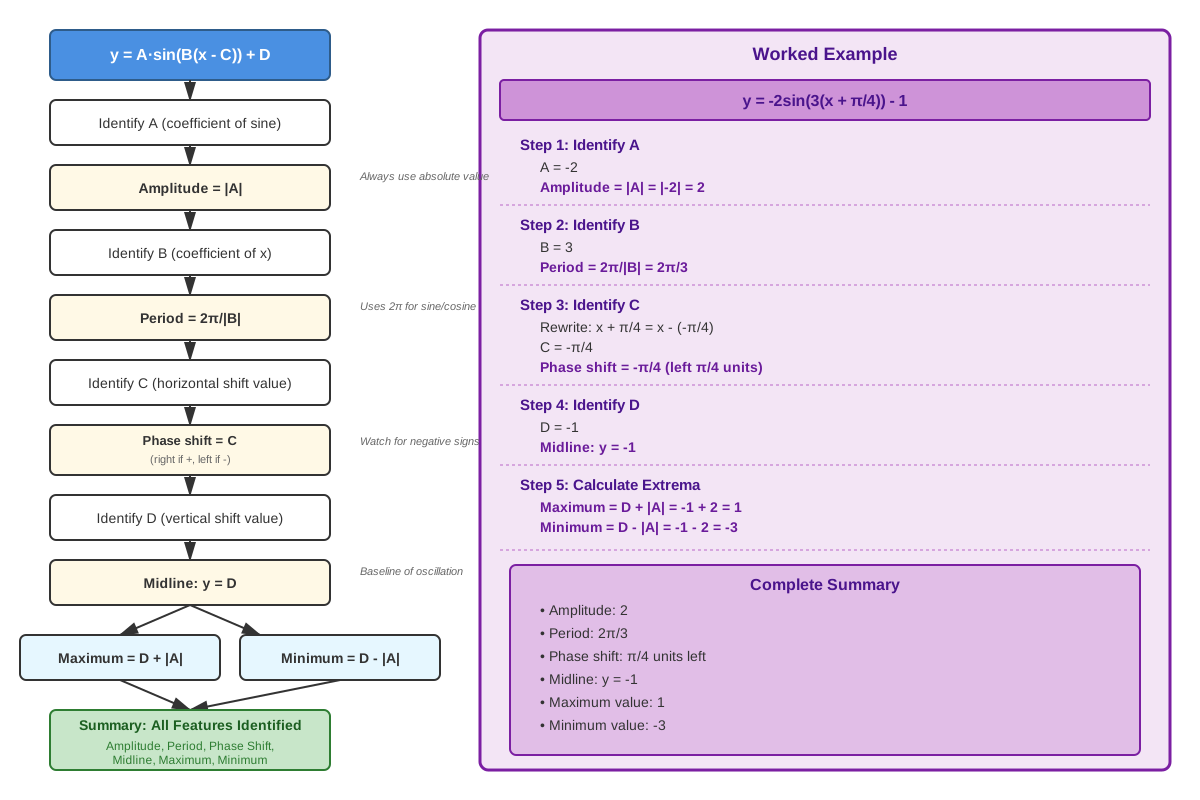
The maximum value of the function equals D + |A|, and the minimum value equals D - |A|. This relationship allows students to work backward from a graph: if a sine curve oscillates between 3 and 7, the amplitude is (7-3)/2 = 2, and the vertical shift is (7+3)/2 = 5.
Period
The period of a sine function is the horizontal length of one complete cycle—the distance along the x-axis before the pattern repeats exactly. For the standard sine function, the period is 2π radians (360°).
The coefficient B affects the period through the formula: Period = 2π/|B|. When B > 1, the function completes cycles more quickly (horizontal compression), creating a shorter period. When 0 < B < 1, cycles take longer to complete (horizontal stretch), creating a longer period.
For example:
- y = sin(2x) has period 2π/2 = π (completes two full cycles in the space where standard sine completes one)
- y = sin(x/3) has period 2π/(1/3) = 6π (completes one cycle over three times the standard distance)
- y = sin(4x) has period 2π/4 = π/2 (completes four cycles in the standard 2π interval)
Phase Shift
Phase shift represents horizontal translation of the entire sine curve left or right. In the form y = A sin(B(x - C)) + D, the graph shifts C units to the right (or |C| units left if C is negative).
To identify phase shift correctly, the equation must be factored so B multiplies the entire (x - C) expression. For example:
- y = sin(x - π/4) shifts right π/4 units
- y = sin(2(x - π/3)) shifts right π/3 units
- y = sin(2x - π) must be rewritten as y = sin(2(x - π/2)) to reveal the phase shift of π/2 right
Phase shift moves all key points (intercepts, maxima, minima) horizontally by the same amount while preserving the shape and vertical position of the curve.
Vertical Shift
Vertical shift moves the entire sine curve up or down, changing the position of the midline (the horizontal line halfway between maximum and minimum values). The parameter D in y = A sin(B(x - C)) + D determines this shift.
When D > 0, the graph shifts upward D units, and the midline becomes y = D. When D < 0, the graph shifts downward |D| units. This transformation affects the range of the function: instead of [-1, 1], the range becomes [D - |A|, D + |A|].
Vertical shift does not affect the period, amplitude, or x-intercepts' spacing, but it does change the actual y-values where the curve crosses the x-axis (if it crosses at all).
Key Points and Symmetry
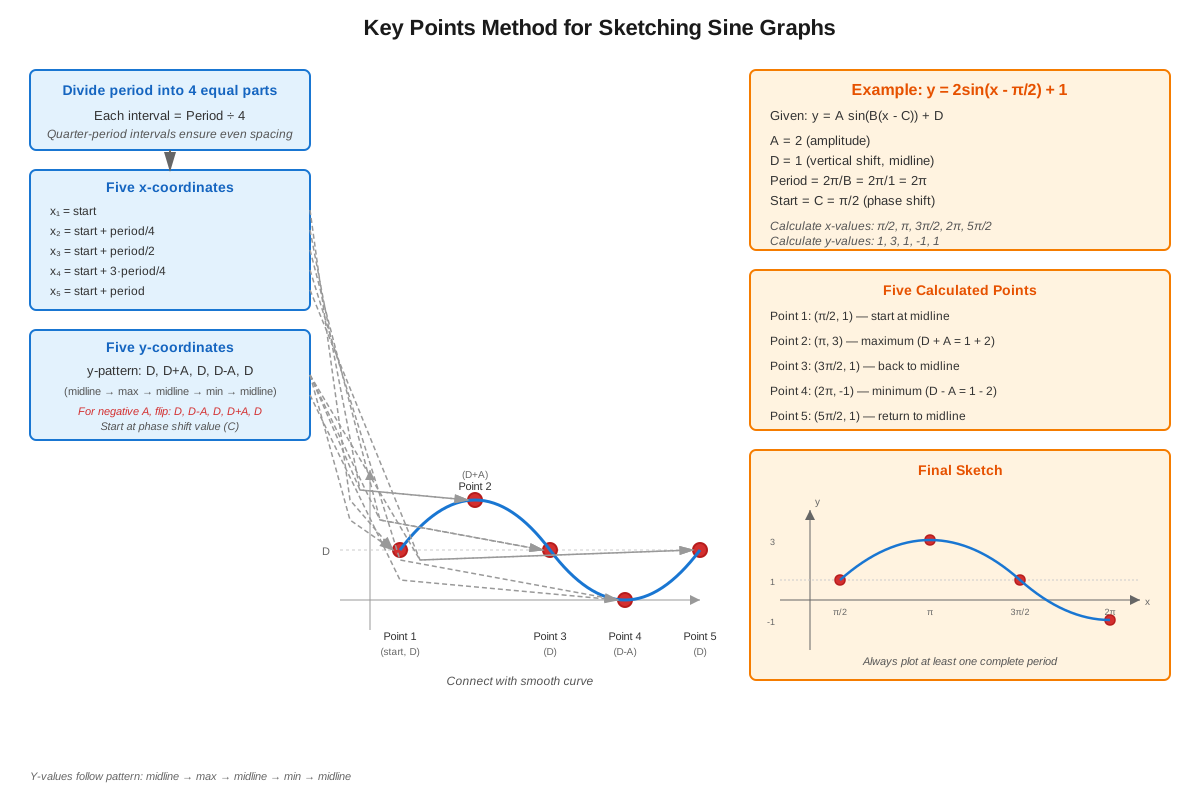
Every sine function has predictable key points within one period that help sketch the graph quickly:
- Starting point (after phase shift): on the midline
- First quarter period: maximum (if A > 0) or minimum (if A < 0)
- Half period: back to midline
- Three-quarter period: minimum (if A > 0) or maximum (if A < 0)
- Full period: returns to starting point
The sine function exhibits odd symmetry about the origin: sin(-x) = -sin(x). This means the graph is symmetric with respect to 180° rotation about the origin. After transformations, this rotational symmetry persists about the point (C, D).
Concept Relationships
The graph of sine emerges directly from the unit circle definition, where sine represents the y-coordinate of a point rotating counterclockwise from (1, 0). As the angle increases from 0 to 2π, the y-coordinate traces the familiar wave pattern, connecting circular motion to periodic graphical behavior.
Transformation concepts flow hierarchically: amplitude (vertical stretch) → affects the range and maximum/minimum values → vertical shift repositions the entire range → period (horizontal compression/stretch) → determines cycle frequency → phase shift repositions the cycle horizontally. Understanding each transformation independently enables analysis of complex combined transformations.
The sine graph relates intimately to the cosine graph, which has identical shape but shifted π/2 units left: sin(x) = cos(x - π/2). This relationship allows conversion between sine and cosine representations and explains why both functions model the same physical phenomena with different starting points.
Relationship map: Unit Circle Definition → Standard Sine Graph → Amplitude Transformation → Vertical Shift → Period Transformation → Phase Shift → General Sine Function → Real-World Applications → Equation-Graph Matching → Problem Solving
Quick check — test yourself on Graph of sine so far.
Try Flashcards →High-Yield Facts
⭐ The standard sine function y = sin(x) has amplitude 1, period 2π, and oscillates between -1 and 1
⭐ Amplitude equals |A| in y = A sin(B(x - C)) + D and represents half the distance between maximum and minimum values
⭐ Period equals 2π/|B| and represents the horizontal length of one complete cycle
⭐ The range of y = A sin(B(x - C)) + D is [D - |A|, D + |A|]
⭐ Phase shift equals C (positive means right, negative means left) when the equation is in the form y = A sin(B(x - C)) + D
- The midline of a transformed sine function is the horizontal line y = D
- Maximum value occurs at y = D + |A| and minimum value occurs at y = D - |A|
- The sine function crosses its midline at the beginning, middle, and end of each period
- A negative coefficient A reflects the sine graph over the midline, inverting the wave
- The domain of all sine functions is all real numbers (-∞, ∞)
- One complete sine cycle includes exactly one maximum, one minimum, and three midline crossings
- The sine function is periodic, meaning it repeats its pattern indefinitely in both directions
- To find the equation from a graph, identify amplitude (half the vertical distance), period (horizontal distance for one cycle), vertical shift (midline position), and phase shift (horizontal displacement from standard position)
Common Misconceptions
Misconception: The amplitude can be negative → Correction: Amplitude is always positive and equals |A|. A negative coefficient A reflects the graph but doesn't create negative amplitude; it indicates the graph is inverted.
Misconception: Period equals B → Correction: Period equals 2π/|B|, not B itself. The coefficient B is inversely related to period—larger B values create shorter periods, not longer ones.
Misconception: In y = sin(2x - π), the phase shift is -π → Correction: The phase shift is π/2 to the right. The equation must be factored as y = sin(2(x - π/2)) to correctly identify the phase shift as π/2.
Misconception: The range of y = 3sin(x) is [0, 3] → Correction: The range is [-3, 3]. Amplitude affects both the maximum and minimum values equally, extending the range in both directions from the midline.
Misconception: Vertical shift changes the amplitude → Correction: Vertical shift (D) moves the entire graph up or down but doesn't change the amplitude. A function y = 2sin(x) + 5 still has amplitude 2; it just oscillates between 3 and 7 instead of -2 and 2.
Misconception: All sine graphs start at the origin → Correction: Only y = sin(x) starts at the origin. Phase shifts and vertical shifts move the starting point, and amplitude changes affect the initial slope.
Misconception: The x-intercepts of a sine function are always at multiples of π → Correction: This is only true for y = sin(x). Transformations change where the function crosses the x-axis (or it may not cross at all if the vertical shift is large enough).
Worked Examples
Example 1: Identifying Transformations from an Equation
Problem: For the function y = -2sin(3(x - π/6)) + 1, identify the amplitude, period, phase shift, vertical shift, maximum value, minimum value, and midline.
Solution:
Step 1: Identify the general form parameters by comparing to y = A sin(B(x - C)) + D
- A = -2
- B = 3
- C = π/6
- D = 1
Step 2: Calculate amplitude
- Amplitude = |A| = |-2| = 2
Step 3: Calculate period
- Period = 2π/|B| = 2π/3
Step 4: Identify phase shift
- Phase shift = C = π/6 to the right
Step 5: Identify vertical shift
- Vertical shift = D = 1 unit upward
- Midline: y = 1
Step 6: Calculate maximum and minimum values
- Since A is negative, the graph is reflected (starts by going down)
- Maximum value = D + |A| = 1 + 2 = 3
- Minimum value = D - |A| = 1 - 2 = -1
Answer: Amplitude = 2, Period = 2π/3, Phase shift = π/6 right, Vertical shift = 1 up, Maximum = 3, Minimum = -1, Midline: y = 1
This problem directly addresses the learning objective of explaining the core rules behind sine graphs by systematically applying transformation formulas.
Example 2: Finding an Equation from a Graph
Problem: A sine curve has a maximum value of 5, a minimum value of -1, completes one full cycle from x = 0 to x = π, and passes through the point (0, 2). Find the equation in the form y = A sin(B(x - C)) + D.
Solution:
Step 1: Find the vertical shift (D) using the midline
- Midline = (maximum + minimum)/2 = (5 + (-1))/2 = 4/2 = 2
- D = 2
Step 2: Find the amplitude (A)
- Amplitude = (maximum - minimum)/2 = (5 - (-1))/2 = 6/2 = 3
- Since we need to determine the sign of A, check the behavior at x = 0
Step 3: Find B using the period
- Period = π (given: one cycle from 0 to π)
- Period = 2π/|B|, so π = 2π/|B|
- |B| = 2π/π = 2
- B = 2 (we'll assume positive unless the graph indicates otherwise)
Step 4: Determine the sign of A and find C
- At x = 0, y = 2 (given point)
- The midline is y = 2, so the function starts at the midline
- For standard sine, this suggests C = 0 (no phase shift)
- Test: y = 3sin(2(0 - 0)) + 2 = 3sin(0) + 2 = 0 + 2 = 2 ✓
Step 5: Verify the equation works
- At x = π/4 (one-quarter period), we should reach maximum or minimum
- y = 3sin(2(π/4)) + 2 = 3sin(π/2) + 2 = 3(1) + 2 = 5 ✓ (maximum)
- This confirms A = 3 (positive)
Answer: y = 3sin(2x) + 2
This example demonstrates applying sine graph concepts to ACT-style questions by working backward from graphical features to algebraic representation.
Exam Strategy
When approaching ACT graph of sine questions, first identify what the question asks: equation from graph, graph from equation, specific feature value, or application problem. Scan for the key features you need—don't waste time calculating everything if the question only asks for amplitude.
Trigger words and phrases that signal sine graph questions:
- "periodic function," "oscillates," "repeats every," "cycles"
- "amplitude," "maximum value," "minimum value," "midline"
- "completes one cycle," "period"
- "shifted horizontally/vertically"
- "Which graph represents..."
- "What is the value of [parameter]..."
Process of elimination strategies:
- For graph-matching questions, eliminate options with wrong amplitude first (easiest to spot visually)
- Check the period next—count how many cycles appear in a given interval
- Verify the vertical position (midline) matches
- Finally check phase shift if needed
Time allocation: Spend 45-60 seconds on straightforward identification questions, up to 90 seconds on complex transformation or application problems. If a question requires calculating all four parameters, budget time accordingly but remember you can often eliminate wrong answers without complete calculations.
Quick checks:
- Does the amplitude match the vertical distance from midline to maximum?
- Does the period match 2π/B?
- Is the equation properly factored to identify phase shift?
- Do the maximum and minimum values equal D ± |A|?
Exam Tip: When matching equations to graphs, start at x = 0 and check if the y-value matches what the equation predicts. This quick verification eliminates many wrong answers immediately.
Memory Techniques
APVP - Remember the four transformations in order of calculation priority:
- Amplitude (|A|)
- Period (2π/|B|)
- Vertical shift (D)
- Phase shift (C)
"All People Value Pizza" - When analyzing a sine graph, check features in this order: Amplitude, Period, Vertical shift, Phase shift
"Max Plus Min, Divide by Two" - To find the midline (vertical shift): (maximum + minimum)/2
"Max Minus Min, Divide by Two" - To find amplitude: (maximum - minimum)/2
"Two Pi Over B" - For period calculation, remember the phrase "two pi over B" as a rhythmic chant
Visualization strategy: Picture the sine wave as an ocean wave. The amplitude is how high the wave rises above calm water (midline). The period is the distance between wave crests. Vertical shift is the tide level changing. Phase shift is the wave moving along the beach.
Sign memory: "Negative A flips the wave upside-down" - imagine the coefficient A as a switch that inverts the entire curve when negative
Summary
The graph of sine is a fundamental periodic function that appears frequently on the ACT Math section, requiring students to understand both the standard sine curve and its transformations. The standard function y = sin(x) oscillates between -1 and 1 with period 2π, creating a smooth wave pattern. The general form y = A sin(B(x - C)) + D incorporates four key transformations: amplitude |A| (vertical stretch), period 2π/|B| (horizontal stretch/compression), phase shift C (horizontal translation), and vertical shift D (vertical translation). Success on ACT questions requires quickly identifying these parameters from equations or graphs, calculating maximum and minimum values as D ± |A|, and recognizing how transformations affect the curve's appearance. Students must master working bidirectionally—finding equations from graphs and predicting graphs from equations—while applying efficient problem-solving strategies under time pressure.
Key Takeaways
- The standard sine function y = sin(x) has amplitude 1, period 2π, domain of all real numbers, and range [-1, 1]
- In y = A sin(B(x - C)) + D: amplitude = |A|, period = 2π/|B|, phase shift = C, vertical shift = D
- Maximum value = D + |A| and minimum value = D - |A|; the midline is y = D
- To find amplitude or vertical shift from a graph: amplitude = (max - min)/2 and vertical shift = (max + min)/2
- Phase shift must be identified from factored form y = A sin(B(x - C)) + D; factor out B if necessary
- Negative coefficient A reflects the sine graph over the midline, inverting the wave pattern
- ACT questions test transformation identification, equation-graph matching, and feature calculation—practice all three types
Related Topics
Cosine Graphs: The cosine function produces an identical wave shape to sine but shifted π/2 units left, making it essential for understanding phase relationships and alternative representations of periodic phenomena.
Tangent Graphs: Unlike sine and cosine, tangent graphs have vertical asymptotes and a period of π, requiring different analysis techniques but building on the same transformation principles.
Trigonometric Equations: Solving equations like sin(x) = 0.5 graphically requires understanding where horizontal lines intersect the sine curve, directly applying graph interpretation skills.
Function Transformations: The transformation rules for sine functions (vertical stretch, horizontal compression, translations) apply to all function families, making sine graphs an excellent context for mastering general transformation concepts.
Modeling Periodic Phenomena: Real-world applications involving seasonal patterns, wave motion, and oscillations require translating verbal descriptions into sine function equations and interpreting their graphs.
Practice CTA
Now that you've mastered the core concepts of sine graphs, it's time to solidify your understanding through active practice. Attempt the practice questions to test your ability to identify transformations, match equations to graphs, and solve ACT-style problems under realistic conditions. Use the flashcards to reinforce key formulas and definitions until they become automatic. Remember: understanding the concepts is just the first step—consistent practice builds the speed and confidence you need to excel on test day. Every problem you solve strengthens your pattern recognition and problem-solving efficiency. You've got this!
Sign up free to keep reading
Create a free AnvayaPrep account to finish this ACT guide on Graph of sine — plus flashcards and practice questions.