Overview
Understanding author attitude is one of the most critical skills for success on the ACT Reading section. Author attitude refers to the writer's feelings, opinions, or stance toward the subject matter, characters, events, or ideas presented in a passage. Unlike simple comprehension questions that ask "what" happened, author attitude questions probe deeper into "how" the author feels about what they're describing. This skill requires students to move beyond literal understanding and engage with the text's tone, word choice, and rhetorical strategies.
On the ACT, approximately 15-20% of Reading questions directly or indirectly test your ability to identify and interpret author attitude. These questions appear across all passage types—prose fiction, social science, humanities, and natural science—making this a universally applicable skill. The ACT frequently phrases these questions using terms like "tone," "perspective," "point of view," or "the author's attitude toward X can best be described as..." Mastering this topic is essential because it not only helps you answer direct attitude questions but also improves your overall reading comprehension by training you to read actively and critically.
ACT author attitude questions connect to broader reading skills including understanding rhetorical strategies, analyzing word choice (diction), recognizing bias, and interpreting figurative language. When you can accurately identify an author's attitude, you're better equipped to predict how they'll develop arguments, understand why they include certain details, and recognize the purpose behind their writing choices. This skill forms the foundation for advanced literary analysis and critical thinking that extends far beyond standardized testing.
Learning Objectives
- [ ] Identify when Author attitude is being tested in ACT Reading questions
- [ ] Explain the core rule or strategy behind determining Author attitude
- [ ] Apply Author attitude analysis to ACT-style questions accurately
- [ ] Distinguish between different degrees of author attitude (strongly positive, mildly critical, neutral, etc.)
- [ ] Recognize textual evidence that reveals author attitude, including word choice, tone, and rhetorical devices
- [ ] Eliminate incorrect answer choices that misrepresent the intensity or direction of the author's feelings
- [ ] Synthesize multiple textual clues to form a complete picture of the author's perspective
Prerequisites
- Basic reading comprehension: Understanding literal meaning is necessary before analyzing attitude; students must grasp what the passage says before determining how the author feels about it
- Vocabulary knowledge: Recognizing connotations (positive vs. negative associations) of words is essential for detecting subtle attitude markers
- Understanding of tone: Familiarity with descriptive terms for tone (optimistic, skeptical, reverent, critical) provides the vocabulary needed to identify attitudes
- Main idea identification: Author attitude often relates directly to the passage's central purpose, so recognizing main ideas helps contextualize attitude
Why This Topic Matters
In real-world contexts, identifying author attitude is fundamental to media literacy and critical thinking. Every article, editorial, advertisement, and social media post contains an author's perspective, whether explicit or implicit. Understanding how to detect bias, recognize persuasive techniques, and distinguish between objective reporting and opinion-based writing empowers students to be informed consumers of information. This skill is invaluable in academic settings where analyzing primary sources, evaluating research papers, and understanding historical documents requires recognizing the author's stance and potential biases.
On the ACT Reading section, author attitude questions appear with remarkable consistency. Exam statistics show that each test typically includes 3-5 direct attitude questions, plus several additional questions where understanding attitude helps eliminate wrong answers. These questions carry the same point value as any other question, but they're often missed by students who focus solely on factual recall. The ACT specifically designs passages to test whether students can move beyond surface-level comprehension to deeper analytical thinking.
Author attitude appears in ACT passages through several common patterns. In prose fiction, you'll analyze the narrator's feelings toward characters or events. In social science passages, authors reveal their stance on theories, policies, or research findings. Humanities passages often showcase the author's admiration for artists, criticism of cultural trends, or enthusiasm for historical movements. Even natural science passages, which seem objective, contain subtle attitudes—excitement about discoveries, skepticism toward outdated theories, or concern about environmental issues. Recognizing these patterns helps you anticipate when attitude questions will appear and where to look for evidence.
Core Concepts
Defining Author Attitude
Author attitude encompasses the writer's emotional stance, intellectual position, and evaluative judgment toward their subject matter. This attitude manifests through deliberate choices in language, structure, and emphasis. Unlike mood (which describes the emotional atmosphere created for the reader) or tone (the author's manner of expression), attitude specifically refers to the author's feelings and opinions about what they're discussing. On the ACT, understanding this distinction is crucial because questions may use these terms interchangeably, but they all point toward the same analytical skill: determining how the author feels.
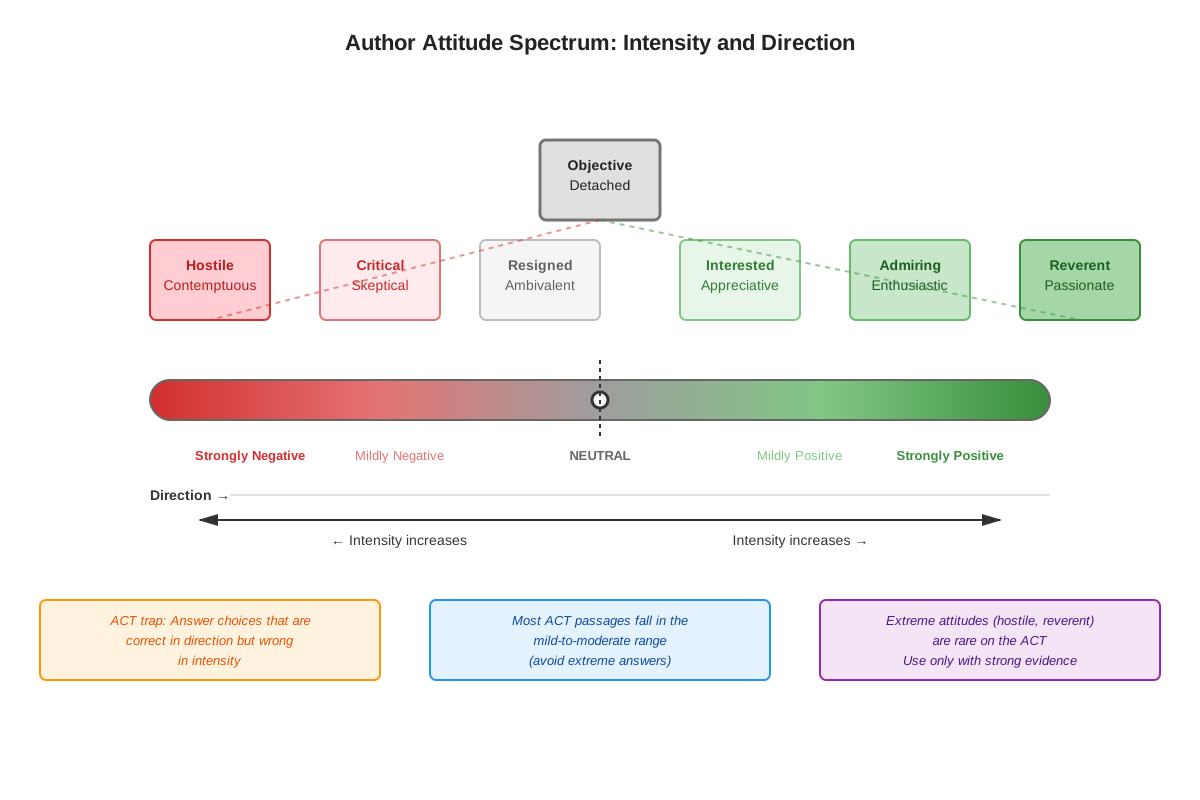
Author attitude exists on a spectrum from strongly negative to strongly positive, with various neutral positions in between. The ACT tests your ability to identify not just the direction (positive/negative) but also the intensity (mild/strong) of the author's feelings. A common trap in answer choices involves selecting an attitude that's correct in direction but wrong in intensity—for example, choosing "enthusiastic" when the author is merely "appreciative," or selecting "hostile" when they're only "mildly critical."
Textual Evidence for Author Attitude
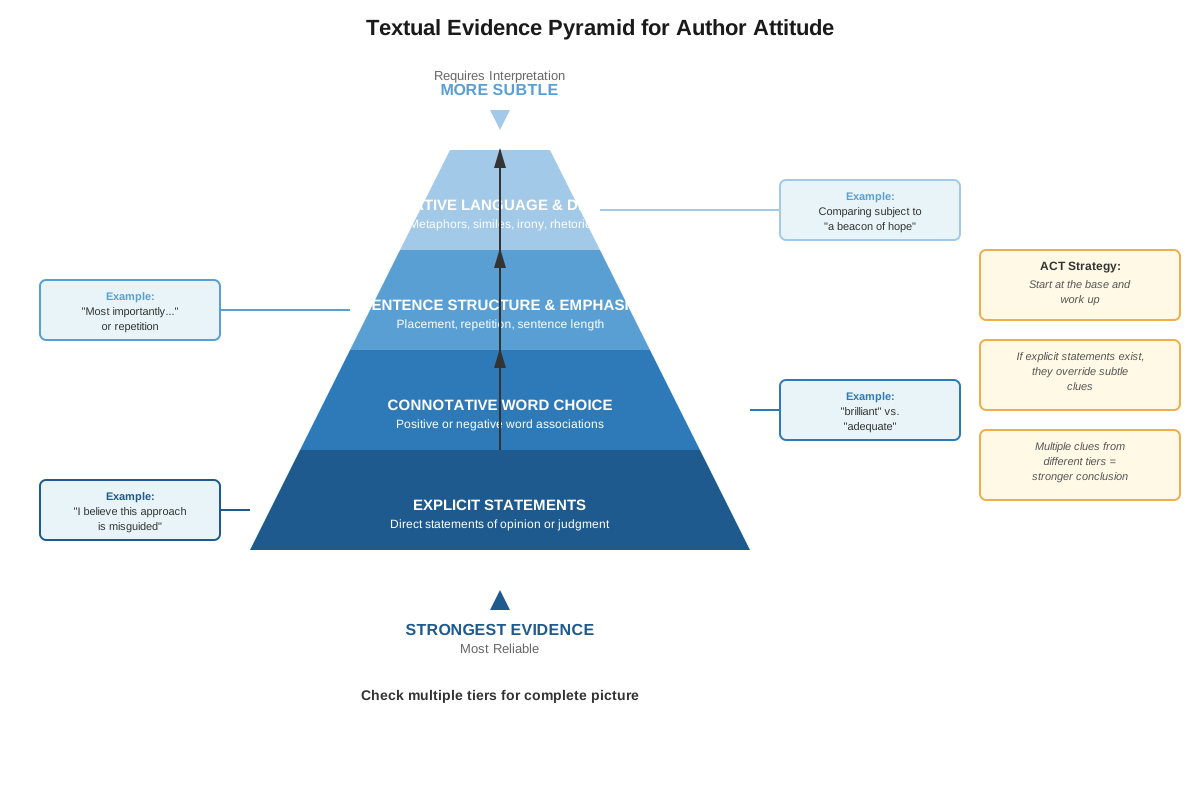
The most reliable indicators of author attitude are word choice (diction) and descriptive language. Authors reveal their feelings through adjectives, adverbs, and verbs with strong connotations. Consider the difference between describing a politician's speech as "calculated" versus "thoughtful"—both suggest planning, but "calculated" carries negative connotations of manipulation while "thoughtful" suggests positive deliberation. On the ACT, you must train yourself to notice these subtle distinctions.
Figurative language provides another window into author attitude. Metaphors, similes, and analogies aren't just decorative—they reveal how the author conceptualizes their subject. An author who compares a scientific breakthrough to "opening a door to endless possibilities" reveals optimism and excitement. One who describes the same breakthrough as "Pandora's box" suggests concern about unintended consequences. The ACT frequently includes passages where figurative language serves as the primary evidence for attitude questions.
Sentence structure and punctuation can also signal attitude. Exclamation points indicate enthusiasm or strong emotion. Rhetorical questions suggest the author wants readers to reach a particular conclusion. Short, declarative sentences may convey certainty or emphasis, while longer, complex sentences might indicate careful consideration or ambivalence. Parenthetical asides often contain the author's personal commentary or editorial voice.
Categories of Author Attitude
Understanding common attitude categories helps you quickly identify the correct answer choice. Here's a comprehensive breakdown:
| Attitude Category | Characteristics | Example Words/Phrases |
|---|---|---|
| Strongly Positive | Enthusiastic support, admiration, celebration | Revolutionary, brilliant, masterpiece, profound impact, extraordinary |
| Moderately Positive | Approval, appreciation, respect | Valuable, noteworthy, commendable, effective, worthwhile |
| Neutral/Objective | Balanced presentation, factual reporting | According to, research shows, evidence suggests, documented |
| Moderately Negative | Criticism, concern, disappointment | Problematic, questionable, limited, unfortunately, falls short |
| Strongly Negative | Condemnation, ridicule, outrage | Disastrous, absurd, completely fails, inexcusable, catastrophic |
| Ambivalent | Mixed feelings, acknowledging both positives and negatives | However, although, while X is true, on the other hand |
| Skeptical | Doubt, questioning, requiring more evidence | Allegedly, supposedly, claims to, remains to be seen, dubious |
Context Clues for Attitude
Author attitude rarely appears in isolation—it's woven throughout the passage. To accurately identify attitude, you must consider context at multiple levels. At the sentence level, look at how the author frames information. Do they present facts neutrally or with evaluative commentary? At the paragraph level, notice whether the author develops arguments that support or challenge the subject. At the passage level, consider the overall purpose: Is the author trying to persuade, inform, entertain, or critique?
Contrast and comparison often reveal attitude. When an author compares their subject favorably to something else, they're showing approval. When they contrast it negatively, they're expressing criticism. Pay attention to transitional words like "however," "unfortunately," "fortunately," "surprisingly," and "remarkably"—these signal the author's evaluation of what follows.
The Role of Evidence Selection
What an author chooses to include or exclude reveals their attitude as much as how they describe it. An author who spends three paragraphs detailing the benefits of a policy and one sentence acknowledging drawbacks clearly favors that policy. This emphasis through allocation is a sophisticated attitude indicator that the ACT tests regularly. Similarly, the types of evidence an author cites—expert testimony, statistical data, anecdotal examples, or historical precedents—can indicate their attitude toward their subject and their intended audience.
Concept Relationships
Author attitude connects directly to several other reading comprehension skills tested on the ACT. Understanding main idea is prerequisite to identifying attitude because the author's feelings typically relate to their central argument or purpose. If the main idea is "renewable energy offers solutions to climate change," the author's attitude toward renewable energy is likely positive.
Word choice analysis → reveals → Author attitude → supports → Purpose identification. This chain shows how recognizing connotative language helps you determine attitude, which in turn helps you understand why the author wrote the passage. For example, an author with an admiring attitude toward a historical figure likely wrote to celebrate their achievements, while a critical attitude suggests a purpose of reevaluation or correction.
Author attitude also connects to point of view and perspective. In prose fiction, the narrator's attitude toward characters and events shapes how readers perceive the story. In nonfiction, the author's professional background, cultural context, and personal experiences influence their attitude toward their subject. The ACT may ask you to consider how the author's perspective shapes their attitude or how their attitude reveals their perspective.
The relationship between textual evidence and author attitude is bidirectional. You use specific textual evidence to determine attitude, but understanding the author's attitude also helps you interpret ambiguous passages and predict which details the author considers most important. This reciprocal relationship makes author attitude a central organizing principle for reading comprehension.
High-Yield Facts
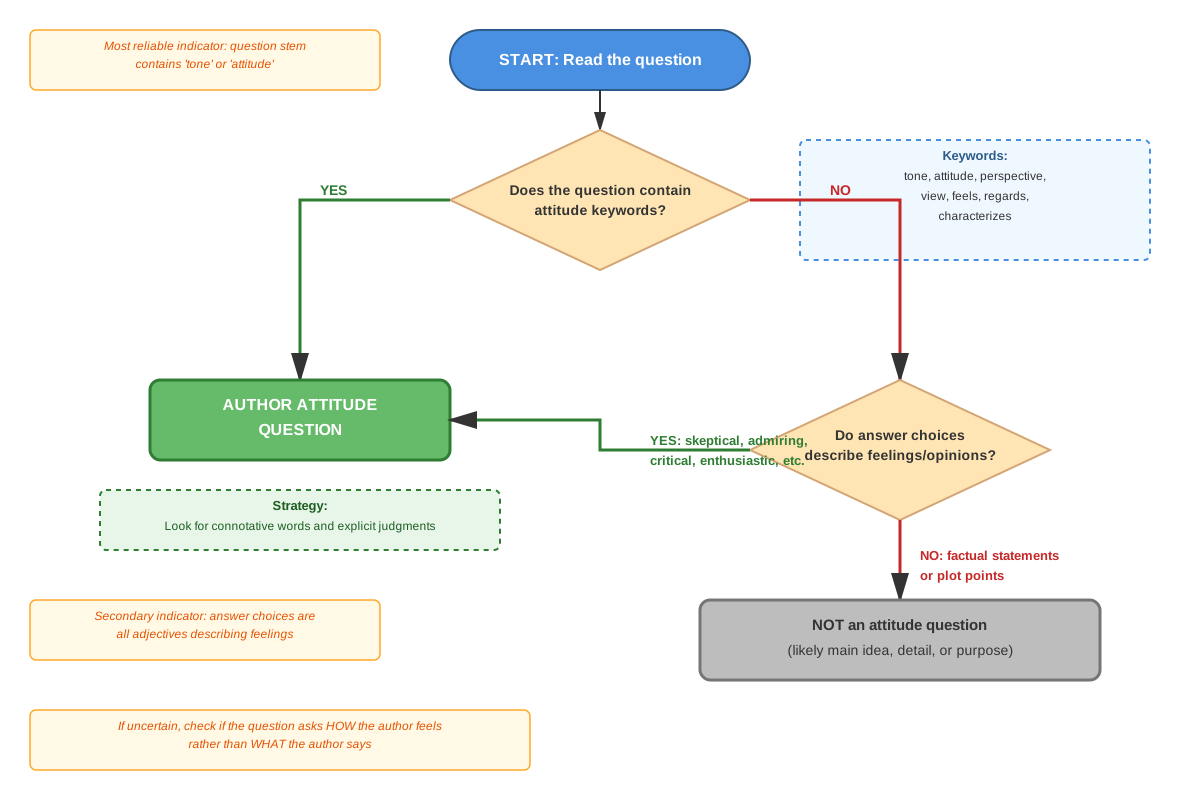
⭐ Author attitude questions typically use phrases like "the author's tone," "the author's perspective," "the author regards X as," or "the author's attitude toward X can best be described as."
⭐ The correct answer to an attitude question must match both the direction (positive/negative) and intensity (strong/mild) of the author's feelings.
⭐ Word choice (diction) is the most reliable evidence for author attitude—pay special attention to adjectives, adverbs, and verbs with strong connotations.
⭐ Extreme answer choices (words like "contemptuous," "reverent," "scathing," or "ecstatic") are usually wrong unless the passage contains equally strong language.
⭐ Neutral or objective attitudes are rare in ACT passages—most authors reveal at least a mild attitude toward their subject.
- Author attitude can change throughout a passage, but ACT questions typically ask about the overall or predominant attitude
- Figurative language (metaphors, similes, analogies) often provides the strongest evidence for author attitude
- The amount of space an author devotes to different aspects of their subject reveals their priorities and attitudes
- Transitional words like "unfortunately," "remarkably," "surprisingly," and "fortunately" are explicit attitude markers
- In prose fiction, the narrator's attitude may differ from the author's attitude—ACT questions specify which they're asking about
- Rhetorical questions usually indicate the author wants readers to reach a particular conclusion, revealing their attitude
- Punctuation matters: exclamation points show enthusiasm, quotation marks can indicate skepticism or irony, and em dashes often introduce editorial commentary
Quick check — test yourself on Author attitude so far.
Try Flashcards →Common Misconceptions
Misconception: Author attitude is the same as the passage's mood or the reader's emotional response.
Correction: Author attitude specifically refers to the writer's feelings and opinions about their subject matter, not the emotional atmosphere they create or how readers feel. A passage about a tragic event might have a somber mood, but the author's attitude toward the event could be sympathetic, critical of those responsible, or analytical and detached.
Misconception: If a passage presents facts without obvious opinion words, the author's attitude must be neutral or objective.
Correction: Even seemingly objective passages reveal attitude through subtle choices in emphasis, evidence selection, and framing. An author who presents only positive research findings about a treatment while omitting negative studies reveals a favorable attitude through selective inclusion, even without using explicitly positive language.
Misconception: Strong language in the passage always means the author has a strong attitude.
Correction: Authors may quote others' strong opinions while maintaining a more moderate attitude themselves. Always distinguish between the author's voice and quoted material. The ACT tests this distinction by including answer choices that confuse the attitude of people discussed in the passage with the author's own attitude.
Misconception: The author's attitude must remain consistent throughout the entire passage.
Correction: Authors can express different attitudes toward different aspects of their subject, or their attitude may evolve as they present new information. However, ACT questions asking about "the author's attitude" typically refer to the predominant or overall attitude unless they specify a particular paragraph or aspect.
Misconception: Identifying author attitude is subjective and based on personal interpretation.
Correction: While reading involves some interpretation, author attitude on the ACT is always supported by specific textual evidence. The correct answer can be proven using word choice, tone, emphasis, and other concrete elements from the passage. If you can't point to specific evidence, you're likely making assumptions rather than analyzing the text.
Worked Examples
Example 1: Natural Science Passage
Passage Excerpt:
"The discovery of CRISPR-Cas9 gene editing technology represents nothing short of a revolution in molecular biology. This elegant system, borrowed from bacterial immune defenses, allows researchers to edit DNA with unprecedented precision. While early gene therapy attempts were plagued by off-target effects and limited success rates, CRISPR offers a level of accuracy that seemed impossible just a decade ago. The implications are staggering: genetic diseases that have tormented families for generations may finally yield to treatment. Of course, ethical considerations demand careful attention, but the potential benefits are too significant to ignore."
Question: The author's attitude toward CRISPR-Cas9 technology can best be described as:
A) Cautiously skeptical
B) Enthusiastically optimistic
C) Objectively neutral
D) Deeply concerned
Solution Process:
Step 1: Identify attitude markers in the passage.
- "nothing short of a revolution" = strongly positive language
- "elegant system" = positive, appreciative
- "unprecedented precision" = positive, emphasizing superiority
- "seemed impossible just a decade ago" = emphasizing remarkable achievement
- "implications are staggering" = strong positive reaction
- "may finally yield to treatment" = hopeful, optimistic
- "potential benefits are too significant to ignore" = strong positive conclusion
Step 2: Note any qualifying or negative language.
- "Of course, ethical considerations demand careful attention" = acknowledges concerns but doesn't dwell on them
- "plagued by off-target effects" = describes past problems, not current technology
Step 3: Evaluate the balance and intensity.
The passage contains overwhelmingly positive language with only brief acknowledgment of ethical considerations. The author uses strong, enthusiastic words ("revolution," "staggering," "elegant") rather than moderate terms.
Step 4: Match to answer choices.
- A) Incorrect: "Skeptical" suggests doubt, but the author expresses confidence in the technology
- B) Correct: "Enthusiastically optimistic" matches both the positive direction and strong intensity of the language
- C) Incorrect: "Objectively neutral" doesn't account for the evaluative, positive language throughout
- D) Incorrect: "Deeply concerned" is the opposite direction; the author mentions concerns but doesn't emphasize them
Answer: B
Connection to Learning Objectives: This example demonstrates how to identify attitude through word choice (strong positive adjectives), recognize intensity (enthusiastic vs. moderate), and eliminate answers that mismatch the textual evidence.
Example 2: Humanities Passage
Passage Excerpt:
"Critics have long celebrated Jackson Pollock's drip paintings as masterpieces of Abstract Expressionism, but this assessment deserves reconsideration. While Pollock's technique was undeniably innovative, the question remains whether innovation alone constitutes artistic merit. His canvases, covered in seemingly random splatters, lack the compositional discipline that characterizes truly great art. Supporters argue that Pollock liberated painting from representational constraints, yet one might equally argue that he simply abandoned the technical skill that separates art from mere activity. The emperor, it seems, may have no clothes."
Question: The author's attitude toward Jackson Pollock's artistic reputation is:
A) Respectfully admiring
B) Moderately appreciative
C) Pointedly skeptical
D) Completely dismissive
Solution Process:
Step 1: Identify the author's main claim.
The author questions the high regard for Pollock's work, suggesting it's overrated.
Step 2: Catalog attitude indicators.
- "this assessment deserves reconsideration" = challenges conventional view
- "the question remains whether" = expresses doubt
- "seemingly random splatters" = negative characterization
- "lack the compositional discipline" = criticism
- "one might equally argue that he simply abandoned" = presents negative counterargument
- "The emperor, it seems, may have no clothes" = literary allusion suggesting fraud or overvaluation
Step 3: Note any positive or balancing statements.
- "undeniably innovative" = acknowledges one positive quality
- "Supporters argue" = presents opposing view but doesn't endorse it
Step 4: Assess intensity.
The author uses pointed criticism and ends with a strong metaphor suggesting Pollock's reputation is undeserved. However, they acknowledge innovation and frame their criticism as questioning rather than absolute condemnation.
Step 5: Eliminate and select.
- A) Incorrect: "Admiring" is the opposite direction
- B) Incorrect: "Appreciative" suggests positive attitude; the passage is predominantly critical
- C) Correct: "Pointedly skeptical" captures the critical direction and moderate-to-strong intensity without overstating
- D) Incorrect: "Completely dismissive" is too extreme; the author acknowledges innovation and uses qualifying language like "may"
Answer: C
Connection to Learning Objectives: This example shows how to distinguish between different intensities of negative attitude, recognize how authors use rhetorical questions and literary allusions to convey attitude, and avoid extreme answer choices when the author uses qualifying language.
Exam Strategy
When approaching ACT author attitude questions, follow this systematic process:
Step 1: Identify the Question Type
Watch for trigger phrases: "the author's tone," "the author regards," "the author's attitude toward," "the author's perspective," or "the passage suggests the author feels." These signal that you need to analyze attitude rather than recall facts.
Step 2: Locate Relevant Passage Sections
If the question asks about the author's attitude toward a specific subject, person, or idea, find where the passage discusses that topic. Underline or mentally note key descriptive words and phrases in those sections.
Step 3: Create a Mental Attitude Profile
Before looking at answer choices, form your own description: Is the author positive or negative? Strongly or mildly? Are they balanced or one-sided? This prevents answer choices from influencing your interpretation.
Step 4: Analyze Answer Choices Systematically
Eliminate answers that are wrong in direction (positive when the author is negative, or vice versa). Then eliminate answers that are wrong in intensity (too strong or too weak). This two-step elimination process is highly effective.
Exam Tip: On the ACT, extreme answer choices (using words like "contemptuous," "reverent," "scathing," "ecstatic," or "zealous") are usually incorrect unless the passage contains equally extreme language. The test makers include these as traps for students who recognize the direction but misjudge the intensity.
Time Allocation: Author attitude questions should take 30-45 seconds once you've read the passage. If you're spending more time, you're likely overthinking. Trust the textual evidence and your systematic elimination process.
Process of Elimination Tips:
- Eliminate any answer that contradicts explicit statements in the passage
- Eliminate answers that describe attitudes toward the wrong subject (confusing the author's attitude toward X with their attitude toward Y)
- Eliminate answers that confuse quoted opinions with the author's own attitude
- When stuck between two choices, reread the relevant section and count positive vs. negative words—the balance usually reveals the answer
Common Trap Patterns:
- The Intensity Trap: Right direction, wrong strength (e.g., "enthusiastic" when the author is merely "interested")
- The Subject Confusion Trap: Describes someone else's attitude mentioned in the passage, not the author's
- The Partial Reading Trap: Based on one paragraph when the overall passage reveals a different attitude
- The Assumption Trap: Requires inferring an attitude not supported by textual evidence
Memory Techniques
DICTION Mnemonic for analyzing author attitude:
- Descriptive words (adjectives and adverbs)
- Intensity of language (strong vs. mild)
- Comparisons and contrasts
- Transitional words signaling evaluation
- Inclusion/exclusion of evidence
- Overall emphasis and space allocation
- Negative vs. positive connotations
The Attitude Spectrum Visualization: Picture a horizontal line with "Strongly Negative" on the far left, "Neutral" in the center, and "Strongly Positive" on the far right. As you read, mentally place the author's attitude on this line. This visual helps you distinguish between similar attitudes that differ in intensity.
The "Would the Author Say This?" Test: When evaluating answer choices, imagine the author making a statement that reflects that attitude. Would it sound consistent with their language in the passage? This technique helps you eliminate answers that feel wrong even when you can't immediately articulate why.
Acronym for Common Positive Attitudes: AREA
- Appreciative
- Respectful
- Enthusiastic
- Admiring
Acronym for Common Negative Attitudes: SCUD
- Skeptical
- Critical
- Uncertain/Ambivalent
- Disapproving
Summary
Author attitude represents the writer's feelings, opinions, and evaluative stance toward their subject matter, revealed through word choice, tone, emphasis, and rhetorical strategies. On the ACT Reading section, identifying author attitude is essential for answering 15-20% of questions directly and for improving overall comprehension. The key to mastering this skill lies in analyzing textual evidence systematically: examining diction for connotative meaning, noting the intensity of language, recognizing figurative language and rhetorical devices, and considering what the author emphasizes or omits. Successful students distinguish between direction (positive/negative) and intensity (strong/mild) of attitude, avoid extreme answer choices unless supported by equally extreme language, and use the two-step elimination process to identify correct answers. Author attitude connects to broader reading skills including main idea identification, purpose analysis, and understanding perspective. By training yourself to read actively for attitude markers rather than passively absorbing information, you develop critical thinking skills that serve you well beyond standardized testing.
Key Takeaways
- Author attitude refers to the writer's feelings and opinions toward their subject, revealed through deliberate language choices and emphasis
- Correct answers must match both the direction (positive/negative/neutral) and intensity (strong/moderate/mild) of the author's attitude
- Word choice, particularly adjectives, adverbs, and verbs with strong connotations, provides the most reliable evidence for attitude
- Extreme answer choices are usually incorrect on the ACT unless the passage contains equally extreme language
- Use the two-step elimination process: first eliminate wrong direction, then eliminate wrong intensity
- Author attitude questions appear across all passage types and account for approximately 15-20% of ACT Reading questions
- Distinguish between the author's attitude and the attitudes of people or sources discussed in the passage—the ACT frequently tests this distinction
Related Topics
Rhetorical Strategies and Purpose: Understanding why authors make specific choices in presenting information builds directly on attitude analysis. Once you can identify how an author feels, you're better equipped to understand why they structured their argument in a particular way.
Point of View and Perspective: This topic explores how an author's background, experiences, and position influence their attitude. Mastering author attitude provides the foundation for analyzing how perspective shapes interpretation.
Tone and Mood: While related to attitude, tone and mood involve different analytical skills. Understanding the distinctions between these concepts prevents confusion on questions that use these terms.
Textual Evidence and Support: Advanced analysis of how authors use evidence to support claims connects directly to attitude—what evidence authors choose and how they present it reveals their stance.
Comparative Reading: Some ACT passages present paired texts with different authors discussing the same topic. Identifying and comparing author attitudes is essential for answering questions about these passages.
Practice CTA
Now that you've mastered the core concepts of author attitude, it's time to put your knowledge into practice! Complete the practice questions to test your ability to identify attitude markers, distinguish between intensity levels, and eliminate trap answers. Use the flashcards to reinforce key vocabulary and attitude categories. Remember: author attitude is a skill that improves with deliberate practice. Each passage you analyze strengthens your ability to read critically and think analytically—skills that will serve you not just on test day, but throughout your academic career and beyond. You've got this!
Sign up free to keep reading
Create a free AnvayaPrep account to finish this ACT guide on Author attitude — plus flashcards and practice questions.