Overview
Point of view is one of the most frequently tested elements in the ACT Reading section, appearing in approximately 15-20% of all Craft and Structure questions. Understanding point of view means recognizing who is telling the story, what their relationship is to the events being described, and how their perspective shapes the information presented to the reader. This skill extends beyond simply identifying whether a passage uses "I" or "he/she"—it requires analyzing how the narrator's position influences tone, bias, reliability, and the selection of details included in the text.
The ACT consistently tests point of view because it assesses a student's ability to think critically about how information is filtered through a particular consciousness or perspective. When students master this topic, they gain the ability to distinguish between what actually happens in a passage and how those events are interpreted or presented by the narrator. This distinction is crucial for answering questions about author's purpose, tone, characterization, and the reliability of information presented in both literary narratives and informational texts.
ACT point of view questions connect directly to other essential Reading concepts including tone, author's purpose, and textual evidence. A narrator's point of view determines what information readers can access, influences the emotional coloring of events, and shapes the overall meaning of a passage. Students who understand point of view can more accurately interpret character motivations, identify bias in argumentative texts, and recognize the limitations or advantages of different narrative perspectives—all skills that translate directly into higher scores across multiple question types on the ACT Reading section.
Learning Objectives
- [ ] Identify when Point of view is being tested in ACT Reading questions
- [ ] Explain the core rule or strategy behind Point of view analysis
- [ ] Apply Point of view concepts to ACT-style questions accurately
- [ ] Distinguish between first-person, second-person, and third-person narration in passages
- [ ] Analyze how a narrator's perspective affects the reliability and completeness of information
- [ ] Evaluate how shifts in point of view within a passage affect meaning and interpretation
- [ ] Determine the relationship between point of view and other literary elements such as tone and bias
Prerequisites
- Basic narrative structure: Understanding of plot, character, and setting provides the foundation for recognizing how point of view shapes these elements
- Pronoun identification: Recognizing first-person (I, we), second-person (you), and third-person (he, she, they) pronouns is essential for quickly identifying narrative perspective
- Reading comprehension fundamentals: The ability to track who is speaking and what information is being conveyed forms the basis for more sophisticated point of view analysis
- Tone and mood recognition: Understanding emotional coloring in text helps students recognize how point of view influences the presentation of events
Why This Topic Matters
Point of view analysis is a critical real-world skill that extends far beyond standardized testing. In daily life, recognizing perspective helps individuals evaluate news sources, understand bias in media, interpret personal accounts, and make informed decisions about the reliability of information. Professional fields including journalism, law, psychology, and literature all require sophisticated understanding of how perspective shapes narrative and argumentation.
On the ACT Reading section, point of view questions appear with remarkable consistency. Approximately 2-3 questions per test directly assess point of view, and many additional questions require implicit understanding of narrative perspective to answer correctly. These questions typically appear in both the Literary Narrative/Prose Fiction passages and occasionally in Social Science or Humanities passages that include personal accounts or historical narratives. The ACT tests point of view through various question formats: direct identification questions ("The passage is told from whose point of view?"), perspective analysis questions ("The narrator's attitude toward X can best be described as..."), and limitation questions ("Based on the passage, the narrator could NOT know which of the following?").
Common manifestations of point of view testing on the ACT include questions about what the narrator can or cannot know, how the narrator's position affects the information presented, shifts between different perspectives within a passage, and the reliability or bias of the narrator. Students who master point of view gain a significant advantage because this knowledge helps them eliminate incorrect answer choices that attribute knowledge or attitudes to the wrong character or that misrepresent the narrator's relationship to events.
Core Concepts
Types of Point of View
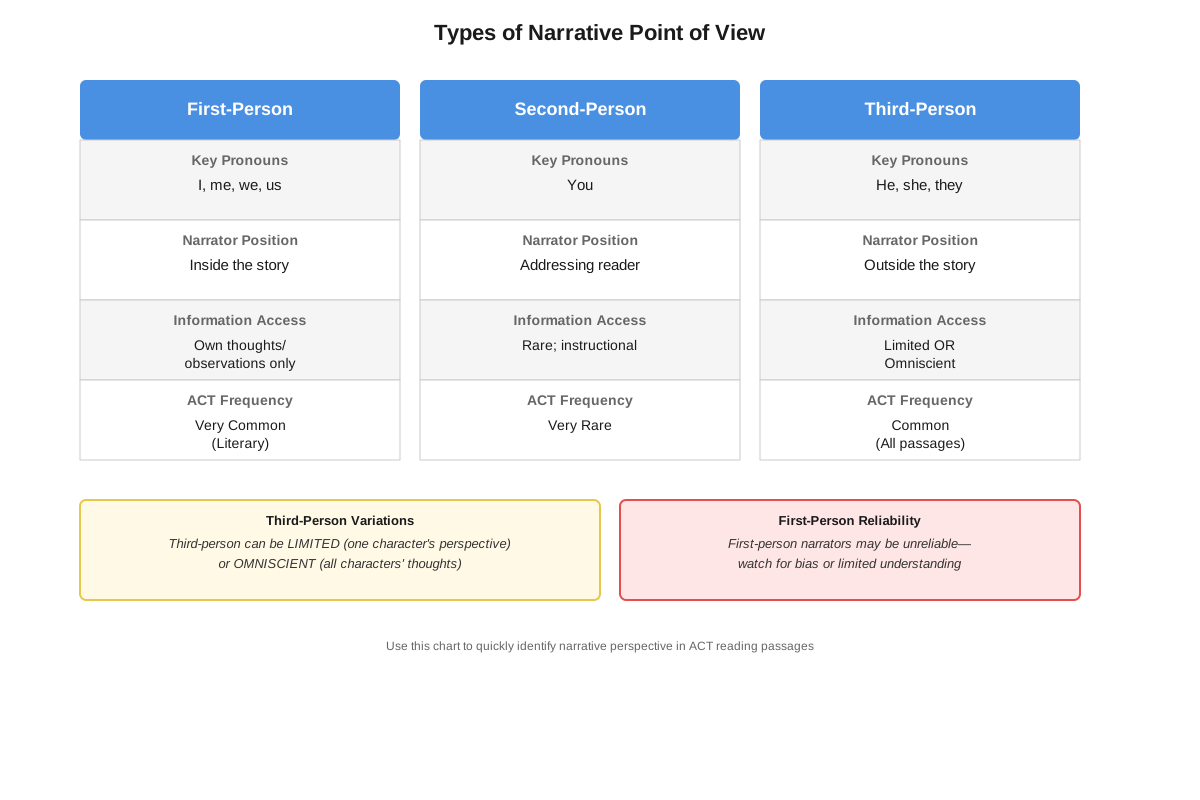
The point of view of a passage refers to the perspective from which the story or information is told. The ACT primarily tests three major categories of point of view, each with distinct characteristics that affect how information is presented and what readers can know.
First-person point of view uses "I," "me," "we," and "us" pronouns. The narrator is a character within the story who relates events from their personal experience. This perspective provides direct access to one character's thoughts, feelings, and perceptions but limits readers to only what that character witnesses, knows, or believes. First-person narrators can be protagonists (main characters) or peripheral observers. On the ACT, first-person passages often appear in Literary Narrative sections and require students to distinguish between what the narrator experiences directly versus what they infer or assume.
Second-person point of view uses "you" as the primary pronoun, directly addressing the reader. This perspective is relatively rare in ACT passages but occasionally appears in instructional texts or experimental literary pieces. When it does appear, students must recognize that "you" creates a sense of direct involvement or instruction.
Third-person point of view uses "he," "she," "they," and character names. This perspective exists outside the story's action. Third-person narration divides into several important subcategories that the ACT frequently tests:
| Point of View Type | Pronouns | Knowledge Access | Common ACT Usage |
|---|---|---|---|
| First-person | I, me, we, us | Limited to narrator's direct experience | Literary narratives, memoirs |
| Second-person | You | Varies; often instructional | Rare; occasional humanities passages |
| Third-person limited | He, she, they | Limited to one character's thoughts | Literary narratives |
| Third-person omniscient | He, she, they | Access to multiple characters' thoughts | Literary narratives, some fiction |
| Third-person objective | He, she, they | External observations only | Journalism-style passages |
Third-Person Variations
Third-person limited restricts the narrative to one character's perspective, following their thoughts and feelings while referring to them in third person. This creates an interesting hybrid: readers get internal access to one character's mind but maintain some narrative distance. ACT questions often test whether students recognize that in third-person limited passages, the narrator can reveal one character's thoughts but not others'.
Third-person omniscient provides access to multiple characters' thoughts, feelings, and experiences. The narrator knows everything about all characters and can move freely between different perspectives. ACT passages using this point of view allow the narrator to reveal information that no single character could know, and questions often test whether students recognize this unlimited narrative knowledge.
Third-person objective (also called dramatic or camera-eye) presents only observable actions, dialogue, and events without accessing any character's internal thoughts. This perspective resembles a camera recording events. While less common on the ACT, when it appears, students must recognize that the narrator reports only what could be seen or heard, not what characters think or feel internally.
Narrator Reliability and Bias
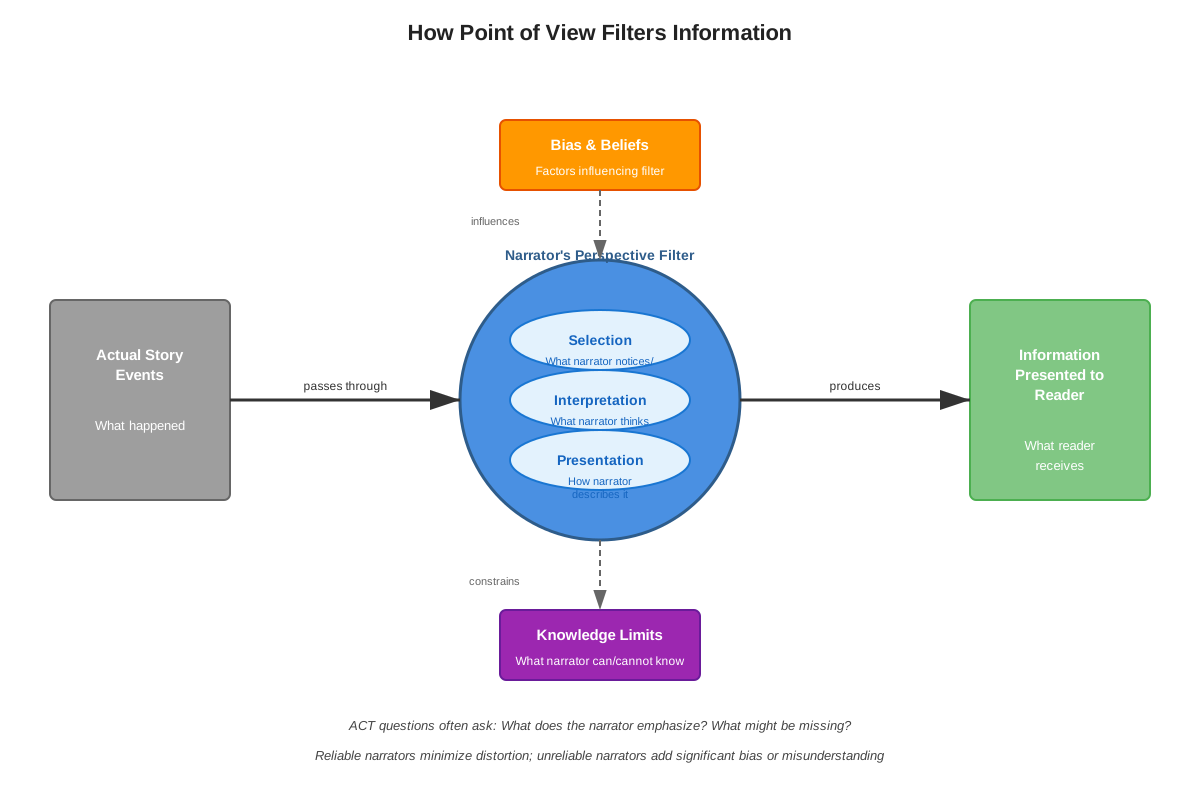
Understanding narrator reliability is crucial for ACT success. Not all narrators present information objectively or accurately. The ACT tests whether students can recognize when a narrator's perspective is limited, biased, or potentially unreliable.
Reliable narrators present information that readers can trust as accurate within the story's world. Their observations align with other evidence in the passage, and they demonstrate awareness of their own limitations.
Unreliable narrators present information that may be distorted by their limited knowledge, bias, emotional state, or deliberate deception. ACT passages may feature narrators who misunderstand situations, hold prejudiced views, or lack complete information. Questions test whether students can identify when a narrator's account might be questionable.
Bias and perspective significantly affect how narrators present information. A narrator's background, beliefs, emotional state, and relationship to events color their account. The ACT frequently includes questions asking students to identify the narrator's attitude, recognize bias in presentation, or determine how the narrator's position affects the information provided.
Point of View and Information Access
A critical concept for ACT success is understanding what the narrator can and cannot know based on their point of view. This principle generates numerous test questions.
First-person narrators cannot know:
- Other characters' unspoken thoughts or feelings
- Events that occurred when they weren't present
- Information that hasn't been shared with them
- The future (unless writing retrospectively)
Third-person limited narrators cannot know:
- Thoughts of characters other than the focal character
- Events occurring simultaneously in different locations (unless the focal character is present)
- Information the focal character doesn't possess
Third-person omniscient narrators can know:
- All characters' thoughts and feelings
- Events occurring in multiple locations simultaneously
- Background information and context
- Future events (if the narrative structure allows)
Shifts in Point of View
Some ACT passages include shifts in point of view, moving between different perspectives or time frames. These shifts may occur between paragraphs or sections. Questions test whether students can:
- Recognize when a shift has occurred
- Identify whose perspective is being presented in each section
- Understand how the shift affects the information available
- Synthesize information from multiple perspectives
Concept Relationships
Point of view serves as a foundational element that connects to virtually every other aspect of reading comprehension tested on the ACT. The relationship flows as follows:
Point of view → determines → Information access: The narrator's perspective directly controls what information readers can access, which affects all subsequent interpretation.
Point of view → influences → Tone and mood: A first-person narrator's emotional state colors their description of events, while an objective third-person narrator creates a more neutral tone.
Point of view → shapes → Characterization: How characters are presented depends entirely on whether readers access their thoughts directly (first-person or third-person limited from their perspective), through another character's observations (first-person or third-person limited from another's perspective), or through an omniscient narrator's comprehensive view.
Point of view → affects → Theme and meaning: The perspective from which a story is told influences which themes emerge as central and how readers interpret events' significance.
Point of view → connects to → Author's purpose: Authors deliberately choose point of view to achieve specific effects, so understanding this choice helps students answer author's purpose questions.
The prerequisite knowledge of pronouns and basic narrative structure enables point of view identification, which then enables more sophisticated analysis of reliability, bias, and perspective—all of which connect to the broader Reading skills of making inferences, determining main ideas, and analyzing author's craft.
Quick check — test yourself on Point of view so far.
Try Flashcards →High-Yield Facts
⭐ First-person narrators use "I" and can only report their own direct experiences, thoughts, and observations—they cannot know other characters' unspoken thoughts.
⭐ Third-person limited provides access to one character's internal thoughts while maintaining narrative distance through third-person pronouns.
⭐ Point of view questions often ask what the narrator "could NOT know" or "would most likely believe"—these test understanding of perspective limitations.
⭐ The ACT frequently tests whether students can distinguish between what actually happens in a passage versus how the narrator interprets or presents those events.
⭐ Omniscient narrators can reveal multiple characters' thoughts and information that no single character possesses.
- Second-person point of view ("you") is rare on the ACT but appears occasionally in instructional or experimental texts.
- Narrator reliability affects whether readers should trust the information presented—unreliable narrators may be biased, misinformed, or deliberately deceptive.
- Shifts in point of view within a passage signal important transitions that the ACT often tests through questions about whose perspective is being presented.
- Third-person objective narration presents only observable actions and dialogue without accessing any character's thoughts.
- The narrator's emotional state, background, and relationship to events create bias that colors their presentation of information.
- Retrospective first-person narration (looking back on past events) allows narrators to comment on their younger selves with greater knowledge or perspective.
- Point of view determines not only what information is presented but also how that information is emotionally colored and interpreted.
Common Misconceptions
Misconception: First-person narrators always tell the truth and present events accurately. → Correction: First-person narrators can be unreliable, biased, or mistaken. Their perspective is limited to their own understanding, which may be incomplete or distorted by emotion, prejudice, or lack of information.
Misconception: Third-person narration is always objective and unbiased. → Correction: Third-person narration can be highly subjective, especially in third-person limited where the narrative closely follows one character's biased perspective. Even omniscient narrators can present information with particular emotional coloring or emphasis.
Misconception: If a passage uses "he" or "she," the narrator must be omniscient and know everything. → Correction: Third-person narration includes limited and objective perspectives that have significant restrictions on what they can reveal. Students must look for evidence of whether the narrator accesses multiple characters' thoughts (omniscient) or restricts access (limited/objective).
Misconception: Point of view never changes within a single passage. → Correction: ACT passages sometimes include shifts in point of view, particularly between different time periods, sections, or when incorporating multiple accounts of the same events. Recognizing these shifts is often the key to answering questions correctly.
Misconception: The narrator and the author are the same person. → Correction: The narrator is a constructed voice or perspective created by the author. Even in first-person narratives, the "I" is a character or persona, not necessarily the author themselves. This distinction is crucial for understanding that the narrator's views may not represent the author's views.
Misconception: Point of view only matters in fiction passages. → Correction: Point of view is equally important in non-fiction, where it affects bias, reliability, and the selection of information presented. Historical accounts, personal essays, and argumentative texts all have distinct perspectives that shape their content.
Worked Examples
Example 1: Identifying Point of View and Its Limitations
Passage excerpt: "Sarah watched her brother disappear into the crowd, his shoulders hunched against the cold. She wondered if he was angry with her, but his face had revealed nothing. The city streets swallowed him whole, and she turned back toward home, her own thoughts a jumble of regret and confusion. Somewhere across town, their mother waited, unaware of the argument that had just unfolded."
Question: Based on the passage, the narrator has direct access to which of the following?
A) Sarah's thoughts and her brother's thoughts
B) Sarah's thoughts only
C) The mother's thoughts and Sarah's thoughts
D) All three characters' thoughts equally
Solution Process:
Step 1: Identify the pronouns used. The passage uses "she" and "he," indicating third-person narration.
Step 2: Determine what internal thoughts are revealed. The passage states "She wondered if he was angry" (Sarah's thought) and "her own thoughts a jumble of regret and confusion" (Sarah's internal state). These phrases provide direct access to Sarah's mind.
Step 3: Check for other characters' internal thoughts. The passage says "his face had revealed nothing"—this indicates Sarah is interpreting external signs, not accessing his thoughts directly. The mother is described as "unaware," which is information about her state but not direct access to her thoughts.
Step 4: Classify the point of view. This is third-person limited, restricted to Sarah's perspective. The narrator can tell us what Sarah thinks and feels but only what she observes about others.
Answer: B - The narrator has direct access to Sarah's thoughts only. This is third-person limited point of view focused on Sarah.
Connection to learning objectives: This example demonstrates how to identify point of view type and understand its limitations—crucial skills for ACT success.
Example 2: Analyzing Narrator Reliability and Bias
Passage excerpt: "I knew immediately that Professor Chen was going to be difficult. She walked into the classroom with that superior air that academics always have, looking down her nose at us as if we were beneath her notice. When she announced the reading list—twelve books in one semester!—I could see she was one of those professors who thinks students have nothing better to do than read her assignments. The other students seemed intimidated, but I wasn't fooled by her act."
Question: The narrator's description of Professor Chen suggests that the narrator is:
A) Providing an objective account of the professor's behavior
B) Interpreting the professor's actions through a lens of preexisting bias
C) Accurately reporting what other students thought about the professor
D) Describing events that all students would perceive identically
Solution Process:
Step 1: Identify the point of view. The use of "I" indicates first-person narration, meaning we're getting one person's subjective perspective.
Step 2: Look for language indicating interpretation versus fact. Phrases like "I knew immediately," "that superior air," "looking down her nose," and "I wasn't fooled by her act" all represent the narrator's interpretations, not objective facts.
Step 3: Identify evidence of bias. The narrator uses loaded language ("that superior air," "academics always have") and makes assumptions about the professor's motivations without evidence. The phrase "academics always have" reveals a preexisting negative attitude toward academics in general.
Step 4: Consider reliability. The narrator claims to know what "other students seemed" to feel and what the professor thinks, but provides no evidence beyond their own interpretation. This suggests an unreliable or biased narrator.
Answer: B - The narrator is interpreting the professor's actions through preexisting bias against academics. The language reveals prejudgment rather than objective observation.
Connection to learning objectives: This example shows how point of view affects reliability and how to identify narrator bias—essential skills for distinguishing between fact and interpretation on the ACT.
Exam Strategy
Recognizing Point of View Questions
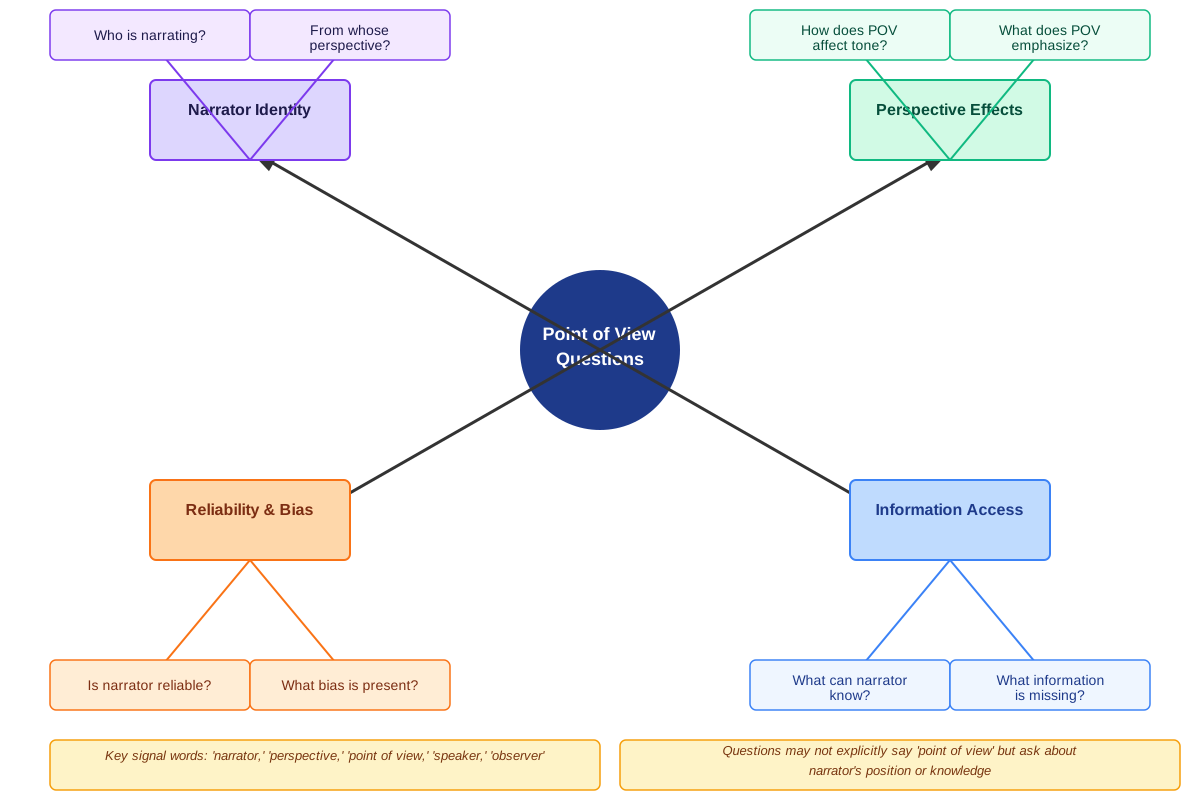
ACT point of view questions use specific trigger phrases that signal what's being tested:
- "The passage is told from the point of view of..."
- "The narrator of the passage can best be described as..."
- "Based on the passage, the narrator could NOT know..."
- "The narrator's perspective is that of..."
- "The passage is narrated by someone who..."
- "It can reasonably be inferred that the narrator..."
Exam Tip: When you see these phrases, immediately identify the pronouns used in the passage and determine the narrator's relationship to events before looking at answer choices.
Systematic Approach to Point of View Questions
Step 1: Quickly scan the passage for pronouns (I/we vs. he/she/they) to establish basic point of view category.
Step 2: Determine the narrator's position—are they a character in the story (first-person or involved) or outside it (third-person)?
Step 3: Assess information access—does the narrator reveal multiple characters' thoughts (omniscient) or limit access to one perspective (limited)?
Step 4: For questions about what the narrator knows or believes, return to the passage and find direct evidence rather than making assumptions.
Step 5: Eliminate answer choices that attribute knowledge the narrator couldn't have based on their point of view.
Process of Elimination Strategies
For identification questions ("The passage is told from whose point of view?"):
- Eliminate any answer that names a character whose thoughts are never directly revealed
- Eliminate "omniscient narrator" if the passage only accesses one character's thoughts
- Eliminate "objective narrator" if any internal thoughts are revealed
For limitation questions ("The narrator could NOT know..."):
- Eliminate anything the narrator directly states or observes
- Eliminate anything the narrator could reasonably infer from evidence presented
- Keep answers that require knowledge of other characters' unspoken thoughts (in first-person or third-person limited)
For reliability/bias questions:
- Look for loaded language, assumptions, or interpretations presented as facts
- Eliminate answers suggesting objectivity when the narrator uses emotional or judgmental language
- Keep answers that acknowledge the narrator's subjective position
Time Management
Point of view questions typically require 30-45 seconds to answer once you've read the passage. Don't spend excessive time re-reading large sections; instead:
- Use your initial passage read to note the point of view (mark "1st person" or "3rd limited" in the margin)
- For specific questions, scan for the relevant character or section rather than re-reading everything
- If a question asks about narrator limitations, think logically about the point of view type rather than searching for explicit statements
Memory Techniques
The POINT Acronym for Analysis
Pronoun check (I/we vs. he/she/they)
Observer or participant (inside or outside the story)
Information access (one mind, all minds, or external only)
Narrator reliability (trustworthy or biased)
Thoughts revealed (whose internal perspective is shown)
Visualization Strategy
Picture point of view as a camera position:
- First-person: Camera is inside one character's head, showing their view and thoughts
- Third-person limited: Camera follows one character closely, showing their thoughts but maintaining some distance
- Third-person omniscient: Camera can fly anywhere, zoom into any character's mind
- Third-person objective: Camera records from outside, showing only what could be filmed
The "Knowledge Boundary" Technique
Draw a mental circle around what the narrator can know:
- Inside the circle: Direct experiences, observations, own thoughts
- On the boundary: Reasonable inferences from evidence
- Outside the circle: Other characters' unspoken thoughts, events when narrator wasn't present
When answering "could NOT know" questions, look for answer choices outside the circle.
Summary
Point of view is a high-yield ACT Reading topic that determines who tells the story and what information readers can access. The three main categories—first-person (I/we), second-person (you), and third-person (he/she/they)—each create different relationships between narrator and events. Third-person narration further divides into limited (one character's thoughts), omniscient (all characters' thoughts), and objective (external observations only). Understanding these distinctions allows students to answer questions about what narrators can know, how their perspective affects information presentation, and whether their account is reliable or biased. The ACT consistently tests point of view through direct identification questions, limitation questions ("could NOT know"), and reliability questions. Success requires recognizing that first-person and third-person limited narrators cannot access other characters' unspoken thoughts, while omniscient narrators have unlimited knowledge. Students must distinguish between what actually happens in a passage and how the narrator interprets those events, recognizing that all narrators—even third-person ones—can present information with bias or emotional coloring. Mastering point of view provides a foundation for understanding tone, characterization, author's purpose, and theme.
Key Takeaways
- Point of view determines who tells the story and controls what information readers can access—first-person uses "I/we," third-person uses "he/she/they"
- First-person and third-person limited narrators cannot know other characters' unspoken thoughts or events they didn't witness
- Third-person omniscient narrators have unlimited access to all characters' thoughts and can reveal information no single character possesses
- The ACT frequently tests point of view through "could NOT know" questions that assess understanding of narrator limitations
- Narrator reliability and bias significantly affect how information is presented—students must distinguish between objective facts and subjective interpretations
- Recognizing shifts in point of view within passages is crucial for tracking whose perspective is being presented in each section
- Point of view connects directly to tone, characterization, and author's purpose, making it foundational for multiple question types
Related Topics
Tone and Mood: Understanding point of view is essential for analyzing tone because the narrator's perspective determines the emotional coloring of events. Mastering point of view enables more sophisticated tone analysis.
Author's Purpose and Rhetoric: Authors deliberately choose point of view to achieve specific effects. Understanding why an author selected a particular perspective helps answer purpose questions.
Characterization: Point of view determines how characters are revealed—through their own thoughts (first-person), another character's observations, or an omniscient narrator's comprehensive view.
Inference and Textual Evidence: Point of view affects what can be legitimately inferred from a passage. Understanding narrator limitations helps students make appropriate inferences supported by evidence.
Comparative Reading: Some ACT passages present multiple perspectives on the same topic. Point of view analysis skills enable effective comparison of different accounts.
Practice CTA
Now that you've mastered the core concepts of point of view, it's time to apply this knowledge! Work through the practice questions to test your ability to identify point of view types, recognize narrator limitations, and analyze how perspective shapes information presentation. The flashcards will help you internalize key distinctions and trigger phrases. Remember: point of view questions are high-yield and highly predictable—with focused practice, you can master this topic and consistently earn points on test day. Your investment in understanding perspective will pay dividends across multiple question types!
Sign up free to keep reading
Create a free AnvayaPrep account to finish this ACT guide on Point of view — plus flashcards and practice questions.