Overview
The function of a paragraph is one of the most frequently tested concepts in the ACT Reading section, appearing in approximately 15-20% of all Craft and Structure questions. This skill requires students to step back from the details within a paragraph and identify its broader purpose within the passage as a whole. Rather than asking what a paragraph says, these questions ask why the author included it—what role it plays in developing the passage's argument, narrative, or explanation.
Understanding paragraph function is essential because it tests reading comprehension at a structural level. The ACT rewards students who can recognize organizational patterns and authorial intent, not just those who can recall specific details. When students master this skill, they develop a more sophisticated understanding of how writers construct arguments, build narratives, and guide readers through complex ideas. This metacognitive awareness translates directly into faster, more accurate reading and better performance across all question types.
The ACT function of a paragraph questions connect intimately with other Craft and Structure concepts, including author's purpose, text structure, and point of view. These questions also bridge to Key Ideas and Details questions by requiring students to distinguish between what information a paragraph contains and what purpose that information serves. Mastering paragraph function creates a foundation for understanding how individual parts contribute to the whole—a skill that elevates performance across the entire Reading section.
Learning Objectives
- [ ] Identify when Function of a paragraph is being tested
- [ ] Explain the core rule or strategy behind Function of a paragraph
- [ ] Apply Function of a paragraph to ACT-style questions accurately
- [ ] Distinguish between paragraph content and paragraph purpose
- [ ] Recognize the six most common paragraph functions in ACT passages
- [ ] Eliminate incorrect answer choices by identifying scope mismatches
- [ ] Analyze how a paragraph's position affects its likely function
Prerequisites
- Main idea identification: Understanding a paragraph's function requires first grasping what the paragraph is about; the function describes why that content appears
- Passage structure awareness: Recognizing how passages are organized (chronologically, compare-contrast, problem-solution) helps predict what functions different paragraphs might serve
- Transition word recognition: Words like "however," "furthermore," and "for example" signal relationships between ideas and often indicate paragraph function
- Author's purpose basics: Paragraph function is essentially the author's purpose at the paragraph level rather than the passage level
Why This Topic Matters
In real-world reading, understanding paragraph function enables readers to navigate complex texts efficiently. Professionals in every field must quickly identify which sections of reports, articles, or proposals contain background information, which present arguments, and which offer evidence. This skill allows readers to prioritize information and understand how authors build persuasive cases or explanatory frameworks.
On the ACT Reading section, paragraph function questions appear with remarkable consistency. Students can expect 2-4 questions per test that explicitly ask about a paragraph's role, purpose, or function. These questions typically appear in the following formats: "The main purpose of the third paragraph is to...", "The author includes the second paragraph primarily in order to...", or "In relation to the passage as a whole, the fifth paragraph serves to..." Additionally, understanding paragraph function improves performance on other question types by helping students navigate passages more strategically.
These questions appear across all four passage types (Literary Narrative, Social Science, Humanities, and Natural Science), though they're particularly common in Social Science and Humanities passages where authors construct explicit arguments. The ACT favors passages with clear organizational structures, making paragraph function questions highly predictable once students learn to recognize the patterns.
Core Concepts
What Is Paragraph Function?
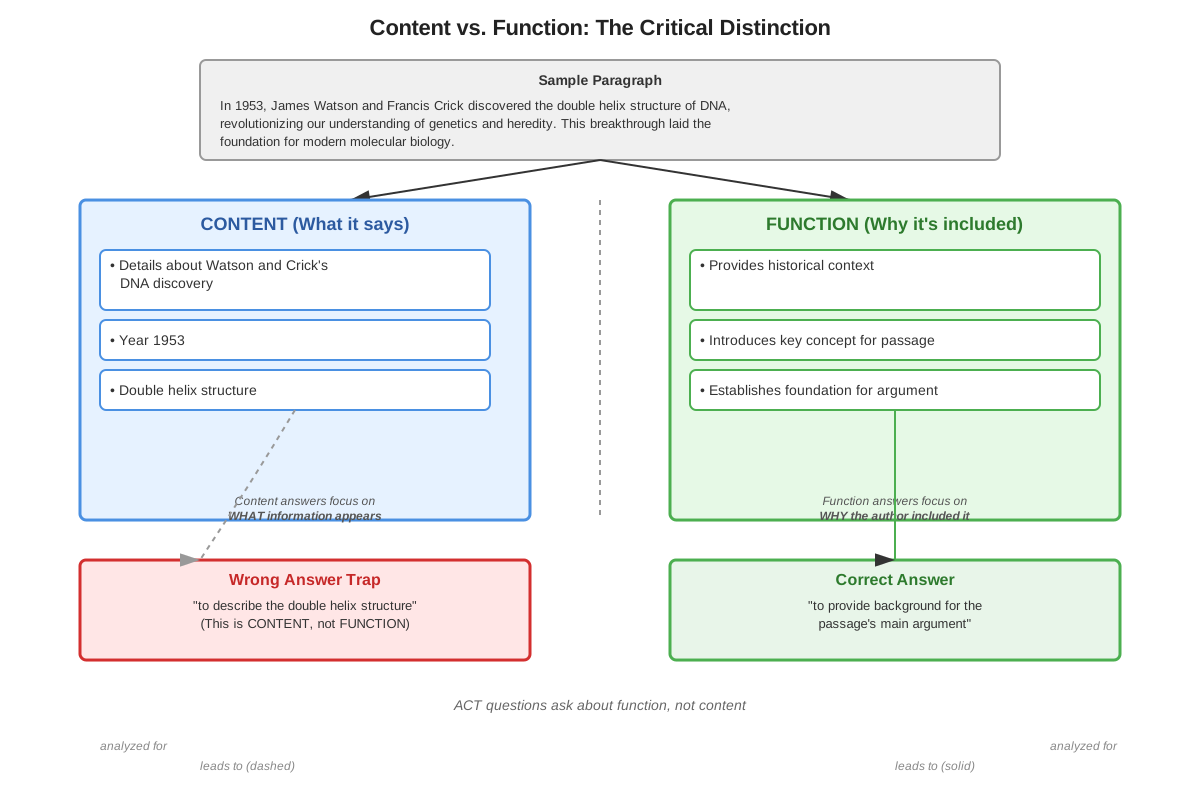
The function of a paragraph refers to the role that paragraph plays in advancing the author's overall purpose for the passage. While paragraph content describes what the paragraph says, paragraph function describes why the author included it. This distinction is crucial: two paragraphs might discuss completely different topics yet serve the same function (both might provide examples supporting a claim), or two paragraphs might discuss the same topic yet serve different functions (one introduces a theory while another critiques it).
Function operates at a higher level of abstraction than content. When identifying function, students must ask: "What would be missing from the passage if this paragraph were removed?" The answer reveals the paragraph's purpose within the larger structure.
The Six Common Paragraph Functions
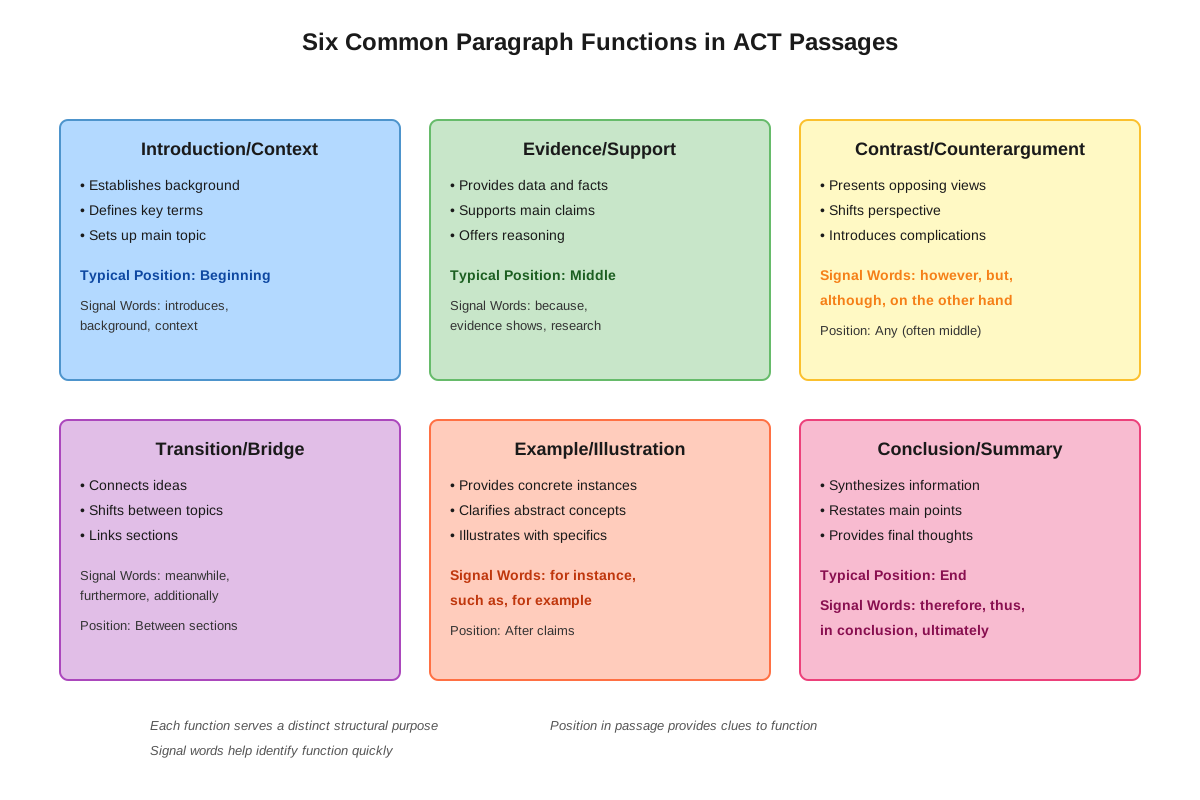
ACT passages typically employ paragraphs that serve one of six primary functions. Recognizing these patterns dramatically improves accuracy and speed:
| Function | Description | Common Positions | Trigger Words/Phrases |
|---|---|---|---|
| Introduction/Context | Establishes background, defines terms, or sets the scene | First 1-2 paragraphs | "Historically," "Background," "Context," "To understand" |
| Thesis/Main Claim | States the author's central argument or the passage's main point | Early (paragraphs 1-3) | "However," "In fact," "The key point," "Most importantly" |
| Evidence/Support | Provides examples, data, or reasoning that supports a claim | Middle paragraphs | "For example," "Research shows," "Consider," "Evidence suggests" |
| Counterargument/Alternative View | Presents opposing perspectives or challenges to the main argument | Middle paragraphs | "Critics argue," "Some believe," "An alternative view," "However" |
| Qualification/Limitation | Acknowledges exceptions, limitations, or nuances to claims | Middle to late paragraphs | "Nevertheless," "Despite," "Although," "It should be noted" |
| Conclusion/Synthesis | Summarizes key points, suggests implications, or looks forward | Final 1-2 paragraphs | "Thus," "Therefore," "Ultimately," "In conclusion," "Looking ahead" |
Analyzing Paragraph Position
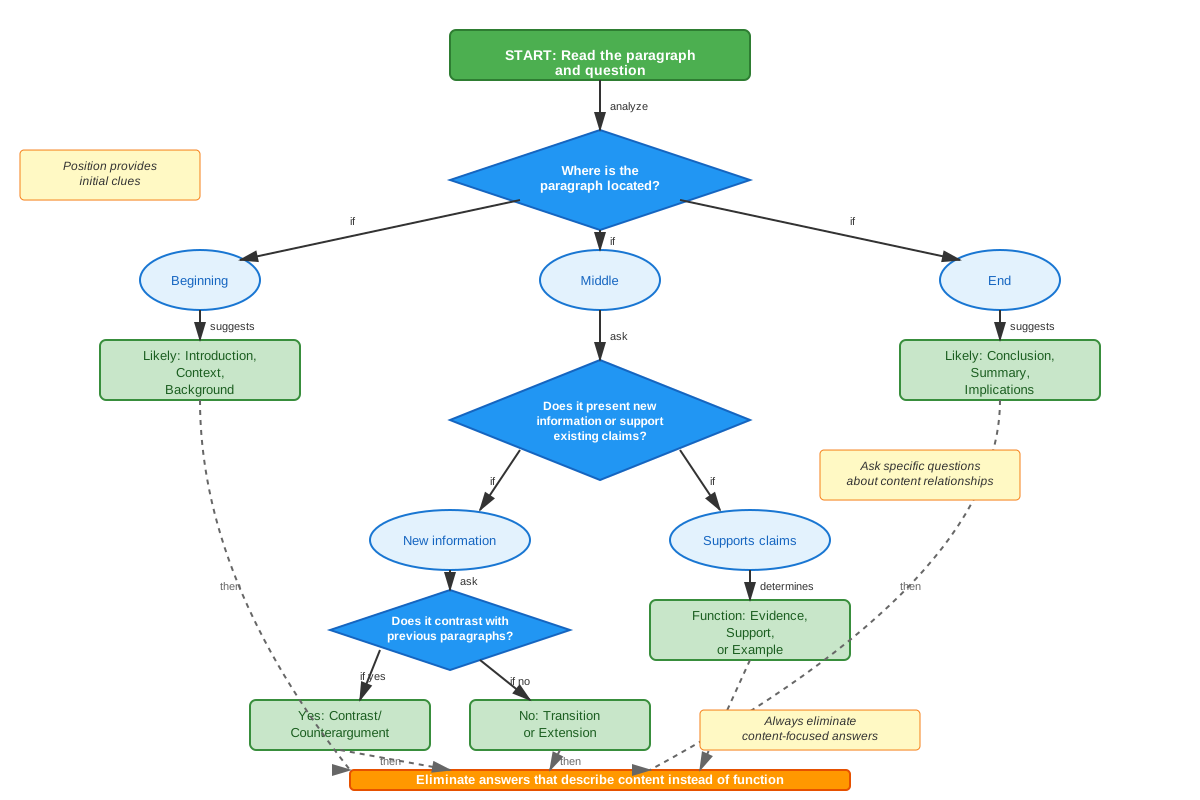
A paragraph's location within a passage provides crucial clues about its likely function. Opening paragraphs typically establish context, introduce topics, or present scenarios that the rest of the passage will explore. They rarely contain the author's main argument in full form, though they may hint at it.
Middle paragraphs do the heavy lifting of development. They present evidence, explore examples, compare alternatives, or build arguments step by step. These paragraphs often have the most specific content but serve supporting functions relative to the passage's main purpose.
Concluding paragraphs synthesize information, emphasize implications, or connect ideas back to broader themes. They rarely introduce entirely new information but rather reframe or extend what has already been established.
The Content-Function Distinction
Students frequently confuse what a paragraph discusses with what purpose it serves. Consider this example: A paragraph describes a specific experiment conducted by a scientist. The content is "an experiment involving plant growth under different light conditions." However, the function might be "to provide evidence supporting the author's claim that environmental factors significantly influence development" or "to illustrate the methods typical of early botanical research" or "to introduce a finding that later paragraphs will challenge." The same content can serve different functions depending on the passage's overall structure and argument.
This distinction explains why wrong answers on function questions often accurately describe paragraph content but misidentify its purpose. The ACT deliberately includes these tempting wrong answers to test whether students understand the difference between "what" and "why."
Scope Matching
Correct answers to paragraph function questions must match the scope of both the paragraph and its role in the passage. An answer that's too narrow focuses on a single detail within the paragraph rather than its overall purpose. An answer that's too broad describes the entire passage's purpose rather than the specific paragraph's contribution.
For example, if a paragraph provides three examples of renewable energy sources in a passage arguing for environmental policy reform, the correct answer should capture "providing examples of renewable energy" (not just "discussing solar power"—too narrow, or "arguing for policy reform"—too broad, that's the whole passage's purpose).
Transition Analysis
The sentences immediately before and after a paragraph often reveal its function. Transition sentences at the beginning of a paragraph signal how it relates to what came before: "However" indicates contrast or counterargument, "Furthermore" suggests additional support, "For instance" introduces an example, and "Despite these advantages" acknowledges limitations.
Similarly, how the following paragraph begins shows what function was just completed. If the next paragraph starts with "This example illustrates," the previous paragraph likely served an illustrative function. If it begins with "Beyond these concerns," the previous paragraph probably presented problems or criticisms.
Concept Relationships
The function of a paragraph concept sits at the intersection of several reading comprehension skills. It builds directly on main idea identification—students must first understand what a paragraph is about before determining why it's included. This relationship flows in one direction: main idea → paragraph function.
Paragraph function connects bidirectionally with passage structure understanding. Recognizing overall structure (problem-solution, chronological narrative, compare-contrast) helps predict individual paragraph functions, while analyzing individual paragraph functions reveals the passage's overall structure. These skills reinforce each other.
The concept also relates closely to author's purpose at different scales. The passage-level author's purpose (to persuade, inform, entertain, or explain) constrains what functions individual paragraphs can serve. A paragraph in a persuasive passage might present evidence or acknowledge counterarguments, while a paragraph in a narrative passage might establish setting or develop character. This represents a hierarchical relationship: passage purpose → paragraph function.
Understanding paragraph function enhances performance on inference questions because recognizing why an author included information helps students draw appropriate conclusions about the author's beliefs, assumptions, and reasoning process. This represents an enabling relationship: paragraph function mastery → improved inference skills.
Finally, paragraph function connects to vocabulary in context through transition words and phrases. The language authors use to introduce paragraphs often explicitly signals function, creating a supporting relationship where vocabulary knowledge → easier function identification.
Relationship Map: Main Idea → Paragraph Function ↔ Passage Structure → Author's Purpose (passage level) → Paragraph Function → Enhanced Inference Skills, with Vocabulary Knowledge supporting Function Identification throughout.
High-Yield Facts
- ⭐ Paragraph function questions ask "why" the author included a paragraph, not "what" the paragraph discusses
- ⭐ The six most common paragraph functions are: introduction/context, thesis/claim, evidence/support, counterargument, qualification/limitation, and conclusion/synthesis
- ⭐ Correct answers must match the scope of the specific paragraph, not the entire passage or a single detail
- ⭐ Opening paragraphs typically establish context or introduce topics; they rarely contain the full main argument
- ⭐ Middle paragraphs usually provide evidence, examples, or development of ideas presented earlier
- Concluding paragraphs synthesize information or emphasize implications rather than introducing new content
- Transition words at paragraph beginnings (however, furthermore, for example) strongly signal paragraph function
- Wrong answers often accurately describe paragraph content but misidentify its purpose
- A paragraph's function depends on its relationship to surrounding paragraphs and the passage's overall structure
- Multiple paragraphs can serve the same function (e.g., three consecutive paragraphs all providing different examples)
- The same content can serve different functions in different passages depending on context
- Function questions frequently use phrases like "primarily serves to," "main purpose," or "in order to"
- Eliminating answers that are too broad (describe whole passage) or too narrow (describe one detail) improves accuracy
- Understanding paragraph function improves reading speed by helping students predict what's coming next
Quick check — test yourself on Function of a paragraph so far.
Try Flashcards →Common Misconceptions
Misconception: The function of a paragraph is the same as its main idea.
Correction: Main idea describes what the paragraph is about (content), while function describes why the author included it (purpose). A paragraph's main idea might be "the discovery of penicillin," but its function could be "providing an example of accidental scientific breakthroughs" or "introducing a development that the passage will later analyze."
Misconception: Every paragraph serves a unique function in a passage.
Correction: Multiple paragraphs often serve the same function. A passage might include three consecutive paragraphs that all provide different examples supporting the same claim. Each has different content but the same function: supporting evidence.
Misconception: The first sentence of a paragraph always reveals its function.
Correction: While topic sentences often provide clues, function is determined by the paragraph's role in the passage structure, not just its opening. A paragraph might begin with a specific detail but serve the broader function of illustrating a general principle.
Misconception: Longer paragraphs serve more important functions than shorter ones.
Correction: Paragraph length doesn't determine functional importance. A brief two-sentence paragraph might serve the crucial function of stating the passage's thesis, while a lengthy paragraph might simply provide one of several supporting examples.
Misconception: If a paragraph discusses a counterargument, its function is to support that counterargument.
Correction: Presenting a counterargument and supporting it are different functions. Most passages present counterarguments in order to refute them or acknowledge complexity, not to endorse them. The function is "presenting an alternative view" or "acknowledging opposing perspectives," not "supporting the counterargument."
Misconception: The correct answer will use the same words as the paragraph.
Correction: Correct answers typically paraphrase or describe function at a higher level of abstraction. If a paragraph discusses three renewable energy sources, the answer won't list those sources but will say something like "providing examples of alternative energy options."
Misconception: Function questions are really just asking about the author's overall purpose.
Correction: Function questions ask about a specific paragraph's role, which is narrower than the author's overall purpose. The passage's purpose might be "to argue for policy change," but a specific paragraph's function might be "to establish historical context" or "to present supporting evidence."
Worked Examples
Example 1: Social Science Passage
Passage Context: A passage discusses the debate over standardized testing in education. The first two paragraphs introduce the topic and note its controversy. The third paragraph reads:
"Proponents of standardized testing argue that these assessments provide objective measures of student achievement across diverse schools and districts. They point to data showing correlations between test scores and later academic success. Furthermore, supporters contend that standardized tests hold schools accountable and help identify achievement gaps that might otherwise go unnoticed."
Question: The main purpose of the third paragraph is to:
A) Prove that standardized testing accurately measures student ability
B) Present arguments made by those who support standardized testing
C) Explain why standardized testing has become controversial
D) Describe the author's position on educational assessment
Analysis:
Step 1: Identify what the paragraph discusses (content). The paragraph presents arguments in favor of standardized testing: objectivity, correlation with success, accountability, and identifying gaps.
Step 2: Determine why the author included this content (function). The paragraph presents these as arguments made by "proponents" and "supporters"—the author is reporting what others believe, not necessarily endorsing these views. Given the passage context (a debate), this paragraph likely presents one side before the author explores the other side or offers analysis.
Step 3: Evaluate each answer against the paragraph's function:
- Choice A is too strong and misidentifies function. The paragraph presents arguments that testing is accurate, but its function isn't to prove this—it's to report what proponents argue. This confuses content with function.
- Choice B correctly identifies the function: presenting/reporting arguments made by supporters. This matches both the content and the purpose within the debate structure.
- Choice C is too broad. While the paragraph relates to the controversy, its specific function is to present one side, not to explain the controversy overall.
- Choice D misidentifies whose position is being presented. The paragraph presents proponents' views, not the author's position.
Answer: B
Connection to Learning Objectives: This example demonstrates identifying when function is being tested (the phrase "main purpose"), distinguishing content from function (what arguments are made vs. why the author presents them), and applying scope matching (the paragraph presents one side's arguments, not the author's view or the whole controversy).
Example 2: Natural Science Passage
Passage Context: A passage explains the development of plate tectonic theory. Earlier paragraphs describe continental drift theory and its initial rejection. The fifth paragraph reads:
"The discovery of mid-ocean ridges in the 1950s provided crucial evidence that would eventually validate continental drift theory. Underwater mapping revealed vast mountain ranges on the ocean floor, with newer rock near the ridges and progressively older rock farther away. This pattern suggested that new seafloor was continuously forming at the ridges and spreading outward—a process that could explain how continents moved."
Question: In relation to the passage as a whole, the fifth paragraph primarily serves to:
A) Describe the geographic features of mid-ocean ridges
B) Explain the process by which new seafloor forms
C) Introduce evidence that supported a previously rejected theory
D) Argue that underwater mapping is essential to geology
Analysis:
Step 1: Identify the paragraph's content. The paragraph discusses mid-ocean ridges, their rock age patterns, and seafloor spreading.
Step 2: Consider the paragraph's position and relationship to surrounding content. The passage has established that continental drift was initially rejected. This paragraph introduces a discovery that "provided crucial evidence that would eventually validate" the theory. The function is about the role this discovery played in the theory's development.
Step 3: Evaluate answers for scope and accuracy:
- Choice A accurately describes content (geographic features) but misses the function. The paragraph isn't included just to describe features—it's included to show how these features served as evidence. Too narrow and content-focused.
- Choice B also describes content (the seafloor spreading process) but not function. The paragraph explains the process in order to show how it provided evidence, but explaining the process isn't the primary function. Too narrow.
- Choice C correctly identifies function: introducing evidence that supported the previously rejected continental drift theory. This captures why the author included this paragraph in the passage's narrative about the theory's development.
- Choice D is too broad and inaccurate. The paragraph uses underwater mapping as part of its example, but the function isn't to argue for mapping's importance generally.
Answer: C
Connection to Learning Objectives: This example shows how paragraph position (following discussion of theory rejection) helps identify function, demonstrates the content-function distinction (describing features vs. introducing evidence), and illustrates how the correct answer captures the paragraph's role in the passage's overall narrative structure.
Exam Strategy
Recognizing Function Questions
Function questions use predictable language. Watch for these trigger phrases:
- "The main purpose of [paragraph X] is to..."
- "The author includes [paragraph X] primarily in order to..."
- "[Paragraph X] serves mainly to..."
- "In relation to the passage as a whole, [paragraph X]..."
- "The function of [paragraph X] is to..."
When you see these phrases, immediately shift from detail-focused reading to structural thinking. You're being asked about purpose, not content.
The Three-Step Approach
Step 1: Identify the paragraph's main idea (what it's about). Read or reread the paragraph quickly, focusing on the first and last sentences. Summarize the content in your own words: "This paragraph discusses X."
Step 2: Determine the paragraph's function (why it's included). Before looking at answers, ask: "What would be missing if this paragraph were removed?" Consider the paragraph's position and its relationship to surrounding paragraphs. Predict the function: "This paragraph is included to [provide evidence for / introduce / contrast with / qualify] the idea that..."
Step 3: Match your prediction to the answers. Eliminate choices that describe content without capturing function, that are too broad (whole passage purpose), or too narrow (single detail).
Process of Elimination Strategies
Eliminate "too narrow" answers: If an answer focuses on a single detail, example, or sentence within the paragraph rather than its overall purpose, eliminate it. These answers often start with very specific language: "to describe the chemical composition of..." when the paragraph's function is broader, like "to provide an example of..."
Eliminate "too broad" answers: If an answer describes the entire passage's purpose rather than the specific paragraph's contribution, eliminate it. These answers often match the passage's main idea but don't capture what this particular paragraph contributes.
Eliminate "content not function" answers: If an answer accurately describes what the paragraph discusses but doesn't explain why the author included it, eliminate it. These are the most tempting wrong answers. Ask: "Does this answer tell me the paragraph's role in the passage structure, or just what it talks about?"
Watch for scope words: Words like "primarily," "mainly," and "most importantly" in the question stem indicate you should choose the answer that captures the paragraph's central function, even if other answers describe secondary purposes.
Time Management
Function questions should take 30-45 seconds once you've read the passage. If you've actively read with structure in mind, you'll already have a sense of each paragraph's role. Don't reread the entire paragraph unless necessary—focus on the first sentence, last sentence, and transitions to/from surrounding paragraphs.
If you're stuck between two answers, both of which seem to describe the paragraph's purpose, choose the one that better fits the passage's overall structure and the paragraph's position. The correct answer will align with the passage's organizational pattern.
Memory Techniques
The "PIECES" Mnemonic
Remember the six common paragraph functions with PIECES:
- Present context/background (Introduction)
- Introduce claim/thesis
- Evidence and examples (Support)
- Counterargument or alternative view
- Exceptions and limitations (Qualification)
- Synthesize and conclude
When you encounter a function question, mentally run through PIECES to predict which function the paragraph likely serves based on its position and content.
The "Why Not What" Reminder
Create a mental association: Function questions ask "Why not What." Visualize a question mark with "WHY?" written above it and "WHAT?" crossed out below. This simple reminder helps you avoid the most common error—choosing answers that describe content instead of function.
Position-Function Mapping
Visualize a passage as a three-part structure:
- Beginning = Setup (context, introduction, thesis)
- Middle = Development (evidence, examples, counterarguments, qualifications)
- End = Wrap-up (synthesis, implications, conclusions)
When asked about a paragraph's function, first locate it in this three-part structure. This immediately narrows the likely functions.
The "Remove It" Test
When uncertain about function, imagine removing the paragraph entirely. What would the passage lose? The answer reveals function:
- Lose background information? Function = provide context
- Lose support for a claim? Function = provide evidence
- Lose an opposing view? Function = present counterargument
- Lose the main point? Function = state thesis
Summary
The function of a paragraph refers to the role that paragraph plays in advancing the author's overall purpose, distinct from the paragraph's content or main idea. ACT Reading questions about paragraph function test whether students understand why authors include specific paragraphs, not just what those paragraphs discuss. The six most common functions are: providing context/introduction, stating a thesis or claim, offering evidence or examples, presenting counterarguments or alternative views, acknowledging qualifications or limitations, and synthesizing or concluding. Success on these questions requires distinguishing content from purpose, matching answer scope to the specific paragraph's role (not too broad or narrow), and analyzing how paragraph position and transitions signal function. The most common error is selecting answers that accurately describe paragraph content but fail to identify its structural purpose. Students should approach these questions by first identifying what the paragraph discusses, then determining why the author included it based on its relationship to surrounding paragraphs and the passage's overall structure, and finally matching this predicted function to the answer choices while eliminating options that are too broad, too narrow, or focused on content rather than purpose.
Key Takeaways
- Paragraph function describes why an author included a paragraph (purpose), not what the paragraph discusses (content)
- The six common functions are: introduction/context, thesis/claim, evidence/support, counterargument, qualification/limitation, and conclusion/synthesis
- Correct answers must match the scope of the specific paragraph—not the entire passage (too broad) or a single detail (too narrow)
- Paragraph position provides crucial clues: opening paragraphs typically introduce or provide context, middle paragraphs develop ideas with evidence or examples, and concluding paragraphs synthesize or emphasize implications
- Transition words and phrases at paragraph beginnings often explicitly signal function
- The most common wrong answers accurately describe paragraph content but misidentify its structural purpose
- Use the three-step approach: identify content, determine function based on structure and position, then match to answers while eliminating scope mismatches
Related Topics
Text Structure and Organization: Understanding overall passage structure (chronological, compare-contrast, problem-solution, cause-effect) provides the framework within which individual paragraph functions operate. Mastering paragraph function enables deeper analysis of how authors organize complex arguments.
Author's Purpose and Point of View: Paragraph function represents author's purpose at the paragraph level. Students who understand why individual paragraphs are included can better synthesize the author's overall purpose and identify subtle shifts in perspective.
Rhetorical Strategies: Advanced analysis of how authors use specific techniques (repetition, rhetorical questions, appeals to emotion or logic) builds on understanding paragraph function by examining how authors achieve their purposes.
Synthesis Across Multiple Texts: Comparing how different authors structure arguments or narratives requires first understanding how individual paragraphs function within single texts.
Practice CTA
Now that you understand how to identify and analyze paragraph function, it's time to apply these strategies to ACT-style passages. The practice questions and flashcards will help you recognize function questions quickly, distinguish content from purpose, and eliminate wrong answers efficiently. Remember: every function question you practice strengthens your structural reading skills, making you faster and more accurate across all Reading question types. You've learned the framework—now build the automaticity that leads to top scores!
Sign up free to keep reading
Create a free AnvayaPrep account to finish this ACT guide on Function of a paragraph — plus flashcards and practice questions.