Overview
Text structure refers to the organizational framework authors use to arrange ideas, information, and arguments within a passage. On the ACT Reading test, understanding how a passage is structured is crucial for quickly locating information, predicting where certain details will appear, and comprehending the author's purpose and main ideas. Rather than reading every word with equal attention, skilled test-takers recognize structural patterns that help them navigate passages efficiently and answer questions accurately.
The ACT consistently tests students' ability to identify and analyze ACT text structure through questions that ask about the organization of paragraphs, the function of specific sections, the progression of ideas, or the overall architecture of a passage. These questions appear across all passage types—prose fiction, social science, humanities, and natural science—making text structure knowledge universally applicable. Students who master text structure can answer questions more quickly because they understand not just what the passage says, but how it says it and why information appears in a particular order.
Text structure connects intimately with other Reading concepts such as main idea identification, author's purpose, and rhetorical strategy. The way an author structures a passage reveals their intent: a chronological structure might indicate a narrative or historical account, while a problem-solution structure suggests persuasive or analytical writing. By recognizing these patterns, students gain a strategic advantage that extends beyond individual questions to improve overall passage comprehension and time management.
Learning Objectives
- [ ] Identify when Text structure is being tested in ACT Reading questions
- [ ] Explain the core rule or strategy behind Text structure analysis
- [ ] Apply Text structure knowledge to ACT-style questions accurately
- [ ] Recognize and categorize the six major organizational patterns used in ACT passages
- [ ] Determine the function of specific paragraphs or sections within a passage's overall structure
- [ ] Use structural clues to predict where information will appear and navigate passages efficiently
Prerequisites
- Basic reading comprehension: Understanding literal meaning of sentences and paragraphs is necessary before analyzing how those elements are organized
- Paragraph structure awareness: Recognizing topic sentences, supporting details, and transitions helps identify how paragraphs function within larger structures
- Familiarity with main ideas: Distinguishing between main ideas and supporting details enables students to see how information is hierarchically organized
Why This Topic Matters
Understanding text structure provides practical benefits far beyond standardized testing. In academic settings, recognizing organizational patterns helps students take better notes, write more coherent essays, and comprehend complex textbooks across disciplines. Professionally, the ability to quickly grasp how documents are structured—whether reports, proposals, or articles—enables more efficient information processing and better decision-making.
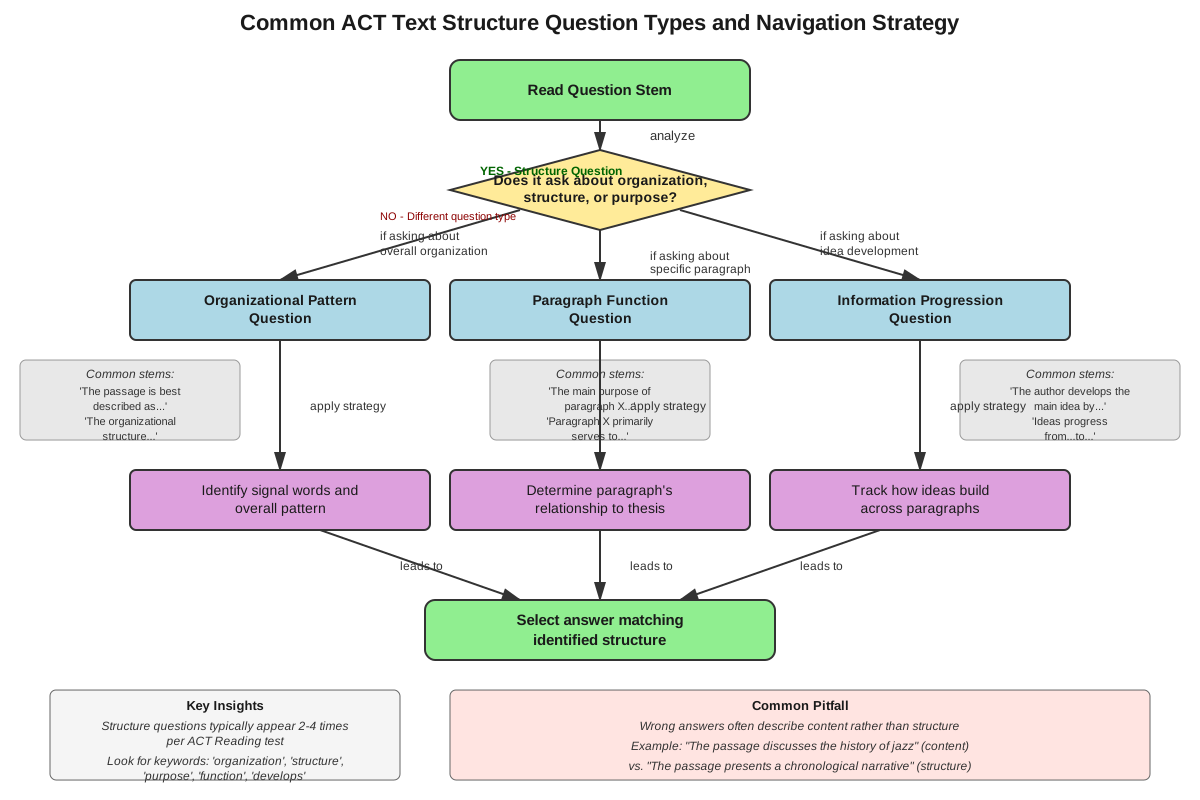
On the ACT Reading test, text structure questions appear with high frequency, typically 2-4 questions per test across the four passages. These questions often ask students to identify the purpose of a paragraph, describe how ideas progress through the passage, or explain why the author organized information in a particular sequence. Common question stems include: "The main purpose of the third paragraph is to...", "The passage is best described as...", "The author develops the main idea primarily by...", or "The organizational structure of the passage can best be described as..."
Text structure questions appear in multiple forms throughout ACT passages. Some questions explicitly ask about organization, while others require structural understanding to answer efficiently. For example, detail questions become much easier when students know that examples typically follow general statements, or that contrasting viewpoints often appear in adjacent paragraphs. The ability to recognize structure transforms reading from a linear, word-by-word process into a strategic, pattern-recognition exercise that saves valuable time.
Core Concepts
The Six Major Organizational Patterns
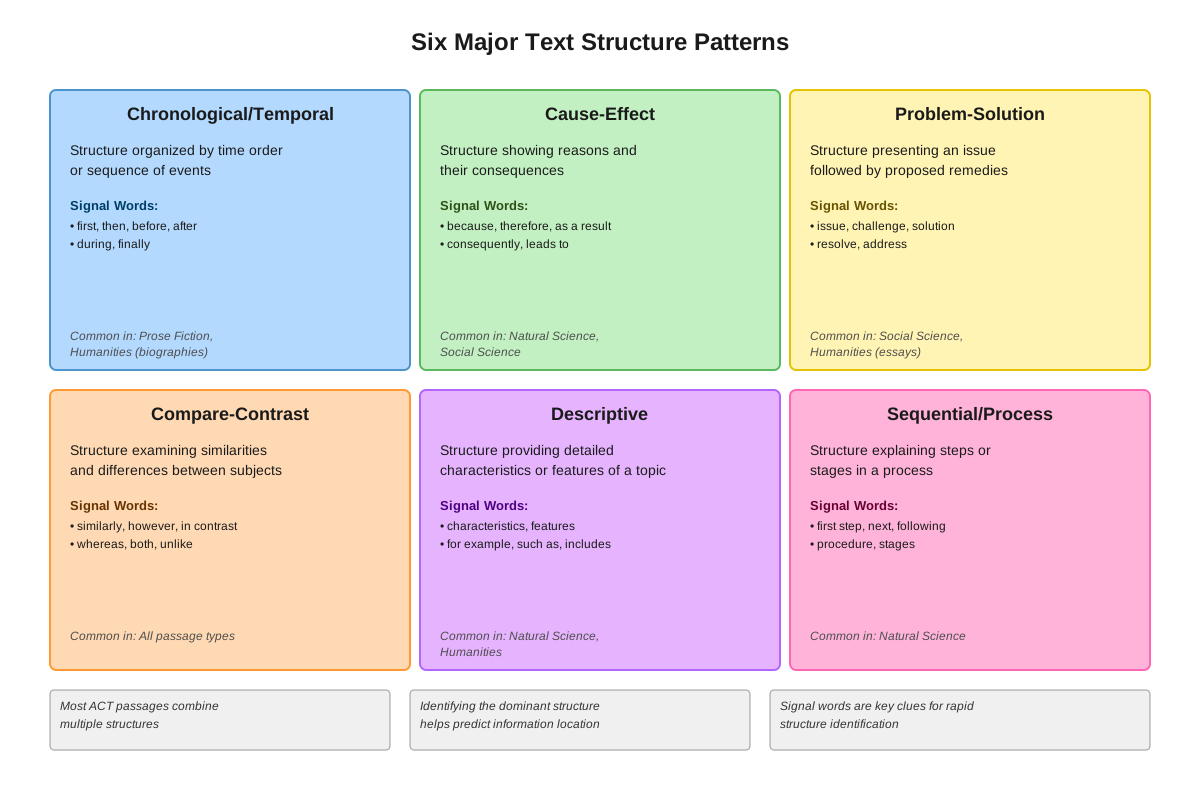
Authors organize passages using recognizable patterns that serve specific purposes. Understanding these patterns allows students to anticipate content and navigate passages strategically.
1. Chronological/Sequential Structure: Information is presented in time order, from earliest to latest events. This structure commonly appears in narrative passages, historical accounts, and process descriptions. Transition words include "first," "then," "next," "subsequently," "finally," and specific dates or time periods.
2. Compare/Contrast Structure: The author examines similarities and differences between two or more subjects. This pattern may present all information about Subject A, then all information about Subject B (block method), or alternate between subjects point-by-point. Signal words include "similarly," "likewise," "however," "in contrast," "whereas," "on the other hand," and "unlike."
3. Cause/Effect Structure: The passage explores reasons why something happened (causes) and the results (effects). This structure may present multiple causes leading to one effect, one cause leading to multiple effects, or a chain of causation. Indicators include "because," "since," "as a result," "consequently," "therefore," "thus," "leads to," and "due to."
4. Problem/Solution Structure: The author presents a problem, challenge, or question, then proposes one or more solutions or answers. This structure often appears in persuasive or analytical passages. The problem typically appears early, with solutions following in subsequent paragraphs.
5. Description/Enumeration Structure: The passage describes a topic by listing characteristics, features, examples, or categories. This structure organizes information spatially, by importance, or by category. Signal phrases include "for example," "for instance," "such as," "including," "characteristics include," and numbered or bulleted lists (implied in prose).
6. Argument/Claim-Evidence Structure: The author presents a thesis or claim, then supports it with evidence, examples, and reasoning. This structure may also include counterarguments followed by refutations. Common in persuasive and analytical writing, this pattern uses phrases like "evidence suggests," "studies show," "for instance," "critics argue," and "however."
Paragraph Function Within Overall Structure
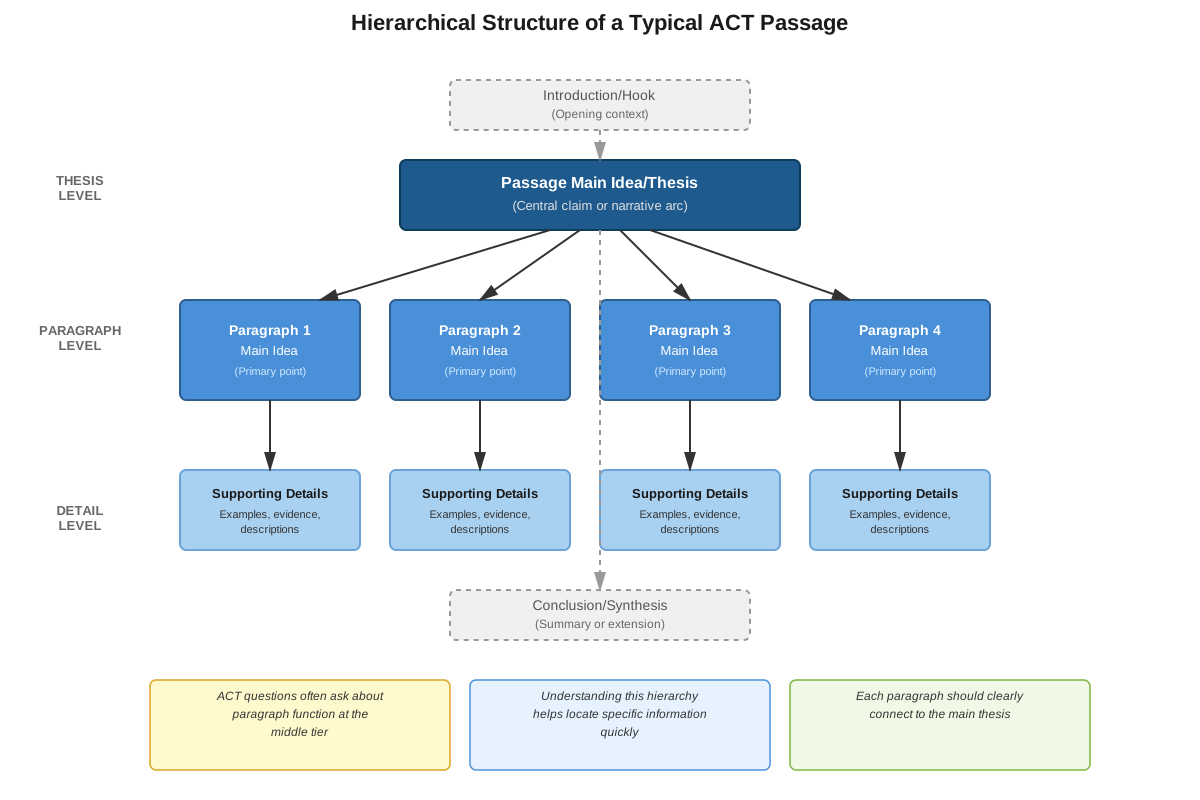
Individual paragraphs serve specific roles within a passage's larger architecture. Recognizing these functions helps students answer questions about purpose and organization.
| Paragraph Position | Common Functions | Typical Content |
|---|---|---|
| Opening paragraph | Introduce topic, establish context, present thesis | Background information, hook, main claim |
| Body paragraphs (early) | Develop main ideas, provide foundational information | Key concepts, definitions, initial evidence |
| Body paragraphs (middle) | Present evidence, examples, analysis | Supporting details, data, illustrations |
| Body paragraphs (late) | Address complications, counterarguments, or applications | Alternative views, implications, extensions |
| Concluding paragraph | Synthesize ideas, reinforce main point, suggest implications | Summary, final thoughts, broader significance |
Structural Transitions and Signposts
Authors use specific words and phrases to signal structural relationships between ideas. These transition words function as roadmaps, indicating how the upcoming content relates to what came before.
Continuation signals (same direction): additionally, furthermore, moreover, also, in addition
Contrast signals (change direction): however, nevertheless, yet, although, despite, conversely
Causation signals (cause-effect): therefore, thus, consequently, as a result, because
Example signals (illustration): for instance, for example, such as, to illustrate
Emphasis signals (importance): indeed, in fact, notably, significantly, especially
Sequence signals (order): first, second, finally, next, subsequently, meanwhile
Structural Clues in Question Stems
ACT questions about text structure use predictable language patterns. Recognizing these patterns helps students identify when structural knowledge is being tested:
- "The main function of the [ordinal number] paragraph is to..."
- "The passage is best described as..."
- "The author develops the main idea primarily by..."
- "The organizational structure of the passage can best be described as..."
- "The author mentions [detail] primarily to..."
- "In relation to the passage as a whole, the [ordinal number] paragraph serves to..."
Macro vs. Micro Structure
Macro structure refers to the overall organization of the entire passage—how major sections relate to create a coherent whole. Understanding macro structure helps students grasp the author's overall purpose and the passage's trajectory.
Micro structure refers to the organization within individual paragraphs—how sentences relate to each other and to the paragraph's main idea. Recognizing micro structure helps students understand how specific details support larger points.
Both levels matter on the ACT. Some questions ask about overall organization (macro), while others focus on the function of specific sentences or paragraphs (micro). Effective readers move fluidly between these levels, understanding how small-scale structures build into large-scale patterns.
Concept Relationships
Text structure serves as a foundational concept that connects to virtually every other aspect of ACT Reading comprehension. The relationship flows as follows:
Text Structure → Main Idea Identification: Understanding how a passage is organized reveals which ideas are central and which are supporting. The structure itself often emphasizes the main idea through placement (thesis statements typically appear early) and repetition (key concepts recur throughout).
Text Structure → Author's Purpose: The organizational pattern an author chooses reflects their purpose. A chronological structure suggests narrative or historical purposes, while argument structure indicates persuasive intent. Recognizing structure helps students infer purpose even when it's not explicitly stated.
Text Structure → Detail Location: Knowledge of common organizational patterns enables strategic skimming. Students who recognize a compare/contrast structure know that information about Subject B will follow information about Subject A, allowing them to skip ahead when searching for specific details.
Paragraph Function → Overall Structure: Individual paragraphs function as building blocks of the larger structure. A paragraph that presents a counterargument contributes to an overall argument structure; a paragraph describing an event contributes to chronological structure.
Transition Words → Structural Relationships: Transition words signal the connections between ideas, making the underlying structure visible. Recognizing these signals helps students map the passage's architecture quickly.
The prerequisite knowledge of basic reading comprehension and paragraph structure enables text structure analysis, which in turn enables more sophisticated skills like synthesizing information across paragraphs and evaluating rhetorical effectiveness.
High-Yield Facts
⭐ Text structure questions typically appear 2-4 times per ACT Reading test, making them high-frequency question types
⭐ The six major organizational patterns are: chronological, compare/contrast, cause/effect, problem/solution, description/enumeration, and argument/claim-evidence
⭐ Transition words serve as structural signposts that reveal how ideas relate to each other
⭐ Opening paragraphs typically introduce the topic and establish context; concluding paragraphs synthesize ideas and suggest implications
⭐ Questions asking about "the main function" or "primary purpose" of a paragraph are testing text structure understanding
- Compare/contrast structures may use block organization (all of A, then all of B) or point-by-point organization (alternating between A and B)
- Cause/effect structures can present multiple causes → one effect, one cause → multiple effects, or causal chains
- The position of information within a passage often indicates its importance: thesis statements appear early, supporting evidence follows
- Authors use parallel structure (repeating organizational patterns) to emphasize relationships between ideas
- Understanding macro structure (overall organization) helps with main idea questions; understanding micro structure (paragraph-level organization) helps with detail questions
Quick check — test yourself on Text structure so far.
Try Flashcards →Common Misconceptions
Misconception: Text structure only matters for questions explicitly asking about organization → Correction: Understanding structure helps answer many question types more efficiently, including detail questions (by knowing where to look), inference questions (by understanding relationships between ideas), and main idea questions (by recognizing which ideas the structure emphasizes).
Misconception: All passages follow only one organizational pattern throughout → Correction: Most ACT passages combine multiple organizational patterns. A passage might have an overall chronological structure while individual paragraphs use cause/effect or compare/contrast patterns. Skilled readers recognize these nested structures.
Misconception: The first sentence of each paragraph always states the paragraph's main idea → Correction: While topic sentences often appear first, they can also appear at the end of a paragraph (especially in narrative passages) or be implied rather than explicitly stated. Students should read the entire paragraph to determine its function.
Misconception: Transition words always appear between paragraphs → Correction: Transition words appear both between and within paragraphs. Recognizing transitions within paragraphs helps understand micro structure; recognizing transitions between paragraphs helps understand macro structure.
Misconception: Text structure questions are subjective and have multiple correct answers → Correction: Text structure questions have definitively correct answers based on objective analysis of how information is organized. The correct answer accurately describes the passage's organizational pattern or a paragraph's function within that pattern.
Misconception: Understanding structure requires memorizing the entire passage → Correction: Effective structure analysis involves recognizing patterns and relationships, not memorization. Students should focus on how ideas connect rather than trying to remember every detail.
Worked Examples
Example 1: Identifying Overall Structure
Passage excerpt: "The Industrial Revolution transformed European society in the late 18th and early 19th centuries. Before this period, most people lived in rural areas and worked in agriculture. The invention of the steam engine in 1769 changed everything. Factories began appearing in cities, drawing workers from the countryside. By 1850, urban populations had exploded, and manufacturing had replaced agriculture as the dominant economic activity. This shift created new social classes and altered family structures. Women and children entered the workforce in unprecedented numbers, often laboring in dangerous conditions. The rapid urbanization also led to overcrowding, poor sanitation, and disease. However, the Industrial Revolution also brought benefits: increased productivity, higher wages for some workers, and technological innovations that improved quality of life."
Question: The organizational structure of this passage can best be described as:
A) A comparison of rural and urban lifestyles
B) A chronological account of changes with analysis of effects
C) An argument against industrialization
D) A description of steam engine technology
Solution Process:
Step 1: Identify the overall pattern by examining how information progresses. The passage begins with a time marker ("late 18th and early 19th centuries") and includes specific dates (1769, 1850), suggesting chronological organization.
Step 2: Note that the passage doesn't just list events—it explains consequences. Phrases like "changed everything," "This shift created," and "also led to" indicate cause/effect relationships embedded within the chronological framework.
Step 3: Evaluate each answer choice:
- Choice A: While the passage mentions rural and urban areas, it doesn't systematically compare them point-by-point. Eliminate.
- Choice B: This accurately captures both the chronological progression (before → 1769 → 1850) and the analysis of effects (social, economic, health impacts). Keep.
- Choice C: The passage presents both negative and positive effects, not a one-sided argument. Eliminate.
- Choice D: The steam engine is mentioned as one catalyst, but the passage focuses on broader social changes. Eliminate.
Answer: B
Connection to learning objectives: This example demonstrates how to identify overall text structure by recognizing organizational patterns (chronological + cause/effect) and how to apply this knowledge to answer ACT-style questions accurately.
Example 2: Determining Paragraph Function
Passage context: A four-paragraph passage about renewable energy. Paragraph 1 introduces the need for alternatives to fossil fuels. Paragraph 2 describes solar energy technology and benefits. Paragraph 3 describes wind energy technology and benefits.
Paragraph 4: "Critics argue that renewable energy sources cannot meet current energy demands due to their intermittent nature—solar panels don't work at night, and wind turbines require consistent wind. However, recent advances in battery storage technology address this limitation. Modern lithium-ion batteries can store excess energy generated during peak production times and release it when production drops. Additionally, a diversified energy grid combining multiple renewable sources ensures more consistent power supply. The intermittency argument, while once valid, no longer justifies continued reliance on fossil fuels."
Question: The main function of the fourth paragraph is to:
A) Introduce a new renewable energy source
B) Present and refute a criticism of renewable energy
C) Explain how batteries work
D) Conclude that fossil fuels are superior
Solution Process:
Step 1: Identify the paragraph's structure. It begins with "Critics argue," signaling a counterargument, then uses "However" to introduce a refutation.
Step 2: Recognize this as a classic argument structure pattern: counterargument → refutation. The paragraph acknowledges an opposing view, then provides evidence against it.
Step 3: Determine the paragraph's function within the overall passage structure. After two paragraphs describing renewable energy benefits, this paragraph addresses potential objections, strengthening the overall argument for renewables.
Step 4: Evaluate answer choices:
- Choice A: No new energy source is introduced; batteries are storage, not generation. Eliminate.
- Choice B: This precisely describes the paragraph's structure and function. Keep.
- Choice C: Battery technology is mentioned as evidence in the refutation, not as the main focus. Eliminate.
- Choice D: The paragraph argues against this conclusion. Eliminate.
Answer: B
Connection to learning objectives: This example shows how to identify when text structure is being tested (questions about paragraph function), recognize structural patterns (counterargument-refutation), and apply this understanding to select the correct answer.
Exam Strategy
Approaching Text Structure Questions
Step 1: Identify structure questions quickly. Look for these trigger phrases in question stems:
- "main function/purpose of the [ordinal] paragraph"
- "passage is best described as"
- "author develops the main idea primarily by"
- "organizational structure"
- "in relation to the passage as a whole"
Step 2: For overall structure questions, skim the first sentence of each paragraph before reading the full passage. This creates a mental outline of how ideas progress and helps identify the dominant organizational pattern.
Step 3: For paragraph function questions, read the paragraph in question plus the sentences immediately before and after it. Understanding how the paragraph connects to surrounding content reveals its function.
Step 4: Use transition words as clues. When a paragraph begins with "However" or "In contrast," it likely presents an opposing view or contrasting information. When it begins with "For example" or "To illustrate," it likely provides supporting evidence for a previous claim.
Process of Elimination Tips
Eliminate answers that describe content rather than structure. If a question asks about organizational structure and an answer choice summarizes what the passage says rather than how it's organized, eliminate it. Structure questions focus on the "how," not the "what."
Eliminate answers that describe only part of the passage. If a question asks about overall structure, eliminate choices that accurately describe one paragraph but not the entire passage.
Eliminate extreme language. Structure questions rarely have correct answers containing words like "only," "never," "always," or "exclusively." Passages typically combine multiple organizational patterns.
Watch for scope mismatches. If a question asks about a specific paragraph's function, eliminate answers that describe the entire passage's purpose or another paragraph's role.
Time Allocation
Text structure questions should take 30-45 seconds each once you've read the passage. If you've actively noted structure while reading (marking transitions, noting paragraph functions), these questions become among the fastest to answer. Invest 10-15 seconds during initial passage reading to identify the overall organizational pattern—this investment pays dividends when structure questions appear.
Exam Tip: Annotate structure while reading. Mark transitions with symbols (→ for continuation, ⟷ for contrast, ∴ for causation) and jot brief function notes beside paragraphs ("ex," "counterarg," "solution"). These annotations make structure questions nearly automatic.
Memory Techniques
CCCDPA Mnemonic for Six Major Patterns
Chronological - time order
Compare/Contrast - similarities and differences
Cause/Effect - reasons and results
Description - characteristics and examples
Problem/Solution - challenge and answer
Argument - claim and evidence
Transition Word Categories: "CCES"
Continuation: additionally, furthermore, moreover (same direction)
Contrast: however, nevertheless, yet (opposite direction)
Example: for instance, such as (illustration)
Sequence: first, next, finally (order)
Paragraph Function Visualization
Visualize passages as buildings:
- Foundation (opening): establishes what the structure stands on
- Floors (body paragraphs): each serves a specific function (evidence room, example room, counterargument room)
- Roof (conclusion): caps everything and provides overview
This spatial metaphor helps remember that each paragraph has a specific architectural function within the overall structure.
"PACES" for Analyzing Paragraph Function
Position: Where does it appear? (opening, middle, end)
Action: What does it do? (introduce, support, contrast, conclude)
Connections: How does it relate to surrounding paragraphs?
Evidence: What type of content does it contain?
Signals: What transition words mark its function?
Summary
Text structure refers to how authors organize ideas within passages, and understanding these organizational patterns is essential for ACT Reading success. The six major structures—chronological, compare/contrast, cause/effect, problem/solution, description, and argument—appear across all passage types and serve as frameworks for efficiently navigating content. Recognizing structure enables students to predict where information will appear, understand relationships between ideas, and answer questions about both overall organization and specific paragraph functions. Structure questions appear 2-4 times per test and use predictable language patterns like "main function of the paragraph" or "passage is best described as." Effective structure analysis involves identifying transition words that signal relationships, understanding how individual paragraphs function within the larger architecture, and recognizing that most passages combine multiple organizational patterns. Students who master text structure gain strategic advantages that extend beyond structure-specific questions to improve performance on detail, main idea, and inference questions by understanding not just what passages say, but how and why they're organized.
Key Takeaways
- Text structure questions appear 2-4 times per ACT Reading test and ask about overall organization or specific paragraph functions
- The six major organizational patterns (chronological, compare/contrast, cause/effect, problem/solution, description, argument) provide frameworks for understanding passage architecture
- Transition words serve as structural signposts revealing how ideas relate: continuation, contrast, causation, example, or sequence
- Paragraph function depends on position, content, and relationship to surrounding paragraphs within the overall structure
- Understanding structure improves efficiency on all question types by enabling strategic navigation and revealing emphasis patterns
- Most passages combine multiple organizational patterns: overall macro structure with different micro structures in individual paragraphs
- Active annotation of structure while reading (marking transitions, noting paragraph functions) makes structure questions faster and easier to answer
Related Topics
Main Idea and Theme: Understanding text structure directly supports main idea identification, as organizational patterns emphasize central concepts through placement and repetition. Mastering structure enables more accurate and efficient main idea analysis.
Author's Purpose and Point of View: The organizational pattern an author chooses reflects their purpose—narrative structures serve different purposes than argumentative structures. Structure analysis provides evidence for inferring purpose.
Rhetorical Strategy and Technique: Text structure represents one category of rhetorical choices authors make. Understanding structure enables analysis of more sophisticated rhetorical techniques like parallelism, juxtaposition, and emphasis.
Supporting Details and Evidence: Recognizing structure helps students understand how details function—whether as examples, evidence, counterarguments, or elaboration—improving both comprehension and detail question accuracy.
Synthesis and Integration: Advanced structure understanding enables students to synthesize information across paragraphs and passages, a skill tested in paired passage questions and higher-level inference questions.
Practice CTA
Now that you understand text structure and its critical role in ACT Reading success, apply this knowledge through practice questions and flashcards. Active practice with authentic ACT-style passages will solidify your ability to recognize organizational patterns quickly and answer structure questions confidently. Remember: structure understanding isn't just about answering structure questions—it's a strategic tool that makes you a faster, more efficient reader across all question types. Each practice passage is an opportunity to strengthen your structural analysis skills and build the pattern recognition that leads to score improvements. Start practicing now to transform your reading approach from linear to strategic!
Sign up free to keep reading
Create a free AnvayaPrep account to finish this ACT guide on Text structure — plus flashcards and practice questions.