Overview
Narrator reliability is a critical literary analysis skill tested extensively on the ACT Reading section. This concept requires students to evaluate whether the narrator of a passage is presenting events, characters, and situations accurately and objectively, or whether their perspective is skewed by bias, limited knowledge, emotional state, or deliberate deception. Understanding ACT narrator reliability enables test-takers to distinguish between what actually happens in a story and what the narrator claims or believes happens—a distinction that frequently determines correct answers on medium to high-difficulty questions.
The ACT Reading test regularly includes prose fiction and literary narrative passages where narrator reliability becomes central to comprehension. Questions may ask students to identify when a narrator's account contradicts evidence in the text, when a character's perspective differs from objective reality, or when the narrator's emotional state colors their interpretation of events. Mastering this skill requires moving beyond surface-level reading to analyze the narrator's credibility, motivations, and limitations.
This topic connects directly to broader Reading concepts including point of view, characterization, tone, and inference. While point of view identifies who tells the story, narrator reliability assesses how trustworthy that storyteller is. This skill also reinforces close reading abilities and evidence-based reasoning—foundational competencies that apply across all ACT Reading passage types, from prose fiction to social science and humanities selections.
Learning Objectives
- [ ] Identify when narrator reliability is being tested in ACT Reading passages
- [ ] Explain the core rule or strategy behind evaluating narrator reliability
- [ ] Apply narrator reliability analysis to ACT-style questions accurately
- [ ] Distinguish between reliable and unreliable narrators based on textual evidence
- [ ] Recognize the different types of unreliable narrators and their characteristics
- [ ] Evaluate how a narrator's limitations affect the reader's understanding of events
- [ ] Synthesize multiple pieces of evidence to determine narrator credibility
Prerequisites
- Point of View (First-person, Third-person, Omniscient): Understanding who narrates a story is essential before evaluating whether that narrator is trustworthy; narrator reliability questions assume students can identify the narrative perspective.
- Characterization: Recognizing how authors reveal character traits through actions, dialogue, and thoughts provides the foundation for assessing whether a narrator's self-perception matches their actual behavior.
- Inference Skills: Drawing conclusions from implicit textual evidence is necessary because unreliable narrators rarely announce their unreliability directly.
- Tone and Mood: Detecting emotional undertones in language helps identify when a narrator's feelings distort their account of events.
Why This Topic Matters
Narrator reliability appears in approximately 15-20% of ACT Reading questions, particularly in prose fiction passages but also in memoir-style humanities passages. The College Board research indicates that questions testing this skill differentiate between mid-range and high-scoring students, making it a high-yield topic for score improvement. Students who master narrator reliability gain 2-4 additional correct answers per test on average.
In real-world applications, evaluating source reliability is fundamental to media literacy, historical analysis, and critical thinking across disciplines. The ability to question perspective and identify bias translates directly to college-level literary analysis, research evaluation, and argumentative writing. Beyond academics, this skill helps navigate everyday situations requiring judgment about whose account of events to trust.
On the ACT, narrator reliability questions typically appear as:
- "The narrator's description of [character/event] suggests that..."
- "Based on the passage, the narrator's perspective can best be described as..."
- "The narrator's account differs from [other character's] view in that..."
- "Which statement best describes the narrator's understanding of the situation?"
- "The passage suggests the narrator is unaware that..."
Core Concepts
Defining Narrator Reliability
A reliable narrator presents events, characters, and situations accurately and objectively within the story's reality. Their account aligns with other evidence in the text, and readers can trust their interpretations and judgments. Conversely, an unreliable narrator provides a distorted, incomplete, or deliberately misleading account. The unreliability may stem from limited knowledge, psychological factors, age or inexperience, bias, or intentional deception.
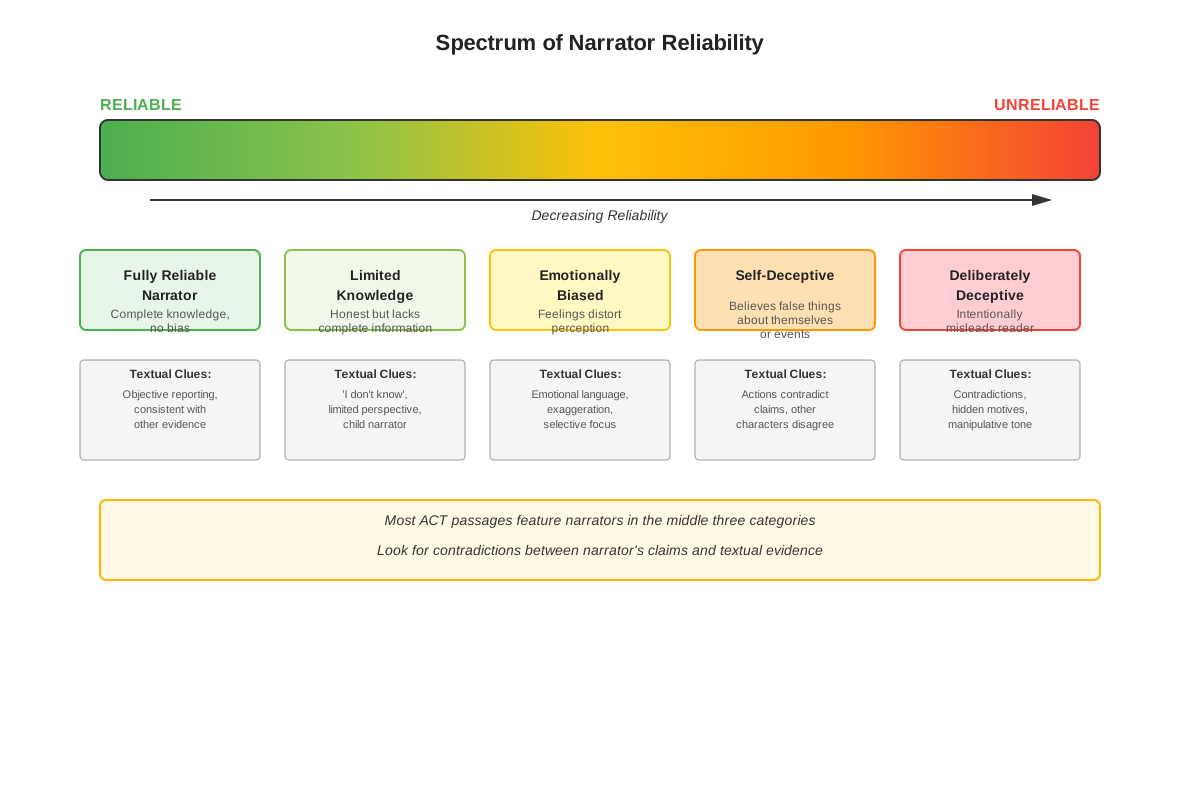
Critically, narrator reliability exists on a spectrum rather than as a binary classification. A narrator might be reliable about certain aspects of the story while unreliable about others. For example, a first-person narrator might accurately describe physical events they witnessed but misinterpret the motivations of other characters.
Types of Unreliable Narrators
Understanding the categories of unreliable narrators helps students quickly identify reliability issues:
| Type | Characteristics | ACT Example Clues |
|---|---|---|
| The Naïve Narrator | Lacks experience or maturity to understand events fully; often a child or innocent character | Simplistic language, misunderstanding adult situations, literal interpretations |
| The Biased Narrator | Strong prejudices or emotional investments distort their perspective | Extreme language about certain characters, contradictions between claims and evidence |
| The Mentally Unstable Narrator | Psychological issues affect perception of reality | Inconsistent accounts, paranoid interpretations, irrational conclusions |
| The Self-Deceiving Narrator | Cannot acknowledge uncomfortable truths about themselves | Justifications that don't match their actions, blind spots about their flaws |
| The Deliberately Deceptive Narrator | Intentionally misleads the reader | Later revelations contradict earlier statements, suspicious omissions |
Textual Signals of Unreliability
The ACT provides specific textual markers that signal narrator unreliability:
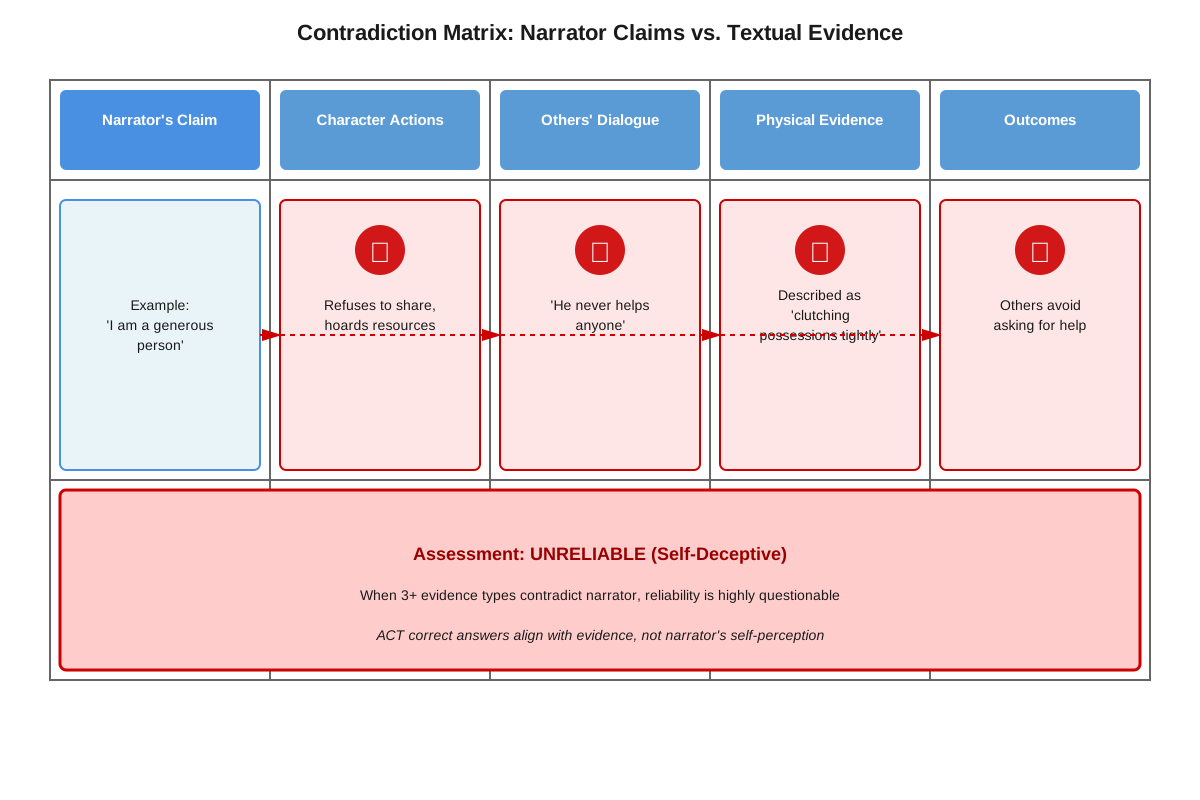
- Contradictions: The narrator's statements conflict with their actions, other characters' perspectives, or objective descriptions
- Extreme Language: Excessive emotional intensity, absolute statements, or hyperbolic descriptions suggest bias
- Limited Knowledge Indicators: Phrases like "I assumed," "I thought," "it seemed," or "I believed" signal subjective interpretation rather than fact
- Other Characters' Reactions: When other characters consistently disagree with or question the narrator's account
- Narrative Gaps: Important information the narrator avoids, dismisses, or claims not to remember
- Temporal Distance: Narrators reflecting on past events may have faulty memory or revised interpretations
The Reliability Evaluation Process
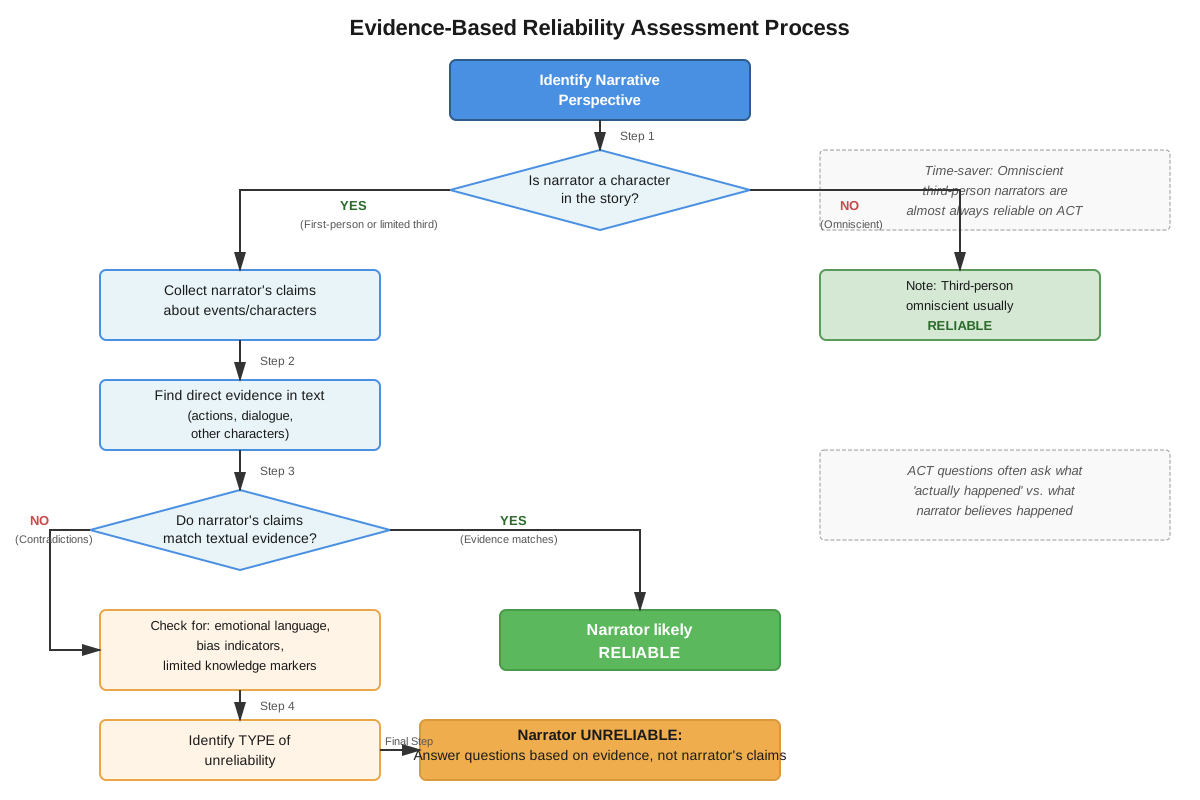
When approaching ACT passages, students should systematically evaluate narrator reliability:
- Identify the narrative perspective: Determine who is telling the story and their relationship to events
- Note qualifying language: Mark phrases indicating uncertainty, assumption, or subjective interpretation
- Compare claims to evidence: Check whether the narrator's interpretations match described actions and dialogue
- Consider motivations: Ask why the narrator might present events in a particular way
- Track contradictions: Flag any inconsistencies in the narrator's account
- Evaluate other perspectives: Compare the narrator's view to other characters' stated or implied perspectives
First-Person vs. Third-Person Reliability
First-person narrators (using "I") are more frequently unreliable on the ACT because their limited perspective is inherent to the narrative form. They can only report what they observe, think, and feel, creating natural opportunities for misunderstanding and bias. ACT passages often exploit this limitation by having first-person narrators misinterpret social situations, misjudge other characters, or remain unaware of information the reader can infer.
Third-person narrators can also be unreliable, though this appears less frequently on the ACT. A third-person limited narrator (following one character's perspective closely) may share that character's biases and blind spots. Even omniscient narrators can be unreliable if they editorialize or present a skewed version of events, though this is rare in ACT passages.
The Role of Context and Evidence
Determining narrator reliability requires synthesizing multiple pieces of textual evidence. A single questionable statement doesn't necessarily indicate unreliability—the pattern matters. Students must distinguish between:
- Intentional ambiguity: The author deliberately creates uncertainty about events
- Narrator limitation: The narrator lacks information but reports honestly within their knowledge
- Narrator unreliability: The narrator's account is demonstrably inaccurate or distorted
The ACT rewards students who support their reliability assessments with specific textual evidence rather than general impressions.
Concept Relationships
Narrator reliability connects to and depends upon several related reading skills. Point of view establishes the foundation—students must first identify who narrates before evaluating their trustworthiness. This leads directly to narrator reliability assessment, which then informs characterization understanding. When a narrator is unreliable, readers must distinguish between the narrator's self-perception and their actual character traits revealed through actions and others' responses.
Inference skills enable narrator reliability analysis because unreliability is rarely stated explicitly. Students must infer from contradictions, tone, and evidence patterns. Similarly, tone analysis helps identify emotional bias that might compromise reliability. A narrator's angry, defensive, or overly sentimental tone signals potential distortion.
The relationship flows: Point of View → Narrator Reliability → Accurate Characterization → Theme Understanding. Misreading narrator reliability cascades into misunderstanding character relationships, conflict sources, and ultimately the passage's central themes.
Quick check — test yourself on Narrator reliability so far.
Try Flashcards →High-Yield Facts
⭐ Narrator reliability questions appear in 15-20% of ACT Reading passages, primarily in prose fiction.
⭐ First-person narrators are more likely to be unreliable than third-person narrators on the ACT.
⭐ Contradictions between a narrator's claims and their described actions are the strongest signal of unreliability.
⭐ Phrases like "I thought," "I assumed," "it seemed," and "I believed" indicate subjective interpretation rather than objective fact.
⭐ When other characters consistently disagree with the narrator's perspective, the narrator is likely unreliable.
- Unreliable narrators may be unaware of their own unreliability, especially self-deceiving narrators.
- Child narrators are frequently unreliable due to limited understanding rather than deception.
- Extreme emotional language (very, always, never, completely) often signals narrator bias.
- Temporal distance between events and narration can create unreliability through faulty memory.
- The ACT rarely uses deliberately deceptive narrators; most unreliability stems from limited perspective or bias.
- Narrator reliability can be partial—reliable about some aspects while unreliable about others.
- Questions asking about "the narrator's perspective" or "the narrator's understanding" often test reliability.
Common Misconceptions
Misconception: All first-person narrators are unreliable. → Correction: First-person narration creates potential for unreliability through limited perspective, but many first-person narrators are reliable within their knowledge. Reliability depends on whether their account matches textual evidence, not merely on narrative perspective.
Misconception: If a narrator makes any mistake or lacks complete information, they are unreliable. → Correction: Unreliability requires a pattern of distortion, bias, or significant misinterpretation. A narrator who honestly reports their limited knowledge while acknowledging uncertainty remains reliable within their scope.
Misconception: Unreliable narrators intentionally deceive readers. → Correction: Most unreliable narrators on the ACT are unaware of their unreliability. They genuinely believe their distorted perspective, making them self-deceived rather than deceptive.
Misconception: Third-person omniscient narrators are always reliable. → Correction: While less common, third-person narrators can be unreliable if they present a biased or incomplete account. Students must evaluate all narrators based on textual evidence rather than assumptions about narrative perspective.
Misconception: Narrator reliability is a subjective interpretation without clear answers. → Correction: The ACT provides specific textual evidence to support reliability determinations. Correct answers are based on contradictions, patterns, and explicit textual signals, not personal opinion.
Worked Examples
Example 1: The Self-Deceiving Narrator
Passage Excerpt: "I've always been generous with my time, helping anyone who asks. Just yesterday, when my sister called needing a ride to the airport, I explained that I had important work to finish—she understood completely. I'm sure she appreciated that I suggested she call a taxi service instead. That's the kind of practical help people really need."
Question: The narrator's account of the interaction with his sister suggests that he:
A) Provided his sister with the transportation she needed
B) Views himself as more helpful than his actions demonstrate
C) Intentionally deceived his sister about his availability
D) Accurately assessed his sister's reaction to his suggestion
Analysis:
Step 1: Identify the narrator's self-perception. The narrator claims to be "always generous" and frames refusing his sister as "practical help."
Step 2: Compare claims to actions. The narrator refused a direct request for help, contradicting his claim of helping "anyone who asks."
Step 3: Evaluate qualifying language. "I'm sure she appreciated" indicates assumption rather than confirmed fact—the narrator doesn't actually know his sister's reaction.
Step 4: Identify the reliability issue. The narrator demonstrates self-deception, believing his refusal constitutes helpfulness.
Answer: B. The contradiction between claiming generosity while refusing help, combined with the assumption about his sister's appreciation, reveals a self-deceiving narrator who views himself as more helpful than his actions demonstrate. This is not intentional deception (eliminating C), and he clearly didn't provide transportation (eliminating A) or accurately assess his sister's reaction—he only assumed it (eliminating D).
Example 2: The Naïve Narrator
Passage Excerpt: "Mother and Father had another 'discussion' last night. I could hear their voices through the wall, though I couldn't make out the words. This morning, Mother's eyes were red, but she said it was just allergies. Father left early for work without eating breakfast, which Mother said meant he was excited about an important meeting. I'm glad they're both so dedicated to their jobs."
Question: The passage suggests the narrator is unaware that:
A) The parents work demanding jobs
B) The mother suffers from allergies
C) The parents' relationship is troubled
D) The father had an early meeting
Analysis:
Step 1: Identify narrator limitations. The narrator is likely a child (naïve narrator) who takes parents' explanations at face value.
Step 2: Note contradictions between evidence and interpretation. Red eyes after a nighttime "discussion" (euphemism for argument) suggests crying, not allergies. Leaving without breakfast after an argument suggests anger, not excitement.
Step 3: Recognize what the reader can infer that the narrator cannot. The evidence points to marital conflict, but the narrator accepts benign explanations.
Step 4: Evaluate answer choices against textual evidence. The narrator explicitly states beliefs about jobs (A), allergies (B), and the meeting (D), but shows no awareness of relationship problems.
Answer: C. The narrator's innocent interpretations of clear conflict signals (nighttime argument, crying, angry departure) demonstrate unawareness of the parents' troubled relationship. The narrator does believe the other options, making them incorrect—the question asks what the narrator is unaware of, not what they believe.
Exam Strategy
When approaching narrator reliability questions on the ACT:
Trigger Words to Watch For:
- "The narrator's perspective suggests..."
- "The narrator appears unaware that..."
- "The narrator's description of [X] indicates..."
- "Based on the narrator's account..."
- "The narrator's understanding can best be described as..."
Step-by-Step Approach:
- Identify the question type (2 seconds): Recognize that narrator perspective or understanding is being tested
- Locate relevant passage sections (15 seconds): Find where the narrator discusses the topic in question
- Compare narrator claims to textual evidence (20 seconds): Check for contradictions, extreme language, or qualifying phrases
- Eliminate answers contradicted by evidence (10 seconds): Remove options that don't match the reliability pattern
- Select the answer supported by specific textual proof (3 seconds): Choose the option that best explains the narrator's limitation or bias
Process of Elimination Tips:
- Eliminate answers that treat the narrator's subjective interpretation as objective fact
- Remove options that ignore contradictions between the narrator's claims and their actions
- Discard answers requiring information the narrator couldn't possess
- Avoid extreme answers unless the narrator demonstrates extreme bias
Time Allocation:
Narrator reliability questions typically require 45-60 seconds—slightly longer than detail questions but shorter than inference questions. Budget this time because these questions reward careful evidence comparison rather than quick reading.
Exam Tip: When stuck between two answers, return to the passage and find the specific sentence that creates doubt about the narrator's reliability. The correct answer will directly address that textual evidence.
Memory Techniques
NARRATOR Mnemonic for evaluating reliability:
- Note the perspective (first or third person)
- Assess qualifying language ("I thought," "seemed")
- Recognize contradictions between claims and actions
- Review other characters' perspectives
- Analyze emotional tone and extreme language
- Track patterns across the passage
- Observe what the narrator doesn't know or mention
- Reference specific textual evidence
The Three C's of Unreliability:
- Contradictions (claims vs. actions)
- Certainty (excessive confidence about unknowable things)
- Conflict (disagreement with other characters)
Visualization Strategy: Picture the narrator as a camera with a filter. A reliable narrator has a clear lens showing events accurately. An unreliable narrator has a colored filter (bias), a cracked lens (mental instability), or limited zoom (naïve perspective) that distorts the image.
Summary
Narrator reliability is a high-yield ACT Reading skill requiring students to evaluate whether a narrator's account is accurate, biased, or distorted. The ACT tests this concept primarily through prose fiction passages featuring first-person narrators whose limited perspective, emotional bias, or inexperience creates unreliability. Students must identify textual signals including contradictions between claims and actions, qualifying language indicating uncertainty, extreme emotional tone, and disagreement from other characters. The evaluation process involves comparing the narrator's interpretations to objective evidence in the passage, recognizing patterns of distortion, and distinguishing between what the narrator believes and what actually occurs in the story. Mastering narrator reliability requires synthesizing multiple pieces of evidence rather than relying on isolated statements, and understanding that unreliability exists on a spectrum from minor limitations to significant distortion. This skill connects directly to characterization, inference, and theme analysis, making it foundational for high-level reading comprehension.
Key Takeaways
- Narrator reliability questions appear in 15-20% of ACT Reading passages and differentiate mid-range from high-scoring students
- Contradictions between a narrator's claims and their described actions provide the strongest evidence of unreliability
- First-person narrators are more frequently unreliable than third-person narrators due to inherent perspective limitations
- Qualifying phrases like "I thought," "seemed," and "I assumed" signal subjective interpretation rather than objective fact
- Most unreliable narrators on the ACT are unaware of their unreliability—they genuinely believe their distorted perspective
- Evaluating narrator reliability requires comparing the narrator's account to other textual evidence and character perspectives
- Correct answers to reliability questions must be supported by specific textual evidence, not general impressions
Related Topics
Point of View and Narrative Perspective: Understanding who tells the story and from what vantage point provides the foundation for reliability analysis. Mastering narrator reliability enables deeper analysis of how perspective shapes meaning.
Characterization Techniques: Evaluating how authors reveal character traits through direct and indirect methods connects to reliability because unreliable narrators often have blind spots about their own character.
Inference and Implicit Meaning: Drawing conclusions from unstated information is essential for identifying unreliability, as narrators rarely announce their own limitations.
Tone and Mood Analysis: Detecting emotional undertones helps identify when feelings distort a narrator's account, advancing to more sophisticated literary analysis.
Theme and Central Idea: Accurate theme identification depends on correctly interpreting narrator reliability, as unreliable narrators may misunderstand the story's central meaning.
Practice CTA
Now that you understand narrator reliability, test your mastery with the practice questions and flashcards designed specifically for this topic. These resources will reinforce your ability to quickly identify reliability signals and apply systematic evaluation strategies under timed conditions. Remember: narrator reliability questions are high-yield opportunities to gain points that separate good scores from great scores. Each practice question you complete builds the pattern recognition skills that make these questions faster and easier on test day. You've got this!
Sign up free to keep reading
Create a free AnvayaPrep account to finish this ACT guide on Narrator reliability — plus flashcards and practice questions.