Overview
Comparing evidence is a critical skill tested in the ACT Reading section that requires students to analyze, evaluate, and synthesize information from multiple sources or different parts of a single passage. This skill goes beyond simple comprehension—it demands that test-takers identify relationships between pieces of textual evidence, recognize how different claims support or contradict each other, and determine which evidence most effectively supports a particular conclusion or argument. On the ACT, ACT comparing evidence questions typically ask students to distinguish between stronger and weaker support for claims, identify similarities and differences in perspectives, or evaluate how multiple pieces of information work together to develop an author's purpose.
The ability to compare evidence is fundamental to critical reading and represents one of the higher-order thinking skills that the ACT assesses. These questions appear regularly across all passage types—prose fiction, social science, humanities, and natural science—making this skill universally applicable regardless of content area. Students who master comparing evidence demonstrate sophisticated analytical abilities that extend beyond memorization or surface-level understanding. They can weigh the relative strength of different arguments, recognize nuanced distinctions between similar claims, and synthesize information from multiple textual locations.
This topic sits at the intersection of several essential Reading skills. It builds upon foundational comprehension abilities while incorporating elements of inference, author's purpose analysis, and textual evidence evaluation. Comparing evidence questions often require students to first understand explicit information, then analyze implicit meanings, and finally synthesize multiple pieces of information to reach a conclusion. This multi-layered cognitive process makes comparing evidence one of the most challenging—and most frequently tested—skills in the Integration of Knowledge and Ideas category of the ACT Reading section.
Learning Objectives
- [ ] Identify when Comparing evidence is being tested in ACT Reading questions
- [ ] Explain the core rule or strategy behind Comparing evidence analysis
- [ ] Apply Comparing evidence skills to ACT-style questions accurately
- [ ] Distinguish between evidence that directly supports a claim versus evidence that provides tangential or weak support
- [ ] Evaluate the relative strength of multiple pieces of evidence when they support competing interpretations
- [ ] Synthesize information from different sections of a passage to form comprehensive comparisons
- [ ] Recognize common question stems and formats that signal comparing evidence tasks
Prerequisites
- Basic reading comprehension: Understanding literal meaning is essential before comparing different pieces of information
- Identifying textual evidence: Students must be able to locate specific supporting details within passages before comparing them
- Understanding main ideas and supporting details: Recognizing the hierarchy of information helps determine which evidence is most relevant
- Making inferences: Comparing evidence often requires understanding implicit meanings, not just explicit statements
- Recognizing author's purpose and tone: Understanding why an author includes certain evidence aids in comparing its effectiveness
Why This Topic Matters
Comparing evidence represents a real-world critical thinking skill that extends far beyond standardized testing. In academic settings, students constantly evaluate competing sources, weigh conflicting research findings, and synthesize information from multiple texts. In professional contexts, decision-makers must assess the strength of different data points, compare testimonies or reports, and determine which evidence best supports strategic choices. The ability to compare evidence effectively is fundamental to informed citizenship, enabling individuals to evaluate news sources, political arguments, and scientific claims with discernment.
On the ACT Reading section, comparing evidence questions appear with high frequency, typically comprising 15-20% of all Reading questions. These questions appear in multiple formats: some ask students to identify which piece of evidence best supports a specific claim, others require comparing how two different sections of the passage relate to each other, and still others ask students to determine which statement is most strongly supported by the passage as a whole. The Integration of Knowledge and Ideas category, which includes comparing evidence, accounts for approximately 13-18% of Reading questions, making it a significant score determinant.
Common manifestations of this topic include questions that ask "Which of the following statements is most strongly supported by the passage?", "According to the passage, X and Y are similar in that...", "The passage indicates that unlike X, Y...", or "Which piece of evidence best supports the author's claim that...?" These questions appear across all four passage types, though they're particularly common in paired passages (when included) and in passages presenting multiple perspectives or contrasting ideas. Natural science passages frequently include comparing evidence questions when discussing competing theories or experimental results, while social science and humanities passages often feature these questions when presenting historical debates or philosophical arguments.
Core Concepts
Understanding Evidence in Reading Passages
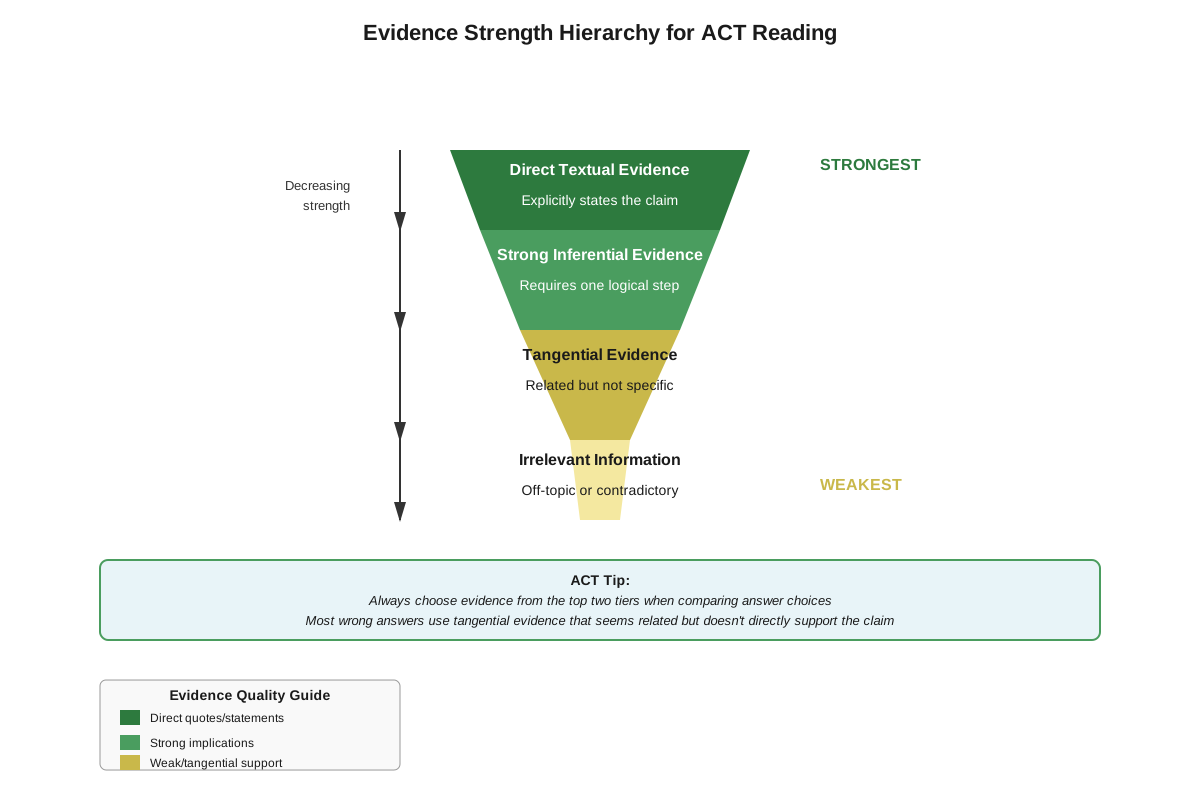
Evidence in ACT Reading passages consists of any information—facts, examples, quotations, descriptions, or data—that an author uses to support claims, develop ideas, or illustrate concepts. Not all evidence carries equal weight. Strong evidence directly addresses the claim in question, provides specific details rather than vague generalizations, and comes from credible sources or logical reasoning within the passage. Weak evidence may be tangentially related, overly general, or based on assumptions rather than established facts within the text.
When comparing evidence, students must first identify what each piece of evidence actually states or implies. This requires careful reading to distinguish between what the passage explicitly says and what students might assume or infer beyond the text. The ACT specifically tests whether students can remain anchored to textual evidence rather than bringing in outside knowledge or making unsupported leaps in logic.
Types of Evidence Comparisons
The ACT tests several distinct types of evidence comparison, each requiring slightly different analytical approaches:
| Comparison Type | Description | Key Strategy |
|---|---|---|
| Strength Comparison | Determining which evidence provides stronger support for a claim | Evaluate directness, specificity, and relevance to the exact claim |
| Similarity Identification | Finding common elements between two pieces of evidence | Look for shared characteristics, parallel structures, or analogous relationships |
| Contrast Recognition | Identifying how pieces of evidence differ or oppose each other | Focus on explicit differences in content, tone, or implication |
| Synthesis Comparison | Combining multiple pieces of evidence to form a comprehensive understanding | Track how different evidence pieces complement or build upon each other |
| Relevance Evaluation | Determining which evidence is most pertinent to a specific question or claim | Assess how directly each piece addresses the specific issue at hand |
The Evidence Evaluation Framework
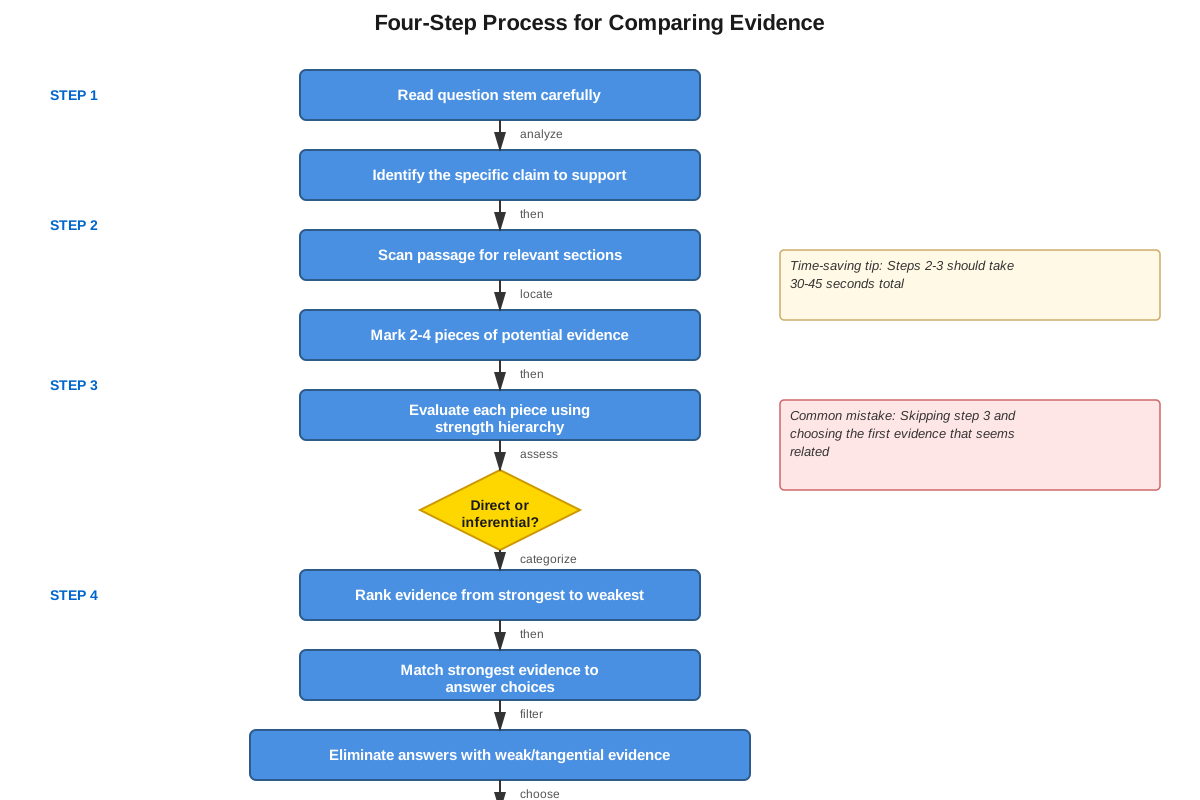
When comparing evidence on the ACT, successful students employ a systematic framework:
- Identify the claim or question focus: Determine exactly what needs to be supported or answered
- Locate relevant evidence: Find all passages that potentially relate to the claim
- Analyze each piece individually: Understand what each piece of evidence actually states
- Compare directly: Place evidence side-by-side mentally to identify relationships
- Evaluate strength and relevance: Determine which evidence most effectively addresses the specific claim
- Verify with passage context: Ensure the comparison accounts for surrounding context
This framework prevents common errors such as selecting evidence that seems related but doesn't directly address the question, or choosing evidence that partially supports a claim when stronger, more complete support exists elsewhere in the passage.
Direct vs. Indirect Evidence
Direct evidence explicitly states information that supports a claim without requiring additional inference. For example, if a passage states "The experiment yielded a 40% increase in productivity," this directly supports a claim about productivity improvement. Indirect evidence requires inference or synthesis to connect to a claim. If a passage describes workers completing tasks faster and with fewer errors, this indirectly supports productivity improvement but requires the reader to make that connection.
The ACT frequently tests whether students can distinguish between these types. Questions asking for what is "most strongly supported" or "most directly supported" typically favor direct evidence over indirect evidence, even when both technically support the claim. Understanding this distinction helps students select the best answer rather than merely an acceptable one.
Comparative Strength Indicators
Certain textual features signal stronger evidence:
- Specificity: Concrete details, numbers, and examples typically provide stronger support than generalizations
- Proximity: Evidence appearing near the claim it supports often indicates intentional connection
- Explicit connection: When authors use phrases like "this demonstrates," "as evidence," or "proving that," they signal strong evidentiary relationships
- Consistency: Evidence that aligns with the passage's overall argument is typically stronger than isolated statements
- Source credibility: Within a passage, evidence attributed to experts or based on research generally carries more weight than speculation or opinion
Context-Dependent Comparison
Evidence strength is not absolute but depends on what specific claim needs support. A piece of evidence might strongly support one claim while weakly supporting another. For example, a description of a character's facial expression might strongly support a claim about their emotional state but only weakly support a claim about their past experiences. Effective evidence comparison always returns to the specific question or claim being addressed.
Concept Relationships
The skill of comparing evidence builds directly upon foundational reading comprehension abilities. Students must first understand individual pieces of information (basic comprehension) before they can meaningfully compare them. This comparison skill then enables more sophisticated analysis of author's purpose—understanding why an author chose particular evidence reveals their rhetorical strategy and intended message.
Comparing evidence connects intimately with inference skills. While some evidence comparisons involve only explicit information, many require students to infer the implications of different pieces of evidence and then compare those implications. For instance, comparing how two characters respond to the same situation might require inferring each character's motivations before comparing them.
The relationship flow operates as follows: Reading Comprehension → enables → Evidence Identification → enables → Evidence Comparison → enables → Synthesis and Evaluation → supports → Critical Analysis of Author's Purpose and Argument Structure. Each skill builds upon the previous, with comparing evidence serving as a crucial middle step between basic understanding and advanced critical analysis.
Within the topic itself, understanding evidence types (direct vs. indirect) enables effective strength comparison, which in turn supports synthesis comparison. The ability to identify similarities and differences between evidence pieces provides the foundation for evaluating which evidence best supports specific claims. All these sub-skills integrate when students face complex ACT questions requiring multi-step evidence analysis.
High-Yield Facts
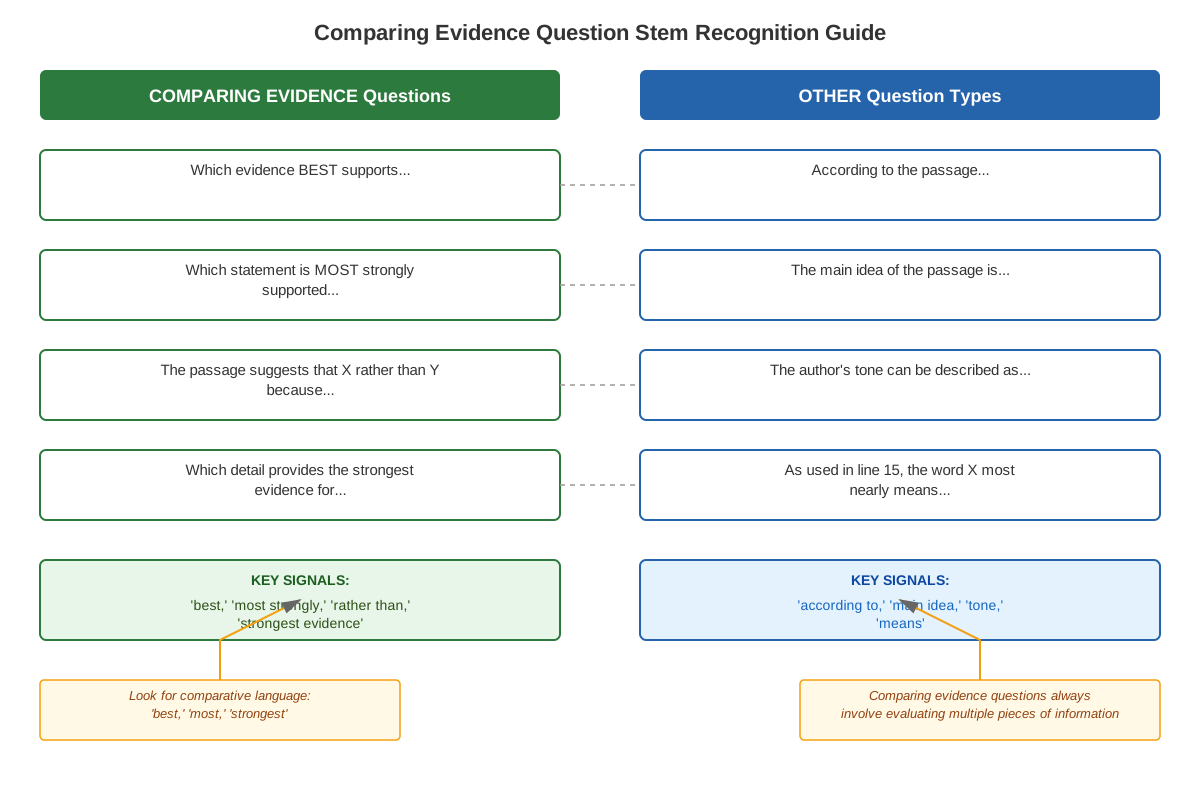
⭐ Comparing evidence questions typically include phrases like "most strongly supported," "best evidence," "similar in that," "unlike," or "both passages indicate"
⭐ Direct, specific evidence almost always provides stronger support than indirect, general evidence on the ACT
⭐ The correct answer must be supported by the passage itself, not by outside knowledge or logical assumptions beyond the text
⭐ When comparing evidence strength, proximity to the claim and explicit connection words signal stronger relationships
⭐ Evidence that appears in multiple locations throughout a passage typically indicates a central, well-supported idea
- Comparing evidence questions appear across all four ACT Reading passage types with roughly equal frequency
- The ACT often includes wrong answers that cite real evidence from the passage but evidence that doesn't directly address the specific question asked
- Evidence comparison questions frequently require synthesizing information from different paragraphs or sections
- Stronger evidence provides specific examples, data, or concrete details rather than vague generalizations
- When two pieces of evidence seem equally strong, the one that more directly addresses the exact wording of the question is typically correct
- Comparative language in passages (words like "however," "similarly," "in contrast") often signals important evidence relationships
- Evidence that contradicts the overall passage argument is typically weaker support for claims aligned with that argument
- The ACT rewards careful attention to qualifying language (words like "some," "often," "may") when comparing evidence strength
Quick check — test yourself on Comparing evidence so far.
Try Flashcards →Common Misconceptions
Misconception: All evidence in a passage carries equal weight and importance.
Correction: Evidence varies significantly in strength based on specificity, directness, relevance, and how explicitly it connects to claims. The ACT specifically tests the ability to distinguish stronger from weaker evidence.
Misconception: If evidence relates to the general topic of a question, it supports any claim about that topic.
Correction: Evidence must specifically address the particular claim or question being asked. Topical relevance is necessary but not sufficient—the evidence must directly support the specific point at issue.
Misconception: Longer or more detailed evidence is always stronger than brief evidence.
Correction: Evidence strength depends on relevance and directness, not length. A single specific fact can provide stronger support than a lengthy tangential description.
Misconception: When comparing evidence, students should choose the answer that seems most logical or true in the real world.
Correction: The ACT tests reading comprehension, not outside knowledge. The correct answer must be the one most strongly supported by the passage itself, regardless of real-world accuracy or logical plausibility.
Misconception: Evidence from the beginning or end of a passage is more important than evidence from the middle.
Correction: Evidence location doesn't determine its strength. While introductions and conclusions often contain main ideas, specific supporting evidence can appear anywhere in a passage and may be equally or more relevant to particular questions.
Misconception: If two pieces of evidence seem to contradict each other, one must be wrong or irrelevant.
Correction: Passages often present multiple perspectives, evolving ideas, or complex situations where different evidence supports different aspects of a topic. The ACT tests the ability to recognize and compare these nuances rather than seeking simple consistency.
Misconception: Comparing evidence only involves finding similarities between pieces of information.
Correction: Evidence comparison includes identifying similarities, recognizing differences, evaluating relative strength, and synthesizing complementary information. Contrast and evaluation are equally important to similarity identification.
Worked Examples
Example 1: Evaluating Evidence Strength
Passage Excerpt: "The industrial revolution transformed European society in the 19th century. Factory workers typically labored 12-14 hours daily in dangerous conditions. One Manchester textile mill recorded 47 serious injuries in 1842 alone. Working-class families struggled to afford basic necessities, and child labor was widespread throughout industrial centers."
Question: Which of the following claims is most strongly supported by the passage?
A) The industrial revolution improved living standards for most Europeans
B) Factory work in 19th-century Europe was hazardous
C) Manchester had more factories than other European cities
D) Child labor was the most serious problem of industrialization
Analysis:
Step 1: Identify what each answer choice claims and what evidence would support it.
Step 2: Locate relevant evidence for each claim:
- Choice A: No evidence supports improved living standards; the passage describes struggles and hardships
- Choice B: Two pieces of direct evidence—"dangerous conditions" and "47 serious injuries in 1842 alone"
- Choice C: The passage mentions Manchester but provides no comparative information about factory numbers
- Choice D: Child labor is mentioned but not characterized as "most serious" or compared to other problems
Step 3: Compare evidence strength:
- Choice B has both general evidence ("dangerous conditions") and specific, concrete evidence ("47 serious injuries")
- The specific numerical data provides particularly strong support
- Other choices either lack supporting evidence or require unsupported inferences
Step 4: Verify the answer addresses the question precisely:
- Choice B's claim about hazardous work is directly, specifically, and multiply supported
Answer: B
Connection to Learning Objectives: This example demonstrates identifying when evidence comparison is tested (the phrase "most strongly supported"), applying the strategy of evaluating specificity and directness, and accurately selecting the answer with the strongest evidentiary support.
Example 2: Comparing Similar Evidence
Passage Excerpt: "Dr. Martinez argued that climate patterns in the region had shifted significantly over the past decade, pointing to increased rainfall variability and more frequent extreme weather events. Meanwhile, Dr. Chen's research focused on temperature changes, documenting a 1.2°C average increase in summer temperatures since 2010. Both scientists agreed that agricultural practices would need to adapt to these environmental changes."
Question: According to the passage, Dr. Martinez's and Dr. Chen's research are similar in that they both:
A) Focus primarily on temperature measurements
B) Conclude that environmental changes require agricultural adaptation
C) Document increased rainfall in the region
D) Predict future climate patterns for the next decade
Analysis:
Step 1: Identify what the question asks—finding a similarity between two pieces of evidence (the two scientists' research).
Step 2: Analyze each scientist's research individually:
- Dr. Martinez: Focuses on rainfall variability and extreme weather; conclusion not explicitly stated
- Dr. Chen: Focuses on temperature changes with specific data; conclusion not explicitly stated
- Both scientists: Explicitly stated to agree on agricultural adaptation need
Step 3: Evaluate each answer choice:
- Choice A: Only Dr. Chen focused on temperature—this is a difference, not a similarity
- Choice B: The passage explicitly states "Both scientists agreed" on this point—direct textual support
- Choice C: Only Dr. Martinez discussed rainfall—another difference
- Choice D: Neither scientist is described as making predictions about the future
Step 4: Compare the strength of support:
- Choice B has explicit, direct support with the phrase "both scientists agreed"
- Other choices either describe differences or lack textual support
Answer: B
Connection to Learning Objectives: This example shows how to identify similarity comparison questions, apply the strategy of analyzing each piece of evidence separately before comparing, and recognize explicit comparison language in passages.
Exam Strategy
Recognizing Comparing Evidence Questions
ACT comparing evidence questions contain specific trigger phrases that signal the skill being tested. Watch for:
- "Most strongly supported by"
- "Best evidence for"
- "Both X and Y"
- "Similar in that"
- "Unlike X, Y"
- "The passage indicates that X and Y differ in"
- "Which of the following is most directly supported"
- "According to the passage, X and Y share"
When these phrases appear, immediately shift into evidence comparison mode rather than simple comprehension mode.
The Four-Step Comparison Process
- Anchor to the specific claim: Underline or mentally note the exact claim or question focus. Don't let your attention drift to related but distinct ideas.
- Locate all potentially relevant evidence: Skim the passage for any information that might relate. Don't commit to an answer until you've surveyed all options.
- Evaluate each piece individually: Before comparing, understand what each piece of evidence actually states. Misunderstanding individual evidence leads to faulty comparisons.
- Compare systematically: Use the answer choices as a guide, but verify each against the passage rather than relying on memory.
Process of Elimination Techniques
When comparing evidence, eliminate answers that:
- Cite evidence that doesn't address the specific question: The evidence might be true and from the passage, but if it doesn't relate to the exact claim being tested, it's wrong
- Require assumptions beyond the passage: If you find yourself thinking "this would be true if..." or "this probably means...", the answer likely requires unsupported inference
- Use absolute language unsupported by the text: Words like "always," "never," "only," or "all" are rarely supported unless the passage uses equally absolute language
- Confuse similarity with difference or vice versa: Carefully check whether the question asks for similarities or differences
Time Management
Comparing evidence questions typically require more time than basic comprehension questions because they involve multiple steps. Allocate approximately:
- 30-45 seconds for questions comparing two pieces of evidence
- 45-60 seconds for questions requiring synthesis of three or more pieces of evidence
- 60-90 seconds for complex comparison questions involving inference
If a comparing evidence question is taking longer than these benchmarks, mark it and return after completing faster questions. These questions reward careful analysis but shouldn't consume disproportionate time.
Verification Strategy
Before finalizing your answer on comparing evidence questions, perform this quick check:
Can I point to specific words or phrases in the passage that directly support this answer? If not, reconsider.
This verification prevents the common error of selecting answers that seem reasonable but lack explicit textual support.
Memory Techniques
The DIRECT Acronym for Evidence Strength
Detailed and specific (not vague or general)
In the passage explicitly (not requiring outside knowledge)
Relevant to the exact claim (not just the general topic)
Explicitly connected (uses clear linking language)
Consistent with passage argument (aligns with overall message)
Textually verifiable (you can point to specific words)
When comparing evidence, mentally run through DIRECT to evaluate which piece is stronger.
The "Two-Column" Visualization
For similarity/difference questions, mentally create two columns:
Evidence A          |  Evidence B
[Key features]      |  [Key features]
                    |
    Similarities: [What they share]
    Differences: [How they contrast]
This mental organization prevents confusion between the two pieces of evidence being compared.
The "Strength Ladder" Technique
Visualize evidence strength as a ladder:
Top Rung: Specific, concrete evidence with numbers or detailed examples
Middle Rung: Clear statements directly addressing the claim
Bottom Rung: Vague generalizations or tangentially related information
When comparing evidence, mentally place each piece on the ladder to quickly assess relative strength.
The "Question Echo" Method
Repeat key words from the question as you evaluate evidence. If the question asks about "economic impacts," mentally echo "economic impacts" as you read each piece of evidence. This keeps your focus anchored to the specific claim rather than drifting to related but distinct ideas.
Summary
Comparing evidence is a high-frequency, high-value skill on the ACT Reading section that requires students to analyze, evaluate, and synthesize textual information systematically. Success depends on distinguishing between evidence that directly supports specific claims versus evidence that is merely topically related, recognizing that evidence strength varies based on specificity, directness, and relevance to the exact question being asked. The most effective approach involves anchoring to the precise claim or question, locating all potentially relevant evidence, evaluating each piece individually before comparing, and verifying that the selected answer has explicit textual support rather than requiring assumptions beyond the passage. Students must recognize trigger phrases like "most strongly supported," "similar in that," and "unlike" that signal comparison questions, then apply systematic evaluation frameworks rather than relying on general impressions or outside knowledge. Mastering this skill requires understanding that the ACT rewards careful textual analysis over logical reasoning divorced from the passage, and that stronger evidence provides specific, concrete details that directly address the claim in question.
Key Takeaways
- Comparing evidence questions appear frequently on the ACT and use specific trigger phrases like "most strongly supported," "best evidence," "similar in that," and "unlike"
- Evidence strength depends on specificity, directness, and relevance to the exact claim—not on length, location, or general topic relatedness
- The correct answer must be explicitly supported by the passage itself, without requiring outside knowledge or unsupported logical leaps
- Systematic comparison involves four steps: anchor to the specific claim, locate all relevant evidence, evaluate each piece individually, then compare directly
- Direct, concrete evidence with specific details or data almost always provides stronger support than indirect, general statements
- Common wrong answers cite real evidence from the passage that doesn't address the specific question or require assumptions beyond the text
- Verification before finalizing answers—asking "Can I point to specific words supporting this?"—prevents the most common errors on comparing evidence questions
Related Topics
Identifying Main Ideas and Supporting Details: Understanding the hierarchy of information in passages provides the foundation for determining which evidence is most central and relevant, directly enabling more sophisticated evidence comparison.
Making Inferences and Drawing Conclusions: Many evidence comparison questions require inferring the implications of different pieces of evidence before comparing them, making inference skills essential for advanced comparison tasks.
Analyzing Author's Purpose and Rhetorical Strategy: Understanding why authors include particular evidence reveals how different pieces of evidence work together to achieve rhetorical goals, deepening comparison analysis.
Evaluating Arguments and Claims: This advanced skill builds directly on comparing evidence, requiring students to assess not just which evidence is stronger but whether evidence adequately supports broader argumentative claims.
Synthesizing Information Across Texts: In paired passage questions, comparing evidence extends beyond single passages to require synthesis across multiple texts, representing the most complex application of evidence comparison skills.
Practice CTA
Now that you've mastered the strategies and concepts behind comparing evidence, it's time to put your knowledge into action! The practice questions and flashcards are specifically designed to reinforce these skills with ACT-style questions that mirror what you'll encounter on test day. Each practice question provides an opportunity to apply the DIRECT framework, practice the four-step comparison process, and build the pattern recognition that leads to faster, more accurate responses. Remember: comparing evidence is a skill that improves dramatically with deliberate practice. The more you engage with these materials, the more automatic and intuitive your evidence evaluation will become. You're building one of the most valuable critical thinking skills tested on the ACT—stay focused, practice systematically, and watch your Reading score improve!
Sign up free to keep reading
Create a free AnvayaPrep account to finish this ACT guide on Comparing evidence — plus flashcards and practice questions.