Overview
Evidence consistency is a critical skill tested throughout the ACT Reading section, requiring students to evaluate whether claims, statements, or answer choices align with information explicitly stated or clearly implied in the passage. This concept forms the foundation of analytical reading comprehension, as approximately 40-50% of ACT Reading questions require students to verify that their answer choice is directly supported by textual evidence rather than personal interpretation or outside knowledge.
The ACT Reading test consistently challenges students to distinguish between what the passage actually says versus what seems plausible, what they wish it said, or what they assume based on prior knowledge. ACT evidence consistency questions demand that students trace every answer choice back to specific lines or paragraphs in the passage, ensuring perfect alignment between the text and their selected response. This skill separates high-scoring students from those who rely on general impressions or memory rather than concrete textual support.
Within the Integration of Knowledge and Ideas framework, evidence consistency connects directly to synthesis, inference, and author's purpose questions. While inference questions require students to draw logical conclusions from stated facts, evidence consistency ensures those inferences remain tethered to the passage rather than floating into speculation. Similarly, when analyzing an author's argument or rhetorical choices, students must verify that their interpretations are consistently supported by specific textual evidence rather than assumptions about what authors "typically" do or mean.
Learning Objectives
- [ ] Identify when Evidence consistency is being tested in ACT Reading questions
- [ ] Explain the core rule or strategy behind Evidence consistency verification
- [ ] Apply Evidence consistency principles to ACT-style questions accurately
- [ ] Distinguish between answer choices that are plausible versus those that are passage-supported
- [ ] Locate and cite specific textual evidence that confirms or contradicts answer choices
- [ ] Recognize common traps that violate evidence consistency principles
- [ ] Evaluate multiple answer choices simultaneously for evidence alignment
Prerequisites
- Basic reading comprehension: Understanding literal meaning of sentences and paragraphs is essential because evidence consistency requires accurate interpretation of what the text explicitly states
- Annotation skills: The ability to mark key information while reading enables quick reference when verifying answer choices against passage content
- Question stem analysis: Recognizing what a question asks determines which type of evidence is required and where to look in the passage
- Passage structure awareness: Understanding how passages are organized (introduction, body paragraphs, conclusion) helps locate relevant evidence efficiently
Why This Topic Matters
Evidence consistency represents the single most important skill for achieving a high ACT Reading score because it serves as the ultimate verification mechanism for every answer choice. Students who master this concept can confidently eliminate wrong answers and select correct ones even when passages cover unfamiliar topics or use challenging vocabulary. In real-world applications, this skill translates directly to critical thinking in academic research, professional analysis, legal reasoning, and media literacy—all contexts where distinguishing supported claims from unsupported assertions is essential.
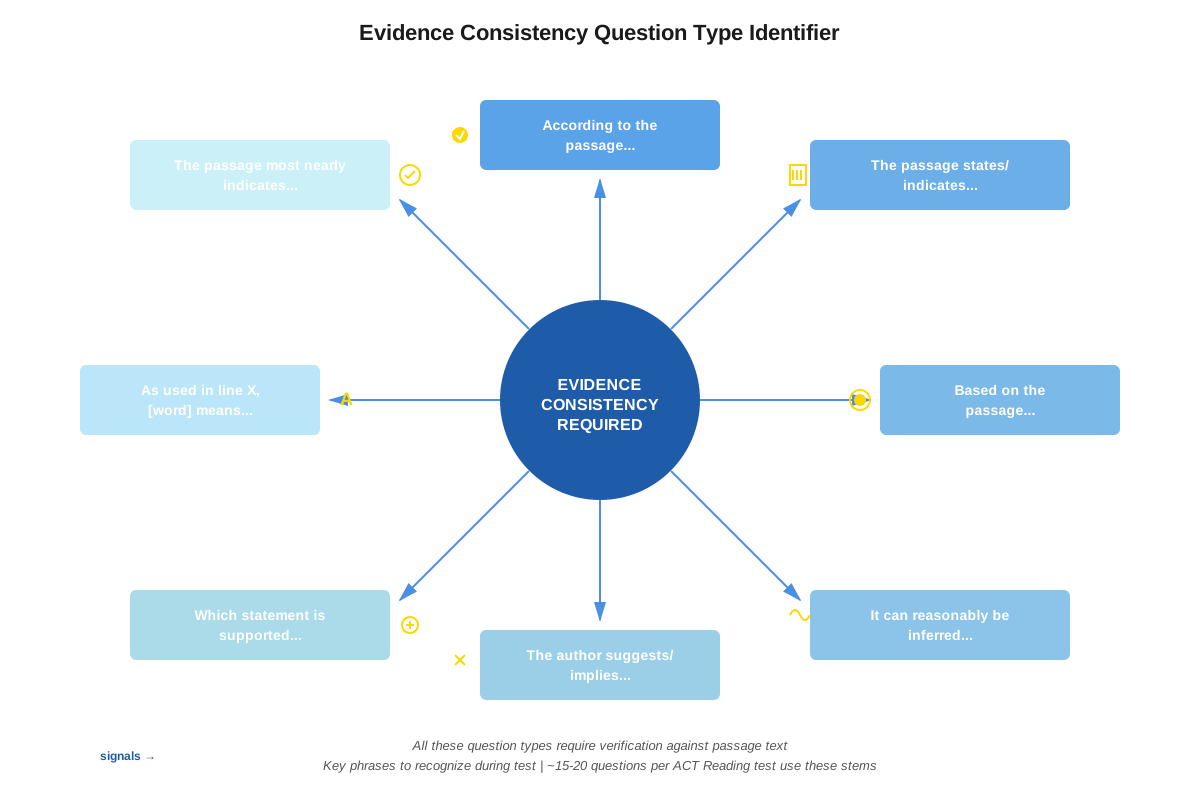
On the ACT Reading test, evidence consistency appears in approximately 15-20 questions per test across all four passage types (Literary Narrative, Social Science, Humanities, and Natural Science). The skill is tested both directly through "according to the passage" questions and indirectly through inference, main idea, and detail questions where wrong answers often contain information that seems reasonable but lacks textual support. Questions testing evidence consistency typically appear as:
- Direct detail questions: "According to the passage, the author believes..."
- Inference questions: "Based on lines 45-52, it can reasonably be inferred that..."
- EXCEPT/NOT questions: "The passage mentions all of the following EXCEPT..."
- Vocabulary-in-context questions: "As it is used in line 23, the word 'deliberate' most nearly means..."
- Author's purpose questions: "The author includes the example in paragraph 3 primarily to..."
Common passage contexts where evidence consistency is tested include character motivations in literary narratives, scientific study results in natural science passages, historical cause-and-effect relationships in social science passages, and artistic techniques in humanities passages. The ACT deliberately crafts wrong answers that violate evidence consistency in predictable ways, making this skill highly coachable and testable.
Core Concepts
The Fundamental Principle of Evidence Consistency
Evidence consistency requires that every answer choice selected on the ACT Reading test must be directly supported by specific information stated or clearly implied in the passage. This principle operates as an absolute rule: if you cannot point to specific lines, sentences, or paragraphs that support an answer choice, that choice is incorrect regardless of how logical or plausible it seems. The passage serves as the sole authority, and students must subordinate their personal knowledge, opinions, and assumptions to what the text explicitly provides.
This concept differs fundamentally from general reading comprehension in everyday life, where readers naturally integrate background knowledge and make assumptions beyond the text. The ACT deliberately tests whether students can restrict their thinking to passage-based evidence alone. For example, if a passage discusses Benjamin Franklin's experiments with electricity but never mentions his role in American independence, an answer choice referencing his political contributions would violate evidence consistency even though that information is historically accurate.
Types of Evidence in ACT Passages
ACT passages contain three distinct types of evidence that students must recognize and utilize:
Explicit evidence consists of information directly stated in the passage using clear, unambiguous language. When a passage states "The experiment yielded unexpected results," this explicit evidence can support answer choices about surprising outcomes. Explicit evidence requires minimal interpretation and provides the strongest support for answer choices.
Implicit evidence includes information that is strongly suggested or logically necessary based on what is stated, even if not directly expressed. If a passage describes a character "slamming the door and refusing to speak for hours," implicit evidence supports the conclusion that the character was angry, even if the word "angry" never appears. The ACT considers implicit evidence valid as long as the inference is unavoidable given the stated facts.
Contextual evidence emerges from the overall tone, structure, and purpose of the passage rather than specific statements. For example, if an author consistently uses positive language when describing a scientific breakthrough and includes multiple examples of its benefits, contextual evidence supports answer choices about the author's favorable attitude, even without an explicit statement like "I believe this breakthrough is positive."
The Evidence Verification Process
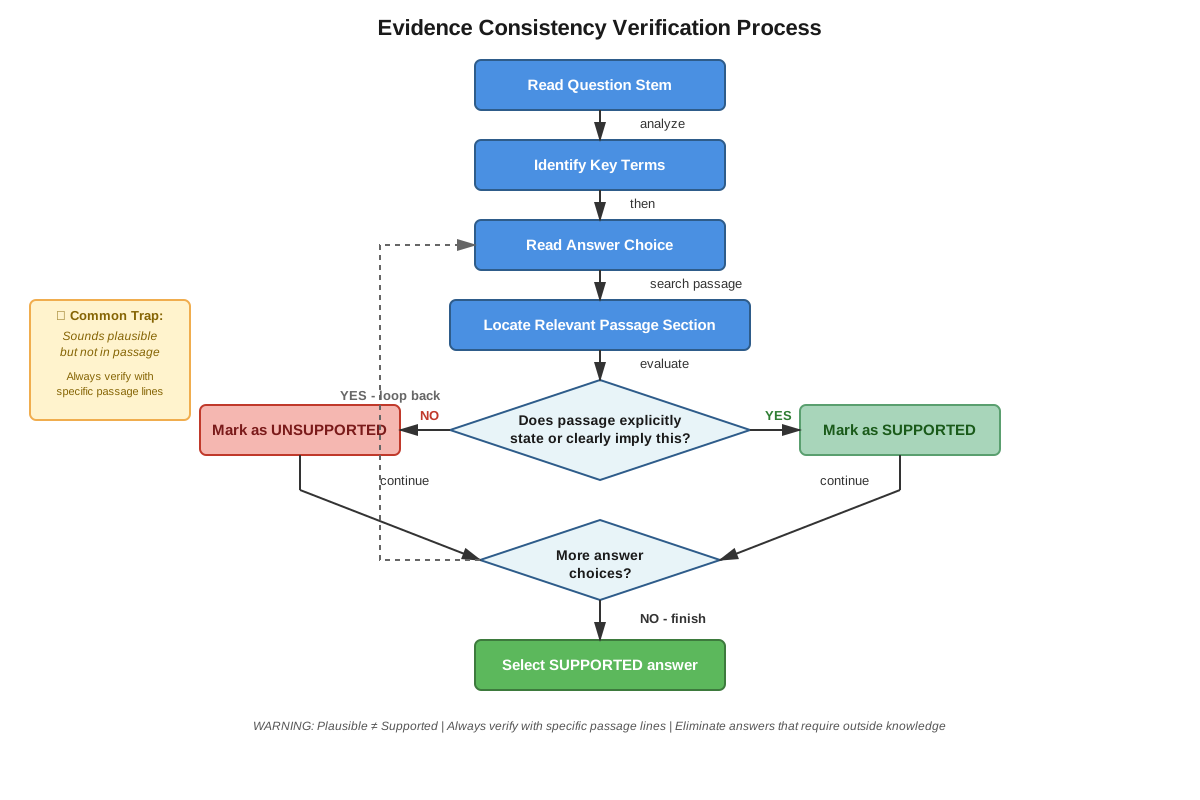
Successful ACT test-takers employ a systematic verification process for every answer choice:
- Read the question stem carefully to identify exactly what type of evidence is required (fact, inference, main idea, detail, etc.)
- Predict an answer based on passage memory before looking at choices, creating a mental benchmark
- Examine each answer choice individually rather than selecting the first plausible option
- Locate specific passage evidence that would support or contradict each choice
- Verify exact alignment between the answer choice wording and the passage evidence
- Eliminate choices that require assumptions, outside knowledge, or information not present in the passage
- Select the choice with the strongest, most direct textual support
This process prevents the common error of selecting answers that "sound good" or seem generally related to the passage topic without being specifically supported by passage content.
Common Evidence Consistency Violations
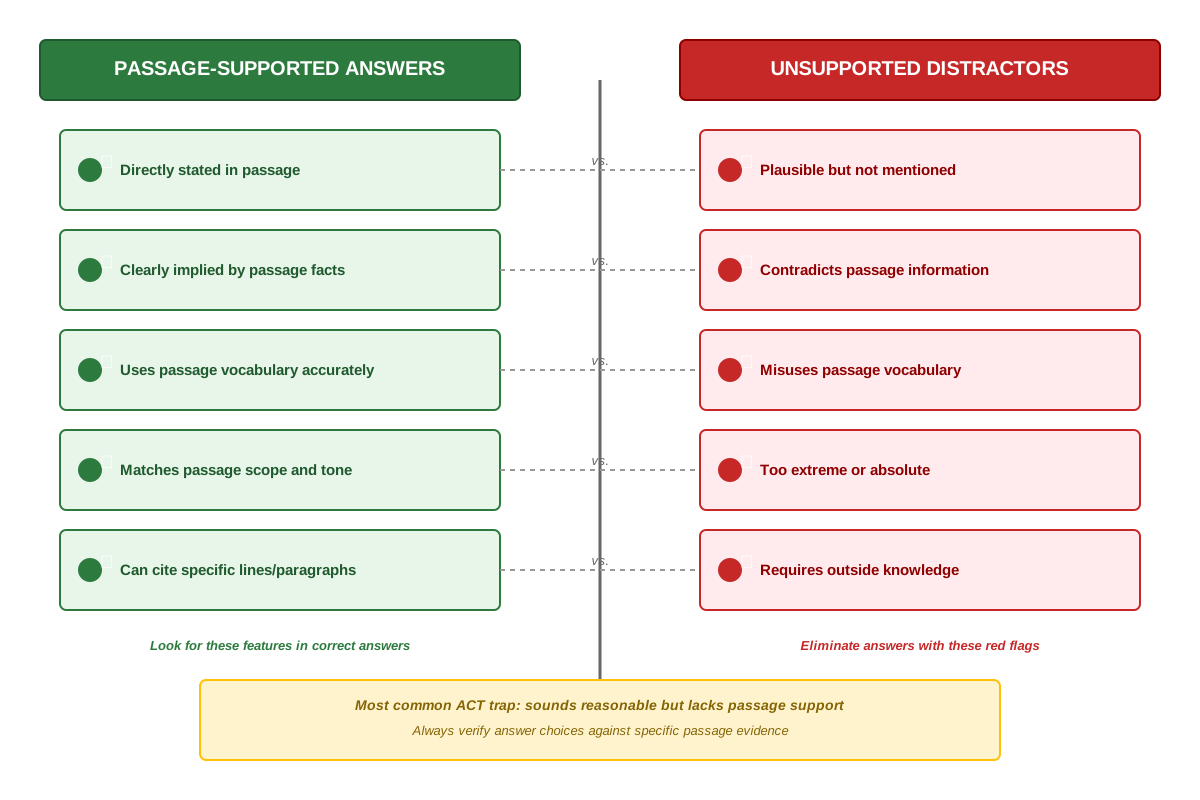
The ACT constructs wrong answers using predictable patterns that violate evidence consistency:
| Violation Type | Description | Example |
|---|---|---|
| Extreme language | Answer uses absolute terms (always, never, only, all) not supported by passage | Passage: "Many scientists support the theory" / Wrong answer: "All scientists agree with the theory" |
| Reversal | Answer states the opposite of what the passage says | Passage: "The policy decreased unemployment" / Wrong answer: "The policy increased unemployment" |
| Outside knowledge | Answer is factually true but not mentioned in the passage | Passage about Mozart's childhood / Wrong answer referencing his later operas (not discussed) |
| Distortion | Answer exaggerates or minimizes information from the passage | Passage: "The study showed modest improvements" / Wrong answer: "The study demonstrated dramatic success" |
| Misplaced detail | Answer contains information from the passage but applied to the wrong subject | Passage discusses both lions and tigers / Wrong answer attributes lion characteristics to tigers |
| Partial truth | Answer begins correctly but adds unsupported information | Passage: "The artist used watercolors" / Wrong answer: "The artist used watercolors to express sadness" (emotion not mentioned) |
The "Point to It" Test
The most reliable evidence consistency strategy is the "point to it" test: before selecting any answer choice, students should be able to point to specific lines in the passage that directly support that choice. If asked to justify the answer to a skeptical reader, students should be able to cite exact passage locations. This test works because correct ACT answers always have clear textual support, while wrong answers require assumptions, interpretations, or logical leaps beyond the passage.
For example, if an answer choice states "The author believes traditional methods are outdated," students should locate sentences where the author explicitly criticizes traditional methods or describes them as no longer effective. If the passage only mentions traditional methods neutrally or describes newer methods without criticizing older ones, the answer choice fails the "point to it" test.
Degree of Support Analysis
Not all textual support is equally strong. Students must evaluate the degree of support each answer choice receives:
- Strong support: Multiple passage references directly address the answer choice concept using similar language
- Moderate support: One clear passage reference directly supports the answer choice
- Weak support: Passage information could be interpreted to support the answer but requires assumptions
- No support: Answer choice introduces information not present or contradicts passage content
On the ACT, correct answers typically have strong or moderate support, while wrong answers have weak or no support. When comparing answer choices, students should select the one with the strongest, most direct evidence rather than the one that seems most interesting or sophisticated.
Concept Relationships
Evidence consistency serves as the foundational skill that enables all other ACT Reading competencies. The relationship flows as follows:
Basic Comprehension → Evidence Consistency → Inference → Synthesis
Students must first understand what the passage literally says (basic comprehension) before they can verify whether answer choices align with that content (evidence consistency). Once evidence consistency is mastered, students can confidently make inferences because they know how to distinguish supported conclusions from unsupported speculation. Finally, synthesis questions requiring students to understand relationships between ideas depend on evidence consistency to ensure those relationships are passage-based rather than assumed.
Evidence consistency also connects directly to annotation skills (prerequisite) because effective annotation creates a reference system for quickly locating supporting evidence. The relationship works bidirectionally: good annotations make evidence verification faster, while practicing evidence verification teaches students what information to annotate.
Within the Integration of Knowledge and Ideas unit, evidence consistency enables author's purpose analysis by ensuring that claims about why an author included specific information are grounded in textual clues rather than speculation. Similarly, comparative analysis questions asking students to identify similarities or differences between ideas in the passage require evidence consistency to verify that the comparison is passage-supported.
The skill also relates to question stem analysis because different question types require different evidence standards. "According to the passage" questions demand explicit evidence, while "it can reasonably be inferred" questions accept implicit evidence. Understanding these distinctions helps students apply appropriate evidence consistency standards.
High-Yield Facts
⭐ Every correct ACT Reading answer must be directly supported by specific passage content—no exceptions
⭐ Wrong answers often contain information that is factually true or logically plausible but not stated or implied in the passage
⭐ The "point to it" test—being able to cite specific lines supporting your answer—is the most reliable verification strategy
⭐ Extreme language (always, never, only, all, none) in answer choices usually indicates evidence consistency violations unless the passage uses equally extreme language
⭐ When two answer choices seem correct, the one with more direct, explicit textual support is always the better choice
- Answer choices that require outside knowledge or assumptions beyond the passage violate evidence consistency and are incorrect
- Evidence consistency applies equally to all question types: detail, inference, main idea, vocabulary-in-context, and author's purpose
- The ACT deliberately places wrong answers that address passage topics but make unsupported claims about those topics
- Correct answers often use synonyms or paraphrases of passage language rather than exact quotations, but the meaning must align perfectly
- Evidence consistency violations are the most common reason students miss questions they "narrowed down to two choices"
Quick check — test yourself on Evidence consistency so far.
Try Flashcards →Common Misconceptions
Misconception: If an answer choice is factually accurate in the real world, it must be correct.
Correction: ACT Reading questions test passage comprehension, not general knowledge. An answer choice can be completely true in reality but wrong on the test if the passage doesn't support it. For example, if a passage discusses Shakespeare's plays but never mentions his sonnets, an answer about his poetry would be incorrect despite being factually accurate.
Misconception: Inference questions allow students to make educated guesses beyond what the passage states.
Correction: Even inference questions require evidence consistency. Valid inferences must be unavoidable conclusions based on stated facts, not possible interpretations or likely scenarios. If the passage says "Maria studied for six hours and still failed the test," you can infer the test was difficult or Maria struggled with the material, but you cannot infer she was distracted while studying—that requires an assumption beyond the passage.
Misconception: If most of an answer choice is supported by the passage, it's correct even if one part isn't mentioned.
Correction: Answer choices must be entirely supported by passage evidence. The ACT frequently creates wrong answers that are 80% correct but include one unsupported detail. Students must verify every component of an answer choice, not just the general idea.
Misconception: Longer, more detailed answer choices are more likely to be correct because they show deeper understanding.
Correction: Answer length has no correlation with correctness. The ACT often makes wrong answers longer by adding unsupported details or qualifications. Students should evaluate evidence support, not answer length or complexity.
Misconception: If you can't find evidence against an answer choice, it must be correct.
Correction: Correct answers require positive evidence supporting them, not merely the absence of contradictory evidence. An answer choice that isn't contradicted by the passage but also isn't supported by it is still wrong. Students must find specific textual support, not just the lack of opposition.
Misconception: The correct answer will always use the same words as the passage.
Correction: The ACT frequently paraphrases passage content in correct answers, using synonyms and different sentence structures while maintaining the same meaning. Students must recognize conceptual alignment, not just word-for-word matches. However, the meaning must align exactly—paraphrasing doesn't excuse adding unsupported information.
Worked Examples
Example 1: Literary Narrative Detail Question
Passage excerpt: "Thomas had always admired his grandfather's workshop, with its smell of sawdust and oil, its walls lined with tools he didn't recognize. As a child, he'd spent countless afternoons watching the old man transform rough lumber into elegant furniture, never speaking unless Thomas asked a question. Now, standing in the empty workshop after the funeral, Thomas picked up a chisel and felt its weight in his palm, wondering if he could learn what his grandfather had never offered to teach him."
Question: According to the passage, Thomas's grandfather:
A) Frequently explained his woodworking techniques to Thomas
B) Encouraged Thomas to pursue woodworking as a career
C) Remained mostly silent while working unless Thomas initiated conversation
D) Felt frustrated that Thomas never showed interest in learning woodworking
Analysis:
Choice A violates evidence consistency through reversal. The passage states the grandfather was "never speaking unless Thomas asked a question," which directly contradicts "frequently explained." Even though Thomas watched his grandfather work, there's no evidence of frequent explanations. Eliminated.
Choice B introduces information not present in the passage. While Thomas spent time in the workshop, nothing in the passage suggests the grandfather encouraged woodworking as a career. This requires an assumption beyond the text. Eliminated.
Choice C aligns perfectly with the explicit evidence: "never speaking unless Thomas asked a question." This is a direct paraphrase of passage content. The answer uses "remained mostly silent" to capture "never speaking" and "unless Thomas initiated conversation" to capture "unless Thomas asked a question." Strong evidence support—likely correct.
Choice D violates evidence consistency by attributing feelings to the grandfather that aren't stated or implied. The passage mentions Thomas "wondering if he could learn what his grandfather had never offered to teach him," but this describes Thomas's current thoughts, not the grandfather's past feelings. Nothing suggests the grandfather felt frustrated. Eliminated.
Correct Answer: C
This example demonstrates how evidence consistency requires exact alignment between answer choices and passage content. Choice C succeeds because every element can be pointed to in the text, while other choices add unsupported information or contradict stated facts.
Example 2: Natural Science Inference Question
Passage excerpt: "The research team observed that coral reefs exposed to increased water temperatures showed a 40% decline in symbiotic algae populations within three weeks. Without these algae, which provide up to 90% of the coral's energy through photosynthesis, the coral tissue began losing its characteristic color. However, when water temperatures returned to normal ranges within a month, approximately 60% of the affected coral colonies gradually regained their algae populations over the following six months."
Question: Based on the passage, it can reasonably be inferred that:
A) Coral reefs cannot survive without symbiotic algae under any circumstances
B) The color loss in coral tissue is directly related to the absence of symbiotic algae
C) All coral colonies will recover if water temperatures normalize within one month
D) Symbiotic algae are more sensitive to temperature changes than coral tissue
Analysis:
Choice A uses extreme language ("cannot...under any circumstances") not supported by the passage. While the passage indicates algae provide 90% of coral energy, it doesn't state that coral cannot survive at all without them. The passage also shows that some coral survived the algae loss long enough to recover. This violates evidence consistency through exaggeration. Eliminated.
Choice B represents a valid inference with strong textual support. The passage states that "without these algae...the coral tissue began losing its characteristic color," establishing a clear causal relationship. The timing (algae decline followed by color loss) and the explicit "without these algae" language support the inference that color loss is directly related to algae absence. Strong evidence support—likely correct.
Choice C violates evidence consistency through extreme language ("all coral colonies will recover"). The passage states "approximately 60% of the affected coral colonies gradually regained their algae populations," which means 40% did not recover even when temperatures normalized. This choice distorts the passage data. Eliminated.
Choice D makes a comparison not supported by passage evidence. While the passage shows algae populations declined when temperatures increased, it doesn't provide information comparing the sensitivity of algae versus coral tissue to temperature changes. The coral tissue also showed effects (color loss), so we cannot determine which is "more sensitive." This requires an assumption beyond the text. Eliminated.
Correct Answer: B
This example illustrates how valid inferences must be unavoidable conclusions from stated facts. Choice B succeeds because the causal relationship between algae absence and color loss is explicitly stated, making the inference directly supported. Other choices either exaggerate passage information or make comparisons the passage doesn't support.
Exam Strategy
Approaching Evidence Consistency Questions
When tackling ACT Reading questions, implement this systematic approach to ensure evidence consistency:
Before reading answer choices, return to the relevant passage section and refresh your memory of what it actually says. This prevents answer choices from contaminating your understanding with their wording. For line reference questions, read 2-3 sentences before and after the referenced lines to capture full context.
Watch for trigger words in question stems that signal evidence consistency is being tested:
- "According to the passage"
- "The passage states"
- "The author mentions"
- "Based on lines X-Y"
- "The passage indicates"
- "As described in the passage"
These phrases demand explicit textual support and warn against using outside knowledge or assumptions.
Process of Elimination Strategy
Eliminate answer choices systematically using evidence consistency criteria:
- First pass: Eliminate choices that directly contradict passage information or introduce topics not discussed
- Second pass: Eliminate choices with extreme language (always, never, only, all) unless the passage uses equally extreme terms
- Third pass: Between remaining choices, eliminate those requiring assumptions or outside knowledge
- Final selection: Choose the answer with the most direct, explicit textual support
Exam Tip: When you've narrowed to two choices, the correct answer is almost always the one that requires fewer logical steps or assumptions to connect to passage evidence. The ACT rewards straightforward, direct connections over complex interpretations.
Time Allocation
Evidence consistency verification should take 15-30 seconds per answer choice. If you cannot quickly locate supporting evidence, the choice is likely wrong. Don't waste time trying to justify weak answer choices—move to options with clearer support.
For questions where you're uncertain, mark them and return after completing easier questions. Often, answering subsequent questions about the same passage will refresh your memory of specific details that help verify evidence consistency on earlier questions.
The "Prove It" Mindset
Adopt a skeptical "prove it" mindset where you challenge every answer choice to demonstrate its passage support. Imagine a teacher asking "Where does the passage say that?" after each selection. If you can't immediately cite specific lines, the answer likely violates evidence consistency.
This mindset is especially crucial for EXCEPT/NOT questions, where you must verify that three choices ARE supported by the passage and one is NOT. These questions require evidence consistency verification for all four choices, making them time-intensive but highly predictable once you master the skill.
Memory Techniques
The PROVE Acronym
Use PROVE to remember the evidence consistency verification process:
- Point to specific passage lines supporting your answer
- Read the answer choice carefully for unsupported additions
- Outside knowledge must be ignored—passage only
- Verify every part of the answer choice, not just the main idea
- Extreme language (always, never, only) requires extreme passage support
The Traffic Light Visualization
Visualize answer choices as traffic lights while evaluating evidence consistency:
- Green light (GO): Direct passage support with specific lines you can cite
- Yellow light (CAUTION): Seems related to passage but requires assumptions
- Red light (STOP): Contradicts passage or introduces unsupported information
Only select green light answers. Yellow and red lights are always wrong on the ACT.
The "Passage is King" Mantra
Remember the phrase "Passage is King" to reinforce that passage content overrides everything else—your knowledge, opinions, assumptions, or what seems logical. When in doubt, return to the passage and let it be the final authority.
The Three-Question Test
Before selecting any answer, ask these three questions:
- Can I point to it? (Specific lines supporting this answer)
- Does it match exactly? (No additions, exaggerations, or distortions)
- Is it all there? (Every part of the answer is passage-supported)
If you answer "no" to any question, the choice violates evidence consistency.
Summary
Evidence consistency represents the fundamental principle underlying all ACT Reading questions: correct answers must be directly supported by specific passage content, while wrong answers violate this principle through contradictions, unsupported additions, extreme language, or reliance on outside knowledge. Mastering this concept requires students to verify that every component of their selected answer choice aligns with explicit or implicit passage evidence, using the "point to it" test to ensure they can cite specific textual support. The ACT constructs wrong answers using predictable patterns—reversals, distortions, misplaced details, partial truths, and outside knowledge—making evidence consistency violations highly recognizable once students learn to identify them. Success depends on subordinating personal knowledge and assumptions to passage authority, systematically eliminating choices that require logical leaps beyond the text, and selecting answers with the strongest, most direct evidence support. This skill applies across all question types and passage genres, making it the single most important competency for achieving a high ACT Reading score.
Key Takeaways
- Evidence consistency requires that every correct answer be directly supported by specific passage content without requiring outside knowledge or unsupported assumptions
- The "point to it" test—being able to cite exact lines supporting your answer—is the most reliable verification strategy for ensuring evidence consistency
- Wrong answers typically violate evidence consistency through extreme language, reversals, distortions, outside knowledge, misplaced details, or partial truths
- Valid inferences must be unavoidable conclusions from stated facts, not merely possible interpretations or likely scenarios
- When choosing between two seemingly correct answers, select the one with more direct, explicit textual support requiring fewer logical steps
- Extreme language in answer choices (always, never, only, all) usually signals evidence consistency violations unless the passage uses equally extreme terms
- Every component of an answer choice must be passage-supported—answers that are 80% correct but include one unsupported detail are completely wrong
Related Topics
Inference and Reasoning: Building on evidence consistency, this topic teaches students how to draw valid conclusions from stated facts while maintaining textual support. Mastering evidence consistency provides the foundation for distinguishing supported inferences from speculation.
Author's Purpose and Rhetoric: Understanding why authors include specific information requires evidence consistency to verify that purpose claims are supported by textual clues rather than assumptions about typical authorial intentions.
Comparative Analysis: Questions asking students to identify relationships between ideas or compare different viewpoints within a passage depend on evidence consistency to ensure comparisons are passage-based rather than imposed by the reader.
Main Idea and Theme: Identifying central arguments requires evidence consistency to verify that main idea claims are supported by multiple passage elements rather than focusing on minor details or personal interpretations.
Vocabulary in Context: Determining word meanings from context requires evidence consistency to ensure selected definitions align with how the word functions in the specific passage rather than relying on dictionary definitions that may not fit.
Practice CTA
Now that you understand the principles of evidence consistency, it's time to apply these strategies to actual ACT-style passages and questions. The practice questions and flashcards will help you recognize evidence consistency violations, strengthen your "point to it" verification skills, and build the confidence needed to select correct answers quickly and accurately. Remember: evidence consistency is a learnable skill that improves dramatically with deliberate practice. Each practice question you complete reinforces the habit of verifying textual support before selecting answers, transforming this concept from an abstract principle into an automatic process that will serve you throughout the ACT Reading section. Start practicing now to make evidence consistency your most powerful test-taking tool!
Sign up free to keep reading
Create a free AnvayaPrep account to finish this ACT guide on Evidence consistency — plus flashcards and practice questions.