Overview
Generalization questions represent a critical question type on the ACT Reading test that requires students to move beyond literal comprehension and synthesize information from multiple parts of a passage to draw broader conclusions. These questions ask test-takers to identify patterns, recognize overarching themes, and determine what can be reasonably inferred about characters, situations, or ideas based on accumulated evidence throughout the text. Unlike detail-oriented questions that point to specific lines, generalization questions demand that students consider the passage holistically and recognize what statements hold true across multiple examples or scenarios presented in the reading.
Mastering ACT generalization questions is essential because they consistently appear on every ACT Reading test, typically comprising 15-20% of all reading questions. These questions assess higher-order thinking skills that colleges value: the ability to recognize patterns, synthesize information, and draw logical conclusions from evidence. Students who struggle with generalization questions often score in the lower percentile ranges because these questions separate those who merely understand individual details from those who can integrate information to see the bigger picture.
Within the broader framework of ACT Reading skills, generalization questions bridge the gap between literal comprehension and analytical reasoning. They build upon foundational skills like identifying main ideas and supporting details while preparing students for more complex inference and reasoning questions. Success with generalization questions demonstrates mastery of the Integration of Knowledge and Ideas standard, which requires students to analyze how different parts of a text work together to create meaning and support broader conclusions about characters, themes, arguments, or situations.
Learning Objectives
- [ ] Identify when Generalization questions is being tested
- [ ] Explain the core rule or strategy behind Generalization questions
- [ ] Apply Generalization questions to ACT-style questions accurately
- [ ] Distinguish between valid generalizations supported by textual evidence and overgeneralizations that extend beyond the passage
- [ ] Evaluate answer choices by checking whether they hold true across multiple examples or sections of the passage
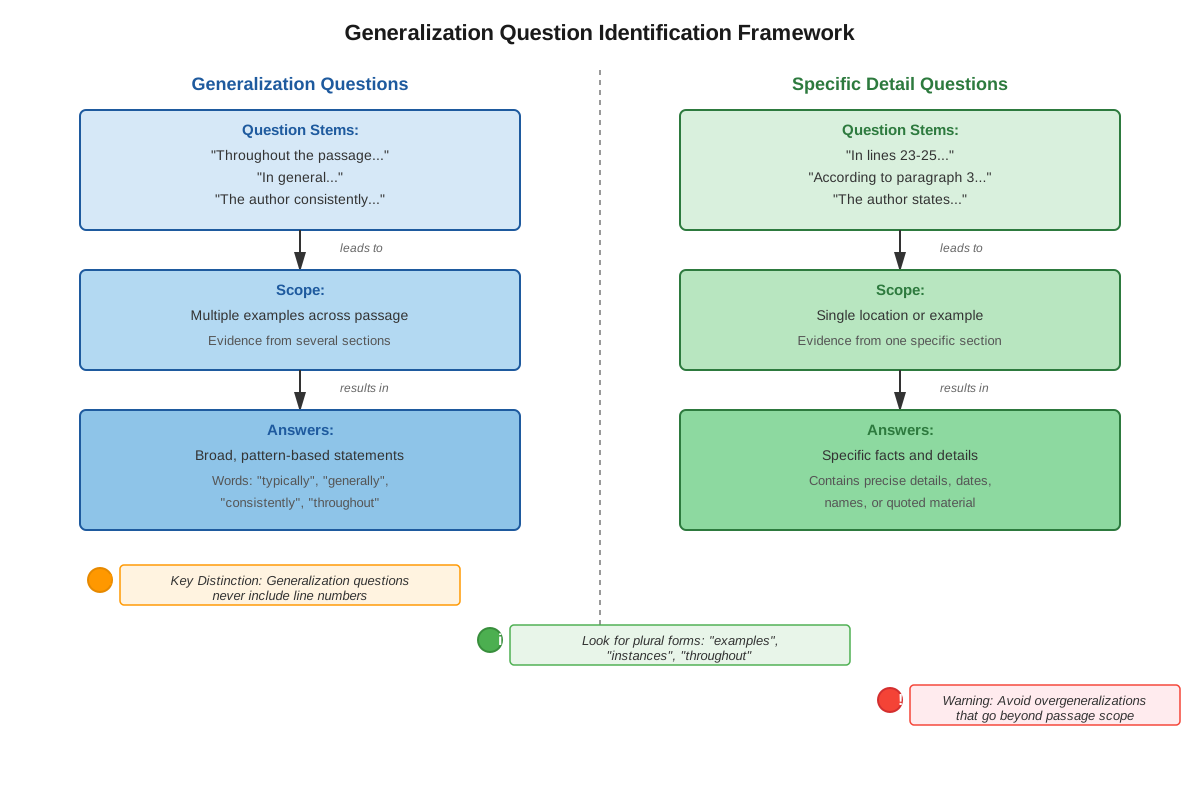
- [ ] Recognize the difference between generalization questions and specific detail questions based on question stems and scope
Prerequisites
- Main idea identification: Understanding the central point of a passage is essential because generalizations must align with the overall message and not contradict the author's purpose
- Supporting detail recognition: Students must be able to locate and understand specific examples and evidence that support or refute potential generalizations
- Basic inference skills: Generalization questions require drawing conclusions that go slightly beyond what's explicitly stated, building on the foundation of making simple inferences
- Passage structure awareness: Recognizing how passages are organized helps students identify patterns and recurring themes that support generalizations
Why This Topic Matters
Generalization questions test a fundamental cognitive skill that extends far beyond standardized testing: the ability to recognize patterns and draw reasonable conclusions from accumulated evidence. In academic settings, students constantly need to synthesize information from multiple sources, identify trends in data, and make evidence-based claims about broader phenomena. In professional contexts, this skill translates to analyzing market trends, understanding customer behavior patterns, evaluating research findings, and making strategic decisions based on multiple data points.
On the ACT Reading test, generalization questions appear with remarkable consistency, typically accounting for 4-8 questions per test across the four passages. These questions carry significant weight because they're often positioned at medium to medium-high difficulty levels, serving as differentiators between students scoring in the mid-20s versus those achieving scores of 30 and above. The College Board research indicates that students who master generalization questions show stronger overall reading comprehension and are better prepared for college-level analytical reading.
Generalization questions commonly appear in several forms across ACT passages. In literary narratives, they might ask about a character's overall personality traits, typical behaviors, or general attitudes based on multiple actions throughout the story. In social science passages, these questions often focus on broader patterns in historical movements, cultural trends, or societal changes. Natural science passages frequently include generalization questions about scientific principles, typical characteristics of phenomena, or general patterns observed across multiple examples. Humanities passages may ask students to generalize about an artist's style, a philosopher's worldview, or recurring themes in a body of work.
Core Concepts
Defining Generalization Questions
A generalization question asks students to identify a statement that holds true across multiple instances, examples, or sections of a passage rather than focusing on a single specific detail. These questions require synthesizing information from various parts of the text to recognize patterns, common characteristics, or overarching truths. The key distinguishing feature is scope: while detail questions zoom in on particular moments or facts, generalization questions zoom out to capture what's consistently or typically true.
Generalization questions can be identified by their characteristic question stems, which often include words like "generally," "typically," "usually," "overall," "throughout the passage," "consistently," or "in general." They may also ask about what "can be said about" a character, concept, or situation based on the passage as a whole, or what is "characteristic of" something described in the text.
Types of Generalization Questions
Character Generalization Questions ask students to identify overall personality traits, typical behaviors, or general attitudes of individuals described in narrative passages. These questions require examining multiple actions, thoughts, or statements attributed to a character throughout the passage to determine what consistently characterizes them. For example, a question might ask: "Based on the passage, the narrator can best be described as generally..." followed by answer choices describing different personality types.
Pattern Recognition Questions require identifying recurring themes, repeated behaviors, or consistent trends described across multiple examples in the passage. These are particularly common in social science and natural science passages where authors present multiple instances of a phenomenon. Students must recognize what remains constant across the various examples rather than focusing on unique aspects of individual cases.
Scope-Based Generalizations test whether students can distinguish between statements that apply broadly versus those that apply only to specific situations mentioned in the passage. The correct answer will be supported by evidence from multiple parts of the text, while incorrect answers often take a detail from one section and incorrectly extend it to the entire passage.
The Evidence Accumulation Principle
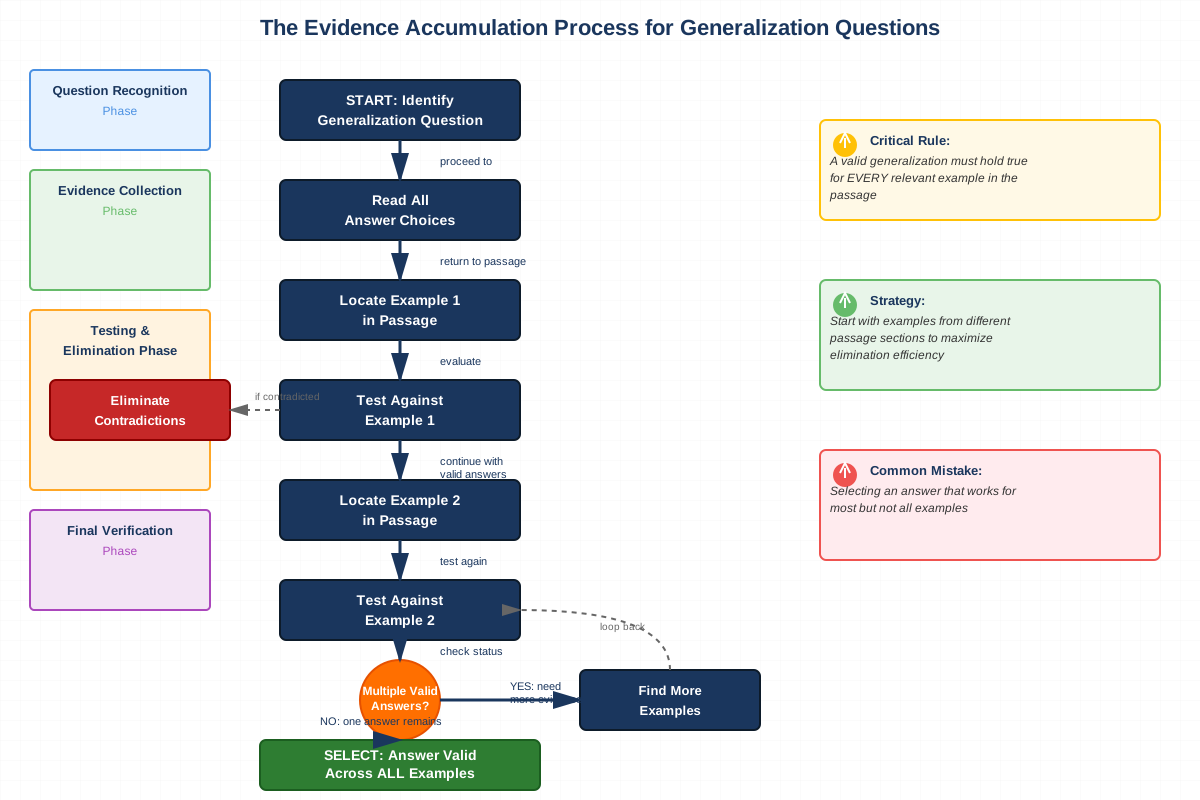
The fundamental strategy for answering generalization questions correctly involves evidence accumulation: systematically checking whether a potential answer choice is supported by multiple pieces of evidence throughout the passage. A valid generalization must be consistent with—or at least not contradicted by—all relevant information in the text. This principle distinguishes generalization questions from inference questions, where a single strong piece of evidence might suffice.
To apply this principle effectively, students should:
- Read the question stem carefully to identify the scope (what person, concept, or situation the generalization should apply to)
- Mentally review or quickly skim the passage to recall multiple relevant examples or instances
- Test each answer choice against these multiple examples
- Eliminate any choice that is contradicted by even one clear example in the passage
- Select the answer that remains consistently true across all relevant evidence
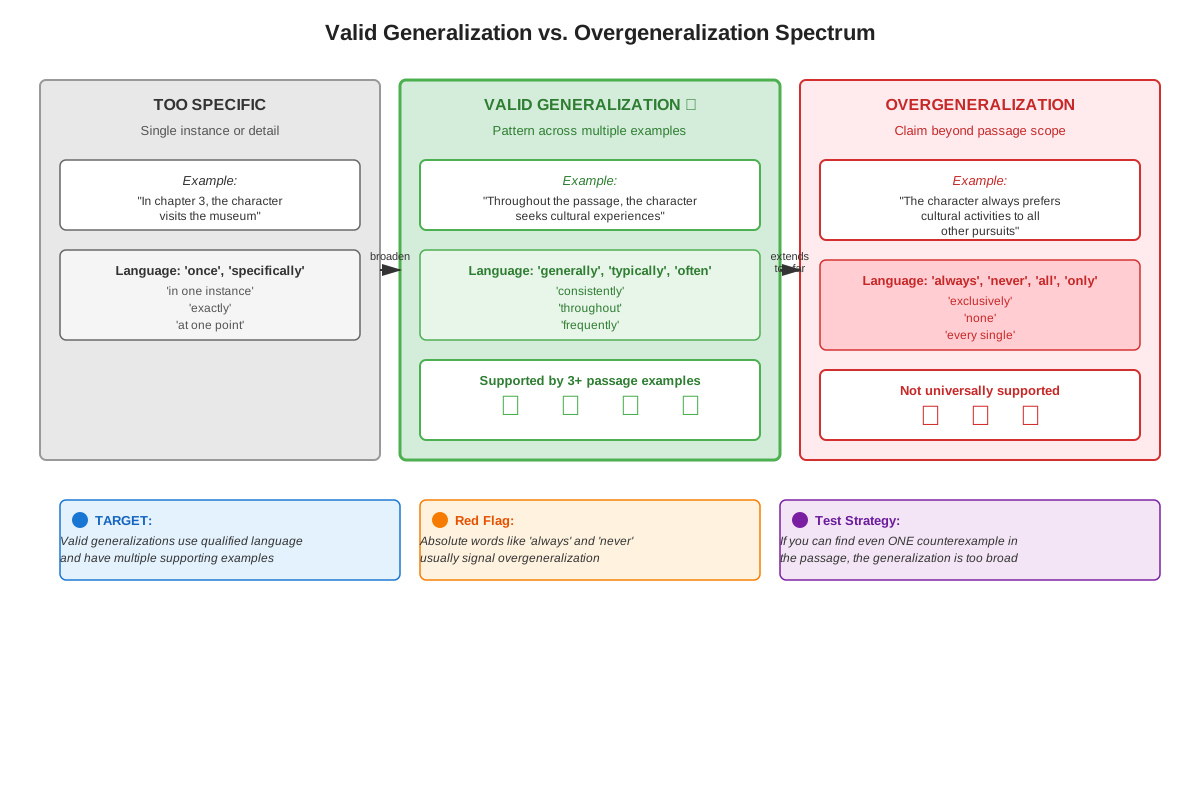
Distinguishing Valid from Invalid Generalizations
| Valid Generalization | Invalid Generalization |
|---|---|
| Supported by multiple examples in the passage | Based on only one or two isolated details |
| Consistent with the overall tone and message | Contradicts information elsewhere in the passage |
| Uses appropriately qualified language (often, typically, generally) | Uses absolute language unsupported by the text (always, never, only) |
| Aligns with the author's purpose and perspective | Extends beyond what the author actually discusses |
| Accounts for nuance and complexity when present | Oversimplifies complex situations described in the passage |
Common Question Stem Patterns
Recognizing the language patterns in generalization question stems helps students quickly identify when this question type is being tested. Common stems include:
- "Throughout the passage, [character/concept] is characterized as..."
- "Based on the passage, it can reasonably be generalized that..."
- "The passage suggests that [subject] typically..."
- "Overall, the author's attitude toward [topic] can best be described as..."
- "Which of the following statements about [subject] is supported by the passage as a whole?"
- "In general, the [people/things] described in the passage..."
- "The passage indicates that [subject] is generally characterized by..."
The Scope Trap
One of the most common errors students make with generalization questions involves scope confusion: selecting an answer that accurately describes one part of the passage but doesn't hold true more broadly. The ACT deliberately includes these tempting wrong answers because they contain accurate information—just information that doesn't generalize appropriately.
For example, if a passage describes a scientist who was initially skeptical of a theory but later became convinced by evidence, a scope trap answer might say "The scientist was skeptical of the theory," which is true for part of the passage but doesn't capture the overall characterization. The correct generalization might be "The scientist's views evolved based on evidence."
Concept Relationships
Generalization questions build directly upon main idea identification skills because valid generalizations must align with the passage's central message. A student who misunderstands the main idea will likely select generalizations that contradict the author's overall purpose. The relationship flows: Main Idea → Provides Context → Guides Valid Generalizations.
These questions also depend heavily on supporting detail recognition but reverse the typical relationship. While detail questions ask students to locate specific evidence, generalization questions require synthesizing multiple details to form broader conclusions. The relationship is: Multiple Supporting Details → Accumulate → Form Valid Generalization.
Generalization questions connect forward to inference questions and author's purpose questions. Mastering generalizations prepares students for inference questions because both require going beyond literal statements, though inferences may require deeper logical leaps. The progression is: Generalization (pattern recognition across explicit information) → Inference (logical conclusions from implicit information) → Author's Purpose (understanding why patterns and information are presented).
Within the topic itself, the concepts interconnect as follows: Question Stem Recognition → Identifies Question Type → Triggers Evidence Accumulation Strategy → Requires Scope Awareness → Enables Elimination of Scope Traps → Leads to Correct Answer Selection.
High-Yield Facts
⭐ Generalization questions typically comprise 15-20% of ACT Reading questions, appearing 4-8 times per test
⭐ Valid generalizations must be supported by multiple pieces of evidence from different parts of the passage, not just one or two details
⭐ Question stems containing "generally," "typically," "overall," "throughout," or "in general" signal generalization questions
⭐ The most common wrong answers are scope traps: statements that are true for one part of the passage but don't generalize to the whole
⭐ Absolute language in answer choices (always, never, only, all) is usually incorrect unless the passage explicitly supports such strong claims
- Generalization questions appear across all four passage types (Literary Narrative, Social Science, Humanities, Natural Science) with roughly equal frequency
- Character generalization questions are most common in Literary Narrative passages, appearing 1-2 times per narrative passage
- Correct answers to generalization questions often use qualified language like "often," "tends to," "generally," or "typically"
- Eliminating answer choices that contradict any clear example in the passage is the most efficient strategy
- Generalization questions usually cannot be answered by reading only one paragraph; they require considering the passage holistically
- Time-efficient students mentally note patterns while reading rather than searching for them only when answering questions
- Generalization questions about the author's attitude or tone require considering word choice and examples throughout the entire passage
Quick check — test yourself on Generalization questions so far.
Try Flashcards →Common Misconceptions
Misconception: Generalization questions can be answered by finding one strong piece of evidence in the passage.
Correction: Unlike detail or inference questions, generalization questions require multiple pieces of supporting evidence from different parts of the passage. A valid generalization must hold true across all relevant examples, not just one instance.
Misconception: If an answer choice contains information stated in the passage, it must be correct.
Correction: The ACT deliberately includes wrong answers that contain accurate information from the passage but don't appropriately generalize. The information might be true for one section but not representative of the passage as a whole—this is the scope trap.
Misconception: Generalization questions are just asking for the main idea in different words.
Correction: While generalizations must align with the main idea, they're more specific. The main idea captures the passage's central message, while generalizations make broader claims about specific characters, concepts, or patterns described in the passage.
Misconception: Qualified language like "sometimes" or "often" makes an answer choice too weak to be correct.
Correction: Appropriately qualified language is actually a hallmark of correct generalization answers because it accurately reflects the nuance in most passages. Overly absolute statements (always, never) are more likely to be incorrect because they're easier to contradict.
Misconception: Generalization questions are easier than inference questions because they don't require reading between the lines.
Correction: Generalization questions require a different but equally challenging skill: synthesizing information from multiple sources. Many students find them harder than inference questions because they require holding more information in mind simultaneously and checking consistency across the entire passage.
Misconception: The correct answer to a generalization question will be explicitly stated somewhere in the passage.
Correction: While the evidence supporting the generalization appears in the passage, the generalization itself is usually a synthesis that isn't stated verbatim. Students must recognize the pattern across multiple examples and select the answer that best captures this pattern.
Worked Examples
Example 1: Literary Narrative Character Generalization
Passage Context: A passage describes a woman named Elena who, throughout the story, volunteers at a community center despite her busy schedule, listens patiently to her teenage daughter's concerns even when tired, and takes time to help her elderly neighbor with groceries. However, one paragraph mentions that she once snapped at a telemarketer who called during dinner.
Question: Based on the passage, Elena can best be characterized as generally:
A) patient and community-minded
B) short-tempered with strangers
C) overwhelmed by her responsibilities
D) focused primarily on her family
Step 1 - Identify the Question Type: The phrase "can best be characterized as generally" signals a generalization question about Elena's overall personality.
Step 2 - Accumulate Evidence: Review all instances of Elena's behavior:
- Volunteers regularly (community-minded)
- Listens patiently to daughter (patient, family-focused)
- Helps elderly neighbor (community-minded)
- Snapped at telemarketer once (one instance of impatience)
Step 3 - Test Each Answer:
- Choice A: "patient and community-minded" - Supported by three major examples (volunteering, listening to daughter, helping neighbor). The single telemarketer incident doesn't negate the pattern of patience shown in more significant relationships.
- Choice B: "short-tempered with strangers" - Based only on the single telemarketer incident; contradicted by her patient volunteering with community members.
- Choice C: "overwhelmed by her responsibilities" - Not supported by the passage; she manages multiple commitments without the passage suggesting she's overwhelmed.
- Choice D: "focused primarily on her family" - Too narrow; ignores her significant community involvement.
Step 4 - Select the Answer: Choice A is correct because it captures the pattern demonstrated across multiple examples throughout the passage. The key insight is recognizing that one minor incident doesn't override the consistent pattern of behavior.
Connection to Learning Objectives: This example demonstrates identifying when generalization questions are tested (the question stem), applying the evidence accumulation strategy (reviewing multiple examples), and distinguishing valid generalizations from scope traps (Choice B is a scope trap based on one detail).
Example 2: Natural Science Pattern Recognition
Passage Context: A passage discusses various desert plants and their adaptations. It describes how cacti store water in thick stems, how mesquite trees develop deep root systems to reach underground water, how some desert flowers bloom only after rare rainfalls, and how creosote bushes space themselves apart to reduce competition for water. One sentence mentions that saguaro cacti can live for 200 years.
Question: The passage suggests that desert plants generally:
F) have evolved specific mechanisms to cope with water scarcity
G) live significantly longer than plants in other environments
H) bloom infrequently to conserve energy
J) rely primarily on deep root systems for survival
Step 1 - Identify the Question Type: "The passage suggests that desert plants generally" indicates a generalization question requiring pattern recognition across multiple examples.
Step 2 - Identify the Common Thread: Review each plant example for shared characteristics:
- Cacti: water storage (water scarcity adaptation)
- Mesquite: deep roots (water scarcity adaptation)
- Desert flowers: bloom after rain (water scarcity adaptation)
- Creosote: spacing pattern (water scarcity adaptation)
- Saguaro: longevity (mentioned but not connected to other examples)
Step 3 - Test Each Answer:
- Choice F: "evolved specific mechanisms to cope with water scarcity" - Every example supports this; each plant has a different mechanism, but all address water scarcity.
- Choice G: "live significantly longer" - Based only on the saguaro detail; no information about other plants' lifespans or comparison to non-desert plants.
- Choice H: "bloom infrequently" - Only one example (desert flowers) relates to blooming; doesn't generalize to all desert plants discussed.
- Choice J: "rely primarily on deep root systems" - Only true for mesquite; cacti use water storage, not deep roots.
Step 4 - Select the Answer: Choice F is correct because it identifies the overarching pattern that connects all examples: different adaptations to the same environmental challenge (water scarcity).
Connection to Learning Objectives: This example shows how to recognize patterns across multiple examples, distinguish between a valid generalization (F) and scope traps based on single details (G, H, J), and apply the core strategy of checking whether an answer holds true for all relevant examples.
Exam Strategy
Approaching Generalization Questions Systematically
When encountering a generalization question, implement this strategic approach:
- Identify the question type immediately by scanning for trigger words (generally, typically, overall, throughout, characterized as)
- Note the scope - determine exactly what person, concept, or phenomenon the generalization should apply to
- Resist the urge to answer immediately even if one answer "feels right" - generalization questions reward systematic checking
- Mentally review or quickly skim for multiple relevant examples before evaluating answer choices
- Use the elimination method by testing each answer against multiple examples, crossing out any choice contradicted by clear evidence
Exam Tip: Generalization questions are excellent candidates for the "check all examples" strategy. Spend an extra 15-20 seconds verifying your answer against multiple parts of the passage—this investment prevents careless errors on questions you have the knowledge to answer correctly.
Trigger Words and Phrases
Question Stem Triggers that signal generalization questions:
- "generally," "typically," "usually," "often," "commonly"
- "overall," "throughout the passage," "as a whole"
- "characterized as," "can best be described as"
- "in general," "for the most part"
- "consistently," "repeatedly"
Answer Choice Red Flags that often indicate incorrect generalizations:
- Absolute language: "always," "never," "only," "exclusively," "all," "none"
- Scope indicators that are too narrow: "once," "in one instance," "initially"
- Extreme modifiers: "completely," "entirely," "totally," "absolutely"
Answer Choice Green Flags that often indicate correct generalizations:
- Qualified language: "often," "tends to," "generally," "typically," "frequently"
- Balanced language: "both...and," "while...also," "although...nevertheless"
- Pattern language: "repeatedly," "consistently," "throughout"
Process of Elimination Strategy
For generalization questions specifically, eliminate answers in this order:
- First pass: Eliminate any answer that is directly contradicted by clear evidence in the passage
- Second pass: Eliminate answers based on only one or two details (scope traps)
- Third pass: Eliminate answers with absolute language unsupported by the passage
- Final selection: Choose the answer supported by the most examples and consistent with the passage's overall message
Time Allocation
Generalization questions typically require 60-75 seconds to answer correctly—slightly longer than detail questions but comparable to inference questions. The extra time is well-invested because these questions are:
- Medium to medium-high difficulty (good score differentiators)
- Less prone to careless errors when approached systematically
- Often positioned to test whether students truly understood the passage holistically
If time is running short, generalization questions should be prioritized over complex inference questions because they're more straightforward to verify using textual evidence.
Memory Techniques
The SAGE Method for Generalization Questions
Scope - Identify what the generalization should apply to
Accumulate - Gather multiple examples from throughout the passage
General - Look for patterns that hold generally, not just once
Eliminate - Remove answers contradicted by any clear example
Visualize a wise SAGE reviewing multiple scrolls (examples) before making a pronouncement (generalization).
The "Three Examples Rule"
Remember: "Three makes it true" - A valid generalization should be supported by at least three pieces of evidence or hold true across at least three different examples in the passage. If you can only find one or two supporting examples, you're likely looking at a scope trap.
The SCOPE Acronym for Avoiding Traps
Single detail? Probably wrong
Contradicted anywhere? Definitely wrong
Overall pattern? Probably right
Passage-wide support? Definitely right
Extreme language? Usually wrong
Visualization Strategy
Picture the passage as a landscape viewed from different heights:
- Ground level (detail questions): You see individual trees and rocks
- Hilltop view (generalization questions): You see patterns in the forest, recurring features
- Aerial view (main idea questions): You see the entire terrain's character
Generalization questions require the "hilltop view"—high enough to see patterns but not so high that you lose important details.
Summary
Generalization questions on the ACT Reading test require students to synthesize information from multiple parts of a passage to identify patterns, recognize overarching characteristics, and draw broader conclusions about characters, concepts, or phenomena. These questions, which comprise 15-20% of reading questions, distinguish students who can integrate information holistically from those who only understand isolated details. The core strategy involves evidence accumulation: systematically checking whether potential answers are supported by multiple examples throughout the passage rather than just one or two details. Success requires recognizing characteristic question stems (containing words like "generally," "typically," or "overall"), understanding the scope of what's being generalized, and avoiding the most common trap—selecting answers that accurately describe one part of the passage but don't hold true more broadly. Valid generalizations use appropriately qualified language, align with the passage's overall message, and remain consistent with all relevant evidence presented in the text. Mastering this question type requires practice in pattern recognition, systematic answer verification, and distinguishing between statements that apply narrowly versus those that generalize appropriately across the entire passage.
Key Takeaways
- Generalization questions require multiple pieces of supporting evidence from different parts of the passage, not just one or two strong details
- Scope traps are the most common wrong answers—they contain accurate information that doesn't generalize appropriately to the whole passage
- Question stems with "generally," "typically," "overall," or "throughout" signal generalization questions and should trigger the evidence accumulation strategy
- Valid generalizations use qualified language (often, tends to, generally) while overly absolute statements (always, never, only) are usually incorrect
- The systematic approach matters more than speed—invest 60-75 seconds to check your answer against multiple examples rather than rushing
- Pattern recognition across examples is the key skill—look for what remains consistent across different instances rather than unique details
- Generalization questions test holistic comprehension—they reward students who understand how different parts of the passage work together to create meaning
Related Topics
Inference Questions: After mastering generalization questions, students should progress to inference questions, which require drawing conclusions that go beyond what's explicitly stated. Generalization skills provide the foundation for inference because both require synthesizing information, though inferences demand deeper logical reasoning.
Author's Purpose and Tone Questions: Understanding generalizations about how authors present information prepares students for questions about why authors make specific choices. Recognizing patterns in word choice and examples helps determine overall purpose and attitude.
Main Idea and Theme Questions: While generalization questions focus on specific aspects of the passage, main idea questions require the broadest generalization of all—capturing the passage's central message. Mastering specific generalizations builds toward identifying overarching themes.
Comparative Reading Questions: Some ACT Reading tests include paired passages requiring students to generalize about similarities and differences between texts. The same evidence accumulation strategy applies but across two passages instead of one.
Supporting Detail Questions: Understanding the relationship between specific details and broader generalizations helps students recognize which details are representative examples versus unique instances, improving performance on both question types.
Practice CTA
Now that you've mastered the strategies for tackling generalization questions, it's time to put your knowledge into action! Access the practice questions and flashcards specifically designed to reinforce these concepts. Remember, recognizing patterns and accumulating evidence are skills that improve dramatically with deliberate practice. Each practice question you work through strengthens your ability to distinguish valid generalizations from scope traps and builds the systematic approach that leads to consistent success on test day. Your investment in mastering this high-yield question type will pay dividends across all four reading passages—start practicing now to transform your understanding into top scores!
Sign up free to keep reading
Create a free AnvayaPrep account to finish this ACT guide on Generalization questions — plus flashcards and practice questions.