Overview
Identifying assumptions is a critical analytical skill tested throughout the ACT Reading section, particularly within the Integration of Knowledge and Ideas domain. An assumption is an unstated belief or premise that an author takes for granted as true when constructing an argument or presenting information. Unlike explicitly stated claims, assumptions operate beneath the surface of the text, forming the logical foundation upon which arguments rest. When the ACT tests this skill, students must recognize what the author believes to be true without directly saying it, bridging the gap between stated evidence and conclusions.
This topic represents a sophisticated level of reading comprehension that goes beyond literal understanding. ACT identifying assumptions questions require students to think critically about what must be true for an author's reasoning to hold together. For example, if a passage argues that a new educational policy will improve student outcomes, the author might assume that schools have the resources to implement the policy, that teachers will adopt it willingly, or that current outcomes are indeed inadequate—none of which may be explicitly stated. Recognizing these hidden premises is essential for evaluating the strength and validity of arguments presented in ACT passages.
The ability to identify assumptions connects directly to other high-level reading skills tested on the ACT, including drawing inferences, analyzing author's purpose, evaluating evidence, and understanding logical relationships. This skill serves as a bridge between basic comprehension and advanced critical analysis, making it foundational for success on the more challenging Integration of Knowledge and Ideas questions that can significantly impact overall Reading scores.
Learning Objectives
By mastering this topic, students will be able to:
- [ ] Identify when Identifying assumptions is being tested in ACT Reading questions
- [ ] Explain the core rule or strategy behind Identifying assumptions
- [ ] Apply Identifying assumptions to ACT-style questions accurately
- [ ] Distinguish between stated claims and unstated assumptions in argumentative passages
- [ ] Recognize the logical gap between evidence and conclusions that assumptions fill
- [ ] Evaluate whether an identified assumption strengthens or weakens an author's argument
- [ ] Differentiate between necessary assumptions (required for the argument) and sufficient assumptions (helpful but not essential)
Prerequisites
Students should have mastery of the following concepts before studying this topic:
- Main idea identification: Understanding what an author explicitly states is necessary before recognizing what they assume; assumptions build upon stated claims
- Drawing inferences: Assumptions are a specific type of inference about what the author believes to be true; general inference skills provide the foundation
- Argument structure: Recognizing premises, evidence, and conclusions helps identify the logical gaps where assumptions reside
- Author's purpose and tone: Understanding why an author writes and their attitude toward the subject reveals the beliefs they likely hold
- Cause and effect relationships: Many assumptions involve unstated causal connections between events or ideas
Why This Topic Matters
In real-world contexts, identifying assumptions is essential for critical thinking across all disciplines. Scientists must recognize assumptions underlying research methodologies, lawyers must identify unstated premises in legal arguments, and informed citizens must evaluate the hidden beliefs behind political rhetoric. This skill enables students to become more discerning consumers of information, questioning not just what is said but what must be believed for those statements to make sense.
On the ACT Reading section, assumption-based questions appear with high frequency, typically comprising 2-4 questions per test across the four passages. These questions often appear in the Natural Sciences and Social Studies passages where authors present arguments about research findings, theories, or policy recommendations. The ACT specifically tests this skill because it distinguishes students who can engage in sophisticated analysis from those who only comprehend surface-level content. Questions testing assumptions typically carry the same point value as other questions, but they often have lower accuracy rates among test-takers, making them high-yield opportunities for prepared students to gain competitive advantage.
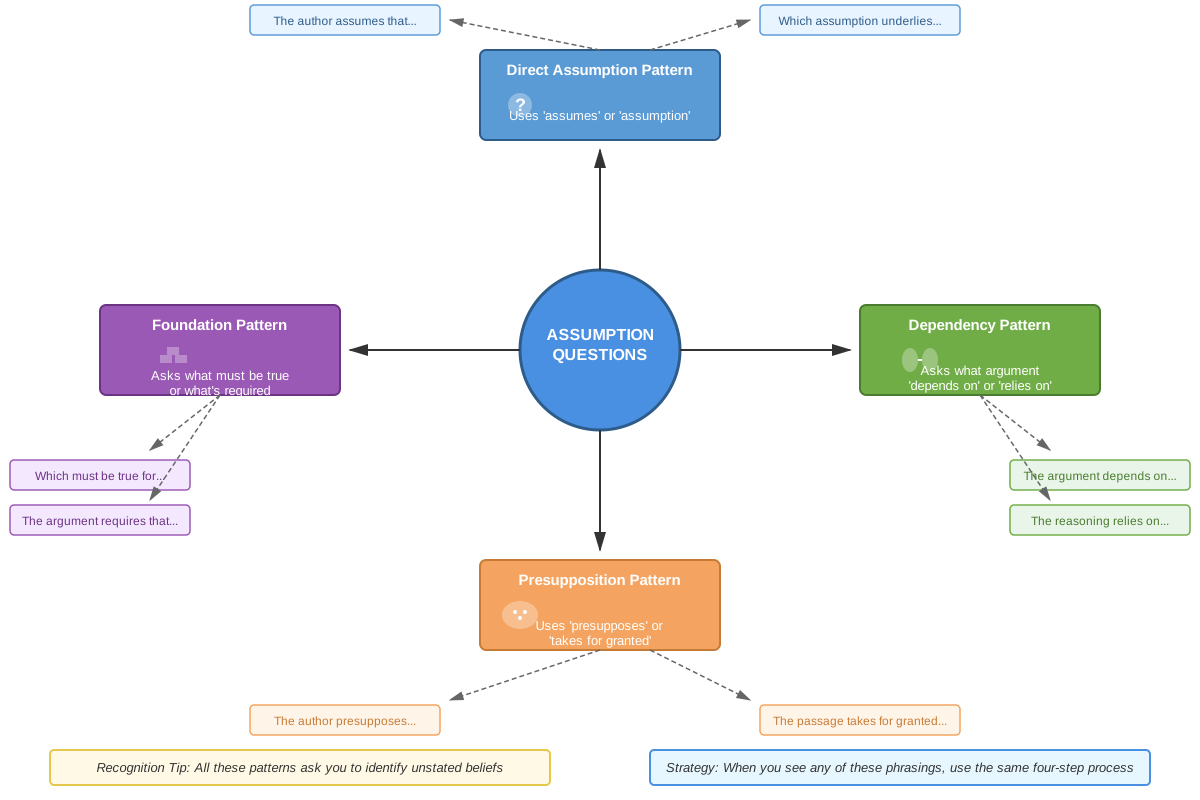
Common question stems that signal assumption identification include: "The author's argument assumes that...," "Which of the following must be true for the author's conclusion to be valid?," "The passage suggests the author believes...," and "The author's reasoning depends on which assumption?" These questions may also appear indirectly through questions about what would strengthen or weaken an argument, since identifying the underlying assumption is necessary to answer such questions correctly.
Core Concepts
What Is an Assumption?
An assumption is an unstated belief, premise, or condition that an author accepts as true without providing explicit evidence or argument. Assumptions function as the invisible connective tissue between stated evidence and conclusions. When an author moves from "Studies show students who eat breakfast perform better on tests" to "Schools should provide free breakfast programs," the assumption might be that cost is the primary barrier preventing students from eating breakfast, or that school-provided meals would be consumed by students who currently skip breakfast.
Assumptions differ from inferences in an important way: while both involve reading between the lines, an inference is something the reader concludes based on textual evidence, whereas an assumption is something the author must believe for their own argument to work. The reader identifies assumptions; the author makes them.
Types of Assumptions
Understanding the different categories of assumptions helps students recognize them more efficiently:
| Assumption Type | Definition | Example |
|---|---|---|
| Causal Assumptions | Beliefs about cause-effect relationships not explicitly proven | Assuming that correlation implies causation; believing one factor causes another without considering alternative explanations |
| Comparative Assumptions | Beliefs about similarities or differences between things being compared | Assuming two groups are similar in all relevant ways except the variable being studied |
| Feasibility Assumptions | Beliefs that something is possible or practical | Assuming a proposed solution can actually be implemented with available resources |
| Value Assumptions | Beliefs about what is important, good, or desirable | Assuming that economic growth is more important than environmental protection |
| Definitional Assumptions | Beliefs about what terms mean or how concepts should be understood | Assuming a particular definition of "success" or "intelligence" without stating it |
The Logical Gap: Evidence to Conclusion
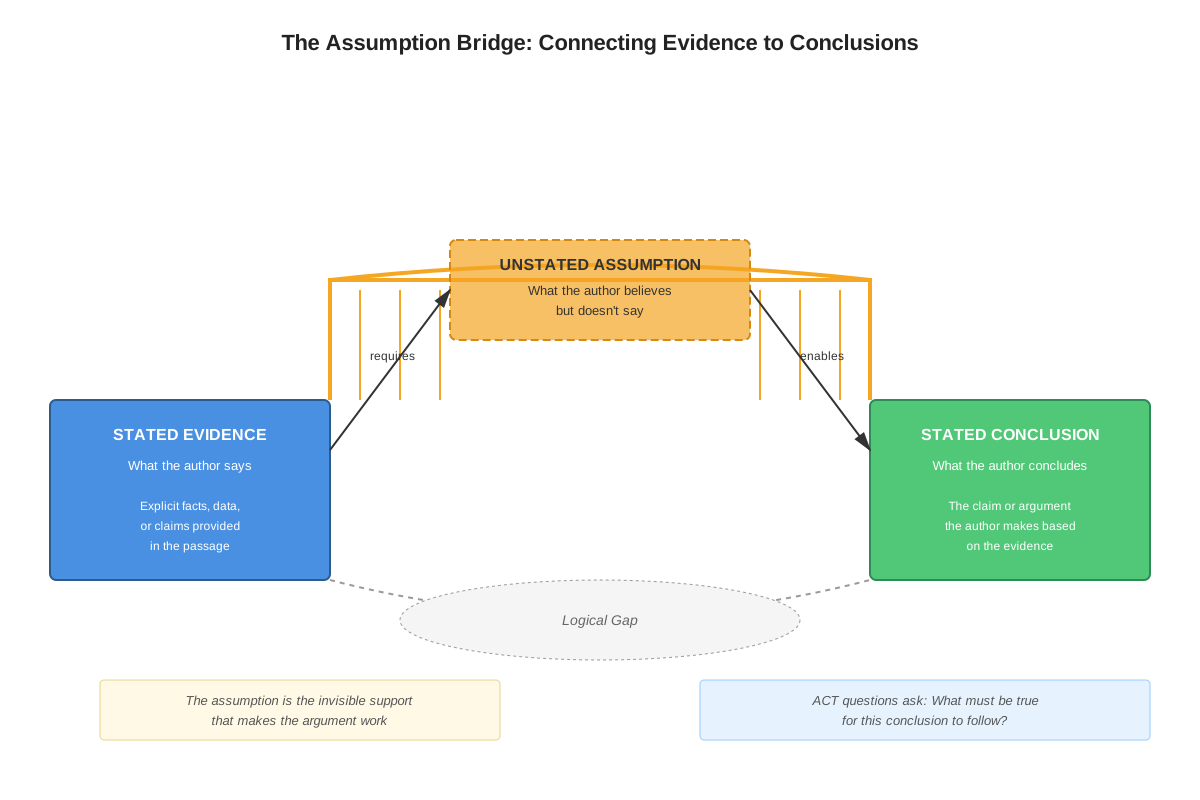
Every assumption fills a logical gap between what is stated and what is concluded. Identifying this gap is the key strategy for finding assumptions. Consider this structure:
Evidence: Company X's profits increased 20% after implementing flexible work schedules.
Conclusion: All companies should implement flexible work schedules to increase profits.
Logical Gap: What must be true to connect this specific example to a universal recommendation?
Assumptions filling the gap:
- Company X is representative of all companies
- The flexible schedule caused the profit increase (not other factors)
- What worked for Company X will work for other companies
- Increased profits are the primary goal for all companies
- There are no significant downsides to flexible schedules
Necessary vs. Sufficient Assumptions
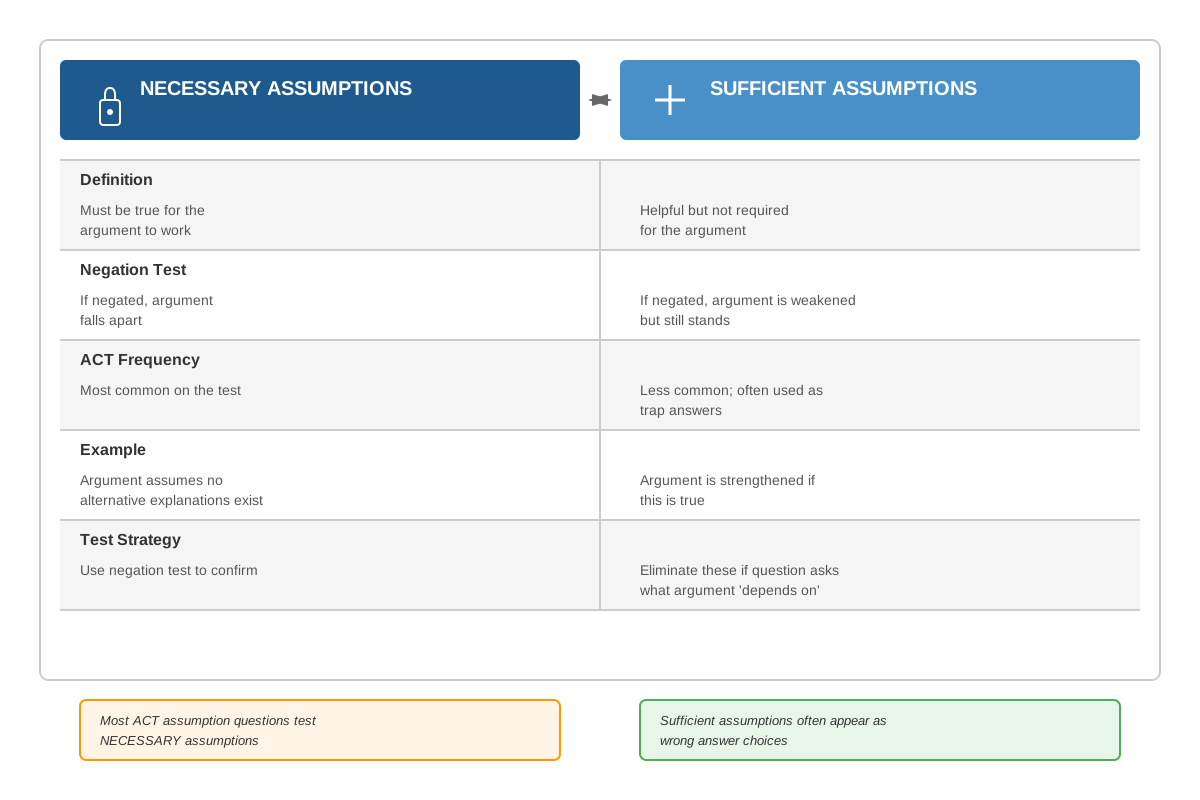
A necessary assumption is one that must be true for the argument to work; if it's false, the argument completely falls apart. A sufficient assumption is one that, if true, would guarantee the conclusion, but the argument might work without it.
For the ACT, focus primarily on necessary assumptions, as these are most commonly tested. To test whether something is a necessary assumption, use the "negation test": if you negate (make false) the assumption and the argument falls apart, it was necessary.
Example argument: "This medication reduced symptoms in clinical trials, so it will help patients."
Potential assumption: "Clinical trial conditions are similar enough to real-world conditions."
Negation test: "Clinical trial conditions are NOT similar to real-world conditions." If this is true, the argument fails—we can't trust that trial results will translate to actual patients. Therefore, this is a necessary assumption.
Recognizing Assumption Questions
The ACT signals assumption questions through specific language patterns:
- "The author assumes that..."
- "The argument depends on which of the following?"
- "Which must be true for the conclusion to be valid?"
- "The author's reasoning presupposes that..."
- "The passage suggests the author believes..."
- "Which of the following is an unstated premise?"
These questions may appear as direct assumption questions or may be embedded in questions about strengthening/weakening arguments, since you must identify the assumption before determining what would affect the argument's strength.
The Bridge Strategy
The most reliable method for identifying assumptions is the bridge strategy: find what connects the evidence to the conclusion. Ask yourself:
- What is the author's conclusion or main claim?
- What evidence does the author provide?
- What must the author believe to be true to make this logical leap?
- What alternative explanations or problems is the author ignoring?
This systematic approach prevents students from selecting answer choices that are merely true statements from the passage rather than actual assumptions.
Concept Relationships
The skill of identifying assumptions builds directly upon inference-making abilities, as both require reading beyond literal text. However, assumptions specifically target the author's unstated beliefs rather than general implications. This skill connects forward to argument evaluation, since recognizing assumptions enables students to assess argument strength—a weak or questionable assumption undermines an entire argument.
The relationship flows as follows: Literal Comprehension → Inference Drawing → Identifying Assumptions → Evaluating Arguments → Synthesizing Multiple Viewpoints
Within the topic itself, understanding the logical gap between evidence and conclusion enables recognition of different assumption types. Causal assumptions often appear when authors discuss research or policy, while value assumptions frequently emerge in passages about social issues or humanities topics. The bridge strategy serves as the unifying method that works across all assumption types.
Identifying assumptions also connects to understanding author's purpose and tone. An author's underlying assumptions often reveal their biases, values, and perspective on a topic. For example, an author who assumes economic considerations outweigh environmental ones reveals their priorities even without stating them directly.
Quick check — test yourself on Identifying assumptions so far.
Try Flashcards →High-Yield Facts
⭐ An assumption is an unstated belief that must be true for an argument to be valid; it bridges the gap between evidence and conclusion.
⭐ To identify assumptions, ask: "What must the author believe for this conclusion to follow from this evidence?"
⭐ The negation test helps verify necessary assumptions: if negating the statement destroys the argument, it's a necessary assumption.
⭐ Assumptions are NOT stated in the passage; if it's explicitly mentioned, it's not an assumption.
⭐ Causal assumptions are the most common type on the ACT, often appearing when authors discuss research findings or policy recommendations.
- Comparative assumptions appear when authors draw parallels between different situations, time periods, or groups without proving they're actually comparable.
- Value assumptions underlie arguments about what should be done, revealing what the author considers important or desirable.
- The correct answer to an assumption question often feels obvious once identified—it's something the author "must" believe but didn't bother to state.
- Wrong answer choices often include statements that are true according to the passage but aren't assumptions, or statements that go beyond what the author needs to assume.
- Feasibility assumptions are common in passages proposing solutions or changes, where authors assume their proposals are actually implementable.
- Authors often assume that correlation implies causation, that samples are representative, or that past patterns will continue into the future.
- Definitional assumptions can be subtle—authors may use terms like "success," "progress," or "improvement" while assuming a particular definition.
Common Misconceptions
Misconception: Any unstated information is an assumption. → Correction: Assumptions are specifically unstated beliefs that the author's argument depends upon. Many things are unstated but irrelevant to the argument's logic. An assumption must be necessary for the reasoning to work.
Misconception: If a statement is true according to the passage, it can be an assumption. → Correction: Assumptions are never explicitly stated in the passage. If you can point to a sentence that says it, it's not an assumption—it's stated evidence or a premise. Assumptions exist in the logical gaps between what is said.
Misconception: The most complex or sophisticated-sounding answer choice is usually the assumption. → Correction: Correct assumptions often seem simple or obvious once identified. The ACT includes complex-sounding wrong answers to trap students who overthink. The right answer directly addresses the logical gap in the argument.
Misconception: Assumptions are the same as inferences. → Correction: While both involve unstated information, inferences are conclusions readers draw from evidence, while assumptions are beliefs the author holds. When identifying assumptions, focus on what the author must believe, not what you as a reader can conclude.
Misconception: Every argument has only one assumption. → Correction: Most arguments rest on multiple assumptions. However, ACT questions will ask about one specific assumption at a time. The correct answer will be the assumption most directly relevant to the specific logical gap the question targets.
Worked Examples
Example 1: Natural Sciences Passage
Passage excerpt: "A recent study found that students who took notes by hand scored higher on conceptual questions than students who typed notes on laptops. Schools should therefore ban laptops from classrooms to improve learning outcomes."
Question: The author's argument assumes which of the following?
A) Hand-written notes are always more detailed than typed notes.
B) The study's participants are representative of all students.
C) Laptops have no educational benefits in classroom settings.
D) Conceptual understanding is the only important learning outcome.
Solution Process:
Step 1: Identify the conclusion: Schools should ban laptops from classrooms.
Step 2: Identify the evidence: One study showed hand-note-takers scored higher on conceptual questions.
Step 3: Find the logical gap: The author jumps from one study's results to a universal policy recommendation. What must be true for this leap to make sense?
Step 4: Apply the negation test to each answer:
- A) Negation: "Hand-written notes are NOT always more detailed." The argument doesn't require this—it's about test scores, not note detail. The argument still works. NOT necessary.
- B) Negation: "The study's participants are NOT representative of all students." If true, we can't generalize from this study to all schools. The argument falls apart. This IS necessary.
- C) Negation: "Laptops DO have educational benefits." Even if true, the author could still argue the benefits of hand-writing outweigh them. The argument doesn't completely fail. NOT necessary.
- D) Negation: "Conceptual understanding is NOT the only important outcome." The argument could still work if conceptual understanding is just one important outcome. NOT necessary.
Answer: B
The author must assume the study participants represent all students; otherwise, the recommendation to ban laptops in all schools doesn't follow from the evidence. This is a comparative assumption—the author assumes the study group is comparable to all students.
Example 2: Social Studies Passage
Passage excerpt: "Archaeological evidence shows that the ancient Minoan civilization on Crete declined rapidly around 1450 BCE, coinciding with a massive volcanic eruption on the nearby island of Thera. The eruption must have caused the civilization's collapse."
Question: The argument depends on which assumption?
A) The Minoans had no warning of the volcanic eruption.
B) No other significant factors contributed to the Minoan decline during this period.
C) Volcanic eruptions always destroy nearby civilizations.
D) The Minoans were unable to rebuild after natural disasters.
Solution Process:
Step 1: Identify the conclusion: The volcanic eruption caused the Minoan collapse.
Step 2: Identify the evidence: The decline and eruption happened at the same time.
Step 3: Find the logical gap: The author moves from correlation (two things happening together) to causation (one caused the other). What must be true for this causal claim to work?
Step 4: Evaluate each answer:
- A) Whether they had warning doesn't affect whether the eruption caused the collapse. The eruption could have caused the collapse either way. NOT necessary.
- B) Negation: "Other significant factors DID contribute to the decline." If true, we can't conclude the eruption "must have" caused the collapse—it might have been these other factors, or a combination. The argument fails. This IS necessary.
- C) This is too extreme ("always"). The author only needs to assume this eruption caused this collapse, not that all eruptions destroy all nearby civilizations. NOT necessary.
- D) The argument is about what caused the initial collapse, not about rebuilding afterward. NOT necessary.
Answer: B
This is a causal assumption. The author assumes no alternative explanations exist for the decline. When arguing that X caused Y based on correlation, authors must assume other potential causes aren't responsible. This is one of the most common assumption patterns on the ACT.
Exam Strategy
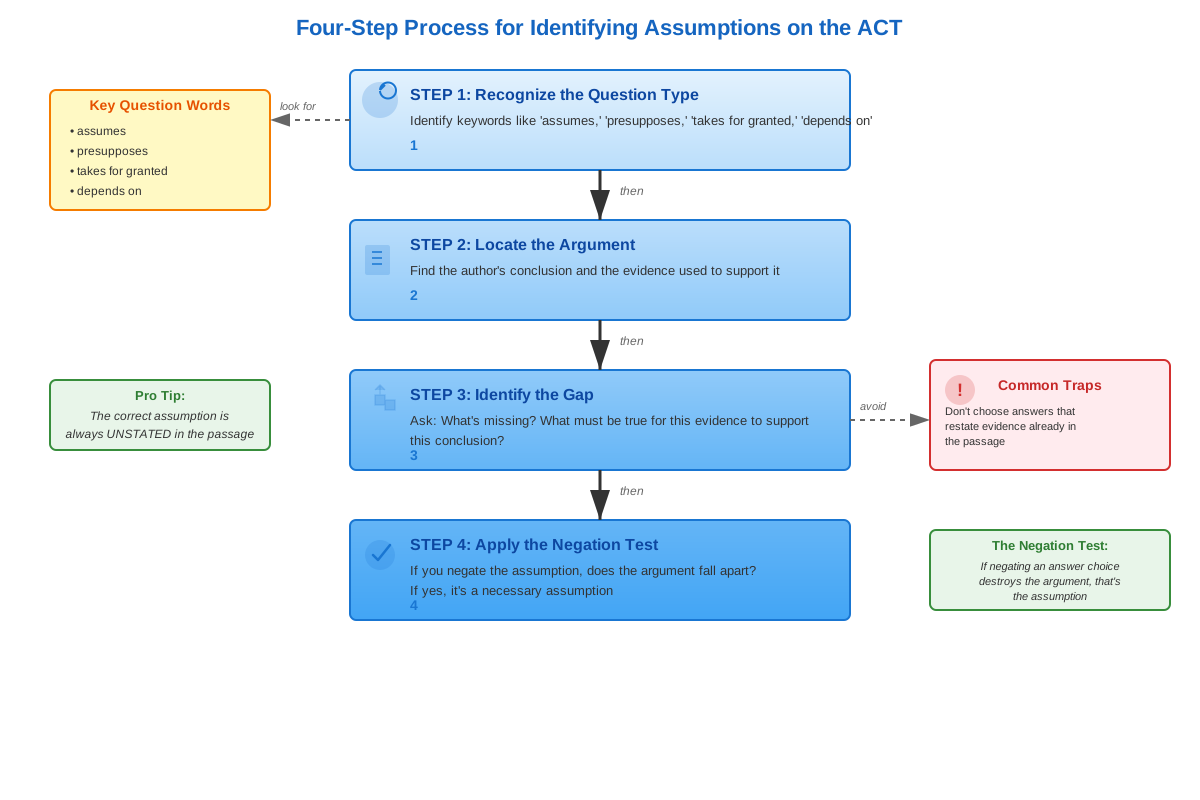
When approaching assumption questions on the ACT, follow this systematic process:
Step 1: Identify the question type by looking for trigger words like "assumes," "depends on," "presupposes," or "must be true for the conclusion to be valid."
Step 2: Find the conclusion in the relevant passage section. Ask yourself: "What is the author trying to prove or convince me of?"
Step 3: Identify the evidence the author provides to support that conclusion.
Step 4: Articulate the logical gap in your own words before looking at answer choices. Ask: "What's missing? What must be true to connect this evidence to this conclusion?"
Step 5: Predict the assumption if possible. Even a general prediction ("The author assumes these two things are comparable" or "The author assumes no other factors are involved") helps you evaluate answers.
Step 6: Use the negation test on promising answer choices. If negating the statement destroys the argument, you've found a necessary assumption.
Step 7: Eliminate wrong answer types:
- Statements explicitly mentioned in the passage (not assumptions)
- Statements that are too extreme or go beyond what's necessary
- Statements that are irrelevant to the specific logical gap
- Statements that might strengthen the argument but aren't necessary for it
Time-Saving Tip: Assumption questions typically take 45-60 seconds. If you're spending more than 75 seconds, make your best guess and move on. These questions reward systematic thinking, not extended deliberation.
Trigger words to watch for in passages that signal assumptions may be tested:
- "Therefore," "thus," "consequently" (indicating conclusions)
- "Must," "should," "ought to" (indicating recommendations based on assumptions)
- "Because," "since," "due to" (indicating causal claims that may rest on assumptions)
- Comparative language: "similarly," "likewise," "just as" (indicating comparative assumptions)
Memory Techniques
BRIDGE Acronym for identifying assumptions:
- Belief that's unstated
- Required for the argument to work
- Invisible in the text (not explicitly mentioned)
- Dependent on by the conclusion
- Gap-filler between evidence and conclusion
- Exposed by the negation test
The "Must Be True" Mantra: When evaluating answer choices, repeatedly ask yourself: "Must the author believe this for the argument to work?" This keeps you focused on necessary assumptions rather than merely true statements or sufficient assumptions.
Visualization Strategy: Picture the argument as a bridge. The evidence is one side, the conclusion is the other side, and the assumption is the invisible support beam underneath. If you remove the beam (negate the assumption), the bridge collapses (the argument fails).
The Three C's of common assumptions:
- Causation: Author assumes correlation means causation
- Comparison: Author assumes things being compared are actually comparable
- Continuation: Author assumes past/present patterns will continue
Summary
Identifying assumptions is a high-level analytical skill that requires students to recognize the unstated beliefs underlying an author's argument. An assumption is not explicitly stated in the passage but must be true for the author's reasoning to be valid. The key strategy involves identifying the logical gap between stated evidence and the conclusion, then determining what the author must believe to bridge that gap. The negation test—checking whether negating a statement destroys the argument—helps verify necessary assumptions. Common assumption types include causal assumptions (believing one thing causes another without proof), comparative assumptions (believing things are similar enough to compare), and value assumptions (believing certain outcomes or priorities matter most). On the ACT, assumption questions appear frequently in Natural Sciences and Social Studies passages, often involving research findings, policy recommendations, or historical interpretations. Success requires distinguishing between stated information and unstated beliefs, avoiding answer choices that are merely true but not necessary, and systematically analyzing the logical structure of arguments.
Key Takeaways
- Assumptions are unstated beliefs that must be true for an author's argument to be valid; they bridge the gap between evidence and conclusions
- Use the bridge strategy: identify the conclusion, identify the evidence, find what must be true to connect them
- The negation test verifies necessary assumptions: if negating the statement destroys the argument, it's a necessary assumption
- Assumptions are never explicitly stated in the passage; if you can quote it, it's not an assumption
- Causal assumptions (assuming correlation means causation) are the most frequently tested type on the ACT
- Wrong answers often include true statements from the passage that aren't assumptions, or statements too extreme to be necessary
- Assumption questions reward systematic analysis over intuition; follow the step-by-step process rather than relying on "feel"
Related Topics
Evaluating Arguments and Evidence: Once students can identify assumptions, the next step is evaluating whether those assumptions are reasonable and whether they strengthen or weaken the overall argument. This skill builds directly on assumption identification.
Author's Purpose and Perspective: Understanding why an author writes and their viewpoint helps predict what assumptions they're likely to make. Authors with different purposes make different assumptions.
Logical Reasoning and Fallacies: Many logical fallacies involve faulty assumptions. Understanding common reasoning errors helps students recognize problematic assumptions more quickly.
Synthesis of Multiple Texts: When comparing passages, identifying each author's assumptions helps explain why they reach different conclusions from similar evidence.
Rhetorical Strategies: Authors sometimes deliberately hide assumptions to make arguments seem stronger than they are. Recognizing rhetorical techniques helps identify these hidden premises.
Practice CTA
Now that you understand the strategies for identifying assumptions, it's time to apply these skills to ACT-style practice questions. The concepts you've learned—the bridge strategy, the negation test, and recognizing common assumption types—will become automatic only through deliberate practice. Challenge yourself with the practice questions and flashcards to reinforce your mastery. Remember: assumption questions often separate good scores from great scores because they test sophisticated analytical thinking. Your ability to systematically identify unstated beliefs gives you a significant competitive advantage. Start practicing now to build the confidence and speed you need for test day success!
Sign up free to keep reading
Create a free AnvayaPrep account to finish this ACT guide on Identifying assumptions — plus flashcards and practice questions.