Overview
The central claim in natural science is one of the most frequently tested concepts in the ACT Reading section, particularly within passages drawn from natural science disciplines such as biology, chemistry, physics, astronomy, and earth sciences. Understanding how to identify and analyze the central claim is fundamental to answering questions about main ideas, author's purpose, and passage structure. On the ACT, natural science passages typically present research findings, scientific theories, or explanations of natural phenomena, and the central claim represents the primary argument, thesis, or conclusion that the author seeks to convey.
Mastering the identification of central claims in natural science passages is essential because approximately 25% of the ACT Reading section consists of natural science content, and questions about main ideas and central arguments appear in nearly every passage. Unlike literary passages that may explore themes through narrative, natural science passages are typically expository and argumentative, presenting evidence to support specific scientific conclusions. The central claim serves as the organizing principle around which all supporting details, examples, and evidence revolve.
This topic connects directly to broader reading comprehension skills tested on the ACT, including distinguishing between main ideas and supporting details, understanding text structure, and recognizing how authors develop arguments through evidence. The ability to quickly identify the ACT central claim in natural science passages enables students to answer not only direct main idea questions but also inference questions, detail questions, and questions about the function of specific paragraphs or examples within the passage's overall argument.
Learning Objectives
- [ ] Identify when Central claim in natural science is being tested
- [ ] Explain the core rule or strategy behind Central claim in natural science
- [ ] Apply Central claim in natural science to ACT-style questions accurately
- [ ] Distinguish between the central claim and supporting evidence in natural science passages
- [ ] Recognize common locations where central claims appear in passage structure
- [ ] Evaluate answer choices to eliminate options that are too broad, too narrow, or off-topic
- [ ] Synthesize information from multiple paragraphs to construct the complete central claim
Prerequisites
- Basic reading comprehension skills: Understanding literal meaning of sentences and paragraphs is necessary before identifying overarching claims
- Familiarity with expository text structure: Natural science passages follow organizational patterns (cause-effect, problem-solution, chronological) that frame central claims
- Ability to distinguish main ideas from details: Recognizing the difference between general statements and specific examples is foundational to claim identification
- Understanding of scientific vocabulary in context: While technical terms will be explained in passages, comfort with scientific language aids comprehension speed
Why This Topic Matters
In real-world contexts, the ability to identify central claims in scientific writing is crucial for evaluating research articles, understanding health information, making informed decisions about technology and environmental issues, and participating in science-based public discourse. Scientists, medical professionals, policymakers, and informed citizens must regularly extract main arguments from complex scientific texts to apply findings appropriately.
On the ACT Reading section, questions about central claims appear with high frequency—typically 1-3 questions per natural science passage, which translates to approximately 3-6 questions across the entire exam. These questions may be phrased as "The main point of the passage is...", "The author's primary purpose is to...", "Which of the following best describes the central claim...", or "The passage is best described as...". Additionally, understanding the central claim is prerequisite to answering many other question types, as it provides the framework for interpreting details, examples, and the author's reasoning.
Natural science passages on the ACT commonly present central claims in several formats: introducing a new scientific discovery or theory, explaining a natural phenomenon, comparing competing scientific explanations, describing the results of research studies, or arguing for a particular interpretation of scientific evidence. The central claim may be explicitly stated in a thesis sentence, or it may need to be inferred by synthesizing information across multiple paragraphs. Recognizing these patterns enables efficient passage navigation and accurate question answering.
Core Concepts
Definition of Central Claim in Natural Science
The central claim in natural science is the primary argument, thesis, or conclusion that organizes and unifies a scientific passage. It represents what the author most wants readers to understand or accept about the scientific topic being discussed. Unlike a topic (which is simply the subject matter), the central claim makes an assertion about that topic—it presents a position, explains a relationship, or draws a conclusion based on evidence.
In natural science contexts, central claims typically take several forms:
- Explanatory claims: Explaining how or why a natural phenomenon occurs
- Discovery claims: Announcing new findings or observations
- Theoretical claims: Proposing or supporting a scientific theory or model
- Comparative claims: Evaluating different explanations or approaches
- Causal claims: Establishing cause-and-effect relationships in nature
Characteristics of Strong Central Claims
Effective central claims in natural science passages share several key characteristics that distinguish them from supporting details:
| Characteristic | Description | Example |
|---|---|---|
| Scope | Broad enough to encompass the entire passage but specific enough to be meaningful | "Epigenetic modifications can alter gene expression without changing DNA sequence" (appropriate scope) vs. "Biology is interesting" (too broad) |
| Arguability | Makes an assertion that requires evidence, not just a fact | "The asteroid impact theory best explains the Cretaceous extinction" (arguable) vs. "Dinosaurs went extinct 65 million years ago" (fact) |
| Centrality | All major sections of the passage relate back to this claim | The claim connects to each paragraph's main point |
| Specificity | Identifies the particular scientific concept, relationship, or conclusion | Names specific phenomena, mechanisms, or theories |
Common Locations of Central Claims
Understanding where central claims typically appear in natural science passages significantly improves identification speed and accuracy:
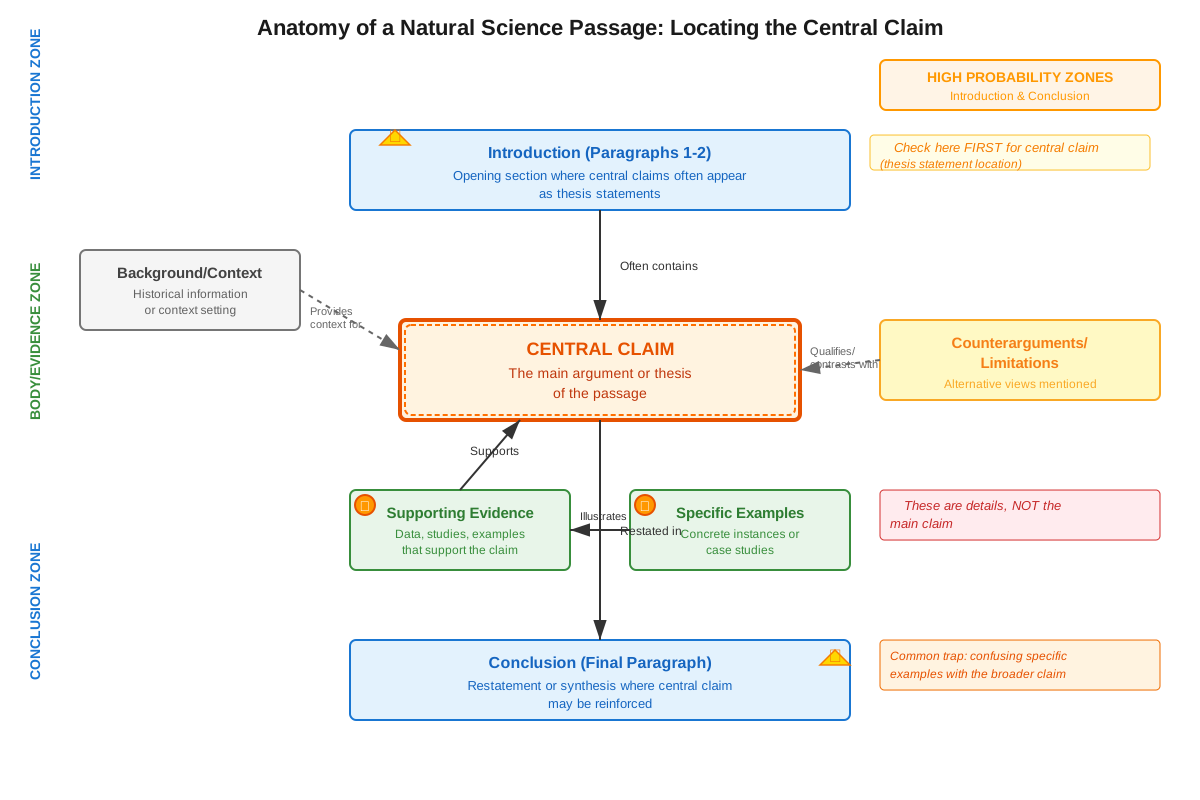
- Opening paragraph (most common): Approximately 60-70% of ACT natural science passages state or strongly hint at the central claim in the first paragraph, often in the last sentence after providing context
- Second paragraph: When the first paragraph provides extensive background or historical context, the central claim often appears early in the second paragraph
- Concluding paragraph: Some passages build toward the central claim, stating it explicitly only after presenting evidence
- Distributed throughout: Occasionally, the complete central claim must be synthesized from thesis statements in multiple paragraphs, particularly in longer or more complex passages
Distinguishing Central Claims from Supporting Elements
A critical skill for ACT success is differentiating the central claim from other passage elements:
Supporting details provide evidence for the central claim through specific examples, data, experimental results, or observations. These are narrower in scope and serve to prove or illustrate the main argument.
Background information establishes context, defines terms, or provides historical perspective but does not constitute the main argument itself.
Counterarguments or alternative theories may be mentioned to be refuted or compared against the central claim, but they are not the author's primary position.
Implications or applications discuss consequences or uses of the central claim but are distinct from the claim itself.
The Relationship Between Central Claims and Passage Structure
Natural science passages on the ACT typically follow predictable organizational patterns that support the central claim:
- Problem-Solution structure: Presents a scientific question or puzzle (problem), then explains the answer or theory (solution/central claim)
- Cause-Effect structure: Establishes causal relationships, with the central claim often being the explanation of why certain effects occur
- Compare-Contrast structure: Evaluates multiple theories or approaches, with the central claim often favoring one explanation
- Chronological/Process structure: Describes sequences of events or steps, with the central claim explaining the significance of the process
Recognizing these structures helps predict where the central claim will appear and how it will be developed.
Synthesis and Inference in Central Claim Identification
Not all central claims are explicitly stated in a single sentence. The ACT frequently requires students to synthesize information across paragraphs to construct the complete central claim. This involves:
- Identifying the main point of each paragraph
- Recognizing the common thread connecting these points
- Formulating a statement that captures this unifying argument
- Verifying that this synthesized claim accounts for all major passage content
This synthesis skill is particularly important for passages that present multiple aspects of a scientific phenomenon or that build arguments progressively through accumulated evidence.
Concept Relationships
The central claim serves as the organizational hub of natural science passages, with all other elements radiating from and supporting this core argument. Supporting details → provide evidence for → Central Claim ← is contextualized by ← Background information. The central claim also determines the passage structure, as authors organize paragraphs to build toward, elaborate on, or provide evidence for their main argument.
Understanding central claims connects directly to prerequisite skills: Basic reading comprehension → enables → Identifying main ideas → which develops into → Recognizing central claims. Similarly, Understanding text structure → reveals → Where central claims typically appear → which accelerates → Efficient claim identification.
The relationship between central claims and other ACT Reading concepts is hierarchical: Central Claim (most general) → Paragraph main ideas (intermediate) → Supporting details (most specific). Questions about author's purpose, passage organization, and the function of specific paragraphs all depend on first understanding the central claim, making this concept foundational to success on multiple question types.
Within natural science passages specifically, the central claim often represents the conclusion drawn from scientific evidence (data, observations, experiments), creating a logical flow: Evidence → supports → Interpretation → which forms → Central Claim. Understanding this relationship helps students evaluate whether answer choices accurately represent the passage's main argument or merely restate supporting evidence.
High-Yield Facts
⭐ The central claim is most commonly located in the final sentence of the first paragraph or the opening sentence of the second paragraph in ACT natural science passages
⭐ The central claim must be broad enough to encompass all major paragraphs but specific enough to distinguish the passage from other texts on similar topics
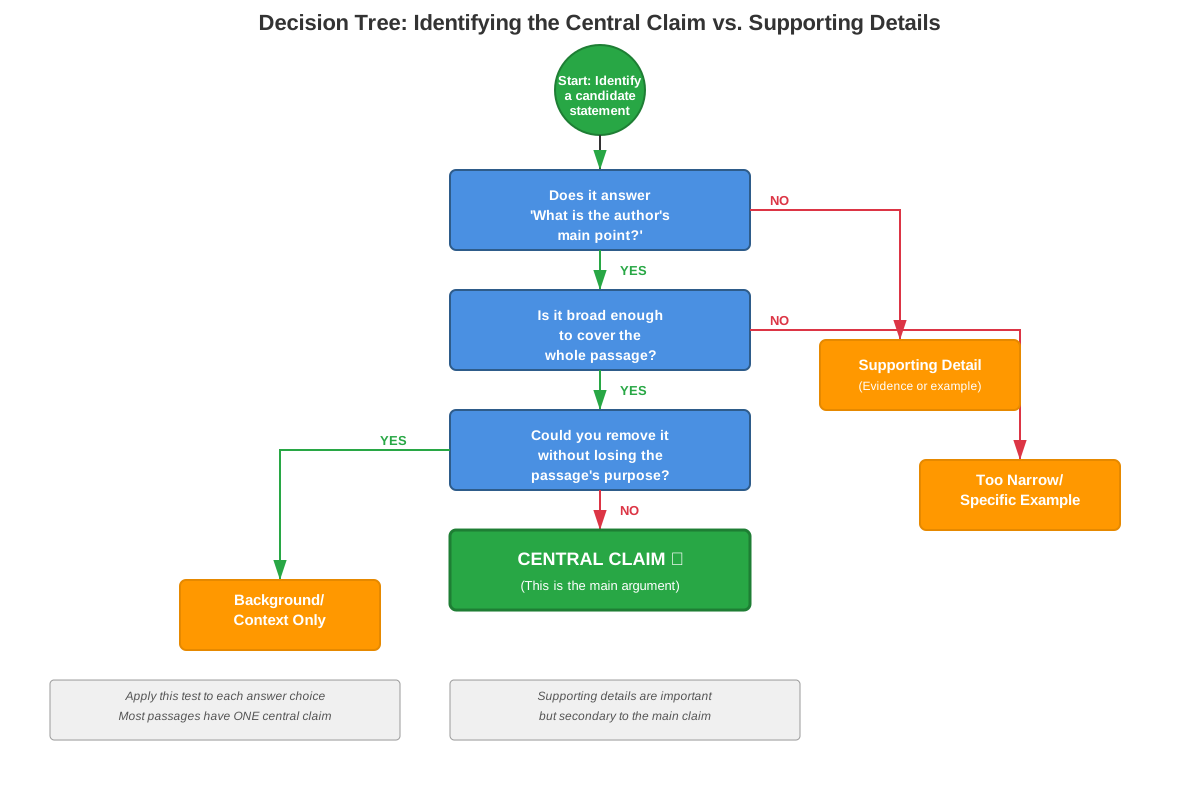
⭐ Supporting details provide evidence FOR the central claim; they are narrower in scope and more specific than the claim itself
⭐ Questions asking about "main point," "primary purpose," "best description," or "central claim" are all testing the same concept
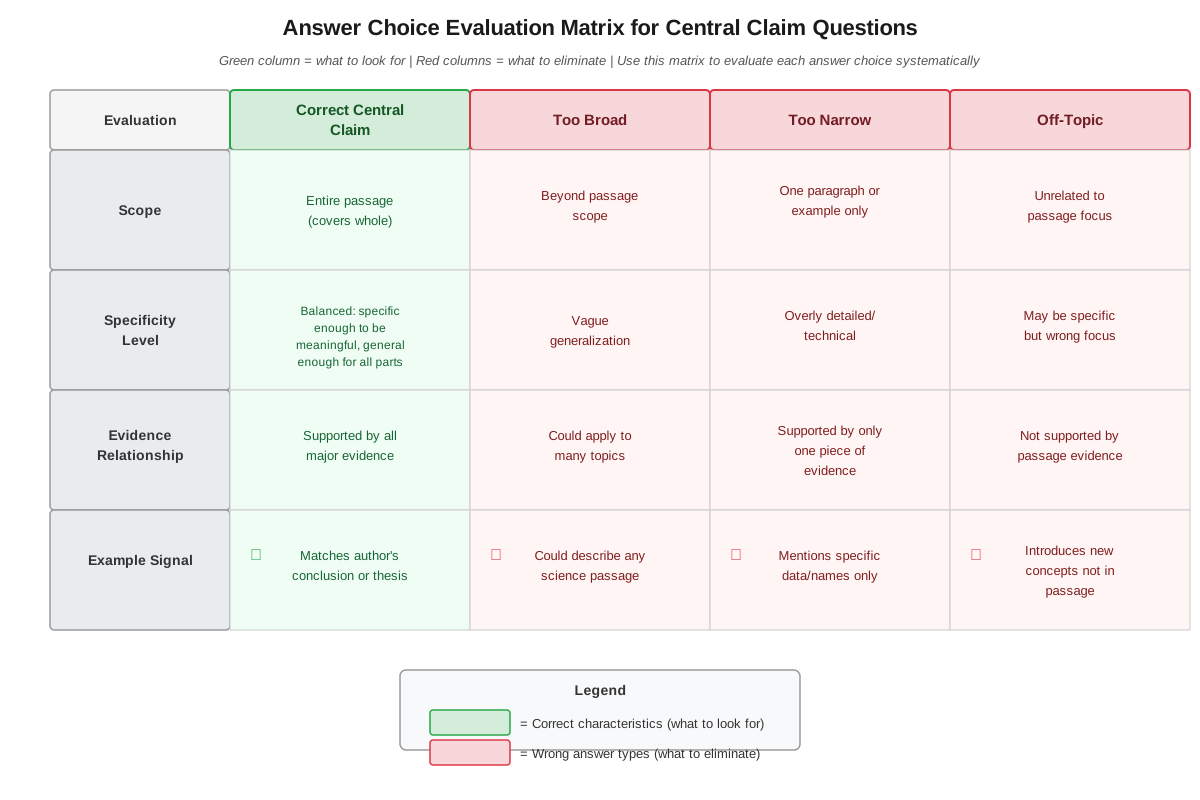
⭐ Incorrect answer choices for central claim questions are typically too broad (could apply to many passages), too narrow (only cover one paragraph), or off-topic (mention details not central to the argument)
- The central claim in natural science passages typically makes an assertion about how or why something occurs, not just what happens
- Authors may state the central claim explicitly using phrases like "This paper argues," "The evidence suggests," "The primary explanation is," or "Research demonstrates"
- When the central claim is not explicitly stated, it can be constructed by identifying what each paragraph contributes to the overall argument
- The title or opening sentence often indicates the topic, but the central claim goes beyond the topic to make an argument about it
- Effective test-takers read the first and last paragraphs carefully, as these most frequently contain or summarize the central claim
- Central claims in comparative passages often take the form "Theory X better explains phenomenon Y than Theory Z"
- Questions about passage organization, author's purpose, and paragraph function all require understanding the central claim first
Quick check — test yourself on Central claim in natural science so far.
Try Flashcards →Common Misconceptions
Misconception: The central claim is always explicitly stated in a single sentence. → Correction: While central claims are often stated explicitly, particularly in opening or closing paragraphs, the ACT frequently requires students to synthesize the central claim from information distributed across multiple paragraphs. The complete argument may need to be inferred by combining the main point of several sections.
Misconception: The topic and the central claim are the same thing. → Correction: The topic is simply the subject matter (e.g., "photosynthesis" or "black holes"), while the central claim makes an argument or assertion about that topic (e.g., "Recent discoveries about photosynthesis efficiency could revolutionize solar panel design" or "Supermassive black holes play a crucial role in galaxy formation"). The central claim always includes the topic but adds a specific position or conclusion.
Misconception: The longest or most detailed paragraph contains the central claim. → Correction: Paragraph length does not indicate importance. Longer paragraphs often provide supporting evidence, examples, or background information, while the central claim may be stated concisely in a shorter paragraph. Focus on the content and function of each paragraph rather than its length.
Misconception: If a statement appears early in the passage, it must be the central claim. → Correction: While central claims often appear in opening paragraphs, early sentences may provide background, define terms, or present questions that the passage will answer. The central claim is the answer or argument, not the setup. Always read through at least the first two paragraphs before identifying the central claim.
Misconception: The central claim is whatever the author spends the most time discussing. → Correction: Authors may devote substantial space to providing evidence, explaining background, or describing methodology, but these supporting elements are not the central claim. The claim is the conclusion drawn from or argument supported by these details, which may be stated relatively briefly.
Misconception: All answer choices that are true statements could be the central claim. → Correction: Many true statements from the passage are supporting details, not the central claim. The correct answer must be the overarching argument that unifies the entire passage, not just an accurate detail from one section.
Worked Examples
Example 1: Explicit Central Claim
Passage excerpt: "For decades, scientists believed that the human brain stopped producing new neurons after childhood. However, recent research using advanced imaging techniques has revolutionized this understanding. Studies conducted at the Salk Institute demonstrate that neurogenesis—the formation of new neurons—continues throughout adult life in specific brain regions, particularly the hippocampus. This discovery has profound implications for treating neurodegenerative diseases and understanding learning and memory. The evidence from multiple independent laboratories now strongly supports the conclusion that adult neurogenesis is not only possible but plays a crucial role in cognitive function and emotional regulation."
Question: Which of the following best states the central claim of the passage?
A) The hippocampus is located in the brain.
B) Scientists at the Salk Institute use advanced imaging techniques.
C) Contrary to previous belief, the adult human brain continues to produce new neurons, which is important for cognitive function.
D) Neurodegenerative diseases affect many people.
Solution Process:
- Identify the topic: Adult neurogenesis (formation of new neurons)
- Look for thesis indicators: The phrase "This discovery has profound implications" and "The evidence now strongly supports the conclusion" signal that the author is building toward a central claim
- Determine what argument is being made: The passage argues that adult neurogenesis occurs (contradicting old beliefs) and is functionally important
- Evaluate each answer choice:
- Choice A: True but too narrow—this is a supporting detail about where neurogenesis occurs, not the main argument
- Choice B: True but too narrow—this describes methodology, not the central claim
- Choice C: Correct—captures both the discovery (adult neurogenesis occurs) and its significance (important for cognitive function), encompasses the entire passage
- Choice D: True but off-topic—mentioned as an implication but not the central claim
- Verify: Choice C is broad enough to cover all major points (the discovery, the evidence, the implications) while remaining specific to this passage's argument
Connection to learning objectives: This example demonstrates how to identify when central claim is being tested (question asks "best states the central claim"), apply the core strategy (locate thesis indicators, evaluate scope), and accurately select the answer that captures the complete argument.
Example 2: Synthesized Central Claim
Passage excerpt: "Paragraph 1: The Cambrian Explosion, occurring approximately 541 million years ago, represents one of the most significant events in evolutionary history. During a relatively brief period of 20-25 million years, most major animal phyla appeared in the fossil record.
Paragraph 2: Several theories have been proposed to explain this rapid diversification. Some scientists point to rising oxygen levels in Earth's oceans, which would have enabled more complex metabolic processes. Others emphasize the evolution of predation, which created selective pressure for defensive adaptations.
Paragraph 3: Recent genetic studies, however, suggest that the apparent 'explosion' may be partly an artifact of preservation. Many animal lineages likely evolved earlier but lacked hard body parts that fossilize readily. The Cambrian period may represent not the origin of these groups but rather the point at which they developed mineralized skeletons.
Paragraph 4: Nevertheless, even accounting for preservation bias, the Cambrian period clearly witnessed unprecedented evolutionary innovation. The combination of environmental changes and genetic developments created conditions uniquely favorable for diversification."
Question: The passage's central claim is best described as:
A) The Cambrian Explosion occurred 541 million years ago.
B) Multiple factors, including environmental conditions and genetic evolution, contributed to the rapid diversification during the Cambrian period, though preservation bias may affect our interpretation.
C) Oxygen levels rose during the Cambrian period.
D) Genetic studies are more reliable than fossil evidence.
Solution Process:
- Recognize that no single sentence states the complete claim: Each paragraph contributes a piece of the argument
- Identify each paragraph's main point:
- Paragraph 1: Introduces the Cambrian Explosion as significant
- Paragraph 2: Multiple theories explain it (environmental factors)
- Paragraph 3: Preservation bias may affect interpretation
- Paragraph 4: Despite bias, real innovation occurred due to multiple factors
- Synthesize the overall argument: The passage argues that the Cambrian diversification was real and resulted from multiple causes, but our understanding is complicated by preservation issues
- Evaluate answer choices:
- Choice A: True but merely states a fact, not an argument—too narrow
- Choice B: Correct—synthesizes the multi-causal explanation (paragraph 2, 4) with the preservation caveat (paragraph 3)
- Choice C: Supporting detail from paragraph 2, not the central claim
- Choice D: Misrepresents the passage—genetic studies complement rather than replace fossil evidence
- Verify scope: Choice B accounts for all four paragraphs and captures the nuanced argument
Connection to learning objectives: This example shows how to synthesize information from multiple paragraphs to construct the central claim when it's not explicitly stated, demonstrating advanced application of the core strategy.
Exam Strategy
Approaching Central Claim Questions
When encountering questions about the central claim in natural science passages, follow this systematic approach:
- Read strategically: Focus intensely on the first paragraph, last paragraph, and the first sentence of each body paragraph—these locations contain central claims most frequently
- Identify thesis indicators: Watch for phrases like "This suggests," "The evidence demonstrates," "The primary explanation," "Research shows," "The main finding," or "This indicates"
- Before looking at answer choices, formulate your own one-sentence summary of the passage's main argument—this prevents answer choices from misleading you
- Apply the scope test: The correct answer must be broad enough to encompass all major paragraphs but specific enough to distinguish this passage from others on similar topics
Trigger Words and Phrases
Questions testing central claim identification use predictable language:
- "The main point of the passage is..."
- "The author's primary purpose is to..."
- "Which of the following best describes the passage?"
- "The central claim of the passage is..."
- "The passage is best characterized as..."
- "The passage primarily serves to..."
Exam Tip: Any question asking about "main," "primary," "central," or "best describes the passage" is testing central claim identification, even if it doesn't use that exact terminology.
Process of Elimination Strategy
Systematically eliminate answer choices using these criteria:
Too Broad: Could apply to many passages on the general topic
- Example: "Biology is complex" (could describe thousands of passages)
Too Narrow: Only covers one paragraph or supporting detail
- Example: An answer that mentions only a specific example from paragraph 3
Off-Topic: Mentions concepts not central to the passage's argument
- Example: Focuses on a brief aside or tangential point
Contradicts the Passage: States the opposite of what the author argues
- Example: Claims the author rejects a theory the passage actually supports
Confuses Supporting Evidence with Claim: Restates data or examples rather than the conclusion drawn from them
- Example: "The experiment measured oxygen levels" instead of "Rising oxygen levels enabled complex life"
Time Allocation
- Spend 30-45 seconds identifying the central claim while reading the passage initially
- Allocate 20-30 seconds per central claim question
- If uncertain, mark the question and return after answering detail questions, which may clarify the overall argument
Exam Tip: Understanding the central claim makes other questions easier. If you're struggling with multiple questions on a passage, return to the central claim and verify your understanding before proceeding.
Memory Techniques
The SCOPE Acronym
Use SCOPE to evaluate whether an answer choice correctly identifies the central claim:
- Specific enough to distinguish this passage from others
- Covers all major paragraphs, not just one section
- Overall argument, not just supporting evidence
- Position or conclusion, not just the topic
- Encompasses the author's main point
The "Elevator Pitch" Visualization
Imagine you have 15 seconds to explain what the passage argues to someone who hasn't read it. What would you say? This mental exercise forces you to identify the essential argument, filtering out supporting details. The central claim is what you'd say in that elevator pitch.
Location Memory: "First, Last, Fast"
Remember that central claims appear most frequently:
- First paragraph (especially last sentence)
- Last paragraph (especially first sentence)
- Fast into the second paragraph (if first paragraph is background)
The "Umbrella Test"
Visualize the central claim as an umbrella that covers all the major points in the passage. If a statement doesn't "cover" (relate to) all major paragraphs, it's not broad enough to be the central claim. If it covers too many possible passages, it's too broad.
Summary
The central claim in natural science passages represents the primary argument, thesis, or conclusion that the author seeks to convey about a scientific topic. Mastering central claim identification is essential for ACT Reading success because it appears in 25% of passages and underlies multiple question types. The central claim differs from the topic by making an assertion rather than simply naming a subject, and it differs from supporting details by providing the overarching argument that evidence supports. Most commonly, central claims appear in the final sentence of the first paragraph or early in the second paragraph, though they may occasionally need to be synthesized from information across multiple paragraphs. Effective identification requires distinguishing between main arguments and supporting elements, understanding passage structure, and applying scope criteria to evaluate answer choices. The correct answer will be broad enough to encompass all major paragraphs while remaining specific enough to distinguish the passage's unique argument, avoiding choices that are too narrow (covering only details), too broad (applying to many passages), or off-topic (emphasizing tangential points).
Key Takeaways
- The central claim is the primary argument or conclusion of a natural science passage, not merely its topic or a supporting detail
- Central claims most frequently appear in the last sentence of the first paragraph or the opening of the second paragraph
- The correct answer must pass the scope test: broad enough to cover all major paragraphs, specific enough to distinguish this passage
- Thesis indicators like "This suggests," "The evidence demonstrates," and "Research shows" often signal central claims
- Eliminate answer choices that are too narrow (one paragraph only), too broad (could apply to many passages), or off-topic
- Synthesizing the central claim from multiple paragraphs is a common ACT challenge requiring identification of each paragraph's contribution to the overall argument
- Understanding the central claim is prerequisite to answering questions about passage organization, author's purpose, and paragraph function
Related Topics
Main Idea vs. Supporting Details: Building on central claim identification, this topic explores how to distinguish between different levels of generality in passage content, enabling more accurate answers to detail questions and inference questions.
Author's Purpose and Tone in Natural Science: Understanding central claims provides the foundation for analyzing why authors write passages and what attitudes they convey toward their subjects, as purpose and tone directly relate to the argument being made.
Passage Structure and Organization: Recognizing how natural science passages are organized (problem-solution, cause-effect, compare-contrast) helps predict where central claims will appear and how they'll be developed, making reading more efficient.
Inference Questions in Natural Science: Many inference questions require understanding the central claim to determine what logically follows from the author's argument, making central claim mastery essential for this question type.
Practice CTA
Now that you've mastered the strategies for identifying central claims in natural science passages, it's time to apply these skills to ACT-style practice questions. Work through the practice questions systematically, using the SCOPE acronym and elimination strategies you've learned. Pay special attention to distinguishing between central claims and supporting details, and practice synthesizing claims from multiple paragraphs. Review the flashcards to reinforce high-yield facts and common question patterns. Remember: identifying central claims quickly and accurately is one of the highest-yield skills for ACT Reading success, as it unlocks not only direct main idea questions but also helps you answer inference, purpose, and structure questions more efficiently. You've got this!
Sign up free to keep reading
Create a free AnvayaPrep account to finish this ACT guide on Central claim in natural science — plus flashcards and practice questions.