Overview
The central claim in social science is one of the most frequently tested concepts on the ACT Reading section, appearing in approximately 25-30% of all social science passages. This concept requires students to identify the main argument, thesis, or position that an author advances throughout a passage drawn from fields such as psychology, sociology, economics, anthropology, or political science. Unlike literary passages where themes may be implicit or symbolic, social science passages typically present arguments more directly, though students must still distinguish between the overarching claim and supporting details, examples, or tangential points.
Understanding how to identify the ACT central claim in social science passages is crucial because it serves as the foundation for answering multiple question types. Once students grasp the central claim, they can more effectively evaluate supporting evidence, understand the author's purpose, recognize organizational structure, and eliminate incorrect answer choices that misrepresent the passage's main point. The central claim acts as the "north star" for passage comprehension—every paragraph, example, and piece of evidence should relate back to this core argument.
This topic connects directly to other essential Reading skills including identifying main ideas, understanding author's purpose, recognizing supporting details, and evaluating argumentative structure. Mastery of central claims in social science passages builds the foundation for more advanced skills like analyzing rhetorical strategies, comparing viewpoints in paired passages, and making inferences based on textual evidence. Students who excel at identifying central claims typically score in the upper percentiles of the ACT Reading section.
Learning Objectives
- [ ] Identify when Central claim in social science is being tested
- [ ] Explain the core rule or strategy behind Central claim in social science
- [ ] Apply Central claim in social science to ACT-style questions accurately
- [ ] Distinguish between a passage's central claim and its supporting arguments or examples
- [ ] Recognize common locations where authors state or imply their central claims
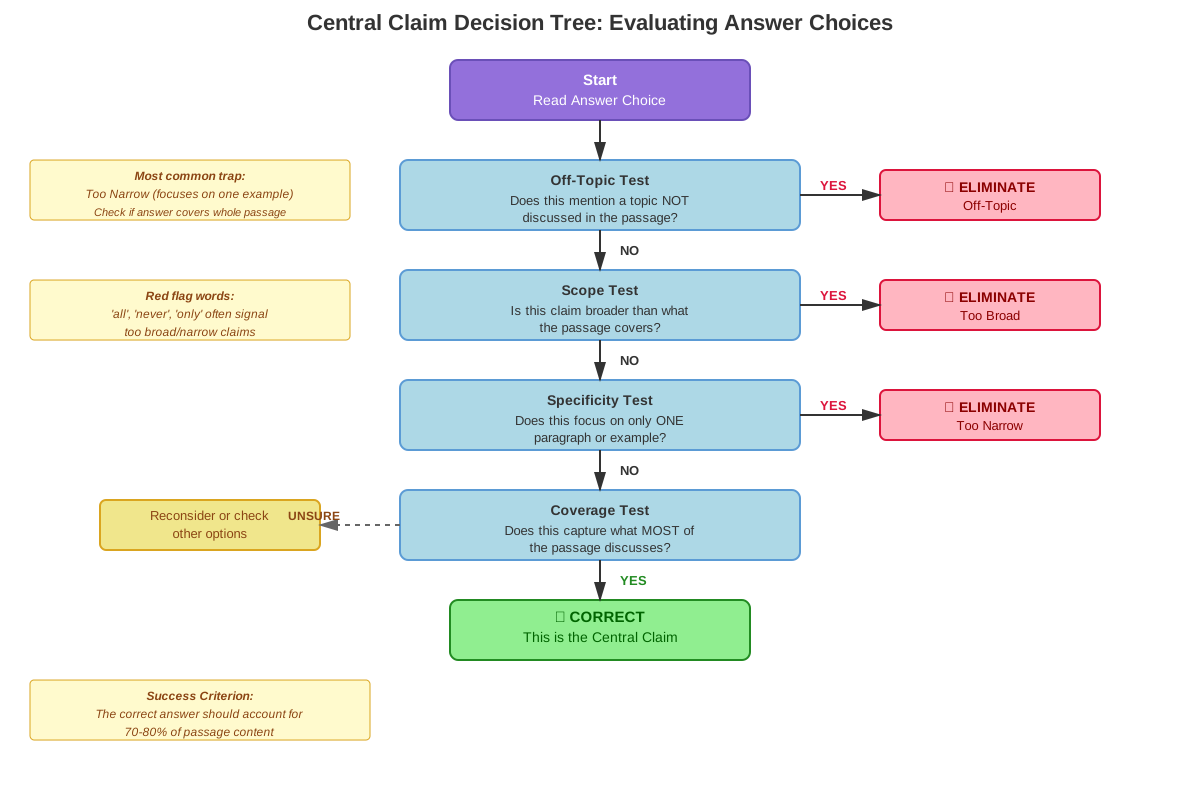
- [ ] Evaluate answer choices to eliminate options that are too broad, too narrow, or off-topic
- [ ] Synthesize information from multiple paragraphs to construct the complete central claim when it's not explicitly stated
Prerequisites
- Basic reading comprehension skills: Ability to understand college-level prose is essential for processing social science passages that often contain specialized vocabulary and complex sentence structures
- Understanding of paragraph structure: Recognition of topic sentences and supporting details helps locate where central claims are typically positioned
- Familiarity with argumentative writing: Knowledge of how authors build arguments through claims, evidence, and reasoning enables students to distinguish main points from supporting material
- Vocabulary at grade level: Social science passages use discipline-specific terminology that students must comprehend to grasp the central claim
Why This Topic Matters
Social science passages constitute one of the four passage types on every ACT Reading test, and questions about the central claim appear with remarkable consistency. Research on ACT question distribution shows that 2-3 questions per social science passage directly or indirectly test understanding of the central claim. This translates to approximately 5-8 questions across the entire Reading section—representing 12-20% of the total score. Students who master this skill gain a significant strategic advantage.
Beyond test performance, the ability to identify central claims in social science writing has profound real-world applications. This skill is essential for college success across disciplines, as students must regularly read academic articles, textbooks, and research papers where identifying the author's main argument is crucial for comprehension and critical analysis. In professional contexts, this ability enables effective evaluation of reports, policy documents, and research findings.
On the ACT, central claim questions appear in several formats: direct questions asking "What is the main point of the passage?", questions about the author's primary purpose, questions asking what the passage "primarily discusses," and inference questions that require understanding the central claim to answer correctly. The central claim may be explicitly stated in the introduction or conclusion, gradually revealed across multiple paragraphs, or implied through accumulated evidence and examples. Recognizing these patterns is essential for efficient, accurate test-taking.
Core Concepts
Definition of Central Claim
The central claim in a social science passage is the primary argument, thesis, or position that the author advances and supports throughout the text. It represents the author's main point—the single most important idea that unifies all paragraphs and examples. Unlike a topic (which is simply the subject matter), a central claim makes an assertion or argument about that topic. For example, a passage's topic might be "social media use among teenagers," while its central claim might be "social media use among teenagers has fundamentally altered peer relationship dynamics in ways that increase anxiety and decrease face-to-face communication skills."
The central claim typically possesses several characteristics: it is specific enough to be meaningful but broad enough to encompass the entire passage; it represents the author's position or perspective rather than just describing what the passage discusses; and it can be supported with evidence from throughout the passage. On the ACT, incorrect answer choices often fail one of these criteria—they're either too vague, too narrow (covering only one paragraph), or they describe a supporting point rather than the main argument.
Common Locations for Central Claims
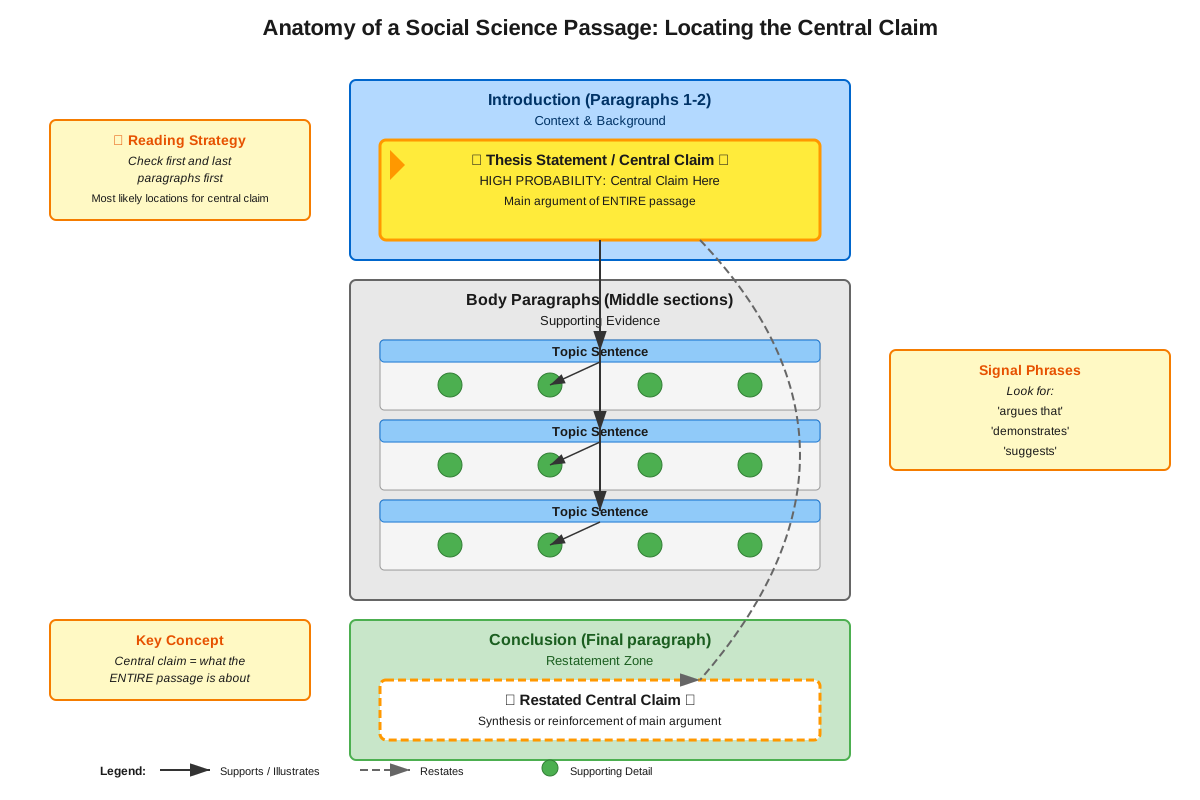
Understanding where authors typically position their central claims dramatically improves efficiency and accuracy. The introduction (first 1-2 paragraphs) is the most common location, where authors often present their thesis after providing context or background. Look for phrases like "this paper argues," "the evidence suggests," "I contend that," or "the primary reason is." However, ACT passages don't always follow this pattern.
The conclusion (final paragraph) frequently restates or crystallizes the central claim, often beginning with phrases like "thus," "therefore," "in conclusion," or "ultimately." Some authors use a delayed thesis structure, building evidence throughout the passage before explicitly stating their claim near the end. Additionally, some passages employ an implicit central claim that must be inferred from the accumulation of evidence and examples—these are typically more challenging but still testable on the ACT.
| Location | Frequency | Trigger Phrases | Strategy |
|---|---|---|---|
| Introduction | 60% | "argues that," "suggests," "contends" | Read first 2 paragraphs carefully |
| Conclusion | 25% | "thus," "therefore," "ultimately" | Check final paragraph for synthesis |
| Throughout | 10% | No single location | Synthesize from topic sentences |
| Implicit | 5% | Not directly stated | Infer from evidence pattern |
Distinguishing Central Claims from Supporting Elements
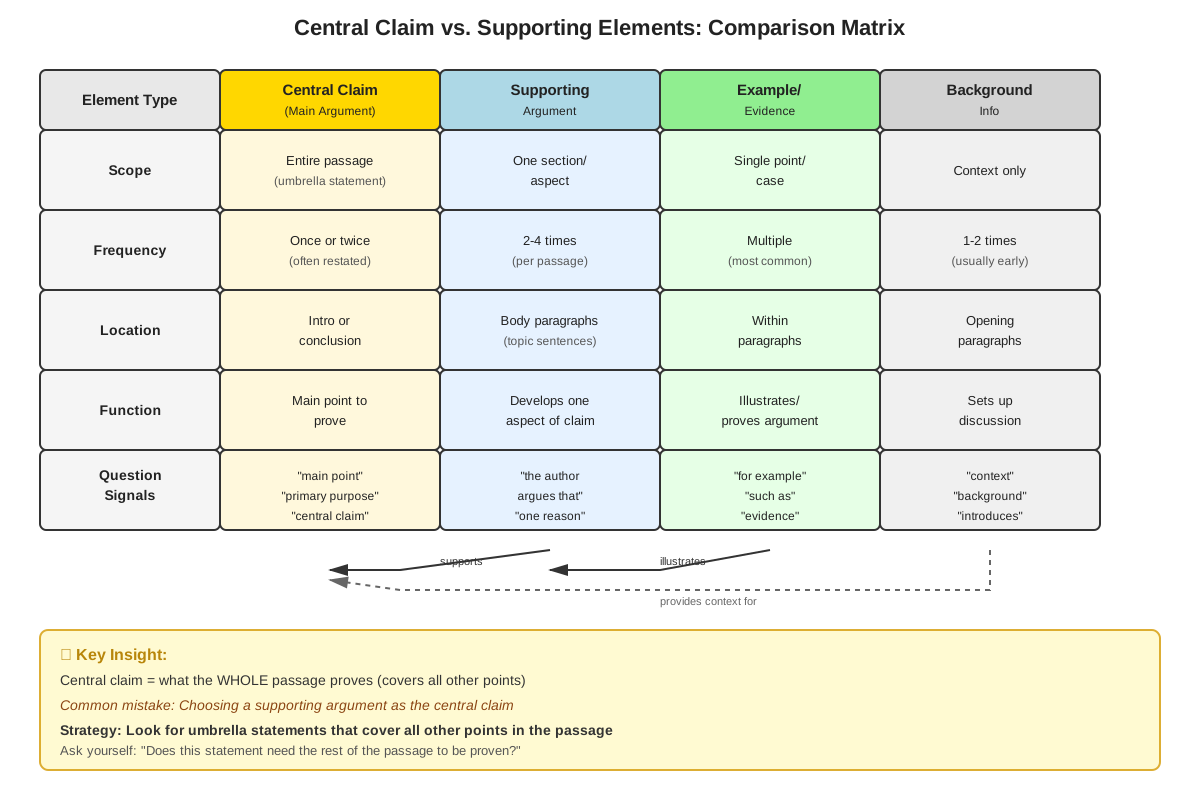
A critical skill is differentiating the central claim from supporting arguments, evidence, examples, and background information. Supporting arguments are subordinate claims that help prove the central claim. Evidence includes data, statistics, research findings, or expert opinions that substantiate arguments. Examples are specific instances or case studies that illustrate points. Background information provides context but doesn't advance the main argument.
Consider this structure: A passage's central claim might be "Urban green spaces significantly improve mental health outcomes in city residents." Supporting arguments might include "green spaces reduce stress hormones," "access to nature improves mood," and "community gardens foster social connection." Evidence would be specific studies showing cortisol reduction or depression score improvements. Examples might describe particular cities like Singapore or Copenhagen. Background information might explain what constitutes a green space or describe urbanization trends.
On the ACT, wrong answer choices frequently present supporting arguments or examples as if they were the central claim. Students must ask: "Does this answer encompass the entire passage, or just one section?" and "Is this the main point, or is it used to prove a larger point?"
Synthesis and Scope
Many ACT passages require synthesis—combining information from multiple paragraphs to construct the complete central claim. An author might introduce a problem in paragraph one, discuss causes in paragraph two, and propose solutions in paragraph three. The central claim encompasses all these elements: "Problem X, caused by factors Y and Z, can be addressed through solution A."
Understanding scope is equally crucial. The central claim should be neither too broad nor too narrow. An answer choice stating "Social factors influence human behavior" is too broad for most passages—it could apply to thousands of different texts. Conversely, "A 2015 study found that teenagers who use Instagram more than 3 hours daily report 15% higher anxiety" is too narrow—it's a specific piece of evidence, not the overarching claim. The correct central claim occupies the middle ground, specific to the passage's content but encompassing its full scope.
Author's Purpose and Central Claim
The central claim directly relates to the author's purpose—why the author wrote the passage. Common purposes in social science passages include: to argue for a position, to explain a phenomenon, to compare different theories or approaches, to analyze causes and effects, or to propose solutions to problems. The central claim articulates what the author aims to accomplish.
For argumentative passages, the central claim is the position being defended. For explanatory passages, it's the main concept being clarified. For comparative passages, it's the conclusion drawn from the comparison. Recognizing the author's purpose helps predict the type of central claim to expect and where it might appear.
Concept Relationships
The central claim serves as the hierarchical apex of passage organization, with all other elements supporting or relating to it. This relationship flows as follows: Central Claim → supported by → Supporting Arguments → substantiated by → Evidence and Examples → contextualized by → Background Information. Understanding this hierarchy prevents students from confusing subordinate elements with the main point.
The central claim concept connects to main idea identification (a prerequisite skill) but requires deeper analysis because social science passages often present complex, nuanced arguments rather than simple main ideas. It also connects to author's purpose because the central claim articulates what the author aims to accomplish. Additionally, understanding central claims enables inference questions—many inferences require knowing the author's main argument to determine what logically follows.
The relationship to supporting details is inverse: while students must identify supporting details, they must simultaneously recognize that these details are not the central claim. This discrimination skill—knowing what something is by understanding what it isn't—is crucial for ACT success. Finally, central claim identification connects to passage structure because recognizing organizational patterns (problem-solution, cause-effect, comparison-contrast) helps predict where the central claim will appear and what form it will take.
High-Yield Facts
⭐ The central claim appears most frequently in the first two paragraphs or the final paragraph of ACT social science passages
⭐ Correct central claim answers must be broad enough to cover the entire passage but specific enough to distinguish this passage from others on similar topics
⭐ Wrong answers often present supporting arguments, specific examples, or background information as if they were the central claim
⭐ Phrases like "argues that," "suggests," "contends," "demonstrates," and "reveals" often signal the central claim
⭐ If the central claim isn't explicitly stated, it can be constructed by synthesizing the topic sentence or main point of each paragraph
- The central claim always represents the author's position or perspective, not just a neutral description of the topic
- Questions asking about "main point," "primary purpose," "primarily concerned with," or "main idea" are all testing central claim identification
- Time-efficient readers identify the central claim during their first read-through, then use it to answer multiple questions
- Approximately 2-3 questions per social science passage directly or indirectly test understanding of the central claim
- The central claim should be defensible using evidence from at least three different paragraphs in the passage
Quick check — test yourself on Central claim in social science so far.
Try Flashcards →Common Misconceptions
Misconception: The central claim is always explicitly stated in the first paragraph → Correction: While the introduction is the most common location, approximately 40% of ACT passages place the central claim elsewhere or require synthesis from multiple paragraphs. Always check the conclusion and be prepared to infer the claim from accumulated evidence.
Misconception: The longest or most detailed paragraph contains the central claim → Correction: Length indicates emphasis on supporting evidence or examples, not necessarily the location of the central claim. A brief thesis statement in the introduction often articulates the central claim more clearly than lengthy body paragraphs filled with evidence.
Misconception: The central claim is the same as the topic → Correction: The topic is what the passage is about (e.g., "climate change policy"), while the central claim is the argument or position about that topic (e.g., "market-based approaches to climate change policy are more effective than regulatory mandates"). The central claim makes an assertion; the topic simply names the subject.
Misconception: If an idea appears multiple times, it must be the central claim → Correction: Repetition can indicate importance, but supporting concepts and evidence are often repeated throughout a passage. The central claim is distinguished by being the overarching argument that all other repeated elements support, not merely by frequency of mention.
Misconception: The correct answer will use the same words as the passage → Correction: ACT answer choices frequently paraphrase the central claim using synonyms and different sentence structures. Students must recognize conceptual equivalence rather than looking for word-for-word matches. This tests deeper comprehension beyond surface-level reading.
Worked Examples
Example 1: Explicitly Stated Central Claim
Passage excerpt: "For decades, economists have debated the relationship between minimum wage increases and employment levels. Traditional economic theory suggests that raising the minimum wage should decrease employment by making labor more expensive. However, recent empirical studies challenge this assumption. Analysis of minimum wage increases in Seattle, San Francisco, and New York reveals that employment in affected sectors remained stable or even increased following wage hikes. This evidence suggests that moderate minimum wage increases do not significantly harm employment and may actually stimulate local economies through increased consumer spending."
Question: Which of the following best expresses the main point of the passage?
A) Traditional economic theory explains the relationship between wages and employment
B) Seattle, San Francisco, and New York have raised their minimum wages
C) Moderate minimum wage increases do not significantly reduce employment
D) Consumer spending stimulates local economies
Analysis:
Step 1: Identify the author's position. The passage begins by presenting traditional theory, then uses "However" to signal a contrasting position. The word "suggests" in the final sentence signals the author's claim.
Step 2: Evaluate scope. The passage discusses multiple cities and focuses on the relationship between minimum wage and employment, with consumer spending mentioned as a secondary mechanism.
Step 3: Eliminate incorrect answers:
- Choice A is incorrect because it represents the traditional view that the passage challenges, not the author's position
- Choice B is too narrow—it's a factual detail used as evidence, not the main argument
- Choice D is too narrow—it's a supporting mechanism mentioned briefly, not the central claim
- Choice C is correct because it captures the author's main argument with appropriate scope, encompassing the evidence from multiple cities while making the specific claim about moderate increases not harming employment
Example 2: Synthesized Central Claim
Passage structure summary:
- Paragraph 1: Introduces the problem of declining civic engagement among young adults
- Paragraph 2: Discusses research showing that traditional civics education has minimal impact on engagement
- Paragraph 3: Presents evidence that service-learning programs significantly increase civic participation
- Paragraph 4: Explains mechanisms—service-learning creates personal connections to community issues
- Paragraph 5: Concludes that educational approaches emphasizing direct community involvement are more effective than traditional classroom instruction
Question: The passage primarily serves to:
A) Describe the problem of declining civic engagement
B) Criticize traditional civics education methods
C) Argue that service-learning is more effective than traditional civics education for promoting civic engagement
D) Explain why young adults are less civically engaged than previous generations
Analysis:
Step 1: Synthesize across paragraphs. The passage moves from problem (paragraph 1) to ineffective solution (paragraph 2) to effective solution (paragraphs 3-4) to conclusion (paragraph 5).
Step 2: Identify the author's purpose. The author isn't merely describing a problem or criticizing an approach—they're advocating for a specific alternative solution.
Step 3: Evaluate answers:
- Choice A is too narrow—describing the problem is only paragraph 1's function
- Choice B is partially correct but incomplete—criticism of traditional methods is subordinate to advocating for service-learning
- Choice C is correct because it captures the complete argument: the comparison between approaches and the conclusion that service-learning is superior
- Choice D addresses a question the passage doesn't answer—causes of decline aren't the focus
This example demonstrates how the central claim often requires synthesizing information across the entire passage structure rather than finding a single sentence.
Exam Strategy
When approaching ACT questions about central claims in social science passages, employ this systematic process:
Step 1: Pre-read strategically. Before diving into questions, spend 10-15 seconds scanning the passage structure. Note the number of paragraphs, any subheadings, and whether the passage appears argumentative or explanatory. This preview helps predict where the central claim might appear.
Step 2: Identify during first read. As you read the passage (which should take 3-4 minutes), actively search for the central claim. Mark or mentally note sentences containing phrases like "argues," "suggests," "demonstrates," "reveals," "contends," or "shows that." Pay special attention to the final sentence of the introduction and the first sentence of the conclusion.
Step 3: Articulate in your own words. Before looking at answer choices, mentally summarize the central claim in one sentence. This prevents answer choices from influencing your understanding and makes it easier to recognize correct paraphrases.
Step 4: Apply the scope test. When evaluating answer choices, ask: "Does this cover the entire passage or just part of it?" Eliminate answers that are too narrow (covering only one paragraph or example) or too broad (could apply to many different passages on similar topics).
Step 5: Use the evidence test. The correct central claim should be supportable with evidence from at least three different parts of the passage. If an answer choice relates to only one or two paragraphs, it's likely a supporting point rather than the central claim.
Exam Tip: Questions asking about "main point," "primary purpose," "primarily concerned with," "main focus," or "best summary" are all testing central claim identification. Recognize these as the same question type requiring the same strategy.
Trigger words to watch for in passages:
- Claim indicators: argues, contends, suggests, demonstrates, reveals, shows, indicates, proposes
- Contrast markers: however, nevertheless, yet, but, although, despite (often signal the author's position after presenting opposing views)
- Conclusion markers: thus, therefore, consequently, ultimately, in sum, overall
Time allocation: Spend approximately 30-45 seconds on central claim questions. If you identified the claim during your initial read, these should be among the fastest questions to answer. If you're uncertain, use the process of elimination based on scope and evidence tests rather than re-reading the entire passage.
Memory Techniques
SCOPE Acronym for evaluating central claim answer choices:
- Specific enough to distinguish this passage from others
- Covers the entire passage, not just one section
- Opinion or position of the author, not just description
- Provable with evidence from multiple paragraphs
- Expressed in the passage (explicitly or through synthesis)
The Umbrella Visualization: Picture the central claim as an umbrella, with all supporting arguments, evidence, and examples as items sheltered beneath it. If an answer choice can't "cover" all the passage's content, it's not the central claim—it's one of the items underneath.
The "So What?" Test: After reading a potential central claim, ask "So what? Why does this matter?" The central claim should answer this question—it's the point the author wants you to understand or believe. Supporting details don't answer "so what?"—they answer "how?" or "why?" in service of the central claim.
First-Last-Synthesis (FLS) Method:
- First: Check the last sentence of the introduction
- Last: Check the first sentence of the conclusion
- Synthesis: If neither contains the claim, synthesize from paragraph topic sentences
The Replacement Test: Try replacing the potential central claim with each answer choice in this sentence: "The author wrote this passage primarily to convince readers that [ANSWER CHOICE]." The option that makes the most sense is likely correct.
Summary
Identifying the central claim in social science passages is a foundational ACT Reading skill that directly impacts performance on 12-20% of Reading section questions. The central claim represents the author's primary argument or position—the main point that unifies the entire passage and that all supporting elements work to establish. Unlike topics (which simply name the subject) or supporting arguments (which are subordinate points), the central claim is the overarching assertion the author wants readers to accept. It typically appears in the introduction or conclusion but may require synthesis from multiple paragraphs. Success requires distinguishing the central claim from supporting arguments, evidence, examples, and background information—all of which are subordinate to the main point. Effective test-takers identify the central claim during their initial passage read, then use it as a reference point for answering multiple questions. The correct answer to central claim questions must have appropriate scope (broad enough to cover the entire passage but specific enough to distinguish it from other texts) and must be supportable with evidence from throughout the passage.
Key Takeaways
- The central claim is the author's primary argument or position, not merely the topic or a supporting point
- Approximately 60% of central claims appear in the first two paragraphs; 25% appear in the conclusion; the remainder require synthesis
- Correct answers must pass the scope test (covering the entire passage without being too vague) and the evidence test (supportable from multiple paragraphs)
- Wrong answers typically present supporting arguments, specific examples, or background information as if they were the central claim
- Identifying the central claim during the initial passage read enables faster, more accurate answering of multiple question types
- Trigger phrases like "argues that," "suggests," and "demonstrates" often signal the central claim's location
- When the central claim isn't explicitly stated, synthesize it by combining the main point from each paragraph's topic sentence
Related Topics
Supporting Details and Evidence: After mastering central claim identification, students should study how authors use specific evidence, examples, and data to support their claims. This skill enables answering questions about the function of specific paragraphs or examples.
Author's Purpose and Tone: Understanding why an author wrote a passage and their attitude toward the subject deepens comprehension of the central claim and helps distinguish between objective reporting and argumentative positions.
Passage Structure and Organization: Recognizing common organizational patterns (problem-solution, cause-effect, comparison-contrast, chronological) helps predict where central claims will appear and how they'll be developed.
Inference Questions: Many inference questions require understanding the central claim to determine what logically follows or what the author would likely agree with on related issues.
Comparative Reading: In paired passages, identifying each passage's central claim is essential for answering questions about how the authors' positions relate, agree, or conflict.
Practice CTA
Now that you've mastered the strategies for identifying central claims in social science passages, it's time to apply these skills! Complete the practice questions to test your ability to distinguish central claims from supporting elements, evaluate answer choice scope, and synthesize claims from complex passages. Use the flashcards to reinforce trigger phrases and common question formats. Remember: identifying the central claim during your first read-through is one of the highest-yield strategies for improving your ACT Reading score. Each practice question you complete strengthens your pattern recognition and builds the confidence you need for test day success. You've got this!
Sign up free to keep reading
Create a free AnvayaPrep account to finish this ACT guide on Central claim in social science — plus flashcards and practice questions.