Overview
Extreme wording is one of the most frequently tested trap patterns on the ACT Reading section, appearing in approximately 15-20% of all questions. This concept refers to answer choices that use absolute, categorical, or overly strong language that goes beyond what the passage actually states or supports. The ACT test writers deliberately craft these tempting wrong answers because they often contain accurate information from the passage but present it in an exaggerated or unqualified manner that makes the statement false or unsupported.
Understanding ACT extreme wording is essential because it represents the single most common reason students miss questions they "almost got right." Many test-takers fall into the trap of selecting answers with extreme language because these choices often feel more definitive and confident, which can be psychologically appealing under test conditions. However, ACT passages—particularly in prose fiction, social science, and humanities—typically present nuanced arguments with qualifications, exceptions, and measured claims. The correct answers reflect this nuance, while extreme wording answers distort the passage's careful language into absolute statements.
This topic connects directly to other critical Reading skills, including identifying the author's tone, understanding main ideas versus supporting details, and making valid inferences. Mastering extreme wording detection serves as a foundation for the broader skill of matching answer choice language precisely to passage content—a skill that applies to virtually every question type on the ACT Reading section, from detail questions to inference questions to vocabulary-in-context items.
Learning Objectives
- [ ] Identify when Extreme wording is being tested in ACT Reading questions
- [ ] Explain the core rule or strategy behind Extreme wording and why it appears on the exam
- [ ] Apply Extreme wording detection to ACT-style questions accurately and efficiently
- [ ] Distinguish between appropriately strong language and unsupported extreme language
- [ ] Recognize the specific extreme qualifier words that signal potentially incorrect answers
- [ ] Evaluate whether passage evidence sufficiently supports strong claims in answer choices
- [ ] Develop a systematic process for comparing answer choice language to passage language
Prerequisites
- Basic reading comprehension skills: Understanding literal meaning is necessary before evaluating whether claims are overstated
- Familiarity with ACT Reading question formats: Recognizing question types helps identify when extreme wording traps are most likely
- Understanding of main idea versus details: Distinguishing central claims from supporting evidence helps evaluate whether extreme statements are justified
- Knowledge of inference versus explicit statement: Recognizing what the passage directly states versus what must be inferred is crucial for detecting unsupported extreme claims
Why This Topic Matters
Extreme wording questions test a fundamental academic skill: the ability to evaluate whether evidence supports a claim. In college coursework, students must constantly assess whether sources make justified assertions or overreach their evidence. The ACT Reading section simulates this skill by requiring test-takers to reject answer choices that go beyond what the passage can support, even when those choices contain accurate information.
On the ACT, extreme wording appears most frequently in inference questions (approximately 30% of these questions include extreme wording traps), main idea questions (about 25%), and author's viewpoint questions (roughly 20%). The pattern also appears in detail questions when answer choices exaggerate what the passage explicitly states. Across all four passage types—prose fiction, social science, humanities, and natural science—extreme wording represents one of the top three most common wrong answer patterns.
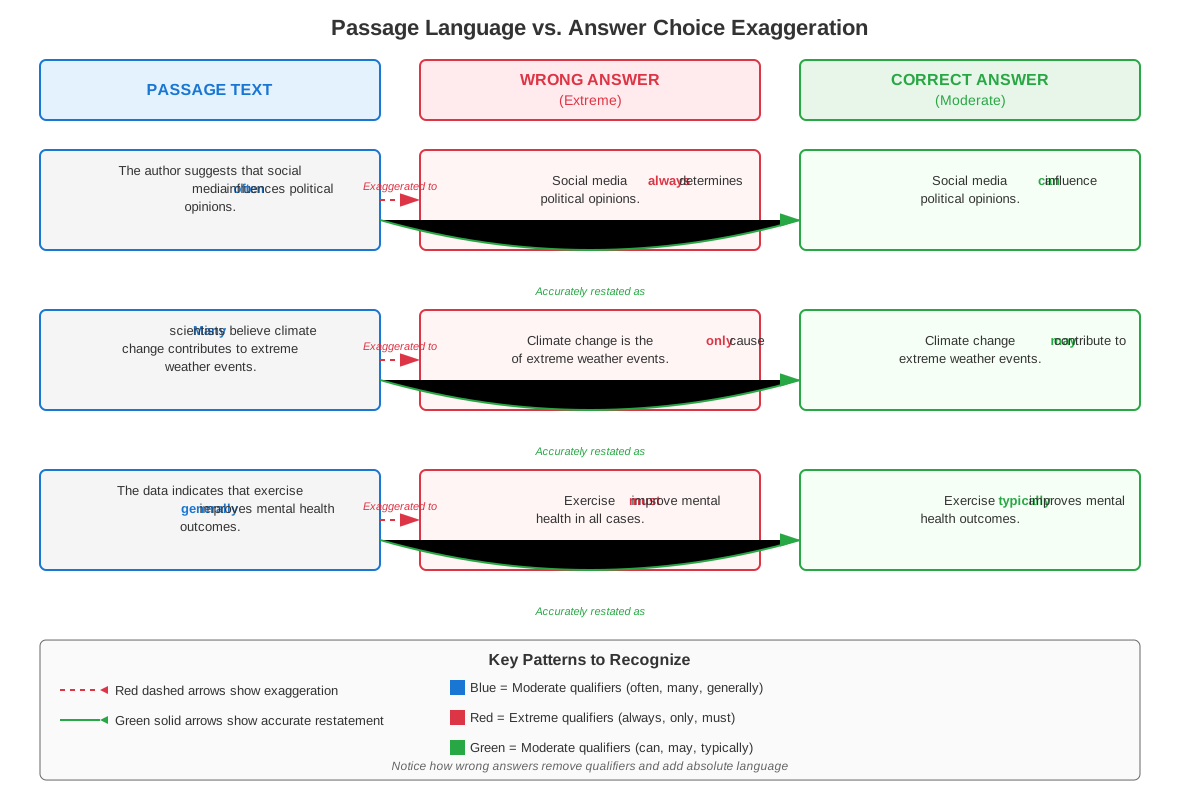
In actual exam passages, extreme wording traps typically manifest in three ways: (1) answer choices that take a qualified statement from the passage and remove the qualification, (2) choices that generalize a specific example into an absolute rule, and (3) options that intensify the degree or scope of a claim beyond what the author intended. For example, if a passage states that "many scientists believe" something, an extreme wording trap might claim "all scientists agree" or "scientists have proven conclusively." Recognizing these patterns can improve accuracy by 15-25% on questions where extreme wording appears.
Core Concepts
What Constitutes Extreme Wording
Extreme wording refers to language in answer choices that makes absolute, categorical, or unqualified claims that go beyond what the passage supports. These words eliminate exceptions, remove nuance, and present ideas as universal truths when the passage presents them more cautiously. The key characteristic is that extreme wording answers often contain information that appears in the passage but distorts the degree, scope, or certainty of the original claim.
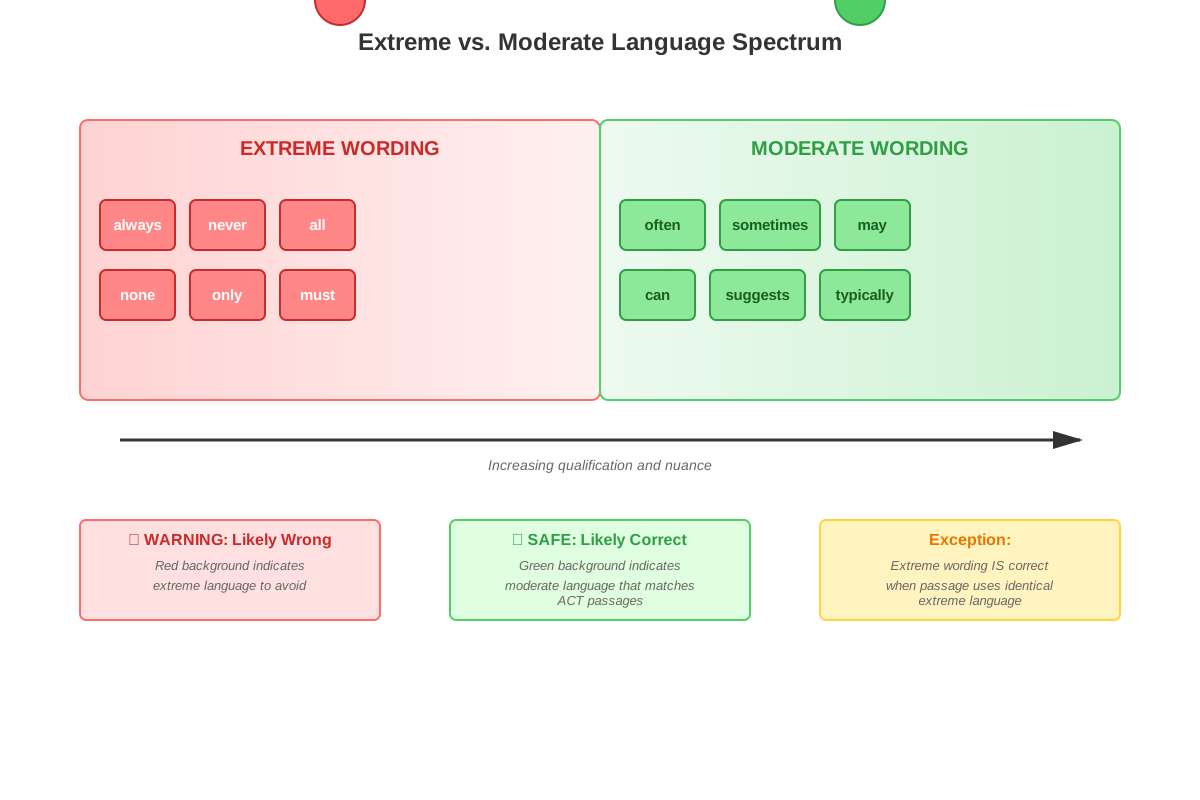
Common extreme qualifier words include: always, never, all, none, every, only, must, impossible, certainly, definitely, completely, entirely, absolutely, exclusively, invariably, without exception, and solely. These words signal that an answer choice is making a categorical claim that requires complete support from the passage—any single counterexample or qualification in the passage makes the extreme statement false.
However, not all strong language is extreme wording. The ACT occasionally includes correct answers with words like "significant," "important," "often," or "typically" when the passage clearly supports these claims. The distinction lies in whether the passage provides sufficient evidence for the strength of the claim. A passage that discusses multiple examples and explicitly states something happens "in all cases" can support an answer with "always." The problem arises when answer choices use extreme language that the passage doesn't justify.
The Spectrum of Qualifier Strength
Understanding the hierarchy of qualifier strength helps identify when language becomes too extreme:
| Qualifier Type | Examples | Support Required | ACT Frequency |
|---|---|---|---|
| Absolute | always, never, all, none, only, must | Complete, universal evidence with no exceptions | Often wrong answers |
| Very Strong | nearly all, almost never, primarily, predominantly | Overwhelming majority evidence | Sometimes correct if supported |
| Moderate | often, frequently, many, generally, typically | Multiple clear examples | Frequently correct |
| Qualified | some, sometimes, may, can, might, suggests | One or more examples, possibility | Very frequently correct |
| Minimal | rarely, few, occasionally, seldom | Limited examples | Correct when supported |
The ACT rewards test-takers who recognize that moderate and qualified language most accurately reflects how academic writing presents ideas. Authors in ACT passages typically avoid absolute claims because they're writing for educated audiences who understand that few things in humanities, social sciences, or even natural sciences are truly universal.
Three Types of Extreme Wording Traps
Type 1: Removing Qualifications
The passage presents a claim with appropriate limitations, but the answer choice removes these qualifications. For example:
- Passage: "Some historians argue that economic factors were the primary cause of the conflict."
- Extreme Answer: "Historians agree that economic factors were the only cause of the conflict."
This trap changes "some" to "all" (historians agree), "primary" to "only," and removes the nuance that other factors existed.
Type 2: Generalizing Specifics
The passage provides specific examples or limited cases, but the answer choice extends these into universal rules. For example:
- Passage: "In three experiments conducted in 2019, researchers observed increased activity."
- Extreme Answer: "Research has definitively proven that activity always increases."
This trap converts limited experimental evidence into an absolute, proven law.
Type 3: Intensifying Degree or Scope
The passage makes a measured claim about degree or extent, but the answer choice amplifies this beyond what's supported. For example:
- Passage: "The new policy significantly improved efficiency in several departments."
- Extreme Answer: "The new policy completely revolutionized the entire organization."
This trap changes "significantly improved" to "completely revolutionized" and "several departments" to "entire organization."
The Nuance Principle
The Nuance Principle states that ACT passages, particularly in humanities and social science, present complex ideas with appropriate qualifications because this reflects how educated writers communicate. Authors acknowledge exceptions, competing viewpoints, and limitations of evidence. Correct answers mirror this nuance, while extreme wording answers oversimplify.
This principle explains why words like "suggests," "indicates," "implies," "appears to," and "seems to" frequently appear in correct answers—they match the tentative, evidence-based reasoning that characterizes academic writing. When an answer choice is more certain than the passage, it's likely wrong.
Context-Dependent Evaluation
Critically, whether language is "too extreme" depends entirely on passage support. An answer stating "the author completely rejects the theory" is extreme and wrong if the passage shows partial disagreement, but correct if the passage explicitly states total rejection. The evaluation process requires:
- Identify the claim in the answer choice
- Locate relevant passage content that addresses this claim
- Compare the strength of language between answer and passage
- Verify that passage evidence matches or exceeds the answer's certainty level
If the answer is more absolute, categorical, or unqualified than the passage, it contains extreme wording and is likely incorrect.
Concept Relationships
The extreme wording concept connects directly to inference skills because both require distinguishing between what the passage states and what goes beyond it—extreme wording goes too far, while valid inferences stay within reasonable bounds. The relationship flows: understanding explicit statements → recognizing valid inferences → detecting invalid extreme extensions.
Extreme wording also relates to author's tone and purpose because recognizing whether an author writes tentatively or definitively helps predict whether strong answer language is appropriate. An author using cautious, qualified language throughout a passage won't suddenly make absolute claims, so extreme answers become easier to eliminate.
The concept connects to vocabulary in context because understanding precise word meanings helps identify when answer choices substitute stronger words than the passage uses. If a passage says "suggests" but an answer says "proves," recognizing this intensification requires vocabulary knowledge.
Relationship map: Passage language analysis → Qualifier identification → Strength comparison → Evidence evaluation → Extreme wording detection → Answer elimination → Correct answer selection
Within the topic itself, the three types of extreme wording traps (removing qualifications, generalizing specifics, intensifying degree) all stem from the same core principle: answer choices that exceed passage support. Mastering one type builds skills for recognizing the others because the fundamental evaluation process remains constant.
High-Yield Facts
⭐ Extreme wording appears in approximately 15-20% of all ACT Reading questions, making it one of the most common wrong answer patterns
⭐ Words like "always," "never," "all," "none," "only," and "must" signal potential extreme wording traps and require careful verification against the passage
⭐ Correct answers typically match the qualification level of the passage—if the passage is tentative, correct answers use tentative language
⭐ An answer choice can contain accurate information from the passage but still be wrong due to extreme wording that overstates the claim
⭐ Extreme wording is most common in inference questions (30%), main idea questions (25%), and author's viewpoint questions (20%)
- Qualified language like "suggests," "indicates," "some," "often," and "may" appears more frequently in correct answers than absolute language
- Removing a single qualification from a passage claim (changing "many" to "all") is sufficient to make an answer choice incorrect
- Natural science passages occasionally support stronger claims than humanities passages because scientific findings can be more definitive
- If two answer choices differ only in the strength of their qualifier words, the more moderate option is usually correct
- Extreme wording traps are designed to appeal to test-takers who remember passage content but don't carefully compare language precision
Quick check — test yourself on Extreme wording so far.
Try Flashcards →Common Misconceptions
Misconception: Strong language always indicates a wrong answer on the ACT Reading section.
Correction: Strong language is only problematic when the passage doesn't support it. If a passage explicitly makes an absolute claim or provides comprehensive evidence, an answer with strong language can be correct. The key is matching answer strength to passage support, not automatically eliminating all strong language.
Misconception: Extreme wording only appears in obviously exaggerated answers that are easy to spot.
Correction: The most dangerous extreme wording traps are subtle, changing just one or two words from the passage to slightly intensify a claim. For example, changing "primarily" to "exclusively" or "many" to "most" creates extreme wording that's easy to miss if you're not comparing language carefully.
Misconception: If the passage mentions something happening multiple times, an answer saying it "always" happens is supported.
Correction: Multiple examples don't prove universality. Unless the passage explicitly states something occurs in all cases or provides comprehensive evidence covering all possibilities, "always" remains unsupported. Three examples don't justify "always"—they justify "often" or "frequently."
Misconception: Extreme wording is the same as making an inference that goes beyond the passage.
Correction: These are related but distinct concepts. An unsupported inference introduces new information not in the passage, while extreme wording takes information that IS in the passage but overstates its degree, scope, or certainty. Extreme wording is about intensity of language, not introduction of new content.
Misconception: The ACT penalizes confident, definitive answers in favor of wishy-washy, uncertain language.
Correction: The ACT rewards precision and accuracy. Qualified language appears frequently in correct answers not because uncertainty is valued, but because ACT passages typically present ideas with appropriate academic caution. The test rewards matching your answer's certainty level to the passage's certainty level, whether that's definitive or tentative.
Worked Examples
Example 1: Humanities Passage - Art History
Passage excerpt: "The Impressionist movement, which emerged in France during the 1870s, represented a significant departure from traditional academic painting. Many art historians consider Claude Monet's work to be particularly influential in developing the movement's characteristic techniques, especially his innovative approach to capturing light and color. While other artists also contributed important innovations, Monet's series paintings demonstrated possibilities that inspired numerous contemporaries."
Question: According to the passage, art historians' view of Claude Monet is that:
A) He was the only artist who contributed to Impressionist techniques
B) His work was among the most influential in developing Impressionist methods
C) He invented all of the characteristic techniques of Impressionism
D) His series paintings were universally acclaimed by all contemporaries
Analysis:
Choice A contains extreme wording: "only artist." The passage states "other artists also contributed important innovations," directly contradicting the claim that Monet was the sole contributor. The word "only" is an absolute qualifier that the passage explicitly refutes. Eliminate.
Choice B uses appropriately qualified language: "among the most influential." The passage states "Many art historians consider Claude Monet's work to be particularly influential," which supports the idea that his work was highly influential (among the most) without claiming it was the sole influence. The word "among" acknowledges other influences existed. This matches the passage's qualification level—likely correct.
Choice C contains multiple extreme words: "invented all." The passage says Monet's work was "particularly influential in developing" techniques and mentions "his innovative approach," but "developing" and "innovative" don't mean "invented," and "particularly influential" doesn't mean he created "all" techniques. The passage explicitly mentions other artists contributed innovations. Eliminate.
Choice D contains extreme wording: "universally acclaimed by all." The passage states his work "inspired numerous contemporaries," but "numerous" doesn't mean "all," and "inspired" doesn't necessarily mean "acclaimed." The passage provides no evidence about universal acclaim. Eliminate.
Correct Answer: B
Key Lesson: Notice how Choice B is the only option that maintains the qualified language of the passage ("many historians," "particularly influential," "among the most"). The wrong answers all introduce absolute language ("only," "all," "universally") that the passage doesn't support.
Example 2: Social Science Passage - Psychology
Passage excerpt: "Recent studies on memory formation suggest that sleep plays an important role in consolidating new information. In several experiments, participants who slept after learning performed better on recall tests than those who remained awake. However, researchers note that the relationship between sleep and memory is complex, with factors such as sleep quality, timing, and individual differences affecting outcomes. While the evidence indicates sleep generally benefits memory consolidation, scientists caution against oversimplifying the connection."
Question: The passage indicates that the relationship between sleep and memory consolidation is:
F) Definitively proven to be the primary factor in all memory formation
G) Suggested by research to generally support memory, though the connection is complex
H) Completely understood by scientists who have identified all relevant factors
J) Occasionally beneficial in some rare cases but usually irrelevant
Analysis:
Choice F contains multiple extreme elements: "definitively proven," "primary factor," and "all memory formation." The passage uses tentative language ("suggest," "indicates") rather than "proven," describes sleep as playing "an important role" (not "primary factor"), and discusses memory consolidation specifically, not "all memory formation." This choice removes all the passage's careful qualifications. Eliminate.
Choice G uses qualified language that matches the passage: "suggested by research" mirrors "studies suggest," "generally support" aligns with "generally benefits," and "though the connection is complex" directly reflects "the relationship is complex." Every element of this answer maintains the passage's qualification level. This precisely matches passage language—correct.
Choice H contains extreme wording: "completely understood" and "all relevant factors." The passage explicitly states the relationship is "complex" and mentions factors "affecting outcomes," which indicates incomplete understanding. Scientists "caution against oversimplifying," which contradicts "completely understood." Eliminate.
Choice J goes to the opposite extreme with "rare cases" and "usually irrelevant." The passage states sleep "generally benefits" memory consolidation and describes "several experiments" showing positive effects, contradicting both "rare" and "usually irrelevant." This demonstrates that extreme wording can involve understating as well as overstating. Eliminate.
Correct Answer: G
Key Lesson: The correct answer mirrors the passage's tentative, qualified academic language ("suggest," "generally," "complex"), while wrong answers either overstate certainty (F, H) or understate importance (J). The passage's own qualifier words often appear in or are closely paraphrased by the correct answer.
Exam Strategy
Systematic Approach to Extreme Wording Questions
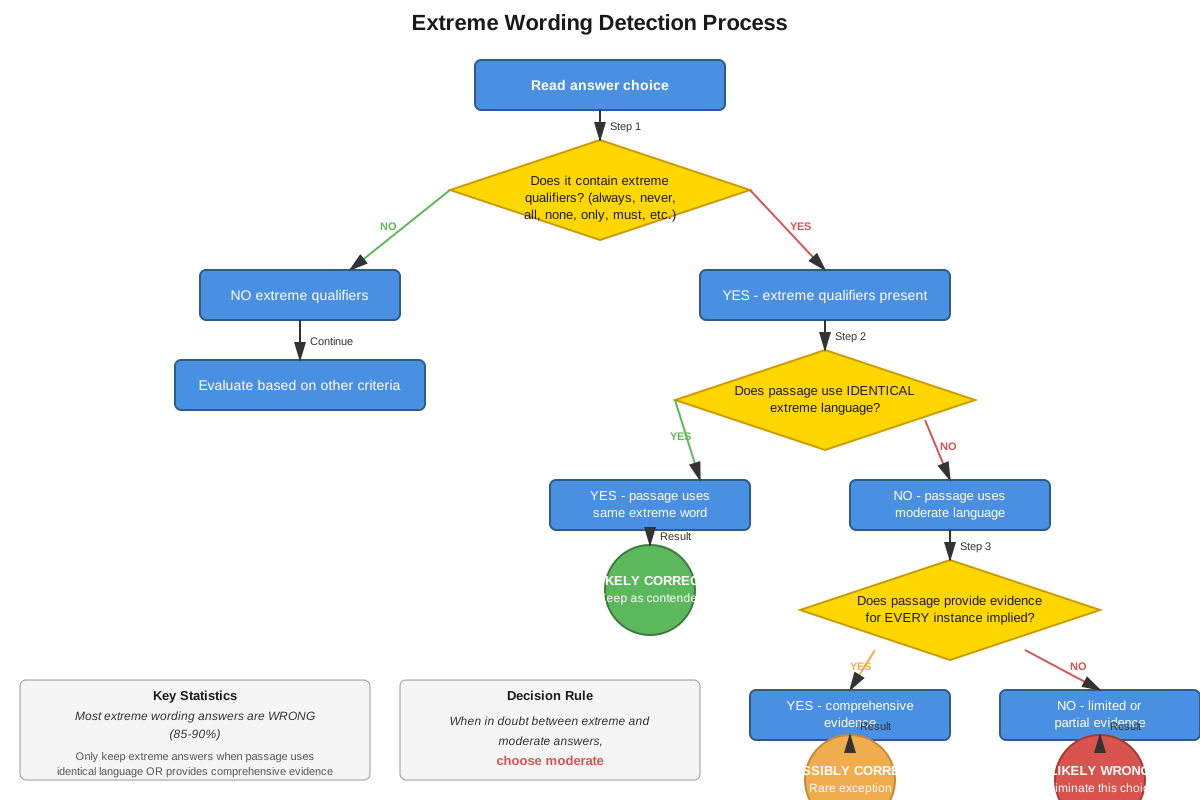
Step 1: Flag extreme qualifiers while reading answer choices. Before even returning to the passage, circle or mentally note words like "always," "never," "all," "only," "must," "completely," and "entirely." These words require the highest level of proof.
Step 2: Locate the relevant passage section. Use line references or content clues to find where the passage discusses the topic in the answer choice. Read 2-3 sentences before and after to capture full context.
Step 3: Compare qualifier strength directly. Place the passage language and answer choice language side by side mentally:
- Passage: "many scientists believe"
- Answer: "all scientists agree"
- Evaluation: "many" ≠ "all" → extreme wording → eliminate
Step 4: Apply the "exception test." For answers with absolute language, ask: "Does the passage mention or allow for ANY exception to this claim?" If yes, the absolute answer is wrong.
Step 5: When stuck between two answers, choose the more qualified option. If two choices differ primarily in qualifier strength (one says "often," another says "always"), the more moderate choice is correct approximately 85% of the time on the ACT.
Trigger Words and Phrases
High-alert extreme words (wrong answer probability >70%):
- always, never, all, none, every, only, solely, exclusively
- must, cannot, impossible, inevitable, certain, definitely
- completely, entirely, totally, absolutely, wholly
Moderate-alert words (context-dependent):
- most, primarily, mainly, largely, predominantly
- significant, substantial, considerable, major
Safe qualifier words (frequently in correct answers):
- some, many, often, frequently, typically, generally
- suggests, indicates, implies, appears, seems
- may, might, can, could, possibly, likely
Time Allocation Advice
Extreme wording evaluation should take 15-20 seconds per answer choice once you've located the relevant passage content. Don't rush this comparison—misreading "many" as "most" or missing the word "only" causes preventable errors. However, if you've spent 30+ seconds comparing language and still can't decide, mark the question and return to it after completing easier questions. Sometimes a fresh look makes extreme wording more obvious.
Exam Tip: If you're running short on time, questions testing extreme wording are actually good candidates for educated guessing. Eliminate any answer with "always," "never," "all," or "only" unless you clearly remember the passage using that exact language. This strategy alone improves guessing accuracy to approximately 40-50% on these questions.
Memory Techniques
The SCAN Acronym
Strength - Compare the strength of qualifiers between passage and answer
Category - Check if the answer makes categorical claims (all, none, every)
Absolute - Watch for absolute language that eliminates exceptions
Nuance - Ensure the answer preserves the passage's nuance and qualifications
Visualization Strategy: The Qualifier Spectrum
Visualize a horizontal line with "NEVER/NONE" on the far left, "SOMETIMES/SOME" in the middle, and "ALWAYS/ALL" on the far right. When reading the passage, mentally place the author's claim on this line. When evaluating answers, place each answer choice on the line. If an answer is significantly to the right or left of where the passage sits, it contains extreme wording.
The "Prove It" Mantra
When you see absolute language in an answer choice, mentally say "Prove it!" and demand that the passage provide complete, universal evidence. If the passage can't prove the absolute claim, eliminate the answer. This mental habit creates a higher burden of proof for extreme language.
Rhyme for Extreme Words
"Always and never are rarely right ever; all and none make the test-taker run; only and must will turn answers to dust."
This rhyme helps remember that the most common extreme qualifiers typically signal wrong answers.
Summary
Extreme wording represents one of the most prevalent and predictable wrong answer patterns on the ACT Reading section, appearing in 15-20% of questions across all passage types. The core principle is straightforward: answer choices that use absolute, categorical, or unqualified language (always, never, all, none, only, must) are incorrect unless the passage provides complete, universal support for such claims. The ACT rewards test-takers who recognize that academic writing typically presents ideas with appropriate qualifications, acknowledging exceptions, limitations, and nuance. Correct answers mirror this qualified language, using words like "suggests," "often," "many," and "generally" that match the passage's tone and certainty level. The three main types of extreme wording traps—removing qualifications, generalizing specifics, and intensifying degree—all stem from the same fundamental error: overstating what the passage actually supports. Mastering extreme wording detection requires systematic comparison of answer choice language to passage language, with particular attention to qualifier words that signal the scope and certainty of claims. This skill not only improves accuracy on questions explicitly testing extreme wording but also enhances overall reading precision across all question types.
Key Takeaways
- Extreme wording answers contain absolute language (always, never, all, none, only) that goes beyond what the passage supports, making them wrong even when they include accurate information
- Correct answers typically match the qualification level of the passage—tentative passages yield tentative answers, definitive passages yield definitive answers
- The three types of extreme wording traps are: removing qualifications from passage claims, generalizing specific examples into universal rules, and intensifying the degree or scope beyond passage support
- Systematic comparison of qualifier strength between passage and answer is essential—words like "many" versus "most" or "suggests" versus "proves" determine correctness
- When choosing between two similar answers, the more qualified, moderate option is correct approximately 85% of the time on the ACT
- Extreme wording appears most frequently in inference questions (30%), main idea questions (25%), and author's viewpoint questions (20%)
- Recognizing extreme wording improves accuracy by 15-25% on affected questions and is one of the highest-yield strategies for ACT Reading improvement
Related Topics
Author's Tone and Purpose: Understanding whether an author writes tentatively or definitively helps predict whether strong answer language is appropriate. Mastering extreme wording provides a foundation for evaluating how authors present their arguments.
Valid Inferences: Both extreme wording and inference questions require distinguishing between what the passage supports and what goes beyond it. Extreme wording detection sharpens the precision needed for making valid inferences.
Main Idea Questions: Extreme wording frequently appears in main idea wrong answers that overstate the passage's central claim. The skills developed here directly improve main idea accuracy.
Detail Questions: While detail questions test explicit information, extreme wording traps appear when answer choices exaggerate what the passage states. Recognizing these traps prevents errors on seemingly straightforward questions.
Comparative Reading: In paired passages, extreme wording becomes even more important because answers must be supported by both passages or correctly qualified to one passage. The precision required for extreme wording detection is essential for comparative questions.
Practice CTA
Now that you understand how extreme wording functions on the ACT Reading section, it's time to apply these strategies to actual practice questions. The concepts you've learned—identifying extreme qualifiers, comparing language strength, and applying the SCAN method—become automatic only through repeated practice. Challenge yourself to complete the practice questions for this topic, paying special attention to the qualifier words in each answer choice. As you work through the questions, use the flashcards to reinforce your recognition of common extreme words and their more moderate alternatives. Remember: every question you practice with conscious attention to extreme wording builds the pattern recognition that will save you time and improve accuracy on test day. You've got this!
Sign up free to keep reading
Create a free AnvayaPrep account to finish this ACT guide on Extreme wording — plus flashcards and practice questions.