Overview
The ACT Reading section frequently employs overly broad answer choices as a sophisticated distractor strategy designed to test a student's ability to distinguish between general statements and specific, passage-supported answers. These answer choices present statements that may be technically true in a general sense but fail to accurately capture the specific details, scope, or nuance of what the passage actually states. Understanding how to identify and eliminate these distractors is crucial for achieving a high score on the ACT Reading test.
Overly broad answer choices represent one of the most common wrong answer patterns on the ACT, appearing in approximately 20-30% of all Reading questions across main idea, detail, and inference question types. These choices are particularly challenging because they often contain accurate information that relates to the passage topic but extends beyond what the author actually discusses or claims. Students who fail to recognize this pattern frequently select these answers because they "sound right" or align with general knowledge about the topic, even when the passage provides more limited or specific information.
Mastering the identification and elimination of ACT overly broad answer choices connects directly to fundamental reading comprehension skills, including close reading, attention to textual evidence, and understanding scope limitations. This skill builds upon the ability to identify main ideas and supporting details while preparing students for more advanced tasks like evaluating author's purpose and making valid inferences. The ability to recognize when an answer choice exceeds the passage's scope is essential not only for the ACT but for college-level reading and critical thinking.
Learning Objectives
- [ ] Identify when overly broad answer choices is being tested in ACT Reading questions
- [ ] Explain the core rule or strategy behind overly broad answer choices and why they function as distractors
- [ ] Apply overly broad answer choices recognition to ACT-style questions accurately
- [ ] Distinguish between appropriately scoped answers and those that extend beyond passage content
- [ ] Evaluate answer choices by comparing their scope to specific textual evidence
- [ ] Recognize common language patterns that signal overly broad statements
- [ ] Develop a systematic approach to eliminating overly broad distractors under timed conditions
Prerequisites
- Close reading skills: The ability to identify specific details and claims within a passage is essential for recognizing when an answer choice extends beyond what the text actually states.
- Understanding of main idea vs. supporting details: Distinguishing between central claims and specific examples helps students recognize when an answer generalizes inappropriately.
- Basic inference skills: Students must understand the difference between what a passage directly states and what can be reasonably inferred to identify when an answer goes too far.
- Familiarity with ACT question types: Knowledge of how the ACT structures questions (main idea, detail, inference, vocabulary) helps students anticipate where overly broad answers typically appear.
Why This Topic Matters
In real-world reading contexts, the ability to distinguish between what a source actually claims and broader generalizations is fundamental to critical thinking, academic research, and informed decision-making. Students who master this skill become better at evaluating arguments, identifying unsupported claims, and avoiding logical fallacies in their own writing and reasoning. This competency extends far beyond standardized testing into college coursework, professional communication, and media literacy.
On the ACT Reading section, overly broad answer choices appear with remarkable consistency across all four passage types (Literary Narrative, Social Science, Humanities, and Natural Science). Statistical analysis of released ACT exams reveals that approximately 25% of incorrect answer choices are overly broad, making this the second most common distractor type after answers that contradict the passage. These distractors appear most frequently in:
- Main idea questions (40% of wrong answers): Where choices expand the passage's central claim to include topics or populations not discussed
- Detail questions (20% of wrong answers): Where choices generalize specific examples into universal statements
- Inference questions (30% of wrong answers): Where choices extend reasonable inferences into unsupported conclusions
- Purpose/Function questions (25% of wrong answers): Where choices attribute broader intentions to the author than the passage supports
The ACT deliberately includes overly broad answer choices because they effectively separate students who read carefully from those who rely on general knowledge or skim for keywords. These distractors are particularly effective because they often contain accurate information about the general topic while failing to match the specific scope of the passage.
Core Concepts
Definition and Characteristics of Overly Broad Answer Choices
An overly broad answer choice is a response option that makes a claim or statement that extends beyond the specific scope, limitations, or details presented in the passage. While the information in such choices may be generally true or logically related to the passage topic, it fails to accurately represent what the author actually discusses, argues, or implies within the specific text.
These answer choices typically exhibit several key characteristics:
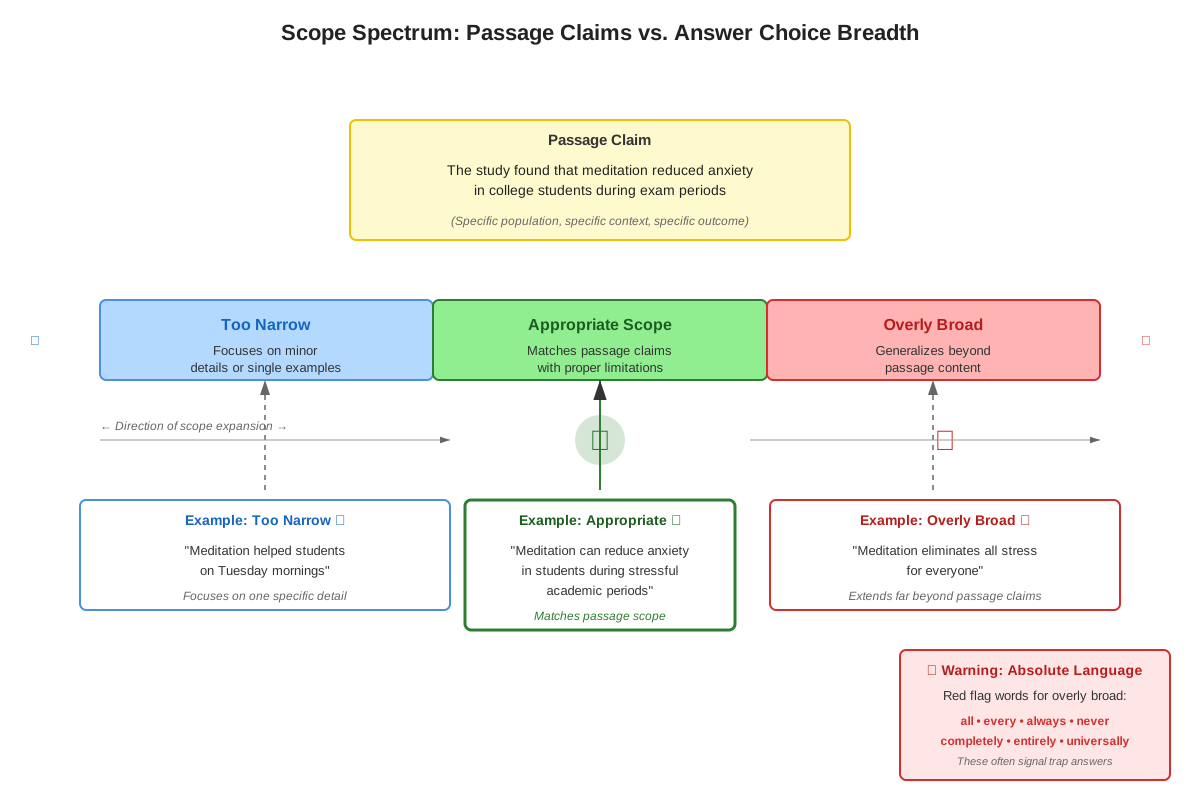
- Scope expansion: The answer applies the passage's specific claim to a larger population, time period, or context than the passage addresses
- Absolute language: Use of universal quantifiers like "all," "every," "always," "never," "completely," or "entirely" when the passage uses more limited language
- Generalization of specifics: Transformation of particular examples or limited cases into universal principles
- Topic conflation: Combination of multiple distinct ideas from the passage into a single, broader statement
The Scope Principle
The fundamental rule for identifying overly broad answer choices is the Scope Principle: The correct answer must match the passage's scope in terms of specificity, limitations, and qualifications. Any answer that extends beyond these boundaries, even if logically related or generally true, is incorrect.
Consider this framework for evaluating scope:
| Passage Scope | Appropriate Answer | Overly Broad Answer |
|---|---|---|
| "Many scientists believe..." | "Some scientists think..." | "Scientists agree..." |
| "In 19th century England..." | "In Victorian England..." | "Throughout European history..." |
| "This species of bird..." | "These particular birds..." | "Birds in general..." |
| "The author suggests..." | "The passage implies..." | "It is universally accepted..." |
Common Language Patterns in Overly Broad Choices
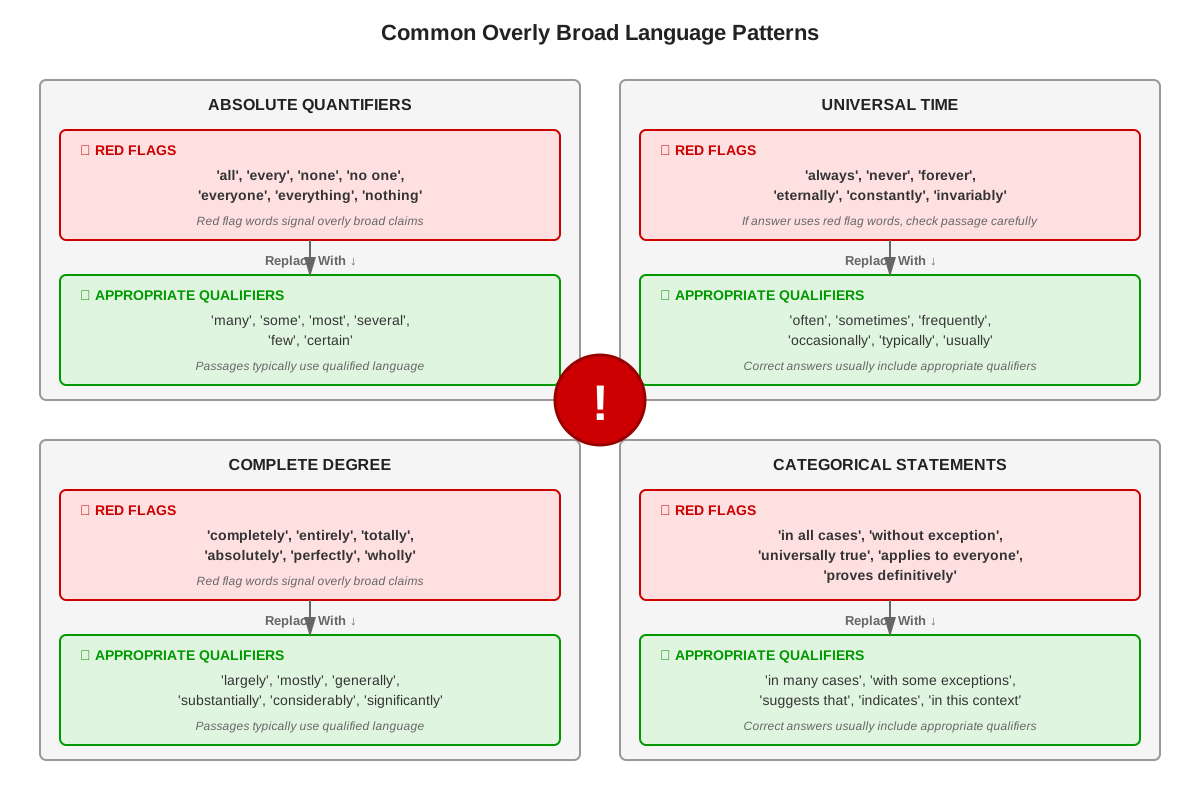
Recognizing specific linguistic markers helps students quickly identify potentially overly broad answers. These patterns include:
Absolute quantifiers: Words like "all," "every," "always," "never," "none," "completely," "entirely," "totally," and "absolutely" should trigger careful comparison with passage language. While passages occasionally use absolute language, more commonly they employ qualifiers like "many," "most," "often," "typically," "generally," or "some."
Categorical statements: Phrases that make universal claims about entire groups, time periods, or concepts without the limitations present in the passage. Examples include "throughout history," "in all cases," "universally," "without exception," and "invariably."
Expanded populations: Answer choices that apply passage claims about a specific group to a larger population. For instance, if a passage discusses "urban teenagers in Chicago," an overly broad answer might reference "American teenagers" or "young people."
The Relationship Between Passage Evidence and Answer Scope
Every correct ACT Reading answer must be directly supported by specific textual evidence. The relationship between evidence and answer scope follows this hierarchy:
- Direct statement: The passage explicitly states the claim in the answer
- Close paraphrase: The answer restates passage content using different words while maintaining identical scope
- Supported inference: The answer makes a claim that logically follows from passage evidence without extending beyond it
- Overly broad (incorrect): The answer makes claims that exceed what the passage states or implies
Strategic Approach to Elimination
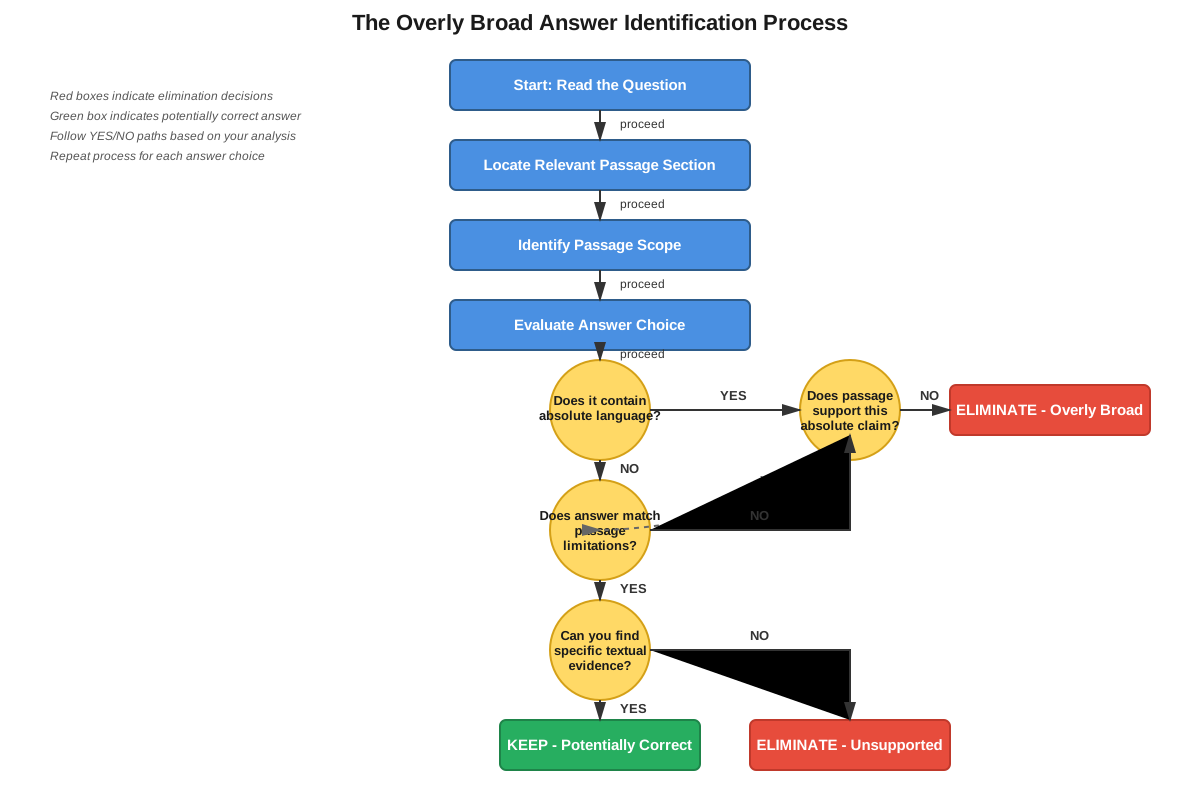
When evaluating answer choices for potential overly broad distractors, apply this systematic process:
- Identify the question's scope: Determine what specific aspect of the passage the question addresses
- Locate relevant passage evidence: Find the specific lines or paragraph that contain the answer
- Note qualifiers and limitations: Pay attention to words like "some," "may," "suggests," "in this case," or "according to"
- Compare each answer to evidence: Ask "Does the passage actually say this, or does this go beyond what's stated?"
- Flag absolute language: Mark any answer with universal claims for careful scrutiny
- Verify specificity: Ensure the answer matches the passage's level of detail and limitation
Context Clues for Identifying Overly Broad Testing
Certain question types and phrasings signal that the ACT is specifically testing the ability to avoid overly broad answers:
- Questions asking what the passage "suggests" or "implies" (testing whether students extend inferences too far)
- Questions with "according to the passage" (emphasizing the need to stay within textual boundaries)
- Main idea questions (testing whether students can identify the specific focus rather than general topic)
- Questions about the author's view or purpose (testing whether students attribute broader intentions than supported)
Concept Relationships
The ability to identify overly broad answer choices connects to multiple fundamental reading comprehension skills in a hierarchical relationship. At the foundation lies close reading → which enables → accurate detail identification → which supports → scope evaluation → which allows for → elimination of overly broad choices.
This skill also relates laterally to other wrong answer patterns. Understanding overly broad choices helps students distinguish them from overly narrow answers (which provide insufficient scope) and distortions (which misrepresent passage content). The relationship can be visualized as a spectrum: overly narrow ← correct scope → overly broad, with distortions existing as a separate category that misrepresents rather than misjudges scope.
The connection to inference questions is particularly important. While inference questions require students to go beyond what's explicitly stated, they must not go so far that they become overly broad. This creates a "Goldilocks zone" where the correct answer extends just beyond direct statements but remains firmly grounded in textual evidence. Mastering overly broad identification helps students navigate this zone effectively.
Additionally, recognizing overly broad choices reinforces understanding of author's purpose and tone. When students can identify that an answer attributes broader claims to an author than the passage supports, they develop stronger skills in understanding what authors actually argue versus what they merely mention or acknowledge.
High-Yield Facts
⭐ Overly broad answer choices appear in approximately 25% of all incorrect ACT Reading answers, making them the second most common distractor type.
⭐ Absolute language (all, every, always, never) in an answer choice requires verification that the passage uses equally absolute language.
⭐ The correct answer must match the passage's scope in terms of population, time period, and degree of certainty.
⭐ Main idea questions most frequently feature overly broad distractors that expand the passage's specific focus into a general topic.
⭐ When a passage discusses a specific example or case study, answers that generalize to "all cases" or "in general" are typically overly broad.
- Answer choices that combine multiple distinct passage ideas into a single broad statement often exceed the passage's scope.
- Qualifiers in the passage ("some," "many," "often," "may," "suggests") indicate limited scope that correct answers must respect.
- Overly broad answers are particularly tempting because they often contain accurate general knowledge about the topic.
- The phrase "according to the passage" in a question stem emphasizes the need to avoid overly broad interpretations.
- Comparing the specific nouns and subjects in the answer choice to those in the passage helps identify scope expansion.
- Time period expansion (specific era → "throughout history") is a common form of overly broad distractor.
- Overly broad answers in inference questions extend beyond what can be reasonably concluded from the evidence provided.
Quick check — test yourself on Overly broad answer choices so far.
Try Flashcards →Common Misconceptions
Misconception: If an answer choice is factually true in the real world, it must be correct. → Correction: ACT Reading questions test what the passage states or implies, not general knowledge. An answer can be factually accurate but still incorrect if it extends beyond the passage's scope.
Misconception: Longer, more detailed answer choices are more likely to be correct. → Correction: Overly broad answers are often longer because they include additional claims not supported by the passage. Length does not indicate correctness; alignment with passage scope does.
Misconception: If the passage mentions a topic, any answer about that topic is acceptable. → Correction: The passage must specifically support the claim in the answer choice. Merely mentioning a topic doesn't justify broad generalizations about it.
Misconception: Main idea questions require the broadest possible answer. → Correction: Main idea answers should capture the passage's specific focus, not the general topic area. The correct main idea matches the passage's particular angle or argument.
Misconception: Inference questions allow for any logical extension of passage ideas. → Correction: Valid inferences must be firmly grounded in textual evidence and cannot extend beyond what the passage reasonably supports. There's a clear boundary between supported inference and overly broad speculation.
Misconception: If an answer uses words from the passage, it must be correct. → Correction: Overly broad answers often incorporate passage vocabulary while making broader claims than the passage supports. Keyword matching is insufficient; scope matching is essential.
Misconception: Eliminating absolute language always eliminates the correct answer. → Correction: While overly broad answers frequently use absolute language, passages occasionally make absolute claims. The key is comparing the answer's language to the passage's language, not automatically eliminating absolutes.
Worked Examples
Example 1: Detail Question
Passage excerpt: "In the 1920s, several prominent American writers, including Ernest Hemingway and F. Scott Fitzgerald, moved to Paris. They were drawn by the city's vibrant artistic community and favorable exchange rates that made living there affordable. These expatriate authors produced some of their most celebrated works during this period."
Question: According to the passage, American writers in the 1920s moved to Paris because:
Answer Choices:
- A) Paris had always been the center of literary innovation
- B) The city offered an active arts scene and economic advantages
- C) All American writers sought to escape Prohibition
- D) European cities were universally preferred by artists
Analysis:
Choice A is overly broad in multiple ways. First, it uses "always," suggesting a universal truth across all time periods, while the passage only discusses the 1920s. Second, it makes a claim about Paris being "the center of literary innovation" that the passage never states. The passage mentions a "vibrant artistic community" but doesn't claim Paris was the center of anything. Eliminate.
Choice B accurately captures the passage's scope. It mentions "the city" (matching the specific location), uses "offered" (appropriately tentative), and identifies the two specific reasons given: "vibrant artistic community" (paraphrased as "active arts scene") and "favorable exchange rates" (paraphrased as "economic advantages"). This matches the passage's scope exactly. Correct answer.
Choice C is overly broad because it uses "All American writers," while the passage specifies only "several prominent American writers." Additionally, the passage never mentions Prohibition as a motivation. This answer extends beyond passage content. Eliminate.
Choice D is overly broad in several ways: "universally preferred" is absolute language not supported by the passage, "European cities" expands beyond the specific city of Paris discussed, and "artists" is broader than the "writers" specifically mentioned. Eliminate.
Key takeaway: The correct answer (B) maintains the passage's specific scope regarding who moved (some writers, not all), where they moved (Paris specifically), and why (the two specific reasons given). All other choices expand beyond these boundaries.
Example 2: Main Idea Question
Passage excerpt: "Recent studies of the Monarch butterfly's migration patterns have revealed surprising flexibility in their routes. While researchers previously believed these butterflies followed rigid, genetically programmed paths from Canada to Mexico, new GPS tracking data shows that individual butterflies adjust their routes based on weather conditions and food availability. This discovery challenges long-held assumptions about insect navigation and suggests that even small-brained creatures possess more adaptive capabilities than scientists once thought."
Question: The main point of the passage is that:
Answer Choices:
- A) All insect species demonstrate advanced problem-solving abilities
- B) Monarch butterflies can modify their migration routes in response to environmental factors
- C) Scientific understanding of animal behavior is always evolving
- D) Genetic programming plays no role in butterfly migration
Analysis:
Choice A is overly broad in multiple dimensions. The passage discusses only Monarch butterflies, not "all insect species." It mentions "adaptive capabilities" but doesn't claim "advanced problem-solving abilities." This answer takes the specific finding about one species and inappropriately generalizes it to all insects. Eliminate.
Choice B accurately captures the passage's main point with appropriate scope. It specifies "Monarch butterflies" (matching the passage's subject), uses "can modify" (appropriately indicating capability without overstating), and identifies "environmental factors" as the cause (encompassing the "weather conditions and food availability" mentioned). This answer stays within the passage's boundaries. Correct answer.
Choice C is overly broad because it generalizes the specific finding about Monarch butterflies into a universal statement about "scientific understanding of animal behavior." While the passage does mention challenging "long-held assumptions," this isn't the main point—it's a consequence of the specific discovery about Monarch butterflies. The answer extends beyond the passage's focus. Eliminate.
Choice D is actually too narrow and also distorts the passage. The passage states that butterflies don't follow "rigid, genetically programmed paths," but this doesn't mean genetics play "no role." This answer goes beyond what the passage states by making an absolute claim the passage doesn't support. Eliminate.
Key takeaway: The correct answer (B) identifies the specific subject (Monarch butterflies), the specific discovery (route flexibility), and the specific cause (environmental factors) without expanding to broader claims about all insects, all science, or completely eliminating genetic factors.
Exam Strategy
Systematic Approach for ACT Reading Questions
When approaching any ACT Reading question, implement this process to identify and eliminate overly broad answer choices:
Step 1: Read the question stem carefully and identify any scope limiters like "according to the passage," "the author suggests," or "in the third paragraph." These phrases signal that answers must stay within specific boundaries.
Step 2: Return to the passage and locate the relevant section. Don't rely on memory—verify the exact language, qualifiers, and limitations the passage uses.
Step 3: Before looking at answer choices, predict what the answer should include based on passage evidence. Note the specific scope: Who? What? When? Where? How much?
Step 4: Evaluate each answer choice by asking three questions:
- Does this match the passage's specific subject (not a broader category)?
- Does this match the passage's degree of certainty (qualifiers like "some," "may," "suggests")?
- Does this match the passage's limitations (time period, location, population)?
Step 5: Flag answers with absolute language ("all," "always," "never," "every") and verify whether the passage uses equally absolute language. If not, eliminate.
Trigger Words and Phrases
In question stems, these phrases indicate heightened risk of overly broad distractors:
- "According to the passage" (emphasizes staying within textual boundaries)
- "The passage suggests" (tests whether students extend inferences too far)
- "The author's main point" (tests whether students confuse general topic with specific focus)
- "Based on the passage" (requires direct textual support)
In answer choices, these words signal potential overly broad answers:
- Absolute quantifiers: all, every, always, never, none, completely, entirely, totally
- Universal scope: throughout history, universally, in all cases, without exception
- Categorical claims: proves, demonstrates conclusively, establishes definitively
- Expanded populations: people in general, everyone, all members of [group]
Process of Elimination Strategy
Use this hierarchy to eliminate overly broad answers efficiently:
- First pass: Eliminate answers with absolute language that doesn't match passage language (saves 10-15 seconds)
- Second pass: Eliminate answers that expand the passage's subject, population, or time period
- Third pass: Between remaining choices, select the one that most closely matches passage qualifiers and limitations
Exam Tip: If you're down to two answers and one is broader than the other, the more specific answer is usually correct. The ACT rewards precision over generalization.
Time Allocation
For questions testing overly broad recognition:
- Detail questions: 30-45 seconds (quick passage reference, straightforward comparison)
- Main idea questions: 45-60 seconds (requires considering entire passage scope)
- Inference questions: 60-75 seconds (requires careful boundary evaluation)
Don't spend extra time trying to justify an overly broad answer. If it extends beyond passage scope, eliminate it immediately and move forward.
Memory Techniques
The SCOPE Acronym
Use SCOPE to remember the key elements to check when evaluating answer choices:
- Subject: Does the answer match the passage's specific subject, or does it broaden to a larger category?
- Certainty: Does the answer match the passage's degree of certainty (qualifiers like "may," "some," "suggests")?
- Origin: Does the answer stay within what the passage states, or does it add outside information?
- Population: Does the answer match the specific group discussed, or does it expand to "all" or "everyone"?
- Extent: Does the answer match the passage's time period, location, and other limitations?
The "Zoom Lens" Visualization
Imagine a camera zoom lens when evaluating answers. The passage provides a specific "zoom level"—perhaps focused on one species of bird in one region during one season. An overly broad answer is like zooming out too far—suddenly you're looking at all birds, all regions, all times. The correct answer maintains the passage's exact zoom level.
The "Three Absolutes" Rule
Remember: Absolute language requires absolute verification. If an answer uses "all," "always," or "never," the passage must use equally absolute language. If the passage says "many," "often," or "rarely," the absolute answer is wrong. Think: "Three absolutes—answer, passage, match—all three or eliminate."
The Boundary Box Technique
Visualize drawing a box around the passage's specific claims. The correct answer must fit entirely within this box. If any part of an answer extends outside the box (broader subject, longer time period, larger population), it's overly broad. Ask: "Does this fit in the box?"
Summary
Overly broad answer choices represent one of the most prevalent and challenging distractor types on the ACT Reading section, appearing in approximately 25% of incorrect answers across all question types. These choices are deliberately designed to test whether students can distinguish between general statements about a topic and the specific claims, limitations, and scope that the passage actually presents. The fundamental principle for identifying these distractors is the Scope Principle: correct answers must match the passage's scope in terms of subject specificity, degree of certainty, population, time period, and qualifications. Students must develop the ability to recognize common markers of overly broad answers, including absolute language (all, always, never, every), expanded populations (applying specific claims to broader groups), and categorical statements that exceed passage limitations. Success requires a systematic approach: carefully reading question stems for scope indicators, locating specific passage evidence, noting qualifiers and limitations, and comparing each answer choice against the passage's exact boundaries. By mastering this skill, students not only improve their ACT Reading scores but also develop critical thinking abilities essential for college-level academic work and real-world information evaluation.
Key Takeaways
- Overly broad answer choices extend beyond the specific scope, limitations, or details presented in the passage, making them incorrect even if generally true
- The Scope Principle requires that correct answers match the passage's specificity regarding subject, certainty, population, time period, and qualifications
- Absolute language (all, every, always, never) in answer choices requires verification that the passage uses equally absolute language
- Main idea questions most frequently feature overly broad distractors that confuse the general topic with the passage's specific focus
- Systematic elimination involves checking whether answers expand the passage's subject, population, time period, or degree of certainty
- Qualifiers in the passage ("some," "many," "often," "may") indicate limited scope that correct answers must respect
- The SCOPE acronym (Subject, Certainty, Origin, Population, Extent) provides a memorable framework for evaluating answer choices against passage boundaries
Related Topics
Overly Narrow Answer Choices: While overly broad answers extend beyond passage scope, overly narrow answers provide insufficient scope by focusing on minor details rather than the question's actual focus. Mastering overly broad identification prepares students to recognize the opposite extreme.
Distortion and Misrepresentation: These wrong answers don't just expand scope—they actively misrepresent passage content. Understanding overly broad choices helps students distinguish between scope problems and accuracy problems.
Valid Inference Techniques: Since inference questions require going beyond explicit statements without becoming overly broad, mastering this topic enables students to navigate the "Goldilocks zone" of appropriate inference.
Author's Purpose and Tone: Recognizing when answers attribute broader intentions or stronger attitudes to authors than passages support builds on overly broad identification skills.
Textual Evidence Evaluation: The ability to match answer scope to passage evidence is fundamental to all ACT Reading questions and represents the next level of mastery after identifying overly broad choices.
Practice CTA
Now that you understand how to identify and eliminate overly broad answer choices, it's time to put this knowledge into practice. Complete the practice questions associated with this topic, paying special attention to comparing answer scope with passage scope. Use the SCOPE acronym and systematic elimination process you've learned. As you work through questions, you'll develop the instinct to quickly spot overly broad distractors, significantly improving your accuracy and speed on the ACT Reading section. Remember: every overly broad answer you correctly eliminate brings you one step closer to your target score. You've got this!
Sign up free to keep reading
Create a free AnvayaPrep account to finish this ACT guide on Overly broad answer choices — plus flashcards and practice questions.