Overview
Overly narrow answer choices represent one of the most sophisticated trap types on the ACT Reading test. These deceptive options contain information that is technically accurate and appears in the passage, but they fail to capture the full scope of what the question is asking. Unlike completely incorrect answers, overly narrow choices present a partial truth—they address only one aspect of a multi-faceted question or focus on a minor detail when the question demands a comprehensive understanding. This makes them particularly challenging for students who recognize familiar content from the passage and select the answer too quickly.
Understanding how to identify and eliminate overly narrow answer choices is essential for achieving a high score on the ACT Reading section. These trap answers appear frequently across all passage types—prose fiction, social science, humanities, and natural science—and they test whether students can distinguish between supporting details and main ideas, between examples and overarching concepts, and between partial explanations and complete answers. The ACT deliberately crafts these choices to appeal to students who have read the passage but haven't fully synthesized the information or carefully analyzed what the question is specifically requesting.
Mastering this concept connects directly to broader reading comprehension skills tested throughout the ACT. The ability to recognize overly narrow answers requires understanding passage structure, identifying main ideas versus supporting details, recognizing the scope of questions, and evaluating whether an answer choice fully addresses all components of a question stem. This skill intersects with other critical reading strategies, including identifying the author's purpose, understanding tone and perspective, and synthesizing information from multiple paragraphs.
Learning Objectives
- [ ] Identify when overly narrow answer choices are being tested in ACT Reading questions
- [ ] Explain the core rule or strategy behind recognizing and eliminating overly narrow answer choices
- [ ] Apply strategies for detecting overly narrow answer choices to ACT-style questions accurately
- [ ] Distinguish between overly narrow answers and appropriately specific correct answers
- [ ] Evaluate answer choices by comparing their scope to the scope of the question stem
- [ ] Recognize common patterns and triggers that signal an answer may be too narrow
- [ ] Develop a systematic approach for verifying that an answer addresses all parts of a multi-component question
Prerequisites
- Understanding of main idea versus supporting details: Essential for recognizing when an answer focuses on a detail rather than the broader concept the question requires
- Ability to identify question scope: Necessary to determine whether a question asks about a specific paragraph, multiple paragraphs, or the entire passage
- Familiarity with ACT question types: Helps recognize which question formats are most susceptible to overly narrow trap answers
- Basic passage annotation skills: Enables students to track the breadth of information relevant to each question
- Understanding of how to eliminate wrong answers: Provides the foundation for adding "too narrow" to the elimination criteria toolkit
Why This Topic Matters
In real-world reading comprehension, the ability to distinguish between partial and complete answers is crucial for academic success, professional communication, and critical thinking. When analyzing complex texts, readers must evaluate whether their understanding captures the full scope of an argument or only fragments of it. This skill translates directly to college coursework, where essay questions and discussion prompts require comprehensive responses rather than narrow, detail-focused answers.
On the ACT Reading test, overly narrow answer choices appear in approximately 15-20% of all questions, making them one of the most frequent trap types students encounter. They are particularly common in questions that ask about the "main purpose," "primary function," "overall effect," or "best description" of a passage, paragraph, or literary element. These questions explicitly require comprehensive answers, making them prime opportunities for test makers to include narrow trap answers that capture only one aspect of the correct response.
This topic appears across multiple question formats on the exam. In main idea questions, narrow answers might focus on a single example rather than the overarching concept. In function questions asking why an author includes specific information, narrow answers might identify what the information says rather than why it's included. In inference questions, narrow answers might address only one piece of evidence when the correct inference requires synthesizing multiple details. In vocabulary-in-context questions, narrow answers might provide one definition of a word without considering how the passage uses it. Understanding this pattern helps students anticipate where narrow traps will appear and approach those questions with heightened awareness.
Core Concepts
Definition and Characteristics of Overly Narrow Answers
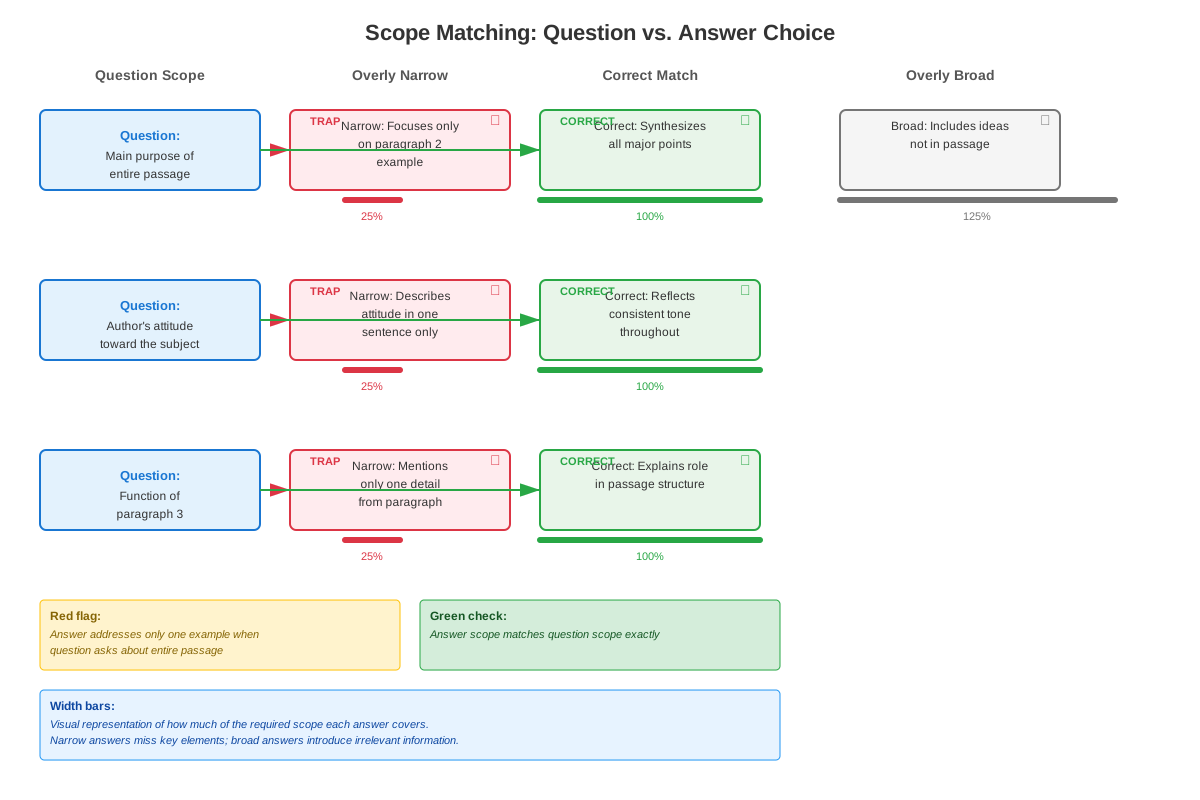
An overly narrow answer choice is a response option that contains accurate information from the passage but fails to encompass the full scope required by the question. These answers are "too small"—they zoom in on one detail, example, or aspect when the question demands a broader perspective. The key characteristic that distinguishes narrow answers from correct answers is scope mismatch: the answer's breadth doesn't align with the question's breadth.
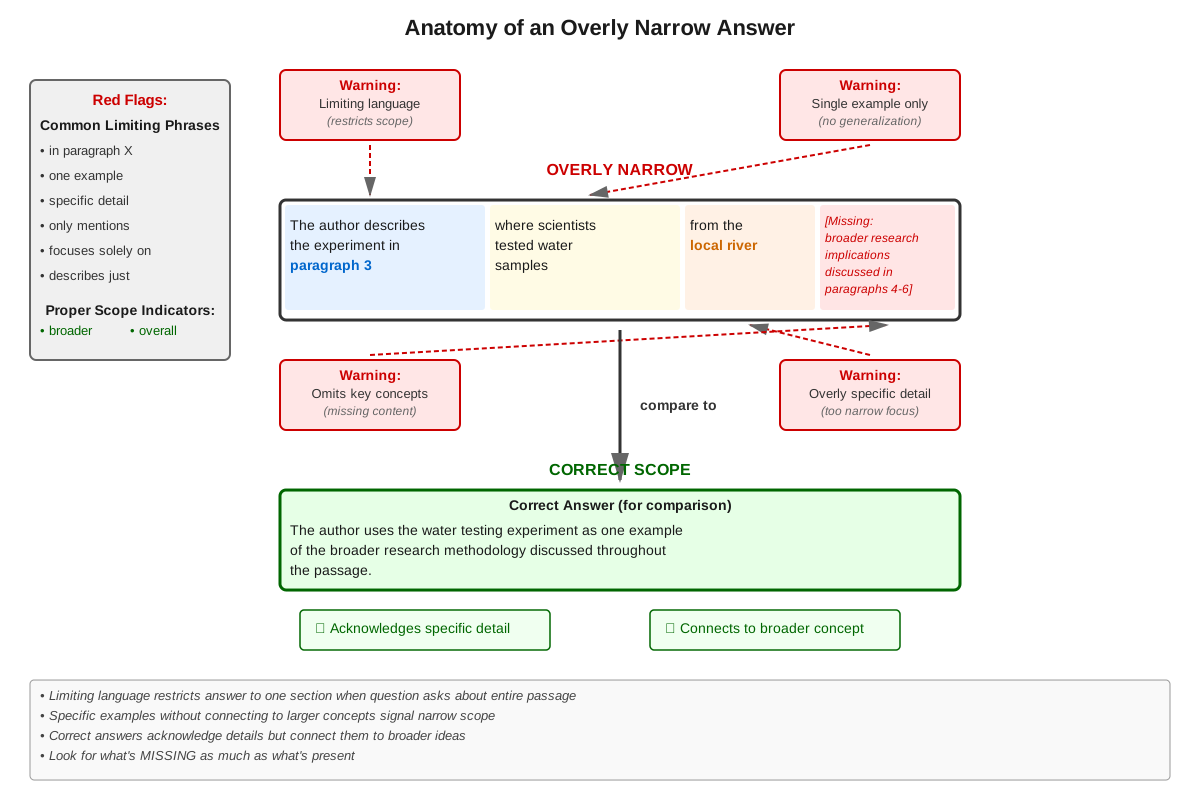
ACT overly narrow answer choices typically exhibit several identifying features. First, they often reference specific examples, particular instances, or individual details mentioned in the passage. Second, they use language that is more restrictive or limited than the correct answer, employing words like "only," "specifically," "particularly," or "exclusively." Third, they address just one component of a multi-part question while ignoring other required elements. Fourth, they may be correct for a portion of the passage but not for the entire scope the question addresses.
The Scope Principle
The fundamental strategy for identifying narrow answers relies on understanding scope alignment. Every ACT Reading question has an implicit or explicit scope—the range of text it covers and the breadth of concept it addresses. Questions might ask about:
- A specific word or phrase (narrowest scope)
- A single sentence or detail
- A paragraph or section
- Multiple paragraphs or sections
- The entire passage (broadest scope)
- A concept or theme throughout the passage
The correct answer must match this scope precisely. An overly narrow answer addresses a scope smaller than what the question requires. Consider this comparison:
| Question Scope | Appropriate Answer Scope | Overly Narrow Answer Scope |
|---|---|---|
| "The passage as a whole primarily..." | Addresses the main theme throughout | Focuses on one example from paragraph 3 |
| "The author's main purpose in lines 45-60 is to..." | Covers the complete function of that section | Mentions only one detail from line 47 |
| "The narrator's attitude toward the city can best be described as..." | Synthesizes multiple descriptions throughout | References only the opening scene |
Common Question Types Vulnerable to Narrow Traps
Certain ACT Reading question formats are particularly susceptible to overly narrow trap answers. Main idea and primary purpose questions frequently include narrow answers that focus on supporting details or examples rather than the overarching concept. For instance, if a passage discusses how three different scientists contributed to understanding climate change, a narrow answer might mention only one scientist's contribution when the question asks about the passage's main focus.
Function questions—those asking "why" an author includes something or "what purpose" a paragraph serves—often feature narrow answers that describe "what" the content says rather than explaining its rhetorical function. If a question asks why an author describes a character's childhood, a narrow answer might state "to show the character grew up poor" when the correct answer is "to explain the character's later motivations and values."
Inference and suggestion questions can include narrow answers that rely on only one piece of evidence when the correct inference requires synthesizing multiple details. If a passage provides three different indicators that a character is nervous, a narrow answer might reference only one indicator while the correct answer encompasses the pattern.
The Part-Versus-Whole Relationship
Understanding the relationship between parts and wholes is crucial for avoiding narrow traps. Many passages present information in a hierarchical structure: specific examples support broader points, which in turn support the main idea. Overly narrow answers often confuse levels in this hierarchy.
Consider this structure:
- Main Idea: Technology has transformed modern communication
- Supporting Point 1: Social media changed personal relationships
- Example: Facebook reconnected old friends
- Supporting Point 2: Mobile devices enabled constant connectivity
- Example: Smartphones allow instant messaging
If a question asks what the passage primarily discusses, an answer focusing on Facebook would be overly narrow (it's an example). An answer about social media would still be too narrow (it's one supporting point). The correct answer would address technology's transformation of communication broadly.
Distinguishing Narrow from Appropriately Specific
Not all specific answers are overly narrow—this is a critical distinction. The ACT includes many questions that require specific, detailed answers. The difference lies in whether the specificity matches the question's scope. An appropriately specific answer provides the precise level of detail the question requests, while an overly narrow answer provides more detail or limitation than requested.
For example, if a question asks "According to the passage, what specific method did the researcher use to collect data?" an answer stating "underwater photography" might be appropriately specific. However, if the question asks "What approach did the researcher take to studying marine life?" that same answer would be overly narrow if the researcher used multiple methods including photography, observation, and sample collection.
Signal Words and Phrases
Certain language patterns frequently appear in overly narrow answer choices. Restrictive language like "only," "solely," "exclusively," "merely," "just," and "simply" often signals an answer that's too limited. Specific references to particular examples, individual instances, or single details can indicate narrowness when the question requires broader coverage. Partial lists that mention "some" elements when the question implies "all" relevant elements also suggest narrow scope.
Conversely, correct answers to broad-scope questions often use inclusive language like "various," "multiple," "overall," "primarily," "generally," "throughout," and "comprehensive." These words signal that the answer encompasses the full range required.
Concept Relationships
The concept of overly narrow answer choices connects directly to several fundamental reading comprehension skills. Understanding passage structure enables students to recognize the hierarchical relationship between main ideas, supporting points, and specific examples—the foundation for identifying when an answer operates at the wrong level of this hierarchy. This structural awareness feeds into recognizing narrow answers because students can map where in the hierarchy each answer choice falls.
Question analysis skills form another crucial connection. Before evaluating answer choices, students must determine the question's scope by identifying key words like "primarily," "main," "overall," "throughout," or "passage as a whole" versus "specifically," "in lines X-Y," or "the example of." This analysis directly informs the scope-matching process central to eliminating narrow answers.
The relationship flows as follows:
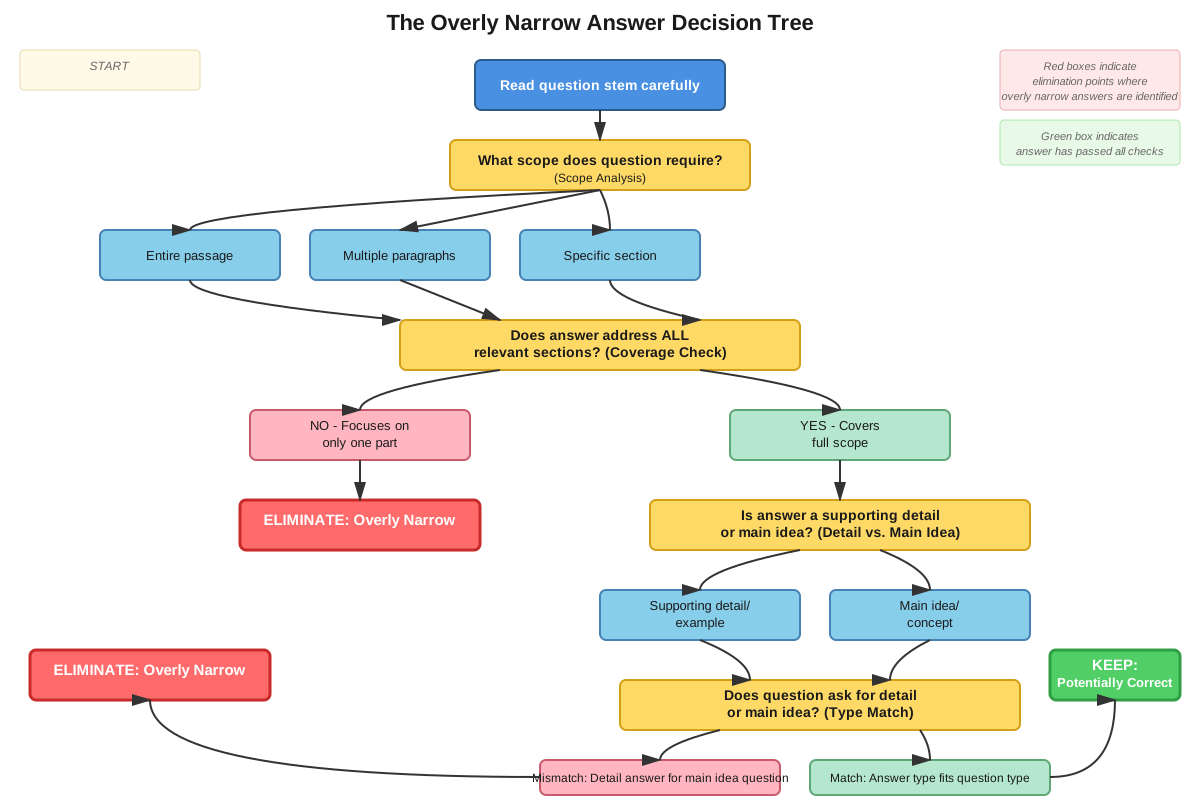
Passage Structure Analysis → Question Scope Identification → Answer Scope Evaluation → Narrow Answer Elimination
Additionally, this concept relates to process of elimination strategies. Students typically eliminate answers in this order: (1) factually incorrect answers, (2) answers contradicting the passage, (3) overly narrow answers, (4) overly broad answers, and (5) answers with wrong tone or emphasis. Understanding where narrow answer elimination fits in this sequence improves efficiency.
The concept also connects to synthesis skills—the ability to combine information from multiple parts of a passage. Questions requiring synthesis are particularly vulnerable to narrow trap answers because students might recognize one piece of relevant information and select an answer addressing only that piece, missing that the question requires integrating multiple pieces.
High-Yield Facts
⭐ Overly narrow answer choices contain accurate information from the passage but fail to match the full scope of the question
⭐ Questions using words like "primarily," "main," "overall," or "throughout" are highly susceptible to narrow trap answers
⭐ Narrow answers often focus on specific examples when the question asks about broader concepts or patterns
⭐ The correct answer's scope must align precisely with the question's scope—neither too narrow nor too broad
⭐ Function questions asking "why" frequently include narrow traps that describe "what" instead
- Restrictive language like "only," "solely," or "exclusively" often signals an overly narrow answer choice
- Narrow answers may address just one component of a multi-part question while ignoring other required elements
- Appropriately specific answers differ from narrow answers based on whether the specificity matches what the question requests
- Approximately 15-20% of ACT Reading questions include overly narrow trap answers
- Synthesis questions requiring information from multiple paragraphs are particularly vulnerable to narrow traps that reference only one paragraph
- Narrow answers often appear in the middle positions (B or C) rather than as the first or last option
- Main idea questions about entire passages frequently include narrow answers focusing on one paragraph or section
- Character analysis questions often feature narrow answers addressing one trait when the question requires a comprehensive description
- Inference questions may include narrow answers based on single pieces of evidence when multiple pieces are needed
- Comparing the breadth of language between answer choices helps identify which options are too narrow or too broad
Quick check — test yourself on Overly narrow answer choices so far.
Try Flashcards →Common Misconceptions
Misconception: If an answer contains information from the passage, it must be correct.
Correction: Accuracy alone doesn't make an answer correct—the answer must also match the scope of the question. Many narrow trap answers contain perfectly accurate information but address only part of what the question asks.
Misconception: More specific answers are always better than general answers.
Correction: The best answer matches the question's level of specificity. For broad questions asking about main ideas or overall purposes, more general answers are often correct, while specific answers are too narrow. For detail questions, specific answers are appropriate.
Misconception: If an answer addresses the paragraph mentioned in the question, it's correct.
Correction: Even when a question references specific lines or paragraphs, the correct answer often requires understanding how that section relates to broader passage themes. Narrow answers might describe only what's in those lines without explaining their function or significance.
Misconception: Longer, more detailed answers are more likely to be correct.
Correction: Length doesn't determine correctness. Narrow answers can be quite long, providing extensive detail about one limited aspect. Conversely, correct answers to broad questions might be relatively concise while still encompassing the full scope required.
Misconception: Eliminating narrow answers means always choosing the broadest option.
Correction: The goal is scope alignment, not maximum breadth. Overly broad answers that go beyond the passage's scope are also incorrect. The correct answer should be neither too narrow nor too broad but precisely matched to the question's scope.
Misconception: Narrow answers only appear in main idea questions.
Correction: While main idea questions frequently feature narrow traps, these answers appear across all question types including function questions, inference questions, detail questions, and vocabulary-in-context questions. Any question with a scope broader than a single detail is vulnerable.
Misconception: If multiple answer choices seem partially correct, choose the one with the most specific information from the passage.
Correction: When multiple answers seem partially correct, the issue is often that some are too narrow. In this situation, choose the answer that encompasses all the relevant information, not the one with the most specific detail.
Worked Examples
Example 1: Main Idea Question
Passage Context: A passage discusses how urban gardens benefit cities by providing fresh food, creating community gathering spaces, reducing urban heat, improving air quality, and offering educational opportunities for children.
Question: The passage primarily serves to:
Answer Choices:
- A) Explain how urban gardens provide fresh vegetables to city residents
- B) Describe the multiple benefits urban gardens offer to cities
- C) Argue that urban gardens are the best solution to food deserts
- D) Illustrate how children learn about plants through garden programs
Analysis:
First, identify the question scope. The word "primarily" signals this asks about the main purpose of the entire passage, requiring a broad-scope answer.
Choice A is overly narrow. While the passage does mention fresh food, this is only one of five benefits discussed. An answer focusing solely on vegetables captures approximately 20% of the passage's content. The restrictive phrase "provide fresh vegetables" limits the scope too much—the passage discusses fresh food more broadly and four other major benefits.
Choice B matches the question scope. "Multiple benefits" encompasses all five advantages discussed throughout the passage. The word "multiple" signals comprehensive coverage, and "benefits" is broad enough to include food, community, environmental, and educational advantages.
Choice C is incorrect for multiple reasons, including being overly narrow in a different way. While it's broad in claiming gardens are "the best solution," it narrows the focus to only food deserts when the passage addresses urban benefits generally. This demonstrates that narrow answers can contain broad language about a limited topic.
Choice D is overly narrow. Educational opportunities for children represent just one of five benefits. The specific focus on "children learn about plants" zooms in on an example when the question asks about the passage's primary purpose.
Correct Answer: B
Key Lesson: When a question asks about what a passage "primarily" does, eliminate answers that focus on single examples or individual supporting points, even if those points are discussed in detail.
Example 2: Function Question
Passage Context: In a literary passage, the narrator describes her grandmother's kitchen in vivid sensory detail—the smell of baking bread, the worn wooden table, the sunlight through lace curtains, and the sound of the radio playing. The passage then explains how these memories shaped the narrator's later decision to become a chef and her philosophy about food bringing people together.
Question: The author's description of the grandmother's kitchen (lines 12-28) primarily serves to:
Answer Choices:
- A) Illustrate the grandmother's skill at baking bread
- B) Establish the sensory-rich environment that influenced the narrator's career path
- C) Demonstrate the narrator's ability to recall specific details from childhood
- D) Show that the grandmother's house had old-fashioned furnishings
Analysis:
Identify the question scope: "primarily serves to" asks about the function or purpose of the description, requiring understanding of why the author included it, not just what it describes.
Choice A is overly narrow in two ways. First, it focuses on only one detail (bread baking) from a multi-sensory description. Second, and more importantly, it describes what the passage says rather than explaining the description's function. This is a classic narrow trap in function questions—describing content instead of explaining purpose.
Choice B correctly identifies the function. It connects the description to its purpose: establishing the environment that influenced the narrator's later choices. "Sensory-rich environment" encompasses all the details (smell, sight, sound), and "influenced the narrator's career path" explains why the author included this description—to show the origins of the narrator's relationship with food and cooking.
Choice C describes what the passage demonstrates but not why the author included it. This answer focuses on the narrator's memory ability rather than the significance of what's remembered. It's too narrow because it addresses a surface-level observation rather than the deeper purpose.
Choice D is overly narrow, focusing on one detail (furnishings) and missing the functional purpose entirely. Like Choice A, it describes what's in the passage rather than explaining why it's there.
Correct Answer: B
Key Lesson: In function questions, narrow answers often describe "what" the passage says rather than explaining "why" the author included it. The correct answer must address purpose, not just content, and must encompass the full scope of the described section.
Exam Strategy
When approaching ACT Reading questions, implement a systematic process to identify and eliminate overly narrow answer choices:
Step 1: Analyze the Question Scope
Before reading answer choices, identify scope indicators in the question stem. Circle words like "primarily," "main," "overall," "throughout," "passage as a whole," or "best described as"—these signal that narrow answers are likely traps. Note whether the question asks about specific lines, a paragraph, multiple sections, or the entire passage.
Step 2: Predict the Scope of the Correct Answer
Based on the question scope, mentally predict how broad or specific the correct answer should be. For "main idea" questions, expect answers addressing overarching themes. For "according to lines X-Y" questions, expect answers focused on that specific section but potentially connecting to broader context.
Step 3: Apply the Scope-Matching Test
As you evaluate each answer choice, ask: "Does this answer's breadth match the question's breadth?" If the question asks about the entire passage but an answer focuses on one paragraph, eliminate it as too narrow. If the question asks about a specific function but an answer addresses only one aspect of that function, eliminate it.
Step 4: Watch for Trigger Words
Narrow Answer Triggers: "only," "solely," "exclusively," "specifically," "particularly," "merely," specific examples, individual instances, single details
Appropriate Broad Answer Indicators: "various," "multiple," "overall," "primarily," "generally," "throughout," "comprehensive," "several"
Step 5: Use the "But What About..." Test
When an answer seems correct, challenge it by asking "But what about [other relevant information from the passage]?" If significant relevant information isn't covered by the answer, it's likely too narrow. For example, if an answer addresses the author's tone in the first half of the passage, ask "But what about the tone in the second half?"
Step 6: Compare Answer Breadth
When multiple answers seem plausible, compare their relative breadth. Often, one answer will be notably narrower than others. If you've identified the question requires broad scope, eliminate the narrowest options first.
Time Allocation Advice: Don't spend extra time trying to justify narrow answers. If your initial reaction is "this answer is true but seems incomplete," trust that instinct and look for a more comprehensive option. Students often waste time convincing themselves a narrow answer is correct because it contains accurate information. Remember: accuracy ≠ correctness when scope doesn't match.
Process of Elimination Order:
- Eliminate factually incorrect answers
- Eliminate answers contradicting the passage
- Eliminate overly narrow answers (for broad-scope questions)
- Eliminate overly broad answers (for specific-scope questions)
- Choose the remaining answer that best matches question scope
Memory Techniques
SCOPE Acronym for evaluating answers:
- Size up the question's breadth first
- Compare answer breadth to question breadth
- Observe trigger words signaling narrow scope
- Predict what a complete answer should cover
- Eliminate answers missing key components
The Zoom Lens Visualization: Picture the question as setting a zoom level on a camera. Main idea questions are "zoomed out" to capture the whole scene. Detail questions are "zoomed in" on specific elements. An overly narrow answer is zoomed in too far for the question's zoom setting. When evaluating answers, visualize whether each answer's "zoom level" matches the question's.
The Umbrella Test: Imagine the correct answer as an umbrella that must cover all relevant information. If significant relevant details stick out from under the umbrella, the answer is too narrow. This visualization helps especially with synthesis questions requiring information from multiple paragraphs.
The "One Example" Red Flag: Train yourself to mentally flag any answer that focuses on a single example, instance, or detail when the question uses words like "primarily," "main," or "overall." Create an automatic association: "primarily" = "not just one example."
Breadth Comparison Mnemonic - WIDE:
- What does the question ask about? (Identify scope)
- Is this answer inclusive enough? (Check coverage)
- Does it describe just one detail? (Red flag for narrow)
- Evaluate if anything's missing (Completeness check)
Summary
Overly narrow answer choices represent a sophisticated trap type on the ACT Reading test, containing accurate information from the passage while failing to match the full scope required by the question. These answers typically focus on specific examples, individual details, or single aspects when questions demand comprehensive understanding of broader concepts, multiple elements, or overarching themes. Success in identifying and eliminating narrow answers depends on mastering scope alignment—ensuring the breadth of the answer precisely matches the breadth of the question. This requires careful analysis of question stems for scope indicators like "primarily," "main," "overall," or "throughout," which signal vulnerability to narrow traps. Students must distinguish between appropriately specific answers (which match the question's requested specificity) and overly narrow answers (which provide more limitation than requested). The strategy involves systematic evaluation: analyzing question scope, predicting appropriate answer breadth, watching for trigger words, and applying the "but what about" test to ensure answers encompass all relevant information. This skill appears across all ACT Reading question types and passages, making it essential for achieving high scores.
Key Takeaways
- Overly narrow answer choices contain accurate passage information but fail to match the question's full scope—they're "too small" for what's being asked
- Questions with words like "primarily," "main," "overall," or "throughout" are highly susceptible to narrow trap answers focusing on single examples or details
- The correct answer's breadth must align precisely with the question's breadth; evaluate scope match before selecting an answer
- Function questions asking "why" frequently include narrow traps that describe "what" instead of explaining purpose
- Use the "but what about" test: if an answer seems correct but leaves out significant relevant information, it's likely too narrow
- Distinguish appropriately specific answers from overly narrow ones by determining whether the specificity matches what the question requests
- Implement systematic scope analysis: identify question breadth, predict answer breadth, compare options, and eliminate mismatches
Related Topics
Overly Broad Answer Choices: The opposite trap type, where answers extend beyond the passage's scope or make claims not supported by the text. Mastering narrow answer identification provides the foundation for recognizing when answers go too far in the other direction.
Main Idea vs. Supporting Details: Understanding the hierarchical structure of passages—how examples support points, which support main ideas—is essential for recognizing when answers operate at the wrong level of this hierarchy.
Question Stem Analysis: Developing skills to identify question type, scope, and specific requirements before evaluating answers. This foundational skill directly enables effective narrow answer identification.
Synthesis and Integration Questions: Questions requiring students to combine information from multiple paragraphs or sections are particularly vulnerable to narrow answers that address only one component. Mastering narrow answer identification is crucial for these high-difficulty questions.
Process of Elimination Strategies: Comprehensive approaches to systematically eliminating wrong answers, of which narrow answer identification is one critical component. Understanding where this fits in the overall elimination sequence improves efficiency.
Practice CTA
Now that you understand how to identify and eliminate overly narrow answer choices, it's time to apply these strategies to real ACT-style questions. The practice questions and flashcards will help you develop the automatic recognition skills needed to spot narrow traps quickly during the actual exam. Focus on implementing the SCOPE acronym and scope-matching test with each question. Remember, mastering this skill can significantly improve your score because narrow answers appear in 15-20% of all Reading questions—that's 6-8 questions per test! Approach each practice question systematically, and you'll build the confidence and expertise needed to navigate these sophisticated traps successfully on test day.
Sign up free to keep reading
Create a free AnvayaPrep account to finish this ACT guide on Overly narrow answer choices — plus flashcards and practice questions.