Overview
Paraphrasing details is one of the most frequently tested skills on the ACT Reading section, appearing in approximately 30-40% of all questions. This skill requires students to recognize when answer choices restate information from the passage using different words and sentence structures while maintaining the original meaning. Unlike direct quotation questions that use identical language, paraphrasing questions test whether students truly comprehend what they've read by presenting the same ideas in alternative phrasing.
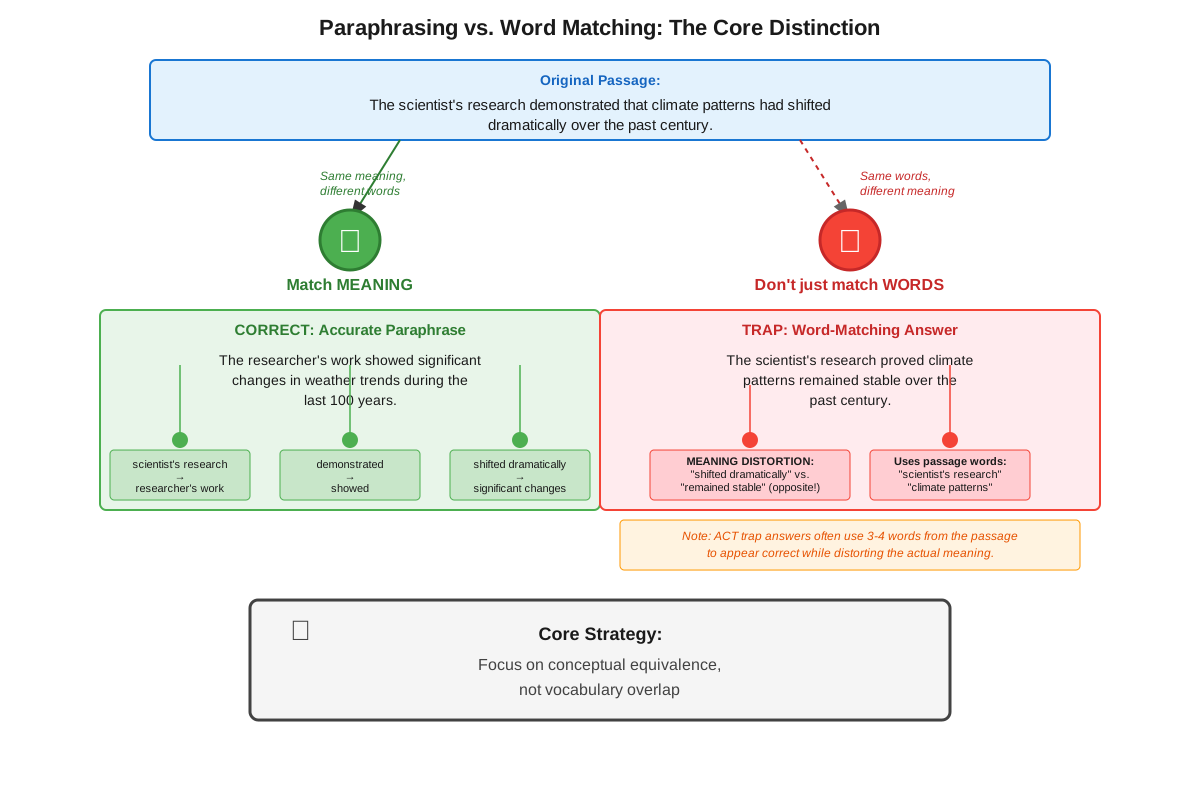
The ACT deliberately designs answer choices to include trap options that use exact words from the passage but distort the meaning, alongside correct answers that use completely different vocabulary while accurately capturing the passage's intent. Mastering ACT paraphrasing details enables students to distinguish between superficial word matching and genuine comprehension. This skill is foundational because it underlies nearly every question type on the Reading section—from main idea questions to inference questions to detail-oriented queries.
Understanding paraphrasing connects directly to broader reading comprehension strategies. It builds upon literal comprehension skills while serving as a gateway to more advanced analytical tasks like drawing inferences and synthesizing information across paragraphs. Students who excel at paraphrasing details demonstrate the ability to move beyond surface-level reading and engage with texts at a conceptual level, which is precisely what the ACT aims to measure.
Learning Objectives
- [ ] Identify when Paraphrasing details is being tested in ACT Reading questions
- [ ] Explain the core rule or strategy behind Paraphrasing details
- [ ] Apply Paraphrasing details to ACT-style questions accurately
- [ ] Distinguish between accurate paraphrases and distorted restatements that use passage vocabulary
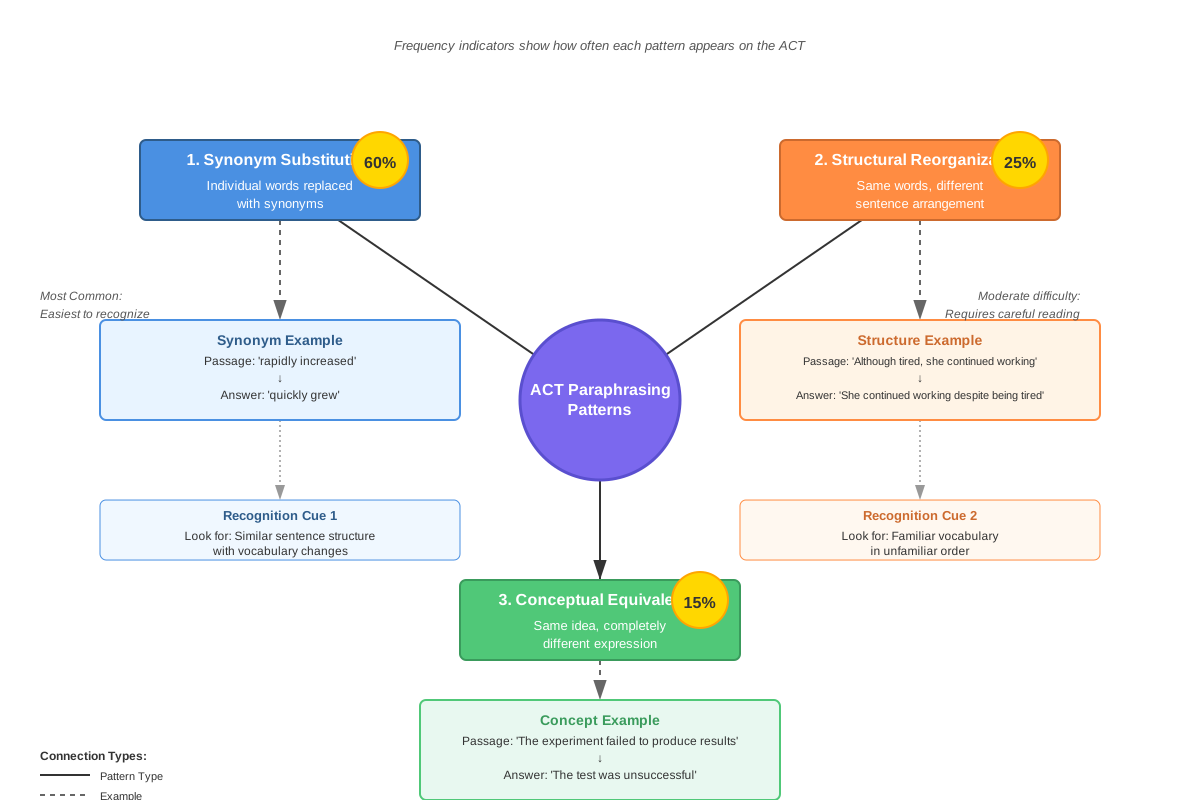
- [ ] Recognize common paraphrasing patterns including synonym substitution, structural reorganization, and conceptual equivalence
- [ ] Evaluate answer choices by matching conceptual meaning rather than surface-level word overlap
- [ ] Identify trap answers that contain passage words but misrepresent the original meaning
Prerequisites
- Literal comprehension skills: The ability to understand explicitly stated information forms the foundation for recognizing when that information has been accurately restated.
- Basic vocabulary knowledge: Recognizing synonyms and understanding word relationships enables identification of paraphrased content.
- Sentence structure awareness: Understanding how ideas can be reorganized grammatically helps identify paraphrases that restructure information.
- Active reading strategies: The ability to annotate and track key details while reading ensures students can locate original statements to verify paraphrases.
Why This Topic Matters
Paraphrasing details represents a critical bridge between basic reading comprehension and advanced analytical thinking. In real-world contexts, professionals constantly encounter information presented in multiple formats—reading a technical report, then hearing the findings summarized in a meeting, or reviewing data presented in both written and visual formats. The ability to recognize when different presentations convey the same core information is essential for academic success, professional communication, and informed citizenship.
On the ACT Reading section, paraphrasing questions appear with remarkable consistency across all four passage types (Literary Narrative, Social Science, Humanities, and Natural Science). Statistical analysis of released ACT exams reveals that 12-16 questions per test directly assess paraphrasing skills, making this the single most common question format. These questions typically appear as:
- Detail questions asking "According to the passage..." or "The passage states that..."
- Function questions asking why an author included specific information
- Comparison questions requiring students to match passage details with answer choices
- NOT/EXCEPT questions where three answers accurately paraphrase passage content
The ACT strategically places paraphrasing questions throughout each passage, testing both minor details and major supporting points. Passages frequently contain 3-4 paraphrasing questions each, and students who master this skill can reliably secure 12-16 additional correct answers per test—a difference of 4-6 points on the scaled Reading score.
Core Concepts
Understanding Paraphrasing Fundamentals
Paraphrasing involves restating information using different words and sentence structures while preserving the original meaning. On the ACT, effective paraphrasing operates at three distinct levels: lexical (word choice), syntactic (sentence structure), and semantic (meaning). The test writers deliberately craft answer choices that challenge students to focus on semantic equivalence rather than surface-level word matching.
The fundamental principle underlying ACT paraphrasing questions is that correct answers prioritize meaning over vocabulary. Students must resist the temptation to select answers simply because they contain words from the passage. Instead, successful test-takers evaluate whether an answer choice captures the same concept, relationship, or detail as the original text, regardless of word overlap.
Three Types of Paraphrasing Transformations
Synonym Substitution
The most straightforward paraphrasing technique involves replacing words with synonyms while maintaining sentence structure. For example:
| Original Passage Text | Paraphrased Answer Choice |
|---|---|
| "The scientist was perplexed by the results" | "The researcher was confused by the findings" |
| "The economy experienced rapid growth" | "The economy underwent swift expansion" |
| "She meticulously documented her observations" | "She carefully recorded her observations" |
The ACT frequently uses synonym substitution for concrete nouns, action verbs, and descriptive adjectives. However, test writers also create trap answers that substitute words inappropriately, changing the meaning subtly. For instance, replacing "suggested" with "proved" or "many" with "all" creates semantic distortions despite using passage-related vocabulary.
Structural Reorganization
More sophisticated paraphrasing involves restructuring sentences while maintaining meaning. This includes:
- Active to passive voice conversion: "The committee approved the proposal" → "The proposal was approved by the committee"
- Clause reordering: "Although it was raining, the game continued" → "The game continued despite the rain"
- Nominalization: "The company decided to expand" → "The company's decision to expand"
- Sentence combining or splitting: Multiple sentences condensed into one, or one complex sentence divided into simpler statements
Structural reorganization tests whether students comprehend relationships between ideas rather than memorizing specific phrasings. The ACT particularly favors this technique when paraphrasing cause-and-effect relationships, temporal sequences, and conditional statements.
Conceptual Equivalence
The most challenging paraphrasing type involves expressing the same concept using entirely different vocabulary and structure. This requires students to grasp the underlying idea rather than tracking specific words. For example:
- Original: "The invention revolutionized communication by allowing instant transmission of messages across vast distances"
- Paraphrase: "The device transformed how people exchanged information by enabling immediate contact regardless of geographic separation"
Conceptual equivalence often appears in questions about main ideas, author's purpose, or the significance of details. Students must identify the core concept (in this example: transformative impact on long-distance communication) and recognize it even when expressed through completely different language.
Identifying Paraphrasing Questions
ACT paraphrasing questions use specific trigger language that signals the need to match passage content with answer choices:
- "According to the passage..."
- "The passage indicates that..."
- "As stated in lines X-Y..."
- "The author mentions that..."
- "Which of the following best describes..."
- "The passage states that..."
These phrases indicate that the correct answer will directly restate passage information rather than requiring inference or analysis. Students should immediately locate the relevant passage section and prepare to match meaning rather than words.
The Word Trap Phenomenon
The ACT's most effective distractor technique involves creating wrong answers that contain exact words or phrases from the passage but distort the meaning. These "word traps" exploit students' tendency to recognize familiar vocabulary and assume correctness. Common word trap patterns include:
- Scope distortion: Using passage words but changing "some" to "all" or "suggested" to "proved"
- Relationship reversal: Maintaining vocabulary but reversing cause-effect or comparison relationships
- Context shifting: Taking words from one paragraph and applying them to a different context
- Detail mixing: Combining accurate details from separate passage sections to create a false statement
Recognizing word traps requires students to verify not just that answer choice words appear in the passage, but that the relationships and meanings remain accurate.
Concept Relationships
The skill of paraphrasing details connects to multiple reading comprehension competencies in a hierarchical structure:
Foundation Level: Literal comprehension and vocabulary knowledge → enables → Recognition of synonym substitution
Intermediate Level: Synonym recognition + Sentence structure awareness → enables → Identification of structural reorganization
Advanced Level: Structural reorganization + Conceptual thinking → enables → Recognition of conceptual equivalence
Application Level: All paraphrasing types + Critical evaluation → enables → Distinguishing accurate paraphrases from word traps
This skill also connects horizontally to other ACT Reading competencies:
- Main Idea questions: Often require paraphrasing the central thesis using different language
- Inference questions: Build upon paraphrasing by requiring students to extend beyond stated information
- Function questions: Require paraphrasing the purpose or effect of specific details
- Vocabulary in Context: Involves identifying paraphrases of individual words or phrases
Mastering paraphrasing details creates a foundation for tackling more complex question types, as students who can accurately identify restated information can then analyze, synthesize, and evaluate that information more effectively.
High-Yield Facts
⭐ Correct ACT answers typically contain 0-30% word overlap with the passage, while trap answers often contain 50-70% word overlap
⭐ Paraphrasing questions account for 30-40% of all ACT Reading questions, making them the most common question type
⭐ The ACT uses three primary paraphrasing techniques: synonym substitution, structural reorganization, and conceptual equivalence
⭐ Word traps—wrong answers using passage vocabulary but distorting meaning—appear in approximately 60% of paraphrasing questions
⭐ Questions beginning with "According to the passage" or "The passage states" almost always test paraphrasing skills
- Synonym substitution is most common for concrete details, while conceptual equivalence appears more frequently in questions about abstract ideas or main points
- The ACT frequently paraphrases numerical information, dates, and statistics by using different units or comparative language
- Structural reorganization often involves converting active voice to passive voice or reordering cause-and-effect relationships
- Correct paraphrases maintain the same level of certainty as the original (e.g., "might" should not become "definitely")
- The ACT rarely uses identical wording between passage and correct answer for detail questions, making word-matching an unreliable strategy
- Paraphrasing questions typically direct students to specific line numbers or paragraphs, making them more time-efficient than inference questions
- Trap answers frequently combine accurate details from different passage sections to create false statements
Quick check — test yourself on Paraphrasing details so far.
Try Flashcards →Common Misconceptions
Misconception: If an answer choice contains exact words from the passage, it must be correct.
Correction: The ACT deliberately creates trap answers using passage vocabulary but distorting relationships, scope, or context. Correct answers often use completely different words while maintaining accurate meaning. Always verify that the relationship and meaning match, not just the vocabulary.
Misconception: Paraphrasing means using synonyms for every word in a sentence.
Correction: Effective paraphrasing may retain some original words (especially technical terms or proper nouns) while restructuring the sentence or changing key terms. The goal is semantic equivalence, not complete vocabulary replacement.
Misconception: Longer, more detailed answer choices are more likely to be correct paraphrases.
Correction: The ACT uses length as a distractor technique. Longer answers often include accurate details mixed with subtle distortions. Correct paraphrases may be concise or detailed—length is not a reliable indicator of accuracy.
Misconception: If you can't find the exact information in the passage, you should make an inference.
Correction: Paraphrasing questions always have direct textual support. If you cannot locate the information, you may be looking in the wrong section or failing to recognize the paraphrased version. Return to the passage and search for the concept rather than specific words.
Misconception: Paraphrasing questions are easier than inference questions because they don't require analysis.
Correction: While paraphrasing questions test different skills than inference questions, they require careful analysis to distinguish accurate restatements from subtle distortions. The ACT's sophisticated trap answers make these questions challenging even for strong readers.
Misconception: You should read all answer choices before checking the passage.
Correction: For paraphrasing questions with line references, the most efficient strategy is to read the relevant passage section first, predict what the answer should convey, then evaluate answer choices against that prediction. This prevents trap answers from influencing your understanding.
Worked Examples
Example 1: Synonym Substitution and Structural Reorganization
Passage excerpt: "Despite facing numerous obstacles during the expedition, including severe weather conditions and equipment failures, the research team persevered and ultimately achieved their primary objective of collecting geological samples from the remote mountain region."
Question: According to the passage, the research team:
A) abandoned their mission due to challenging circumstances and broken tools
B) successfully obtained rock specimens from an isolated mountainous area despite various difficulties
C) experienced severe weather that prevented them from reaching their destination
D) collected geological samples easily because of favorable conditions
Step 1: Identify the question type
The phrase "According to the passage" signals a paraphrasing question requiring direct textual support.
Step 2: Locate and analyze the relevant information
The passage states the team "persevered" (continued despite difficulties) and "achieved their primary objective" (succeeded) of "collecting geological samples" (obtaining rock specimens) from a "remote mountain region" (isolated mountainous area). They faced "obstacles" (difficulties) including "severe weather" and "equipment failures."
Step 3: Evaluate each answer choice
Choice A: Uses passage words ("obstacles," "equipment failures") but distorts meaning by stating they "abandoned their mission" when the passage says they "persevered" and "achieved their objective." This is a word trap—correct vocabulary, wrong meaning.
Choice B: Accurately paraphrases all key elements:
- "successfully obtained" = "achieved their objective of collecting"
- "rock specimens" = "geological samples" (synonym)
- "isolated mountainous area" = "remote mountain region" (synonym + structural reorganization)
- "despite various difficulties" = "despite facing numerous obstacles" (conceptual equivalence)
Choice C: Contains passage words ("severe weather") but distorts meaning by claiming weather "prevented them from reaching their destination" when the passage states they succeeded.
Choice D: Contradicts the passage by stating they collected samples "easily" and had "favorable conditions" when the text emphasizes obstacles and challenges.
Answer: B - This choice demonstrates multiple paraphrasing techniques while maintaining complete semantic accuracy.
Example 2: Conceptual Equivalence
Passage excerpt: "The novelist's early works, characterized by straightforward narrative structures and conventional character development, contrasted sharply with her later experimental novels, which employed fragmented timelines, multiple narrators, and ambiguous endings that challenged readers' expectations."
Question: The passage indicates that the novelist's writing style:
A) remained consistent throughout her career, always featuring traditional storytelling methods
B) evolved from conventional approaches to more innovative and complex techniques
C) became simpler and more accessible to readers over time
D) focused exclusively on experimental methods from the beginning of her career
Step 1: Identify the core concept
The passage describes a change in the novelist's style from "straightforward" and "conventional" (early works) to "experimental" with "fragmented timelines" and "ambiguous endings" (later works). The key concept is stylistic evolution from traditional to innovative.
Step 2: Evaluate answer choices for conceptual equivalence
Choice A: Directly contradicts the passage by claiming consistency when the text emphasizes contrast ("contrasted sharply").
Choice B: Captures the core concept using different vocabulary:
- "evolved" = changed over time (implied by "early works" vs. "later")
- "conventional approaches" = "straightforward narrative structures and conventional character development"
- "innovative and complex techniques" = "experimental novels...fragmented timelines, multiple narrators, and ambiguous endings"
This is conceptual equivalence—no word overlap, but perfect meaning match.
Choice C: Reverses the direction of change, claiming movement toward simplicity when the passage describes movement toward complexity.
Choice D: Uses the passage word "experimental" but distorts timing by claiming this characterized her entire career rather than just later works.
Answer: B - This demonstrates pure conceptual equivalence, restating the entire idea without using passage vocabulary.
Exam Strategy
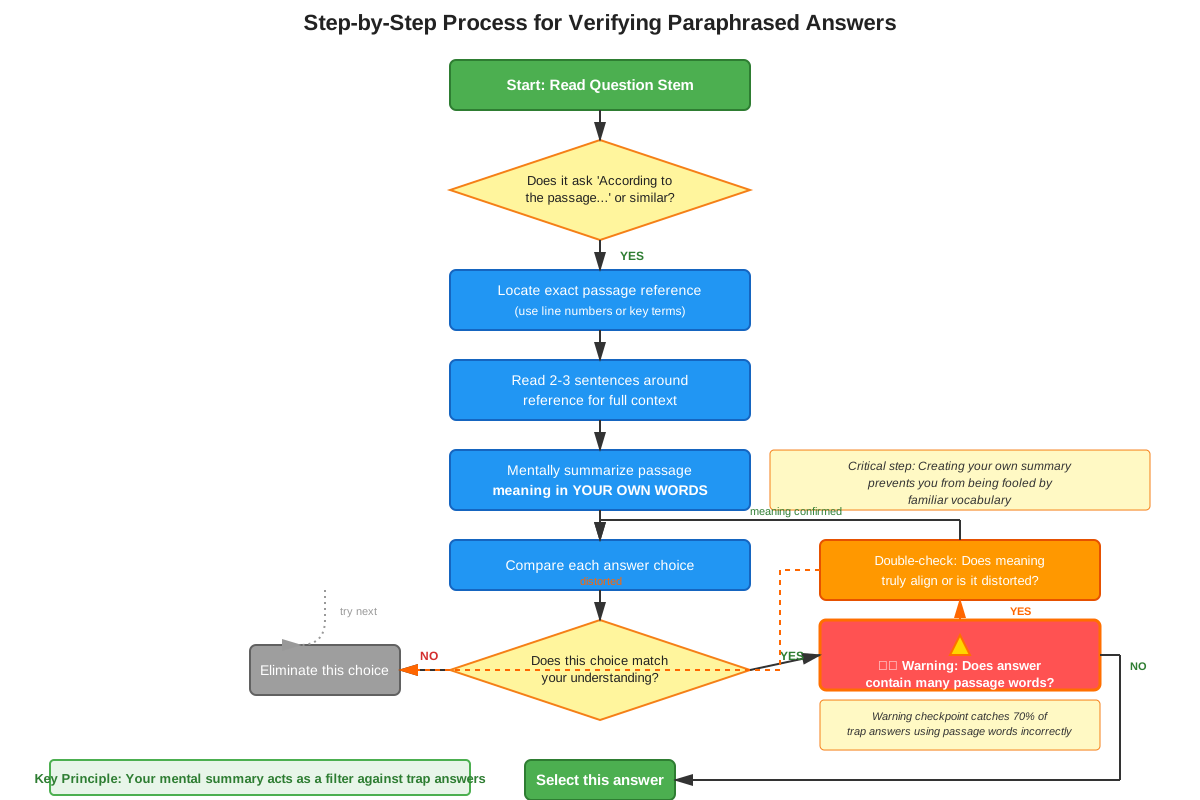
Systematic Approach to Paraphrasing Questions
Step 1: Recognize the question type (5 seconds)
Identify trigger phrases like "According to the passage," "The passage states," or "As mentioned in lines X-Y." These signal paraphrasing questions requiring direct textual support.
Step 2: Locate the relevant passage section (10-15 seconds)
Use line numbers or content clues to find the specific information. Read 2-3 sentences before and after the referenced lines to ensure full context.
Step 3: Formulate a prediction (10 seconds)
Before looking at answer choices, mentally summarize what the passage says in your own words. This prediction serves as your benchmark for evaluating answers.
Step 4: Evaluate answer choices strategically (20-30 seconds)
- Eliminate answers that contradict the passage
- Eliminate word traps that use passage vocabulary but distort meaning
- Select the answer that matches your prediction conceptually, even if vocabulary differs
Exam Tip: Spend more time verifying the passage content than reading answer choices. Students who rush through passage review but carefully read all four answers often fall for word traps.
Trigger Words and Phrases
Question stems indicating paraphrasing:
- "According to the passage"
- "The passage states/indicates/mentions"
- "As stated in lines X-Y"
- "The author notes that"
- "Which of the following best describes"
Red flag words in answer choices (often signal distortions):
- Absolute terms: "always," "never," "all," "none," "only," "must"
- Intensifiers that change degree: "extremely," "slightly," "barely"
- Certainty shifts: "proves" vs. "suggests," "definitely" vs. "possibly"
- Scope changes: "some" vs. "most," "often" vs. "always"
Process of Elimination Techniques
Eliminate first: Answers that contain information not mentioned in the passage or that directly contradict passage statements.
Eliminate second: Word traps—answers with high vocabulary overlap but subtle meaning distortions. Check scope, relationships, and certainty level.
Eliminate third: Answers that mix accurate details from different passage sections to create false statements.
Select: The remaining answer that accurately captures passage meaning, even if vocabulary differs completely.
Time Allocation
Paraphrasing questions should take 45-60 seconds each:
- 15 seconds: Locate and read relevant passage section
- 10 seconds: Formulate prediction
- 25-35 seconds: Evaluate answer choices
These questions are typically faster than inference or main idea questions, so use them to build time reserves for more challenging items.
Memory Techniques
The MATCH Acronym
Use MATCH to evaluate answer choices for paraphrasing questions:
- Meaning: Does the answer convey the same core meaning as the passage?
- Accuracy: Are all details accurate, or are there subtle distortions?
- Tone: Does the answer maintain the same level of certainty (definite vs. possible)?
- Context: Is the information used in the same context as the passage?
- Harmony: Do all parts of the answer align with the passage, or is accurate information mixed with distortions?
The Three P's of Paraphrasing
Remember that effective paraphrasing involves:
- Preserve the meaning
- Present different words
- Prevent distortion
Visualization Strategy
Picture paraphrasing as translation between languages. Just as "hello" in English means "hola" in Spanish—different sounds, same meaning—paraphrasing uses different words for identical concepts. When evaluating answers, ask: "Would these two statements translate to the same meaning?"
The Word Trap Warning System
Create a mental "alarm" that triggers when you see high vocabulary overlap between answer and passage. Train yourself to think: "Familiar words = potential trap. Must verify meaning, not just vocabulary."
Summary
Paraphrasing details represents the most frequently tested skill on the ACT Reading section, appearing in 30-40% of questions across all passage types. Success requires recognizing that correct answers prioritize semantic equivalence over vocabulary matching, often using completely different words while maintaining identical meaning. The ACT employs three primary paraphrasing techniques—synonym substitution, structural reorganization, and conceptual equivalence—with increasing levels of sophistication. The most dangerous trap answers contain exact passage vocabulary but subtly distort meaning through scope changes, relationship reversals, or context shifts. Effective test-takers identify paraphrasing questions through trigger phrases like "According to the passage," locate relevant textual support, formulate predictions before reading answer choices, and systematically eliminate distortions while selecting answers that match passage meaning regardless of word overlap. Mastering this skill provides a foundation for all other ACT Reading question types and reliably improves scores by 4-6 points through securing 12-16 additional correct answers per test.
Key Takeaways
- Paraphrasing questions are the most common ACT Reading question type, accounting for 30-40% of all items
- Correct answers typically have low word overlap with the passage (0-30%), while trap answers often contain 50-70% passage vocabulary
- The three paraphrasing techniques—synonym substitution, structural reorganization, and conceptual equivalence—require progressively deeper comprehension
- Word traps exploit vocabulary recognition by using passage words with distorted meanings, scope, or relationships
- Always verify meaning and relationships, not just vocabulary presence, when evaluating answer choices
- Formulate predictions based on passage content before reading answer choices to avoid trap answer influence
- Use the MATCH acronym (Meaning, Accuracy, Tone, Context, Harmony) to systematically evaluate paraphrasing accuracy
Related Topics
Main Idea and Theme: Building on paraphrasing skills, main idea questions require identifying paraphrases of the passage's central thesis rather than specific details. Mastering detail paraphrasing enables recognition of broader conceptual restatements.
Inference and Implication: While paraphrasing involves restating explicit information, inference requires extending beyond stated content. Strong paraphrasing skills ensure accurate understanding of the textual foundation from which inferences are drawn.
Vocabulary in Context: This skill represents paraphrasing at the word or phrase level, requiring students to identify synonyms or equivalent expressions for specific terms within their passage context.
Author's Purpose and Technique: Questions about why authors include specific details often require paraphrasing the function or effect of information, combining detail recognition with analytical thinking.
Comparative Relationships: Many ACT passages include comparisons, contrasts, or cause-effect relationships that must be accurately paraphrased to answer questions about connections between ideas.
Practice CTA
Now that you understand the strategies and techniques for mastering paraphrasing details, it's time to apply these skills to authentic ACT-style questions. The practice questions and flashcards will reinforce your ability to distinguish accurate paraphrases from word traps, recognize the three paraphrasing techniques, and systematically evaluate answer choices. Remember: paraphrasing mastery comes through deliberate practice with immediate feedback. Each practice question you complete strengthens your pattern recognition and builds the automaticity needed to handle these questions efficiently under timed conditions. Commit to practicing until identifying accurate paraphrases becomes second nature—your ACT Reading score will reflect your dedication.
Sign up free to keep reading
Create a free AnvayaPrep account to finish this ACT guide on Paraphrasing details — plus flashcards and practice questions.