Overview
The passage summary skill is one of the most fundamental and frequently tested abilities on the ACT Reading section. This skill requires students to synthesize information from an entire passage and identify its main idea, central purpose, or overall structure. Unlike detail-oriented questions that focus on specific lines or paragraphs, ACT passage summary questions demand a holistic understanding of what the author is trying to communicate across the entire text.
Mastering passage summary questions is essential because they appear in nearly every ACT Reading test, typically 1-2 times per passage for a total of 4-8 questions per exam. These questions often appear as the first or last question for a passage, asking students to identify the passage's main idea, primary purpose, or best title. Success on these questions requires active reading strategies, the ability to distinguish main ideas from supporting details, and skill in eliminating answer choices that are too narrow, too broad, or simply inaccurate.
The passage summary skill serves as a foundation for virtually all other ACT Reading competencies. Students who can accurately summarize passages are better equipped to answer inference questions, identify author's purpose, analyze structure, and understand relationships between ideas. This skill connects directly to the broader "Key Ideas and Details" domain, which tests whether students can extract and comprehend the most important information from complex texts across fiction, social science, humanities, and natural science passages.
Learning Objectives
- [ ] Identify when Passage summary is being tested
- [ ] Explain the core rule or strategy behind Passage summary
- [ ] Apply Passage summary to ACT-style questions accurately
- [ ] Distinguish between main ideas and supporting details within passages
- [ ] Evaluate answer choices for scope appropriateness (too broad vs. too narrow)
- [ ] Synthesize information from multiple paragraphs to form a cohesive understanding
- [ ] Recognize common distractor patterns in passage summary questions
Prerequisites
- Basic reading comprehension: Understanding literal meaning of sentences and paragraphs is necessary before synthesizing main ideas
- Paragraph structure awareness: Recognizing topic sentences and supporting details helps identify what information is most important
- Vocabulary fundamentals: Adequate vocabulary ensures students understand the passage content well enough to summarize it
- Active reading habits: The ability to engage with text while reading (rather than passively scanning) enables better retention of main ideas
Why This Topic Matters
In academic and professional contexts, the ability to quickly grasp and articulate the main point of complex texts is invaluable. Whether reading research articles, business reports, legal documents, or literary works, professionals must efficiently extract central ideas without getting lost in details. This skill directly translates to college success, where students must synthesize information from textbooks, lectures, and scholarly articles.
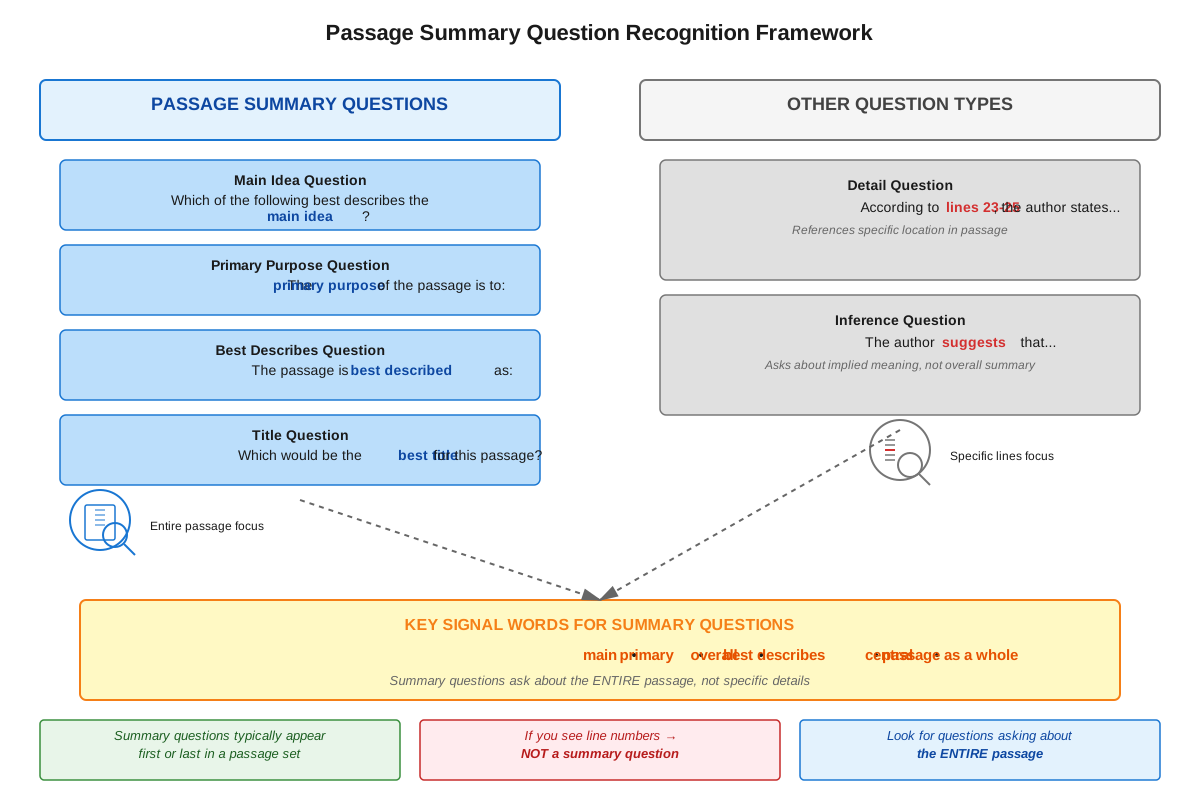
On the ACT Reading section, passage summary questions appear with remarkable consistency. Statistical analysis of released ACT exams shows that approximately 15-20% of all Reading questions test passage summary skills, making this one of the highest-yield topics for focused study. These questions typically appear in several formats: "Which of the following best describes the main idea?", "The passage is best described as:", "The primary purpose of the passage is to:", or "Which of the following would be the best title?"
Passage summary questions commonly appear in all four ACT Reading passage types. In literary narrative passages, they test understanding of plot, character development, or thematic elements. In social science passages, they assess comprehension of arguments, theories, or historical developments. Humanities passages require synthesis of biographical information, artistic movements, or cultural analysis. Natural science passages demand understanding of scientific processes, discoveries, or explanations of phenomena. Regardless of passage type, the core skill remains constant: identifying what the passage is fundamentally about.
Core Concepts
Understanding Main Idea vs. Supporting Details
The foundation of passage summary skills lies in distinguishing between main ideas and supporting details. The main idea represents the central point or overarching message the author wants to communicate throughout the entire passage. Supporting details are specific facts, examples, anecdotes, or evidence that illustrate, prove, or elaborate on the main idea.
Consider this hierarchy: if a passage were a tree, the main idea would be the trunk—the central structure that holds everything together. Supporting details would be the branches—important components that extend from the trunk but are not themselves the core structure. Many students struggle with passage summary questions because they select answer choices that focus on prominent supporting details rather than the overarching main idea.
To identify main ideas effectively, students should ask themselves: "What is the one thing this passage is primarily about? If I had to explain this passage in one sentence to someone who hasn't read it, what would I say?" The answer to these questions typically reveals the main idea.
The Scope Principle
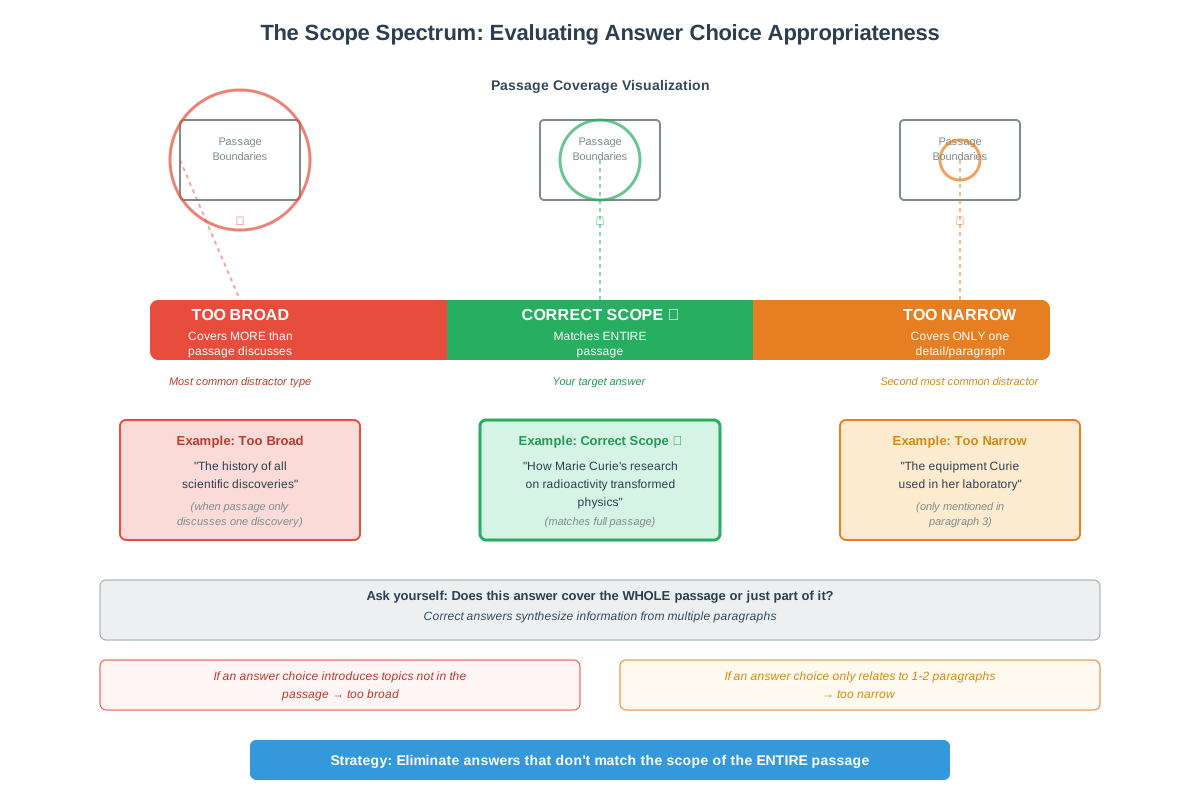
The scope principle is crucial for evaluating passage summary answer choices. Correct answers must match the passage's scope—neither too broad nor too narrow. A scope that is too broad makes claims that extend beyond what the passage actually discusses. A scope that is too narrow focuses on only one paragraph or section rather than the entire passage.
| Scope Issue | Characteristics | Example |
|---|---|---|
| Too Broad | Makes sweeping generalizations; includes topics not discussed in passage | "The history of all scientific discovery" when passage only discusses one scientist's work |
| Appropriate Scope | Matches exactly what the passage covers; accounts for all major sections | "The development and impact of Marie Curie's research on radioactivity" |
| Too Narrow | Focuses on one detail, paragraph, or example | "The equipment Marie Curie used in her laboratory" when passage covers her entire career |
Students should mentally check each answer choice against the passage's actual content. Does this answer choice account for the introduction, body paragraphs, and conclusion? Does it reflect what most of the passage discusses, or just one section?
Identifying Question Stems That Test Summary Skills
Recognizing when a question tests passage summary is the first step toward applying the correct strategy. Common question stems include:
- "The main idea of the passage is..."
- "The passage is primarily concerned with..."
- "Which of the following best describes the passage as a whole?"
- "The primary purpose of the passage is to..."
- "The passage can best be described as..."
- "Which of the following would be the most appropriate title?"
- "The author's main point is that..."
- "The central focus of the passage is..."
These stems all signal that the correct answer must encompass the entire passage, not just isolated sections. When students see these question stems, they should immediately shift to "big picture" thinking rather than searching for specific details.
The First-Last Strategy
Many well-structured passages follow predictable organizational patterns where the main idea appears in specific locations. The first-last strategy involves paying special attention to:
- Opening paragraphs: Often contain thesis statements, introduce the main topic, or establish the passage's purpose
- Closing paragraphs: Frequently restate the main idea, provide conclusions, or synthesize information presented earlier
- Topic sentences: The first sentence of each body paragraph often signals what that section contributes to the overall main idea
While not every passage follows this structure (particularly literary narratives), this strategy provides a reliable starting point for identifying main ideas. Students should annotate these key locations while reading, noting how they relate to the passage's overall purpose.
Synthesis Across Passage Sections
Effective passage summary requires synthesis—combining information from multiple paragraphs to form a unified understanding. Unlike detail questions that can be answered by reading one paragraph, summary questions demand that students consider how all parts of the passage work together.
The synthesis process involves:
- Identifying what each paragraph or section contributes to the whole
- Recognizing patterns or progressions (chronological, cause-effect, problem-solution, comparison-contrast)
- Determining which ideas receive the most emphasis or development
- Understanding how the conclusion relates back to the introduction
Students should practice creating mental or written outlines while reading, noting the purpose of each paragraph in 3-5 words. This practice builds the synthesis skill necessary for passage summary questions.
Concept Relationships
The passage summary skill connects intimately with other ACT Reading competencies. Main idea identification serves as the foundation → which enables author's purpose analysis (understanding why the author wrote the passage) → which connects to tone and attitude questions (how the author feels about the subject) → which relates to inference questions (what can be concluded based on the main ideas presented).
Within the passage summary topic itself, concepts build progressively: Students must first recognize summary question stems → then distinguish main ideas from details → next apply the scope principle to evaluate answers → and finally synthesize information across sections to confirm their choice. Each skill depends on the previous one.
The relationship to prerequisite knowledge is direct: basic comprehension allows students to understand what they're reading → paragraph structure awareness helps identify where main ideas typically appear → active reading habits ensure students retain the big picture while processing details → all of which combine to enable effective passage summary.
High-Yield Facts
⭐ Passage summary questions typically appear 1-2 times per passage, totaling 4-8 questions per ACT Reading test
⭐ Correct summary answers must account for the entire passage, not just one or two paragraphs
⭐ The most common wrong answer type is "too narrow"—focusing on a supporting detail rather than the main idea
⭐ Opening and closing paragraphs most frequently contain explicit statements of the main idea
⭐ If an answer choice mentions something discussed in only one paragraph, it's almost certainly too narrow
- Summary questions often use phrases like "primarily concerned with," "main idea," "best describes," or "primary purpose"
- Correct answers typically use more general language than the specific details found in the passage
- Wrong answers may be factually accurate but still incorrect because they don't capture the main idea
- Literary narrative passages often have main ideas related to character development, relationships, or personal growth
- Science passages typically have main ideas about explaining a process, describing a discovery, or presenting a theory
Quick check — test yourself on Passage summary so far.
Try Flashcards →Common Misconceptions
Misconception: The main idea is always explicitly stated in the first paragraph.
Correction: While opening paragraphs often introduce the main idea, it may be stated in the conclusion, implied throughout, or built gradually across multiple paragraphs. Students must read the entire passage before selecting a summary answer.
Misconception: If a detail is mentioned multiple times, it must be the main idea.
Correction: Repetition indicates importance, but a repeated detail may still be supporting evidence for a broader main idea. Students should ask whether the repeated element is the point itself or evidence supporting a larger point.
Misconception: The longest paragraph contains the main idea.
Correction: Paragraph length indicates development and detail, not necessarily centrality to the main idea. Sometimes the longest paragraph provides extensive supporting evidence while a shorter paragraph states the actual main idea.
Misconception: All information in the passage is equally important for summary questions.
Correction: Passages contain a hierarchy of information. Main ideas are most important, followed by major supporting points, then minor details and examples. Effective summarization requires recognizing this hierarchy.
Misconception: The correct answer will use the same words as the passage.
Correction: Correct summary answers often paraphrase the main idea using synonyms and different phrasing. Students who look only for exact word matches may miss the correct answer and fall for distractors that quote specific details.
Misconception: If I don't understand one paragraph, I can't answer the summary question.
Correction: While understanding the entire passage is ideal, students can often identify the main idea by synthesizing the paragraphs they do understand. One confusing section doesn't necessarily prevent accurate summarization.
Worked Examples
Example 1: Social Science Passage
Passage Summary (abbreviated): The passage begins by describing how urban planners in the 1950s believed highways would solve traffic problems. The second paragraph explains how these highways were built through minority neighborhoods, causing displacement. The third paragraph discusses the environmental impact of increased car usage. The fourth paragraph describes recent movements to remove urban highways and restore neighborhoods. The final paragraph concludes that cities are now reconsidering the highway-centric approach.
Question: The passage is primarily concerned with:
A) The construction techniques used to build urban highways in the 1950s
B) The environmental consequences of automobile transportation
C) The evolution of urban planning approaches to highways and their impacts
D) The displacement of minority communities by infrastructure projects
Analysis:
Step 1: Identify this as a passage summary question (key phrase: "primarily concerned with")
Step 2: Consider what each paragraph contributes:
- Para 1: Initial highway planning philosophy
- Para 2: Social impacts (displacement)
- Para 3: Environmental impacts
- Para 4: Current reversal movements
- Para 5: Changing attitudes
Step 3: Evaluate each answer using the scope principle:
Choice A: Too narrow—construction techniques are not discussed; this focuses on a detail not even present
Choice B: Too narrow—environmental consequences appear in only one paragraph; this is a supporting detail, not the main idea
Choice C: Appropriate scope—"evolution" captures the historical progression from 1950s to present; "approaches to highways" encompasses the planning philosophy; "impacts" covers both social and environmental effects discussed
Choice D: Too narrow—displacement is discussed in one paragraph as one consequence; this is an important supporting detail but not the overarching main idea
Answer: C
Connection to Learning Objectives: This example demonstrates identifying summary questions, applying the scope principle, and synthesizing information across multiple paragraphs to distinguish main ideas from supporting details.
Example 2: Literary Narrative Passage
Passage Summary (abbreviated): The passage follows Maria, a concert pianist, as she returns to her childhood home after her mother's death. The first section describes her reluctance to enter the house. The middle sections show her discovering her mother's old letters, which reveal her mother had once aspired to be a musician but gave up those dreams. The final section shows Maria at the piano, playing a piece her mother loved, and feeling a new connection to her mother's sacrifices and unfulfilled dreams.
Question: Which of the following best describes the passage as a whole?
F) A character's discovery of her mother's past leads to greater understanding and connection
G) A musician struggles with grief after losing her mother
H) A woman finds old letters that reveal family secrets
J) A daughter learns that her mother once wanted to be a musician
Analysis:
Step 1: Recognize the summary question ("best describes the passage as a whole")
Step 2: Identify the narrative arc:
- Beginning: Reluctance, emotional distance
- Middle: Discovery of mother's past
- End: New understanding, emotional connection
Step 3: Apply scope principle to each choice:
Choice F: Appropriate scope—captures the discovery element (letters), the content of discovery (mother's past), and the emotional result (understanding and connection); accounts for beginning, middle, and end
Choice G: Too narrow—grief is present but the passage focuses more on the journey from distance to connection; this misses the discovery and transformation elements
Choice H: Too narrow—finding letters is the mechanism of the plot, not the main point; this describes what happens but not what the passage is about thematically
Choice J: Too narrow—this is one fact Maria learns, but the passage is about the emotional journey and transformation, not just the information itself
Answer: F
Connection to Learning Objectives: This example shows how literary passages require identifying thematic main ideas rather than just plot summaries, and how correct answers capture emotional or character development arcs.
Exam Strategy
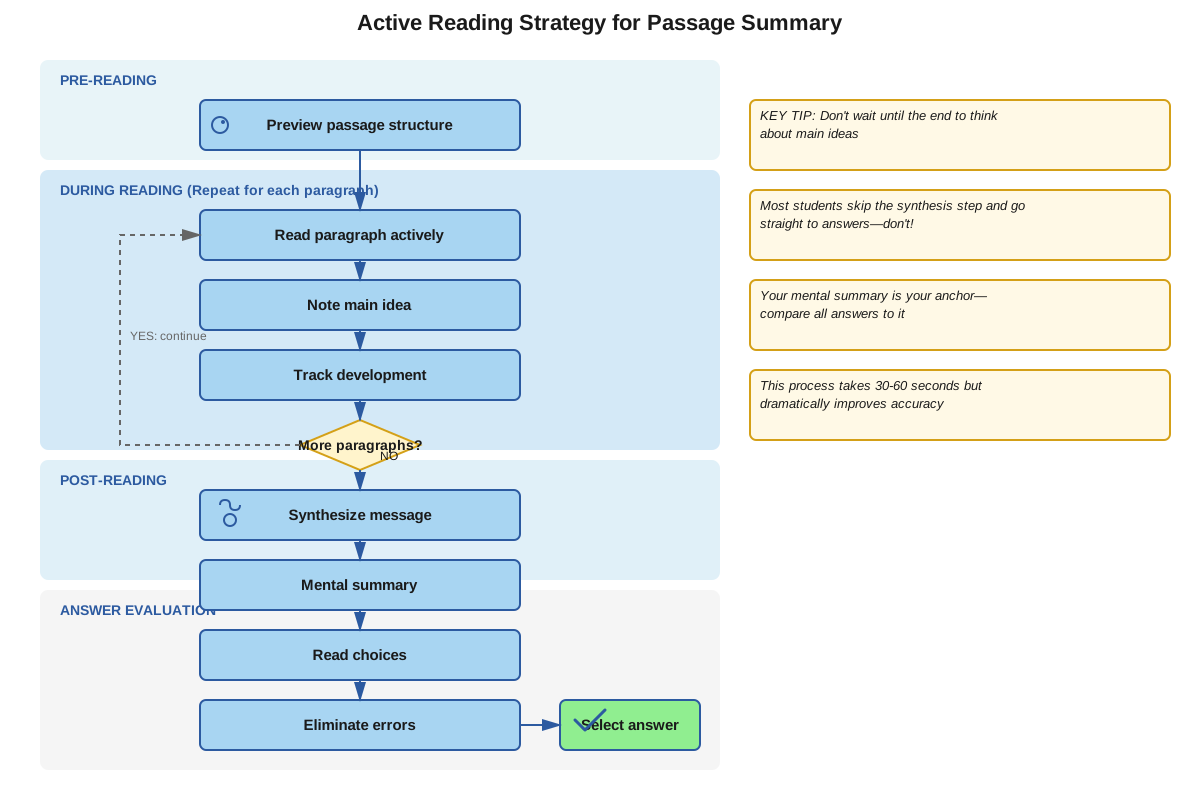
When approaching passage summary questions on the ACT, implement this systematic process:
Before Reading: Recognize that you'll need to identify the main idea, so read actively with this goal in mind. Don't get lost in details.
During Reading:
- Annotate the purpose of each paragraph in 3-5 words in the margin
- Pay special attention to opening and closing paragraphs
- Note any sentences that seem to state the author's main point
- Ask yourself periodically: "What is this passage really about?"
After Reading: Before looking at the question, mentally summarize the passage in one sentence. This pre-formed summary helps you evaluate answer choices.
Trigger Words to Watch For:
- "Primarily concerned with"
- "Main idea"
- "Best describes"
- "Primary purpose"
- "As a whole"
- "Central focus"
- "Best title"
Process of Elimination Strategy:
- Eliminate "too narrow" choices first: Cross out any answer that focuses on only one paragraph or one example. These are the most common wrong answers.
- Eliminate "too broad" choices: Remove answers that make claims beyond what the passage discusses or that would apply to many passages, not this specific one.
- Eliminate factually inaccurate choices: Some answers contain information that contradicts the passage or introduces ideas not mentioned at all.
- Choose the answer that accounts for the most passage content: The correct answer should reflect what happens in the introduction, body, and conclusion.
Exam Tip: If you're stuck between two answers, check which one accounts for more paragraphs. The correct summary answer should relate to at least 3-4 paragraphs in a typical ACT passage.
Time Allocation: Passage summary questions should take 30-45 seconds once you've read the passage. If you've read actively and annotated paragraph purposes, you shouldn't need to re-read large sections. If you find yourself re-reading extensively, you may not have read actively enough initially.
Common Trap: Don't select an answer just because it quotes the passage directly. ACT test-makers often create wrong answers using exact phrases from the passage that represent supporting details, not main ideas.
Memory Techniques
MAIN Acronym for evaluating summary answers:
- Most of the passage (not just one section)
- Accurate to what's actually stated
- Inclusive of key points from beginning, middle, and end
- Not too narrow or too broad
The "Dinner Table Test": Imagine explaining the passage to someone at dinner. What would you say in 1-2 sentences? That's likely the main idea. You wouldn't recite specific details—you'd give the gist.
The "Tree Visualization": Picture the passage as a tree. The trunk (thickest, most central) = main idea. Major branches = key supporting points. Small branches and leaves = specific details and examples. Summary questions ask about the trunk, not the leaves.
The "Three-Paragraph Check": For any answer choice you're considering, ask: "Does this relate to paragraph 1? Does it relate to paragraph 3? Does it relate to paragraph 5?" If the answer is no to any of these, it's probably too narrow.
SCOPE Acronym for wrong answer patterns:
- Specific detail (too narrow)
- Contradicts passage (factually wrong)
- Overstated claim (too broad)
- Partial truth (accurate but incomplete)
- Extraneous information (not discussed)
Summary
Passage summary questions test the ability to identify and articulate the main idea of an entire ACT Reading passage, distinguishing it from supporting details and examples. Success requires active reading that synthesizes information across all paragraphs, recognizing the hierarchical structure of passages where main ideas are supported by details. The scope principle is essential: correct answers must be neither too broad (making claims beyond the passage) nor too narrow (focusing on isolated details). Students should pay particular attention to opening and closing paragraphs where main ideas are often stated explicitly, while also considering how each body paragraph contributes to the overall purpose. Recognizing question stems that signal summary questions—such as "primarily concerned with," "main idea," or "best describes"—allows students to apply the appropriate strategy. The most common wrong answers focus on supporting details rather than main ideas, making the ability to distinguish between these levels of information crucial for success.
Key Takeaways
- Passage summary questions appear 4-8 times per ACT Reading test, making them one of the highest-yield question types
- Correct answers must account for the entire passage, not just one or two paragraphs—apply the scope principle rigorously
- The most common wrong answer pattern is "too narrow"—focusing on a supporting detail instead of the main idea
- Active reading with paragraph-by-paragraph annotation dramatically improves summary question accuracy
- Opening and closing paragraphs most frequently contain explicit main idea statements
- Synthesizing information across multiple sections is essential—summary questions cannot be answered by reading just one paragraph
- Correct answers often paraphrase the main idea rather than quoting the passage directly
Related Topics
Author's Purpose and Point of View: Understanding why an author wrote a passage and their perspective builds directly on passage summary skills. Once students can identify what a passage is about, determining why the author wrote it becomes more accessible.
Text Structure and Organization: Recognizing how passages are organized (chronological, compare-contrast, cause-effect, problem-solution) helps students identify main ideas more efficiently and understand how supporting details relate to central points.
Supporting Evidence and Details: The flip side of passage summary—learning to identify and analyze specific details, examples, and evidence—helps students understand the hierarchy of information in passages.
Inference and Conclusion Questions: Many inference questions require understanding the main idea first, then extending that understanding to draw logical conclusions not explicitly stated.
Practice CTA
Now that you understand the strategies and concepts behind passage summary questions, it's time to put your knowledge into action! Complete the practice questions to test your ability to identify main ideas, apply the scope principle, and distinguish between main ideas and supporting details. Use the flashcards to reinforce key concepts and trigger words. Remember: passage summary is one of the most frequently tested skills on the ACT Reading section, so mastering this topic will directly improve your score. Each practice question you complete builds the pattern recognition and strategic thinking you need for test day success!
Sign up free to keep reading
Create a free AnvayaPrep account to finish this ACT guide on Passage summary — plus flashcards and practice questions.