Overview
The primary purpose question type is one of the most frequently tested concepts on the ACT Reading section, appearing in virtually every test administration. These questions ask students to identify the main goal, central idea, or overarching intent of an entire passage or a significant portion of it. Unlike detail questions that focus on specific facts or supporting evidence, primary purpose questions require students to synthesize information across multiple paragraphs and distinguish between the author's main objective and subordinate points.
Understanding how to identify and answer ACT primary purpose questions is essential because they test reading comprehension at its highest level—the ability to see the forest rather than just the trees. These questions assess whether students can move beyond literal comprehension to grasp what the author is fundamentally trying to accomplish: to inform, persuade, describe, analyze, or entertain. Students who master this skill demonstrate sophisticated reading abilities that extend far beyond test-taking, as identifying purpose is crucial for academic success across all disciplines.
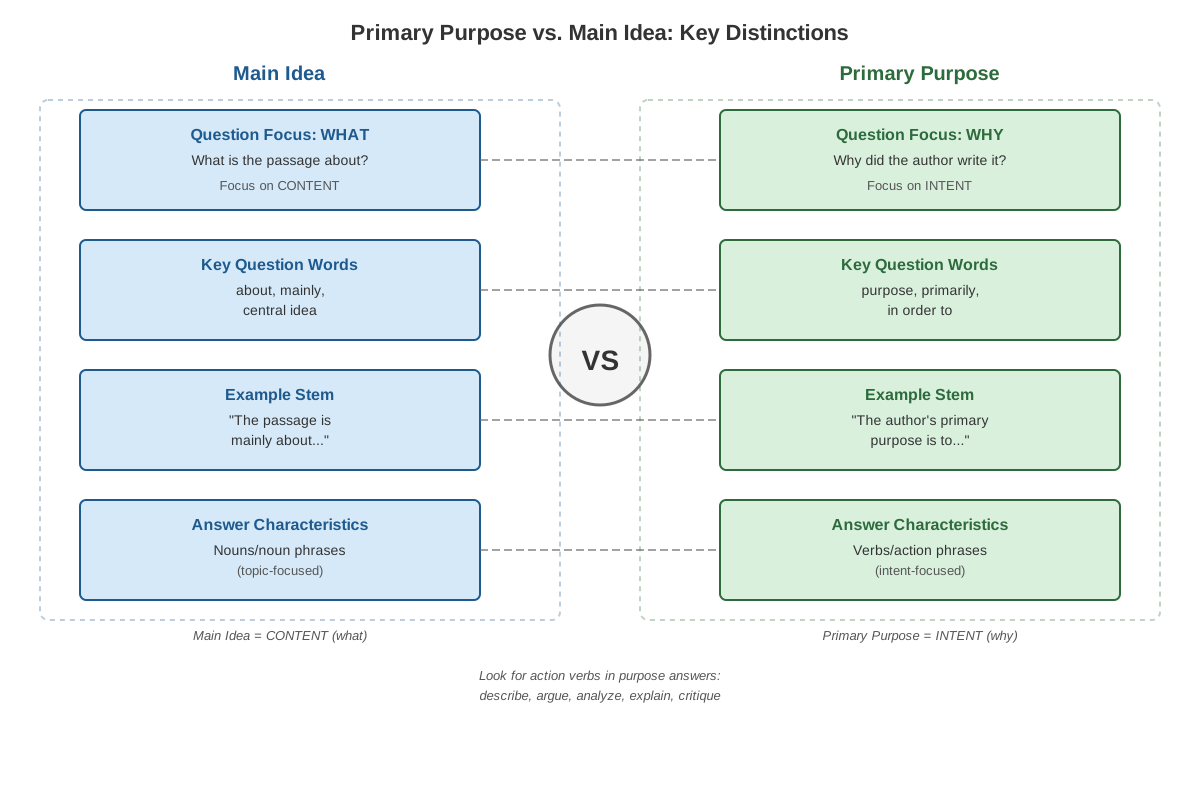
Primary purpose questions connect directly to other Key Ideas and Details concepts, particularly main idea identification and supporting detail recognition. While main idea questions ask "what is the passage about," primary purpose questions ask "why did the author write this passage" or "what is the author trying to do." This subtle but important distinction requires students to think about authorial intent and rhetorical strategy, making it a bridge between literal comprehension and the more analytical skills tested in the Craft and Structure portion of the ACT Reading test.
Learning Objectives
- [ ] Identify when Primary purpose is being tested in ACT Reading questions
- [ ] Explain the core rule or strategy behind Primary purpose question types
- [ ] Apply Primary purpose strategies to ACT-style questions accurately
- [ ] Distinguish between primary purpose and main idea questions
- [ ] Eliminate incorrect answer choices that focus on supporting details rather than overarching purpose
- [ ] Recognize common distractor patterns in primary purpose answer choices
- [ ] Synthesize information from multiple paragraphs to determine authorial intent
Prerequisites
- Basic reading comprehension skills: Understanding literal meaning is necessary before identifying purpose, as students must comprehend what is being said before determining why it's being said
- Paragraph structure awareness: Recognizing topic sentences and supporting details helps students distinguish between main points and subordinate information when determining overall purpose
- Vocabulary knowledge: Understanding words like "analyze," "critique," "describe," "argue," and "explain" is essential for both recognizing question stems and evaluating answer choices
- Passage navigation skills: The ability to skim and scan efficiently allows students to review the entire passage when determining its primary purpose
Why This Topic Matters
Primary purpose questions appear on every ACT Reading test, typically 1-2 times per passage, making them among the most reliable question types students will encounter. These questions carry the same point value as detail questions but often prove more challenging because they require synthesis rather than simple location of information. Students who can quickly and accurately identify primary purpose gain a significant strategic advantage, as understanding the passage's overall goal helps them answer other questions more efficiently.
In real-world contexts, the ability to identify an author's purpose is fundamental to critical thinking and information literacy. Whether evaluating news articles for bias, understanding scientific papers, analyzing historical documents, or interpreting literary works, recognizing what an author is trying to accomplish helps readers engage more deeply and critically with texts. This skill is particularly valuable in college, where students must synthesize information from multiple sources and understand how different authors approach similar topics with different purposes.
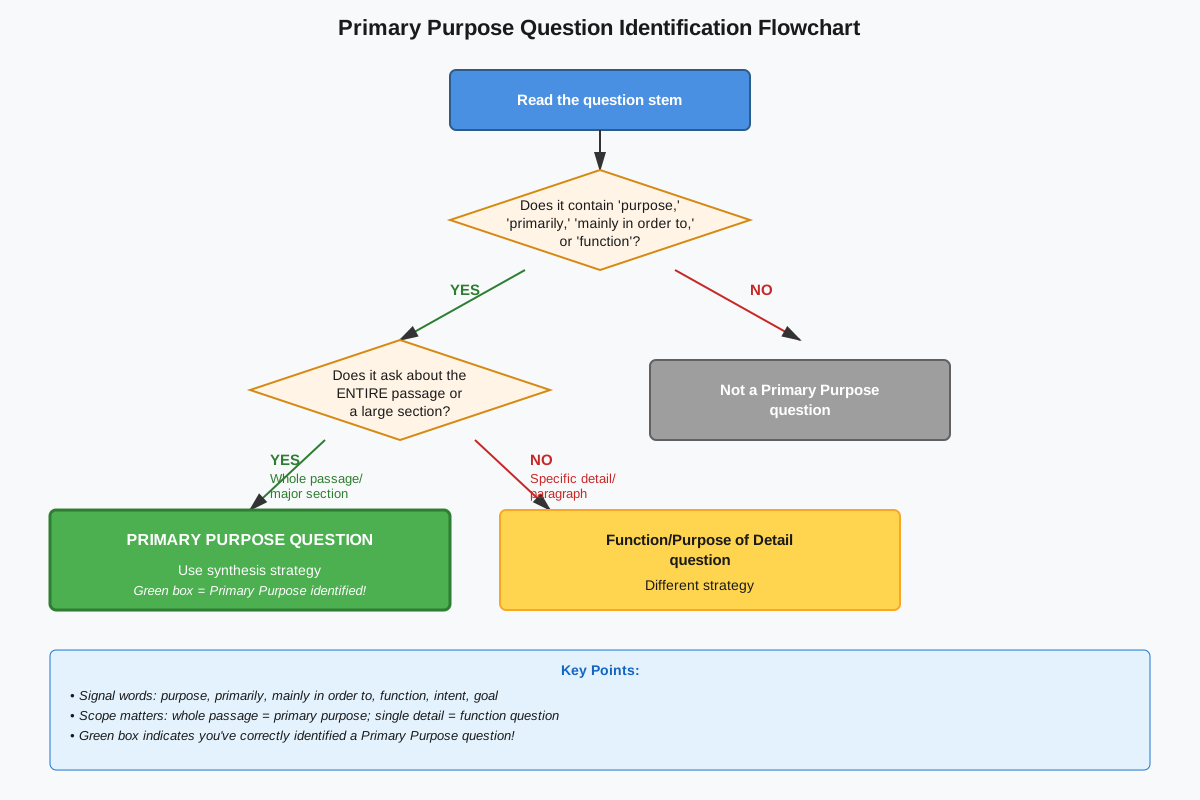
On the ACT, primary purpose questions typically appear in several formats: "The primary purpose of the passage is to...", "The author's main goal in writing this passage is to...", "Which of the following best describes what the passage does?", or "The passage can best be described as..." These questions may address the entire passage or focus on specific paragraphs or sections. They most commonly appear after students have answered several detail questions, though they occasionally appear as the first question to test whether students can grasp the big picture before diving into specifics.
Core Concepts
Understanding Primary Purpose vs. Main Idea
While closely related, primary purpose and main idea represent distinct concepts that students must differentiate. The main idea identifies the central topic or thesis—what the passage is about. The primary purpose identifies the author's goal or intention—what the author is trying to do with that topic. For example, a passage might have a main idea of "the migration patterns of monarch butterflies" while its primary purpose is "to explain the biological mechanisms that enable long-distance butterfly migration." The main idea is the subject; the primary purpose is the action the author takes regarding that subject.
This distinction manifests in answer choice construction. Main idea answers typically use noun phrases ("the history of jazz music"), while primary purpose answers use infinitive verb phrases ("to trace the development of jazz from its origins to modern forms"). Recognizing this grammatical difference helps students quickly eliminate answers that don't match the question type being asked.
The Four Primary Purpose Categories
ACT passages typically fall into one of four purpose categories, each with characteristic features:
To Inform/Explain: The author presents factual information, describes processes, or clarifies concepts without taking a strong position. These passages appear most frequently in Natural Science and Social Science sections. Key indicators include neutral tone, objective language, and emphasis on facts and mechanisms rather than opinions.
To Persuade/Argue: The author advocates for a particular viewpoint, critiques an opposing position, or attempts to convince readers of a claim. These passages often appear in Social Science and Humanities sections. Indicators include evaluative language, counterarguments addressed and refuted, and clear thesis statements expressing the author's position.
To Analyze/Examine: The author breaks down a complex topic into components, explores relationships between elements, or investigates causes and effects. Common in all passage types, these purposes involve deeper investigation than simple explanation. Indicators include comparative language, cause-effect relationships, and examination of multiple perspectives without necessarily advocating for one.
To Describe/Narrate: The author recounts events, portrays experiences, or depicts scenes and characters. Most common in Literary Narrative and Humanities passages, these purposes emphasize storytelling and vivid detail. Indicators include chronological organization, sensory details, and focus on specific experiences rather than general principles.
Identifying Purpose Through Passage Structure
The organization and structure of a passage provide crucial clues to its primary purpose. Passages that begin with a question or problem and then provide answers typically have an explanatory purpose. Those that present a common belief and then challenge it usually aim to persuade. Passages organized chronologically often have narrative or descriptive purposes, while those organized by categories or comparisons typically analyze or examine.
The introduction and conclusion carry disproportionate weight in determining primary purpose. Authors typically state or strongly hint at their purpose in opening paragraphs and reinforce it in closing paragraphs. The body paragraphs provide supporting evidence but rarely shift the fundamental purpose. Students should pay particular attention to the first and last sentences of the passage, as these often contain explicit purpose statements.
Recognizing Purpose Through Tone and Language
An author's tone—the attitude conveyed toward the subject—reveals purpose. Neutral, objective tone suggests informative purpose. Passionate, evaluative tone indicates persuasive purpose. Questioning, exploratory tone points toward analytical purpose. Personal, reflective tone suggests narrative or descriptive purpose.
Specific word choices also signal purpose. Verbs like "demonstrates," "shows," "reveals," and "indicates" suggest explanation. Words like "should," "must," "unfortunately," and "fortunately" indicate persuasion. Phrases like "on one hand" and "however" suggest analysis. Sensory details and emotional language point toward description or narration.
Common Distractor Patterns
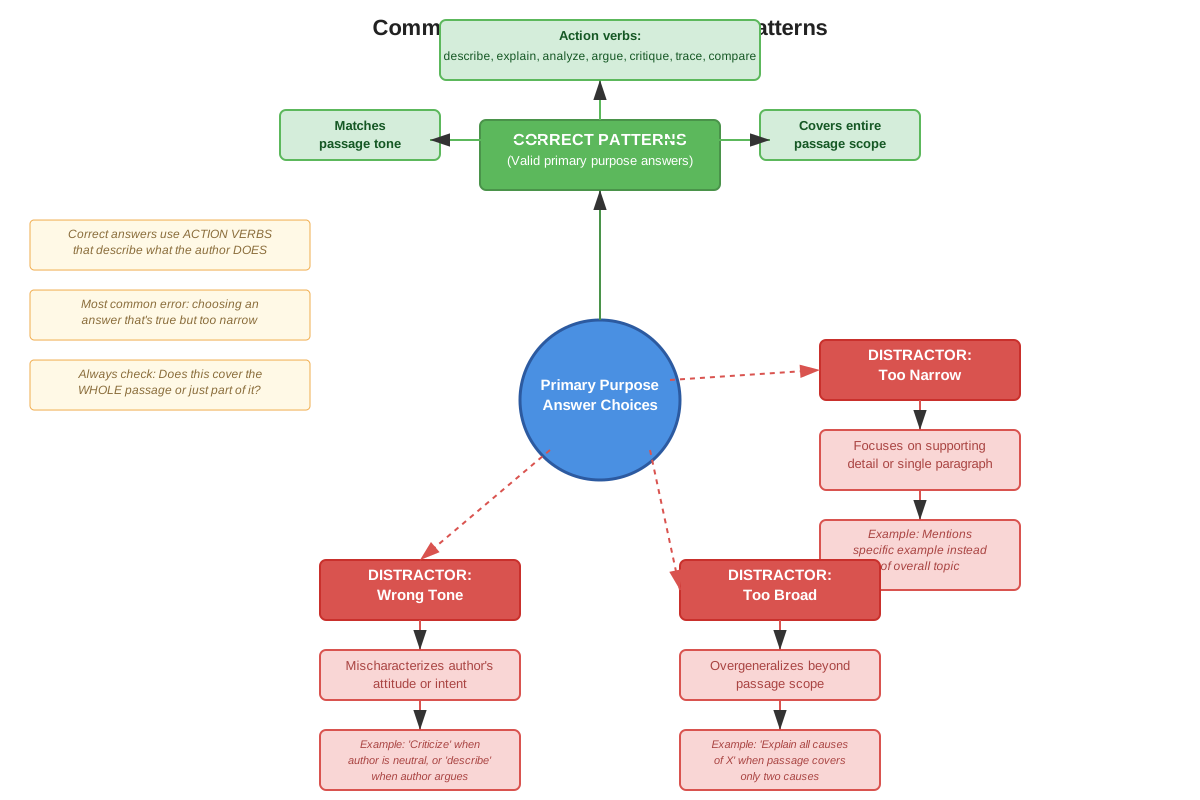
ACT test makers construct wrong answers using predictable patterns. Too narrow distractors focus on supporting details or single paragraphs rather than the entire passage's purpose. A passage explaining climate change might include a paragraph about polar bears, but "to describe the impact of climate change on polar bears" would be too narrow if the passage addresses multiple impacts.
Too broad distractors encompass more than the passage actually covers. If a passage analyzes one poet's use of metaphor, "to examine poetic devices in American literature" would be too broad. Wrong action distractors use the correct topic but the wrong verb—describing when the passage argues, or explaining when it critiques.
Extreme language distractors use absolute terms like "prove," "definitively establish," or "completely refute" when passages typically present more measured arguments. Reversed relationship distractors flip the passage's actual stance, suggesting the author opposes something they actually support.
Concept Relationships
Primary purpose connects hierarchically to other reading comprehension skills. At the foundation lies literal comprehension—understanding what the passage says. Building on this, students identify main ideas—what the passage is about. Primary purpose sits at the next level, requiring students to understand why the author wrote about that topic in that particular way.
Primary purpose also connects laterally to supporting detail questions. Once students identify the primary purpose, they can better evaluate whether specific details serve as main support or tangential information. This relationship flows both ways: understanding the purpose helps locate relevant details, while analyzing how details function helps confirm the purpose.
The relationship map flows as follows: Literal Comprehension → enables → Main Idea Identification → enables → Primary Purpose Recognition → informs → Supporting Detail Evaluation → confirms → Primary Purpose Recognition. Additionally, Tone and Language Analysis → reveals → Primary Purpose, while Structural Analysis → indicates → Primary Purpose.
Primary purpose also connects forward to more advanced skills tested in Craft and Structure questions. Understanding why an author wrote something prepares students to analyze how the author uses rhetorical devices, organizes information, and develops arguments—all higher-order analytical skills.
High-Yield Facts
- ⭐ Primary purpose questions ask "why" the author wrote the passage, not "what" the passage is about
- ⭐ The correct answer must account for the entire passage or specified section, not just one or two paragraphs
- ⭐ Primary purpose answers typically use infinitive verb phrases ("to explain," "to argue," "to describe")
- ⭐ The introduction and conclusion contain the strongest clues to primary purpose
- ⭐ Neutral, objective tone indicates informative/explanatory purpose; evaluative tone indicates persuasive purpose
- Primary purpose questions appear 1-2 times per passage on average, making them highly predictable
- Wrong answers often focus on supporting details rather than overarching purpose (too narrow)
- Wrong answers may use correct topics but incorrect action verbs (wrong action)
- The author's purpose remains consistent throughout the passage; if it seems to shift, reconsider the interpretation
- Extreme language in answer choices ("prove," "definitively establish") is usually incorrect for ACT passages
- Comparative or analytical passages often have purposes involving examination or analysis rather than simple explanation
- Literary narratives most commonly have descriptive or reflective purposes rather than persuasive ones
- Science passages typically inform or explain rather than persuade, even when presenting new research
- The primary purpose encompasses all major points in the passage; if an answer choice ignores a significant section, it's likely wrong
Quick check — test yourself on Primary purpose so far.
Try Flashcards →Common Misconceptions
Misconception: Primary purpose and main idea are the same thing and can be answered identically.
Correction: Primary purpose identifies the author's goal or action (why they wrote it), while main idea identifies the central topic or thesis (what it's about). A passage about renewable energy might have the main idea "solar power technology" but the primary purpose "to explain how solar panels convert sunlight to electricity."
Misconception: The primary purpose can be found in a single sentence or paragraph.
Correction: While the introduction may hint at purpose, the primary purpose must account for the entire passage's content and structure. Students must synthesize information across all paragraphs to ensure their answer encompasses everything the author does, not just what they do in one section.
Misconception: If a passage mentions multiple topics, it must have multiple primary purposes.
Correction: A passage has one overarching primary purpose even if it discusses multiple topics. Those topics serve the single primary purpose. For example, a passage discussing three different renewable energy sources still has one purpose: perhaps to compare renewable energy options or to argue for diversifying energy sources.
Misconception: The most frequently mentioned topic indicates the primary purpose.
Correction: Frequency doesn't determine purpose. A passage might mention a specific example repeatedly while using that example to serve a broader purpose. A passage that mentions Einstein multiple times might not be primarily about Einstein but rather about using his work to explain scientific methodology.
Misconception: Persuasive passages always use obvious words like "should" or "must."
Correction: Authors can persuade through subtle means, including selective presentation of evidence, strategic organization, or tone. A passage can argue for a position without explicit prescriptive language by presenting evidence that leads readers to a particular conclusion.
Misconception: The correct answer will use the same words as the passage.
Correction: Correct primary purpose answers typically paraphrase and synthesize rather than quote directly. Test makers deliberately use synonyms and different phrasing to test comprehension rather than simple matching ability.
Worked Examples
Example 1: Science Passage
Passage Summary: A passage discusses how researchers discovered that certain bacteria can break down plastic polymers. The first paragraph introduces the problem of plastic pollution. The second and third paragraphs explain the discovery process and the specific bacteria involved. The fourth paragraph describes the chemical mechanism by which the bacteria digest plastic. The final paragraph discusses potential applications and limitations of this discovery.
Question: The primary purpose of the passage is to:
A) argue that bacteria-based solutions will solve the plastic pollution crisis
B) describe the discovery and mechanism of plastic-digesting bacteria
C) criticize current plastic recycling methods
D) prove that all plastics can be broken down by bacteria
Analysis:
Step 1: Identify the question type. The phrase "primary purpose" clearly indicates this is a primary purpose question requiring synthesis of the entire passage.
Step 2: Review the passage structure. The passage moves from problem introduction → discovery description → mechanism explanation → application discussion. This structure suggests an informative/explanatory purpose rather than persuasive.
Step 3: Evaluate each answer choice:
Choice A uses "argue," suggesting persuasive purpose, but the passage tone is neutral and informative. Additionally, "will solve" is too strong and definitive—the passage mentions limitations. This is a wrong action distractor with extreme language. Eliminate.
Choice B uses "describe," matching the informative tone. It encompasses both the discovery (paragraphs 2-3) and mechanism (paragraph 4), accounting for most of the passage content. The verb "describe" accurately reflects what the author does. Keep.
Choice C uses "criticize," suggesting persuasive purpose, but the passage doesn't focus on criticizing current methods—it focuses on explaining the new discovery. This is a wrong action distractor. Eliminate.
Choice D uses "prove" (extreme language) and "all plastics" (too broad—the passage discusses specific types). This distractor combines extreme language with factual inaccuracy. Eliminate.
Answer: B is correct because it accurately captures the informative purpose and accounts for the major sections of the passage without being too narrow or too broad.
Example 2: Humanities Passage
Passage Summary: A passage examines three different interpretations of a famous painting by art historians from different eras. The first paragraph introduces the painting and its cultural significance. The second paragraph presents the initial interpretation from the 1920s focusing on religious symbolism. The third paragraph discusses a 1960s feminist interpretation. The fourth paragraph presents a recent postmodern interpretation. The final paragraph reflects on how changing cultural contexts influence art interpretation.
Question: Which of the following best describes what the passage does?
A) to advocate for the most accurate interpretation of the painting
B) to trace the history of art criticism in the twentieth century
C) to examine how interpretations of a painting have evolved across different cultural contexts
D) to explain the religious symbolism in a famous painting
Analysis:
Step 1: Recognize this as a primary purpose question despite different wording ("what the passage does").
Step 2: Note the passage structure: multiple interpretations presented + reflection on interpretation itself. This suggests analytical purpose examining relationships and changes over time.
Step 3: Evaluate each answer:
Choice A suggests the author takes a position on which interpretation is correct, but the passage presents multiple interpretations without declaring one superior. This is a wrong action distractor (advocating vs. examining). Eliminate.
Choice B is too broad. The passage focuses on one painting's interpretations, not the entire history of art criticism. This is a too broad distractor. Eliminate.
Choice C uses "examine" (analytical purpose) and captures both the specific focus (one painting's interpretations) and the broader theme (how cultural contexts influence interpretation). It accounts for all major sections without being too narrow or broad. Keep.
Choice D is too narrow, focusing only on the content of paragraph 2 (religious symbolism) while ignoring the feminist and postmodern interpretations and the reflection on interpretation itself. Eliminate.
Answer: C is correct because it accurately reflects the analytical purpose and encompasses the entire passage's scope and structure.
Exam Strategy
When approaching primary purpose questions on the ACT, implement a systematic strategy that maximizes accuracy while managing time effectively. First, recognize the question type immediately by watching for trigger phrases: "primary purpose," "main goal," "the passage does," "best described as," or "the author's intention." These phrases signal that you need to think about the entire passage's overarching goal, not specific details.
Before looking at answer choices, formulate your own answer in simple terms: "The author is trying to explain/argue/describe/analyze [topic]." This prediction prevents answer choices from influencing your thinking and helps you recognize the correct answer when you see it. Your prediction doesn't need to be perfect—it serves as an anchor for evaluation.
Use the process of elimination strategically by first eliminating answers with wrong action verbs. If the passage clearly explains rather than argues, eliminate all choices using "argue," "persuade," "advocate," or "criticize." Next, eliminate answers that are too narrow (focusing on one paragraph or example) or too broad (encompassing more than the passage covers). Then eliminate answers with extreme language ("prove," "definitively," "completely") unless the passage genuinely makes such strong claims (rare on the ACT).
For the remaining choices, verify that your selection accounts for all major sections of the passage. Mentally check off each paragraph: does this purpose explain why the author included this information? If a significant portion of the passage doesn't fit your chosen answer, reconsider.
Time management for primary purpose questions should be efficient because these questions don't require rereading specific lines. Spend 30-45 seconds maximum. If you've read the passage carefully initially, you should already have a sense of its purpose. If you're uncertain, quickly reread the first and last paragraphs, which typically contain the strongest purpose indicators.
Exam Tip: If two answers seem equally correct, the one that encompasses more of the passage while remaining accurate is usually correct. ACT rewards comprehensive understanding over narrow focus.
Memory Techniques
Use the acronym IDEA to remember the four main purpose categories:
- Inform/Explain
- Describe/Narrate
- Examine/Analyze
- Argue/Persuade
Remember the "Why vs. What" Rule: Primary purpose asks WHY (author's goal), main idea asks WHAT (passage's topic). Visualize a purpose as an arrow pointing toward a target (the author's goal) and a main idea as a circle containing the topic.
Use the "Verb Check" technique: Primary purpose answers need action verbs. If an answer choice is a noun phrase without "to + verb," it's probably wrong. Mentally add "to" before each answer choice to ensure it expresses purpose.
Create a mental image of "The Goldilocks Zone" for scope: too narrow (one paragraph), too broad (beyond the passage), just right (entire passage). When evaluating answers, visualize whether they fit the entire passage like a properly sized container.
Remember "TONE = PURPOSE": Neutral tone → Inform, Evaluative tone → Argue, Exploratory tone → Analyze, Personal tone → Describe. The emotional quality of the writing reveals the author's intention.
Summary
Primary purpose questions test the highest level of reading comprehension by requiring students to identify why an author wrote a passage rather than simply what the passage discusses. These questions appear 1-2 times per passage on every ACT Reading test and demand synthesis of information across the entire passage. The key distinction students must master is between main idea (the topic) and primary purpose (the author's goal or action regarding that topic). Primary purpose answers use infinitive verb phrases and fall into four main categories: to inform/explain, to persuade/argue, to analyze/examine, or to describe/narrate. Success requires recognizing purpose through passage structure, tone, and language while avoiding common distractors that are too narrow, too broad, use wrong action verbs, or employ extreme language. The introduction and conclusion provide the strongest clues to purpose, and the correct answer must account for all major sections of the passage. By systematically eliminating wrong answers and verifying that the chosen answer encompasses the entire passage's scope, students can consistently answer these high-value questions correctly.
Key Takeaways
- Primary purpose identifies the author's goal (why they wrote it), not the topic (what it's about)
- Correct answers use infinitive verb phrases ("to explain," "to argue") and must account for the entire passage
- The four main purpose categories are inform/explain, persuade/argue, analyze/examine, and describe/narrate
- Introduction and conclusion paragraphs contain the strongest clues to primary purpose
- Common wrong answers are too narrow (one detail), too broad (beyond passage scope), wrong action (incorrect verb), or extreme (absolute language)
- Tone reveals purpose: neutral = inform, evaluative = argue, exploratory = analyze, personal = describe
- Eliminate answers systematically: wrong verbs first, then scope issues, then extreme language
Related Topics
Main Idea Identification: While primary purpose asks why the author wrote the passage, main idea questions ask what the passage is centrally about. Mastering primary purpose strengthens main idea skills because understanding authorial intent helps identify which ideas are central versus peripheral.
Supporting Detail Recognition: Once students identify a passage's primary purpose, they can better evaluate whether specific details serve as major support for that purpose or function as minor examples. This connection helps with both detail questions and inference questions.
Tone and Attitude Analysis: Understanding how to identify an author's tone directly supports primary purpose recognition, as tone reveals intent. Students who master primary purpose are well-prepared for Craft and Structure questions about authorial attitude and perspective.
Passage Structure and Organization: Analyzing how authors organize information (chronologically, comparatively, problem-solution) both reveals primary purpose and prepares students for questions about rhetorical strategy and text structure.
Practice CTA
Now that you understand the strategies and concepts behind primary purpose questions, it's time to apply this knowledge! Work through the practice questions to test your ability to identify authorial intent and distinguish primary purpose from supporting details. Use the flashcards to reinforce key concepts and common distractor patterns. Remember, primary purpose questions appear on every ACT Reading test—mastering this skill will directly improve your score. Each practice question you complete strengthens your ability to synthesize information and think about reading at the highest comprehension level. You've got this!
Sign up free to keep reading
Create a free AnvayaPrep account to finish this ACT guide on Primary purpose — plus flashcards and practice questions.