Overview
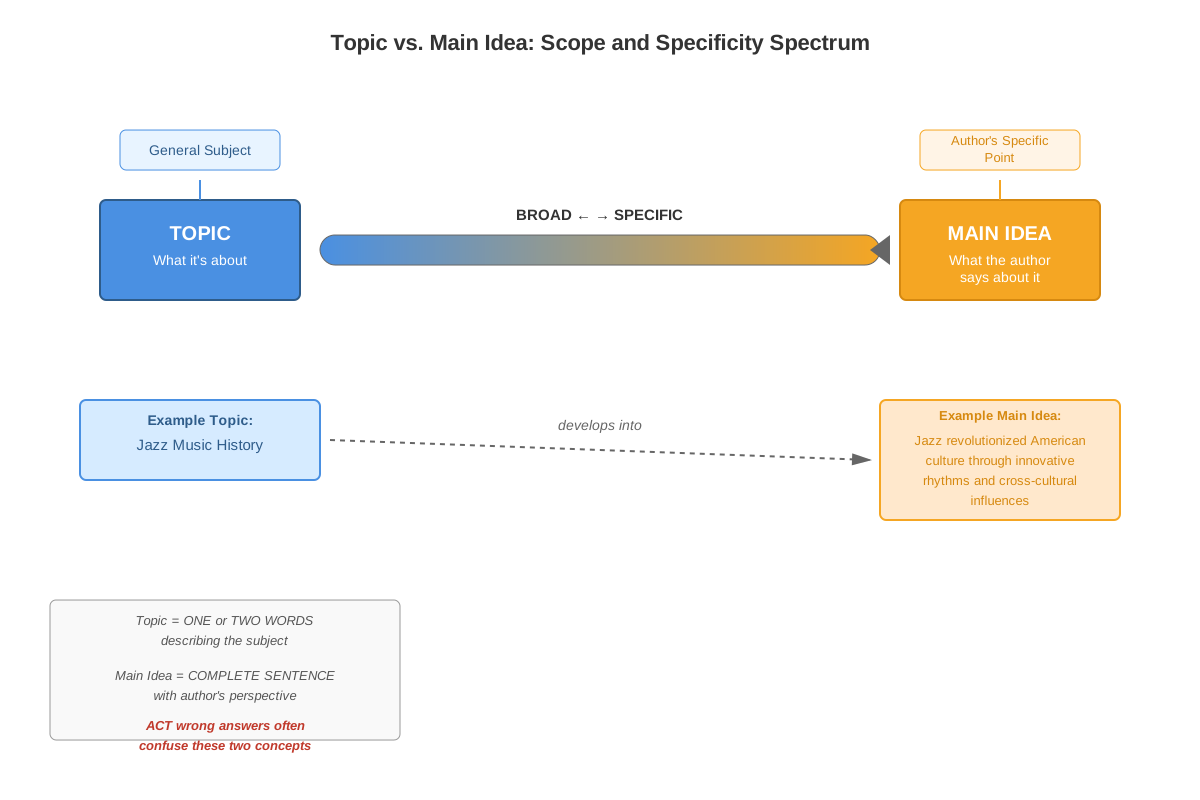
Understanding the topic of a passage is a foundational skill for success on the ACT Reading section. This concept refers to the ability to identify the broad subject matter or main focus that unifies an entire passage. Unlike identifying the main idea (which includes the author's specific point or argument), recognizing the topic requires students to step back and determine what general subject the passage addresses. For example, a passage might have the topic "the history of jazz music" while its main idea might be "jazz music revolutionized American culture through its innovative rhythms and cross-cultural influences."
The ACT topic of a passage questions appear with high frequency on the exam, often as the first question in a passage set or as questions that ask students to identify appropriate titles, summarize content, or determine what the passage is "primarily about." These questions test reading comprehension at its most fundamental level—can the student distinguish between relevant and irrelevant details to identify the unifying thread? Mastering this skill provides the foundation for answering more complex questions about purpose, tone, structure, and specific details.
This topic connects directly to other essential Reading concepts within the Key Ideas and Details domain. Understanding the topic helps students identify main ideas, distinguish between primary and supporting details, and recognize how different paragraphs contribute to the passage's overall focus. Students who can quickly and accurately identify a passage's topic gain a significant strategic advantage: they can eliminate answer choices more efficiently, predict question types, and maintain focus while reading dense or challenging texts.
Learning Objectives
- [ ] Identify when Topic of a passage is being tested
- [ ] Explain the core rule or strategy behind Topic of a passage
- [ ] Apply Topic of a passage to ACT-style questions accurately
- [ ] Distinguish between the topic and the main idea of a passage
- [ ] Recognize common distractors in topic-identification questions
- [ ] Synthesize information from multiple paragraphs to determine the overarching topic
- [ ] Evaluate answer choices for appropriate scope and specificity
Prerequisites
- Basic reading comprehension skills: Students must be able to read and understand grade-level texts, as topic identification builds upon fundamental comprehension abilities.
- Familiarity with passage types: Understanding that ACT Reading includes prose fiction, social science, humanities, and natural science passages helps students adjust their topic-identification strategies accordingly.
- Vocabulary knowledge: A working vocabulary enables students to understand both passage content and answer choices without getting distracted by unfamiliar words.
- Paragraph structure awareness: Recognizing how paragraphs are organized (topic sentences, supporting details, transitions) aids in identifying what the entire passage addresses.
Why This Topic Matters
In real-world contexts, identifying the topic of a text is essential for academic success, professional communication, and information literacy. Students must quickly determine what articles, textbooks, reports, and emails are about to decide whether to read them closely, skim them, or set them aside. This skill transfers directly to college coursework, where students must process large volumes of reading material efficiently.
On the ACT Reading section, topic-identification questions appear in approximately 15-20% of all questions, making them one of the most frequently tested concepts. These questions typically appear in several formats: "This passage is primarily about...", "Which of the following best describes the topic of the passage?", "The main focus of the passage is...", or "An appropriate title for this passage would be...". The ACT deliberately includes wrong answer choices that are too broad (covering more than the passage addresses), too narrow (focusing on only one paragraph or detail), or off-topic (mentioning something discussed briefly but not central to the passage).
Topic questions commonly appear across all four passage types. In prose fiction, the topic might be "a family's adjustment to a new home" or "a character's coming-of-age experience." Social science passages might address topics like "the economic impact of urbanization" or "theories of child development." Humanities passages often cover topics such as "the evolution of Renaissance art" or "a musician's influence on modern composition." Natural science passages typically focus on topics like "the formation of volcanic islands" or "recent discoveries in neuroscience." Recognizing these patterns helps students approach each passage type with appropriate expectations.
Core Concepts
Defining Topic vs. Main Idea
The topic of a passage represents the general subject matter—what the passage is about in broad terms. It answers the question "What is this passage discussing?" The topic is typically expressed in a phrase rather than a complete sentence. For example: "climate change adaptation strategies," "the life of Emily Dickinson," or "quantum computing applications."
In contrast, the main idea includes both the topic and the author's specific point, argument, or perspective about that topic. The main idea answers "What is the author saying about this topic?" and requires a complete sentence. Using the examples above, main ideas might be: "Communities must implement diverse adaptation strategies to address climate change effectively," "Emily Dickinson's reclusive lifestyle profoundly influenced her innovative poetic style," or "Quantum computing will revolutionize data encryption within the next decade."
Understanding this distinction is crucial because ACT questions sometimes test whether students can differentiate between these concepts. A common trap involves answer choices that state the main idea when the question asks for the topic, or vice versa.
Identifying Topic Through Strategic Reading
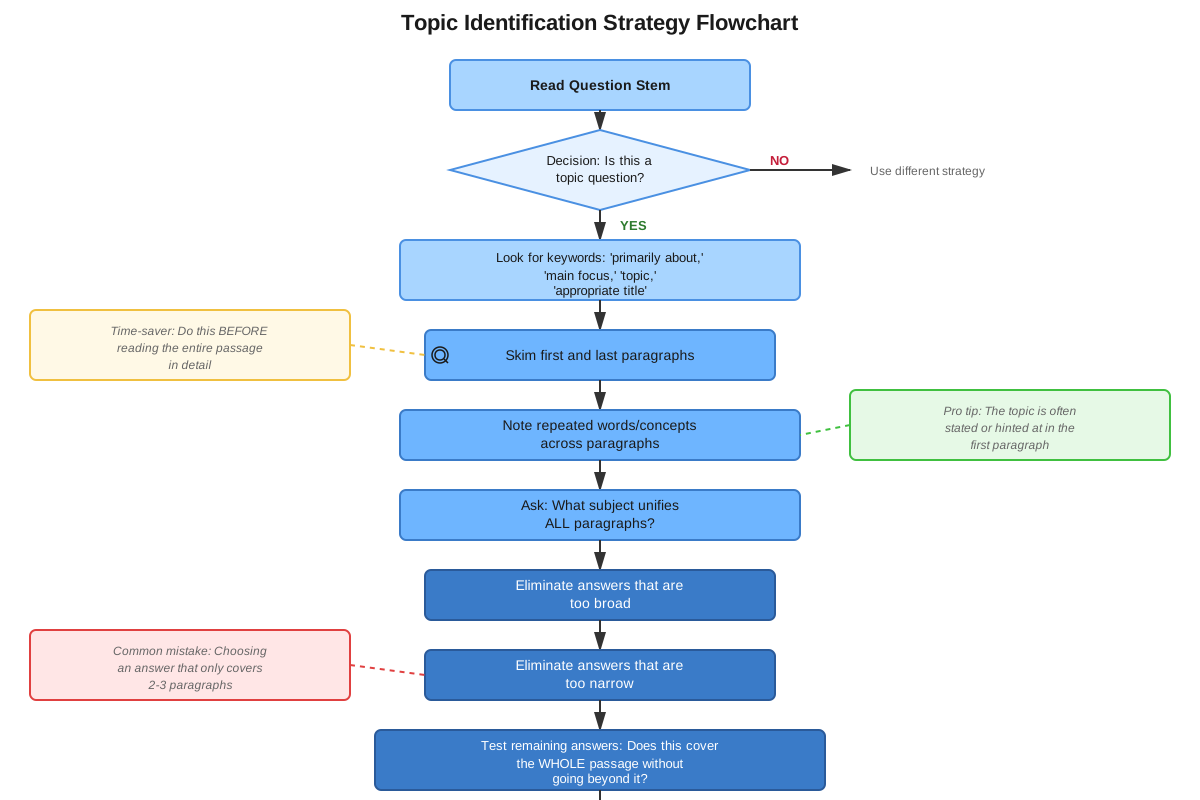
Effective topic identification begins before reading the passage in detail. Students should employ a strategic reading approach that includes:
- Reading the introduction carefully: The first paragraph often introduces the topic explicitly or provides context clues about the passage's focus
- Scanning for repeated words and concepts: Words, phrases, or ideas that appear multiple times throughout the passage typically relate directly to the topic
- Examining paragraph transitions: Transition words and phrases reveal how paragraphs connect and whether they all relate to a unified topic
- Noting the conclusion: The final paragraph often reinforces or summarizes the topic
- Considering the passage type: Different genres have different conventions for presenting topics
Scope and Specificity
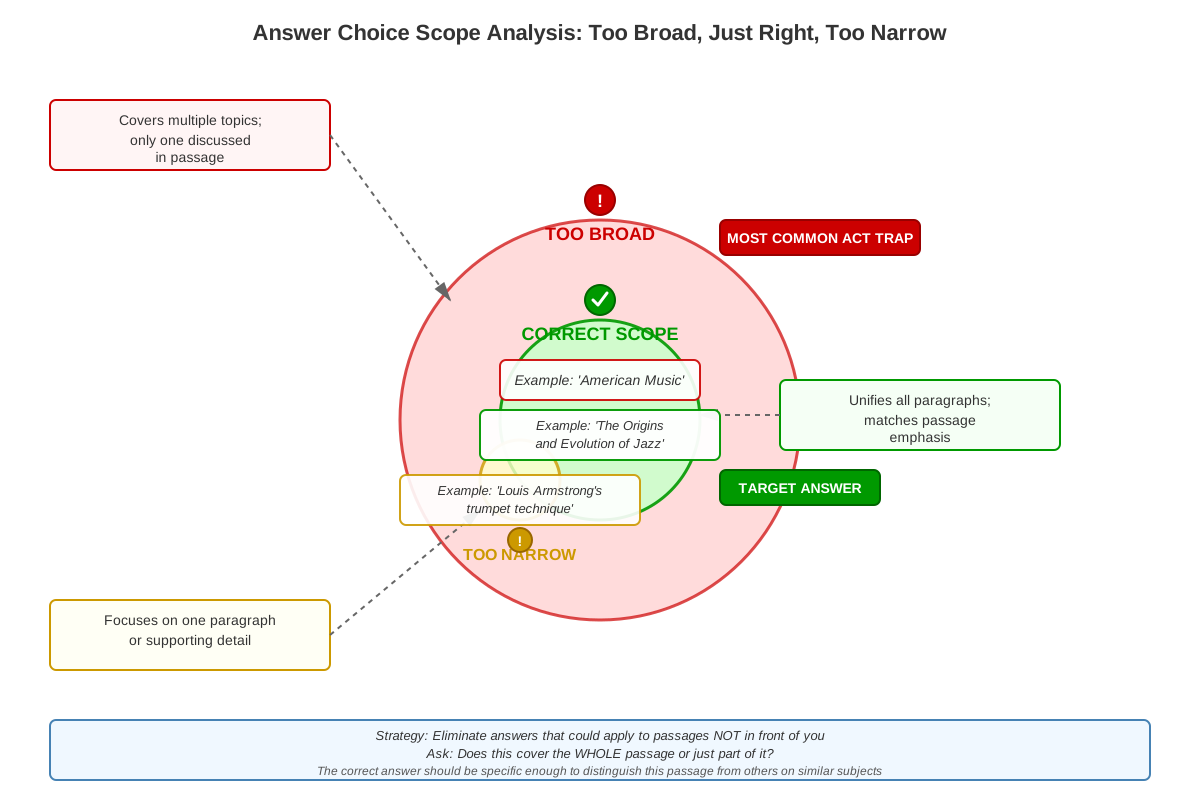
A correct topic answer must have appropriate scope—neither too broad nor too narrow. This concept is critical for eliminating wrong answers efficiently.
| Scope Issue | Description | Example |
|---|---|---|
| Too Broad | Covers more than the passage addresses; could apply to many different passages | "Science" for a passage specifically about photosynthesis in desert plants |
| Appropriate | Matches the passage's actual coverage; specific enough to be meaningful | "Photosynthetic adaptations in desert plants" |
| Too Narrow | Focuses on only one paragraph, example, or detail rather than the whole passage | "The waxy coating on cactus leaves" when the passage covers multiple adaptation types |
Students should ask themselves: "Does this answer choice cover everything important in the passage without including things the passage doesn't discuss?" The correct answer should feel like it encompasses the entire passage without being so vague that it could describe dozens of different texts.
Common Topic Question Formats
The ACT presents topic questions in several recognizable formats:
- Direct topic questions: "The topic of this passage is...", "This passage is primarily concerned with..."
- Title questions: "Which of the following would be the most appropriate title for this passage?"
- Summary questions: "This passage can best be described as..."
- Focus questions: "The main focus of the passage is..."
- Subject questions: "The passage primarily discusses..."
Recognizing these question formats helps students activate the appropriate strategy immediately. All these formats require the same fundamental skill: identifying the unifying subject that connects all parts of the passage.
The Role of Supporting Details
While the topic represents the passage's overall focus, supporting details provide specific information, examples, evidence, and elaboration. A key skill in topic identification involves recognizing that supporting details, no matter how interesting or prominent, are not themselves the topic.
For instance, a passage about "the development of the American highway system" might include extensive details about President Eisenhower's role, specific construction techniques, economic impacts, and environmental consequences. None of these details individually represents the topic—they all support and develop the broader topic of highway system development. Wrong answer choices frequently feature these compelling details to distract students who confuse prominence with centrality.
Topic Consistency Across Paragraphs
A reliable test for topic accuracy involves checking whether the proposed topic applies to every paragraph in the passage. If a passage has five paragraphs, the correct topic should relate to all five, even if each paragraph approaches the topic from a different angle or discusses a different aspect.
Students can mentally create a checklist: "Does paragraph 1 relate to this topic? Does paragraph 2? Does paragraph 3?" If the answer is no for any paragraph, the proposed topic is likely too narrow. This paragraph-by-paragraph verification strategy is particularly useful when students are uncertain between two answer choices.
Concept Relationships
The topic of a passage serves as the foundation for understanding all other aspects of a text. The relationship flows hierarchically: Topic → Main Idea → Supporting Details → Specific Examples. Students must first identify what the passage is about (topic) before they can determine what the author is saying about it (main idea), which is supported by various details and examples.
Topic identification connects directly to main idea questions, as the main idea always includes the topic plus the author's specific point or argument. It also relates to purpose questions (why the author wrote about this topic) and structure questions (how the author organized information about the topic). Understanding the topic helps students predict what kinds of questions might appear and what information to prioritize while reading.
Within the broader Reading section, topic identification supports inference questions by providing context for understanding implicit meanings, and vocabulary-in-context questions by clarifying how words function within the passage's overall focus. Students who misidentify the topic often struggle with these related question types because they lack the proper framework for interpretation.
The skill also connects to test-taking strategy: identifying the topic quickly allows students to create a mental framework for organizing information as they read, improving both comprehension and retention. This framework makes it easier to locate specific details when answering subsequent questions.
High-Yield Facts
⭐ The topic is what the passage is about; the main idea is what the author is saying about the topic
⭐ Topic questions are among the most frequently tested concepts on ACT Reading, appearing in 15-20% of questions
⭐ The correct topic answer must apply to the entire passage, not just one or two paragraphs
⭐ Wrong answers are typically too broad, too narrow, or off-topic (mentioning minor details)
⭐ The first and last paragraphs often provide the strongest clues about the passage's topic
- Topic answers are usually phrases, not complete sentences, while main ideas require complete sentences
- Repeated words, concepts, and themes throughout the passage typically relate directly to the topic
- Title questions are essentially topic questions in disguise—both require identifying the passage's overall focus
- Supporting details, no matter how prominent or interesting, are not the topic themselves
- Different passage types (fiction, social science, humanities, natural science) present topics in characteristic ways
- The topic should feel neither too specific (like a single example) nor too vague (like a general category)
- Transition words between paragraphs reveal whether the passage maintains a unified topic or shifts focus
- If you can't explain how a paragraph relates to the proposed topic, that topic is likely incorrect
Quick check — test yourself on Topic of a passage so far.
Try Flashcards →Common Misconceptions
Misconception: The topic is whatever the passage discusses most extensively or in the greatest detail.
Correction: The topic is the unifying subject of the entire passage, regardless of which aspects receive the most detailed treatment. A passage might spend three paragraphs on one example and one paragraph each on two other examples, but the topic encompasses all the examples, not just the longest one.
Misconception: The topic and main idea are the same thing and can be used interchangeably.
Correction: The topic is the general subject (a phrase), while the main idea includes both the topic and the author's specific point or argument about it (a complete thought). "Renewable energy" is a topic; "Renewable energy sources will become economically competitive with fossil fuels within a decade" is a main idea.
Misconception: The most interesting or surprising information in the passage must be the topic.
Correction: The ACT deliberately includes compelling details that are not central to the passage's topic. These details serve as distractors in answer choices. The topic is determined by what unifies the passage, not by what is most memorable or dramatic.
Misconception: If a concept appears in the first paragraph, it must be the topic.
Correction: While first paragraphs often introduce the topic, they may also provide background information, anecdotes, or context that is not itself the topic. Students must read beyond the introduction to confirm what the entire passage addresses.
Misconception: Topic questions are easy and don't require careful analysis.
Correction: Topic questions can be challenging because wrong answers are carefully crafted to appeal to students who skim, misread, or confuse supporting details with the main focus. These questions require systematic evaluation of scope and coverage.
Misconception: The passage's title (if provided) is always the topic.
Correction: On the ACT, passages typically don't have titles, and when they do, the title might be creative, metaphorical, or intentionally vague. Students must determine the topic from the passage content itself, not from any heading.
Worked Examples
Example 1: Social Science Passage
Passage Summary: A passage discusses how urban planners in three different cities (Copenhagen, Singapore, and Portland) have implemented bicycle infrastructure to reduce traffic congestion. The first paragraph introduces the problem of urban traffic. Paragraphs 2-4 each describe one city's approach in detail, including specific policies, infrastructure investments, and results. The final paragraph discusses common challenges all three cities faced.
Question: This passage is primarily about:
A) The history of bicycle manufacturing in Europe and Asia
B) Urban planning strategies for reducing traffic congestion
C) Bicycle infrastructure initiatives in multiple cities
D) The environmental benefits of cycling versus driving
Analysis:
Let's evaluate each answer choice for appropriate scope:
Choice A is off-topic. While bicycles are mentioned throughout the passage, the passage never discusses bicycle manufacturing or its history. This answer might tempt students who see "bicycle" and "Europe and Asia" (where two of the cities are located) but don't carefully consider what the passage actually addresses.
Choice B is too broad. Urban planning strategies for reducing traffic congestion could include public transit, congestion pricing, parking restrictions, carpooling incentives, and many other approaches. The passage specifically focuses on bicycle infrastructure, not the full range of traffic reduction strategies. This answer could describe hundreds of different passages.
Choice C is correct. This answer has appropriate scope: it's specific enough to distinguish this passage from others (bicycle infrastructure, not just "urban planning" or "transportation") while being broad enough to cover all five paragraphs. The phrase "multiple cities" encompasses Copenhagen, Singapore, and Portland without being too narrow (like "bicycle infrastructure in Copenhagen").
Choice D is too narrow and off-topic. While environmental benefits might be mentioned as one reason cities pursue bicycle infrastructure, the passage primarily focuses on the infrastructure initiatives themselves—the policies, investments, and implementation challenges. This answer focuses on one possible motivation rather than the passage's actual subject.
Strategy Applied: We verified that Choice C applies to every paragraph: Paragraph 1 introduces the context for bicycle infrastructure initiatives, paragraphs 2-4 each describe a city's initiatives, and paragraph 5 discusses challenges common to these initiatives. The answer passes the "whole passage" test.
Example 2: Humanities Passage
Passage Summary: A passage explores the artistic philosophy of painter Georgia O'Keeffe. It begins with biographical information about her early life and training. The middle sections discuss her distinctive approach to painting flowers and landscapes, her views on abstraction versus representation, and her statements about artistic intention. The passage concludes with her influence on later artists.
Question: Which of the following would be the most appropriate title for this passage?
F) "American Art in the Early Twentieth Century"
G) "Georgia O'Keeffe's Artistic Vision and Technique"
H) "The Symbolism of Flowers in Modern Painting"
J) "Women Artists Who Challenged Traditional Conventions"
Analysis:
Choice F is too broad. Georgia O'Keeffe was one of many American artists working in the early twentieth century. A passage with this title would need to discuss multiple artists, movements, and trends. This passage focuses specifically on O'Keeffe, making this title far too general.
Choice G is correct. This title has appropriate scope: it identifies the specific artist (Georgia O'Keeffe) and the aspects of her work the passage addresses (artistic vision and technique). The word "vision" encompasses her philosophy and views, while "technique" covers her distinctive approach to painting. This title would help a reader know exactly what to expect from the passage.
Choice H is too narrow. While the passage discusses O'Keeffe's flower paintings, it also addresses her landscapes, her views on abstraction, and her influence on other artists. A title focusing only on flower symbolism would mislead readers about the passage's actual scope. Additionally, the passage focuses on O'Keeffe specifically, not "modern painting" generally.
Choice J is too broad and partially off-topic. While O'Keeffe was a woman artist who challenged conventions, this title suggests the passage discusses multiple women artists. The passage focuses on O'Keeffe individually, and while her gender might be mentioned, it's not the primary focus. This title could apply to many different passages about various artists.
Strategy Applied: We asked, "Would this title accurately prepare a reader for the passage's content?" Only Choice G provides the right level of specificity—neither so broad that it could describe many different passages nor so narrow that it excludes significant portions of the actual passage.
Exam Strategy
When approaching topic questions on the ACT, students should implement a systematic strategy:
Before Reading: Quickly note the passage type (prose fiction, social science, humanities, or natural science) and any introductory information provided. This context helps predict how the topic will likely be presented.
During Reading: Actively identify the topic as you read. After the first paragraph, form a preliminary hypothesis: "This passage seems to be about..." After each subsequent paragraph, verify whether your hypothesis still fits: "Does this paragraph also relate to that topic?" Adjust your hypothesis if needed. This active reading approach prevents the need to reread the entire passage when a topic question appears.
Trigger Words to Watch For: Topic questions typically include phrases like "primarily about," "main focus," "primarily concerned with," "best described as," "appropriate title," or "passage discusses." These phrases signal that you need to identify the unifying subject, not specific details or the author's argument.
Elimination Strategy:
- First pass: Eliminate answers that are clearly off-topic (mentioning things barely discussed or not discussed at all)
- Second pass: Eliminate answers that are too broad (could apply to many different passages)
- Third pass: Eliminate answers that are too narrow (apply to only one or two paragraphs)
- Final verification: Confirm the remaining answer applies to the entire passage
The Paragraph Test: When uncertain between two answer choices, mentally go through each paragraph and ask whether the proposed topic applies. The correct answer should relate to every paragraph, even if different paragraphs approach the topic from different angles.
Time Management: Topic questions should typically take 30-45 seconds once you've read the passage. If you find yourself spending more than a minute, you may be overthinking. Return to the basics: What is the passage about in general terms? What unifies all the paragraphs?
Common Trap Patterns: The ACT frequently includes wrong answers that feature the most interesting detail, the most frequently mentioned specific example, or a concept from only the introduction or conclusion. Train yourself to recognize these patterns and automatically question whether these elements truly represent the passage's overall topic.
Memory Techniques
The "Umbrella" Visualization: Picture the topic as an umbrella that covers all the paragraphs and details in the passage. If a proposed topic is too narrow, the umbrella is too small and leaves some paragraphs uncovered. If it's too broad, the umbrella is so large it could cover many different passages. The correct topic is an umbrella that's exactly the right size—covering everything in this passage without extending far beyond it.
The "Goldilocks" Principle: Remember that the correct topic is "just right"—not too broad, not too narrow. When evaluating answer choices, literally think "too broad," "too narrow," or "just right" for each option.
T.O.P.I.C. Acronym:
- Test every paragraph (does the topic apply to all of them?)
- Overall focus (what unifies the whole passage?)
- Phrase, not sentence (topics are expressed as phrases)
- Ignore interesting details (they're often distractors)
- Check scope (neither too broad nor too narrow)
The "Dinner Party" Analogy: If someone at a dinner party asked, "What was that passage about?" your answer would be the topic. You wouldn't recite the main idea or list every detail—you'd give a general subject: "It was about bicycle infrastructure in cities" or "It was about Georgia O'Keeffe's artistic philosophy."
First and Last: Remember that the first and last paragraphs are your friends. They often provide the clearest clues about the topic. When in doubt, reread these two paragraphs carefully.
Summary
Identifying the topic of a passage is a foundational ACT Reading skill that requires distinguishing between the general subject matter (topic) and the author's specific point (main idea). The topic represents what the passage is about in broad terms and must apply to the entire passage, not just selected paragraphs or interesting details. Success requires understanding appropriate scope—the correct answer is neither too broad (could apply to many passages) nor too narrow (applies to only part of the passage). Students should actively identify the topic while reading, noting repeated concepts and verifying that their hypothesis applies to each paragraph. Topic questions appear frequently on the ACT in various formats, including direct topic questions, title questions, and summary questions. Mastering this skill provides the foundation for answering more complex questions and improves overall reading comprehension and efficiency.
Key Takeaways
- The topic is the general subject of the passage (a phrase), while the main idea includes the author's specific point about that topic (a complete thought)
- Correct topic answers must apply to the entire passage—test each paragraph to verify coverage
- Wrong answers typically fall into three categories: too broad, too narrow, or off-topic
- Topic questions appear in 15-20% of ACT Reading questions and serve as the foundation for other question types
- Use the first and last paragraphs as primary sources for topic identification, and look for repeated words and concepts throughout
- Eliminate answers systematically: first remove off-topic choices, then those that are too broad or narrow
- Don't confuse interesting or prominent details with the actual topic—supporting details support the topic but aren't the topic themselves
Related Topics
Main Idea Identification: Once students master topic identification, they progress to identifying main ideas, which combine the topic with the author's specific argument or point. This skill builds directly on topic recognition and adds a layer of analytical complexity.
Purpose and Function Questions: Understanding why an author wrote about a particular topic and how different paragraphs function within the passage requires first knowing what the topic is. These questions test deeper comprehension of authorial intent.
Supporting Details and Evidence: After identifying the topic, students must learn to distinguish between primary supporting details (directly related to the main idea) and secondary details (examples, elaborations, and tangential information).
Passage Structure and Organization: Analyzing how authors organize information about a topic—through comparison, chronology, cause-and-effect, or other patterns—builds on the foundation of topic identification.
Synthesis Across Multiple Passages: Advanced ACT questions sometimes require comparing topics across paired passages, a skill that depends on accurately identifying each passage's individual topic first.
Practice CTA
Now that you understand how to identify the topic of a passage, it's time to put these strategies into practice! Complete the practice questions to test your ability to distinguish between topics and main ideas, evaluate scope, and eliminate common distractors. Use the flashcards to reinforce key concepts and trigger words. Remember: topic identification is a skill that improves rapidly with focused practice. Each question you answer strengthens your ability to recognize patterns and avoid traps. You're building a foundation that will support success across all ACT Reading question types—keep practicing, and you'll see your confidence and accuracy grow!
Sign up free to keep reading
Create a free AnvayaPrep account to finish this ACT guide on Topic of a passage — plus flashcards and practice questions.