Overview
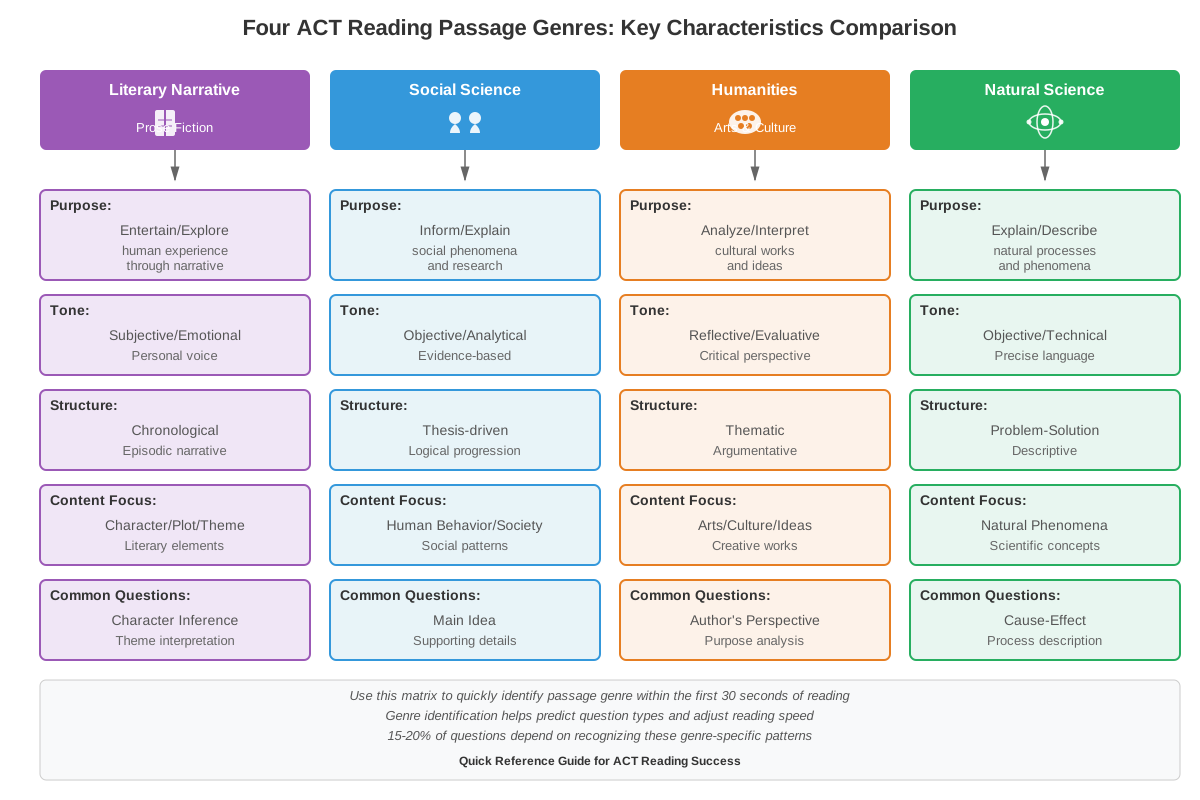
The ACT Reading section presents students with four distinct passages representing different genres: Literary Narrative/Prose Fiction, Social Science, Humanities, and Natural Science. While each passage type has unique characteristics, the exam frequently tests students' ability to recognize and navigate these differences through comparing passage genres. This skill involves understanding how the purpose, structure, tone, and content vary across different types of texts, and how these variations affect the way information is presented and questions are constructed.
Mastering ACT comparing passage genres is essential because approximately 15-20% of Reading questions require students to recognize genre-specific features or apply different reading strategies based on passage type. Students who can quickly identify a passage's genre and adjust their reading approach accordingly gain significant advantages in both speed and accuracy. For instance, recognizing that a Natural Science passage will likely present objective data and causal relationships helps students anticipate the types of questions they'll encounter, while understanding that a Literary Narrative focuses on character development and emotional nuance prepares them for inference-based questions about motivation and theme.
This topic serves as a foundational skill that connects to virtually every other aspect of ACT Reading comprehension. Understanding genre differences enhances students' ability to identify main ideas, analyze author's purpose, interpret tone, and make valid inferences—all core competencies tested throughout the Reading section. By developing expertise in comparing passage genres, students build a mental framework that allows them to approach each passage strategically rather than treating all texts as identical reading experiences.
Learning Objectives
- [ ] Identify when comparing passage genres is being tested in ACT Reading questions
- [ ] Explain the core rule or strategy behind comparing passage genres
- [ ] Apply comparing passage genres to ACT-style questions accurately
- [ ] Distinguish between the four primary ACT passage genres based on structural and content markers
- [ ] Predict question types and difficulty patterns based on passage genre
- [ ] Adapt reading speed and annotation strategies according to genre characteristics
- [ ] Analyze how author's purpose varies systematically across different passage types
Prerequisites
- Basic understanding of the four ACT passage types (Literary Narrative, Social Science, Humanities, Natural Science) - Essential for recognizing which genres are being compared
- Familiarity with main idea identification - Necessary because genre affects how main ideas are presented and developed
- Knowledge of author's purpose and tone - Required since these elements vary predictably across genres
- Experience with basic inference questions - Important because different genres require different inference strategies
- Understanding of passage structure (introduction, body, conclusion) - Relevant because structural conventions differ by genre
Why This Topic Matters
In real-world contexts, the ability to recognize and adapt to different text types is fundamental to academic and professional success. College students must navigate textbooks, research articles, literary analyses, and historical documents—each requiring different reading approaches. Professionals regularly switch between technical reports, persuasive communications, and narrative accounts. The ACT's emphasis on comparing passage genres reflects this practical necessity, testing whether students can flexibly adjust their comprehension strategies based on text type.
On the ACT Reading section, questions explicitly or implicitly testing genre comparison appear in approximately 3-5 questions per test, but the skill indirectly affects performance on 15-20 additional questions. Students who understand genre differences answer questions 20-30% faster because they know where to look for specific information types. For example, knowing that Natural Science passages typically present problems and solutions helps students quickly locate relevant details when answering cause-and-effect questions.
This topic commonly appears in several question formats: direct questions asking students to identify genre characteristics ("This passage is best described as..."), comparative questions requiring recognition of how information would differ in another genre ("If this information were presented in a scientific article instead of a personal narrative, it would most likely..."), and questions about author's approach that depend on understanding genre conventions ("The author's use of personal anecdotes is typical of which type of writing?"). Additionally, the ACT occasionally includes paired passages from different genres, making explicit genre comparison essential for success.
Core Concepts
The Four Primary ACT Passage Genres
The ACT Reading section consistently presents four passage types, each with distinct characteristics that affect content, structure, and question patterns.
Literary Narrative/Prose Fiction passages are excerpts from novels, short stories, memoirs, or personal essays. These texts prioritize character development, emotional experience, and narrative arc. They employ literary devices such as metaphor, symbolism, and imagery. The language tends to be descriptive and evocative rather than purely informational. Questions on these passages frequently test inference about character motivation, interpretation of figurative language, and understanding of theme and mood. The chronology may be non-linear, with flashbacks or stream-of-consciousness elements.
Social Science passages examine topics in anthropology, economics, political science, psychology, sociology, and related fields. These texts present research findings, theoretical frameworks, or analyses of human behavior and social systems. They maintain an academic but accessible tone, balancing objective presentation with interpretation. Structure typically follows a problem-solution or cause-effect pattern, with clear topic sentences and supporting evidence. Questions emphasize understanding of research methodology, interpretation of data, and recognition of cause-and-effect relationships.
Humanities passages explore topics in art, music, literature, philosophy, architecture, dance, theater, and cultural studies. These texts often blend biographical information with critical analysis, combining narrative elements with argumentative or expository content. The tone ranges from appreciative to analytical, and passages frequently include the author's interpretations and value judgments. Questions test understanding of artistic movements, biographical details, critical perspectives, and the relationship between cultural context and creative work.
Natural Science passages cover biology, chemistry, physics, earth science, astronomy, and related disciplines. These texts explain scientific phenomena, describe research processes, or present theories and discoveries. The language is precise and technical, with specialized vocabulary defined in context. Structure emphasizes logical progression, often moving from observation to hypothesis to conclusion. Questions focus on understanding scientific processes, interpreting experimental results, and recognizing cause-and-effect relationships in natural systems.
Genre-Specific Structural Patterns
Each genre follows predictable organizational patterns that skilled readers can recognize and exploit.
| Genre | Typical Structure | Opening Strategy | Development Pattern | Conclusion Style |
|---|---|---|---|---|
| Literary Narrative | Scene-based or chronological | Establishes setting, character, or conflict | Character actions, dialogue, internal reflection | Resolution or reflection on meaning |
| Social Science | Thesis-driven | Presents research question or social phenomenon | Evidence, examples, counterarguments | Implications or future directions |
| Humanities | Biographical-analytical | Introduces artist/work and context | Analysis of specific works/ideas | Assessment of legacy or significance |
| Natural Science | Process or explanation | Describes phenomenon or poses question | Mechanisms, data, experimental evidence | Scientific consensus or applications |
Understanding these patterns allows students to predict where specific information types will appear, dramatically reducing search time during questions.
Genre-Specific Language and Tone Markers
Each passage type employs characteristic language that signals its genre identity.
Literary Narrative markers include sensory details ("the acrid smell of smoke"), emotional descriptors ("her heart sank"), dialogue tags ("she whispered"), and figurative language ("time crawled forward"). The tone is subjective and personal, often using first-person perspective or close third-person narration that accesses characters' thoughts.
Social Science markers include research terminology ("the study found," "participants reported"), statistical references ("a significant correlation," "the majority of respondents"), theoretical frameworks ("according to cognitive theory"), and hedging language ("suggests," "may indicate," "appears to"). The tone is objective but interpretive, typically using third-person perspective and present tense for general findings.
Humanities markers include evaluative language ("masterful," "innovative," "influential"), historical context references ("during the Renaissance," "in response to industrialization"), artistic terminology ("composition," "motif," "technique"), and interpretive phrases ("can be understood as," "reflects," "embodies"). The tone blends objectivity with appreciation and critical judgment.
Natural Science markers include technical vocabulary ("photosynthesis," "tectonic plates," "molecular structure"), process descriptions ("first," "subsequently," "as a result"), quantitative data ("measured," "calculated," "observed"), and causal language ("causes," "leads to," "produces"). The tone is objective and explanatory, using passive voice and present tense for established facts.
Question Type Patterns by Genre
Different genres generate predictable question patterns that students can anticipate.
Literary Narrative questions heavily emphasize inference about character emotions and motivations (30-40% of questions), interpretation of figurative language and symbolism (20-25%), understanding of narrative perspective and point of view (15-20%), and identification of theme and mood (15-20%). Detail questions are less common and typically ask about character actions rather than factual information.
Social Science questions focus on main idea and thesis identification (25-30%), understanding of cause-and-effect relationships (25-30%), interpretation of research findings and data (20-25%), and recognition of supporting evidence (15-20%). These passages generate more "according to the passage" questions requiring specific textual support.
Humanities questions balance biographical details (20-25%), understanding of artistic or philosophical concepts (25-30%), interpretation of the author's critical perspective (20-25%), and connections between context and creative work (20-25%). Questions often ask students to distinguish between factual information and the author's interpretations.
Natural Science questions emphasize understanding of scientific processes and mechanisms (30-35%), cause-and-effect relationships in natural systems (25-30%), interpretation of experimental evidence (20-25%), and vocabulary in context (10-15%). These passages generate the most questions requiring students to follow multi-step logical sequences.
Strategic Reading Adjustments by Genre
Effective readers modify their approach based on genre recognition.
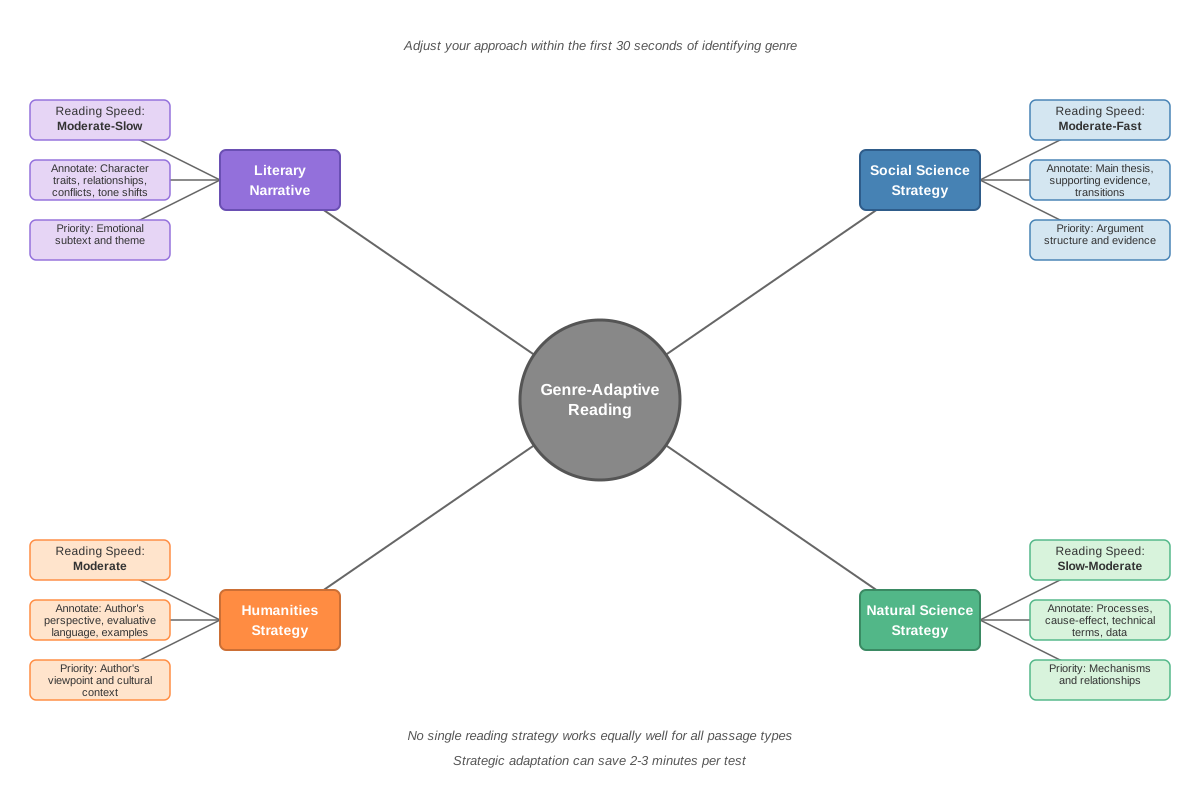
For Literary Narratives, students should read at a moderate pace, paying close attention to character descriptions, emotional language, and shifts in tone or perspective. Annotation should focus on character traits, relationships, conflicts, and moments of realization or change. Students should pause to visualize scenes and consider characters' unstated motivations.
For Social Science passages, students should read at a steady pace, identifying the research question or social issue in the first paragraph, then tracking how evidence supports the main argument. Annotation should mark the thesis, major supporting points, examples, and any counterarguments or limitations mentioned. Students should note transitions that signal cause-and-effect relationships.
For Humanities passages, students should read at a moderate pace, distinguishing between biographical facts and critical interpretations. Annotation should separate information about the artist/work from the author's analysis and evaluation. Students should note historical context and how it relates to the creative work being discussed.
For Natural Science passages, students should read carefully but can move quickly through familiar concepts, slowing down for complex processes or unfamiliar terminology. Annotation should map out processes step-by-step, mark cause-and-effect relationships, and note any experimental procedures or findings. Students should create mental diagrams of systems or processes described.
Concept Relationships
The concepts within comparing passage genres form an interconnected system where recognition of one element facilitates understanding of others. Genre identification (recognizing whether a passage is Literary Narrative, Social Science, Humanities, or Natural Science) serves as the foundation, leading directly to prediction of structural patterns (knowing how information will be organized). This structural awareness enables efficient information location (finding specific details quickly during questions), which improves both speed and accuracy.
Simultaneously, genre identification activates knowledge of characteristic language and tone markers, which helps students interpret author's purpose more accurately. Understanding purpose then clarifies question type expectations (predicting which question types will appear), allowing students to adjust reading strategies proactively rather than reactively.
These concepts connect to prerequisite knowledge in several ways. The ability to identify main ideas becomes more sophisticated when students recognize that main ideas appear in different locations and forms across genres. Understanding of author's purpose deepens when students recognize that purpose varies systematically by genre—Literary Narratives explore human experience, Social Science passages explain social phenomena, Humanities passages evaluate cultural contributions, and Natural Science passages explain natural processes.
The relationship map flows as follows:
Genre Identification → Structural Pattern Recognition → Strategic Reading Adjustment → Efficient Information Location → Faster, More Accurate Answering
Parallel pathway: Genre Identification → Language/Tone Recognition → Purpose Understanding → Question Type Prediction → Targeted Annotation → Improved Performance
High-Yield Facts
⭐ Literary Narrative passages generate the highest percentage of inference questions (60-70% of questions require inference), while Natural Science passages generate the lowest (30-40%)
⭐ The first paragraph of each passage type serves a different function: Literary Narratives establish scene/character, Social Science presents the research question, Humanities introduces the subject and context, Natural Science describes the phenomenon to be explained
⭐ Social Science and Natural Science passages use more explicit transition words and topic sentences than Literary Narrative and Humanities passages
⭐ Questions asking about "the author's primary purpose" have different correct answer patterns by genre: Literary Narratives typically "explore" or "portray," Social Science "explain" or "analyze," Humanities "evaluate" or "describe," Natural Science "explain" or "describe"
⭐ Vocabulary-in-context questions appear most frequently in Natural Science passages (2-3 per passage) and least frequently in Literary Narratives (0-1 per passage)
- Literary Narrative passages are the only genre that regularly includes dialogue and first-person narration
- Humanities passages uniquely blend chronological biographical information with thematic analysis of works or ideas
- Natural Science passages are the only genre where understanding the sequence of steps in a process is regularly tested
- Social Science passages more frequently include discussion of limitations, counterarguments, or alternative explanations than other genres
- The correct answers to main idea questions in Literary Narratives are typically more abstract and thematic, while in Natural Science they are more concrete and process-focused
- Paired passages on the ACT most commonly pair two passages from the same genre, but when they pair different genres, it's usually Social Science with Natural Science or Humanities with Literary Narrative
Quick check — test yourself on Comparing passage genres so far.
Try Flashcards →Common Misconceptions
Misconception: All ACT passages should be read at the same speed and with the same strategy.
Correction: Reading speed and strategy should vary by genre. Literary Narratives require careful attention to nuance and character development, while Natural Science passages allow faster reading of familiar concepts with slowdowns for complex processes. Social Science passages benefit from thesis-focused reading, while Humanities passages require distinguishing facts from interpretations.
Misconception: Natural Science passages are always harder than other passage types.
Correction: Difficulty varies by individual student background and the specific passage content. Many students find Natural Science passages easier because of their logical structure and explicit transitions. Literary Narratives often prove more challenging because they require sophisticated inference about implicit character motivations and themes.
Misconception: The genre of a passage doesn't affect the types of questions asked.
Correction: Genre strongly predicts question types. Literary Narratives generate far more inference and figurative language questions, while Natural Science passages generate more cause-and-effect and process questions. Recognizing these patterns helps students anticipate and prepare for specific question types.
Misconception: Humanities passages are just biographies, so they're similar to Literary Narratives.
Correction: While Humanities passages often include biographical information, they differ fundamentally from Literary Narratives in purpose and structure. Humanities passages analyze and evaluate cultural contributions using an academic, critical lens, while Literary Narratives explore human experience through storytelling. Humanities passages blend factual information with interpretation, requiring students to distinguish between the two.
Misconception: Social Science passages are boring and unimportant compared to other genres.
Correction: Social Science passages are highly relevant to understanding human behavior and social systems, and they appear in every ACT Reading section. Moreover, the skills developed reading Social Science passages—identifying thesis statements, tracking evidence, recognizing cause-and-effect relationships—transfer directly to college-level reading across disciplines.
Misconception: You can identify genre solely from the topic label provided before each passage.
Correction: While the ACT labels passages as "Prose Fiction," "Social Science," "Humanities," or "Natural Science," skilled readers should verify genre through structural and linguistic markers. Occasionally, a passage labeled "Humanities" might discuss scientific topics (like the history of astronomy), requiring readers to recognize it's still analyzing cultural/historical significance rather than explaining natural processes.
Worked Examples
Example 1: Identifying Genre from Opening Paragraphs
Passage Excerpt A: "The quantum mechanical model of the atom emerged from decades of experimental observations that classical physics could not explain. When heated, elements emit light at specific wavelengths, producing distinct spectral lines. This phenomenon, first observed in the mid-19th century, suggested that electrons occupy discrete energy levels rather than existing in a continuous range of energies."
Passage Excerpt B: "Margaret Atwood's dystopian novels have consistently explored the intersection of gender, power, and environmental collapse. Her 1985 novel The Handmaid's Tale imagined a theocratic regime that stripped women of autonomy, a vision that resonated with readers concerned about the erosion of reproductive rights. Decades later, the novel's television adaptation sparked renewed interest in Atwood's prescient warnings."
Analysis Process:
For Excerpt A, we identify several Natural Science markers: technical vocabulary ("quantum mechanical," "spectral lines," "discrete energy levels"), reference to experimental observations, chronological development of scientific understanding ("emerged from decades," "first observed"), and causal language ("suggested that"). The structure moves from general phenomenon to specific evidence to theoretical explanation—a classic Natural Science pattern. The tone is objective and explanatory, with no personal perspective or evaluation.
For Excerpt B, we identify Humanities markers: focus on an artist and their work (Margaret Atwood and her novels), evaluative language ("consistently explored," "prescient warnings"), connection between creative work and cultural context ("resonated with readers concerned about"), and critical analysis of themes ("intersection of gender, power, and environmental collapse"). The structure introduces the artist, discusses a specific work, and evaluates its cultural significance—a typical Humanities pattern.
Application to Questions: Recognizing Excerpt A as Natural Science, we would expect questions about the scientific process (how observations led to theory), cause-and-effect relationships (why spectral lines suggested discrete energy levels), and vocabulary in context (defining "quantum mechanical" or "discrete"). For Excerpt B, we would anticipate questions about the author's critical perspective on Atwood's work, the relationship between the novel and its cultural context, and the significance of the television adaptation.
Example 2: Adjusting Strategy Based on Genre Recognition
Scenario: A student encounters a passage labeled "Social Science" that begins: "In 2018, researchers at Stanford University conducted a longitudinal study examining the relationship between social media use and adolescent well-being. Over three years, they tracked 500 teenagers, measuring both their daily social media engagement and various psychological indicators including self-esteem, anxiety levels, and sleep quality."
Strategic Approach:
Step 1 - Genre Confirmation: The student confirms this is indeed Social Science through markers: research study reference, academic institution, methodology description ("longitudinal study," "tracked," "measuring"), and focus on human behavior ("adolescent well-being").
Step 2 - Structural Prediction: Based on Social Science genre, the student predicts the passage will follow this structure: (1) research question/phenomenon, (2) methodology, (3) findings/results, (4) interpretation/implications. The student knows to look for the main finding in the middle-to-later paragraphs, not the introduction.
Step 3 - Annotation Strategy: The student marks: the research question (relationship between social media and well-being), the sample size and duration (500 teenagers, three years), the variables measured (social media engagement, self-esteem, anxiety, sleep quality), and will watch for the findings and any limitations or alternative explanations mentioned.
Step 4 - Question Anticipation: The student expects questions about: the study's main finding, cause-and-effect relationships (does social media cause changes in well-being?), the significance of the methodology (why longitudinal? why these specific measures?), and possibly limitations of the research.
Step 5 - Reading Pace Adjustment: The student reads the methodology section relatively quickly (just noting key details) but slows down for the findings and interpretation sections, where most questions will focus.
Outcome: By recognizing the genre and adjusting strategy accordingly, the student reads more efficiently, annotates more effectively, and answers questions more accurately than if treating this passage identically to a Literary Narrative or Natural Science passage.
Exam Strategy
When approaching ACT Reading questions involving genre comparison, students should implement a systematic strategy that begins before reading and continues through answering questions.
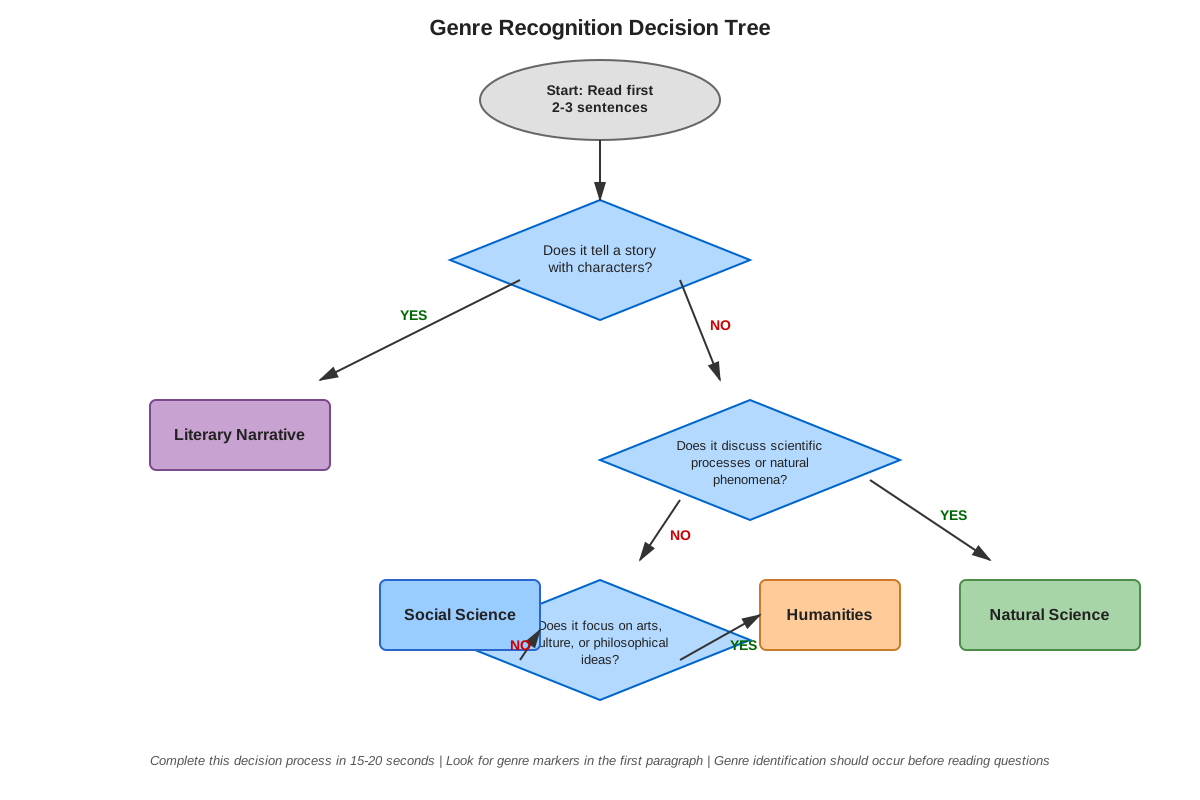
Pre-Reading Genre Identification: Before reading the passage, examine the label provided ("Prose Fiction," "Social Science," "Humanities," or "Natural Science") and quickly scan the first few lines to confirm genre through structural and linguistic markers. This takes only 5-10 seconds but activates the appropriate mental framework for the entire passage.
Trigger Words for Genre-Specific Questions: Watch for these phrases that signal genre comparison is being tested:
- "This passage is best described as..." (direct genre identification)
- "The author's approach is most similar to that of..." (comparing authorial methods across genres)
- "Unlike a scientific article, this passage..." (explicit genre contrast)
- "The primary purpose of this passage is to..." (purpose varies by genre)
- "The tone of this passage can best be described as..." (tone patterns differ by genre)
Process-of-Elimination Strategies: When answering genre-related questions, eliminate options that:
- Describe purposes inconsistent with the genre (e.g., "to entertain through fictional narrative" for a Natural Science passage)
- Use tone descriptors that don't match genre conventions (e.g., "highly subjective and emotional" for a Social Science passage)
- Suggest structural patterns atypical of the genre (e.g., "organized chronologically around a character's development" for a Natural Science passage)
- Include content types that don't appear in the genre (e.g., "experimental data and statistical analysis" for a Literary Narrative)
Time Allocation by Genre: Adjust time spent based on genre characteristics:
- Literary Narratives: 8-9 minutes (slower reading required for nuance, but questions often flow naturally)
- Social Science: 8-9 minutes (moderate reading pace, questions require careful textual support)
- Humanities: 8-9 minutes (moderate pace, need to distinguish facts from interpretations)
- Natural Science: 7-8 minutes (can read familiar concepts quickly, questions are often straightforward)
Strategic Question Ordering: When questions explicitly test genre comparison, consider answering them after completing other questions on the passage, as working through content-specific questions deepens understanding of genre characteristics and makes comparison questions easier.
Annotation Codes by Genre: Develop genre-specific annotation systems:
- Literary Narrative: Mark character emotions (E), conflicts (C), and theme moments (T)
- Social Science: Mark thesis (TH), evidence (EV), and counterarguments (CA)
- Humanities: Mark biographical facts (F) and critical interpretations (I)
- Natural Science: Mark processes (P), causes (→), and effects (E)
Memory Techniques
LENS Mnemonic for Genre Characteristics:
- Literary: Lives and emotions (focus on character experience)
- Explanatory: Evidence-based (Social Science uses research and data)
- Notable: Names and contributions (Humanities focuses on artists and their work)
- Scientific: Systems and processes (Natural Science explains how things work)
Purpose Pattern Acronym - PEEE:
- Portray (Literary Narrative primary purpose)
- Explain (Social Science and Natural Science primary purpose)
- Evaluate (Humanities primary purpose)
- Explore (Literary Narrative secondary purpose)
Visualization Strategy - The Four Rooms:
Imagine four distinct rooms, each representing a genre:
- Literary Room: Cozy, with comfortable chairs and soft lighting, where people share stories and emotions
- Social Science Lab: Modern research facility with computers displaying data, researchers in discussion
- Humanities Gallery: Museum or concert hall with artwork on walls, programs describing artists' lives and contributions
- Natural Science Laboratory: Traditional lab with microscopes, beakers, and diagrams of natural processes on whiteboards
When reading a passage, mentally "place" yourself in the appropriate room, activating associated expectations and strategies.
Tone Spectrum Memory Aid:
Create a mental spectrum from subjective to objective:
Most Subjective → Literary Narrative → Humanities → Social Science → Natural Science → Most ObjectiveThis helps predict tone-related answer choices and eliminate options inconsistent with genre position on the spectrum.
Question Type Frequency Finger Method:
Assign each finger to a genre and tap it when you see characteristic question types:
- Thumb (Literary): Tap for inference and figurative language questions
- Index (Social Science): Tap for thesis and evidence questions
- Middle (Humanities): Tap for evaluation and context questions
- Ring (Natural Science): Tap for process and cause-effect questions
- Pinky: Tap for vocabulary questions (most common in Natural Science)
This kinesthetic reinforcement strengthens the association between genres and question patterns.
Summary
Comparing passage genres is a foundational ACT Reading skill that enables students to recognize the distinct characteristics of Literary Narrative, Social Science, Humanities, and Natural Science passages and adjust their reading strategies accordingly. Each genre follows predictable patterns in structure, language, tone, and question types. Literary Narratives emphasize character development and emotional experience, generating inference-heavy questions. Social Science passages present research and analysis of human behavior, with questions focusing on thesis, evidence, and cause-and-effect relationships. Humanities passages blend biographical information with critical evaluation of cultural contributions, requiring students to distinguish facts from interpretations. Natural Science passages explain natural phenomena through logical, process-oriented exposition, with questions emphasizing mechanisms and causal relationships. Students who master genre comparison can predict where information will appear, anticipate question types, and allocate time efficiently. This skill directly improves performance by enabling strategic reading adjustments, targeted annotation, and faster, more accurate question answering. Success requires recognizing genre markers in the opening paragraphs, understanding how purpose and tone vary systematically across genres, and applying genre-specific strategies throughout the reading and question-answering process.
Key Takeaways
- The four ACT passage genres (Literary Narrative, Social Science, Humanities, Natural Science) have distinct structural patterns, language markers, and question type distributions that skilled readers recognize and exploit
- Genre identification should occur within the first paragraph through recognition of purpose, tone, and structural markers, enabling immediate strategic adjustments
- Literary Narratives generate 60-70% inference questions and require careful attention to character emotions and figurative language, while Natural Science passages generate more straightforward cause-and-effect and process questions
- Social Science and Natural Science passages use explicit transitions and clear topic sentences, allowing faster information location, while Literary Narratives and Humanities passages require more careful reading for implicit meanings
- Effective annotation strategies vary by genre: mark character emotions in Literary Narratives, thesis and evidence in Social Science, facts versus interpretations in Humanities, and processes and causal relationships in Natural Science
- Understanding genre-specific question patterns allows students to predict approximately 70% of question types before reading the questions, enabling more targeted initial reading
- Time allocation should vary by genre, with Literary Narratives and complex Social Science passages receiving 8-9 minutes, while straightforward Natural Science passages may require only 7-8 minutes
Related Topics
Paired Passage Strategies: Building on genre comparison skills, students learn to analyze paired passages that may represent the same or different genres, requiring synthesis and comparison across texts. Mastering single-passage genre comparison is essential before tackling paired passages.
Author's Purpose and Perspective: This topic deepens understanding of how authorial intent varies systematically across genres, with Literary Narrative authors exploring human experience, Social Science authors explaining phenomena, Humanities authors evaluating contributions, and Natural Science authors describing processes.
Rhetorical Strategies by Genre: Advanced students examine how persuasive techniques, evidence types, and organizational patterns vary across genres, recognizing that Social Science passages use empirical evidence while Humanities passages employ critical analysis and Literary Narratives use narrative techniques.
Vocabulary in Context Across Genres: This skill extends genre comparison by recognizing that vocabulary questions function differently across passage types—Natural Science passages test technical terms, Literary Narratives test figurative language, and Social Science passages test academic terminology.
Main Idea Identification by Genre: Students learn that main ideas appear in different forms and locations depending on genre—explicit thesis statements in Social Science, thematic insights in Literary Narratives, evaluative conclusions in Humanities, and explanatory frameworks in Natural Science.
Practice CTA
Now that you've mastered the core concepts of comparing passage genres, it's time to apply this knowledge to authentic ACT-style questions. The practice questions and flashcards will challenge you to identify genre markers, predict question types, and apply genre-specific strategies under timed conditions. Remember that genre comparison is a skill that improves dramatically with deliberate practice—each passage you analyze strengthens your ability to recognize patterns and adjust strategies automatically. Approach the practice materials strategically: time yourself, annotate using genre-specific codes, and review both correct and incorrect answers to understand how genre recognition leads to better performance. You've built a powerful framework for ACT Reading success—now put it into action!
Sign up free to keep reading
Create a free AnvayaPrep account to finish this ACT guide on Comparing passage genres — plus flashcards and practice questions.