Overview
Humanities passages represent one of the four core passage types on the ACT Reading test, appearing consistently on every administration of the exam. These passages draw from disciplines including memoir, personal essays, literary criticism, art history, music theory, philosophy, architecture, dance, and cultural studies. Unlike the more straightforward prose fiction or natural science passages, ACT humanities passages blend narrative storytelling with analytical commentary, requiring students to navigate both the author's personal perspective and broader cultural or artistic concepts.
Understanding humanities passages is essential for ACT success because they account for approximately 25% of the Reading section—typically one complete passage with 10 questions. These passages often challenge students with dense vocabulary, abstract concepts, and layered arguments that interweave personal reflection with scholarly analysis. The author's voice tends to be more subjective and interpretive than in social science or natural science passages, demanding that readers distinguish between factual claims and opinion-based assertions.
Mastering humanities passages builds upon fundamental reading comprehension skills while preparing students for the interpretive demands of literary analysis. Success with these passages requires synthesizing techniques used in both prose fiction (tracking narrative voice and tone) and informational texts (identifying main ideas and supporting evidence). This topic serves as a bridge between creative and analytical reading, developing the flexible comprehension strategies necessary for tackling all ACT Reading passage types with confidence.
Learning Objectives
- [ ] Identify when Humanities passages is being tested
- [ ] Explain the core rule or strategy behind Humanities passages
- [ ] Apply Humanities passages to ACT-style questions accurately
- [ ] Distinguish between the author's personal narrative and analytical commentary within a single passage
- [ ] Recognize common structural patterns in humanities writing (chronological memoir, thematic analysis, comparative criticism)
- [ ] Evaluate how authors use specific examples from arts and culture to support broader claims
- [ ] Synthesize information from multiple paragraphs to answer inference questions about artistic or cultural concepts
Prerequisites
- Basic reading comprehension skills: Understanding main ideas, supporting details, and paragraph structure forms the foundation for tackling any ACT passage type
- Familiarity with author's purpose and tone: Humanities passages heavily rely on recognizing whether the author is informing, persuading, reflecting, or analyzing
- Vocabulary in context strategies: These passages frequently contain sophisticated terminology from arts and cultural criticism that must be decoded through context clues
- Understanding of passage structure: Recognizing how introductions, body paragraphs, and conclusions function helps navigate the often-complex organization of humanities writing
Why This Topic Matters
Humanities passages test critical thinking skills that extend far beyond standardized testing. The ability to analyze cultural artifacts, understand artistic movements, and evaluate interpretive arguments prepares students for college-level coursework in literature, history, philosophy, and the arts. These passages develop intellectual flexibility by requiring readers to appreciate subjective perspectives while identifying objective evidence.
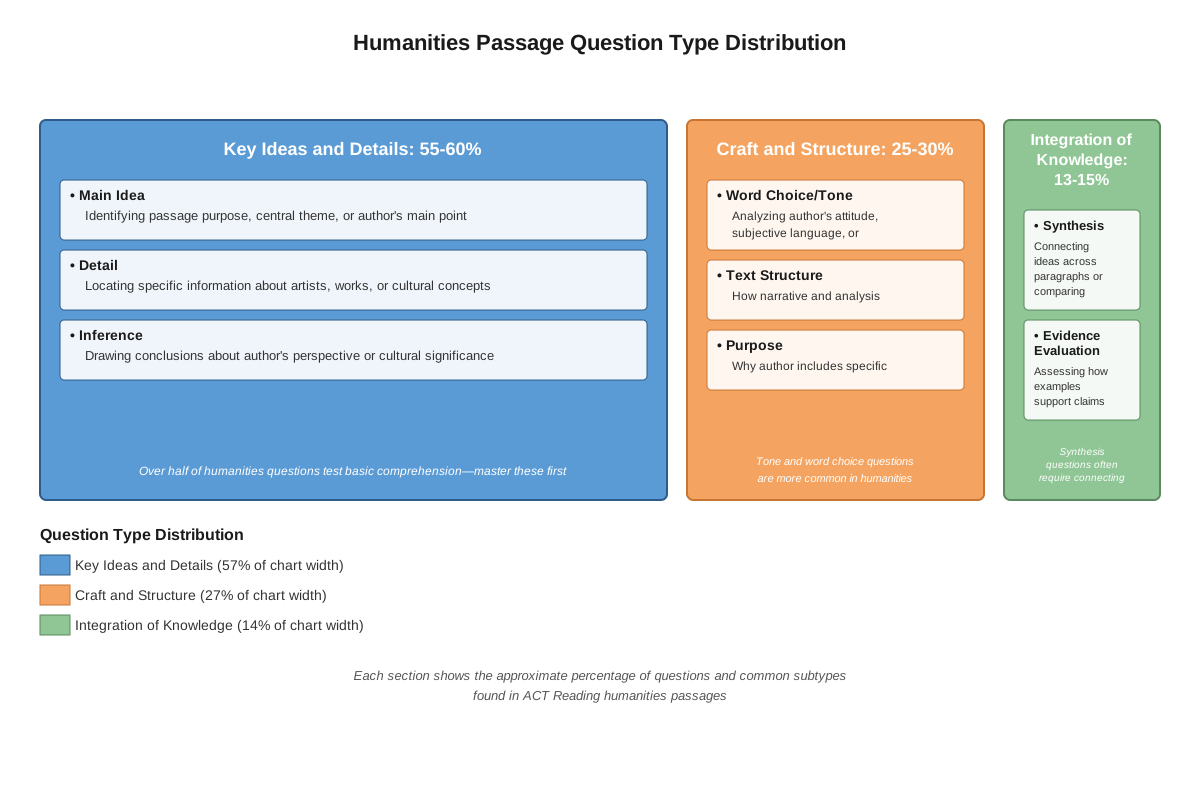
On the ACT, humanities passages appear as one of the four required passage types, guaranteeing 10 questions (25% of the Reading section) on every test administration. According to ACT data, humanities passages generate questions across all six cognitive skill categories: Key Ideas and Details (55-60%), Craft and Structure (25-30%), and Integration of Knowledge and Ideas (13-15%). The most common question types include identifying main ideas, determining word meaning in context, analyzing author's purpose, making inferences about cultural concepts, and tracing the development of ideas throughout the passage.
These passages typically appear in one of several formats: memoir excerpts where authors reflect on formative experiences with art or culture; essays analyzing specific artists, movements, or works; biographical sketches of cultural figures; or comparative analyses examining multiple artistic traditions. Students frequently encounter passages about visual arts, music, literature, architecture, dance, theater, or philosophical concepts, often written by practitioners, critics, or scholars in these fields.
Core Concepts
Defining Humanities Passages
Humanities passages on the ACT are nonfiction prose selections drawn from memoirs, personal essays, literary criticism, art history, music theory, philosophy, and cultural studies. These passages distinguish themselves from other nonfiction types through their focus on human culture, artistic expression, and interpretive analysis rather than scientific inquiry or social science research. The writing style typically blends personal reflection with scholarly commentary, creating a unique voice that is simultaneously subjective and analytical.
The ACT defines humanities broadly to encompass any discipline concerned with human culture and creative expression. This includes passages about painting, sculpture, photography, film, literature, poetry, music composition and performance, dance, theater, architecture, design, philosophy, and cultural traditions. Authors may be artists reflecting on their craft, critics analyzing works, historians tracing movements, or individuals recounting transformative encounters with art and culture.
Structural Patterns in Humanities Writing
Humanities passages follow several predictable organizational patterns that, once recognized, significantly improve comprehension and question-answering efficiency:
Chronological Memoir Structure: The author recounts personal experiences with art or culture in time order, often beginning with an early encounter and tracing how understanding deepened over time. These passages typically include reflective commentary explaining the significance of events.
Thematic Analysis Structure: The passage organizes around a central artistic concept or cultural theme, with each paragraph exploring a different aspect or example. The introduction presents the main interpretive claim, body paragraphs provide supporting evidence from specific works or artists, and the conclusion synthesizes the analysis.
Comparative Structure: The author examines two or more artists, movements, works, or traditions, highlighting similarities and differences. These passages often alternate between subjects or address each fully before comparing.
Biographical Narrative Structure: The passage traces an artist's or thinker's life and work, typically emphasizing how personal experiences shaped creative output or philosophical development.
The Personal-Analytical Balance
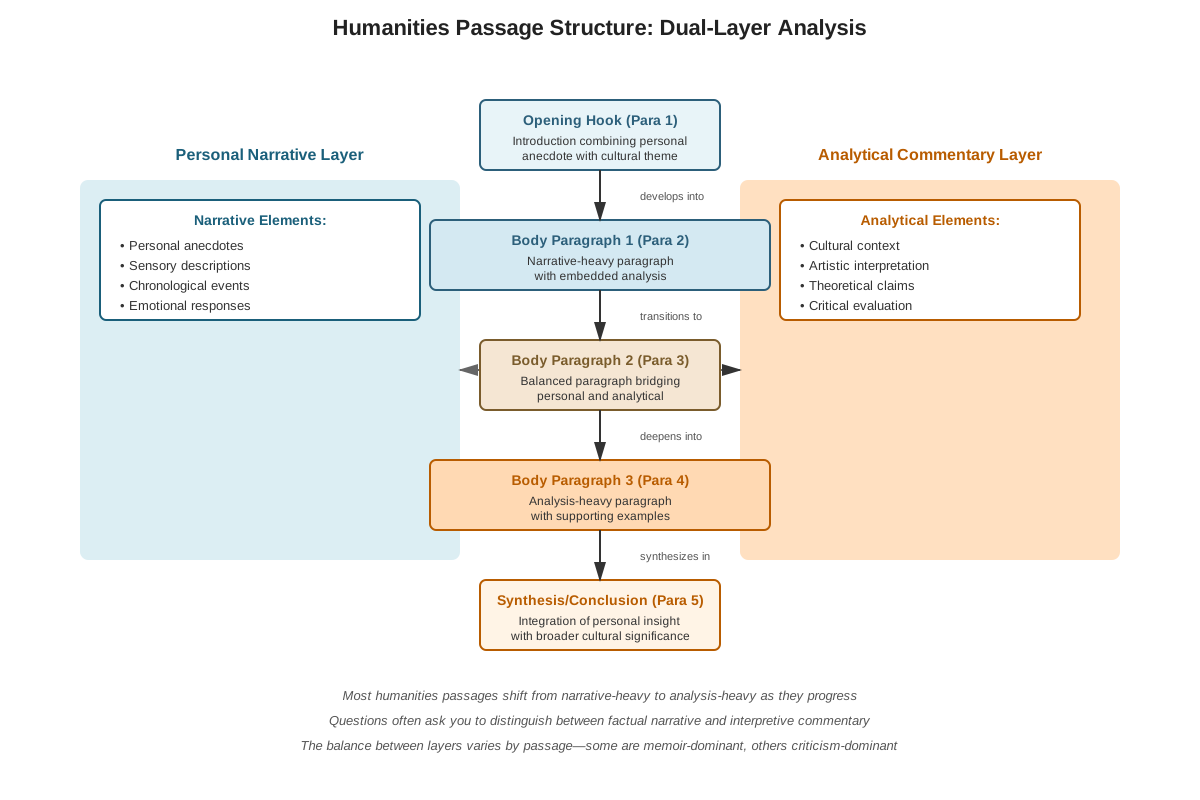
A defining characteristic of humanities passages is the interweaving of personal narrative with analytical commentary. Authors frequently shift between recounting subjective experiences ("I remember the first time I saw...") and making objective claims about artistic or cultural phenomena ("This technique revolutionized modern architecture..."). Successful readers must track these shifts to answer questions about the author's perspective versus factual information.
This balance manifests in several ways:
| Personal Elements | Analytical Elements |
|---|---|
| First-person narration | Third-person description of works/artists |
| Emotional responses to art | Technical terminology and formal analysis |
| Anecdotes about encounters | Historical context and influence |
| Subjective interpretations | Evidence-based arguments |
| Reflective conclusions | Scholarly citations or references |
Questions often test whether students can distinguish the author's opinion from established facts, requiring careful attention to qualifying language like "I believe," "seems to," "arguably," versus definitive statements.
Vocabulary and Terminology
Humanities passages contain specialized vocabulary from arts criticism and cultural studies. Unlike scientific terminology that can be precisely defined, humanities vocabulary often carries nuanced meanings that must be inferred from context. Common categories include:
- Artistic techniques: chiaroscuro, counterpoint, perspective, motif, symbolism
- Movement descriptors: avant-garde, minimalist, baroque, romantic, postmodern
- Analytical terms: juxtaposition, synthesis, paradigm, aesthetic, ethos
- Evaluative language: evocative, profound, derivative, innovative, seminal
The ACT frequently tests vocabulary in context, asking students to determine the meaning of sophisticated terms based on surrounding sentences. Rather than requiring prior knowledge of specialized terminology, these questions assess the ability to use context clues effectively.
Author's Purpose and Tone
Understanding why the author wrote the passage and the attitude conveyed toward the subject is crucial for humanities passages. Common purposes include:
- To reflect on personal growth through artistic experience: The author shares how encountering specific works or traditions shaped their understanding
- To analyze and interpret artistic works: The author presents an argument about meaning, technique, or significance
- To inform readers about cultural traditions or movements: The author educates while maintaining an engaging, accessible voice
- To persuade readers to appreciate or reconsider an artist or work: The author advocates for a particular interpretation or evaluation
Tone in humanities passages ranges from reverent and appreciative to critical and analytical, but rarely becomes purely objective or detached. Authors typically demonstrate passion for their subject while maintaining intellectual rigor.
Question Types and Cognitive Skills
Humanities passages generate predictable question types aligned with ACT's cognitive framework:
Key Ideas and Details questions ask students to identify main ideas, summarize sections, locate supporting details, and understand explicit information. These constitute the majority of questions and reward active reading with annotation.
Craft and Structure questions focus on word meaning in context, author's purpose, point of view, and how the passage is organized. These questions test understanding of how the author constructs arguments and conveys meaning.
Integration of Knowledge and Ideas questions require synthesizing information across paragraphs, making inferences, analyzing arguments, and evaluating claims. These higher-order questions often separate top scorers from average performers.
Concept Relationships
The concepts within humanities passages form an interconnected system where understanding one element enhances comprehension of others. The structural patterns (chronological, thematic, comparative, biographical) determine how the personal-analytical balance manifests throughout the passage. For example, chronological memoir structures typically begin with more personal narrative and progress toward analytical reflection, while thematic analysis structures alternate between personal examples and scholarly commentary.
Vocabulary and terminology serve as signals for both structure and purpose. When an author shifts from personal anecdotes to technical terms like "chiaroscuro" or "counterpoint," this signals a transition from narrative to analysis. Similarly, evaluative language ("profound," "derivative") reveals the author's tone and purpose, helping readers distinguish opinion from fact.
Author's purpose and tone directly influence which question types appear. Passages with strong persuasive purposes generate more Craft and Structure questions about rhetorical techniques, while informative passages yield more Key Ideas and Details questions about specific facts and examples.
This relationship map illustrates the connections:
Structural Pattern → determines → Personal-Analytical Balance → signals through → Vocabulary/Terminology → reveals → Author's Purpose/Tone → predicts → Question Types
Understanding these relationships enables strategic reading. By identifying the structural pattern in the first two paragraphs, students can anticipate how information will be organized, where to find specific details, and which question types will likely appear.
High-Yield Facts
⭐ Humanities passages always appear once per ACT Reading test, accounting for exactly 10 questions (25% of the section)
⭐ The most common humanities topics are visual arts (painting, sculpture, photography), music, literature/literary criticism, and memoir about cultural experiences
⭐ Approximately 55-60% of humanities questions test Key Ideas and Details, making main idea identification and detail location the highest-yield skills
⭐ Humanities passages blend first-person narrative with third-person analysis more than any other passage type
⭐ Vocabulary-in-context questions appear more frequently in humanities passages than in science passages due to specialized arts terminology
- Humanities passages average 750-900 words, similar to other ACT passage types
- The author's tone in humanities passages is typically passionate, appreciative, or thoughtfully critical rather than neutral or purely objective
- Questions about the author's purpose or perspective appear in approximately 70% of humanities passages
- Chronological organization is more common in humanities passages than in social science or natural science passages
- Comparative structures (examining two artists, movements, or works) generate questions asking students to distinguish between the subjects being compared
- Humanities passages frequently include rhetorical questions that express the author's perspective rather than request information
- The conclusion of humanities passages often contains the author's most explicit statement of main idea or interpretive claim
- Questions asking about "the passage as a whole" or "the main purpose" can usually be answered by synthesizing the introduction and conclusion
- Specific examples (particular paintings, musical compositions, or cultural practices) serve as evidence for broader claims about artistic movements or cultural phenomena
- Inference questions in humanities passages often ask students to extend the author's reasoning to new examples not explicitly discussed
Quick check — test yourself on Humanities passages so far.
Try Flashcards →Common Misconceptions
Misconception: Humanities passages require prior knowledge of art history, music theory, or philosophy to answer questions correctly.
Correction: The ACT is designed as a reading comprehension test, not a content knowledge test. All information needed to answer questions appears within the passage itself. While cultural literacy may speed comprehension, questions can be answered using only the provided text and context clues.
Misconception: First-person narration means the entire passage is subjective opinion rather than factual information.
Correction: Humanities passages blend personal perspective with objective facts. Authors frequently use first-person voice to introduce topics while providing verifiable information about artists, movements, and works. Questions distinguish between the author's opinions and factual claims, requiring readers to identify which is which.
Misconception: Specialized vocabulary in humanities passages should be skipped if unfamiliar, since it won't be tested.
Correction: Vocabulary-in-context questions frequently appear in humanities passages, and understanding key terms is essential for comprehending the author's argument. Rather than skipping unfamiliar words, students should use context clues to infer meaning, as this skill is directly tested.
Misconception: Humanities passages are always about "old" or "classical" art forms like Renaissance painting or classical music.
Correction: ACT humanities passages cover the full range of cultural expression, including contemporary art, modern architecture, jazz, film, photography, and current cultural practices. The passages are as likely to discuss 21st-century artists as historical figures.
Misconception: The author's personal anecdotes are less important than the analytical sections and can be skimmed quickly.
Correction: Personal narratives often contain crucial information about the author's perspective, the development of ideas, and the emotional or cultural significance of the subject. Questions frequently ask about the purpose or significance of specific anecdotes, making them as important as analytical sections.
Misconception: Humanities passages follow the same structure as literary fiction passages since both deal with arts and culture.
Correction: While both may discuss artistic subjects, humanities passages are nonfiction essays with clear argumentative or informative purposes, while prose fiction passages are narrative stories. Humanities passages require identifying thesis statements, tracing arguments, and evaluating evidence—skills distinct from following plot and character development.
Worked Examples
Example 1: Identifying Structure and Purpose
Passage Excerpt (simplified for demonstration):
"I first encountered Georgia O'Keeffe's work at age twelve, standing before 'Sky Above Clouds IV' in the Art Institute of Chicago. The painting's vast expanse of white clouds stretching toward infinity overwhelmed me, creating a sense of both peace and exhilaration I had never experienced from art before.
O'Keeffe's approach to landscape painting revolutionized American modernism by abstracting natural forms into their essential shapes and colors. Rather than depicting clouds realistically, she reduced them to rhythmic patterns of white and blue, transforming a naturalistic subject into a meditation on space, light, and perception. This technique, which she developed over decades of painting in New Mexico, influenced countless artists who followed."
Question: The author's primary purpose in the first paragraph is to:
A) Provide biographical information about Georgia O'Keeffe's life in New Mexico
B) Establish a personal connection to O'Keeffe's work that motivates the subsequent analysis
C) Argue that O'Keeffe was the most important American modernist painter
D) Describe the technical methods O'Keeffe used to create abstract paintings
Worked Solution:
Step 1: Identify the structural pattern. The passage begins with first-person narrative (personal anecdote) and transitions to third-person analysis (discussion of O'Keeffe's technique and influence). This is a classic chronological memoir structure moving from personal experience to scholarly commentary.
Step 2: Analyze the first paragraph's content. The author describes a specific childhood encounter with a painting, emphasizing the emotional response ("overwhelmed me," "peace and exhilaration"). No technical analysis or biographical facts appear here—only personal reaction.
Step 3: Consider the relationship between paragraphs. The second paragraph shifts to analytical discussion of O'Keeffe's technique. The first paragraph must serve as a foundation or motivation for this analysis.
Step 4: Evaluate each answer choice:
- A: Incorrect. No biographical information appears in the first paragraph; this content appears in paragraph two.
- B: Correct. The personal anecdote establishes why the author cares about O'Keeffe's work, providing context for the analytical discussion that follows.
- C: Incorrect. No comparative claim about O'Keeffe's importance appears; the author describes personal experience, not makes arguments about artistic ranking.
- D: Incorrect. Technical methods are discussed in paragraph two, not paragraph one.
Answer: B
Connection to Learning Objectives: This example demonstrates how to identify structural patterns (chronological memoir), distinguish between personal narrative and analysis, and recognize author's purpose—all core skills for humanities passages.
Example 2: Vocabulary in Context and Inference
Passage Excerpt:
"The minimalist movement in sculpture, exemplified by Donald Judd's geometric forms, represented a radical departure from the expressive, gestural work of Abstract Expressionists. Where Jackson Pollock's paintings pulsed with emotional energy and visible traces of the artist's hand, Judd's fabricated metal boxes eliminated all evidence of personal touch. This austere aesthetic initially alienated critics who valued art's capacity to convey human feeling, but Judd argued that his work's power lay precisely in its refusal to manipulate viewers' emotions through obvious artistic gestures."
Question 1: As used in the passage, "austere" most nearly means:
A) Expensive and exclusive
B) Severely simple and unadorned
C) Emotionally moving
D) Technically complex
Worked Solution:
Step 1: Locate context clues surrounding "austere aesthetic." The passage describes Judd's work as "geometric forms," "fabricated metal boxes," and work that "eliminated all evidence of personal touch."
Step 2: Identify contrasts. The passage contrasts Judd's work with Pollock's "expressive, gestural" paintings that "pulsed with emotional energy." Judd's aesthetic is the opposite of expressive and emotional.
Step 3: Note the reaction. Critics who "valued art's capacity to convey human feeling" were "alienated" by this aesthetic, suggesting it lacks emotional warmth or decoration.
Step 4: Evaluate choices:
- A: Nothing in context suggests cost or exclusivity
- B: Correct. "Severely simple and unadorned" matches the description of geometric forms without personal touch
- C: Opposite of the passage's meaning; the aesthetic specifically avoided emotional manipulation
- D: The passage emphasizes simplicity (geometric forms, boxes), not complexity
Answer: B
Question 2: Based on the passage, Judd would most likely agree with which statement?
A) Abstract Expressionism represented the pinnacle of 20th-century art
B) Effective art must reveal the artist's emotional state
C) Removing obvious artistic gestures can create a different kind of aesthetic power
D) Sculpture should always be handmade by the artist
Worked Solution:
Step 1: Locate Judd's stated position. The passage says "Judd argued that his work's power lay precisely in its refusal to manipulate viewers' emotions through obvious artistic gestures."
Step 2: Identify the key claim. Judd believes art can be powerful without emotional manipulation or visible artist's hand—power comes from restraint and simplicity.
Step 3: Evaluate choices:
- A: Judd's work "represented a radical departure from" Abstract Expressionism, suggesting disagreement with this movement's approach
- B: Directly contradicts Judd's position; he eliminated evidence of personal touch and emotional manipulation
- C: Correct. This paraphrases Judd's argument that refusing obvious gestures creates power
- D: The passage mentions "fabricated metal boxes," suggesting Judd used industrial fabrication rather than handmaking
Answer: C
Connection to Learning Objectives: These questions demonstrate applying vocabulary strategies, making inferences about artistic concepts, and distinguishing between different perspectives within a passage—essential skills for ACT humanities questions.
Exam Strategy
Pre-Reading Strategy
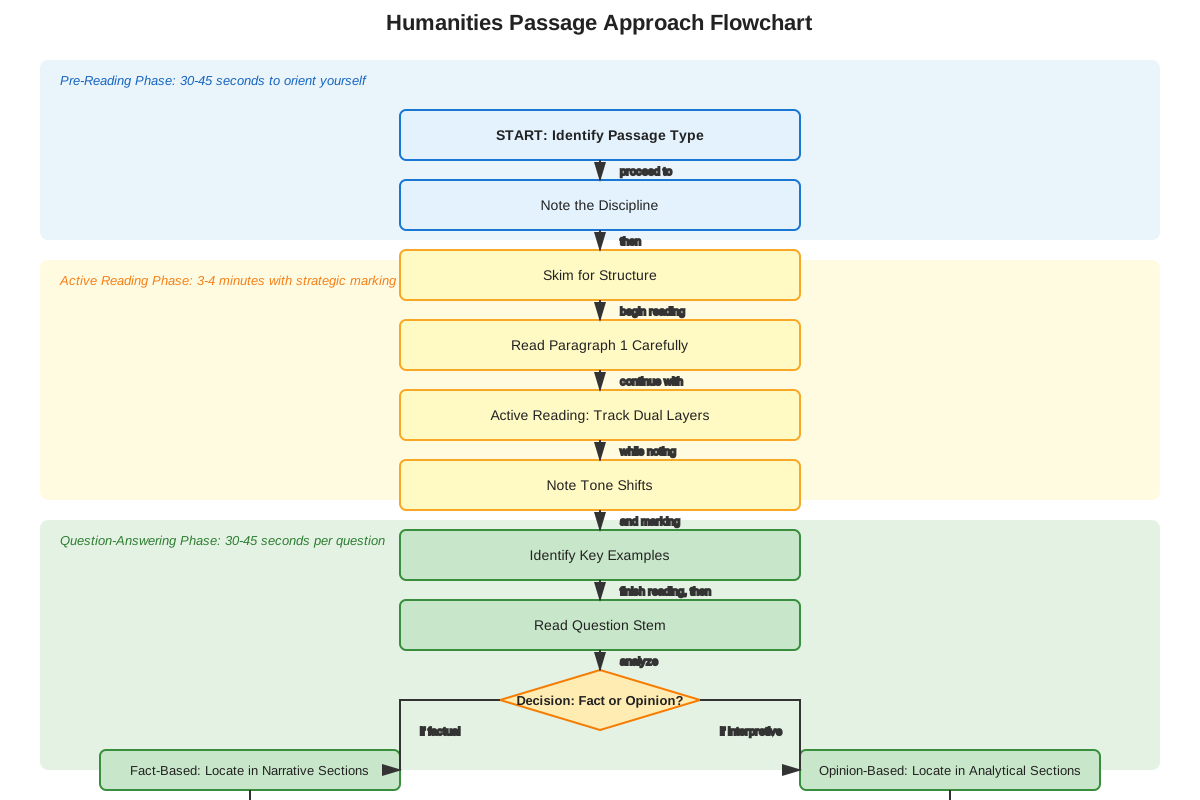
Before diving into the passage, quickly identify it as humanities by scanning for:
- Trigger words: art, artist, painting, music, composer, architecture, memoir, culture, aesthetic, philosophy
- First-person pronouns: "I," "my," "we" suggest memoir or personal essay
- Names of artists or works: Proper nouns referring to cultural figures signal humanities content
- Dates and movements: References to artistic periods (Renaissance, Modernism, Baroque) confirm humanities
This identification takes 5-10 seconds and allows you to activate appropriate reading strategies.
Active Reading Approach
Annotate the personal-analytical balance: Mark transitions between first-person narrative and third-person analysis with symbols (e.g., "P" for personal, "A" for analytical). This helps you quickly locate information when questions ask about the author's perspective versus factual claims.
Identify the main idea by paragraph 2: Humanities passages typically state or strongly suggest their central claim within the first two paragraphs. Underline this thesis or write a brief margin note. Most "main purpose" questions can be answered by referring to this early statement.
Track specific examples: When the author mentions particular artists, works, or cultural practices, bracket these examples and note what broader point they support. Questions frequently ask about the purpose of specific examples.
Note tone shifts: Mark places where the author's attitude changes (from appreciative to critical, from uncertain to confident). Tone questions often focus on these shifts.
Question-Answering Tactics
For main idea questions: Synthesize the introduction and conclusion. The author's primary purpose usually appears explicitly in one of these locations. Eliminate answers that are too narrow (focusing on one paragraph's content) or too broad (going beyond the passage's scope).
For vocabulary-in-context questions:
- Cover the answer choices
- Read the sentence containing the word and the sentences immediately before and after
- Predict a synonym based on context
- Evaluate choices against your prediction
- Substitute each remaining choice into the original sentence to test fit
For detail questions: Use paragraph annotations to locate information quickly. The question stem usually contains a specific reference (artist name, movement, work) that appears in only one or two paragraphs.
For inference questions: The correct answer must be supported by passage evidence but not stated explicitly. Eliminate answers that:
- Contradict passage information
- Require outside knowledge
- Make claims too extreme for the evidence provided
- Repeat passage statements without adding inference
For author's purpose questions: Consider both the content (what is discussed) and the tone (how it's discussed). The purpose combines these elements. An appreciative tone about a specific artist suggests the purpose is to celebrate or advocate for that artist's work.
Time Management
Allocate 8-9 minutes for each passage, including reading and answering all 10 questions. For humanities passages specifically:
- 3-4 minutes: Active reading with annotation
- 4-5 minutes: Answering questions
- 30 seconds: Final review of any flagged questions
If a question requires re-reading large sections, flag it and return after completing easier questions. Don't let one difficult question consume time needed for others.
Process of Elimination Triggers
Eliminate answers that:
- Use extreme language ("always," "never," "only," "completely") unless the passage itself uses such definitive terms
- Introduce new topics not discussed in the passage
- Contradict explicit passage statements
- Focus on minor details when the question asks about main ideas
- Reverse cause and effect relationships described in the passage
- Confuse the author's view with views the author describes but doesn't endorse
Memory Techniques
HUMANITIES Acronym for Passage Features
Historical context often provided
Unique blend of personal and analytical
Memoir or essay format common
Artistic terminology and concepts
Narrative elements with reflection
Interpretive arguments about meaning
Tone is passionate or thoughtful
Inferences about culture required
Examples support broader claims
Subjectivity balanced with evidence
The "Three P's" for Structure Recognition
Personal: First-person anecdotes and experiences
Professional: Third-person analysis and scholarly commentary
Purpose: Why the author combines these elements (to reflect, analyze, persuade, inform)
Identifying these three elements in the first two paragraphs reveals the passage's structure and predicts question types.
Vocabulary Context Clue Visualization
Picture a spotlight illuminating the unfamiliar word, with shadows extending one sentence before and one sentence after. The meaning emerges from these shadows (context clues) rather than the spotlight itself (the word in isolation). This visualization reminds students to read surrounding sentences rather than fixating on the unknown term.
Question Type Sorting: "CAN I?"
Craft and Structure: How is it written?
Analysis: What does it mean?
Narrative: What happened?
Inference: What's implied?
This mnemonic helps categorize questions quickly, activating appropriate strategies for each type.
Summary
Humanities passages on the ACT Reading test blend personal narrative with analytical commentary about arts, culture, and human creative expression. These passages, which appear once per test and account for 10 questions, draw from memoir, personal essays, literary criticism, art history, music theory, philosophy, and cultural studies. Success requires recognizing structural patterns (chronological memoir, thematic analysis, comparative, biographical), tracking the balance between first-person narrative and third-person analysis, and understanding specialized vocabulary through context clues. The most common question types test main idea identification, vocabulary in context, author's purpose and tone, and inference about cultural concepts. Strategic reading involves annotating the personal-analytical balance, identifying the thesis within the first two paragraphs, tracking specific examples and their purposes, and noting tone shifts. Questions can be answered efficiently by synthesizing introduction and conclusion for main ideas, using context clues for vocabulary, locating specific references for details, and ensuring inferences are supported by textual evidence. Mastering humanities passages requires distinguishing the author's subjective perspective from objective facts while appreciating how personal experiences and scholarly analysis work together to create meaning.
Key Takeaways
- Humanities passages always blend personal narrative with analytical commentary, requiring readers to track shifts between subjective experience and objective claims about art and culture
- The passage structure (chronological memoir, thematic analysis, comparative, or biographical) can be identified within the first two paragraphs and predicts how information will be organized throughout
- Approximately 55-60% of questions test Key Ideas and Details, making main idea identification and detail location the highest-yield skills for score improvement
- Vocabulary-in-context questions appear frequently and should be answered using surrounding sentences as context clues rather than relying on prior knowledge of specialized arts terminology
- The author's primary purpose and main idea typically appear explicitly in the introduction or conclusion, making these sections crucial for answering "passage as a whole" questions
- Distinguishing between the author's personal opinions and factual information about artists, movements, or works is essential for answering perspective and purpose questions accurately
- Specific examples (particular paintings, compositions, or cultural practices) always serve as evidence for broader claims, and questions frequently ask about the purpose of these examples
Related Topics
Prose Fiction Passages: While humanities passages analyze culture and arts, prose fiction passages present narrative stories. Mastering humanities passages develops skills in tracking author's purpose and tone that transfer to analyzing narrative voice and character perspective in fiction.
Social Science Passages: These passages share the analytical, argumentative structure of humanities writing but focus on psychology, sociology, economics, and political science rather than arts and culture. Understanding how humanities authors support claims with specific examples prepares students for similar evidence-based reasoning in social science contexts.
Natural Science Passages: The most distinct from humanities, these passages present scientific research and explanations. However, the vocabulary-in-context skills developed through humanities passages apply equally to decoding scientific terminology.
Rhetorical Analysis Skills: Advanced study of how authors construct arguments, use rhetorical devices, and manipulate tone extends the foundational skills developed through humanities passage analysis.
Comparative Reading: Some ACT Reading tests include paired passages requiring comparison. The comparative structure common in humanities passages (examining two artists or movements) provides excellent preparation for these paired passage questions.
Practice CTA
Now that you've mastered the core concepts, strategies, and common patterns in ACT humanities passages, it's time to apply this knowledge! Complete the practice questions to test your ability to identify passage types, analyze personal-analytical balance, decode vocabulary in context, and answer all question types accurately. The flashcards will reinforce high-yield facts and help you internalize the structural patterns and question-answering strategies. Remember: humanities passages reward active reading with annotation, strategic time management, and careful distinction between the author's perspective and factual claims. With focused practice, you'll approach these passages with confidence and efficiency, turning a potentially challenging passage type into a reliable source of points on test day. You've got this!
Sign up free to keep reading
Create a free AnvayaPrep account to finish this ACT guide on Humanities passages — plus flashcards and practice questions.