Overview
Natural science passages represent one of the four core passage types students encounter on the ACT Reading test, appearing consistently on every administration of the exam. These passages present scientific information drawn from fields such as biology, chemistry, physics, astronomy, geology, and environmental science. Unlike the technical writing found in actual scientific journals, ACT natural science passages are written for a general audience and focus on explaining scientific concepts, discoveries, research findings, or natural phenomena in accessible language.
Understanding how to approach natural science passages is essential for ACT success because they constitute 25% of the Reading section—one complete passage with 10 questions out of the total 40 questions on the test. These passages differ significantly from prose fiction and humanities passages in their structure, vocabulary, and the types of questions they generate. Natural science passages typically follow a more predictable organizational pattern, often presenting a problem or question, describing research or observations, and explaining findings or theories. They may discuss the work of individual scientists, trace the evolution of scientific understanding, or explain complex natural processes in detail.
The skills required to excel on natural science passages extend beyond simple reading comprehension. Students must be able to identify main ideas and supporting details, understand cause-and-effect relationships, follow logical sequences, interpret data or experimental results described in prose, and distinguish between facts and hypotheses. These passages also test the ability to understand scientific vocabulary in context, recognize the author's purpose and tone, and make inferences based on the information provided. Mastering natural science passages builds critical reading skills that support success across all ACT Reading passage types while also reinforcing comprehension strategies valuable for the ACT Science section.
Learning Objectives
- [ ] Identify when Natural science passages is being tested
- [ ] Explain the core rule or strategy behind Natural science passages
- [ ] Apply Natural science passages to ACT-style questions accurately
- [ ] Distinguish between different organizational structures commonly used in natural science passages
- [ ] Recognize and interpret scientific terminology and technical vocabulary within context
- [ ] Analyze the relationship between hypotheses, evidence, and conclusions presented in scientific writing
- [ ] Evaluate the author's tone, purpose, and perspective when presenting scientific information
Prerequisites
- Basic reading comprehension skills: Understanding main ideas, supporting details, and paragraph structure forms the foundation for tackling any ACT Reading passage, including natural science texts.
- Familiarity with ACT Reading question types: Knowledge of detail questions, inference questions, vocabulary-in-context questions, and main idea questions enables efficient question analysis.
- General scientific literacy: Basic exposure to scientific concepts and terminology from high school science courses helps students navigate content more confidently, though specific scientific knowledge is never required to answer questions.
- Time management fundamentals: Understanding the 35-minute time constraint for four passages (approximately 8-9 minutes per passage) is essential for strategic reading and question answering.
Why This Topic Matters
Natural science passages appear on every single ACT Reading test, making them unavoidable and high-stakes. Students who develop strong strategies for these passages secure 10 guaranteed questions—25% of their Reading score. Unlike some standardized tests that assess prior scientific knowledge, the ACT Reading section tests only what appears in the passage itself, meaning any student can excel on natural science passages regardless of their science coursework background.
In real-world applications, the skills developed through natural science passage practice extend far beyond test day. The ability to read and comprehend scientific information critically is essential for informed citizenship in an age of climate change debates, medical decision-making, and technological advancement. College students across all majors encounter scientific writing in general education courses, research papers, and professional publications. The analytical reading skills honed through natural science passage practice—identifying claims, evaluating evidence, understanding methodology, and recognizing limitations—transfer directly to academic and professional success.
On the ACT, natural science passages generate specific question types with predictable patterns. Approximately 40-50% of questions test explicit detail comprehension, asking students to locate and understand specific information stated in the passage. Another 30-40% assess inference and reasoning, requiring students to draw logical conclusions from the information provided. The remaining questions typically address vocabulary in context, author's purpose or tone, passage structure, and comparative relationships between ideas. Natural science passages frequently include questions about cause-and-effect relationships, the sequence of events or processes, the purpose of research or observations, and the implications or applications of findings. Understanding these patterns allows students to read strategically and anticipate question types.
Core Concepts
Characteristics of Natural Science Passages
Natural science passages on the ACT share several defining characteristics that distinguish them from other passage types. These passages typically range from 700-900 words and are adapted from books, magazines, or journals written for general audiences rather than specialists. The writing style balances accessibility with precision, explaining complex concepts without oversimplification while avoiding excessive technical jargon. When specialized vocabulary appears, context clues or brief definitions usually accompany the terms.
The tone of natural science passages tends to be objective, informative, and explanatory, though some passages may convey enthusiasm for discoveries or concern about environmental issues. Authors typically maintain a third-person perspective and focus on presenting information rather than persuading readers. However, subtle bias or perspective may appear when passages discuss controversial topics, competing theories, or the significance of research findings.
Common Organizational Structures
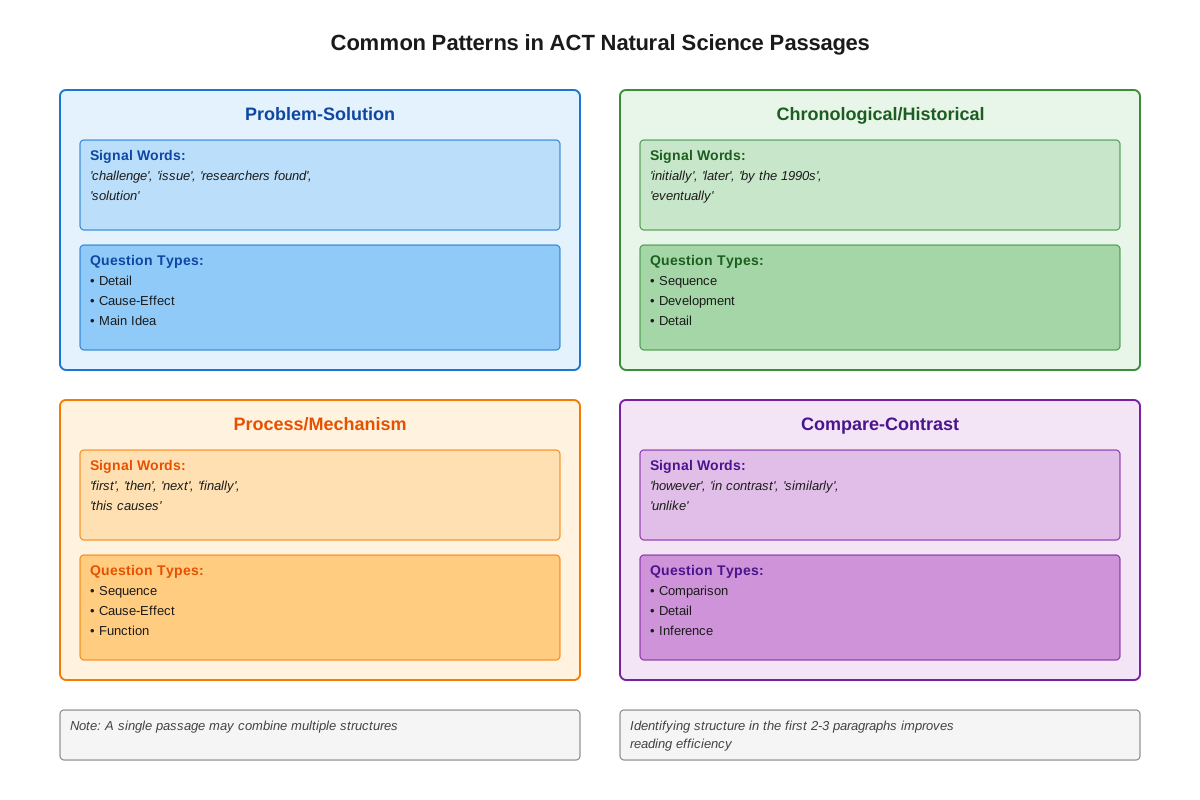
Natural science passages follow several predictable organizational patterns that students can learn to recognize quickly:
Chronological/Historical Structure: These passages trace the development of scientific understanding over time, often beginning with early theories or observations and progressing through discoveries that refined or revolutionized the field. Signal words include "initially," "subsequently," "by the 1950s," "eventually," and "currently."
Problem-Solution Structure: The passage presents a scientific question or challenge, then describes research, observations, or theories that address it. This structure often includes sections on methodology, findings, and implications.
Cause-and-Effect Structure: These passages explain natural phenomena by describing causes and their resulting effects, or trace chains of causation through complex systems. Environmental science and ecology passages frequently use this structure.
Compare-and-Contrast Structure: The passage examines two or more theories, species, processes, or phenomena, highlighting similarities and differences. This structure often appears in passages discussing competing scientific explanations or evolutionary relationships.
Process/Mechanism Explanation: These passages describe how something works or occurs in nature, breaking down complex processes into sequential steps or interconnected components.
Types of Natural Science Content
ACT natural science passages draw from diverse scientific disciplines, each with characteristic features:
| Scientific Field | Common Topics | Typical Features |
|---|---|---|
| Biology | Evolution, animal behavior, ecology, genetics, physiology | Descriptions of organisms, adaptations, relationships between species |
| Earth Science | Geology, meteorology, oceanography, climate | Explanations of natural processes, time scales, planetary systems |
| Astronomy | Planets, stars, galaxies, cosmology | Large scales, theoretical concepts, observation methods |
| Chemistry | Molecular processes, materials, reactions | Explanations of invisible processes, properties of substances |
| Physics | Forces, energy, motion, waves | Abstract concepts, mathematical relationships described in prose |
| Environmental Science | Conservation, ecosystems, human impact | Cause-effect relationships, policy implications |
Scientific Vocabulary and Context Clues
Natural science passages inevitably include specialized terminology, but the ACT never requires students to bring outside scientific knowledge to understand these terms. Instead, passages provide context clues through several methods:
Definition clues directly state the meaning: "Photosynthesis, the process by which plants convert light energy into chemical energy, occurs primarily in leaves."
Example clues illustrate the concept: "Extremophiles—organisms like the bacteria found in boiling hot springs or frozen Antarctic lakes—thrive in conditions that would kill most life forms."
Contrast clues define by opposition: "Unlike ectotherms, which rely on external heat sources, endotherms generate their own body heat through metabolism."
Restatement clues express the same idea differently: "The mitochondria, often called the cell's powerhouse, produces the energy currency that fuels cellular activities."
Understanding Scientific Claims and Evidence
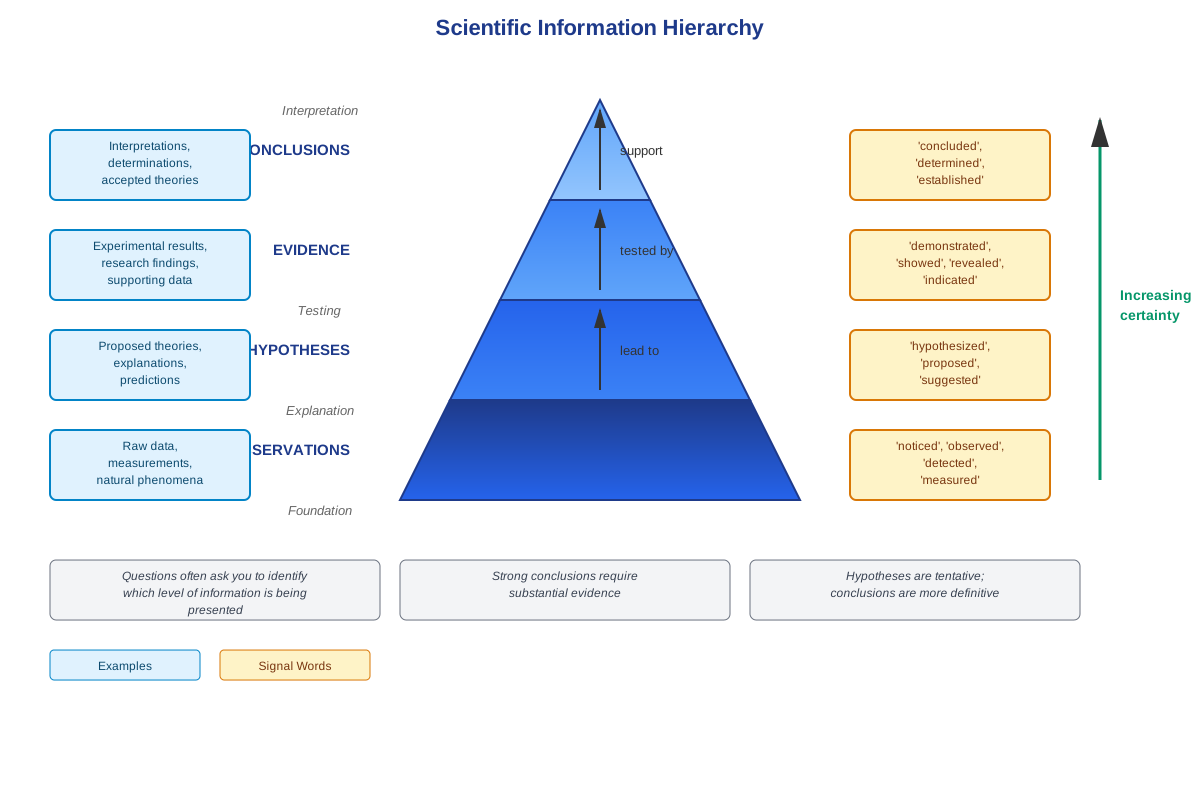
Natural science passages present information with varying degrees of certainty, and recognizing these distinctions is crucial for answering questions accurately. Students must differentiate between:
Established facts: Information presented as accepted scientific knowledge, often using present tense and definitive language ("Water molecules consist of two hydrogen atoms and one oxygen atom").
Hypotheses and theories: Proposed explanations that may be supported by evidence but remain open to revision, often signaled by words like "suggests," "proposes," "theorizes," or "hypothesizes."
Observations and data: Specific findings from research or studies, typically presented as past-tense descriptions of what scientists observed or measured.
Interpretations and implications: The meaning or significance scientists attribute to their findings, often introduced with phrases like "this indicates," "researchers concluded," or "these findings suggest."
Author's Purpose and Perspective
While natural science passages maintain an informative tone, authors make choices about what to emphasize, how to frame information, and which details to include. Recognizing the author's purpose helps students answer questions about tone, main idea, and passage structure. Common purposes include:
- Explaining a scientific concept or natural phenomenon to general readers
- Describing a significant discovery or breakthrough and its importance
- Tracing the historical development of scientific understanding
- Presenting a scientific controversy or competing theories
- Highlighting the implications of research for society or the environment
- Profiling a scientist's work and contributions to their field
Concept Relationships
The concepts within natural science passages form an interconnected web of understanding. Passage structure determines how content is organized and presented, which in turn influences the types of questions that appear. For example, a chronological structure tracking the history of a scientific theory naturally generates questions about sequence and the evolution of ideas, while a cause-and-effect structure produces questions about relationships and consequences.
Scientific vocabulary serves as the building blocks for understanding claims and evidence, as precise terminology allows authors to describe complex phenomena accurately. The relationship between context clues and vocabulary is reciprocal: recognizing context clue patterns helps students decode unfamiliar terms, while understanding key terms unlocks the meaning of surrounding sentences.
Author's purpose shapes every other element of the passage. An author aiming to explain a discovery will structure the passage differently than one comparing competing theories, will choose different vocabulary and examples, and will present evidence with different emphasis. Understanding purpose provides a framework for interpreting all other passage elements.
The connection to prerequisite knowledge is direct: basic reading comprehension skills enable students to identify passage structure and extract information, while familiarity with question types allows efficient application of natural science passage strategies. The general scientific literacy prerequisite reduces cognitive load when encountering scientific content, freeing mental resources for analysis and question-answering.
These concepts also connect forward to other ACT Reading passage types. The analytical skills developed for natural science passages—identifying structure, understanding technical vocabulary in context, distinguishing claims from evidence—transfer directly to social science passages, which share many organizational and stylistic features. The practice of reading objectively and extracting information without prior knowledge supports success on all passage types.
High-Yield Facts
⭐ Natural science passages appear exactly once on every ACT Reading test, always containing 10 questions that represent 25% of the Reading score.
⭐ The ACT never requires outside scientific knowledge; all information needed to answer questions appears within the passage itself.
⭐ Approximately 40-50% of natural science passage questions test explicit detail comprehension, making careful reading and efficient passage navigation essential.
⭐ Context clues for scientific vocabulary appear in the same sentence or immediately adjacent sentences, using definition, example, contrast, or restatement patterns.
⭐ Chronological, problem-solution, cause-and-effect, compare-and-contrast, and process explanation structures account for nearly all natural science passage organizations.
- Natural science passages are adapted from sources written for general audiences, not from technical journals or textbooks, ensuring accessibility.
- Questions frequently test the relationship between hypotheses and evidence, requiring students to distinguish what scientists observed from what they concluded.
- Signal words indicating cause-and-effect relationships ("therefore," "consequently," "as a result," "because") are high-value markers for both comprehension and question-answering.
- The author's tone in natural science passages typically remains objective and informative, though subtle enthusiasm or concern may appear regarding discoveries or environmental issues.
- Questions about "the author's main purpose" or "the passage primarily serves to" can be answered by identifying the dominant organizational structure and overall focus.
- Comparative questions ("According to the passage, X differs from Y in that...") frequently appear in passages discussing multiple theories, species, or processes.
- Time-sequence questions ("Which of the following occurred first?" or "The passage indicates that X happened before Y") commonly test chronological passages.
- Natural science passages often include questions requiring students to apply information from the passage to new situations or predict outcomes based on described principles.
Quick check — test yourself on Natural science passages so far.
Try Flashcards →Common Misconceptions
Misconception: Students need strong science backgrounds to succeed on natural science passages.
Correction: The ACT Reading test assesses reading comprehension, not scientific knowledge. All information required to answer questions appears in the passage. Students with limited science coursework can score perfectly by reading carefully and applying standard reading strategies. In fact, extensive scientific knowledge can sometimes be a disadvantage if students rely on outside information instead of what the passage states.
Misconception: Scientific vocabulary must be memorized before test day.
Correction: Natural science passages always provide context clues for specialized terminology. Rather than memorizing scientific terms, students should practice identifying and using context clues—definitions, examples, contrasts, and restatements—that appear within the passage. The skill of decoding unfamiliar vocabulary through context is far more valuable than pre-existing vocabulary knowledge.
Misconception: Natural science passages are harder than other passage types.
Correction: While natural science passages may seem intimidating due to scientific content, they often follow more predictable structures than prose fiction or humanities passages. Their logical organization, clear cause-and-effect relationships, and objective tone can actually make them easier to navigate. Many high-scoring students find natural science passages among the most straightforward because they present information systematically rather than through narrative or abstract discussion.
Misconception: Every detail in a natural science passage must be fully understood before attempting questions.
Correction: Perfect comprehension of every sentence is neither necessary nor efficient. Strategic readers identify main ideas, note the location of details, and understand overall structure, then return to specific sections when questions require detailed information. Attempting to master every technical detail during the initial reading wastes time and mental energy.
Misconception: Questions always follow the order of information in the passage.
Correction: While many questions do follow passage order, this pattern is not guaranteed. Some questions require synthesizing information from multiple paragraphs or understanding overall passage structure. Students should use paragraph references and line numbers when provided, but also develop skills in quickly scanning for relevant information when questions jump around the passage.
Misconception: The correct answer to inference questions will be explicitly stated in the passage.
Correction: Inference questions require students to draw logical conclusions based on passage information, not simply locate stated facts. However, correct inferences must be directly supported by passage evidence—they are logical extensions of stated information, not wild guesses. The key is distinguishing between what the passage states explicitly and what it strongly implies.
Worked Examples
Example 1: Identifying Structure and Answering a Main Purpose Question
Passage Excerpt (abbreviated):
"For decades, scientists believed that the deep ocean floor was a barren wasteland, devoid of life due to crushing pressure, frigid temperatures, and complete absence of sunlight. This view changed dramatically in 1977 when researchers exploring the Galápagos Rift discovered hydrothermal vents—fissures in the ocean floor releasing superheated, mineral-rich water. Surrounding these vents, they found thriving ecosystems unlike anything previously known.
These vent communities depend not on photosynthesis but on chemosynthesis, a process by which bacteria convert chemicals from the vent water into energy. These bacteria form the base of a food web supporting tube worms, clams, crabs, and fish. The discovery revolutionized understanding of life's requirements and possibilities, suggesting that life might exist in extreme environments previously considered uninhabitable, including potentially on other planets or moons with subsurface oceans."
Question: The passage primarily serves to:
A) Argue that photosynthesis is unnecessary for complex life forms
B) Describe a scientific discovery that changed understanding of where life can exist
C) Explain the chemical process of chemosynthesis in detail
D) Compare hydrothermal vent ecosystems to surface ocean ecosystems
Solution Process:
Step 1: Identify the passage structure. This excerpt follows a problem-solution or chronological discovery structure: old belief → discovery → new understanding → implications.
Step 2: Determine the main focus. The passage emphasizes the 1977 discovery and how it "changed" and "revolutionized" scientific understanding. The discovery itself and its impact on scientific thinking dominate the passage.
Step 3: Evaluate each answer choice:
- Choice A: Too narrow and argumentative. The passage mentions photosynthesis only to contrast it with chemosynthesis, not to argue against its importance.
- Choice B: Matches the structure and emphasis. The passage describes the hydrothermal vent discovery and explicitly states it "changed" understanding and "revolutionized" views about where life can exist.
- Choice C: Too narrow. Chemosynthesis is mentioned but not explained in detail; it's one element supporting the larger point about the discovery's significance.
- Choice D: Incorrect focus. The passage doesn't compare vent ecosystems to surface ecosystems; it contrasts the energy sources (chemosynthesis vs. photosynthesis) but focuses on the discovery's implications.
Answer: B
Connection to Learning Objectives: This example demonstrates identifying when natural science passages are being tested (recognizing the passage type), explaining the core strategy (identifying structure to determine main purpose), and applying the strategy to ACT-style questions accurately.
Example 2: Using Context Clues and Making Inferences
Passage Excerpt:
"Monarch butterflies undertake one of nature's most remarkable migrations, traveling up to 3,000 miles from breeding grounds in the United States and Canada to overwintering sites in Mexico. Unlike bird migrations, where the same individuals make round trips, the monarch migration spans multiple generations. The butterflies that arrive in Mexico are the great-great-grandchildren of those that left the previous spring. This raises a profound question: how do monarchs navigate to a specific location they have never visited?
Recent research suggests that monarchs use a time-compensated sun compass, adjusting their flight direction based on the sun's position and the time of day. Their antennae contain circadian clocks that help them account for the sun's movement across the sky. Additionally, monarchs may use magnetic field detection as a backup navigation system when skies are cloudy."
Question: Based on the passage, the author's use of the phrase "profound question" (line X) most nearly emphasizes:
A) The difficulty scientists face in studying butterfly migration
B) The remarkable nature of monarchs navigating to places they've never been
C) The superiority of monarch navigation compared to bird navigation
D) The complexity of the time-compensated sun compass mechanism
Solution Process:
Step 1: Locate and understand the context. The "profound question" appears immediately after the statement that monarchs reach destinations their ancestors left, but they themselves have never visited.
Step 2: Determine what makes the question "profound." The passage establishes that unlike birds (where the same individuals make round trips), monarchs navigate to specific locations across multiple generations without prior experience. This inherited navigation ability is presented as remarkable and puzzling.
Step 3: Evaluate answer choices:
- Choice A: Discusses scientific difficulty, but the passage doesn't emphasize challenges in studying migration—it focuses on the remarkable nature of the phenomenon itself.
- Choice B: Directly connects to the context. The "profound question" emphasizes how remarkable it is that monarchs navigate to specific places they've never visited, which the passage explicitly states is unlike bird migration.
- Choice C: Makes an unsupported comparison. The passage contrasts monarch and bird migration to highlight the unique challenge monarchs face, not to claim superiority.
- Choice D: Too narrow and misplaced. The sun compass is mentioned as part of the answer to the profound question, not as what makes the question profound.
Answer: B
Connection to Learning Objectives: This example demonstrates interpreting vocabulary in context ("profound question"), making inferences about author's purpose and emphasis, and distinguishing between what the passage states versus what it implies.
Exam Strategy
Pre-Reading Strategy
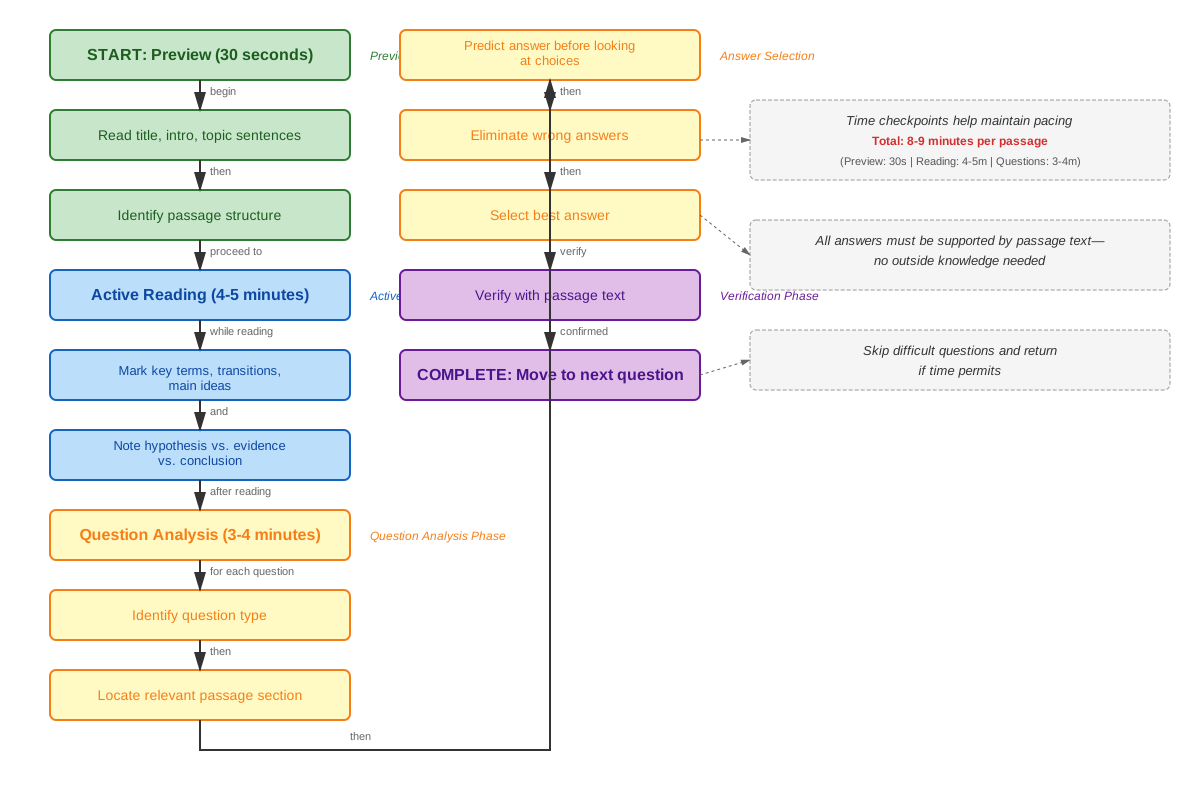
Before diving into a natural science passage, invest 10-15 seconds scanning for structural clues. Read the italicized introduction (if present), glance at the first sentence of each paragraph to identify the organizational pattern, and note any obvious transitions or section breaks. This brief preview creates a mental framework that improves comprehension and retention during the full reading.
Active Reading Approach
Read natural science passages with a pencil in hand, marking key elements:
- Underline or bracket the main idea or thesis
- Circle transition words indicating structure (however, therefore, first, subsequently)
- Star important discoveries, conclusions, or turning points
- Note paragraph topics in margins (e.g., "old theory," "1977 discovery," "implications")
This active engagement improves focus and creates a visual map for quickly relocating information when answering questions.
Trigger Words and Phrases
Certain words and phrases signal high-value information likely to generate questions:
Causation triggers: "because," "therefore," "as a result," "consequently," "leads to," "causes," "due to"—these indicate cause-and-effect relationships frequently tested in questions.
Contrast triggers: "however," "unlike," "in contrast," "whereas," "on the other hand"—these signal comparisons or competing ideas that often appear in questions.
Emphasis triggers: "significant," "remarkable," "surprisingly," "most important," "primary," "crucial"—these highlight information the author considers noteworthy, often tested in main idea or purpose questions.
Uncertainty triggers: "suggests," "may," "possibly," "theorizes," "hypothesizes," "unclear"—these indicate tentative conclusions or ongoing questions, important for distinguishing facts from theories.
Time triggers: "initially," "subsequently," "eventually," "currently," "by 1950," "before"—these mark chronological relationships frequently tested in sequence questions.
Question-Answering Process
For detail questions ("According to the passage..." or "The passage states that..."):
- Identify key words in the question
- Scan the passage for those words or synonyms
- Read the surrounding sentences carefully
- Match passage information to answer choices, eliminating those that contradict, distort, or aren't mentioned
For inference questions ("The passage suggests..." or "It can be reasonably inferred..."):
- Locate relevant passage information
- Identify what the passage directly implies but doesn't explicitly state
- Eliminate answers that require outside knowledge or make unsupported leaps
- Choose the answer most directly supported by passage evidence
For vocabulary-in-context questions:
- Read the entire sentence containing the word
- Read the sentences immediately before and after
- Substitute each answer choice into the sentence
- Choose the option that maintains the sentence's meaning and fits the passage context
For main idea/purpose questions:
- Consider the passage structure and organization
- Identify what the passage spends most time discussing
- Eliminate answers that are too narrow (single paragraphs) or too broad (beyond passage scope)
- Choose the answer that encompasses the passage's primary focus
Time Management
Allocate approximately 3-4 minutes for reading the natural science passage and 4-5 minutes for answering the 10 questions. If a question proves difficult, mark it and move forward—returning to challenging questions after completing easier ones prevents time waste and maintains momentum. Natural science passages often contain questions with clear, definitive answers based on stated information, so prioritize these before tackling more complex inference questions.
Process of Elimination
Natural science passage answer choices often include:
Distortions: Answers that twist passage information slightly, using similar vocabulary but changing meaning. Eliminate these by checking exact passage wording.
Out-of-scope: Answers that discuss topics not addressed in the passage or require outside scientific knowledge. Eliminate these immediately.
Contradictions: Answers that directly oppose passage information. These are usually easy to eliminate with quick passage reference.
Too extreme: Answers using absolute language ("always," "never," "only," "all") when the passage uses qualified language ("often," "may," "some," "typically"). Eliminate unless the passage truly supports the extreme claim.
Memory Techniques
SCIENCE Acronym for Passage Approach
Structure: Identify the organizational pattern (chronological, cause-effect, problem-solution, compare-contrast, process)
Context: Use context clues for unfamiliar vocabulary
Ideas: Mark main ideas and topic sentences
Evidence: Distinguish facts from hypotheses and theories
Navigate: Note paragraph topics for quick reference
Causation: Circle cause-and-effect relationships
Emphasis: Star important discoveries and conclusions
The "Three Cs" for Scientific Vocabulary
When encountering unfamiliar terms, remember the three types of context clues:
- Comparison/Contrast: The term is defined by what it's similar to or different from
- Clarification: The term is directly defined or restated
- Clues from examples: The term is illustrated through specific instances
Visualization for Passage Structure
Create mental images for common structures:
- Chronological: Visualize a timeline with key dates or events marked
- Cause-and-Effect: Picture a chain of dominoes, each causing the next to fall
- Compare-and-Contrast: Imagine a Venn diagram with overlapping and distinct features
- Problem-Solution: Envision a locked door (problem) and a key (solution)
- Process: See a flowchart with sequential steps
The "FACT vs. THEORY" Distinction
FACT: Firm, Accepted, Confirmed, Tested—presented in definitive language
THEORY: Tentative, Hypothetical, Exploratory, Ongoing, Researched, Yielding—presented with qualifying language
Summary
Natural science passages constitute a critical 25% of the ACT Reading test, appearing once on every exam with 10 questions. These passages present scientific information from diverse fields—biology, chemistry, physics, astronomy, earth science, and environmental science—written for general audiences rather than specialists. Success requires no outside scientific knowledge; instead, students must master reading comprehension strategies specific to scientific writing: identifying organizational structures (chronological, problem-solution, cause-and-effect, compare-and-contrast, and process explanation), using context clues to decode specialized vocabulary, distinguishing established facts from hypotheses and theories, and recognizing the relationship between evidence and conclusions. The passages follow predictable patterns, with approximately 40-50% of questions testing explicit detail comprehension and 30-40% assessing inference and reasoning. Strategic readers actively mark structural elements, note paragraph topics, and identify trigger words signaling causation, contrast, emphasis, and uncertainty. By understanding these patterns and applying systematic question-answering processes, students can confidently tackle natural science passages regardless of their science background, securing valuable points through careful reading and strategic analysis rather than prior content knowledge.
Key Takeaways
- Natural science passages appear exactly once per ACT Reading test, always containing 10 questions worth 25% of the Reading score, making them unavoidable and high-stakes.
- All information needed to answer questions appears within the passage itself—outside scientific knowledge is never required and can sometimes mislead students who rely on it instead of passage content.
- Five organizational structures account for nearly all natural science passages: chronological/historical, problem-solution, cause-and-effect, compare-and-contrast, and process/mechanism explanation; identifying structure quickly improves comprehension and question-answering efficiency.
- Context clues for scientific vocabulary always appear in the same sentence or immediately adjacent sentences, using definition, example, contrast, or restatement patterns—decoding unfamiliar terms through context is more valuable than memorizing scientific vocabulary.
- Distinguishing between established facts (definitive language), hypotheses and theories (tentative language), observations (what was found), and interpretations (what findings mean) is essential for answering questions accurately, particularly inference questions.
- Active reading strategies—marking main ideas, circling transition words, noting paragraph topics, and starring important discoveries—create a visual map that enables quick information retrieval when answering questions.
- Strategic time allocation (3-4 minutes reading, 4-5 minutes answering questions) and systematic question-answering processes (locate information, eliminate wrong answers, verify with passage evidence) maximize accuracy and efficiency on test day.
Related Topics
Social Science Passages: These passages share many structural and strategic similarities with natural science passages, including objective tone, logical organization, and technical vocabulary in context. Mastering natural science passage strategies provides a strong foundation for social science success, as both require identifying structure, using context clues, and distinguishing claims from evidence.
ACT Science Section: While the Science section tests scientific reasoning rather than reading comprehension, the skills developed through natural science passage practice—interpreting data presentations, understanding experimental design, and analyzing relationships between variables—directly support Science section performance.
Prose Fiction Passages: Understanding how natural science passages differ from prose fiction (objective vs. subjective tone, logical vs. narrative structure, informative vs. character-driven purpose) helps students adjust their reading approach for different passage types, improving overall Reading section performance.
Humanities Passages: These passages often discuss scientific topics from historical, philosophical, or cultural perspectives, blending natural science content with humanities analysis. Success on natural science passages builds skills for understanding scientific content in humanities contexts.
Vocabulary in Context Strategies: Advanced vocabulary strategies applicable across all passage types build on the context clue skills essential for natural science passages, enabling students to decode unfamiliar words efficiently regardless of subject matter.
Practice CTA
Now that you've mastered the strategies and concepts for natural science passages, it's time to put your knowledge into action! Complete the practice questions to apply these strategies to authentic ACT-style passages and questions. Use the flashcards to reinforce key concepts, vocabulary, and structural patterns until they become automatic. Remember: natural science passages are highly predictable once you understand their patterns, and consistent practice transforms these strategies from conscious techniques into instinctive skills. Every practice passage you complete builds the confidence and competence you need to excel on test day. You've got this—now prove it to yourself through deliberate practice!
Sign up free to keep reading
Create a free AnvayaPrep account to finish this ACT guide on Natural science passages — plus flashcards and practice questions.