Overview
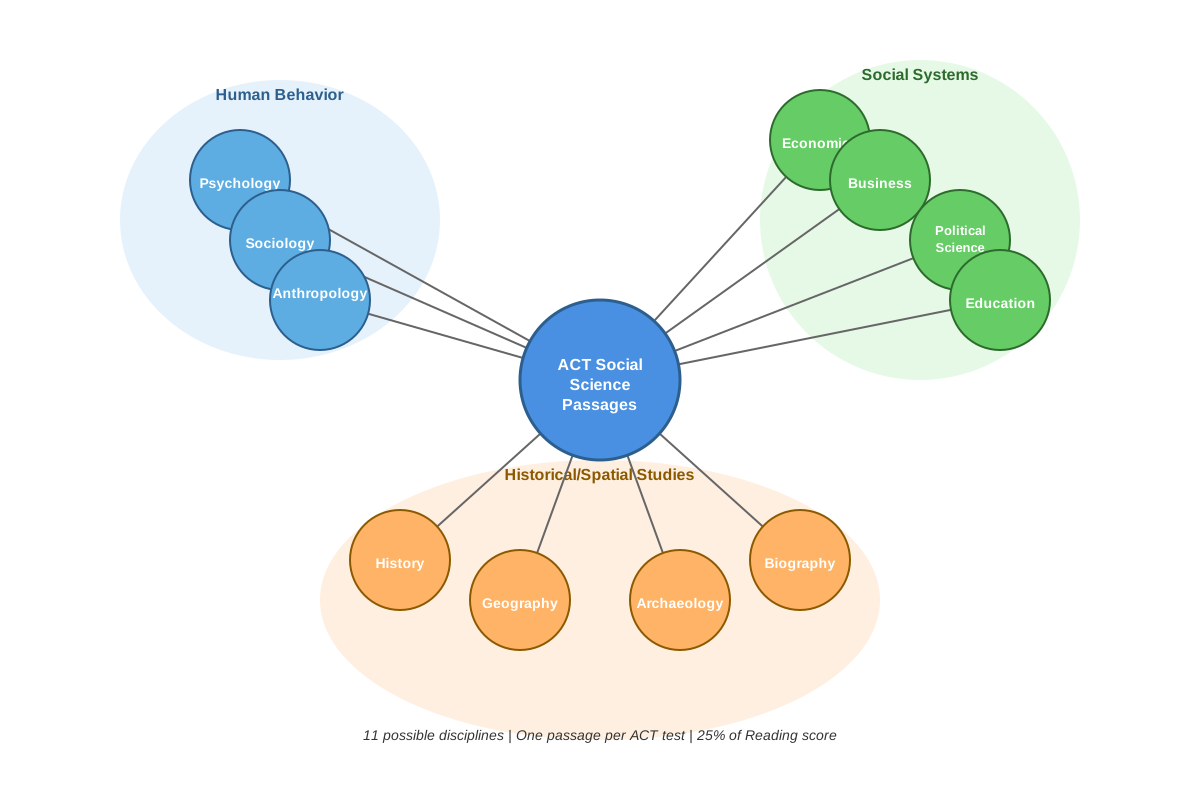
Social science passages represent one of the four core passage types that appear on every ACT Reading test. These passages draw from disciplines including anthropology, archaeology, biography, business, economics, education, geography, history, political science, psychology, and sociology. Unlike prose fiction passages that focus on narrative and character development, or natural science passages that emphasize scientific processes and discoveries, ACT social science passages examine human behavior, societal structures, cultural phenomena, and historical events through an analytical lens.
Understanding social science passages is essential for ACT success because they consistently appear as one of the four passages on every test administration, typically accounting for 25% of your Reading score (10 questions out of 40). These passages often present the greatest challenge for students who excel at concrete scientific thinking or literary analysis but struggle with abstract social theories, historical context, and nuanced arguments about human systems. The passages frequently blend narrative elements with analytical frameworks, requiring readers to track both factual information and interpretive claims simultaneously.
Social science passages connect to broader ACT Reading skills including main idea identification, detail comprehension, inference-making, and author's purpose analysis. However, they demand specific strategies for handling dense informational content, understanding specialized terminology in context, and navigating passages that may shift between historical periods, theoretical perspectives, or case studies. Mastering these passages builds critical reading skills applicable to all passage types while preparing students for the academic reading demands of college-level coursework in humanities and social sciences.
Learning Objectives
- [ ] Identify when Social science passages is being tested
- [ ] Explain the core rule or strategy behind Social science passages
- [ ] Apply Social science passages to ACT-style questions accurately
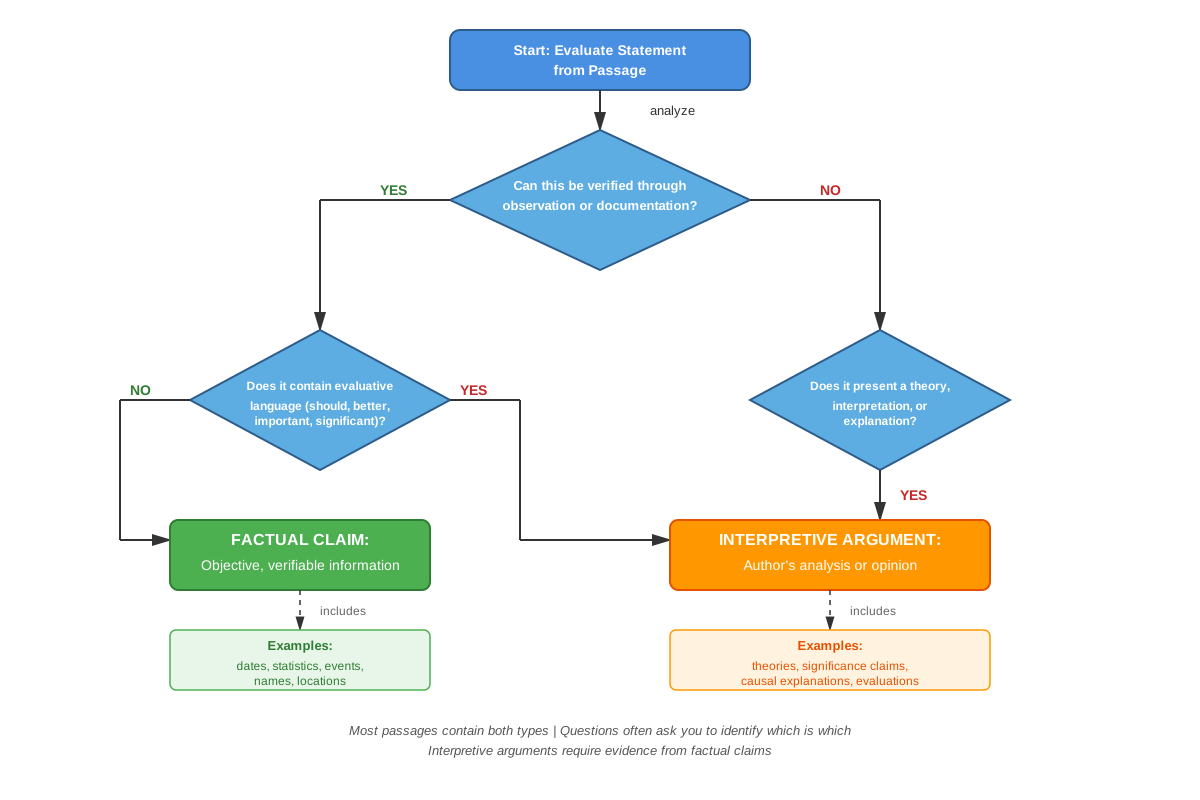
- [ ] Distinguish between factual claims and interpretive arguments within social science texts
- [ ] Recognize common organizational patterns in social science writing (chronological, cause-effect, compare-contrast, problem-solution)
- [ ] Synthesize information from multiple paragraphs to answer inference and synthesis questions
- [ ] Evaluate the author's tone, purpose, and perspective in academic social science writing
Prerequisites
- Basic reading comprehension skills: Understanding literal meaning, main ideas, and supporting details forms the foundation for tackling more complex social science analysis
- Familiarity with ACT Reading test format: Knowing the 35-minute time constraint, 4-passage structure, and 10 questions per passage enables efficient strategy application
- Vocabulary in context skills: Social science passages contain specialized terminology that must be understood through contextual clues rather than prior knowledge
- Paragraph-level comprehension: The ability to identify topic sentences and supporting evidence within individual paragraphs is essential before synthesizing across an entire passage
Why This Topic Matters
Social science passages matter because they reflect the type of analytical, evidence-based writing students will encounter throughout college and professional life. These passages train readers to evaluate arguments about human behavior, understand historical causation, and analyze social systems—skills fundamental to informed citizenship and professional success across virtually all career paths.
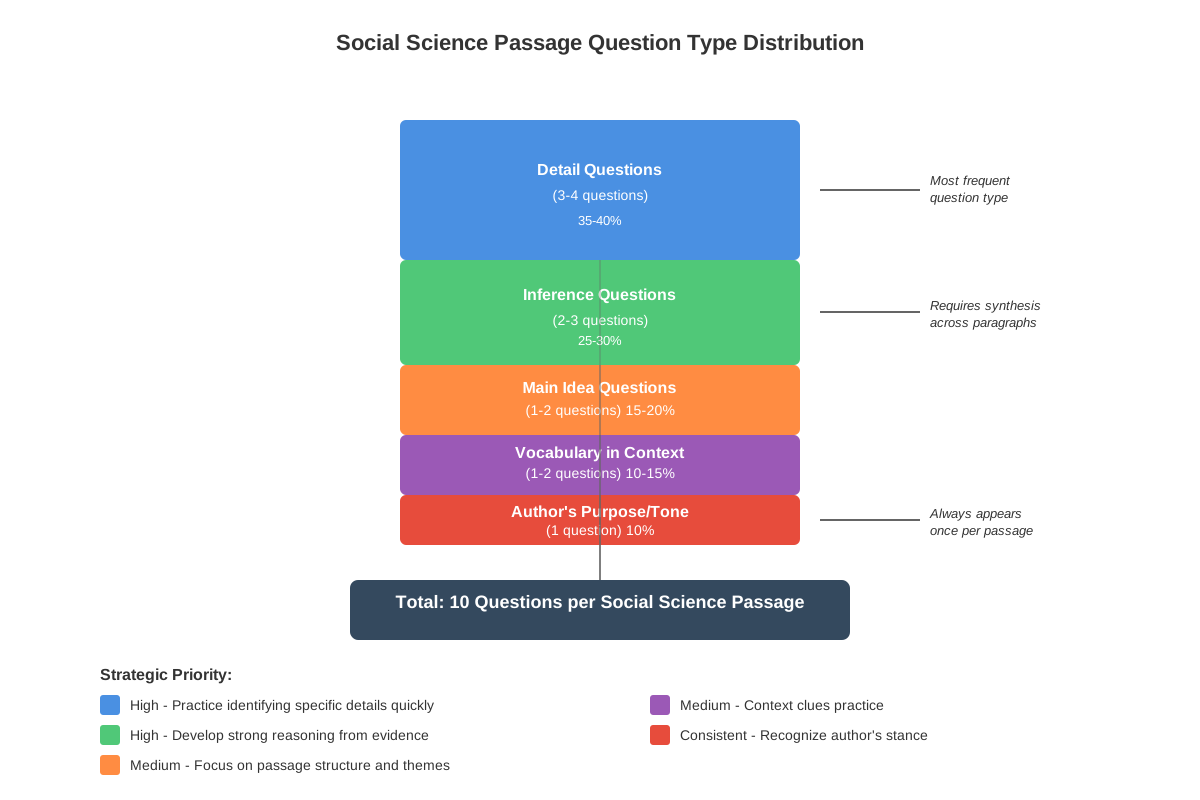
On the ACT, social science passages appear with absolute consistency: one passage per test, always. This predictability makes them high-yield study material. The 10 questions accompanying each social science passage typically break down as follows: 3-4 detail questions, 2-3 inference questions, 1-2 main idea or purpose questions, 1-2 vocabulary-in-context questions, and 1-2 function or structure questions. Understanding these patterns allows for strategic preparation.
Common manifestations of social science passages include: biographical excerpts about historical figures that analyze their impact on society; anthropological studies examining cultural practices and their meanings; economic analyses exploring market behaviors or policy effects; psychological research discussing human cognition or behavior patterns; historical narratives that interpret events through particular theoretical lenses; and sociological examinations of group dynamics, institutions, or social change. The passages typically run 750-900 words and maintain an academic but accessible tone, similar to introductory college textbooks or high-quality journalism.
Core Concepts
Characteristics of Social Science Passages
Social science passages possess distinctive features that set them apart from other ACT passage types. These texts typically adopt an expository structure, presenting information, analysis, and arguments about human-related phenomena. The writing style balances accessibility with academic rigor, avoiding the highly technical language of natural science passages while maintaining more formal diction than prose fiction.
Key characteristics include:
- Thesis-driven organization: Most passages advance a central argument or interpretation rather than simply presenting facts
- Evidence-based reasoning: Claims are supported through historical examples, research findings, statistical data, or case studies
- Contextual complexity: Passages often require understanding historical periods, cultural contexts, or theoretical frameworks
- Multiple perspectives: Authors may present competing viewpoints before advocating for their own interpretation
- Specialized vocabulary: Terms from specific disciplines (e.g., "cultural diffusion," "market equilibrium," "cognitive dissonance") appear but are usually defined contextually
Common Organizational Patterns
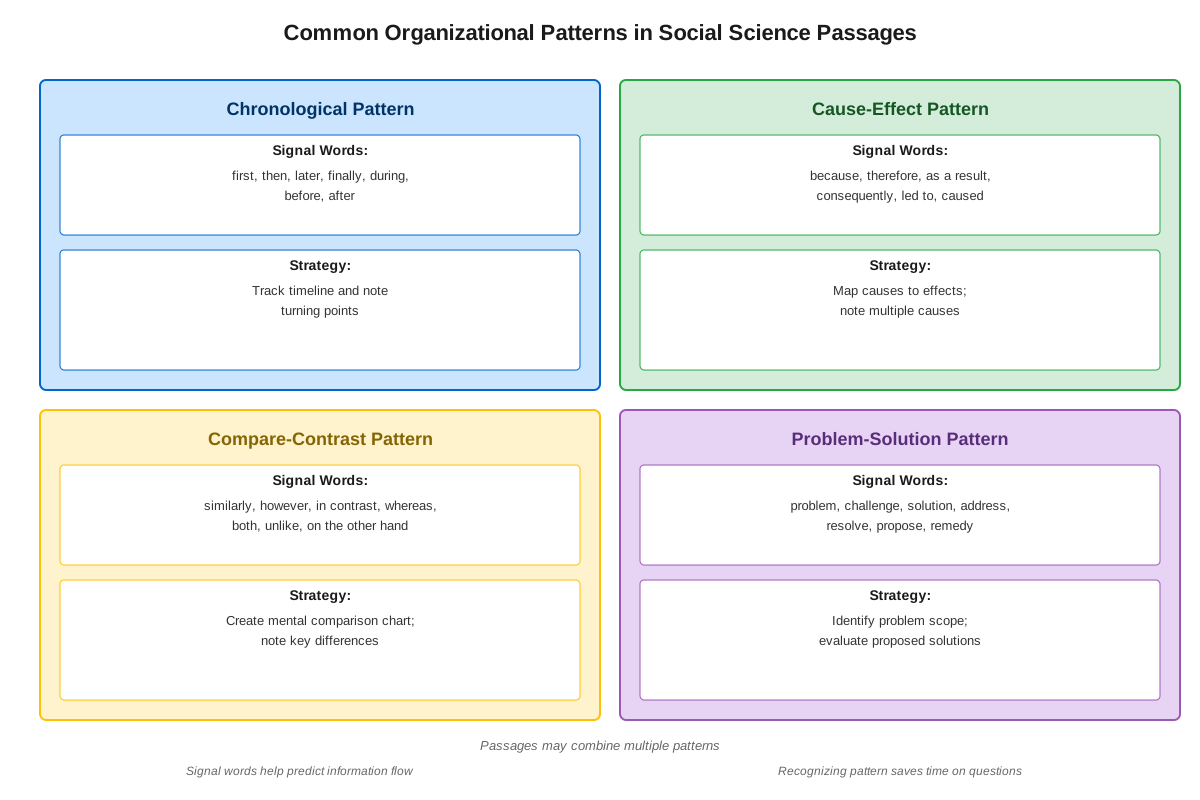
Understanding how social science passages structure information dramatically improves comprehension and question-answering efficiency. The ACT employs several recurring organizational patterns:
| Pattern | Description | Signal Words | Example Topic |
|---|---|---|---|
| Chronological | Events or developments presented in time order | first, then, subsequently, eventually, by 1950 | Biography of a civil rights leader |
| Cause-Effect | Explores how one phenomenon leads to another | because, therefore, as a result, consequently, led to | Economic depression's impact on migration |
| Compare-Contrast | Examines similarities and differences | however, in contrast, similarly, whereas, unlike | Two approaches to education reform |
| Problem-Solution | Identifies an issue and proposes responses | challenge, address, solution, approach, resolved | Urban planning addressing housing shortages |
| Thematic | Organizes around central ideas rather than sequence | aspect, dimension, characteristic, element | Features of democratic governance |
Recognizing these patterns early in a passage—often evident in the first two paragraphs—provides a mental framework for organizing information as you read.
Types of Social Science Content
ACT social science passages draw from diverse disciplines, each with characteristic concerns and approaches:
Historical passages examine past events, figures, or periods, emphasizing causation, significance, and interpretation. These passages often challenge students to distinguish between factual events and the author's interpretive framework. For example, a passage might describe the facts of westward expansion while arguing for a particular interpretation of its causes or consequences.
Biographical passages focus on individuals' lives, achievements, and impacts. Unlike simple chronologies, ACT biographical passages analyze how personal experiences shaped contributions or how individuals influenced broader social movements. The emphasis falls on significance and interpretation rather than mere life events.
Anthropological and sociological passages explore cultural practices, social structures, group behaviors, or societal changes. These passages frequently examine how communities function, how cultures evolve, or how social forces shape individual and collective behavior. They may introduce theoretical concepts like "social capital" or "cultural adaptation" that must be understood through context.
Psychological passages investigate human cognition, behavior, motivation, or development. While overlapping with natural science when discussing research methodology, these passages emphasize implications for understanding human nature and social interaction rather than biological mechanisms.
Economic and political science passages analyze systems of resource allocation, governance structures, policy decisions, or power dynamics. These passages often present arguments about how institutions function or should function, requiring readers to track both descriptive and normative claims.
Question Types and Passage Features
Social science passages generate predictable question types that test specific comprehension skills:
Detail questions ask about explicitly stated information. Success requires careful reading and the ability to locate specific information quickly. These questions often include line references or paragraph indicators.
Inference questions require drawing conclusions based on stated information. The correct answer must be supported by passage evidence but won't be directly stated. Social science passages particularly test inference about causation, motivation, significance, and implications.
Main idea and purpose questions assess understanding of the passage's central argument or the author's primary objective. Social science passages often have layered purposes—both informing about a topic and advancing an interpretation.
Vocabulary-in-context questions test whether students can determine specialized term meanings from surrounding text. Social science passages frequently introduce discipline-specific vocabulary that must be understood contextually.
Function and structure questions ask why the author included specific information or how passage sections relate. These questions test understanding of rhetorical strategy and organizational logic.
Reading Strategies for Social Science Passages
Effective social science passage reading requires active engagement rather than passive absorption. The following strategies optimize comprehension and question-answering efficiency:
- Preview strategically: Read the first paragraph completely and skim topic sentences of subsequent paragraphs to establish the passage's scope and organization
- Identify the thesis early: Most social science passages state or strongly imply their central argument in the first two paragraphs
- Track structure: Note organizational patterns and how paragraphs relate to the thesis
- Distinguish fact from interpretation: Mark where the author moves from describing what happened to explaining why or what it means
- Note transitions: Words like "however," "moreover," and "consequently" signal important logical relationships
- Annotate minimally: Brief marginal notes about paragraph topics aid navigation during question-answering
- Read for understanding, not memorization: Focus on grasping arguments and relationships rather than memorizing details
Concept Relationships
The concepts within social science passages form an interconnected system. Passage characteristics (expository style, thesis-driven structure, evidence-based reasoning) determine which organizational patterns authors employ. These patterns, in turn, shape how information is presented and thus influence which reading strategies prove most effective. Understanding content types (historical, biographical, anthropological, etc.) helps predict likely question types and the skills they'll test.
This topic connects to prerequisite knowledge in several ways: basic reading comprehension skills provide the foundation for identifying main ideas and details in social science contexts; familiarity with ACT format enables efficient time management when applying social science-specific strategies; vocabulary-in-context skills become particularly crucial given the specialized terminology in these passages; and paragraph-level comprehension scales up to passage-level synthesis required for inference and main idea questions.
The relationship map flows as follows:
Passage Characteristics → inform → Organizational Patterns → guide → Reading Strategies → enable → Efficient Question-Answering → produces → High Scores
Additionally: Content Type Recognition → predicts → Likely Question Types → suggests → Targeted Preparation
High-Yield Facts
⭐ Social science passages appear exactly once on every ACT Reading test, consistently accounting for 10 of the 40 questions
⭐ The first two paragraphs typically establish the passage's thesis, scope, and organizational pattern
⭐ Detail questions can be answered by locating specific information in the passage; inference questions require combining stated information to reach unstated conclusions
⭐ Correct answers to inference questions are always supported by passage evidence, even though they're not explicitly stated
⭐ Social science passages blend factual information with interpretive arguments; distinguishing between these is essential for answering purpose and main idea questions
- Social science passages draw from at least eight disciplines: anthropology, archaeology, biography, business, economics, education, geography, history, political science, psychology, and sociology
- The passages typically run 750-900 words and maintain an academic but accessible tone similar to introductory college textbooks
- Chronological, cause-effect, compare-contrast, problem-solution, and thematic organizational patterns account for the vast majority of social science passage structures
- Vocabulary-in-context questions in social science passages test discipline-specific terms that are defined through surrounding context rather than requiring prior knowledge
- Function questions ask "why did the author include this information?" and require understanding rhetorical purpose rather than just content
Quick check — test yourself on Social science passages so far.
Try Flashcards →Common Misconceptions
Misconception: Social science passages require extensive background knowledge in history, psychology, or other social sciences to answer questions correctly.
Correction: The ACT is designed as a reading comprehension test, not a content knowledge test. All information needed to answer questions appears in the passage itself. While background knowledge may speed comprehension, it's never required and can sometimes lead students to answer based on outside knowledge rather than passage content.
Misconception: The correct answer to inference questions is the most interesting or plausible-sounding option.
Correction: Correct inference answers must be directly supported by passage evidence. They represent the most conservative, well-supported conclusion rather than the most dramatic or interesting possibility. Students should be able to point to specific passage content that supports their answer choice.
Misconception: Social science passages are purely factual and objective, presenting information without bias or interpretation.
Correction: While social science passages present evidence and maintain academic tone, they typically advance interpretive arguments. Authors make choices about which events to emphasize, how to explain causation, and what significance to assign to phenomena. Recognizing the author's interpretive framework is essential for answering purpose and main idea questions.
Misconception: Every detail in the passage is equally important and should be remembered.
Correction: Social science passages contain varying levels of information importance. The thesis, main supporting arguments, and key examples are high-priority; minor details and tangential examples are low-priority. Effective reading focuses on understanding structure and main arguments rather than memorizing every fact.
Misconception: Difficult vocabulary means you can't understand the passage.
Correction: Social science passages are written to be comprehensible even when introducing specialized terms. Context clues, definitions, examples, and restatements allow readers to grasp meaning without prior knowledge of technical vocabulary. Questions testing vocabulary always provide sufficient context for determining meaning.
Misconception: You should read the questions before reading the passage to know what to look for.
Correction: For social science passages, reading questions first often wastes time and creates confusion because you don't yet have the context to understand what questions are asking. A more efficient approach is reading the passage actively to understand its structure and argument, then approaching questions with that framework in mind.
Worked Examples
Example 1: Historical Passage with Cause-Effect Structure
Passage Excerpt (abbreviated for illustration):
"The Great Migration of African Americans from the rural South to urban centers in the North and West between 1916 and 1970 fundamentally transformed American society. While historians have long recognized economic factors—particularly the demand for industrial labor during World War I and the mechanization of Southern agriculture—as primary drivers of this demographic shift, recent scholarship emphasizes the role of social networks in shaping migration patterns. Letters from earlier migrants describing opportunities and offering assistance created 'migration chains' that channeled subsequent migrants toward specific destinations. A migrant from Mississippi, for instance, was far more likely to settle in Chicago than New York, not because Chicago offered objectively superior opportunities, but because established Mississippi communities in Chicago provided crucial support systems..."
Question: The passage suggests that the traditional historical explanation for the Great Migration was:
A) Complete and required no revision
B) Focused primarily on economic factors
C) Emphasized social networks over economic causes
D) Ignored the role of World War I entirely
Worked Solution:
Step 1: Identify what the question asks. This is a detail/inference hybrid asking about the "traditional historical explanation" mentioned in the passage.
Step 2: Locate relevant passage content. The second sentence states: "historians have long recognized economic factors—particularly the demand for industrial labor during World War I and the mechanization of Southern agriculture—as primary drivers."
Step 3: Analyze the passage structure. The word "While" signals contrast. The passage presents the traditional view (economic factors) before introducing "recent scholarship" that "emphasizes the role of social networks." This structure indicates the traditional view focused on economics, while newer interpretations add social factors.
Step 4: Evaluate answer choices:
- A) Incorrect—the passage presents recent scholarship as adding to or revising traditional explanations
- B) Correct—directly supported by "historians have long recognized economic factors...as primary drivers"
- C) Incorrect—this describes recent scholarship, not traditional explanations
- D) Incorrect—the passage explicitly mentions WWI as part of traditional economic explanations
Answer: B
Connection to Learning Objectives: This example demonstrates identifying social science passage content (historical analysis), recognizing organizational patterns (contrast between traditional and recent scholarship), and distinguishing between different perspectives within a passage.
Example 2: Anthropological Passage with Compare-Contrast Structure
Passage Excerpt (abbreviated):
"Two competing theories attempt to explain the rapid spread of agricultural practices during the Neolithic Revolution. The 'demic diffusion' model proposes that farming spread primarily through population movement—farmers migrating into new territories and displacing or absorbing hunter-gatherer populations. Archaeological evidence supporting this view includes genetic studies showing population replacement in some regions and the rapid, uniform spread of farming techniques across large areas. In contrast, the 'cultural diffusion' model argues that agricultural knowledge spread through cultural transmission between groups, with existing populations adopting farming practices from neighbors without significant population movement. Proponents point to regions where genetic continuity suggests local populations adopted agriculture while maintaining their demographic composition..."
Question: According to the passage, which of the following would most strongly support the cultural diffusion model over the demic diffusion model?
F) Evidence of rapid, uniform spread of farming techniques
G) Genetic studies showing population replacement
H) Archaeological findings indicating genetic continuity in a region that adopted agriculture
J) Discovery of migration routes used by early farmers
Worked Solution:
Step 1: Identify the question type. This is an inference question asking which evidence would support one theory over another.
Step 2: Understand the key distinction between theories:
- Demic diffusion: farming spread through population movement (farmers migrating)
- Cultural diffusion: farming spread through knowledge transfer (existing populations adopting practices)
Step 3: Identify what evidence supports each theory:
- Demic diffusion evidence: genetic studies showing population replacement, rapid uniform spread
- Cultural diffusion evidence: genetic continuity (same population) + adoption of agriculture
Step 4: Evaluate answer choices:
- F) Incorrect—the passage associates this with demic diffusion
- G) Incorrect—explicitly mentioned as supporting demic diffusion
- H) Correct—genetic continuity (same population) + agriculture adoption directly supports cultural diffusion's claim that "existing populations adopted agriculture"
- J) Incorrect—migration routes would support demic diffusion (population movement)
Answer: H
Connection to Learning Objectives: This example shows how to identify compare-contrast organizational patterns, distinguish between competing theories in social science passages, and apply passage information to answer inference questions about evidence and support.
Exam Strategy
Approaching Social Science Passages Efficiently
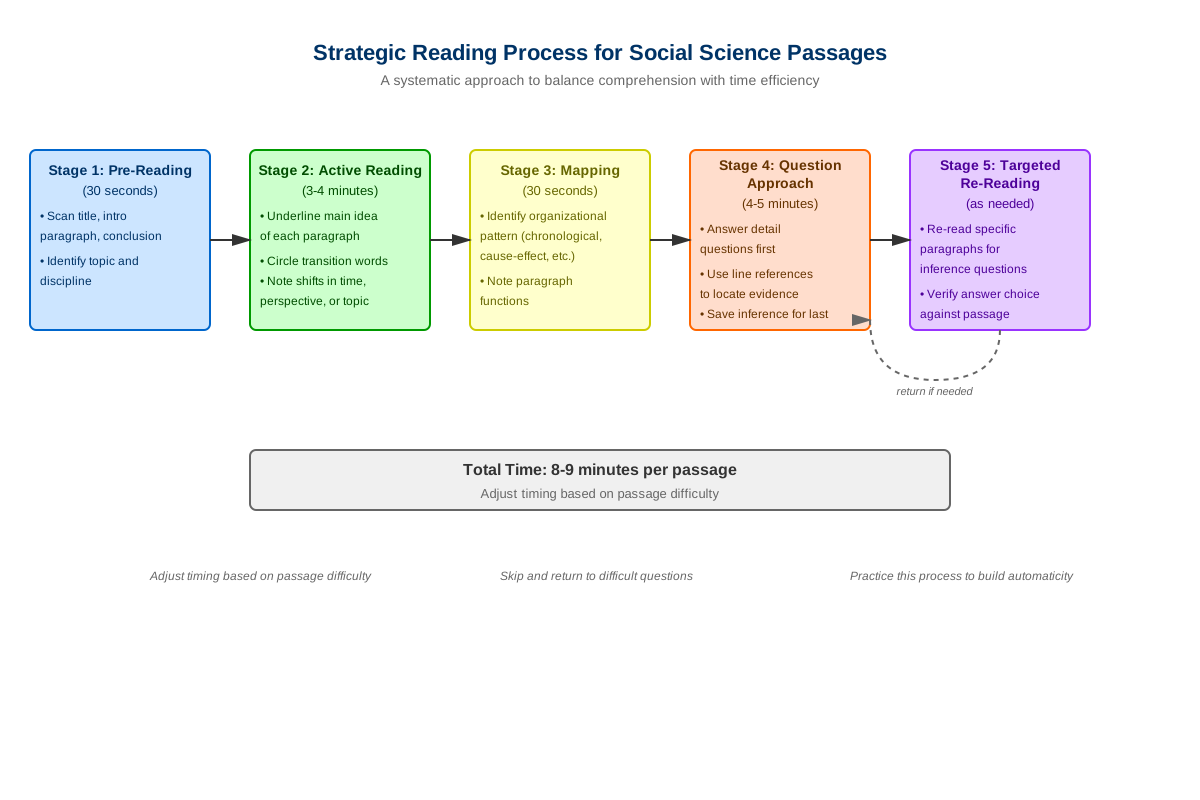
Time allocation: Spend approximately 8-9 minutes per passage, including reading and answering all 10 questions. For social science passages specifically, allocate 3-4 minutes for active reading and 4-5 minutes for questions.
Reading approach: Use the "thesis-first" strategy. Read the first paragraph completely to establish topic and scope. Read the first sentence of each subsequent paragraph to understand structure. Then read the entire passage with this framework in mind, focusing on understanding the author's argument and how evidence supports it.
Trigger Words and Phrases
Watch for these signal words that indicate important passage elements:
Thesis indicators: "argues that," "demonstrates," "reveals," "suggests," "shows that," "indicates"
Contrast signals: "however," "in contrast," "whereas," "unlike," "on the other hand," "nevertheless"
Cause-effect markers: "because," "therefore," "as a result," "consequently," "led to," "resulted in," "caused"
Evidence introduction: "for example," "for instance," "research shows," "studies indicate," "evidence suggests"
Author's perspective: "importantly," "significantly," "notably," "surprisingly," "unfortunately"
Process of Elimination Tips
For detail questions: Eliminate answers containing information not mentioned in the passage or contradicting passage content. The correct answer will paraphrase passage information.
For inference questions: Eliminate answers that go too far beyond passage support or contradict passage information. The correct answer requires only a small logical step from stated information.
For main idea questions: Eliminate answers that are too narrow (covering only one paragraph) or too broad (going beyond passage scope). Also eliminate answers focusing on supporting details rather than the central argument.
For vocabulary-in-context questions: Eliminate your pre-existing definition if it doesn't fit the passage context. Substitute each answer choice into the sentence to test which makes sense.
For function questions: Eliminate answers describing what the information says rather than why the author included it. Focus on rhetorical purpose.
Question Order Strategy
Don't feel obligated to answer questions in order. Consider this approach:
- Start with detail questions that include line references—these are often quickest
- Move to vocabulary-in-context questions—these are typically straightforward
- Address inference questions—these require more thought but have clear support
- Finish with main idea and function questions—these benefit from having worked through other questions
Memory Techniques
PACES - Remember the five common organizational patterns:
- Problem-solution
- Analytical/thematic
- Chronological
- Effect (cause-effect)
- Similarities/differences (compare-contrast)
THESIS - Remember what to identify in the first two paragraphs:
- Topic (what is this about?)
- Hypothesis/main argument (what is the author claiming?)
- Evidence type (what kind of support is used?)
- Structure (how is information organized?)
- Interpretation vs. fact (is this descriptive or argumentative?)
- Scope (what time period, region, or aspect is covered?)
The "So What?" Test: For main idea questions, ask "So what is the author's point?" The correct answer should capture not just the topic but the author's perspective or argument about that topic.
The "Point to It" Rule: For inference questions, you should be able to point to specific passage sentences that support your answer. If you can't, reconsider your choice.
Visualization Strategy: For passages with chronological or geographical elements, quickly sketch a timeline or simple map in the margin. Visual organization aids comprehension and question-answering.
Summary
Social science passages represent a consistent, high-yield component of ACT Reading, appearing once per test and accounting for 25% of the Reading score. These passages draw from disciplines including history, anthropology, psychology, economics, and sociology, presenting thesis-driven arguments supported by evidence. Success requires recognizing organizational patterns (chronological, cause-effect, compare-contrast, problem-solution, thematic), distinguishing factual information from interpretive arguments, and understanding the author's purpose and perspective. The first two paragraphs typically establish the passage's thesis and structure, making them crucial for efficient comprehension. Questions test detail comprehension, inference, main idea identification, vocabulary in context, and understanding of rhetorical function. Effective strategies include active reading focused on argument structure rather than detail memorization, using signal words to track logical relationships, and applying passage-specific evidence to answer inference questions conservatively. Unlike content-knowledge tests, the ACT provides all necessary information within the passage itself, making careful reading and strategic question-answering more important than background knowledge in social sciences.
Key Takeaways
- Social science passages appear exactly once per ACT Reading test, consistently generating 10 questions worth 25% of your Reading score
- These passages are thesis-driven and analytical, blending factual information with interpretive arguments that must be distinguished
- The first two paragraphs establish the passage's central argument, scope, and organizational pattern—read these carefully to create a mental framework
- Five organizational patterns (chronological, cause-effect, compare-contrast, problem-solution, thematic) account for most social science passage structures
- All information needed to answer questions appears in the passage; background knowledge in social sciences is never required
- Inference questions require conservative conclusions directly supported by passage evidence, not dramatic or interesting possibilities
- Efficient reading focuses on understanding the author's argument and how evidence supports it, not memorizing every detail
Related Topics
Natural Science Passages: Understanding social science passages builds skills for handling natural science passages, which share expository structure and evidence-based reasoning but focus on scientific rather than social phenomena. Mastering social science passages' analytical reading strategies transfers directly to natural science contexts.
Prose Fiction Passages: While prose fiction emphasizes narrative and character, both passage types require inference skills and attention to author's purpose. Social science passage practice strengthens the analytical thinking needed for interpreting character motivation and thematic elements in fiction.
Humanities Passages: These passages share social science passages' focus on human culture and achievement but emphasize arts, literature, and philosophy. The reading strategies for social science passages—tracking arguments, distinguishing fact from interpretation, understanding organizational patterns—apply directly to humanities passages.
Paired Passages: Some ACT Reading tests include paired passages that may both be social science texts or combine social science with another type. Mastering single social science passages prepares students for comparing and synthesizing information across paired passages.
Practice CTA
Now that you've mastered the core concepts and strategies for social science passages, it's time to apply this knowledge! Work through the practice questions to test your ability to identify passage characteristics, recognize organizational patterns, and answer ACT-style questions efficiently. Use the flashcards to reinforce high-yield facts and key terminology. Remember: social science passages are predictable and learnable. With focused practice applying these strategies, you'll approach this passage type with confidence and consistently answer questions accurately. Your investment in mastering this high-yield topic will pay dividends on test day—one social science passage, 10 questions, 25% of your Reading score. Make them count!
Sign up free to keep reading
Create a free AnvayaPrep account to finish this ACT guide on Social science passages — plus flashcards and practice questions.