Overview
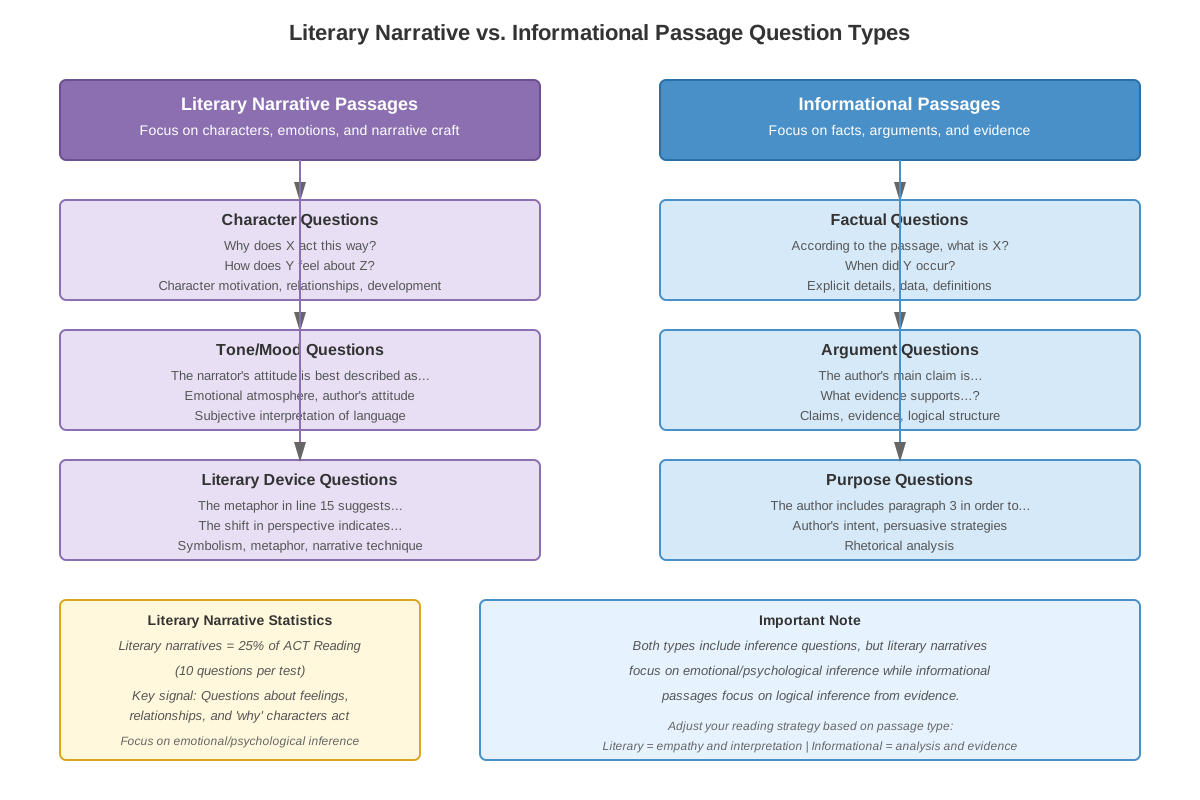
Literary narrative passages represent one of the four core passage types that appear on every ACT Reading test. These passages are excerpts from novels, short stories, memoirs, or personal essays that focus on character development, plot progression, and thematic exploration. Unlike informational texts, literary narratives emphasize storytelling elements such as dialogue, internal monologue, descriptive language, and emotional nuance. Students encounter one literary narrative passage on each ACT Reading section, typically positioned as the first passage in the test booklet.
Mastering ACT literary narrative passages is essential because they require a distinct reading approach compared to social science, humanities, or natural science passages. While informational passages prioritize factual comprehension and argument analysis, literary narratives demand attention to character motivation, tone shifts, symbolic meaning, and narrative perspective. These passages test not just what happens in the story, but why characters act as they do, how the author creates mood and atmosphere, and what deeper meanings emerge from seemingly simple events. The questions accompanying literary narratives often probe subtle emotional states, character relationships, and the author's craft in ways that require careful textual analysis.
Literary narrative passages connect to broader ACT Reading skills including main idea identification, detail recognition, inference making, and vocabulary in context. However, they uniquely emphasize understanding human behavior, interpreting figurative language, and recognizing how narrative techniques create meaning. Success with these passages builds the foundation for tackling questions about author's purpose, tone, and rhetorical strategy that appear across all passage types. Students who excel at literary narratives develop sophisticated close-reading skills that transfer to analyzing arguments, evaluating evidence, and understanding complex texts in academic and professional contexts.
Learning Objectives
- [ ] Identify when Literary narrative passages is being tested
- [ ] Explain the core rule or strategy behind Literary narrative passages
- [ ] Apply Literary narrative passages to ACT-style questions accurately
- [ ] Analyze character development and motivation within narrative contexts
- [ ] Distinguish between different narrative perspectives and their effects on meaning
- [ ] Evaluate how literary devices contribute to theme and tone
- [ ] Synthesize information from multiple parts of a passage to answer inference questions
Prerequisites
- Basic reading comprehension skills: Understanding literal meaning in prose texts is foundational before tackling interpretive questions about character and theme
- Familiarity with narrative elements: Recognizing plot, setting, character, conflict, and resolution helps students organize information while reading
- Vocabulary knowledge: Literary passages often use sophisticated or context-dependent language that requires strong vocabulary skills
- Time management fundamentals: Students should understand the ACT Reading section structure (4 passages, 40 questions, 35 minutes) before developing passage-specific strategies
Why This Topic Matters
Literary narrative passages appear on every single ACT Reading test, accounting for exactly 25% of the reading questions (10 out of 40 questions). This consistency makes them one of the most predictable and high-yield areas for focused preparation. Unlike the other three passage types that may vary in difficulty and content, literary narratives follow recognizable patterns in both passage structure and question types, making them an excellent opportunity for score improvement through targeted practice.
In real-world contexts, the skills developed through analyzing literary narratives extend far beyond standardized testing. Understanding character motivation, recognizing subtext in communication, and interpreting emotional nuance are essential competencies in professional environments, interpersonal relationships, and civic engagement. The ability to read between the lines, grasp implicit meanings, and appreciate multiple perspectives—all skills honed through literary analysis—proves invaluable in fields ranging from law and medicine to business and education.
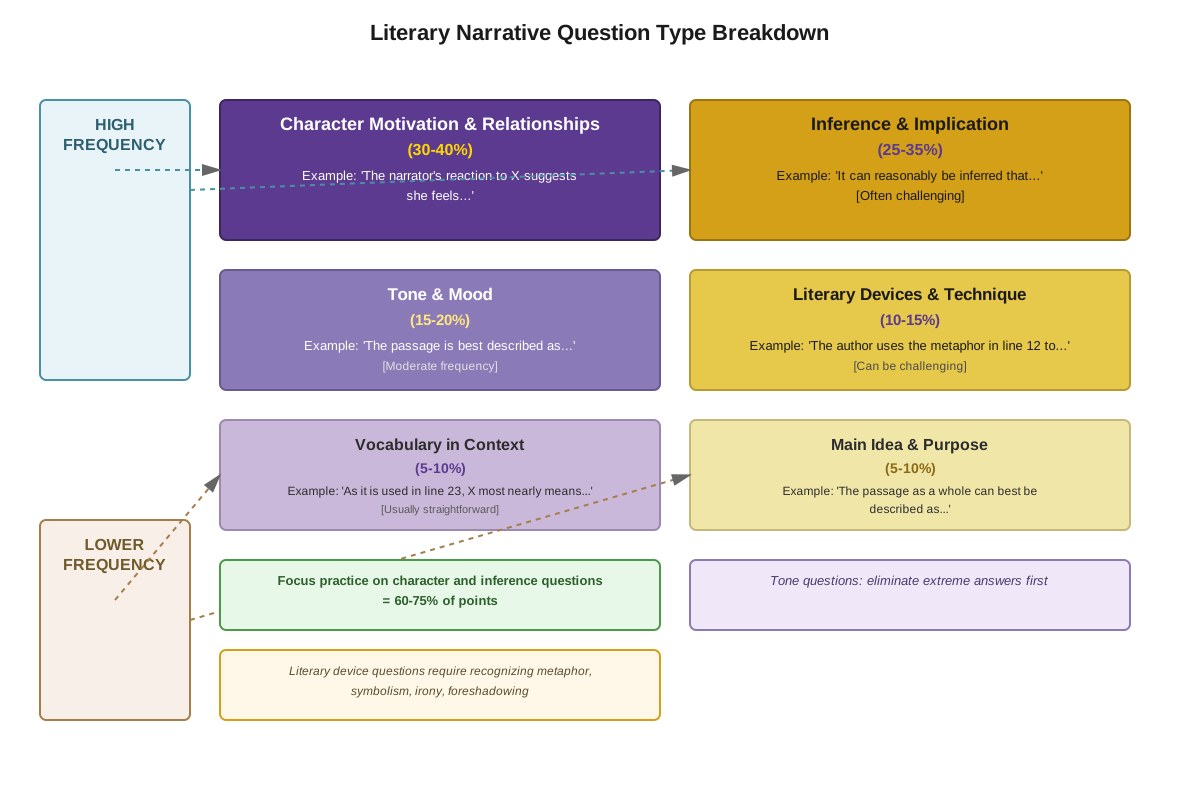
On the ACT, literary narrative passages commonly appear in several formats: coming-of-age stories featuring adolescent protagonists navigating identity or relationships; family dynamics exploring generational conflicts or cultural tensions; historical fiction set in specific time periods with period-appropriate language; and memoir excerpts recounting formative personal experiences. Questions typically address character emotions and motivations (30-40% of questions), passage details and sequence (25-30%), vocabulary in context (15-20%), main ideas and themes (10-15%), and author's craft and narrative technique (10-15%). Recognizing these patterns allows students to anticipate question types and allocate reading attention strategically.
Core Concepts
Narrative Perspective and Point of View
The narrative perspective determines who tells the story and how much information readers access. First-person narratives use "I" or "we" and limit readers to one character's thoughts, perceptions, and knowledge. This creates intimacy and subjectivity but restricts understanding of other characters' internal states. Third-person limited narratives use "he," "she," or "they" while maintaining focus on one character's consciousness, offering slightly more objectivity than first-person while preserving selective access to thoughts. Third-person omniscient narratives provide access to multiple characters' thoughts and broader contextual information.
On the ACT, identifying narrative perspective helps answer questions about what the narrator knows, why certain information is included or omitted, and how perspective shapes meaning. For example, a first-person narrator might misinterpret another character's actions, creating dramatic irony where readers understand more than the narrator. Questions often ask students to recognize these limitations: "The narrator's description of Maria suggests that he..." or "Based on the passage, the narrator appears unaware that..."
Character Development and Motivation
Character development refers to how characters change, grow, or reveal complexity throughout a passage. ACT passages typically show characters facing conflicts, making decisions, or experiencing realizations that illuminate their values, fears, desires, or beliefs. Understanding character motivation—the reasons behind actions and choices—is crucial for answering the majority of literary narrative questions.
Characters reveal themselves through multiple channels: direct statements about their thoughts and feelings, dialogue with other characters, actions and behavioral choices, reactions to events or other characters, and the narrator's descriptions or judgments. Strong readers synthesize information from all these sources rather than relying on a single statement. For instance, a character might claim to feel confident (direct statement) while their nervous gestures (action) and hesitant speech patterns (dialogue) reveal underlying anxiety.
| Character Revelation Method | Example | What It Shows |
|---|---|---|
| Internal monologue | "She wondered if she'd made the right choice" | Direct access to thoughts/doubts |
| Dialogue | "I'm fine," he said sharply | Tone reveals emotion beyond words |
| Action | Maria slammed the door | Physical behavior indicates feeling |
| Reaction | His hands trembled as he read | Involuntary response shows impact |
| Description | Her usually bright eyes seemed distant | Narrator's observation of change |
Theme and Meaning
Theme represents the underlying message, insight, or commentary about human experience that emerges from the narrative. Unlike plot (what happens), theme addresses why the story matters and what it reveals about life, relationships, society, or human nature. ACT passages rarely state themes explicitly; instead, students must infer them from patterns in character behavior, conflicts, resolutions, and symbolic elements.
Common themes in ACT literary narratives include identity and self-discovery, family relationships and generational differences, cultural heritage and assimilation, loss and grief, courage and moral choice, and the tension between individual desires and social expectations. Questions about theme often ask students to identify the passage's main concern, explain what a character learns, or determine what the passage suggests about a broader concept.
Tone and Mood
Tone reflects the author's or narrator's attitude toward the subject matter, while mood describes the emotional atmosphere created for readers. Tone might be nostalgic, critical, affectionate, ambivalent, or resigned. Mood might be tense, melancholic, hopeful, or ominous. Both emerge from word choice, sentence structure, imagery, and pacing.
Identifying tone requires attention to connotation—the emotional associations of words beyond their literal definitions. A character described as "slender" versus "scrawny" versus "emaciated" creates different tones despite similar literal meanings. Similarly, sentence structure affects tone: short, choppy sentences create tension or urgency, while long, flowing sentences suggest contemplation or ease.
Literary Devices and Author's Craft
ACT literary narratives employ various literary devices to create meaning and effect. Key devices include:
- Imagery: Sensory details that create vivid mental pictures and establish mood
- Metaphor and simile: Comparisons that illuminate character or situation through association
- Symbolism: Objects, actions, or elements that represent abstract ideas
- Foreshadowing: Hints about future events that create anticipation or irony
- Flashback: Interruptions in chronological sequence that provide background or context
- Irony: Contrasts between appearance and reality, expectation and outcome, or statement and meaning
Questions about author's craft ask why the author includes specific details, how particular techniques affect meaning, or what purpose a narrative choice serves. For example: "The author's description of the house in lines 23-27 primarily serves to..." or "The author uses the metaphor in line 45 most likely to suggest..."
Passage Structure and Organization
Literary narratives on the ACT typically follow one of several organizational patterns. Chronological narratives present events in time order, often focusing on a single significant incident or brief time period. Frame narratives begin in the present, flash back to past events, then return to the present, creating contrast between past and present perspectives. Reflective narratives alternate between describing events and commenting on their significance, common in memoir excerpts.
Understanding structure helps students navigate passages efficiently and anticipate where to find information. The opening typically establishes setting, introduces characters, and hints at central conflicts. The middle develops conflicts, reveals character through action and interaction, and builds toward a turning point. The conclusion often provides resolution, reflection, or a shift in understanding, though ACT passages sometimes end ambiguously or mid-action since they're excerpts from longer works.
Concept Relationships
The core concepts within literary narrative passages form an interconnected system where each element influences and illuminates others. Narrative perspective determines what information readers access about character development, since first-person narrators can only directly reveal their own thoughts while third-person omniscient narrators can expose multiple characters' internal states. This perspective choice directly affects tone, as first-person narrators create more subjective, emotionally immediate tones while third-person narration often allows for more objective or ironic tones.
Character motivation drives plot events and reveals theme. When characters make choices based on their values, fears, or desires, these decisions illustrate broader insights about human nature that constitute thematic meaning. For example, a character who chooses family loyalty over personal ambition demonstrates themes about sacrifice, duty, or the complexity of love. The literary devices authors employ—particularly metaphor, symbolism, and imagery—serve as vehicles for expressing both character psychology and thematic content, creating layers of meaning beyond literal events.
Tone and mood emerge from the synthesis of all other elements: perspective shapes voice, character situations create emotional atmosphere, thematic concerns influence word choice, and literary devices generate specific effects. Meanwhile, passage structure organizes how these elements unfold, determining when readers encounter key character revelations, how conflicts escalate, and where thematic insights emerge.
This interconnection means that ACT questions rarely test concepts in isolation. A question about why an author includes a specific detail might require understanding character motivation (why this detail matters to the character), tone (how the detail is described), and theme (what larger point the detail illustrates). Recognizing these relationships enables students to use one element to understand others—for instance, using tone clues to infer character emotions that aren't explicitly stated.
High-Yield Facts
⭐ Literary narrative passages always appear as the first passage in the ACT Reading section, allowing students to anticipate this passage type and prepare mentally for its specific demands.
⭐ Approximately 30-40% of questions on literary narratives address character emotions, motivations, or relationships, making character analysis the single most important skill for these passages.
⭐ The correct answer to inference questions about character feelings must be supported by specific textual evidence, not by what seems psychologically plausible or what students would feel in similar situations.
⭐ When questions ask about the narrator's or character's perspective, wrong answers often reflect information the character doesn't know or wouldn't think, testing whether students recognize perspective limitations.
⭐ Questions using "primarily," "mainly," or "most likely" require identifying the best answer among multiple partially correct options, not finding the only correct answer.
- Literary narrative passages typically range from 700-900 words and are always prose fiction or literary nonfiction (memoir/personal essay).
- Questions appear in roughly chronological order, with early questions addressing the passage's beginning and later questions addressing its end.
- "EXCEPT" and "NOT" questions require checking all four answer choices against the passage rather than stopping at the first match.
- Vocabulary-in-context questions test how words function in specific passages, not dictionary definitions, so context clues are essential.
- Questions about author's purpose or craft ("The author includes the detail in lines 23-25 primarily to...") require thinking about narrative function, not just content.
Quick check — test yourself on Literary narrative passages so far.
Try Flashcards →Common Misconceptions
Misconception: Literary narrative questions test personal opinions about characters or subjective interpretations of events. → Correction: Every correct answer must be directly supported by specific textual evidence. The ACT tests reading comprehension and analysis, not personal response. Students should be able to point to exact lines that support their answer choice.
Misconception: The first-person narrator's perspective represents the author's views or the "correct" interpretation of events. → Correction: First-person narrators are characters with limited, subjective perspectives. They may misunderstand situations, hold biases, or lack information. Questions often test whether students recognize these limitations and can distinguish between what the narrator believes and what the passage actually suggests.
Misconception: Difficult vocabulary words must be understood through dictionary definitions. → Correction: ACT vocabulary questions test words in context. The surrounding sentences provide clues about meaning, and the correct answer reflects how the word functions in that specific passage, which may differ from its most common definition.
Misconception: Literary passages require slow, careful reading of every word to understand subtle meanings. → Correction: While literary narratives do require attention to nuance, spending too much time on initial reading leaves insufficient time for questions. Effective readers balance initial comprehension with strategic return to the passage when answering questions, using line references to locate relevant sections.
Misconception: Questions about theme or main idea can be answered from the passage's first or last paragraph alone. → Correction: Theme emerges from the entire passage through patterns in character behavior, conflicts, and resolutions. While opening and closing paragraphs may contain important information, theme questions require synthesizing evidence from throughout the passage.
Misconception: If an answer choice contains information stated in the passage, it must be correct. → Correction: Wrong answers often include accurate details from the passage but don't answer the specific question asked. Students must verify that answer choices both contain true information and directly address what the question is asking.
Worked Examples
Example 1: Character Motivation Question
Passage Excerpt: "Elena stood at the edge of her grandmother's garden, the letter crumpled in her fist. She'd read it three times now, each word more impossible than the last. Her grandmother had kept this secret for forty years—forty years of Sunday dinners and birthday cards and careful conversations that skirted the truth. Elena thought of all the times she'd complained about her own problems, trivial worries about college applications and friend drama, while her grandmother carried this weight in silence. The tomato plants swayed in the evening breeze, and Elena remembered helping plant them last spring, her grandmother's weathered hands guiding hers into the soil. 'Some things grow in darkness,' her grandmother had said then, and Elena had thought she meant the seeds."
Question: Based on the passage, Elena's reaction to the letter is most strongly characterized by:
A) Anger at being deceived for so long
B) A mixture of shock and newfound respect
C) Confusion about what the letter means
D) Relief that the secret is finally revealed
Analysis: This question requires synthesizing multiple textual clues about Elena's emotional state:
- Evidence of shock: "each word more impossible than the last" indicates disbelief and surprise
- Evidence of respect/understanding: Elena reflects on her grandmother "carrying this weight in silence" and contrasts her own "trivial worries" with her grandmother's burden, showing she's gaining perspective on her grandmother's strength
- Evidence against anger: While Elena notes the secret was kept for "forty years," her tone is contemplative rather than accusatory; she focuses on understanding rather than blame
- Evidence against confusion: Elena has read the letter three times and clearly understands its content; she's processing its implications, not struggling with comprehension
- Evidence against relief: The passage emphasizes difficulty ("impossible," "weight") rather than liberation
The memory of planting tomatoes and the grandmother's cryptic comment "Some things grow in darkness" further suggests Elena is developing deeper understanding of her grandmother's experience. The correct answer is B: Elena experiences shock at the revelation while simultaneously developing respect for her grandmother's resilience.
Connection to Learning Objectives: This example demonstrates how to identify character emotions through indirect evidence (analyzing word choice, tone, and reflection rather than explicit statements) and apply close reading strategies to ACT-style questions.
Example 2: Author's Craft Question
Passage Excerpt: "The bus station at midnight was a fluorescent purgatory. Marcus watched a woman in a red coat pace the length of the waiting area, her heels clicking a steady rhythm against the linoleum. Click-click-click-pause. Click-click-click-pause. She'd turn at the vending machines, then again at the restroom doors, tracing the same path she'd walked for the past hour. An old man slept across three plastic chairs, his coat pulled over his face. A teenager hunched over a phone, thumbs moving in the blue glow. Everyone waiting. Everyone suspended between wherever they'd been and wherever they were going. Marcus checked his watch again: 12:17. The bus to Chicago wasn't due until 2:30, but he'd arrived at ten, unable to stay in his apartment another minute, unable to face the empty rooms that still smelled like her perfume."
Question: The author's description of the bus station in lines 1-9 primarily serves to:
A) Establish the specific time and location of the scene
B) Create a mood that reflects Marcus's emotional state
C) Provide background information about the other passengers
D) Suggest that Marcus will miss his bus to Chicago
Analysis: This question tests understanding of how descriptive passages function within narratives:
- Evaluating option A: While the passage does mention "midnight" and "bus station," establishing setting is a secondary function. The description goes far beyond basic setting details, suggesting a deeper purpose.
- Evaluating option B: The description creates a mood of limbo and stagnation through multiple techniques:
- "Fluorescent purgatory" uses metaphor to suggest an uncomfortable in-between state
- The woman's repetitive pacing ("Click-click-click-pause") emphasizes monotony and anxiety
- "Everyone waiting. Everyone suspended" explicitly states the theme of being caught between states
- This mirrors Marcus's emotional situation: he's fled his apartment but hasn't moved forward; he's "suspended" between his past relationship and an uncertain future
- Evaluating option C: While other passengers are mentioned, they're not developed as individuals. They function as part of the overall atmosphere rather than as important background information.
- Evaluating option D: Nothing suggests Marcus will miss his bus. He's arrived very early, indicating he'll definitely catch it.
The description's primary function is to create an atmosphere of suspended animation and uncomfortable waiting that mirrors and reinforces Marcus's emotional state. The external environment reflects his internal experience. The correct answer is B.
Connection to Learning Objectives: This example shows how to analyze author's craft by examining the function of descriptive passages, recognizing how literary devices (metaphor, repetition, imagery) create mood, and connecting descriptive elements to character psychology and theme.
Exam Strategy
Initial Reading Approach
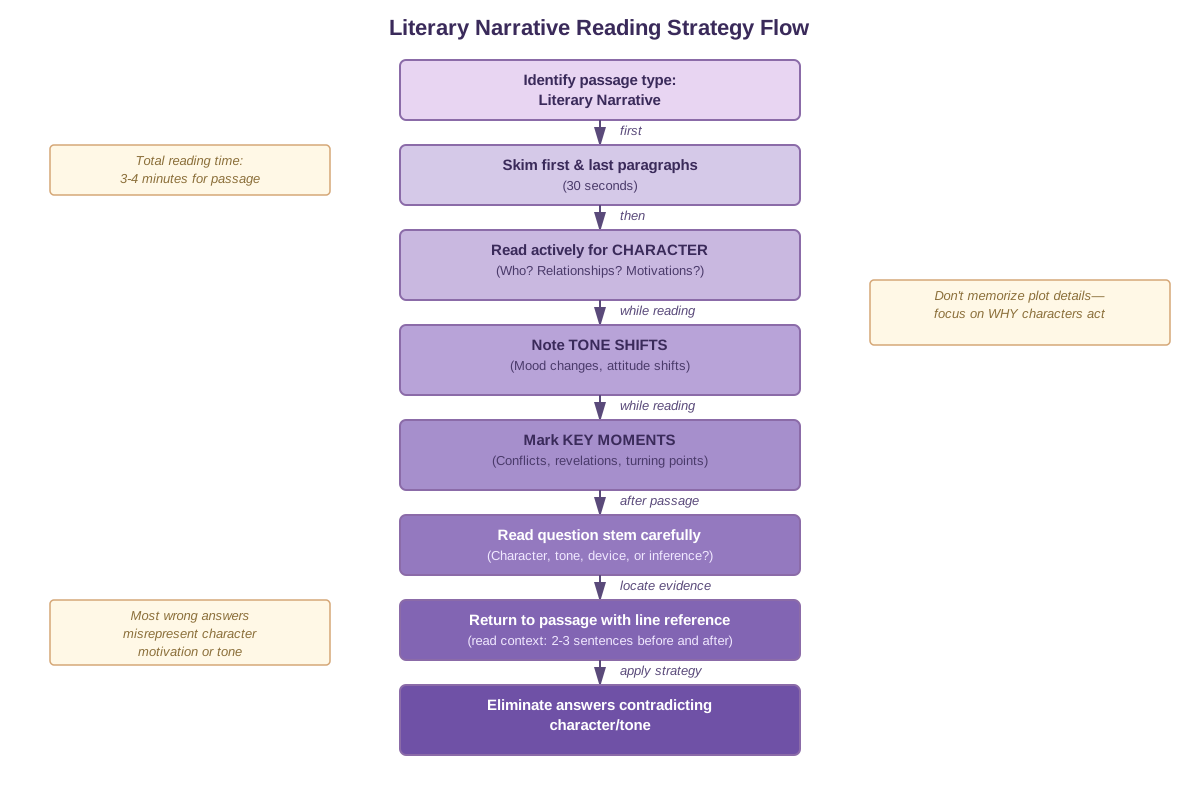
Spend approximately 3-4 minutes on the initial reading of literary narrative passages, focusing on the "big picture": Who are the main characters? What is happening? What is the central conflict or situation? What is the emotional tone? Resist the urge to memorize details or analyze every sentence during this first pass. Instead, build a mental framework that allows efficient return to specific sections when answering questions.
Pay special attention to the opening paragraph (which establishes situation, characters, and tone), any dialogue (which reveals character relationships and conflicts), and the final paragraph (which often contains resolution, reflection, or thematic insight). Mark or mentally note shifts in time, location, or emotional tone, as these transitions frequently generate questions.
Trigger Words and Question Types
Certain words in questions signal specific approaches:
- "Primarily," "mainly," "most nearly": Indicate that multiple answers may be partially correct; choose the most comprehensive or central answer
- "Suggests," "implies," "indicates": Require inference from textual evidence rather than explicit statements
- "According to the passage," "the passage states": Direct comprehension questions where the answer is explicitly stated
- "Most likely," "probably," "apparently": Inference questions requiring logical conclusions from evidence
- "In context," "as it is used in line X": Vocabulary questions requiring attention to surrounding sentences
When questions reference specific lines, always read 2-3 sentences before and after the referenced lines to understand full context. Line references are starting points, not complete answers.
Process of Elimination Strategies
For literary narrative questions, eliminate answers that:
- Contradict passage information: Even if an answer seems plausible, it's wrong if it conflicts with stated facts
- Introduce information not in the passage: Correct answers must be supported by textual evidence, not outside knowledge or assumptions
- Reflect the wrong character's perspective: If a question asks about Character A's feelings, eliminate answers describing Character B's perspective
- Are too extreme: Words like "always," "never," "completely," or "only" often signal wrong answers, as literary passages typically present nuanced situations
- Answer a different question: Verify that remaining answers actually address what the question asks, not just related topics
Time Management
Allocate approximately 8-9 minutes per passage (including questions). If a question proves difficult, mark it and return after completing easier questions. Since questions generally follow passage order, skipping a difficult question doesn't prevent answering subsequent ones.
For literary narratives specifically, character motivation and emotion questions typically take longer than detail questions, so budget time accordingly. If running short on time, prioritize detail questions (which can be answered quickly by locating information) over complex inference questions.
Memory Techniques
CHARACTERS mnemonic for analyzing character in literary narratives:
- Conflicts they face
- How they speak (dialogue)
- Actions they take
- Reactions to events
- Attitude and emotions
- Changes they undergo
- Thoughts revealed
- Evidence from narrator
- Relationships with others
- Symbolic associations
TONE SHIFT for tracking emotional changes:
- Time markers (then, now, suddenly)
- Opposing words (but, however, yet)
- New information revealed
- Emotional vocabulary changes
Sentence structure shifts (long to short, or vice versa)
- However/although/despite signals
- Imagery changes (dark to light, closed to open)
- Focus shifts (external to internal)
- Transition words
Visualization Strategy: When reading literary narratives, create a mental "movie" of the scene. Visualize characters' facial expressions, body language, and spatial relationships. This engages memory more effectively than processing words alone and helps answer questions about character emotions and relationships.
The "Why Does This Matter?" Technique: After each paragraph, briefly ask: "Why did the author include this? What does it reveal about character or theme?" This active reading approach builds comprehension and prepares students for author's craft questions.
Summary
Literary narrative passages on the ACT test students' ability to analyze character, understand narrative perspective, interpret tone and theme, and recognize how authors use literary devices to create meaning. These passages, which always appear first in the Reading section, account for 25% of reading questions and emphasize character motivation and emotional states more than any other passage type. Success requires balancing initial comprehension reading with strategic return to the text when answering questions, using textual evidence to support all answers, and recognizing that correct answers must both contain accurate information and directly address what each question asks. Students must distinguish between what narrators or characters believe and what passages actually suggest, understand how narrative perspective limits information access, and synthesize evidence from multiple parts of passages to answer inference questions. The most effective approach combines attention to character development, recognition of tone and mood through word choice and imagery, understanding of how literary devices create layers of meaning, and awareness of common question patterns that test these elements. Mastering literary narratives requires practice with the specific reading strategies and question types that distinguish fiction analysis from informational text comprehension.
Key Takeaways
- Literary narrative passages always appear first in the ACT Reading section and focus on character, theme, and author's craft rather than factual information
- Character motivation and emotion questions comprise 30-40% of literary narrative questions and require synthesizing evidence from actions, dialogue, thoughts, and narrator descriptions
- Every correct answer must be supported by specific textual evidence; personal opinions or outside knowledge should never influence answer choices
- Narrative perspective determines what information readers access and often creates dramatic irony where readers understand more than narrators or characters
- Questions using "primarily," "mainly," or "most likely" require choosing the best answer among multiple partially correct options
- Effective time management involves spending 3-4 minutes on initial reading to grasp the big picture, then returning strategically to specific sections when answering questions
- Understanding how literary devices (imagery, metaphor, symbolism) function to reveal character psychology and theme is essential for author's craft questions
Related Topics
Social Science Passages: After mastering literary narratives, students should develop strategies for social science passages, which require different reading approaches focused on argument structure, evidence evaluation, and factual comprehension rather than character analysis.
Humanities Passages: These passages about arts, culture, and philosophy share some characteristics with literary narratives (attention to tone, author's perspective) while introducing new challenges like historical context and critical analysis.
Paired Passages: Some ACT Reading sections include paired passages that require comparing perspectives, synthesizing information across texts, and recognizing relationships between passages—skills that build on single-passage mastery.
Inference Questions Across Passage Types: The inference skills developed through literary narrative analysis transfer to all passage types, making this topic foundational for overall ACT Reading success.
Vocabulary in Context: Literary narratives frequently test sophisticated vocabulary and figurative language, making vocabulary development a natural extension of literary passage work.
Practice CTA
Now that you've mastered the core concepts and strategies for ACT literary narrative passages, it's time to apply this knowledge through focused practice. Complete the practice questions for this topic, paying special attention to character motivation questions and author's craft questions, which represent the highest-yield question types. Use the flashcards to reinforce key concepts like narrative perspective, literary devices, and common question patterns. Remember: consistent practice with immediate feedback is the most effective way to transform knowledge into test-day performance. Each practice question you complete strengthens your pattern recognition and builds the confidence you need to excel on test day. You've built a strong foundation—now put it to work!
Sign up free to keep reading
Create a free AnvayaPrep account to finish this ACT guide on Literary narrative passages — plus flashcards and practice questions.