Overview
Reading for argument is one of the most critical skills tested on the ACT Reading section. Unlike passages that simply present information or tell a story, argumentative passages aim to persuade the reader of a particular viewpoint, position, or interpretation. These passages appear regularly in the Prose Fiction, Social Science, Humanities, and Natural Science sections, making the ability to identify, analyze, and evaluate arguments essential for achieving a competitive score.
The ACT frequently tests whether students can distinguish between an author's claims and the evidence used to support those claims, recognize rhetorical strategies employed to persuade readers, and evaluate the strength and logic of presented arguments. ACT reading for argument questions require students to move beyond simple comprehension and engage in critical analysis of how authors construct and defend their positions. This skill set is particularly important because approximately 25-30% of ACT Reading questions involve some element of argument analysis, whether identifying the author's main claim, recognizing supporting evidence, or understanding counterarguments.
Mastering reading for argument connects directly to other essential ACT Reading skills, including identifying main ideas, understanding author's purpose and tone, making inferences, and analyzing text structure. When students can effectively read for argument, they develop a framework for approaching all passage types more strategically, as even narrative and informational texts often contain implicit arguments or perspectives that influence how information is presented.
Learning Objectives
- [ ] Identify when Reading for argument is being tested in ACT passages and questions
- [ ] Explain the core rule or strategy behind Reading for argument
- [ ] Apply Reading for argument to ACT-style questions accurately
- [ ] Distinguish between claims, evidence, and reasoning within argumentative passages
- [ ] Recognize and analyze rhetorical strategies used to strengthen arguments
- [ ] Evaluate counterarguments and how authors address opposing viewpoints
- [ ] Identify logical fallacies and weaknesses in argumentative reasoning
Prerequisites
- Basic reading comprehension skills: Understanding literal meaning is foundational before analyzing argumentative structure
- Vocabulary knowledge: Recognizing transition words and rhetorical language helps identify argumentative elements
- Main idea identification: Arguments are built around central claims that function as sophisticated main ideas
- Understanding of text structure: Recognizing how paragraphs relate helps track argument development
- Author's purpose awareness: Arguments are a specific type of persuasive purpose
Why This Topic Matters
In real-world contexts, the ability to read critically for argument is essential for evaluating news articles, political speeches, scientific debates, legal documents, and academic research. Citizens who can identify claims, evaluate evidence, and recognize persuasive techniques make more informed decisions about complex issues. This skill extends beyond test-taking into college coursework, where students must analyze scholarly arguments across disciplines, and into professional environments where evaluating proposals and recommendations is routine.
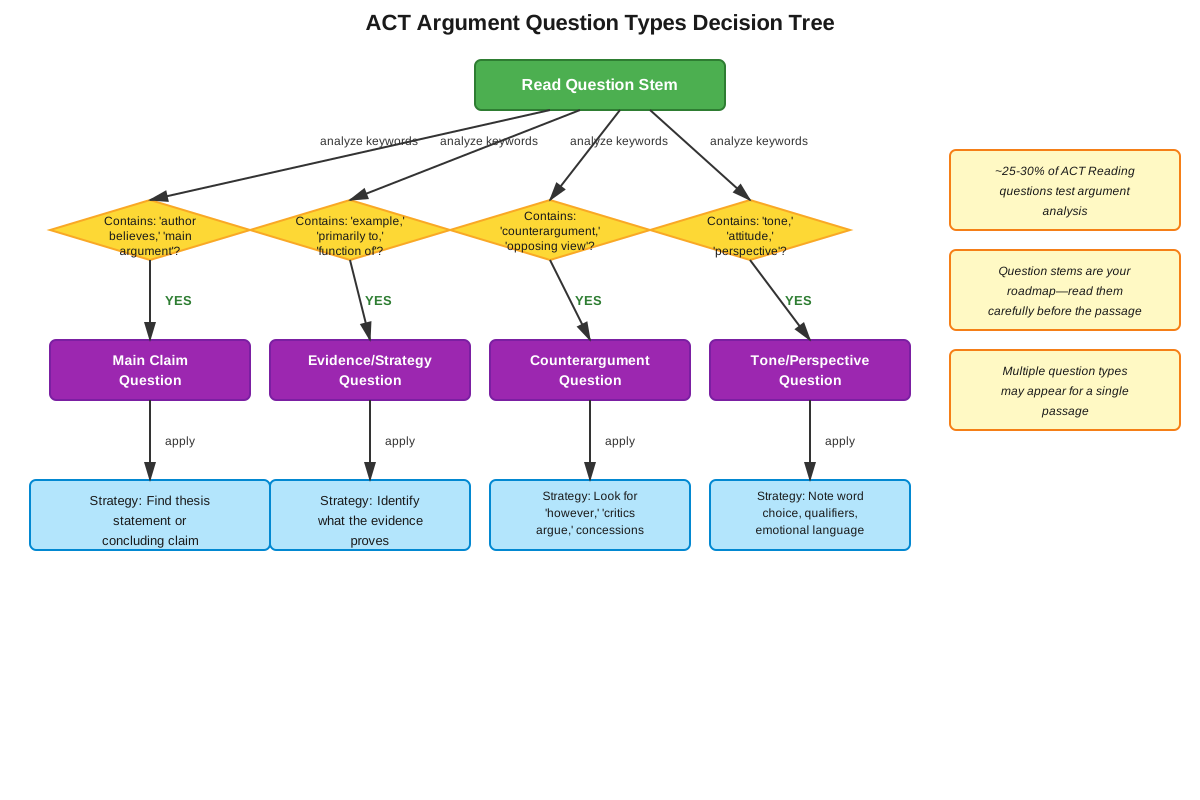
On the ACT specifically, argument-related questions appear in every test administration across all four passage types. Approximately 8-12 questions per test directly assess argument analysis skills, including questions about the author's main claim, supporting evidence, rhetorical strategies, tone that reveals argumentative stance, and how the author addresses alternative viewpoints. These questions often appear as "According to the passage, the author believes..." or "The author uses the example in lines X-Y primarily to..." or "Which statement best describes the author's perspective on..."
Argumentative elements appear most prominently in Social Science and Humanities passages, where authors frequently advocate for particular interpretations of historical events, social phenomena, or artistic movements. However, Natural Science passages also contain arguments when authors debate scientific theories or advocate for particular research approaches, and even Prose Fiction passages can present implicit arguments about human nature, social issues, or moral questions through narrative choices.
Core Concepts
What Constitutes an Argument
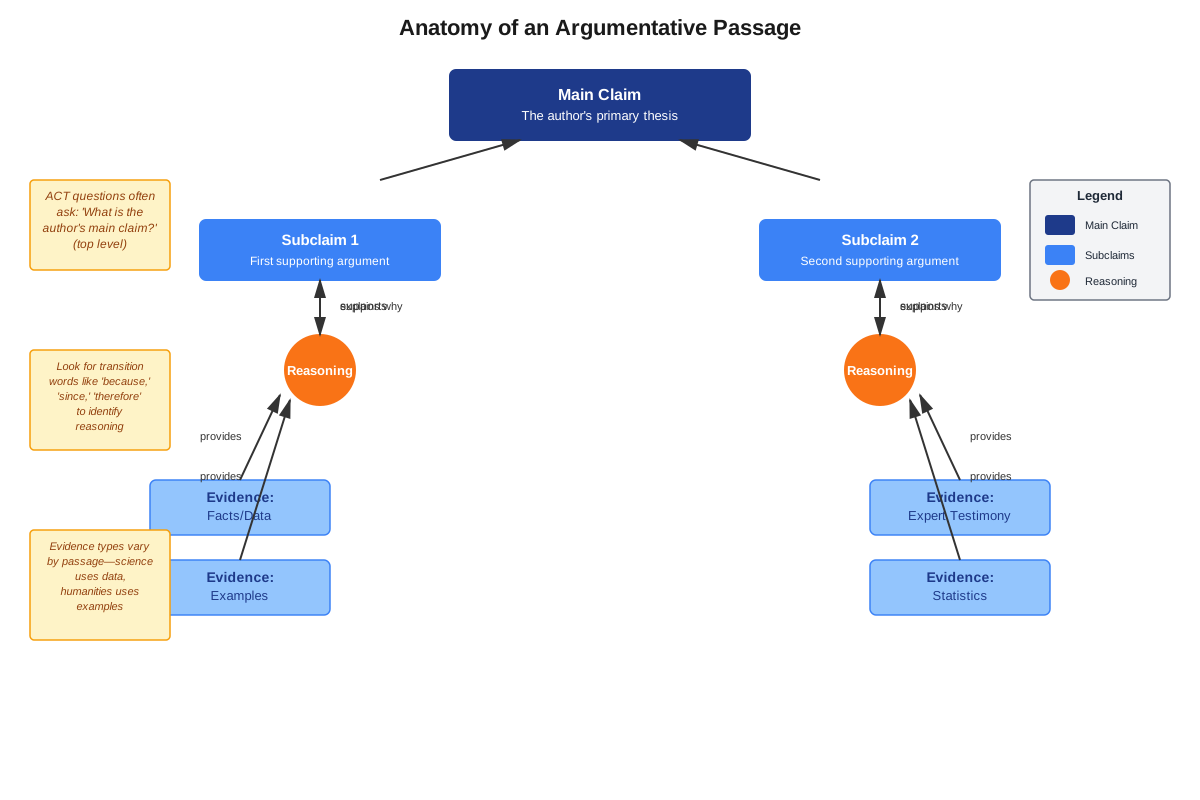
An argument in reading comprehension consists of three essential components: a claim (the position or assertion the author wants readers to accept), evidence (facts, examples, statistics, expert testimony, or logical reasoning that supports the claim), and reasoning (the logical connections explaining how the evidence supports the claim). On the ACT, recognizing these components is crucial because questions frequently ask students to identify which element is which.
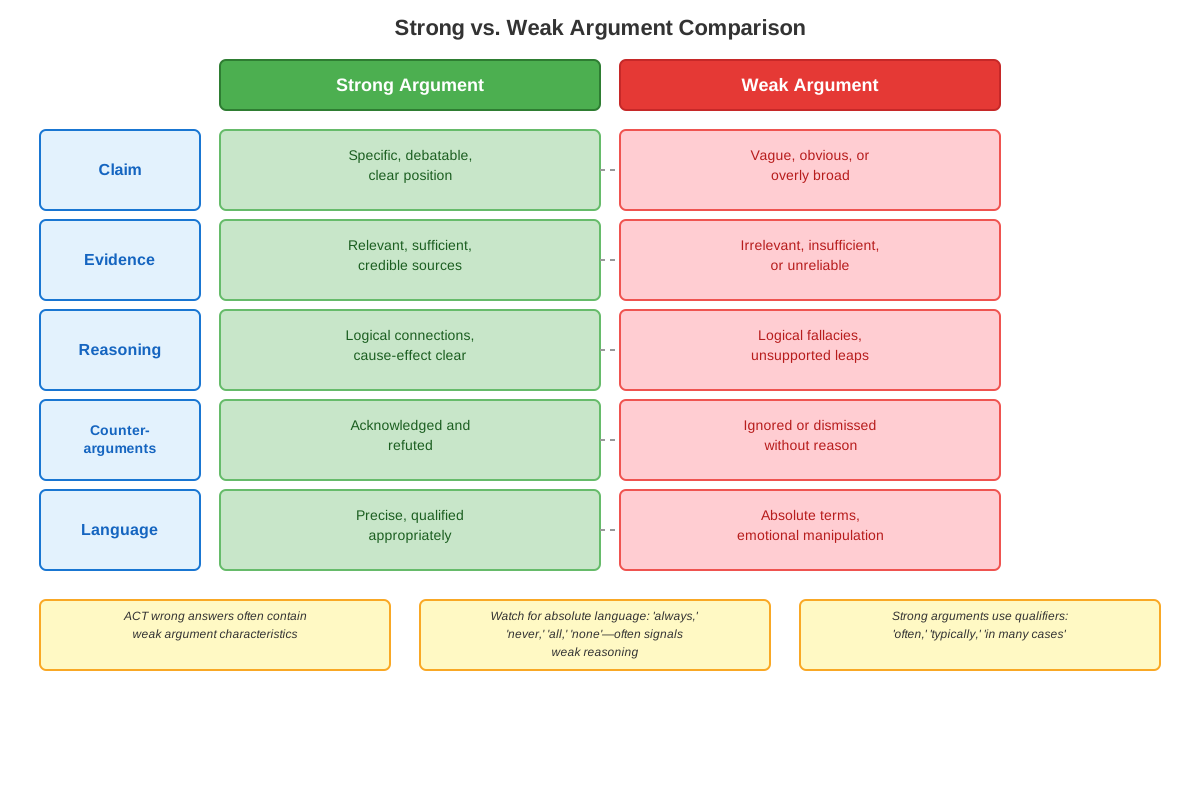
The claim represents the author's main position or thesis—what they want to convince readers to believe or accept. Claims can be explicit (directly stated) or implicit (suggested through the overall argument). Strong claims are debatable, meaning reasonable people could disagree, and specific enough to be supported with concrete evidence. Weak claims are either too obvious to need argument or too vague to be meaningfully supported.
Evidence provides the support structure for claims. The ACT tests various evidence types: empirical data (statistics, research findings), expert testimony (quotes from authorities), historical examples (past events that illustrate a point), analogies (comparisons to similar situations), and logical reasoning (deductive or inductive logic). Understanding evidence types helps students answer questions about how authors support their arguments.
Reasoning connects evidence to claims by explaining the logical relationship. This is often the most subtle component because authors sometimes assume readers will make connections without explicit explanation. ACT questions frequently test whether students understand these implicit logical connections.
Identifying Argumentative Passages
Not all ACT passages are primarily argumentative, so recognizing when reading for argument is necessary begins with identifying passage characteristics. Argumentative passages typically include opinion language (words like "should," "must," "unfortunately," "clearly"), evaluative statements (judgments about whether something is good, bad, effective, or problematic), and persuasive structure (building toward a conclusion the author wants readers to accept).
Key textual markers signal argumentative content:
| Marker Type | Examples | Function |
|---|---|---|
| Opinion indicators | "I believe," "arguably," "clearly," "unfortunately" | Signal subjective claims |
| Contrast words | "however," "despite," "although," "while" | Introduce counterarguments or complications |
| Emphasis words | "importantly," "significantly," "crucially" | Highlight key evidence |
| Causal language | "therefore," "thus," "consequently," "because" | Show reasoning connections |
| Qualifying language | "may," "might," "could," "possibly" | Indicate nuanced claims |
Analyzing Argument Structure
ACT passages organize arguments in recognizable patterns. The classical structure presents the main claim early, follows with supporting evidence in body paragraphs, addresses counterarguments, and concludes by reinforcing the main position. The inductive structure presents evidence and examples first, building toward the main claim at the end. The comparative structure evaluates multiple positions before advocating for one.
Understanding structure helps students predict where to find answers. Questions about the main argument typically direct students to introductory or concluding paragraphs, while questions about specific evidence point to body paragraphs. Questions about counterarguments often reference middle sections where authors acknowledge opposing views before refuting them.
Rhetorical Strategies and Techniques
Authors employ specific rhetorical strategies to make arguments more persuasive. The ACT frequently tests recognition of these techniques:
Appeals to ethos establish the author's credibility through expertise, experience, or moral character. Authors might reference their credentials, demonstrate knowledge of opposing views, or use measured, reasonable tone to appear trustworthy.
Appeals to pathos engage readers' emotions through vivid examples, emotionally charged language, or narratives that create sympathy or outrage. While emotional appeals can be legitimate, the ACT sometimes tests whether students recognize when emotion substitutes for logical reasoning.
Appeals to logos use logic, evidence, and reasoning. These include deductive reasoning (applying general principles to specific cases), inductive reasoning (drawing general conclusions from specific examples), and analogical reasoning (arguing that similar situations should be treated similarly).
Concession and refutation strengthen arguments by acknowledging opposing viewpoints (concession) before explaining why they're inadequate (refutation). This technique demonstrates the author's awareness of complexity and makes the argument appear more balanced and credible.
Evaluating Argument Quality
The ACT occasionally asks students to evaluate argument strength, requiring recognition of what makes arguments effective or flawed. Strong arguments feature relevant, sufficient, and credible evidence; logical reasoning without gaps; acknowledgment of counterarguments; and appropriate qualifications that avoid overgeneralization.
Common argument weaknesses include insufficient evidence (making broad claims based on limited examples), irrelevant evidence (providing support that doesn't actually relate to the claim), logical fallacies (reasoning errors like false cause, slippery slope, or ad hominem attacks), and overgeneralization (claiming something is always true based on limited cases).
Question Types for Argument Analysis
ACT argument questions appear in several predictable formats:
- Main claim identification: "The author's primary argument is that..."
- Evidence function: "The author mentions X in order to..."
- Rhetorical strategy: "The author's use of the example in paragraph 3 primarily serves to..."
- Author's perspective: "Based on the passage, the author would most likely agree that..."
- Counterargument recognition: "The author addresses the opposing view that..."
- Tone and stance: "The author's attitude toward X can best be described as..."
Concept Relationships
The components of argument analysis build upon each other hierarchically. Claim identification forms the foundation—students must first recognize what the author is arguing before analyzing how they argue it. Once the main claim is clear, evidence recognition becomes possible, as students can identify which passage elements support the central position. Reasoning analysis then connects claims and evidence by examining the logical relationships between them.
These core skills enable more sophisticated analysis: rhetorical strategy recognition requires understanding how evidence functions within the argument structure, while counterargument analysis demands recognizing how authors position their claims against alternatives. Finally, argument evaluation synthesizes all previous skills to assess overall effectiveness.
This topic connects to prerequisite skills through expansion: main idea identification extends into claim identification when the main idea represents a debatable position; author's purpose becomes more specific when the purpose is persuasion; text structure analysis deepens when structure serves argumentative strategy.
The relationship map flows: Basic Comprehension → Main Idea/Author's Purpose → Claim Identification → Evidence Recognition → Reasoning Analysis → Rhetorical Strategy Recognition → Counterargument Analysis → Argument Evaluation
High-Yield Facts
⭐ The author's main claim often appears in the introduction or conclusion, but can be implicit throughout the passage
⭐ Evidence functions to support claims—ACT questions frequently ask WHY the author includes specific examples or data
⭐ Transition words like "however," "although," and "despite" often signal counterarguments or complications to the main claim
⭐ When authors acknowledge opposing viewpoints before refuting them, this strengthens rather than weakens their argument
⭐ Rhetorical questions in argumentative passages typically emphasize points the author wants readers to accept
- Authors use qualifying language ("may," "might," "often") to make claims more defensible and nuanced
- Analogies and comparisons serve as evidence by suggesting similar situations should be treated similarly
- Emotional language and vivid examples appeal to pathos but don't necessarily indicate weak arguments
- The strongest arguments address potential objections rather than ignoring them
- Causal language ("therefore," "thus," "because") reveals the reasoning that connects evidence to claims
- Expert testimony and statistical data typically represent appeals to logos
- An author's tone (enthusiastic, critical, measured, skeptical) reveals their stance on the argument
- Questions asking what the author "would most likely agree with" test understanding of the overall argumentative position
- Evidence can be factual (objective data) or anecdotal (specific examples), and both types appear on the ACT
- The purpose of most argumentative passages is to persuade, convince, or advocate rather than simply inform
Quick check — test yourself on Reading for argument so far.
Try Flashcards →Common Misconceptions
Misconception: All ACT passages contain explicit arguments that are clearly stated.
Correction: Many passages contain implicit arguments where the author's position must be inferred from tone, evidence selection, and overall emphasis rather than direct statements. Students must recognize argumentative stance even when authors don't explicitly say "I argue that..."
Misconception: Acknowledging counterarguments weakens the author's position.
Correction: Addressing opposing viewpoints actually strengthens arguments by demonstrating the author's awareness of complexity and providing opportunities to explain why alternatives are inadequate. ACT questions often test whether students recognize this rhetorical strategy.
Misconception: Emotional language or vivid examples indicate a weak, illogical argument.
Correction: Appeals to pathos are legitimate rhetorical strategies when combined with logical reasoning and evidence. The ACT tests whether students can recognize different types of appeals, not whether they can dismiss emotional content as invalid.
Misconception: The main claim is always the first sentence of the passage.
Correction: While claims often appear in introductions, they can be positioned anywhere, including the conclusion. Some passages build inductively toward a claim stated at the end, while others weave the main argument throughout without a single explicit thesis statement.
Misconception: All evidence mentioned in a passage supports the main claim.
Correction: Authors sometimes present evidence for counterarguments before refuting them, or include background information that contextualizes rather than directly supports the claim. Students must distinguish between evidence that supports the author's position and evidence presented for other purposes.
Misconception: Longer passages with more examples always present stronger arguments.
Correction: Argument strength depends on evidence quality, logical reasoning, and relevance—not quantity. A passage with numerous weak or irrelevant examples presents a weaker argument than one with fewer but more compelling pieces of evidence.
Worked Examples
Example 1: Identifying Claims and Evidence
Passage Excerpt:
"The widespread adoption of electric vehicles (EVs) represents our best opportunity to reduce transportation-related carbon emissions. While critics point to the environmental costs of battery production, this concern overlooks the total lifecycle analysis. Studies from the Union of Concerned Scientists demonstrate that even when accounting for manufacturing emissions, EVs produce less than half the carbon emissions of comparable gasoline vehicles over their operational lifetime. Furthermore, as electrical grids incorporate more renewable energy sources, the environmental advantage of EVs will only increase. The transition to electric transportation is not merely beneficial—it is essential for meeting our climate goals."
Question: The author's main claim is that:
A) Battery production creates significant environmental problems
B) Electric vehicles are the most important solution for reducing transportation emissions
C) Renewable energy sources are becoming more common
D) Gasoline vehicles produce twice the emissions of electric vehicles
Solution Process:
Step 1: Identify opinion language and evaluative statements. The phrase "represents our best opportunity" signals a claim rather than neutral information. The word "essential" in the final sentence reinforces this argumentative stance.
Step 2: Distinguish the main claim from supporting evidence. The Union of Concerned Scientists study is evidence (factual support), not the claim itself. The statement about renewable energy increasing EV advantages is a supporting point, not the main argument.
Step 3: Recognize how the author addresses counterarguments. "While critics point to..." introduces an opposing view that the author then refutes, which is a strategy to strengthen the main claim rather than the claim itself.
Step 4: Evaluate answer choices against the identified claim. Choice A represents the counterargument, not the author's position. Choice C is supporting evidence. Choice D is a specific fact from the evidence. Choice B captures the main argumentative position—that EVs are the "best opportunity" (most important solution) for reducing emissions.
Answer: B
Connection to Learning Objectives: This example demonstrates identifying when argument is being tested (recognizing evaluative language and persuasive structure), explaining the strategy (distinguishing claims from evidence and counterarguments), and applying the skill to select the correct answer.
Example 2: Analyzing Rhetorical Strategy
Passage Excerpt:
"Consider the case of Maria Gonzalez, a single mother working two minimum-wage jobs who still cannot afford her family's healthcare costs. Her story is not unique—millions of Americans face similar impossible choices between medical care and basic necessities. This human reality, more than any economic statistic, reveals the urgent need for healthcare reform. When we debate policy details, we must remember that behind every percentage point and budget projection are real people whose lives hang in the balance."
Question: The author's primary purpose in describing Maria Gonzalez is to:
A) Provide statistical evidence for healthcare costs
B) Illustrate the human impact of inadequate healthcare access
C) Argue that single mothers face unique healthcare challenges
D) Demonstrate that minimum-wage jobs are insufficient
Solution Process:
Step 1: Identify the rhetorical strategy being employed. The author uses a specific, emotionally resonant example (Maria Gonzalez) rather than abstract data. This is an appeal to pathos—engaging readers' emotions to strengthen the argument.
Step 2: Determine the function of this strategy within the overall argument. The author explicitly states the purpose: "This human reality, more than any economic statistic, reveals the urgent need for healthcare reform." The example serves to make the abstract problem concrete and emotionally compelling.
Step 3: Recognize the relationship between the example and the broader claim. Maria Gonzalez represents "millions of Americans," making her story evidence for a systemic problem rather than an isolated case.
Step 4: Evaluate answer choices for the function, not just the content. Choice A is incorrect because Maria's story is anecdotal, not statistical evidence. Choice C is too narrow—she's an example of a broader problem, not specifically about single mothers. Choice D focuses on minimum wage rather than healthcare. Choice B correctly identifies that the example illustrates human impact, which is the rhetorical function the author explicitly states.
Answer: B
Connection to Learning Objectives: This example shows how to recognize rhetorical strategies (appeals to pathos through specific examples), understand their function in strengthening arguments, and apply this understanding to questions about author's purpose and evidence function.
Exam Strategy
Approaching Argument Questions Systematically
When encountering an ACT passage, quickly assess whether it's primarily argumentative by scanning for opinion language, evaluative statements, and persuasive structure. If argumentative elements are present, read with specific attention to identifying the main claim, noting supporting evidence, and recognizing counterarguments.
Active reading strategies for argumentative passages include:
- Underline or mentally note the main claim when identified
- Mark transition words that signal counterarguments ("however," "although," "despite")
- Bracket examples and evidence, noting their function
- Circle words revealing the author's tone and stance
Trigger Words and Phrases
Questions testing argument analysis use predictable language:
Claim identification triggers: "The author's main argument," "The passage suggests that the author believes," "According to the author's perspective"
Evidence function triggers: "The author mentions X in order to," "The example in paragraph 3 primarily serves to," "The author uses the statistic to"
Rhetorical strategy triggers: "The author's use of," "The primary purpose of," "The author employs"
Counterargument triggers: "The author addresses the opposing view," "The author acknowledges," "Critics mentioned in the passage"
Process of Elimination Techniques
For main claim questions, eliminate choices that represent:
- Specific evidence rather than the overarching argument
- Counterarguments the author refutes rather than supports
- Background information rather than the author's position
- Details too narrow to be the main claim
For evidence function questions, eliminate choices that:
- Describe what the evidence says rather than why the author includes it
- Misrepresent the evidence's relationship to the main claim
- Focus on irrelevant aspects of the example
- Confuse evidence with the claim it supports
Time Allocation
Argumentative passages often require slightly more processing time than purely informational passages because students must track not just what is said but why and how it's argued. Allocate approximately:
- 3-4 minutes for initial reading with active annotation
- 5-6 minutes for answering questions
- 30-45 seconds per question, with more time for complex argument evaluation questions
If a question asks about argument structure or rhetorical strategy and the answer isn't immediately clear, return to the relevant passage section rather than guessing—these questions reward careful analysis of specific textual evidence.
Memory Techniques
C.E.R. Framework for Argument Components
Remember the three essential elements of any argument with C.E.R.:
- Claim: What the author wants you to believe
- Evidence: Facts, examples, data supporting the claim
- Reasoning: Logical connections between evidence and claim
R.A.C.E. for Counterargument Strategy
When authors address opposing views, they follow R.A.C.E.:
- Recognize: Acknowledge the opposing viewpoint exists
- Address: Explain what the opposition argues
- Counter: Provide reasoning or evidence against it
- Emphasize: Reinforce why the author's position is stronger
Three Appeals Visualization
Picture a triangle with three points representing rhetorical appeals:
- Top point (Ethos): Author's credibility—imagine a graduation cap or expert badge
- Left point (Pathos): Emotional appeal—imagine a heart
- Right point (Logos): Logical appeal—imagine a brain or mathematical equation
Transition Word Categories
Group transition words by function:
- Contrast (signals counterargument or complication): however, although, despite, while, yet
- Causation (shows reasoning): therefore, thus, consequently, because, since
- Emphasis (highlights key points): importantly, significantly, crucially, notably
- Addition (builds argument): furthermore, moreover, additionally, also
Summary
Reading for argument on the ACT requires students to move beyond basic comprehension to analyze how authors construct and defend positions. Every argument consists of three core components: claims (the positions authors want readers to accept), evidence (the support for those claims), and reasoning (the logical connections between evidence and claims). Successful students identify these components, recognize rhetorical strategies like appeals to ethos, pathos, and logos, and understand how authors strengthen arguments by acknowledging and refuting counterarguments. The ACT tests argument analysis through questions about main claims, evidence function, rhetorical strategies, author's perspective, and counterargument recognition. Mastering this skill requires active reading that tracks not just what passages say but why and how authors argue their positions, attention to transition words and opinion language that signal argumentative elements, and systematic approaches to question types that test different aspects of argument analysis.
Key Takeaways
- Arguments consist of claims (positions), evidence (support), and reasoning (logical connections)—identify all three components when reading argumentatively
- The main claim may be explicit or implicit and can appear anywhere in the passage, though introductions and conclusions are most common
- Evidence function questions ask WHY authors include examples, not just WHAT the examples say
- Acknowledging counterarguments before refuting them strengthens rather than weakens arguments
- Transition words like "however," "although," and "despite" signal counterarguments or complications
- Rhetorical strategies (ethos, pathos, logos) are legitimate persuasive techniques that the ACT tests for recognition, not evaluation
- Author's tone and word choice reveal argumentative stance even when claims aren't explicitly stated
Related Topics
Author's Purpose and Tone: Understanding why authors write and the attitudes they convey deepens argument analysis, as persuasive purpose and evaluative tone signal argumentative content.
Text Structure and Organization: Recognizing how passages are organized helps predict where claims, evidence, and counterarguments appear, making argument analysis more efficient.
Making Inferences: Many argumentative claims are implicit rather than explicit, requiring inference skills to identify the author's position from evidence and tone.
Comparative Reading: Some ACT passages present multiple perspectives on an issue, requiring students to track different arguments and evaluate their relationships.
Evidence Evaluation in Science Passages: Natural science passages often present competing theories or research interpretations, applying argument analysis skills to scientific contexts.
Practice CTA
Now that you understand the core concepts and strategies for reading for argument, it's time to apply these skills to authentic ACT-style passages and questions. The practice questions and flashcards will reinforce your ability to identify claims, analyze evidence, recognize rhetorical strategies, and answer argument-related questions accurately and efficiently. Remember: argument analysis is a skill that improves with deliberate practice. Each practice passage you analyze strengthens your ability to recognize argumentative patterns and respond to questions confidently. You've built the foundation—now put it into action!
Sign up free to keep reading
Create a free AnvayaPrep account to finish this ACT guide on Reading for argument — plus flashcards and practice questions.