Overview
Reading for experiment is a critical skill tested in the ACT Reading section, specifically within the Science Reasoning passages that occasionally appear. This skill involves analyzing experimental descriptions, understanding research methodologies, identifying variables, and interpreting results presented in prose format. Unlike the ACT Science section where data is primarily presented in graphs and tables, ACT reading for experiment requires students to extract scientific information from dense paragraphs, understand cause-and-effect relationships, and follow the logical progression of scientific inquiry through written descriptions.
Mastering this topic is essential for ACT success because experimental passages appear regularly in the Reading section, particularly in natural science passages. These passages test not only reading comprehension but also the ability to distinguish between hypotheses and conclusions, identify experimental controls, understand the purpose of specific procedures, and recognize how evidence supports or refutes claims. Students who struggle with reading for experiment often misidentify the independent and dependent variables, confuse the researcher's methodology with their findings, or fail to recognize which details are relevant to answering questions about experimental design.
This topic connects directly to broader Reading concepts including main idea identification, detail recognition, and inference-making. However, reading for experiment adds a layer of scientific literacy that requires understanding the structure of scientific writing, the logic of experimental design, and the relationship between procedures and outcomes. Strong performance on these passages demonstrates both reading proficiency and analytical thinking—skills that translate directly to college-level coursework across disciplines.
Learning Objectives
- [ ] Identify when reading for experiment is being tested in ACT passages
- [ ] Explain the core rule or strategy behind reading for experiment
- [ ] Apply reading for experiment to ACT-style questions accurately
- [ ] Distinguish between experimental procedures, observations, and conclusions in scientific passages
- [ ] Recognize the relationship between variables (independent, dependent, and controlled) in written experimental descriptions
- [ ] Evaluate how evidence from experiments supports or contradicts hypotheses presented in the passage
- [ ] Analyze the purpose and function of specific experimental steps described in prose format
Prerequisites
- Basic reading comprehension skills: Understanding main ideas, supporting details, and paragraph structure is foundational to extracting experimental information from dense scientific prose.
- Familiarity with ACT passage structure: Knowing how ACT passages are organized helps students navigate scientific writing more efficiently and locate key experimental details.
- Understanding of cause-and-effect relationships: Experiments are fundamentally about causation, so recognizing how one event leads to another is essential for interpreting experimental descriptions.
- Basic scientific vocabulary: Terms like hypothesis, variable, control, and conclusion appear frequently in experimental passages and must be understood in context.
Why This Topic Matters
Reading for experiment is not merely an academic exercise—it represents a fundamental literacy skill required in modern society. From evaluating medical research in news articles to understanding climate studies or assessing product testing claims, the ability to critically read experimental descriptions impacts informed decision-making in everyday life. This skill bridges the gap between scientific knowledge and public understanding, enabling students to become educated consumers of scientific information.
On the ACT, experimental passages appear in approximately 25-30% of Reading sections, typically as one of the four passages. These passages generate 8-10 questions that test various aspects of experimental comprehension. Question types include identifying the purpose of specific procedures, determining what results support particular conclusions, recognizing experimental controls, understanding the sequence of experimental steps, and inferring what additional experiments might reveal. The passages themselves often describe biological studies, psychological experiments, geological observations, or physical science investigations.
Common manifestations of this topic include passages describing animal behavior studies, ecological field research, laboratory experiments testing chemical reactions, archaeological excavations, astronomical observations, or medical trials. The ACT favors passages that present a clear experimental narrative with identifiable procedures, observations, and conclusions, making them accessible to students without specialized scientific knowledge while still testing sophisticated analytical reading skills.
Core Concepts
Structure of Experimental Passages
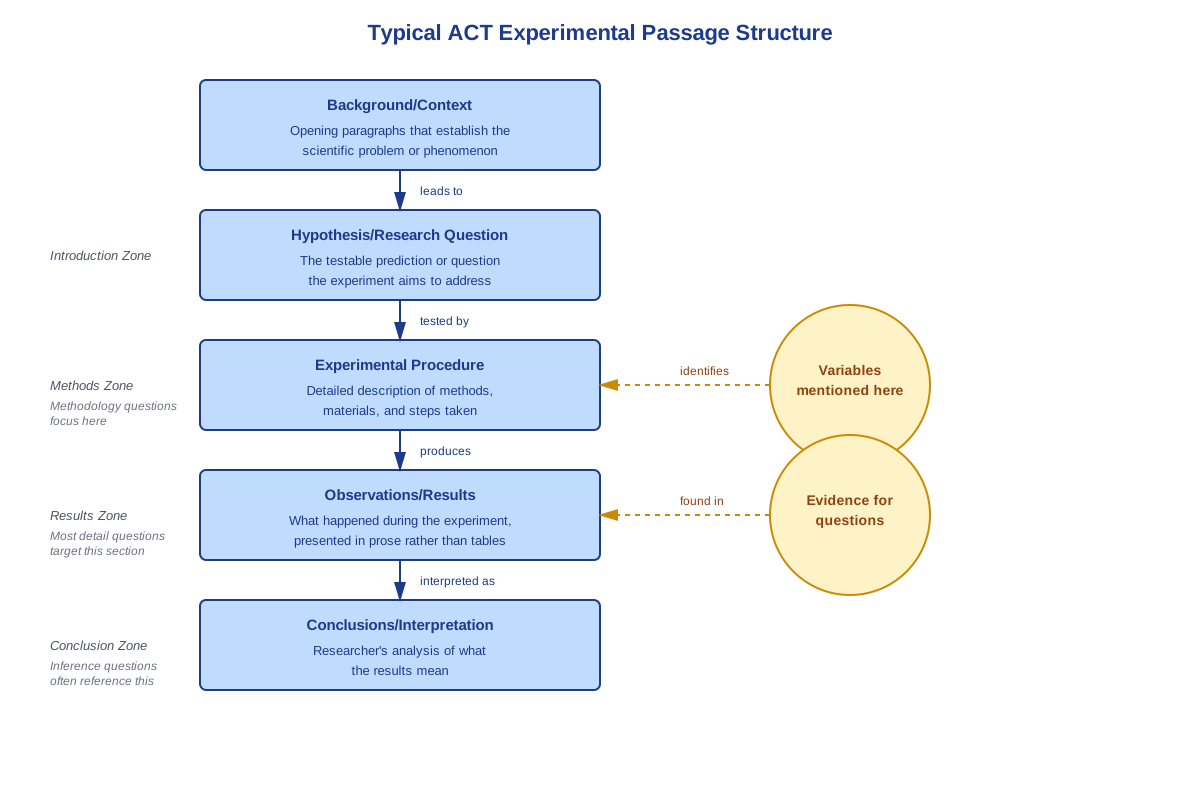
Experimental passages on the ACT follow a predictable organizational pattern that mirrors scientific writing conventions. The passage typically begins with background information establishing the context and significance of the research question. This introduction may present existing theories, describe gaps in current knowledge, or explain why the experiment matters. The middle sections detail the experimental procedure—the specific steps researchers took, including materials used, conditions maintained, and measurements recorded. Finally, the passage concludes with results and interpretation, presenting what the researchers observed and what those observations mean.
Understanding this structure allows students to navigate passages efficiently. When questions ask about methodology, students know to focus on the middle sections. When questions concern conclusions or implications, the final paragraphs contain the relevant information. This structural awareness transforms reading from a linear process into a strategic search for specific types of information.
Identifying Variables in Prose
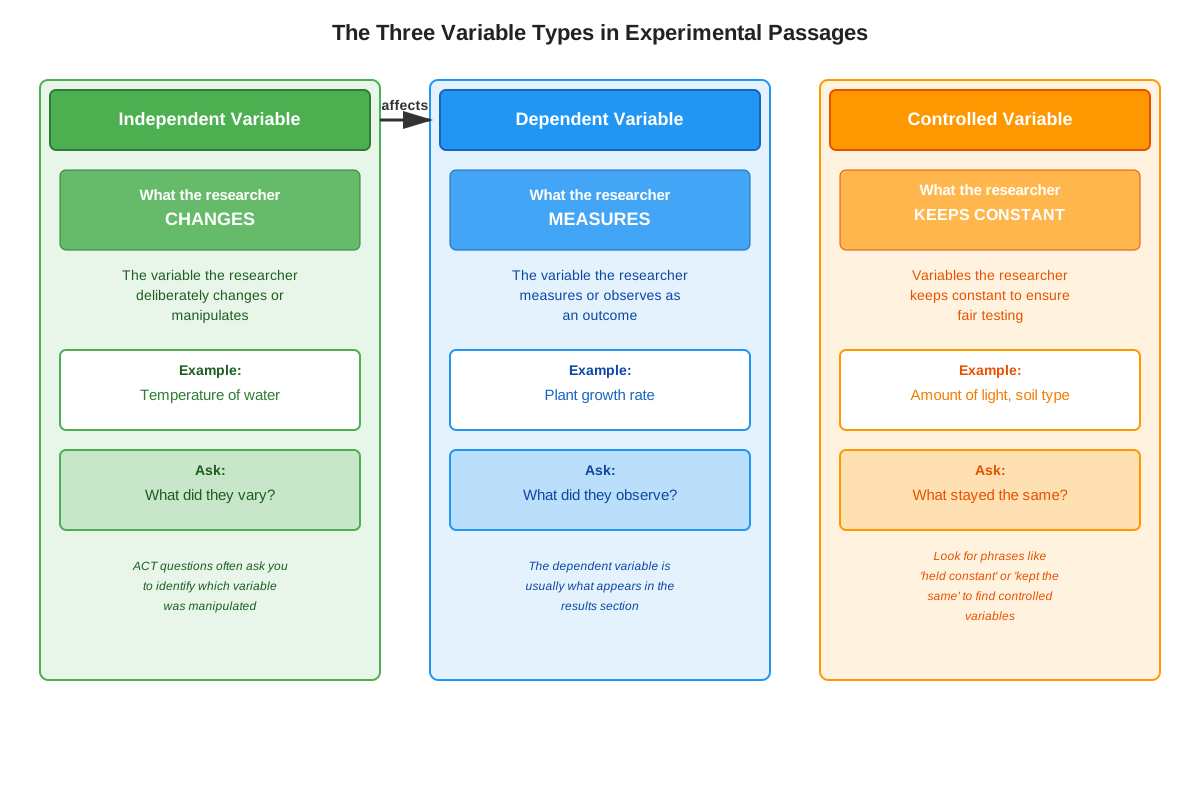
Unlike the ACT Science section where variables appear in labeled axes and column headers, reading for experiment requires extracting variable information from sentences. The independent variable is what researchers deliberately change or manipulate—it's the cause in the cause-and-effect relationship. The dependent variable is what researchers measure or observe—it's the effect. Controlled variables are factors kept constant to ensure that observed changes result from the independent variable alone.
In prose, these variables often appear in specific grammatical constructions. Independent variables frequently follow phrases like "researchers varied," "scientists manipulated," "the team adjusted," or "conditions were changed by." Dependent variables appear after phrases like "measured," "observed," "recorded," "noted changes in," or "monitored." For example, in the sentence "Scientists increased temperature in five-degree increments and measured the rate of enzyme activity," temperature is the independent variable (what was changed) and enzyme activity rate is the dependent variable (what was measured).
Experimental Controls and Their Purpose
Experimental controls serve as comparison baselines, allowing researchers to determine whether observed effects result from the independent variable or from other factors. A control group experiences identical conditions except for the independent variable. In reading passages, controls might be described as "untreated samples," "baseline measurements," "comparison groups," or "standard conditions."
Recognizing controls in prose requires attention to comparative language. Phrases like "compared to," "in contrast with," "while the control group," or "baseline measurements showed" signal the presence of controls. Understanding why controls exist—to isolate the effect of the independent variable—helps students answer questions about experimental validity and design quality.
Distinguishing Procedures from Results
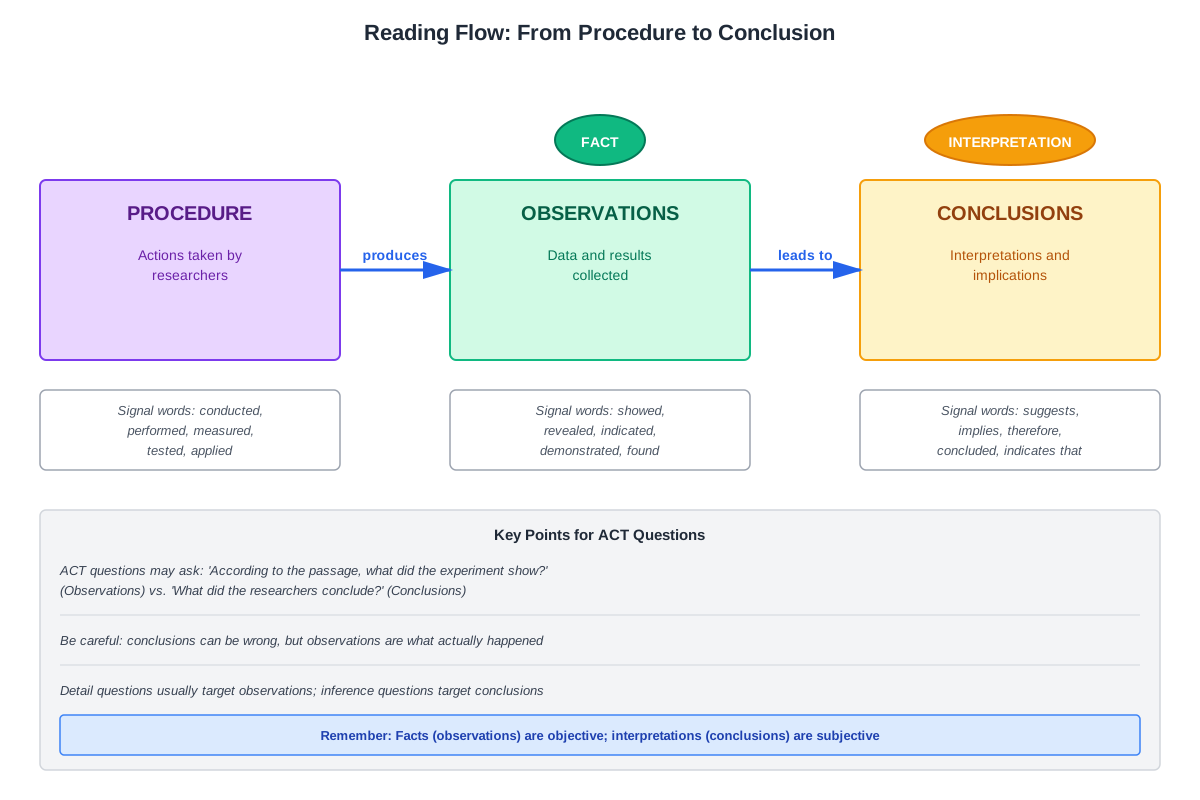
A common challenge in reading for experiment involves separating what researchers did (procedures) from what they found (results). Procedures describe actions: mixing, heating, observing, measuring, recording. Results describe outcomes: increased, decreased, remained constant, varied, correlated. The verb tense and type often provide clues—procedures typically use past tense action verbs ("researchers placed," "the team heated"), while results use past tense state-of-being or change verbs ("levels increased," "samples remained stable").
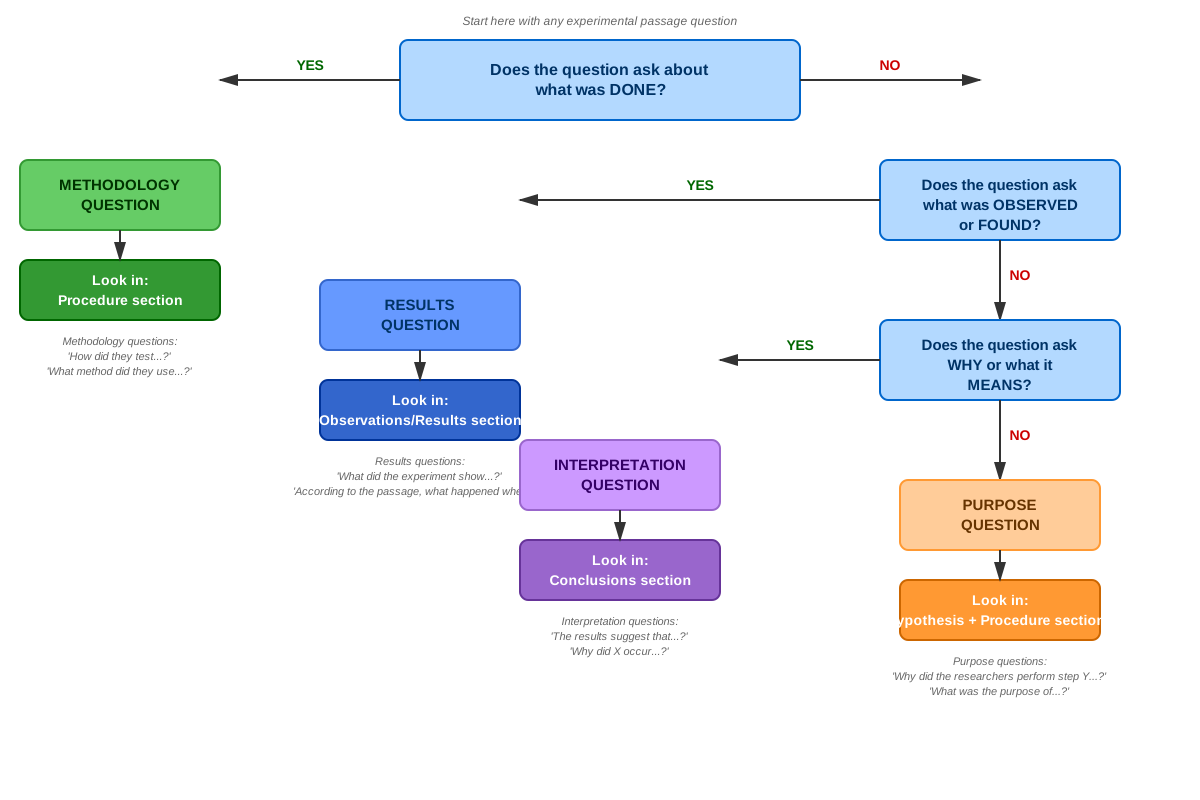
This distinction matters because ACT questions frequently ask students to identify which statement describes methodology versus which describes findings. Confusing these elements leads to incorrect answers on questions like "According to the passage, which of the following describes a step in the experimental procedure?" versus "Which of the following was a result of the experiment?"
Hypothesis-Evidence Relationships
Scientific passages present hypotheses—testable predictions or proposed explanations—and then describe experiments designed to test them. The relationship between hypothesis and evidence is central to reading for experiment. Evidence may support a hypothesis (observations match predictions), contradict it (observations differ from predictions), or be inconclusive (observations neither clearly support nor refute predictions).
In prose, hypotheses often appear in conditional language: "if...then" statements, "predicted that," "expected to find," "hypothesized that," or "proposed that." Evidence appears in declarative statements about observations: "results showed," "data indicated," "observations revealed," or "measurements demonstrated." Students must track which pieces of evidence relate to which hypotheses and determine the nature of that relationship.
Sequential Experimental Steps
Many experimental passages describe multi-step procedures where the order matters. Understanding sequence requires attention to temporal markers: "first," "next," "then," "subsequently," "after," "before," "finally." Some passages describe parallel experiments conducted simultaneously, requiring students to distinguish between different experimental conditions or groups.
Questions about sequence might ask "Which of the following occurred first in the experiment?" or "According to the passage, what did researchers do immediately after measuring initial temperatures?" Answering these questions requires mentally mapping the experimental timeline as described in the passage.
Purpose and Rationale
Strong experimental passages explain not just what researchers did but why they did it—the purpose behind specific procedures. Understanding purpose requires inferring the logical connection between methods and research goals. For example, if a passage states "To eliminate the possibility that light exposure affected results, researchers conducted trials in complete darkness," students must recognize that darkness served to control for light as a variable.
Purpose-related questions often begin with "Why did the researchers..." or "The main purpose of [specific procedure] was to..." Answering these requires understanding the logic of experimental design, not just recalling stated facts.
Concept Relationships
The concepts within reading for experiment form an interconnected system where understanding one element enhances comprehension of others. The structure of experimental passages provides the framework within which all other concepts operate—knowing where to find procedural details versus results enables efficient identification of variables and controls. Understanding variables is prerequisite to distinguishing procedures from results, since procedures describe manipulating independent variables while results describe changes in dependent variables.
The relationship between hypothesis and evidence depends on accurately identifying what constitutes evidence (results) versus what constitutes prediction (hypothesis), which in turn requires distinguishing procedures from results. Sequential experimental steps often reflect the logical progression from establishing controls, manipulating independent variables, measuring dependent variables, and drawing conclusions—a sequence that mirrors the passage structure.
Purpose and rationale serves as the unifying concept, explaining why researchers structured experiments as they did, why they included specific controls, why they measured particular variables, and why they drew specific conclusions from their results. This concept connects back to the passage structure, as understanding purpose helps students predict where to find specific information types.
These concepts also connect to prerequisite knowledge: cause-and-effect relationships underlie the independent-dependent variable distinction, basic reading comprehension enables extraction of procedural details from prose, and scientific vocabulary provides the language for discussing hypotheses, controls, and variables.
High-Yield Facts
- ⭐ Experimental passages always describe what researchers did (procedures), what they observed (results), and what those observations mean (conclusions)—questions test the ability to distinguish these three elements.
- ⭐ The independent variable is what researchers deliberately change; the dependent variable is what they measure in response; controlled variables are kept constant.
- ⭐ Controls provide comparison baselines—they experience identical conditions except for the independent variable being tested.
- ⭐ Hypotheses appear before experiments and make predictions; results appear after experiments and describe observations; conclusions interpret what results mean.
- ⭐ Temporal markers (first, next, then, after, before, finally) signal the sequence of experimental steps and are crucial for answering order-based questions.
- Questions asking "Why did researchers..." test understanding of experimental purpose and design rationale, not just factual recall.
- Phrases like "compared to," "in contrast with," and "baseline measurements" signal the presence of experimental controls.
- Verb types distinguish procedures (action verbs: heated, mixed, placed) from results (state/change verbs: increased, remained, varied).
- Evidence supports a hypothesis when observations match predictions; evidence contradicts a hypothesis when observations differ from predictions.
- Multiple experiments in one passage often test the same hypothesis under different conditions or test different aspects of a broader research question.
- Experimental passages may describe field studies (observations in natural settings) or laboratory experiments (controlled artificial settings)—both follow the same structural principles.
- Questions about experimental validity often focus on whether appropriate controls were used or whether variables were properly isolated.
Quick check — test yourself on Reading for experiment so far.
Try Flashcards →Common Misconceptions
Misconception: The hypothesis is the same as the conclusion. → Correction: A hypothesis is a prediction made before the experiment; a conclusion is an interpretation drawn after analyzing results. Hypotheses may be supported or contradicted by experimental evidence, leading to conclusions that either affirm or reject the original hypothesis.
Misconception: Any factor mentioned in the passage is a variable being tested. → Correction: Only factors that researchers deliberately manipulate are independent variables. Many factors mentioned are controlled variables (kept constant) or simply contextual details. The dependent variable is specifically what researchers measure, not every outcome mentioned.
Misconception: Results and conclusions are the same thing. → Correction: Results are objective observations and measurements (what happened), while conclusions are interpretations of what those results mean (why it matters or what it proves). Results might state "temperature increased by 15 degrees," while the conclusion interprets "this increase suggests the reaction is endothermic."
Misconception: The control group receives no treatment at all. → Correction: Control groups often receive standard or baseline treatment—they're not necessarily untreated. The key is that controls differ from experimental groups only in the specific variable being tested. In medical trials, controls might receive a placebo (a treatment), not nothing.
Misconception: Experimental passages require prior scientific knowledge to understand. → Correction: ACT experimental passages are designed to be comprehensible using only information provided in the passage. While scientific vocabulary helps, all necessary concepts are explained in context. Questions test reading comprehension and logical reasoning, not specialized scientific knowledge.
Misconception: The first experiment mentioned is always the most important. → Correction: Passages may describe preliminary experiments, pilot studies, or background research before presenting the main experiment. The most important experiment is typically the one that most directly addresses the passage's central research question, which may appear anywhere in the passage.
Worked Examples
Example 1: Identifying Variables and Controls
Passage Excerpt: "To investigate whether caffeine affects memory retention in adolescents, researchers recruited 60 high school students and divided them into two groups. The experimental group consumed 200mg of caffeine one hour before studying a list of 50 vocabulary words, while the control group consumed a caffeine-free beverage with identical taste and appearance. Both groups studied the word list for 30 minutes in quiet, well-lit rooms maintained at 72°F. Twenty-four hours later, all participants completed a recall test."
Question: According to the passage, which of the following was the independent variable in this experiment?
Step 1: Identify what researchers deliberately manipulated. The passage states one group "consumed 200mg of caffeine" while the other "consumed a caffeine-free beverage." Caffeine presence/absence is what researchers controlled and varied between groups.
Step 2: Confirm this is what was changed, not what was measured. The passage indicates researchers measured memory (through the recall test), but they manipulated caffeine consumption.
Step 3: Eliminate controlled variables. Room lighting, temperature (72°F), study duration (30 minutes), and word list (50 words) were kept constant—these are controlled variables, not the independent variable.
Answer: The independent variable was caffeine consumption (presence or absence of 200mg caffeine).
Connection to Learning Objectives: This example demonstrates identifying when reading for experiment is tested (recognizing an experimental description) and applying the core strategy (distinguishing independent variables from dependent and controlled variables in prose format).
Example 2: Distinguishing Procedures, Results, and Conclusions
Passage Excerpt: "Marine biologists hypothesized that increased ocean acidity would reduce coral calcification rates. They collected coral samples from three reef locations and placed them in tanks with varying pH levels: 8.2 (normal), 7.9 (moderately acidic), and 7.6 (highly acidic). After six weeks, researchers measured calcium carbonate deposition in each sample. Corals in pH 8.2 tanks showed normal calcification rates of 12mm per year. Those in pH 7.9 tanks exhibited reduced rates of 8mm per year, while corals in pH 7.6 tanks showed severely diminished rates of 4mm per year. These findings suggest that even moderate increases in ocean acidity significantly impair coral growth, potentially threatening reef ecosystems."
Question: Which of the following statements describes a result rather than a procedure or conclusion?
Step 1: Identify procedural statements (what researchers did). Procedures include: collecting samples, placing them in tanks, varying pH levels, measuring calcium carbonate deposition after six weeks.
Step 2: Identify result statements (what researchers observed/measured). Results include: specific calcification rates at each pH level (12mm, 8mm, 4mm per year).
Step 3: Identify conclusion statements (interpretations of what results mean). The conclusion is: "even moderate increases in ocean acidity significantly impair coral growth, potentially threatening reef ecosystems."
Step 4: Apply to answer choices. A result would state an observation without interpretation—the specific measurements at different pH levels.
Answer: "Corals in pH 7.9 tanks exhibited reduced rates of 8mm per year" is a result—it states an observation without explaining what it means or describing how it was obtained.
Connection to Learning Objectives: This example demonstrates applying reading for experiment to ACT-style questions by distinguishing between the three key elements of experimental passages and recognizing how each is presented in prose.
Exam Strategy
When approaching experimental passages on the ACT Reading section, employ a systematic strategy that maximizes efficiency and accuracy. First, identify the passage type immediately—experimental passages typically appear in the natural sciences slot and contain clear markers like "researchers," "experiment," "hypothesis," "measured," or "observed." Recognizing the passage type activates the appropriate reading framework.
Second, map the passage structure during your initial read. Mentally note where the passage transitions from background to procedures to results to conclusions. This structural map allows rapid navigation when answering questions. Consider making brief marginal notes: "bkgd" for background, "proc" for procedures, "res" for results, "conc" for conclusions.
Third, watch for trigger words and phrases that signal key experimental elements:
- Hypothesis indicators: "predicted," "hypothesized," "expected," "proposed," "if...then"
- Procedure indicators: "researchers conducted," "scientists measured," "the team placed," "samples were treated"
- Variable indicators: "varied," "manipulated," "changed," "adjusted" (independent); "measured," "recorded," "observed" (dependent)
- Control indicators: "compared to," "baseline," "control group," "standard conditions"
- Result indicators: "showed," "demonstrated," "revealed," "indicated," "data showed"
- Conclusion indicators: "suggests," "indicates," "implies," "therefore," "thus," "these findings"
Fourth, use process of elimination strategically. For questions about procedures, eliminate answers describing results or conclusions. For questions about results, eliminate answers describing methods or interpretations. For questions about variables, eliminate answers describing constants. This categorical elimination often narrows choices to one or two options.
Fifth, allocate time wisely. Experimental passages often contain dense procedural details that slow reading. Resist the urge to memorize every detail on the first read—instead, read for structure and return to specific details when questions demand them. Spend approximately 3-4 minutes on the initial read and 5-6 minutes answering questions, using the passage structure map to locate information quickly.
Sixth, recognize common question patterns:
- "According to the passage, which of the following was a step in the experimental procedure?" → Look in procedure sections; answer describes an action.
- "The results of the experiment indicate that..." → Look in results sections; answer states an observation.
- "The main purpose of [specific procedure] was to..." → Infer the logical reason for that step in the experimental design.
- "Which of the following, if true, would most weaken the researchers' conclusion?" → Identify the conclusion, then find what would contradict it.
Finally, verify answers by checking back to the passage. Experimental passages contain precise details, and answer choices often include subtle distortions. Confirm that your selected answer accurately reflects passage information without adding unsupported inferences.
Memory Techniques
HVRC Mnemonic for Experimental Passage Structure: Hypothesis → Variables → Results → Conclusions. This sequence reminds students that passages typically present predictions first, describe what was manipulated and measured, report observations, then interpret findings.
IDeaS for Variable Types: Independent (what researchers change), Dependent (what researchers measure), Standardized/controlled (what researchers keep constant). The capital letters emphasize that Independent and Dependent are the primary variables, while controlled variables provide the stable background.
Visualization Strategy: Picture an experiment as a story with three acts. Act 1 (Setup): Scientists have a question and make a prediction. Act 2 (Action): Scientists do something and watch what happens. Act 3 (Resolution): Scientists explain what it all means. This narrative framework helps students organize information and predict where to find specific details.
The "Change-Measure-Compare" Framework: In any experiment, researchers Change something (independent variable), Measure something (dependent variable), and Compare results to a baseline (control). This three-word framework captures the essence of experimental design and helps students identify key elements.
Purpose Prompt: When encountering any experimental procedure, mentally ask "Why would they do this?" This habit builds understanding of experimental rationale and prepares students for purpose-based questions.
Verb Type Distinction: Remember that action verbs (heated, mixed, placed, divided) describe procedures, while state/change verbs (increased, decreased, remained, varied) describe results. This grammatical distinction provides a quick sorting mechanism when distinguishing procedures from results.
Summary
Reading for experiment is a high-yield ACT Reading skill that requires students to extract and analyze experimental information from prose passages. Success depends on understanding the standard structure of experimental writing (background, procedures, results, conclusions), identifying variables and controls within sentences rather than graphs, distinguishing between what researchers did and what they found, and recognizing the relationship between hypotheses and evidence. The core strategy involves mapping passage structure during the initial read, using trigger words to identify key experimental elements, and applying categorical thinking to distinguish procedures from results from conclusions. Students must recognize that experimental passages test reading comprehension and logical reasoning rather than specialized scientific knowledge—all necessary information appears in the passage. Mastery requires practice identifying variables in prose format, understanding the purpose behind experimental procedures, and tracking the logical flow from research question through methodology to findings and interpretation.
Key Takeaways
- Experimental passages follow a predictable structure: background/hypothesis → procedures → results → conclusions; mapping this structure enables efficient navigation.
- The independent variable is what researchers change, the dependent variable is what they measure, and controlled variables are kept constant—identifying these in prose requires attention to specific verb phrases and grammatical constructions.
- Procedures describe actions researchers took; results describe observations they made; conclusions interpret what results mean—distinguishing these three elements is essential for answering most experimental passage questions.
- Controls provide comparison baselines and are identified through phrases like "compared to," "baseline," or "control group"—understanding their purpose helps answer questions about experimental validity.
- Trigger words signal key elements: "hypothesized/predicted" indicates hypotheses, "measured/observed" indicates data collection, "showed/demonstrated" indicates results, "suggests/indicates" signals conclusions.
- Questions about experimental purpose test understanding of why researchers used specific procedures, not just what they did—this requires inferring the logical connection between methods and research goals.
- All necessary information appears in the passage; experimental passages test reading comprehension and analytical reasoning, not prior scientific knowledge.
Related Topics
Interpreting Data Representations: While reading for experiment focuses on prose descriptions, interpreting data representations involves extracting information from graphs, tables, and charts. Mastering both skills provides comprehensive scientific literacy for the ACT Science section and science-related Reading passages.
Analyzing Arguments in Natural Science Passages: Beyond experimental descriptions, some natural science passages present scientific arguments or debates. Understanding how to read for experiment provides the foundation for analyzing how scientists use evidence to support claims.
Comparative Experiments and Studies: Advanced experimental passages may describe multiple related experiments or comparative studies. Mastering single-experiment passages enables progression to more complex multi-experiment scenarios.
Inference and Implication Questions: Reading for experiment builds the analytical skills needed for inference questions, as understanding experimental logic requires drawing conclusions from stated information.
Practice CTA
Now that you've mastered the core concepts of reading for experiment, it's time to apply these strategies to actual ACT-style passages and questions. The practice questions and flashcards will reinforce your ability to identify variables, distinguish procedures from results, and recognize experimental structures in prose format. Remember that reading for experiment is a skill that improves with deliberate practice—each passage you analyze strengthens your ability to navigate scientific writing efficiently and accurately. Approach the practice materials with confidence, knowing that you now have a systematic framework for tackling experimental passages. Your investment in mastering this high-yield topic will pay dividends not only on test day but throughout your academic career!
Sign up free to keep reading
Create a free AnvayaPrep account to finish this ACT guide on Reading for experiment — plus flashcards and practice questions.