Overview
Implication questions represent one of the most sophisticated and frequently tested question types on the ACT Reading section. These questions require students to go beyond the literal text and draw logical conclusions based on what the author suggests, hints at, or implies without stating directly. Unlike detail questions that ask about explicitly stated information, implication questions test the ability to read between the lines and understand the deeper meaning, tone, and unstated assumptions within a passage.
Mastering ACT implication questions is essential for achieving a competitive score because they typically comprise 20-30% of all Reading questions across the four passages. These questions assess critical thinking skills that colleges value: the ability to synthesize information, recognize cause-and-effect relationships, understand character motivations in literary passages, and grasp an author's underlying purpose or attitude. Students who struggle with implication questions often find themselves stuck in the mid-20s score range, while those who master them consistently score 30 and above.
Within the broader framework of ACT Reading skills, implication questions bridge the gap between basic comprehension and advanced analysis. They build upon foundational skills like identifying main ideas and locating details, while also connecting to higher-order tasks such as analyzing author's craft and evaluating arguments. Success with these questions requires both careful attention to textual evidence and the confidence to make reasonable inferences that extend slightly beyond what is explicitly written—a balance that defines skilled reading comprehension.
Learning Objectives
- [ ] Identify when Implication questions is being tested
- [ ] Explain the core rule or strategy behind Implication questions
- [ ] Apply Implication questions to ACT-style questions accurately
- [ ] Distinguish between valid inferences supported by textual evidence and unsupported assumptions
- [ ] Recognize the specific language patterns and question stems that signal implication questions
- [ ] Evaluate answer choices by determining which conclusions are most directly supported by passage details
- [ ] Synthesize multiple pieces of textual evidence to support a single implied conclusion
Prerequisites
- Main Idea Identification: Understanding the central point of a passage provides the foundation for recognizing what the author implies about that topic
- Detail Location Skills: Finding specific information quickly is essential because valid implications must be grounded in textual evidence
- Vocabulary in Context: Recognizing connotations and nuanced word meanings helps identify subtle implications in tone and attitude
- Basic Reading Comprehension: The ability to understand literal meaning is necessary before moving to implied meaning
- Passage Structure Awareness: Knowing how ideas connect helps predict what the author might be suggesting through organizational choices
Why This Topic Matters
Implication questions appear with remarkable consistency across all four ACT Reading passages—Prose Fiction/Literary Narrative, Social Science, Humanities, and Natural Science. On average, students encounter 8-12 implication questions per test, making them one of the three most common question types alongside main idea and detail questions. The ACT deliberately includes these questions to differentiate between students who merely decode words and those who truly comprehend complex texts.
In real-world contexts, the ability to understand implications is fundamental to academic success and professional communication. College-level reading requires students to grasp unstated assumptions in scholarly arguments, recognize bias in research, and understand the broader significance of findings. In professional settings, reading between the lines of emails, reports, and proposals is essential for effective decision-making. The ACT tests this skill because it predicts college readiness more accurately than simple recall questions.
These questions commonly appear in several forms throughout ACT passages. In literary narratives, they ask about character motivations, relationships, and emotional states that the author suggests through actions and dialogue rather than direct statements. In informational passages, they test understanding of cause-and-effect relationships, the significance of research findings, or an author's attitude toward a subject. Social science passages often include implication questions about historical consequences or societal impacts, while natural science passages may ask students to infer the next logical step in an experiment or the broader applications of a discovery.
Core Concepts
Defining Implication Questions
Implication questions ask students to identify conclusions that logically follow from the passage but are not explicitly stated. These questions test inferential reasoning—the ability to combine textual evidence with logical thinking to reach a supported conclusion. The key distinguishing feature is that the answer will never be directly quoted from the passage, yet it must be firmly grounded in specific textual details. The ACT carefully crafts these questions to have one clearly best answer that is more strongly supported than the others, even though multiple answers might seem plausible at first glance.
Question Stem Recognition
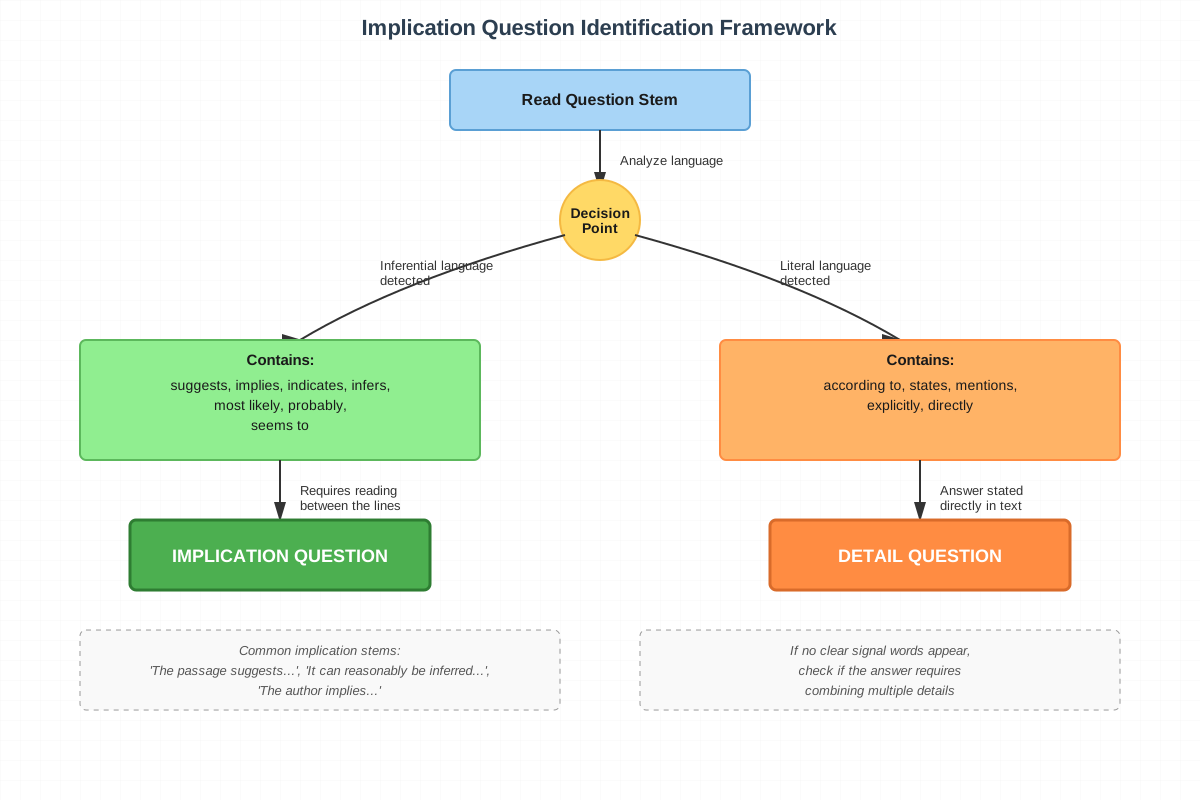
Recognizing implication questions quickly saves valuable time and activates the appropriate reading strategy. Common question stems include:
- "It can reasonably be inferred from the passage that..."
- "The passage suggests that..."
- "Based on the passage, it is most likely that..."
- "The author implies that..."
- "Which of the following statements is most strongly supported by the passage?"
- "The passage indicates that..."
- "It is reasonable to conclude from the passage that..."
The words "inferred," "suggests," "implies," "indicates," and "most likely" are trigger words that signal you need to go beyond literal comprehension. When you see these terms, immediately shift your approach from finding direct quotes to synthesizing evidence.
The Evidence-Based Inference Process
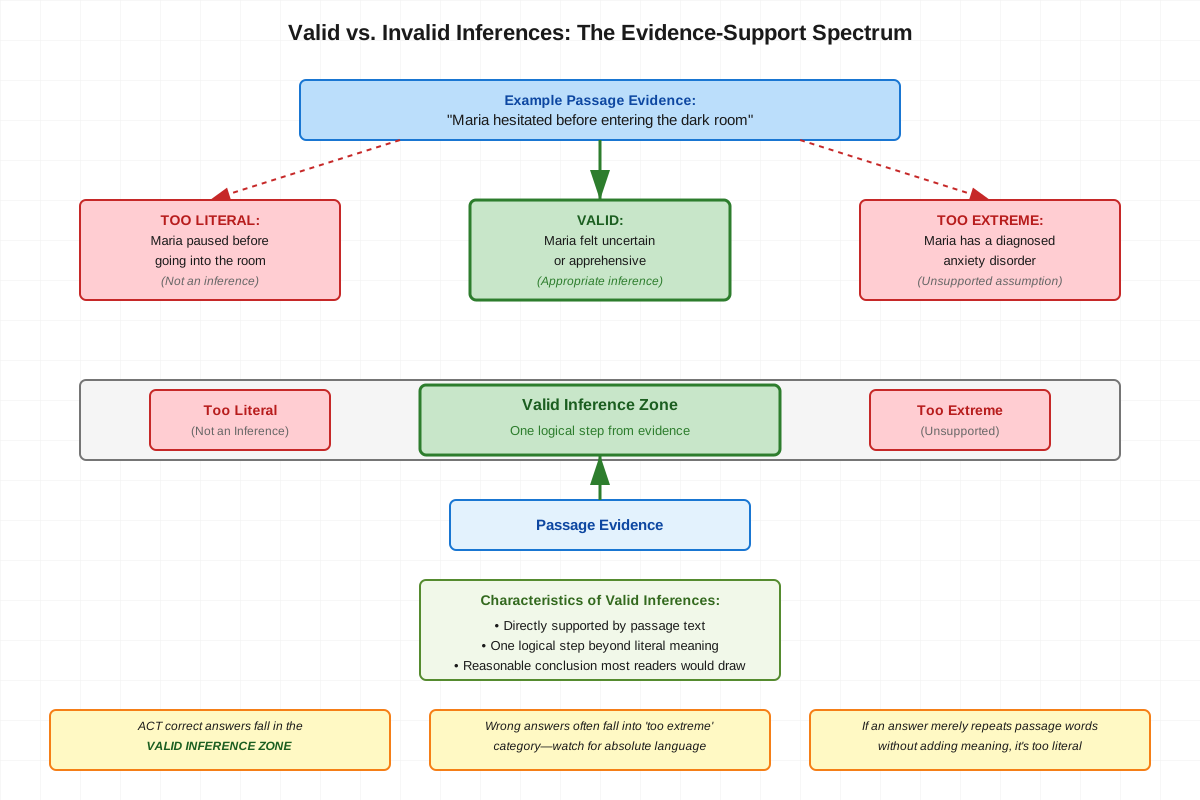
Valid inferences on the ACT follow a specific logical structure:
- Textual Evidence (what the passage explicitly states)
- Logical Connection (reasonable thinking that bridges the gap)
- Supported Conclusion (the implied information)
The crucial principle is that ACT implication questions require small logical steps, not giant leaps. The correct answer will feel like a natural, almost inevitable conclusion from the evidence. If you find yourself making multiple assumptions or complex chains of reasoning, you've likely gone too far.
Types of Implications Tested
| Implication Type | What It Tests | Example Question Focus |
|---|---|---|
| Causal Implications | Understanding unstated cause-and-effect relationships | "The passage suggests that the decline in population was caused by..." |
| Characterization | Inferring personality traits, motivations, or feelings from actions and dialogue | "It can be inferred that the protagonist feels..." |
| Author's Attitude | Determining the author's opinion or stance through word choice and tone | "The author's description of the theory suggests she views it as..." |
| Comparative Implications | Drawing conclusions about similarities or differences not directly stated | "The passage implies that Method A differs from Method B in that..." |
| Temporal/Sequential | Understanding what likely happened before or after the described events | "Based on the passage, it is most likely that before the experiment..." |
| Purpose/Function | Inferring why something was done or included | "The author mentions the statistic primarily to suggest..." |
The Scope Principle
One of the most important concepts for implication questions is scope—the range of what can be reasonably concluded. Correct answers on the ACT maintain appropriate scope: they don't overstate the evidence (too broad) or focus on irrelevant details (too narrow).
Too Broad: "The passage suggests that all scientists agree..." (when only one scientist's view was discussed)
Too Narrow: "The passage implies that the experiment occurred on Tuesday..." (when the specific day is irrelevant to the point)
Appropriate Scope: "The passage suggests that the scientist's findings challenged previous assumptions..." (directly supported by the discussion of how results differed from expectations)
Evidence Location Strategy
For implication questions, the supporting evidence typically appears in one of three locations:
- Concentrated in one paragraph or section: The question stem often provides line references or paragraph numbers
- Distributed across multiple related passages: Requires synthesizing information from different parts of the text
- Embedded in descriptive language or examples: The implication emerges from how something is described rather than from explicit statements
Effective test-takers develop the habit of mentally noting where different types of information appear during their initial passage reading, making evidence location faster during question-answering.
The "Must Be True" Standard
Unlike some inference questions on other tests, ACT implication questions use a "most reasonable" or "most strongly supported" standard rather than an absolute "must be true" standard. This means the correct answer should be the most logical conclusion given the evidence, even if alternative explanations might theoretically exist. The ACT designs wrong answers to be either unsupported by the passage, contradicted by the passage, or less strongly supported than the correct answer.
Concept Relationships
The skills required for implication questions build directly upon fundamental reading comprehension abilities. Detail location skills provide the foundation because every valid inference must be anchored in specific textual evidence. Students first learn to find explicitly stated information, then progress to understanding what that information suggests. Main idea comprehension connects to implication questions because understanding the author's overall purpose helps predict what they might be suggesting about specific details—implications typically align with and support the passage's central argument.
Within the Integration of Knowledge and Ideas skill category, implication questions relate closely to author's craft and purpose questions. Both require understanding not just what is said but why and how it's said. The difference is that craft questions focus on rhetorical techniques and structural choices, while implication questions focus on unstated conclusions. These skills reinforce each other: recognizing that an author uses emotional language (craft) helps infer their attitude toward the subject (implication).
The relationship flow works as follows: Literal Comprehension → enables → Detail Location → combines with → Contextual Understanding → produces → Valid Inferences → which support → Analysis of Author's Purpose. Mastering implication questions also prepares students for comparative reading tasks where they must infer relationships between two passages, and for synthesis questions that require combining multiple pieces of information to reach a conclusion.
High-Yield Facts
- ⭐ Implication questions account for approximately 20-30% of all ACT Reading questions, making them one of the three most common question types
- ⭐ The correct answer to an implication question is NEVER directly quoted from the passage but is ALWAYS supported by specific textual evidence
- ⭐ Question stems containing "inferred," "suggests," "implies," "indicates," or "most likely" signal implication questions
- ⭐ Valid ACT inferences require only small logical steps from the evidence—if reasoning becomes complex, the answer is likely wrong
- ⭐ Wrong answers to implication questions typically fall into four categories: too extreme, unsupported, contradicted by the passage, or outside the scope
- Every correct implication answer can be defended by pointing to specific lines or paragraphs in the passage
- Literary narrative passages tend to have more characterization and motivation implication questions than other passage types
- Science passages often include implication questions about experimental results, applications, or next logical steps
- The phrase "most strongly supported" indicates that multiple answers might seem possible, but one has significantly better textual backing
- Implication questions often appear in clusters—if one question asks about an implication in paragraph 3, another might test a related implication nearby
- Author's attitude implications can be identified through word choice: "merely," "unfortunately," "remarkable," and similar words reveal unstated opinions
- Causal implication questions frequently use "because," "resulted in," "led to," or "caused by" in the answer choices
- The ACT rarely tests implications that require specialized outside knowledge—all necessary information appears in the passage
- Comparative implications ("differs from," "similar to") require careful attention to what is stated about each element being compared
Quick check — test yourself on Implication questions so far.
Try Flashcards →Common Misconceptions
Misconception: Implication questions allow for personal interpretation and opinion about what the passage might mean.
Correction: ACT implication questions have objectively correct answers based on textual evidence. While the answer isn't explicitly stated, it must be the most logical conclusion supported by specific passage details. Personal opinions or creative interpretations that aren't grounded in the text are always incorrect.
Misconception: The correct answer to an implication question will use the same vocabulary and phrasing as the passage.
Correction: Correct answers to implication questions typically paraphrase or restate ideas using different words. If an answer choice quotes the passage directly, it's more likely answering a detail question. Implication answers express conclusions that follow from the evidence rather than repeating the evidence itself.
Misconception: If an answer choice could possibly be true based on real-world knowledge, it's a valid inference.
Correction: ACT implication questions test what can be concluded from the specific passage, not from general knowledge. An answer might be factually true in the real world but still be incorrect if the passage doesn't support that conclusion. Always return to textual evidence rather than relying on outside information.
Misconception: Implication questions are subjective and depend on how you interpret the passage.
Correction: While implication questions require interpretation, the ACT designs them to have one clearly best answer that is more strongly supported than the alternatives. The test-makers use careful wording and evidence placement to ensure that skilled readers will consistently select the same answer. If you're torn between two choices, one typically has stronger or more direct textual support.
Misconception: You should choose the answer that makes the biggest or most interesting claim.
Correction: Correct implications on the ACT tend to be modest, reasonable conclusions that stay close to the evidence. Extreme claims, dramatic statements, or sweeping generalizations are usually wrong answers designed to trap students who overcomplicate the inference. The most defensible, conservative conclusion is typically correct.
Misconception: If you can't find a specific line that proves an implication, the answer must be wrong.
Correction: Valid implications often emerge from synthesizing multiple pieces of evidence or from the overall tone and context rather than a single quotable line. However, you should still be able to point to relevant sections of the passage that collectively support the inference. The difference is that the support might be distributed rather than concentrated in one sentence.
Worked Examples
Example 1: Literary Narrative Implication
Passage Excerpt:
"Marcus glanced at the acceptance letter one more time before folding it carefully and placing it in his desk drawer, beneath a stack of old photographs. He hadn't mentioned it to his parents at dinner, even when his mother asked about the mail. Instead, he'd talked about his shift at the garage and his plans to work extra hours next month. Later that evening, he stood in the doorway of his younger sister's room, watching her struggle with algebra homework at the desk he'd built for her last summer."
Question: Based on the passage, it can most reasonably be inferred that Marcus:
A) is excited to share his college acceptance with his family
B) has decided not to attend the college that accepted him
C) feels conflicted about leaving his family to attend college
D) believes his parents would disapprove of his college choice
Analysis:
First, identify the question type: "most reasonably be inferred" signals an implication question. We need to draw a conclusion about Marcus's feelings or situation that isn't directly stated.
Evidence gathering:
- Marcus received an acceptance letter but hid it in a drawer
- He deliberately avoided mentioning it when his mother asked about mail
- He discussed working extra hours instead
- He watches his sister with apparent concern
- He built furniture for his sister, showing care for family
Evaluating each choice:
Choice A: "Excited to share" contradicts the evidence. If excited, he wouldn't hide the letter or avoid mentioning it. Eliminated.
Choice B: "Decided not to attend" goes too far. Nothing suggests he's made a final decision; he's just not sharing the news yet. This is an overstatement of what we can conclude. Eliminated.
Choice C: "Feels conflicted about leaving" is supported by multiple pieces of evidence. He's hiding the letter (suggesting ambivalence), discussing work plans (possibly thinking about financial support for family), and watching his sister with apparent concern (suggesting worry about leaving). The conflict between opportunity (college) and obligation (family) is implied by his behavior. Strong candidate.
Choice D: "Parents would disapprove" is unsupported. Nothing in the passage suggests parental disapproval. He's avoiding the topic, but the reason isn't stated or implied to be fear of disapproval. Eliminated.
Correct Answer: C
This example demonstrates how valid inferences synthesize multiple details to reach a conclusion about unstated feelings or motivations. The answer doesn't require speculation—it's the most logical explanation for the described behavior.
Example 2: Natural Science Implication
Passage Excerpt:
"The research team's initial hypothesis predicted that increased carbon dioxide levels would accelerate plant growth uniformly across all species tested. However, after six months of controlled experiments, the data revealed significant variation. While C3 plants showed the expected 20-30% growth increase, C4 plants demonstrated only marginal improvements of 5-8%. The researchers noted that C4 plants, which evolved in tropical environments with naturally higher CO2 concentrations, already possessed more efficient carbon-fixing mechanisms. The team subsequently revised their experimental design to examine whether other environmental factors, such as water availability and temperature, might interact with CO2 levels differently in the two plant types."
Question: The passage most strongly suggests that the researchers:
A) proved that C4 plants are superior to C3 plants in all environments
B) discovered that their initial hypothesis was too simplistic
C) determined that carbon dioxide has no effect on C4 plant growth
D) confirmed that all plants respond identically to environmental changes
Analysis:
Question type: "most strongly suggests" indicates an implication question about what the research findings mean.
Evidence gathering:
- Initial hypothesis predicted "uniform" acceleration across all species
- Results showed "significant variation" instead
- Researchers noted evolutionary differences between plant types
- Team "revised their experimental design" to examine interactions with other factors
Evaluating each choice:
Choice A: "Superior in all environments" is extreme and unsupported. The passage discusses different responses to CO2 but makes no superiority claims. Eliminated.
Choice B: "Too simplistic" is strongly supported. The initial hypothesis predicted uniform results, but the data showed variation. The fact that researchers revised their design to examine interactions with other factors implies they recognized their original hypothesis didn't account for important variables. This is a reasonable, modest inference. Strong candidate.
Choice C: "No effect" contradicts the passage, which states C4 plants showed "5-8%" improvement—small but not zero. Eliminated.
Choice D: "Identically" directly contradicts the passage's emphasis on "significant variation." Eliminated.
Correct Answer: B
This example shows how scientific passages often include implication questions about research significance or what findings suggest about scientific understanding. The correct answer requires recognizing that when researchers revise their approach after unexpected results, it implies their original thinking was incomplete.
Exam Strategy
Systematic Approach to Implication Questions
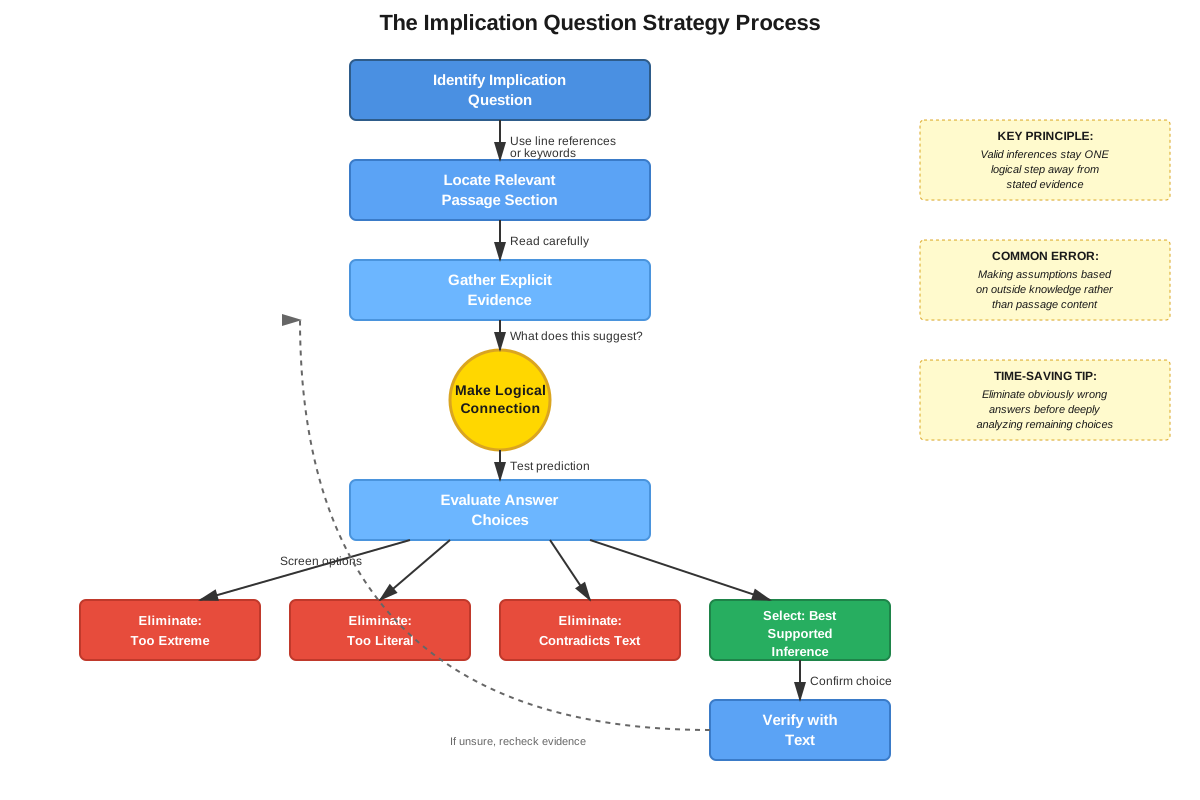
When you encounter an implication question, follow this proven four-step process:
- Identify the question type by spotting trigger words (inferred, suggests, implies, indicates)
- Locate the relevant passage section using line references or content clues in the question stem
- Gather specific evidence by reading 2-3 sentences before and after the referenced area
- Predict an answer in your own words before looking at choices
This prediction step is crucial—it prevents you from being swayed by attractive but incorrect answer choices.
Trigger Words and Phrases
Beyond the question stems themselves, watch for these words in answer choices that often signal correct implications:
- Qualifying language: "may," "likely," "suggests," "appears to," "seems to" (correct answers are often appropriately cautious)
- Causal connections: "because," "therefore," "as a result," "consequently"
- Comparative terms: "more than," "less than," "unlike," "in contrast to"
Conversely, these words often appear in wrong answers:
- Absolute terms: "always," "never," "all," "none," "must," "cannot" (too extreme)
- Unsupported extremes: "best," "worst," "only," "completely"
Process of Elimination Strategy
For implication questions specifically, eliminate answers that:
- Directly contradict passage information (easiest to eliminate)
- Require information not in the passage (outside knowledge or speculation)
- Make extreme or absolute claims (too broad)
- Focus on irrelevant details (too narrow or off-topic)
The remaining answer should be the one most directly supported by textual evidence, even if it requires a small logical step.
Time Allocation
Implication questions typically require 45-60 seconds each—slightly more than detail questions but less than complex analysis questions. If you find yourself spending more than 75 seconds on an implication question:
- You may be overthinking the inference
- Return to the passage and look for more direct evidence
- Eliminate extreme answers and choose the most conservative remaining option
Exam Tip: If stuck between two answers on an implication question, choose the one that requires fewer assumptions and stays closer to the explicit text. The ACT rewards careful, evidence-based thinking over creative interpretation.
Passage-Specific Strategies
Literary Narratives: Focus on character actions, dialogue, and descriptive language to infer emotions and motivations. Pay attention to what characters do versus what they say.
Social Science: Look for implications about causes, effects, and significance of historical or social phenomena. Author's attitude is frequently tested.
Humanities: Watch for implications about artistic or cultural significance, influences, and the author's evaluation of the subject.
Natural Science: Focus on implications about experimental results, applications, limitations, and next logical steps in research.
Memory Techniques
The CITE Method for Implication Questions
Connect the question to passage evidence
Identify what's stated versus what's implied
Test each answer against textual support
Eliminate answers that go too far
This acronym helps you remember the systematic approach that prevents both under-thinking (choosing answers without evidence) and over-thinking (making unsupported leaps).
The "One Small Step" Visualization
Picture implication questions as stepping stones across a stream. The passage is one bank, the correct answer is the other bank, and you need exactly one stepping stone (one logical step) to cross. If you need multiple stones (multiple assumptions), you've gone wrong. Visualize yourself taking that single, confident step from evidence to conclusion.
The Three-Zone Answer Framework
Mentally categorize answer choices into three zones:
- Red Zone: Contradicted by passage or completely unsupported (eliminate immediately)
- Yellow Zone: Possible but weakly supported or requiring too many assumptions (eliminate second)
- Green Zone: Directly supported by evidence with one small logical step (correct answer)
This color-coding system helps you quickly sort through options without getting overwhelmed.
Acronym for Wrong Answer Types: XTREME
Xtreme claims (too absolute)
Too broad or too narrow (scope problems)
Requires outside knowledge
Evidence contradicts it
Multiple assumptions needed
Explicitly stated (not an implication)
When evaluating answer choices, mentally check each against this list to identify why wrong answers are incorrect.
Summary
Implication questions test the ability to draw reasonable, evidence-based conclusions that extend slightly beyond what is explicitly stated in ACT Reading passages. These questions, which comprise 20-30% of the Reading section, require students to synthesize textual evidence and make small logical inferences about character motivations, causal relationships, author's attitudes, and the significance of information. Success depends on recognizing question stems that include words like "inferred," "suggests," or "implies," then locating specific passage evidence that supports one conclusion more strongly than others. The key principle is that correct answers require only one small logical step from the evidence—they are never directly quoted but are always firmly grounded in the text. Students must avoid both under-supported creative interpretations and answers that are too extreme, too broad, or require outside knowledge. By systematically gathering evidence, predicting answers before reviewing choices, and eliminating options that contradict the passage or make unsupported claims, test-takers can consistently identify the most reasonable inference and achieve higher scores on this high-yield question type.
Key Takeaways
- Implication questions ask for conclusions that logically follow from passage evidence but aren't explicitly stated—they require one small inferential step
- Recognize these questions through trigger words: "inferred," "suggests," "implies," "indicates," "most likely," and "most strongly supported"
- Correct answers are never directly quoted but are always supported by specific textual evidence you can point to and defend
- Wrong answers typically fall into predictable categories: too extreme, contradicted by the passage, unsupported by evidence, or requiring outside knowledge
- Use the four-step approach: identify question type, locate relevant passage section, gather evidence, predict answer before reviewing choices
- Appropriate scope is crucial—correct inferences stay close to the evidence without overstating or understating what can be concluded
- Literary passages emphasize character motivation and emotion implications; science passages focus on research significance and applications
Related Topics
Author's Purpose and Craft Questions: These questions examine why authors make specific rhetorical choices and how they structure arguments. Mastering implications helps with craft questions because both require understanding unstated intentions and effects.
Comparative Reading Skills: Some ACT Reading sections include paired passages requiring students to infer relationships between texts. The implication skills developed here transfer directly to comparing unstated similarities and differences.
Tone and Attitude Analysis: Determining an author's attitude requires inferring opinions from word choice and emphasis rather than explicit statements—a specialized application of implication skills.
Synthesis Questions: These advanced questions require combining information from multiple passage sections to reach a conclusion, building on the evidence-gathering and logical reasoning practiced with basic implication questions.
Main Idea and Purpose Questions: Understanding what an author implies about specific details reinforces comprehension of the overall purpose and central argument of a passage.
Practice CTA
Now that you understand the strategies and principles behind ACT implication questions, it's time to apply these skills to authentic practice materials. Work through the practice questions associated with this topic, focusing on identifying question types, gathering evidence systematically, and eliminating wrong answers using the strategies you've learned. As you practice, pay attention to patterns in your mistakes—are you making inferences that go too far, or not far enough? Are you being swayed by extreme answer choices? Use the flashcards to reinforce recognition of trigger words and common wrong answer types. Remember that implication questions reward careful, evidence-based thinking, and with consistent practice, you'll develop the confidence to tackle even the most challenging inference questions efficiently. Your ability to read between the lines will not only boost your ACT Reading score but also prepare you for the analytical thinking required in college coursework. Start practicing now to transform this high-yield question type into one of your greatest strengths!
Sign up free to keep reading
Create a free AnvayaPrep account to finish this ACT guide on Implication questions — plus flashcards and practice questions.