Overview
Experimental graphs are visual representations of data collected during scientific investigations, and they form the backbone of the Data Representation passages on the ACT Science test. These graphs transform numerical data into visual formats—including line graphs, bar charts, scatter plots, and more—allowing students to quickly identify patterns, trends, and relationships between variables. Mastering the interpretation of ACT experimental graphs is not merely helpful; it is absolutely essential for achieving a competitive score, as approximately 30-40% of all ACT Science questions require direct graph interpretation skills.
The ACT Science section tests scientific reasoning rather than content memorization, and experimental graphs serve as the primary vehicle for this assessment. Students must extract information from graphs, identify trends, make predictions based on visual data, and understand the relationships between independent and dependent variables. Unlike traditional science exams that might ask students to recall facts, the ACT presents data in graphical form and expects students to analyze, interpret, and draw conclusions within a strict time constraint of approximately 52 seconds per question.
Understanding experimental graphs connects directly to broader scientific literacy and data analysis skills. These graphs appear in every Data Representation passage (typically 3 passages per test) and frequently in Research Summaries passages as well. The ability to quickly decode axis labels, understand scale, identify trends, and extrapolate or interpolate data points distinguishes high-scoring students from those who struggle. This topic serves as a foundation for understanding experimental design, variable relationships, and the scientific method itself—all critical components of the ACT Science curriculum.
Learning Objectives
- [ ] Identify when Experimental graphs is being tested in ACT Science passages
- [ ] Explain the core rule or strategy behind Experimental graphs interpretation
- [ ] Apply Experimental graphs analysis to ACT-style questions accurately
- [ ] Distinguish between different types of experimental graphs and their appropriate uses
- [ ] Extract quantitative data from graphs with varying scales and units
- [ ] Predict values beyond the given data range using trend analysis
- [ ] Compare multiple graphs to identify relationships between different experimental variables
Prerequisites
- Basic coordinate system understanding: Students must recognize x-axis (horizontal) and y-axis (vertical) orientations, as all graph interpretation depends on correctly identifying which variable is plotted where.
- Variable identification: Distinguishing between independent variables (manipulated by researchers) and dependent variables (measured outcomes) is essential for understanding cause-and-effect relationships shown in graphs.
- Unit awareness: Recognizing common scientific units (meters, seconds, grams, degrees Celsius, etc.) enables accurate data interpretation and prevents magnitude errors.
- Trend recognition: Understanding concepts like "increasing," "decreasing," "constant," and "proportional" allows students to describe relationships between variables accurately.
Why This Topic Matters
Experimental graphs represent one of the highest-yield topics for ACT Science preparation. Statistical analysis of recent ACT exams reveals that graph interpretation questions appear in approximately 15-20 questions per test, accounting for roughly 35-50% of the entire Science section. This frequency makes experimental graphs the single most tested skill in ACT Science, surpassing even passage comprehension and experimental design questions.
In real-world applications, scientists across all disciplines use experimental graphs to communicate findings, identify patterns in complex data sets, and make evidence-based decisions. From climate scientists tracking temperature changes over decades to medical researchers analyzing drug efficacy, graphs transform raw numbers into actionable insights. The ACT tests this skill because it represents fundamental scientific literacy required for college-level coursework in biology, chemistry, physics, environmental science, and even social sciences.
On the ACT, experimental graphs appear in three primary contexts: Data Representation passages (which consist almost entirely of graph interpretation), Research Summaries passages (which include graphs alongside experimental descriptions), and occasionally in Conflicting Viewpoints passages (where graphs support different scientific perspectives). Questions typically ask students to read specific values from graphs, identify trends, compare data across multiple graphs, extrapolate beyond given data, or determine relationships between variables. The most challenging questions combine multiple skills—for example, reading a value from one graph, using that value to find information in a second graph, and then comparing the result to a third data set.
Core Concepts
Types of Experimental Graphs
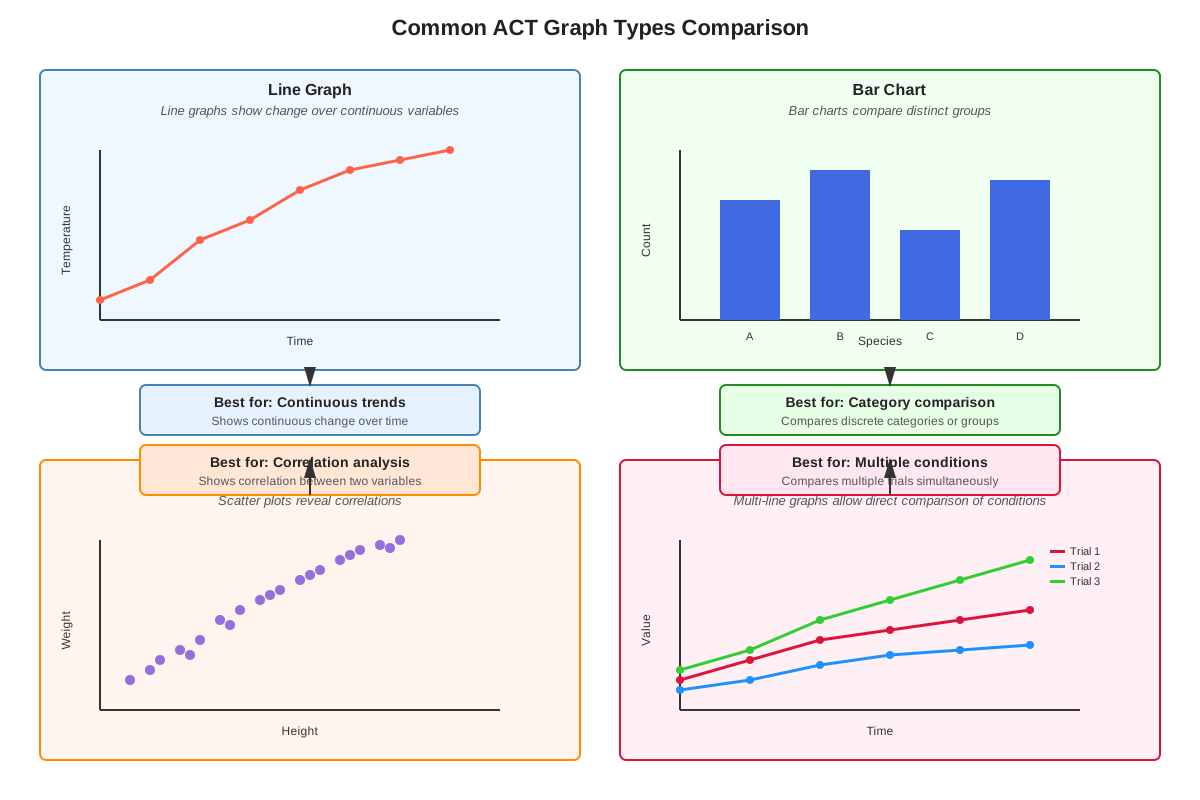
The ACT Science section employs several standard graph types, each designed to display specific kinds of relationships. Line graphs show continuous relationships between variables, with data points connected by lines to emphasize trends over time or across a range of values. These appear most frequently when displaying how one variable changes in response to another, such as temperature versus time or velocity versus distance.
Scatter plots display individual data points without connecting lines, typically used when showing correlations between variables or when data points are discrete measurements rather than continuous functions. The ACT often uses scatter plots to test whether students can identify positive correlations (both variables increase together), negative correlations (one increases while the other decreases), or no correlation (random distribution).
Bar graphs compare discrete categories or groups using rectangular bars whose heights represent measured values. These graphs excel at showing comparisons between different experimental conditions, species, locations, or time periods. The ACT frequently uses bar graphs when presenting data from multiple trials or comparing results across different experimental groups.
Tables present numerical data in organized rows and columns, though technically not graphs, they serve similar analytical purposes and often appear alongside visual graphs in ACT passages.
Graph Components and Anatomy
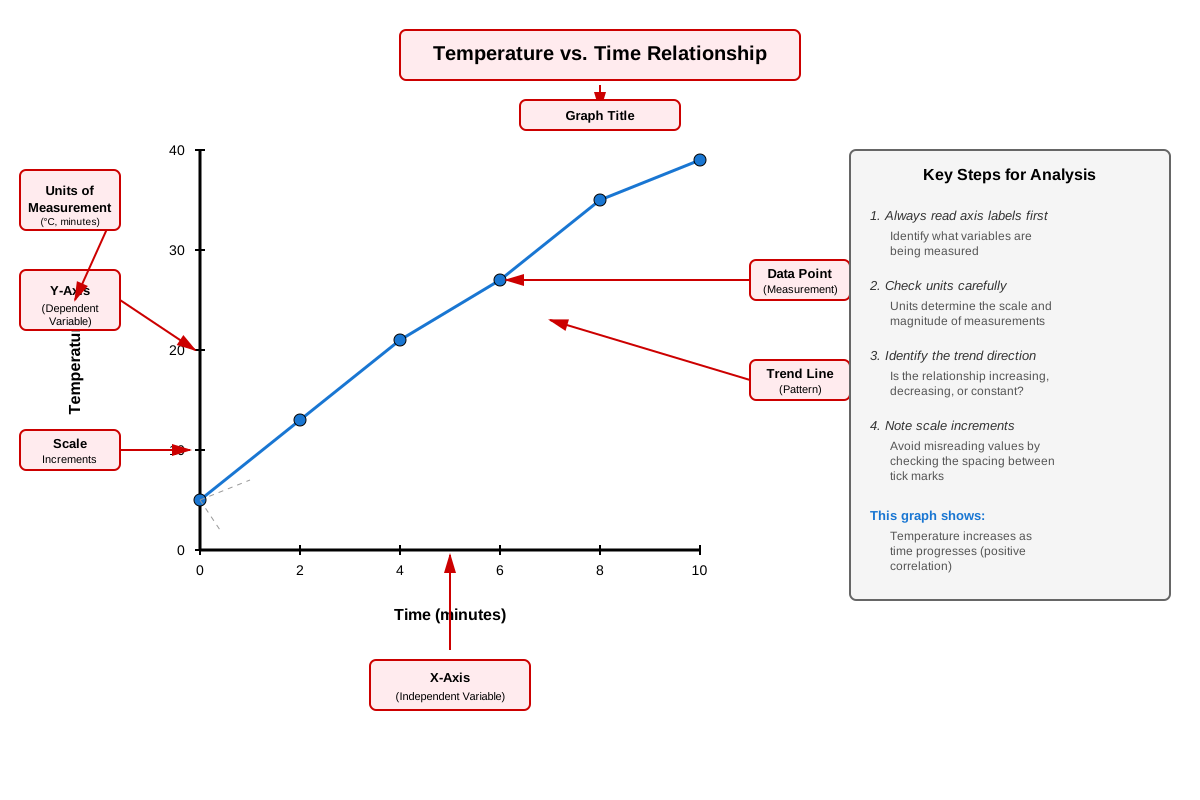
Every experimental graph contains essential components that students must identify and interpret correctly. The x-axis (horizontal axis) typically represents the independent variable—the factor that researchers deliberately manipulate or control. The y-axis (vertical axis) usually displays the dependent variable—the outcome that researchers measure in response to changes in the independent variable.
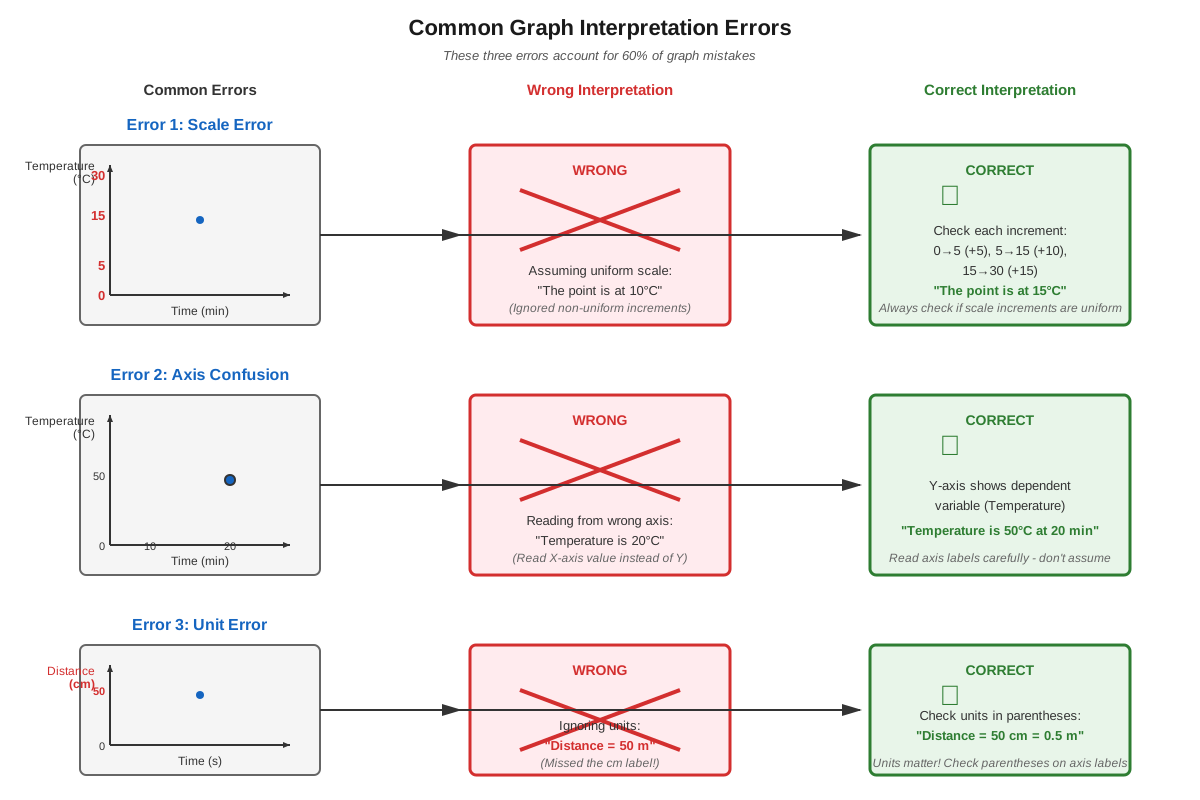
Axis labels identify what each axis represents and must include units of measurement. A common ACT trap involves changing units between graphs or using unconventional units, testing whether students pay attention to these critical details. For example, one graph might show time in seconds while another uses minutes, or temperature might appear in Celsius on one graph and Kelvin on another.
Scale refers to the numerical intervals marked along each axis. The ACT deliberately varies scales to test careful reading—one graph might use increments of 10 while another uses increments of 100. Non-uniform scales (where intervals change size) occasionally appear to challenge students who assume all grid squares represent equal values.
Data points are the individual measurements plotted on the graph, while trend lines or curves connect these points to show overall patterns. The ACT expects students to distinguish between actual measured data points and interpolated values (estimates between measured points) or extrapolated values (predictions beyond the measured range).
Legends or keys explain what different symbols, colors, or line styles represent when multiple data sets appear on a single graph. Students must reference legends to avoid confusing different experimental conditions or variables.
Reading and Interpreting Graph Data
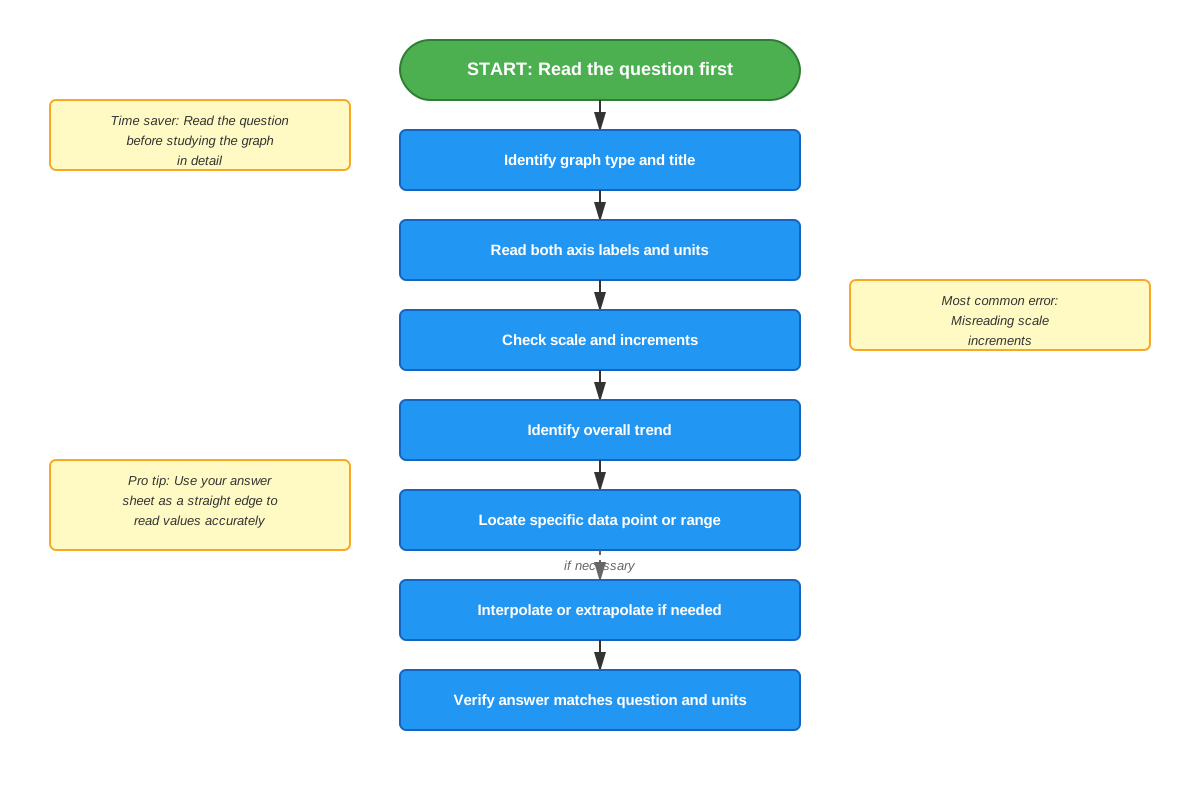
Extracting information from experimental graphs requires systematic approaches. To read a specific value, students should:
- Locate the relevant position on the x-axis
- Move vertically until reaching the data point or trend line
- Move horizontally to the y-axis to read the corresponding value
- Check units and scale carefully
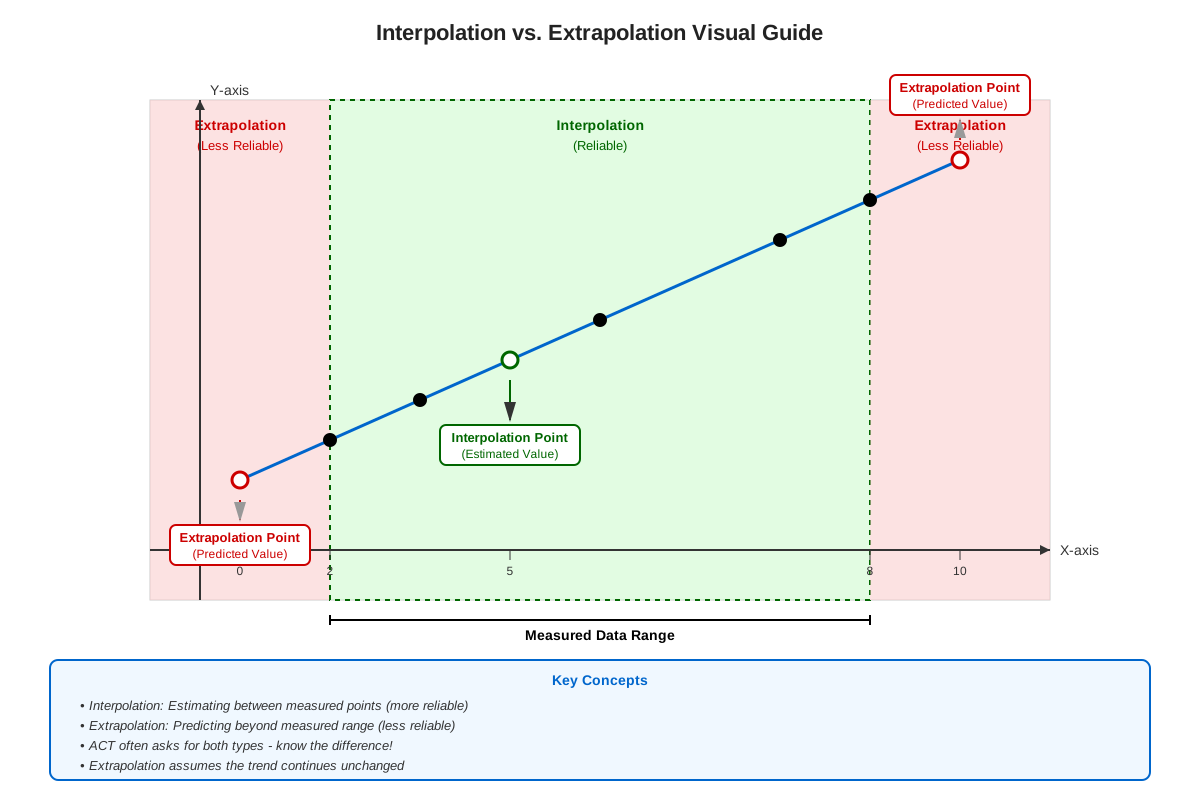
Interpolation involves estimating values between measured data points. When a question asks for a value that falls between two plotted points, students should estimate proportionally based on the trend line or curve connecting those points. For linear relationships, this estimation is straightforward; for curved relationships, students must account for the curve's shape.
Extrapolation extends trends beyond the measured data range. If a graph shows data from 0 to 50 seconds and a question asks about 60 seconds, students must project the established trend forward. The ACT typically expects students to continue linear trends in straight lines or extend curved trends following the established pattern.
Identifying Trends and Relationships
Direct relationships (positive correlations) occur when both variables increase together or decrease together. On a graph, this appears as an upward-sloping line or curve from left to right. For example, as temperature increases, the volume of a gas increases—both variables move in the same direction.
Inverse relationships (negative correlations) occur when one variable increases while the other decreases. These appear as downward-sloping lines or curves. For instance, as altitude increases, air pressure decreases—the variables move in opposite directions.
No relationship means changes in one variable don't predictably affect the other, appearing as scattered points with no clear pattern or as a horizontal line indicating the dependent variable remains constant regardless of the independent variable's value.
Proportional relationships represent special cases where the ratio between variables remains constant. Direct proportionality produces straight lines passing through the origin (0,0), while inverse proportionality produces hyperbolic curves.
Comparing Multiple Graphs
Many ACT questions require synthesizing information from multiple graphs within a single passage. Students must:
- Identify which variables appear in multiple graphs to establish connections
- Recognize when one graph's output serves as another graph's input
- Compare trends across graphs to identify broader patterns
- Note differences in scales, units, or ranges between graphs
For example, a passage might present Graph 1 showing temperature versus time and Graph 2 showing enzyme activity versus temperature. To determine enzyme activity at a specific time, students must first use Graph 1 to find the temperature at that time, then use that temperature value in Graph 2 to find the corresponding enzyme activity.
Concept Relationships
The concepts within experimental graphs form an interconnected hierarchy. Understanding graph types provides the foundation for recognizing graph components, which enables accurate data reading, which then allows for trend identification, ultimately supporting multi-graph synthesis. Each skill builds upon the previous one—students cannot accurately identify trends without first reading data correctly, and they cannot read data without understanding axis labels and scales.
Experimental graphs connect directly to prerequisite knowledge of coordinate systems and variables. The x-y coordinate plane from mathematics translates directly to scientific graphs, where the independent variable (x-axis) and dependent variable (y-axis) follow the same spatial logic. Understanding variables from experimental design helps students predict which variable should appear on which axis and interpret cause-and-effect relationships.
This topic also connects forward to more advanced ACT Science skills. Mastering experimental graphs enables students to evaluate experimental design (understanding why researchers chose specific variables), assess conflicting viewpoints (comparing data supporting different hypotheses), and make predictions (extending trends to new scenarios). The relationship map flows: Basic Graph Literacy → Data Extraction → Trend Analysis → Multi-Graph Integration → Experimental Evaluation → Scientific Reasoning.
Quick check — test yourself on Experimental graphs so far.
Try Flashcards →High-Yield Facts
⭐ The x-axis typically represents the independent variable (what researchers manipulate), while the y-axis represents the dependent variable (what researchers measure).
⭐ When reading values from graphs, always check the scale and units on both axes before selecting an answer.
⭐ Direct relationships show both variables moving in the same direction (both increase or both decrease), appearing as upward-sloping lines.
⭐ Inverse relationships show variables moving in opposite directions (one increases while the other decreases), appearing as downward-sloping lines.
⭐ To find a value between two data points (interpolation), estimate proportionally based on the trend line connecting those points.
- Scatter plots without connecting lines indicate discrete measurements or potential correlations rather than continuous functions.
- Bar graphs compare discrete categories and are ideal for showing differences between experimental groups or conditions.
- Legends or keys are essential when multiple data sets appear on one graph—always reference them to avoid confusion.
- Non-linear relationships (curves) indicate that the rate of change varies across the range of the independent variable.
- When extrapolating beyond measured data, continue the established trend pattern but recognize that predictions become less reliable farther from actual measurements.
- Horizontal lines indicate the dependent variable remains constant regardless of changes in the independent variable (no relationship).
- The steepness of a line or curve indicates the rate of change—steeper slopes mean faster changes in the dependent variable.
Common Misconceptions
Misconception: The variable on the x-axis is always time. → Correction: While time frequently appears on the x-axis, any independent variable can occupy this position. The ACT deliberately varies which variables appear on which axes to test careful reading. Always check axis labels rather than making assumptions.
Misconception: All grid squares on a graph represent equal values. → Correction: The ACT sometimes uses non-uniform scales where intervals change size. Always check the numerical labels on axes rather than counting grid squares. A graph might use intervals of 10 for the first section and intervals of 50 for the second section.
Misconception: Data points and trend lines mean the same thing. → Correction: Data points represent actual measurements taken during the experiment, while trend lines show the general pattern or mathematical relationship. Questions asking for "measured values" require reading actual data points, while questions about "trends" or "relationships" focus on the overall pattern.
Misconception: If two variables both increase, they are directly proportional. → Correction: Direct proportionality is a specific relationship where the ratio between variables remains constant, producing a straight line through the origin. Two variables can both increase (direct relationship) without being proportional if the rate of increase changes or if the line doesn't pass through (0,0).
Misconception: Extrapolating far beyond the data range is as reliable as reading values within the measured range. → Correction: Extrapolation becomes increasingly uncertain the farther you move from actual measurements. While the ACT expects students to extend trends reasonably, extreme extrapolations may not follow the same pattern, especially for non-linear relationships that might level off or change direction.
Misconception: Correlation shown in a graph proves causation. → Correction: Graphs can show that two variables change together (correlation), but this doesn't prove one causes the other. The ACT occasionally tests this distinction by asking students to identify relationships versus explain mechanisms.
Worked Examples
Example 1: Multi-Step Graph Reading
Question: A passage presents two graphs. Graph 1 shows the relationship between altitude (x-axis, measured in kilometers from 0-10) and air temperature (y-axis, measured in °C from -50 to 20). Graph 2 shows the relationship between air temperature (x-axis, measured in °C from -50 to 20) and sound speed (y-axis, measured in m/s from 300 to 350). At an altitude of 6 km, what is the approximate speed of sound?
Solution Process:
Step 1: Identify what information we need. The question asks for sound speed at a specific altitude, but we have two separate graphs that must be used in sequence.
Step 2: Use Graph 1 to find the temperature at 6 km altitude. Locate 6 km on the x-axis, move vertically to the trend line, then move horizontally to the y-axis. The temperature reads approximately -20°C.
Step 3: Use this temperature value in Graph 2. Locate -20°C on Graph 2's x-axis, move vertically to the trend line, then move horizontally to the y-axis. The sound speed reads approximately 320 m/s.
Step 4: Verify units and reasonableness. The answer is in m/s as requested, and the value falls within the graph's range, making it reasonable.
Answer: The speed of sound at 6 km altitude is approximately 320 m/s.
Connection to Learning Objectives: This example demonstrates applying experimental graphs to ACT-style questions by requiring multi-graph synthesis, accurate data extraction, and careful attention to axis labels and units.
Example 2: Trend Analysis and Extrapolation
Question: A graph shows bacterial population (y-axis, measured in thousands of cells, ranging from 0-100) versus time (x-axis, measured in hours from 0-8). Data points appear at 0 hours (5 thousand cells), 2 hours (10 thousand cells), 4 hours (20 thousand cells), 6 hours (40 thousand cells), and 8 hours (80 thousand cells). The points form an upward-curving line. Based on this trend, which is the best estimate for the bacterial population at 10 hours?
Solution Process:
Step 1: Identify the type of relationship. The population doubles every 2 hours (5→10→20→40→80), indicating exponential growth rather than linear growth. The upward-curving line confirms this.
Step 2: Recognize that this requires extrapolation beyond the measured range (8 hours) to predict the value at 10 hours.
Step 3: Continue the established pattern. If the population doubles every 2 hours and was 80 thousand at 8 hours, it should reach approximately 160 thousand at 10 hours (2 hours later).
Step 4: Evaluate answer choices. If choices include 90 thousand (linear extrapolation), 120 thousand (moderate increase), 160 thousand (exponential continuation), and 200 thousand (over-extrapolation), select 160 thousand as it best matches the established doubling pattern.
Answer: Approximately 160 thousand cells.
Connection to Learning Objectives: This example demonstrates explaining the core strategy behind experimental graphs (recognizing exponential versus linear trends) and applying this understanding to make predictions beyond the measured data range.
Exam Strategy
When approaching ACT experimental graphs questions, implement a systematic process to maximize accuracy and efficiency. Begin by quickly scanning the passage to identify how many graphs are present and what variables each displays. This 10-second overview prevents confusion when questions reference specific graphs and helps identify potential connections between multiple graphs.
Trigger words that signal graph interpretation questions include: "According to Figure 1," "Based on the graph," "As shown in the data," "At what value of [variable]," "What is the relationship between," "Which of the following best describes the trend," and "If the pattern continues." These phrases indicate that the answer comes directly from visual data analysis rather than passage text comprehension.
For questions asking you to read specific values, use a systematic approach: locate the given value on the appropriate axis, trace to the data point or trend line, then trace to the other axis to read the answer. Use your answer sheet edge or pencil as a straight-edge to improve accuracy when tracing across the graph. Always verify you're reading the correct scale—check whether each grid line represents 1, 5, 10, or another interval.
Process-of-elimination strategies work particularly well for graph questions. If a question asks about a trend and answer choices include "increases," "decreases," "remains constant," and "increases then decreases," you can immediately eliminate options that contradict the visual pattern. For numerical answers, eliminate choices that fall outside the graph's range or that would require impossible extrapolations.
Time allocation for graph questions should average 30-40 seconds per question, slightly faster than the overall Science section average. Graph questions typically require less reading than passage-based questions, allowing you to bank time for more complex experimental design or conflicting viewpoints questions. However, multi-graph synthesis questions may require 50-60 seconds, so adjust accordingly.
When facing difficult graph questions, look for these common patterns: questions asking about the "highest" or "lowest" value test whether you can identify maxima and minima; questions using "approximately" signal that precise reading isn't necessary and estimation suffices; questions asking "which variable was held constant" test whether you understand experimental design principles alongside graph interpretation.
Exam Tip: If you're struggling to read a precise value from a graph, check whether the answer choices are widely spaced (10, 20, 30, 40) or closely spaced (23, 25, 27, 29). Widely spaced choices indicate estimation is acceptable, while closely spaced choices require more careful reading.
Memory Techniques
AXIS mnemonic for remembering graph orientation:
- Across = x-axis (horizontal)
- X-axis = independent variable (what you change)
- Independent comes first (cause before effect)
- Side = y-axis (vertical, on the side)
"DRY MIX" for variable placement:
- Dependent
- Responding
- Y-axis
- Manipulated
- Independent
- X-axis
Trend Direction Memory: Visualize a person walking up or down a hill. If both variables increase together (direct relationship), the person walks uphill from left to right (positive slope). If one increases while the other decreases (inverse relationship), the person walks downhill from left to right (negative slope).
Scale Check Reminder: Use the acronym SCALE:
- Start at zero? (Check if axes begin at zero or another value)
- Count the intervals (Don't assume each line is 1 unit)
- All axes checked (Verify both x and y)
- Labels read (Confirm what each axis represents)
- Examine units (Note if units differ between graphs)
Multi-Graph Strategy: Remember "FIND":
- First graph gives you a value
- Input that value into the second graph
- Note the new output
- Double-check units match between graphs
Summary
Experimental graphs represent the highest-yield topic in ACT Science, appearing in 35-50% of all questions and serving as the primary vehicle for testing data interpretation skills. Success requires mastering multiple interconnected skills: identifying graph types (line graphs, scatter plots, bar graphs), understanding graph anatomy (axes, scales, labels, legends), extracting data accurately through reading, interpolation, and extrapolation, and recognizing relationships (direct, inverse, proportional, or no correlation). The ACT deliberately tests careful reading by varying scales, changing units between graphs, and requiring multi-graph synthesis where information from one graph serves as input for another. Students must approach graph questions systematically—always checking axis labels and scales before reading values, using straight-edges to improve accuracy, and distinguishing between actual data points and trend lines. The most challenging questions combine multiple skills, such as extrapolating a trend from one graph and using that predicted value in a second graph to make further predictions. Mastering experimental graphs provides the foundation for success across all ACT Science passage types and represents an essential skill for college-level scientific coursework.
Key Takeaways
- Experimental graphs appear in approximately 15-20 questions per ACT Science test, making them the single most frequently tested skill
- Always verify axis labels, scales, and units before reading values—the ACT deliberately varies these elements to test careful attention
- The x-axis typically shows the independent variable (manipulated) while the y-axis shows the dependent variable (measured response)
- Direct relationships show both variables moving together (upward slope), while inverse relationships show opposite movement (downward slope)
- Multi-graph questions require using output from one graph as input for another—trace the variable that connects the graphs
- Interpolation (estimating between data points) is more reliable than extrapolation (predicting beyond measured range)
- Distinguish between data points (actual measurements) and trend lines (overall patterns) when answering questions about specific values versus general relationships
Related Topics
Experimental Design and Variables: Understanding how scientists design experiments, control variables, and establish cause-and-effect relationships provides context for why graphs display specific variables and relationships. Mastering experimental graphs enables deeper analysis of experimental methodology.
Data Tables and Numerical Analysis: While graphs visualize data, tables present the same information numerically. Students who master graph interpretation can more easily transition to extracting information from data tables and converting between formats.
Statistical Concepts: Advanced graph interpretation connects to understanding error bars, standard deviation, and statistical significance—concepts that occasionally appear in more challenging ACT Science passages.
Scientific Models and Predictions: The extrapolation skills developed through graph mastery directly support understanding how scientists use models to make predictions about unobserved conditions or future events.
Practice CTA
Now that you've mastered the core concepts of experimental graphs, it's time to cement your understanding through active practice. Attempt the practice questions designed specifically for this topic, focusing on applying the systematic strategies outlined in this guide. Use the flashcards to reinforce high-yield facts and test your ability to quickly recall key concepts under time pressure. Remember, graph interpretation is a skill that improves dramatically with deliberate practice—each question you work through strengthens your pattern recognition and builds the confidence needed to tackle any graph the ACT presents. Your investment in mastering this high-yield topic will pay dividends across the entire Science section!
Sign up free to keep reading
Create a free AnvayaPrep account to finish this ACT guide on Experimental graphs — plus flashcards and practice questions.