Overview
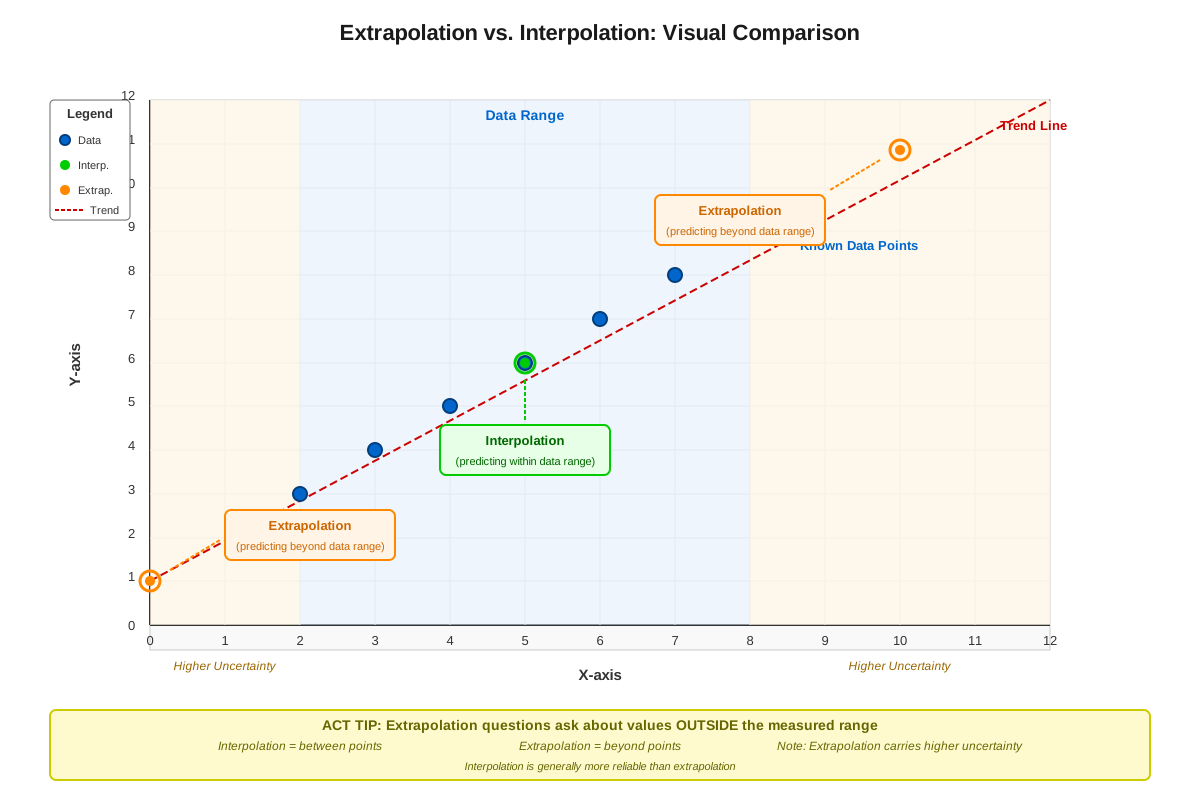
Extrapolation is a critical data analysis skill tested extensively on the ACT Science section, particularly within Data Representation passages. This technique involves extending a pattern or trend beyond the range of given data points to predict values that fall outside the measured observations. Unlike interpolation, which estimates values between known data points, extrapolation requires students to project trends into unmeasured territory—either beyond the highest measured value or below the lowest one.
On the ACT Science test, ACT extrapolation questions assess whether students can identify patterns in graphs, tables, and charts, then logically extend those patterns to answer "what if" scenarios. These questions frequently appear in 2-4 questions per Science section and are considered medium-to-high difficulty because they require both pattern recognition and the confidence to make predictions beyond concrete data. Students must distinguish between linear trends, exponential growth or decay, and other mathematical relationships to make accurate predictions.
Mastering extrapolation connects directly to broader scientific reasoning skills, including hypothesis formation, experimental design interpretation, and understanding the limitations of data. This skill bridges Data Representation with Research Summaries passages, where students must predict experimental outcomes under modified conditions. Strong extrapolation abilities also support success in Conflicting Viewpoints passages, where extending theoretical models beyond their stated boundaries often determines correct answers.
Learning Objectives
- [ ] Identify when Extrapolation is being tested in ACT Science passages
- [ ] Explain the core rule or strategy behind Extrapolation
- [ ] Apply Extrapolation to ACT-style questions accurately
- [ ] Distinguish between extrapolation and interpolation in data analysis contexts
- [ ] Recognize the limitations and potential errors in extrapolated predictions
- [ ] Evaluate whether a trend is linear, exponential, or follows another pattern before extrapolating
- [ ] Determine when extrapolation is inappropriate or unreliable based on data characteristics
Prerequisites
- Graph reading and interpretation: Essential for identifying the visual patterns and trends that form the basis of all extrapolation tasks
- Understanding coordinate systems: Required to locate points accurately and determine direction of trends on x-y axes
- Basic pattern recognition: Necessary to distinguish between different types of mathematical relationships (linear, exponential, inverse)
- Table data analysis: Fundamental for extracting numerical patterns when data is presented in tabular rather than graphical format
- Units and scale interpretation: Critical for making quantitative predictions that maintain proper magnitude and dimensional consistency
Why This Topic Matters
Extrapolation represents a fundamental scientific thinking skill that extends far beyond standardized testing. Scientists use extrapolation daily to predict climate patterns decades into the future, estimate population growth, forecast disease spread, and model chemical reaction rates under untested conditions. Engineers extrapolate material stress data to design structures that will withstand forces beyond laboratory testing limits. Medical researchers extrapolate dose-response relationships to establish safe medication ranges.
On the ACT Science section, extrapolation questions appear with remarkable consistency—typically 2-4 questions per test, representing approximately 5-10% of all Science questions. These questions most commonly appear in Data Representation passages (which comprise 3 of the 6-7 passages), but also surface in Research Summaries when students must predict experimental outcomes under modified conditions. The ACT specifically tests extrapolation because it assesses higher-order thinking: students must not only read data but also understand underlying relationships well enough to extend them logically.
Common ACT extrapolation scenarios include: predicting temperature changes beyond measured time intervals, estimating population sizes at future dates, determining chemical concentrations at unmeasured pH levels, forecasting velocity or acceleration values beyond recorded observations, and projecting biological growth rates past experimental endpoints. Questions typically use trigger phrases like "Based on the data, at 50°C the rate would most likely be...", "If the trend continues, at Day 10...", or "According to Figure 1, a concentration of 8 M would most likely result in..."
Core Concepts
Definition and Fundamental Principle
Extrapolation is the process of estimating values outside the range of observed data by extending an identified pattern or trend. The fundamental assumption underlying all extrapolation is that the relationship observed within the measured range continues unchanged beyond that range. This assumption carries inherent risk—the further from measured data one extrapolates, the less reliable the prediction becomes, as new factors or changing relationships may emerge outside the observation window.
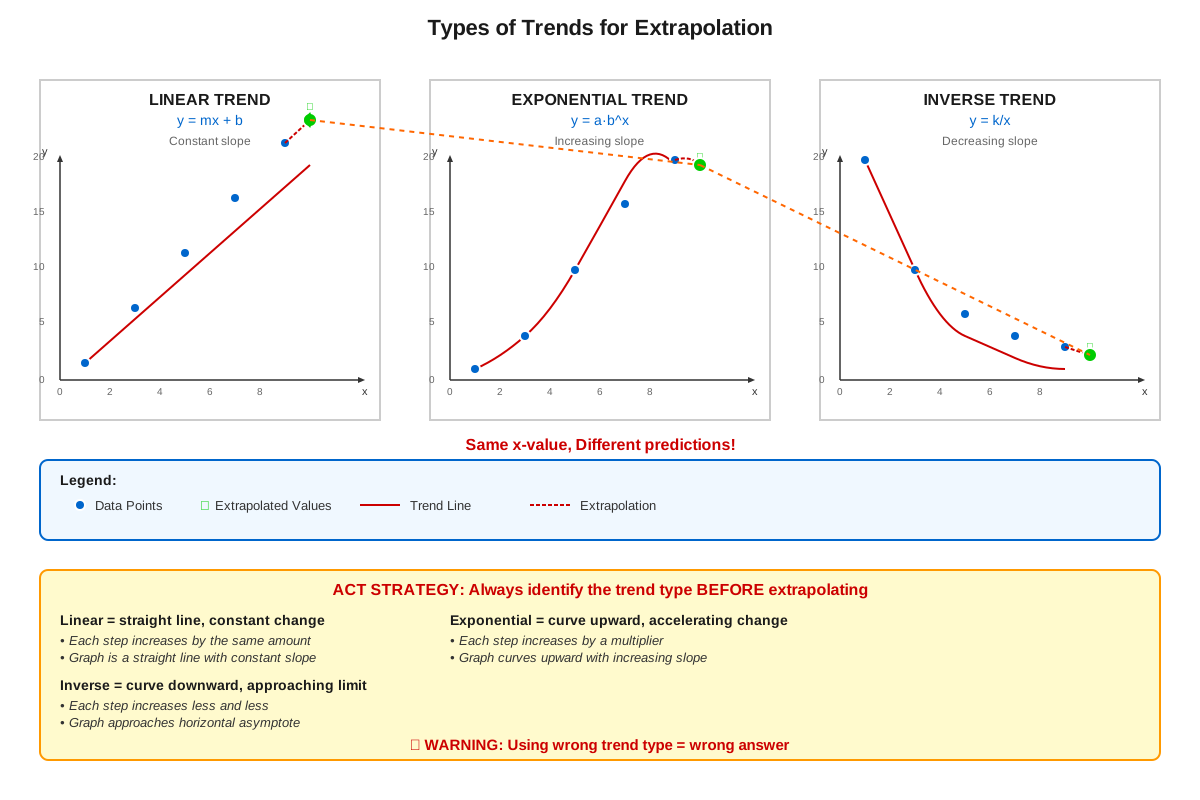
The mathematical foundation of extrapolation rests on identifying the functional relationship between variables. For linear relationships, this means recognizing constant rates of change (slope). For exponential relationships, it requires identifying constant multiplicative factors. For inverse relationships, students must recognize reciprocal patterns. The ACT primarily tests linear and simple exponential extrapolations, occasionally including logarithmic or power relationships.
Types of Extrapolation on the ACT
Linear Extrapolation represents the most common type tested. When data points form a straight line or approximate linear pattern, students extend that line beyond the measured range. The key characteristic is constant rate of change—for every unit increase in the independent variable, the dependent variable changes by the same amount. On graphs, this appears as points forming a straight line; in tables, it manifests as constant differences between consecutive values.
Exponential Extrapolation involves patterns where values increase or decrease by constant multiplicative factors rather than constant additive amounts. Population growth, radioactive decay, and compound interest follow exponential patterns. On the ACT, these appear as curves that accelerate upward (exponential growth) or decelerate toward an asymptote (exponential decay). Students must recognize that equal intervals on the x-axis correspond to equal ratios (not differences) on the y-axis.
Curvilinear Extrapolation encompasses non-linear, non-exponential patterns including parabolic, logarithmic, and power relationships. These require students to recognize the curve's shape and trajectory, then mentally extend that curve beyond the data range. The ACT typically makes these questions easier by providing clear visual curves or by asking qualitative questions ("would increase," "would decrease") rather than requiring precise numerical predictions.
Extrapolation vs. Interpolation
Understanding the distinction between these two techniques is crucial for ACT success:
| Feature | Interpolation | Extrapolation |
|---|---|---|
| Location | Between known data points | Beyond the range of known data |
| Reliability | Higher—bounded by actual measurements | Lower—no measurements to constrain prediction |
| Risk | Minimal—pattern is confirmed on both sides | Higher—pattern may change outside measured range |
| ACT Frequency | Common (3-5 questions per test) | Common (2-4 questions per test) |
| Difficulty | Generally easier | Generally harder |
The Extrapolation Process: Step-by-Step
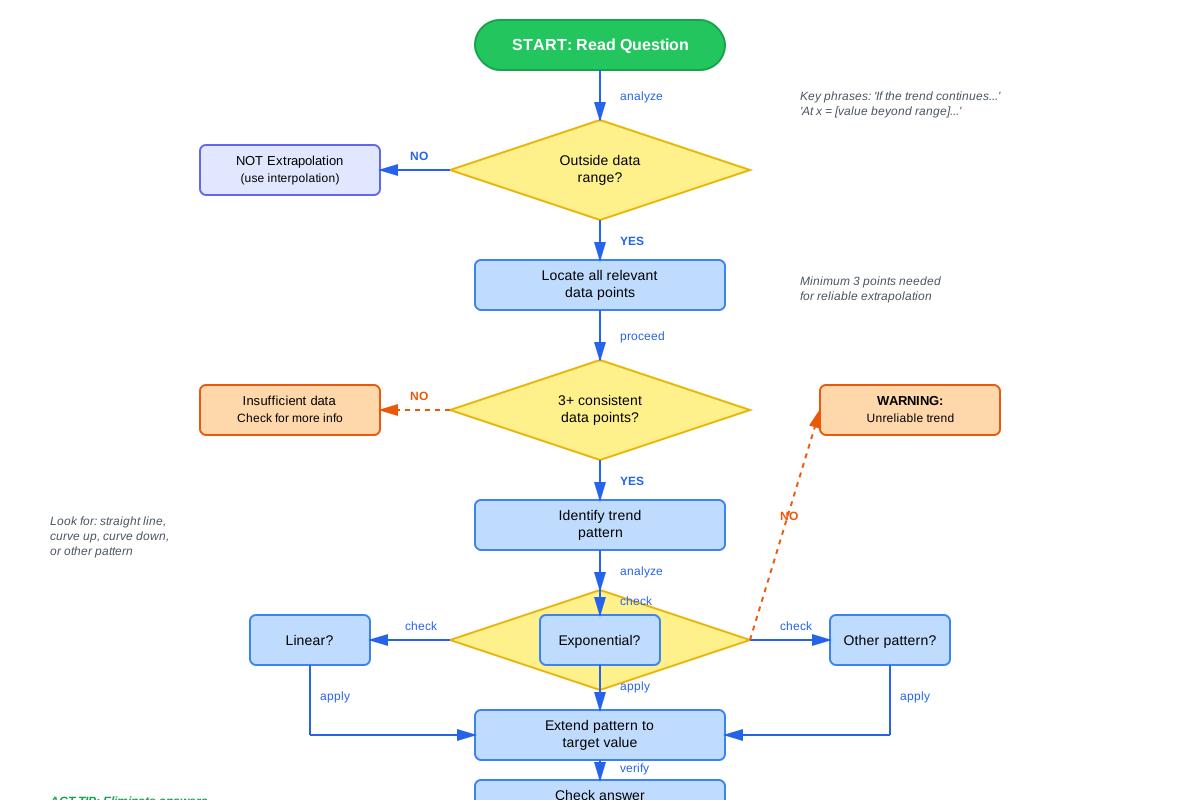
- Identify the data range: Determine the minimum and maximum values of the independent variable that were actually measured
- Recognize the pattern: Analyze whether the relationship is linear, exponential, or follows another pattern
- Assess pattern consistency: Verify that the pattern holds throughout the measured range without significant deviations
- Determine direction: Identify whether extrapolating beyond the maximum (right/upward) or below the minimum (left/downward)
- Extend the pattern: Apply the identified relationship to calculate or estimate the value at the requested point
- Evaluate reasonableness: Check whether the predicted value makes logical sense given the context
Limitations and Reliability Considerations
All extrapolations carry uncertainty that increases with distance from measured data. The ACT occasionally tests whether students recognize when extrapolation becomes unreliable. Key limitation factors include:
Range extension distance: Predicting a value 10% beyond measured data is far more reliable than predicting 200% beyond. The ACT typically keeps extrapolations within 20-50% of the data range to maintain reasonable reliability.
Pattern complexity: Simple linear relationships extrapolate more reliably than complex curvilinear patterns. Exponential relationships can extrapolate reliably if the underlying mechanism (like population growth) is well-understood.
Physical constraints: Some relationships have natural boundaries that limit extrapolation. For example, percentages cannot exceed 100%, temperatures cannot fall below absolute zero, and populations cannot become negative. ACT questions occasionally test whether students recognize these constraints.
Sample size and variability: Data with high scatter or few data points extrapolates less reliably than data with many points showing consistent patterns. The ACT typically provides clear patterns to minimize this complication.
Concept Relationships
Extrapolation builds directly upon fundamental graph reading skills, requiring students to first accurately interpret axes, scales, and data points before attempting to extend patterns. This topic connects intimately with trend analysis—students must identify whether data shows increasing, decreasing, or constant patterns before extrapolating. The relationship flows: data reading → pattern recognition → trend identification → extrapolation.
Within Data Representation passages, extrapolation often combines with interpolation questions, testing whether students can distinguish between estimating within versus beyond data ranges. Both skills share the common foundation of pattern recognition but diverge in their reliability and the reasoning required.
Extrapolation connects forward to hypothesis testing in Research Summaries passages. When students extrapolate experimental results to predict outcomes under modified conditions, they essentially generate testable hypotheses. This relationship appears in questions like "Based on Experiment 1, if the researchers conducted Experiment 2 at 100°C instead of 80°C, the reaction rate would most likely..."
The concept also relates to data limitations and experimental design. Understanding when extrapolation becomes unreliable helps students evaluate experimental conclusions and recognize when additional data collection is necessary—a skill tested in higher-difficulty ACT Science questions.
Relationship Map:
Graph/Table Reading → Pattern Recognition → Trend Analysis → Extrapolation → Prediction Evaluation → Hypothesis Formation → Experimental Design Critique
High-Yield Facts
- ⭐ Extrapolation extends patterns BEYOND the measured data range, while interpolation estimates values WITHIN the measured range
- ⭐ Linear extrapolation assumes constant rate of change; exponential extrapolation assumes constant multiplicative factor
- ⭐ The further from measured data you extrapolate, the less reliable the prediction becomes
- ⭐ ACT extrapolation questions use trigger phrases like "If the trend continues," "Based on the data," and "would most likely be"
- ⭐ Always check whether the requested value falls inside (interpolation) or outside (extrapolation) the data range before answering
- Extrapolation questions appear in approximately 2-4 questions per ACT Science section
- Linear relationships show constant differences between consecutive values in tables
- Exponential relationships show constant ratios between consecutive values in tables
- Physical constraints (like 0% minimum or 100% maximum) can limit valid extrapolation ranges
- Extrapolation reliability depends on pattern consistency throughout the measured range
- Curvilinear extrapolations require recognizing the curve's shape and trajectory direction
- ACT extrapolation questions typically extend 20-50% beyond the measured data range
- Scatter in data points reduces extrapolation reliability but ACT usually provides clear patterns
- Extrapolation applies to both graphical and tabular data presentations equally
- Time-series data (measurements over time) frequently appears in ACT extrapolation questions
Quick check — test yourself on Extrapolation so far.
Try Flashcards →Common Misconceptions
Misconception: Extrapolation and interpolation are the same process, just applied to different data sets.
Correction: These are fundamentally different techniques. Interpolation estimates values between known data points (within the measured range), while extrapolation extends patterns beyond the measured range. Extrapolation carries significantly more uncertainty because no actual measurements constrain the prediction on one or both sides.
Misconception: All trends continue indefinitely in the same pattern, so extrapolation is always reliable.
Correction: Extrapolation assumes pattern continuation but this assumption often fails in reality. Physical limits, changing conditions, or new factors can alter relationships outside the measured range. The ACT occasionally tests this by asking about very distant extrapolations or situations where physical constraints would prevent pattern continuation.
Misconception: If data points show any scatter or variation, extrapolation is impossible.
Correction: Perfect linearity is not required for valid extrapolation. Students should identify the overall trend despite minor variations. The ACT typically provides data with clear enough patterns that reasonable extrapolation remains possible even with some scatter.
Misconception: Exponential patterns always curve upward on graphs.
Correction: Exponential decay curves downward, approaching (but never reaching) zero or an asymptote. Both exponential growth and decay are exponential patterns. Students must examine whether values are increasing or decreasing by constant multiplicative factors.
Misconception: The answer to an extrapolation question must be a precise numerical value.
Correction: Many ACT extrapolation questions ask qualitative questions: "would increase," "would decrease," "would be greater than," or "would be between X and Y." Students should read carefully to determine whether precise calculation or directional reasoning is required.
Misconception: Extrapolation only applies to line graphs, not to tables or other data presentations.
Correction: Extrapolation applies to any data presentation where patterns can be identified—tables, bar graphs, scatter plots, or line graphs. The underlying principle (extending patterns beyond measured ranges) remains constant regardless of presentation format.
Worked Examples
Example 1: Linear Extrapolation from a Graph
Question: The graph below shows the relationship between temperature (°C) and reaction rate (moles/second) for a chemical reaction. Measurements were taken at 10°C, 20°C, 30°C, and 40°C, showing reaction rates of 2, 4, 6, and 8 moles/second respectively. Based on this data, what would the reaction rate most likely be at 50°C?
A) 9 moles/second
B) 10 moles/second
C) 12 moles/second
D) 16 moles/second
Solution Process:
Step 1 - Identify the data range: The measured temperatures range from 10°C to 40°C. The question asks about 50°C, which is beyond the maximum measured value, confirming this is an extrapolation question.
Step 2 - Recognize the pattern: Examining the data points:
- At 10°C: 2 moles/second
- At 20°C: 4 moles/second (increase of 2)
- At 30°C: 6 moles/second (increase of 2)
- At 40°C: 8 moles/second (increase of 2)
The constant increase of 2 moles/second for every 10°C increase indicates a linear relationship.
Step 3 - Calculate the rate of change: The slope is 2 moles/second per 10°C, or 0.2 moles/second per °C.
Step 4 - Extend the pattern: From 40°C to 50°C is a 10°C increase. Following the established pattern: 8 + 2 = 10 moles/second.
Step 5 - Evaluate reasonableness: The answer continues the linear trend without violating any physical constraints.
Answer: B) 10 moles/second
This example demonstrates linear extrapolation with constant additive increases, the most common type on the ACT.
Example 2: Exponential Extrapolation from a Table
Question: A biology student tracked bacterial population growth over 4 hours, recording the following data:
| Time (hours) | Population (thousands) |
|---|---|
| 0 | 5 |
| 1 | 10 |
| 2 | 20 |
| 3 | 40 |
| 4 | 80 |
Based on this data, if the growth pattern continues, the population at 5 hours would most likely be closest to:
A) 100 thousand
B) 120 thousand
C) 160 thousand
D) 200 thousand
Solution Process:
Step 1 - Identify the data range: Measurements span 0 to 4 hours. The question asks about 5 hours, which is beyond the measured range—this is extrapolation.
Step 2 - Recognize the pattern: Examine the relationship between consecutive values:
- 0 to 1 hour: 5 → 10 (multiplied by 2)
- 1 to 2 hours: 10 → 20 (multiplied by 2)
- 2 to 3 hours: 20 → 40 (multiplied by 2)
- 3 to 4 hours: 40 → 80 (multiplied by 2)
The constant doubling indicates exponential growth, not linear growth. This is characteristic of bacterial reproduction where each cell divides to produce two cells.
Step 3 - Apply the pattern: If the population doubles every hour, then at 5 hours: 80 × 2 = 160 thousand.
Step 4 - Evaluate reasonableness: Exponential growth in bacterial populations is biologically realistic for short time periods with unlimited resources (typical laboratory conditions).
Step 5 - Eliminate wrong answers:
- Choice A (100) would represent linear growth (adding 20 each hour)
- Choice B (120) represents no clear pattern
- Choice D (200) over-extrapolates beyond the doubling pattern
Answer: C) 160 thousand
This example illustrates exponential extrapolation, requiring students to recognize multiplicative rather than additive patterns—a critical distinction that separates medium from high-difficulty questions.
Exam Strategy
Identifying Extrapolation Questions
ACT extrapolation questions contain specific trigger language that signals the question type. Watch for phrases including:
- "If the trend continues..."
- "Based on the data, at [value beyond range]..."
- "Would most likely be..."
- "According to [Figure/Table], a [variable] of [value outside measured range]..."
- "If the experiment were conducted at [unmeasured condition]..."
The most reliable identification method is checking whether the requested value falls outside the measured data range. Quickly scan the graph axes or table values to identify minimum and maximum measured values, then compare to the question's requested value.
Systematic Approach to Extrapolation Questions
Exam Tip: Use the "RIDER" approach for extrapolation questions: Range check, Identify pattern, Direction determination, Extend pattern, Reasonableness evaluation.
Time allocation: Spend 30-45 seconds on straightforward linear extrapolations, up to 60 seconds on exponential or curvilinear extrapolations. If a question requires more than 90 seconds, mark it and return after completing easier questions.
Process of Elimination Strategies
When uncertain about the exact extrapolated value, eliminate answers using these strategies:
Direction elimination: Determine whether the trend is increasing or decreasing, then eliminate answers that move in the wrong direction. This alone often eliminates 2-3 answer choices.
Magnitude elimination: Estimate whether the extrapolated value should be slightly beyond, moderately beyond, or far beyond the last measured value. Eliminate answers with unreasonable magnitudes.
Pattern-type elimination: If the pattern is clearly linear (constant differences), eliminate answers that would require exponential growth. If exponential (constant ratios), eliminate answers suggesting linear growth.
Physical constraint elimination: Eliminate answers that violate physical impossibilities (negative populations, percentages above 100%, temperatures below absolute zero).
Common Trap Answers
The ACT includes predictable wrong answers in extrapolation questions:
- The interpolation trap: An answer that would be correct if the question asked about a value within the data range
- The linear assumption trap: For exponential data, an answer assuming linear growth
- The last-value trap: Simply repeating the last measured value without extending the pattern
- The over-extrapolation trap: An answer that extends the pattern too aggressively, beyond reasonable bounds
Memory Techniques
The "EXTRA" Mnemonic
Remember the key steps of extrapolation with EXTRA:
- Examine the data range (is the requested value outside?)
- X-amine the pattern (linear, exponential, or other?)
- Track the trend direction (increasing or decreasing?)
- Reach beyond the data (extend the pattern)
- Assess reasonableness (does the answer make sense?)
Visual Memory Aid
Picture extrapolation as "EXTending the RailroAd"—you're laying new track beyond where the existing rails end, following the same direction and curve that the existing track established. Just as railroad engineers can't suddenly change direction or grade when extending track, extrapolation must maintain the established pattern.
The "Inside vs. Outside" Hand Trick
Hold your hands together forming a boundary. Points between your hands = interpolation (inside). Points beyond either hand = extrapolation (outside). This physical reminder helps distinguish the two concepts during the exam.
Pattern Recognition Acronym: "LED"
Remember the three main pattern types with LED:
- Linear: constant differences (add/subtract same amount)
- Exponential: constant ratios (multiply/divide by same factor)
- Decaying or other: curves that don't fit linear or exponential
Summary
Extrapolation is the process of extending identified data patterns beyond the measured range to predict values at unmeasured points. This high-yield ACT Science skill appears in 2-4 questions per test, primarily in Data Representation passages but also in Research Summaries when predicting experimental outcomes. Success requires distinguishing extrapolation (beyond data range) from interpolation (within data range), recognizing pattern types (linear with constant differences, exponential with constant ratios, or curvilinear), and understanding that prediction reliability decreases with distance from measured data. The systematic approach involves confirming the requested value falls outside the measured range, identifying the mathematical relationship governing the data, extending that pattern appropriately, and evaluating whether the prediction respects physical constraints and logical boundaries. Students must watch for trigger phrases like "if the trend continues" and "would most likely be," recognize common trap answers that assume wrong pattern types, and apply process-of-elimination strategies based on trend direction and magnitude reasonableness.
Key Takeaways
- Extrapolation extends patterns beyond measured data ranges, while interpolation estimates within ranges—always verify which applies before answering
- Linear patterns show constant additive changes; exponential patterns show constant multiplicative changes—identifying the pattern type is essential for accurate extrapolation
- Extrapolation reliability decreases as distance from measured data increases; ACT questions typically stay within 20-50% beyond the data range
- Trigger phrases like "if the trend continues," "based on the data," and "would most likely be" signal extrapolation questions
- Use the RIDER approach: Range check, Identify pattern, Direction determination, Extend pattern, Reasonableness evaluation
- Physical constraints (percentages can't exceed 100%, populations can't be negative) can limit valid extrapolation ranges
- Process of elimination based on trend direction and magnitude often narrows choices to 1-2 answers even without precise calculation
Related Topics
Interpolation: The complementary skill of estimating values within the measured data range. Mastering extrapolation makes interpolation easier since both require pattern recognition, but interpolation carries less uncertainty.
Trend Analysis: The broader skill of identifying whether data shows increasing, decreasing, constant, or cyclical patterns. Strong trend analysis abilities directly support both extrapolation and interpolation.
Experimental Design and Data Limitations: Understanding when extrapolation becomes unreliable connects to evaluating experimental conclusions and recognizing when additional data collection is necessary—skills tested in higher-difficulty Research Summaries questions.
Mathematical Modeling: Advanced application of extrapolation principles where students must understand the underlying mechanisms producing observed patterns, enabling more sophisticated predictions in Conflicting Viewpoints passages.
Statistical Reasoning: Concepts like correlation, causation, and data variability relate to extrapolation reliability and the confidence one can place in predictions beyond measured ranges.
Practice CTA
Now that you've mastered the core concepts and strategies for extrapolation, it's time to cement your understanding through active practice. Complete the practice questions to apply these techniques to authentic ACT-style scenarios, and use the flashcards to reinforce pattern recognition and key distinctions. Remember: extrapolation questions are highly predictable once you've trained yourself to recognize patterns and apply the systematic RIDER approach. With focused practice, these medium-difficulty questions can become reliable point-gainers on test day. Your investment in mastering this high-yield topic will pay dividends across multiple questions in every ACT Science section!
Sign up free to keep reading
Create a free AnvayaPrep account to finish this ACT guide on Extrapolation — plus flashcards and practice questions.